Analysis of the Continuous Disclosure Framework in Australia
VerifiedAdded on 2020/05/28
|11
|2366
|32
Report
AI Summary
This report examines the continuous disclosure framework in Australia, focusing on its role in fostering a robust and efficient equities market. It explores the importance of timely and accurate information dissemination to investors, as regulated by Chapter 6CA of the Corporations Act and ASX Listing Rules. The report reviews the principles of continuous disclosure, including the need for equal access to information, and the restrictions on selective disclosure to prevent insider trading. It also analyzes the role of the Australian Securities and Investment Commission (ASIC) in enforcing these regulations, including surveillance of analyst briefings. The report concludes that while the framework is generally effective, regulators like ASIC need to be creative in their approach to enforcement and that the continuous disclosure regime provides investors with timely and accurate information.
Running head: THE ROLE OF THE CONTINUOUS DISCLOSURE FRAMEWORK
The Role of the Continuous Disclosure Framework
Name of the Student:
Name of the University:
Author’s Note:
Course ID:
The Role of the Continuous Disclosure Framework
Name of the Student:
Name of the University:
Author’s Note:
Course ID:

Paraphrase This Document
Need a fresh take? Get an instant paraphrase of this document with our AI Paraphraser
1THE ROLE OF THE CONTINUOUS DISCLOSURE FRAMEWORK
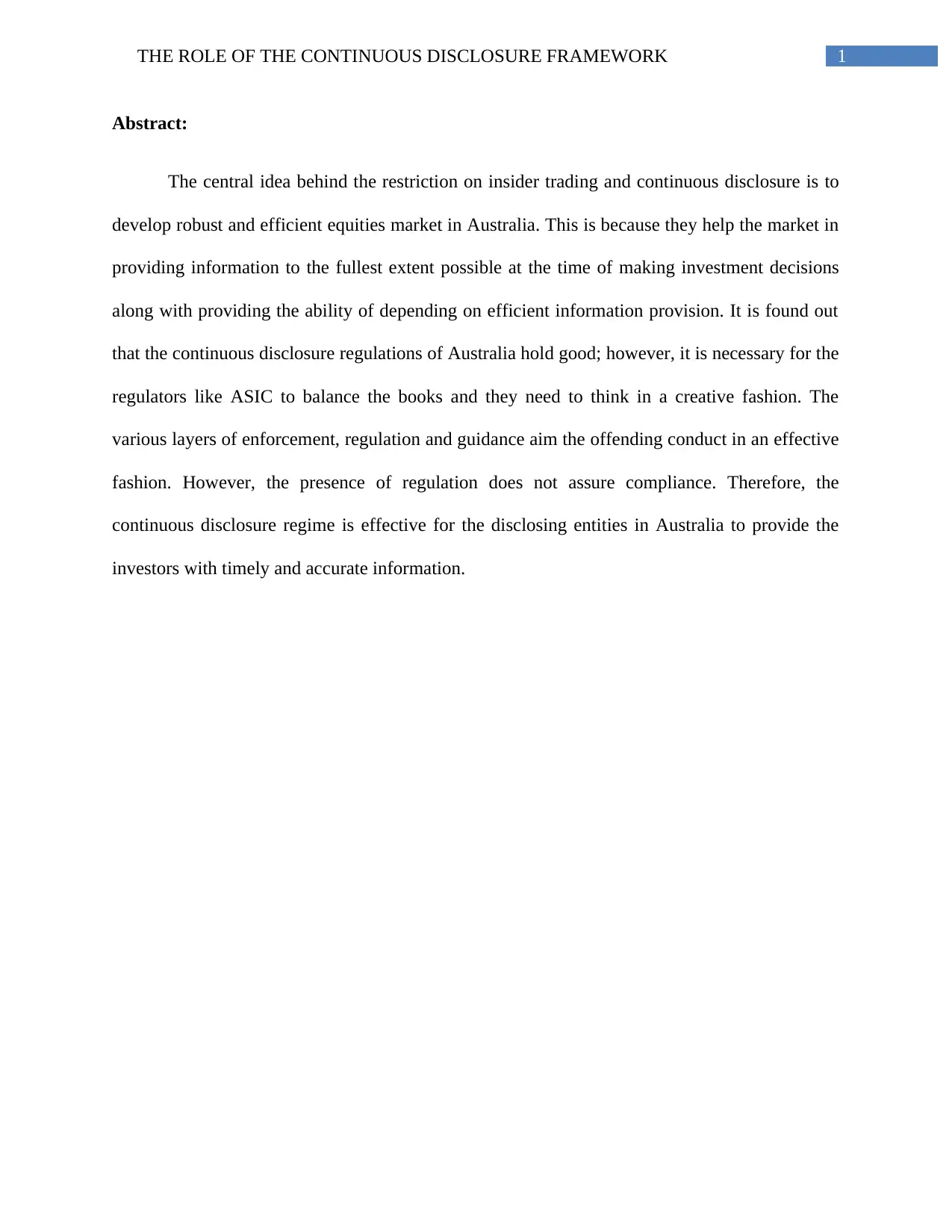
Abstract:
The central idea behind the restriction on insider trading and continuous disclosure is to
develop robust and efficient equities market in Australia. This is because they help the market in
providing information to the fullest extent possible at the time of making investment decisions
along with providing the ability of depending on efficient information provision. It is found out
that the continuous disclosure regulations of Australia hold good; however, it is necessary for the
regulators like ASIC to balance the books and they need to think in a creative fashion. The
various layers of enforcement, regulation and guidance aim the offending conduct in an effective
fashion. However, the presence of regulation does not assure compliance. Therefore, the
continuous disclosure regime is effective for the disclosing entities in Australia to provide the
investors with timely and accurate information.
Abstract:
The central idea behind the restriction on insider trading and continuous disclosure is to
develop robust and efficient equities market in Australia. This is because they help the market in
providing information to the fullest extent possible at the time of making investment decisions
along with providing the ability of depending on efficient information provision. It is found out
that the continuous disclosure regulations of Australia hold good; however, it is necessary for the
regulators like ASIC to balance the books and they need to think in a creative fashion. The
various layers of enforcement, regulation and guidance aim the offending conduct in an effective
fashion. However, the presence of regulation does not assure compliance. Therefore, the
continuous disclosure regime is effective for the disclosing entities in Australia to provide the
investors with timely and accurate information.
2THE ROLE OF THE CONTINUOUS DISCLOSURE FRAMEWORK
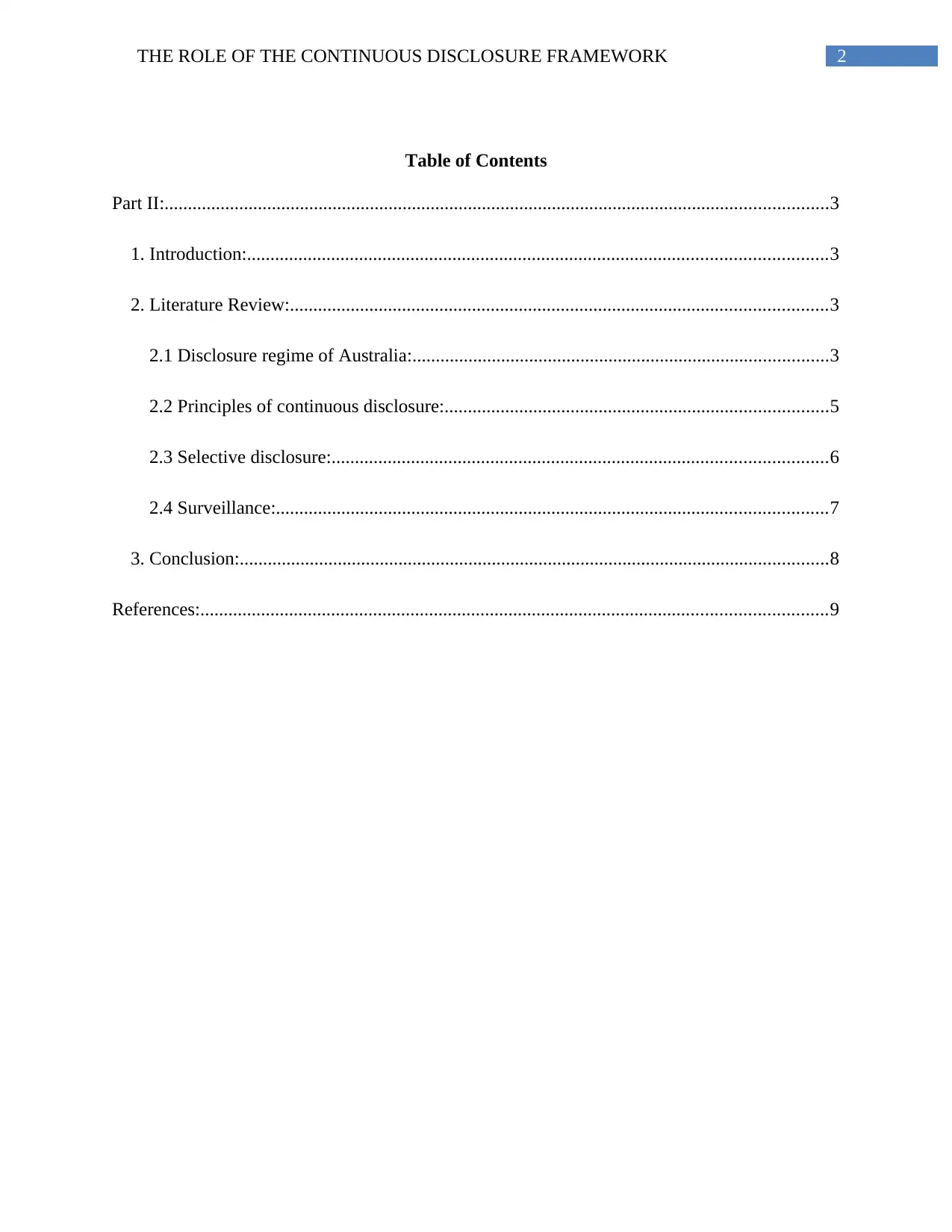
Table of Contents
Part II:..............................................................................................................................................3
1. Introduction:............................................................................................................................3
2. Literature Review:...................................................................................................................3
2.1 Disclosure regime of Australia:.........................................................................................3
2.2 Principles of continuous disclosure:..................................................................................5
2.3 Selective disclosure:..........................................................................................................6
2.4 Surveillance:......................................................................................................................7
3. Conclusion:..............................................................................................................................8
References:......................................................................................................................................9
Table of Contents
Part II:..............................................................................................................................................3
1. Introduction:............................................................................................................................3
2. Literature Review:...................................................................................................................3
2.1 Disclosure regime of Australia:.........................................................................................3
2.2 Principles of continuous disclosure:..................................................................................5
2.3 Selective disclosure:..........................................................................................................6
2.4 Surveillance:......................................................................................................................7
3. Conclusion:..............................................................................................................................8
References:......................................................................................................................................9
⊘ This is a preview!⊘
Do you want full access?
Subscribe today to unlock all pages.

Trusted by 1+ million students worldwide
3THE ROLE OF THE CONTINUOUS DISCLOSURE FRAMEWORK
Part II:
1. Introduction:
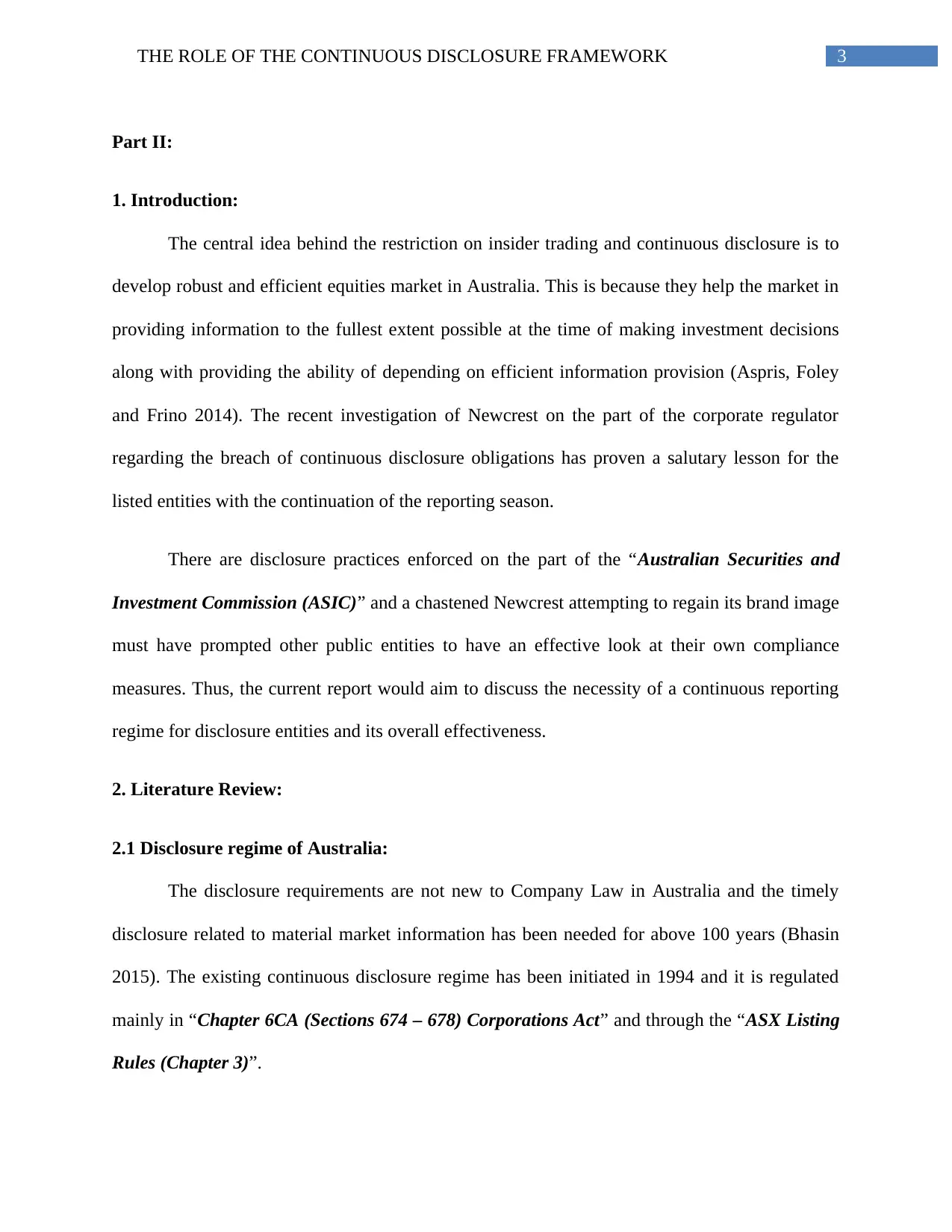
The central idea behind the restriction on insider trading and continuous disclosure is to
develop robust and efficient equities market in Australia. This is because they help the market in
providing information to the fullest extent possible at the time of making investment decisions
along with providing the ability of depending on efficient information provision (Aspris, Foley
and Frino 2014). The recent investigation of Newcrest on the part of the corporate regulator
regarding the breach of continuous disclosure obligations has proven a salutary lesson for the
listed entities with the continuation of the reporting season.
There are disclosure practices enforced on the part of the “Australian Securities and
Investment Commission (ASIC)” and a chastened Newcrest attempting to regain its brand image
must have prompted other public entities to have an effective look at their own compliance
measures. Thus, the current report would aim to discuss the necessity of a continuous reporting
regime for disclosure entities and its overall effectiveness.
2. Literature Review:
2.1 Disclosure regime of Australia:
The disclosure requirements are not new to Company Law in Australia and the timely
disclosure related to material market information has been needed for above 100 years (Bhasin
2015). The existing continuous disclosure regime has been initiated in 1994 and it is regulated
mainly in “Chapter 6CA (Sections 674 – 678) Corporations Act” and through the “ASX Listing
Rules (Chapter 3)”.
Part II:
1. Introduction:
The central idea behind the restriction on insider trading and continuous disclosure is to
develop robust and efficient equities market in Australia. This is because they help the market in
providing information to the fullest extent possible at the time of making investment decisions
along with providing the ability of depending on efficient information provision (Aspris, Foley
and Frino 2014). The recent investigation of Newcrest on the part of the corporate regulator
regarding the breach of continuous disclosure obligations has proven a salutary lesson for the
listed entities with the continuation of the reporting season.
There are disclosure practices enforced on the part of the “Australian Securities and
Investment Commission (ASIC)” and a chastened Newcrest attempting to regain its brand image
must have prompted other public entities to have an effective look at their own compliance
measures. Thus, the current report would aim to discuss the necessity of a continuous reporting
regime for disclosure entities and its overall effectiveness.
2. Literature Review:
2.1 Disclosure regime of Australia:
The disclosure requirements are not new to Company Law in Australia and the timely
disclosure related to material market information has been needed for above 100 years (Bhasin
2015). The existing continuous disclosure regime has been initiated in 1994 and it is regulated
mainly in “Chapter 6CA (Sections 674 – 678) Corporations Act” and through the “ASX Listing
Rules (Chapter 3)”.
Paraphrase This Document
Need a fresh take? Get an instant paraphrase of this document with our AI Paraphraser
4THE ROLE OF THE CONTINUOUS DISCLOSURE FRAMEWORK
According to “Section 674”, it is necessary for the organisations to notify the investors
regarding the information not available generally having a material effect on the value or price of
the securities. As per “Listing Rule 3.1”, market-sensitive information is to be revealed
immediately upon the organisation becoming aware of it and “Guidance Note 8” helps in
clarifying the above-stated application (Buckby, Gallery and Ma 2015).
Continuous disclosure helps in minimising information asymmetry between investors and
managers and it is a measure of effective governance, which has been reinforced in “Principle 5
in ASX Corporate Governance Principles and Recommendations”. ASIC has various
enforcement alternatives available, in which an organisation violates its continuous disclosure
obligations. Such alternatives might be in the form of civil penalty proceedings having a
maximum fine of $1,000,000, enforceable undertakings, proceedings related to criminal penalty
and use of notices related to infringement initiated in 2004 (Carnegie and O’Connell 2014).
The adherence to notice of infringement does not prohibit ASIC to undertake civil
penalty proceedings against those associated with the alleged violation and it does not have any
influence the obligations of the third parties, which has been affected negatively on the part of
the conduct “(Section 1317HA)”. Even though infringement notices could be handled rapidly,
there is likelihood that big organisations might envision such notices as a simple and cheap way
with minimum effect on reputation.
The policing activity of ASIC helps in judging the extent of the continuous disclosure
regime. The Commissioner of ASIC in a presentation to the “Australasian Investor Relations
Association (AIRA)” on 31st July 2013 has stated that there have been 28 insider-trading actions,
out of which 18 of them have to be solved and 5 are yet to be resolved. In addition, the
According to “Section 674”, it is necessary for the organisations to notify the investors
regarding the information not available generally having a material effect on the value or price of
the securities. As per “Listing Rule 3.1”, market-sensitive information is to be revealed
immediately upon the organisation becoming aware of it and “Guidance Note 8” helps in
clarifying the above-stated application (Buckby, Gallery and Ma 2015).
Continuous disclosure helps in minimising information asymmetry between investors and
managers and it is a measure of effective governance, which has been reinforced in “Principle 5
in ASX Corporate Governance Principles and Recommendations”. ASIC has various
enforcement alternatives available, in which an organisation violates its continuous disclosure
obligations. Such alternatives might be in the form of civil penalty proceedings having a
maximum fine of $1,000,000, enforceable undertakings, proceedings related to criminal penalty
and use of notices related to infringement initiated in 2004 (Carnegie and O’Connell 2014).
The adherence to notice of infringement does not prohibit ASIC to undertake civil
penalty proceedings against those associated with the alleged violation and it does not have any
influence the obligations of the third parties, which has been affected negatively on the part of
the conduct “(Section 1317HA)”. Even though infringement notices could be handled rapidly,
there is likelihood that big organisations might envision such notices as a simple and cheap way
with minimum effect on reputation.
The policing activity of ASIC helps in judging the extent of the continuous disclosure
regime. The Commissioner of ASIC in a presentation to the “Australasian Investor Relations
Association (AIRA)” on 31st July 2013 has stated that there have been 28 insider-trading actions,
out of which 18 of them have to be solved and 5 are yet to be resolved. In addition, the
5THE ROLE OF THE CONTINUOUS DISCLOSURE FRAMEWORK
conviction rate of ASIC from 2009 until present is nearly four times higher in contrast to the
previous decade (Henderson et al. 2015). At present, 25 investigations pertaining to insider
trading have been active and ASIC has issued 11 infringement notices to nine organisations for
failing to satisfy the continuous disclosure obligations (Chang, Hooi and Wee 2014).
2.2 Principles of continuous disclosure:
The following are the main principles of the continuous disclosure regime in Australia:
It is necessary for the entities to release adequate information for allowing investors to
make rightful judgements regarding the security prices, even though the investors might
make distinct judgements based on such information. In addition, the entities must not
disclose misleading or falsified information to the users.
The organisations are required to reveal price sensitive information materially to the
market, as soon as they obtain information. In addition, they need to reveal information
promptly at the time it becomes evident that disclosure could not be withheld legitimately
anymore.
Price sensitive information needs to be made available to the investors equally for placing
them in an advantageous position in contrast to others. In this context, North (2014)
stated that the absence of selective disclosure is essential to the integrity of the market.
Hence, selective disclosure develops the potential in relation to insider trading, in which
the investors’ trade based on materially price sensitive information.
It is necessary for the continuous disclosure regime to strike an effective balance between
strengthening timely disclosure of price sensitive information materially and restricting
the prior disclosure of such information. Moreover, the entities are restricted to develop a
conviction rate of ASIC from 2009 until present is nearly four times higher in contrast to the
previous decade (Henderson et al. 2015). At present, 25 investigations pertaining to insider
trading have been active and ASIC has issued 11 infringement notices to nine organisations for
failing to satisfy the continuous disclosure obligations (Chang, Hooi and Wee 2014).
2.2 Principles of continuous disclosure:
The following are the main principles of the continuous disclosure regime in Australia:
It is necessary for the entities to release adequate information for allowing investors to
make rightful judgements regarding the security prices, even though the investors might
make distinct judgements based on such information. In addition, the entities must not
disclose misleading or falsified information to the users.
The organisations are required to reveal price sensitive information materially to the
market, as soon as they obtain information. In addition, they need to reveal information
promptly at the time it becomes evident that disclosure could not be withheld legitimately
anymore.
Price sensitive information needs to be made available to the investors equally for placing
them in an advantageous position in contrast to others. In this context, North (2014)
stated that the absence of selective disclosure is essential to the integrity of the market.
Hence, selective disclosure develops the potential in relation to insider trading, in which
the investors’ trade based on materially price sensitive information.
It is necessary for the continuous disclosure regime to strike an effective balance between
strengthening timely disclosure of price sensitive information materially and restricting
the prior disclosure of such information. Moreover, the entities are restricted to develop a
⊘ This is a preview!⊘
Do you want full access?
Subscribe today to unlock all pages.
Trusted by 1+ million students worldwide
6THE ROLE OF THE CONTINUOUS DISCLOSURE FRAMEWORK
speculative environment and volatility of price with the help of frequent conflicting
declarations regarding indefinite or incomplete matters.
The continuous disclosure regime needs to develop an effective balance between
requiring the timely revelation of materially price sensitive information and protecting
the commercial benefits of the disclosing firms. However, this application could be made
only, in which there is strict maintenance of confidentiality in relation to such matters.
The materially price sensitive information withheld from the investors need to be kept
confidential. While an organisation might disseminate information to its commercial
partners and advisers, these individuals need not trade in the shares of the organisation. In
situations, information is available widely due to the violation of confidence; it needs to
be disclosed to the investors based on time and equality.
The organisations need to receive consistent and clear guidance in association with their
obligation for disclosing materially price sensitive information. This regime needs to take
into account a group of penalties, which could be tailored to various circumstances
(Reitmaier et al. 2017).
2.3 Selective disclosure:
The concentration of investigation of ASIC into Newcrest is whether it revealed its
position to the chosen analysts prior to a market update release announcing production downfall
and considerable write-offs. There is a close association between insider trading and selective
disclosure. As pointed out by Chapple and Truong (2015), markets depend on the information
flow; however, such dependence must not be at the cost of efficiency and equity. In addition, it
must not restrain the informed and confident investors. Thus, selective disclosures skews the
speculative environment and volatility of price with the help of frequent conflicting
declarations regarding indefinite or incomplete matters.
The continuous disclosure regime needs to develop an effective balance between
requiring the timely revelation of materially price sensitive information and protecting
the commercial benefits of the disclosing firms. However, this application could be made
only, in which there is strict maintenance of confidentiality in relation to such matters.
The materially price sensitive information withheld from the investors need to be kept
confidential. While an organisation might disseminate information to its commercial
partners and advisers, these individuals need not trade in the shares of the organisation. In
situations, information is available widely due to the violation of confidence; it needs to
be disclosed to the investors based on time and equality.
The organisations need to receive consistent and clear guidance in association with their
obligation for disclosing materially price sensitive information. This regime needs to take
into account a group of penalties, which could be tailored to various circumstances
(Reitmaier et al. 2017).
2.3 Selective disclosure:
The concentration of investigation of ASIC into Newcrest is whether it revealed its
position to the chosen analysts prior to a market update release announcing production downfall
and considerable write-offs. There is a close association between insider trading and selective
disclosure. As pointed out by Chapple and Truong (2015), markets depend on the information
flow; however, such dependence must not be at the cost of efficiency and equity. In addition, it
must not restrain the informed and confident investors. Thus, selective disclosures skews the
Paraphrase This Document
Need a fresh take? Get an instant paraphrase of this document with our AI Paraphraser
7THE ROLE OF THE CONTINUOUS DISCLOSURE FRAMEWORK
loyalty of the analysts, restricts the investors obtaining equal admission to information,
undermines transparency and spoils confidence.
Selective disclosure could result in vicious cycle, in which the organisations use the
chosen access of the analysts in the form of a tool for securing favourable reviews in gaining an
overview that access could be withdrawn; in case, the report do not resemble the goals of the
organisation. Along with this, the institutional investors might utilise their power of investment
for extracting preferential access to information from the listed organisations via private
briefings (Choi et al. 2016).
However, it would not be a feasible idea to suggest abolishing selective briefings. They
play a significant role by filling in gaps that the analysts might misuse in the normal course of
inquiries. This is pertinent, since the investors are the individuals benefitted from the expertise of
the analysts. Webcasting and access to all the pertinent documents with the help of the company
website, is a method of levelling the playing field (Fu, Carson and Simnett 2015). The
organisations have started already to adopt this method in relation to formalised analysts and in
few cases, journalist briefings. Despite the fact that selective briefings are another matter clearly
and even though free access to each analyst briefing might convince the retail investors, the goal
could be adjudged as unrealistic. Thus, the recent initiative of surveillance undertaken on the part
of ASIC is a significant inclusion in the disclosure regime.
2.4 Surveillance:
The new program of ASIC to carry out spot checks with the chosen organisations and
monitoring adherence is overdue. This is because of the complexities of successful mounting and
succeeding in criminal prosecution along with the overall implications of costs for ASIC of civil
loyalty of the analysts, restricts the investors obtaining equal admission to information,
undermines transparency and spoils confidence.
Selective disclosure could result in vicious cycle, in which the organisations use the
chosen access of the analysts in the form of a tool for securing favourable reviews in gaining an
overview that access could be withdrawn; in case, the report do not resemble the goals of the
organisation. Along with this, the institutional investors might utilise their power of investment
for extracting preferential access to information from the listed organisations via private
briefings (Choi et al. 2016).
However, it would not be a feasible idea to suggest abolishing selective briefings. They
play a significant role by filling in gaps that the analysts might misuse in the normal course of
inquiries. This is pertinent, since the investors are the individuals benefitted from the expertise of
the analysts. Webcasting and access to all the pertinent documents with the help of the company
website, is a method of levelling the playing field (Fu, Carson and Simnett 2015). The
organisations have started already to adopt this method in relation to formalised analysts and in
few cases, journalist briefings. Despite the fact that selective briefings are another matter clearly
and even though free access to each analyst briefing might convince the retail investors, the goal
could be adjudged as unrealistic. Thus, the recent initiative of surveillance undertaken on the part
of ASIC is a significant inclusion in the disclosure regime.
2.4 Surveillance:
The new program of ASIC to carry out spot checks with the chosen organisations and
monitoring adherence is overdue. This is because of the complexities of successful mounting and
succeeding in criminal prosecution along with the overall implications of costs for ASIC of civil
8THE ROLE OF THE CONTINUOUS DISCLOSURE FRAMEWORK
as well as criminal proceedings (Gopalan and Hogan 2014). The laws could be a blend of
punishment and persuasion. The push of ASIC to the briefings of the analysts is considered as
third pillar, which is participation. Thus, it has become increasingly inherent that corporate
governance could be monitored properly and it needs to be improved as well, if the regulators
involve in its processes.
3. Conclusion:
Based on the above discussion, it could be inferred that the continuous disclosure
regulations of Australia hold good; however, it is necessary for the regulators like ASIC to
balance the books and they need to think in a creative fashion. The various layers of
enforcement, regulation and guidance aim the offending conduct in an effective fashion.
However, the presence of regulation does not assure compliance. In addition, the initiation of the
briefings surveillance initiative of ASIC is considered as significant evidence, which the
regulator is planning ahead. Therefore, the continuous disclosure regime is effective for the
disclosing entities in Australia to provide the investors with timely and accurate information.
as well as criminal proceedings (Gopalan and Hogan 2014). The laws could be a blend of
punishment and persuasion. The push of ASIC to the briefings of the analysts is considered as
third pillar, which is participation. Thus, it has become increasingly inherent that corporate
governance could be monitored properly and it needs to be improved as well, if the regulators
involve in its processes.
3. Conclusion:
Based on the above discussion, it could be inferred that the continuous disclosure
regulations of Australia hold good; however, it is necessary for the regulators like ASIC to
balance the books and they need to think in a creative fashion. The various layers of
enforcement, regulation and guidance aim the offending conduct in an effective fashion.
However, the presence of regulation does not assure compliance. In addition, the initiation of the
briefings surveillance initiative of ASIC is considered as significant evidence, which the
regulator is planning ahead. Therefore, the continuous disclosure regime is effective for the
disclosing entities in Australia to provide the investors with timely and accurate information.
⊘ This is a preview!⊘
Do you want full access?
Subscribe today to unlock all pages.
Trusted by 1+ million students worldwide
9THE ROLE OF THE CONTINUOUS DISCLOSURE FRAMEWORK
References:
Aspris, A., Foley, S. and Frino, A., 2014. Does insider trading explain price run‐up ahead of
takeover announcements?. Accounting & Finance, 54(1), pp.25-45.
Bhasin, M.L., 2015. Disclosure of Intellectual Capital in Annual Reports: Comparing Evidence
from India and Australia.
Buckby, S., Gallery, G. and Ma, J., 2015. An analysis of risk management disclosures:
Australian evidence. Managerial Auditing Journal, 30(8/9), pp.812-869.
Carnegie, G.D. and O’Connell, B.T., 2014. A longitudinal study of the interplay of corporate
collapse, accounting failure and governance change in Australia: Early 1890s to early
2000s. Critical Perspectives on Accounting, 25(6), pp.446-468.
Chang, M., Hooi, L. and Wee, M., 2014. How does investor relations disclosure affect analysts'
forecasts?. Accounting & Finance, 54(2), pp.365-391.
Chapple, L. and Truong, T.P., 2015. Continuous disclosure compliance: does corporate
governance matter?. Accounting & Finance, 55(4), pp.965-988.
Choi, K.W.S., Chen, X., Wright, S. and Wu, H., 2016. Responsive Enforcement Strategy and
Corporate Compliance with Disclosure Regulations.
Fu, Y., Carson, E. and Simnett, R., 2015. Transparency report disclosure by Australian audit
firms and opportunities for research. Managerial Auditing Journal, 30(8/9), pp.870-910.
References:
Aspris, A., Foley, S. and Frino, A., 2014. Does insider trading explain price run‐up ahead of
takeover announcements?. Accounting & Finance, 54(1), pp.25-45.
Bhasin, M.L., 2015. Disclosure of Intellectual Capital in Annual Reports: Comparing Evidence
from India and Australia.
Buckby, S., Gallery, G. and Ma, J., 2015. An analysis of risk management disclosures:
Australian evidence. Managerial Auditing Journal, 30(8/9), pp.812-869.
Carnegie, G.D. and O’Connell, B.T., 2014. A longitudinal study of the interplay of corporate
collapse, accounting failure and governance change in Australia: Early 1890s to early
2000s. Critical Perspectives on Accounting, 25(6), pp.446-468.
Chang, M., Hooi, L. and Wee, M., 2014. How does investor relations disclosure affect analysts'
forecasts?. Accounting & Finance, 54(2), pp.365-391.
Chapple, L. and Truong, T.P., 2015. Continuous disclosure compliance: does corporate
governance matter?. Accounting & Finance, 55(4), pp.965-988.
Choi, K.W.S., Chen, X., Wright, S. and Wu, H., 2016. Responsive Enforcement Strategy and
Corporate Compliance with Disclosure Regulations.
Fu, Y., Carson, E. and Simnett, R., 2015. Transparency report disclosure by Australian audit
firms and opportunities for research. Managerial Auditing Journal, 30(8/9), pp.870-910.
Paraphrase This Document
Need a fresh take? Get an instant paraphrase of this document with our AI Paraphraser
10THE ROLE OF THE CONTINUOUS DISCLOSURE FRAMEWORK
Gopalan, S. and Hogan, K., 2014. Ethical Transnational Corporate Activity At Home And
Abroad: A proposal for reforming continuous disclosure obligations in Australia and the United
States. Colum. Hum. Rts. L. Rev., 46, p.1.
Henderson, S., Peirson, G., Herbohn, K. and Howieson, B., 2015. Issues in financial accounting.
Pearson Higher Education AU.
North, G., 2014. Listed Company Disclosure and Financial Market Transparency: Is this a Battle
Worth Fighting or Merely Policy and Regulatory Mantra?. Browser Download This Paper.
Reitmaier, C., Reitmaier, C., Schultze, W. and Schultze, W., 2017. Enhanced business reporting:
value relevance and determinants of valuation-related disclosures. Journal of Intellectual
Capital, 18(4), pp.832-867.
Gopalan, S. and Hogan, K., 2014. Ethical Transnational Corporate Activity At Home And
Abroad: A proposal for reforming continuous disclosure obligations in Australia and the United
States. Colum. Hum. Rts. L. Rev., 46, p.1.
Henderson, S., Peirson, G., Herbohn, K. and Howieson, B., 2015. Issues in financial accounting.
Pearson Higher Education AU.
North, G., 2014. Listed Company Disclosure and Financial Market Transparency: Is this a Battle
Worth Fighting or Merely Policy and Regulatory Mantra?. Browser Download This Paper.
Reitmaier, C., Reitmaier, C., Schultze, W. and Schultze, W., 2017. Enhanced business reporting:
value relevance and determinants of valuation-related disclosures. Journal of Intellectual
Capital, 18(4), pp.832-867.

1 out of 11


Related Documents


Your All-in-One AI-Powered Toolkit for Academic Success.
+13062052269
info@desklib.com
Available 24*7 on WhatsApp / Email
![[object Object]](/_next/static/media/star-bottom.7253800d.svg)
Unlock your academic potential
Copyright © 2020–2026 A2Z Services. All Rights Reserved. Developed and managed by ZUCOL.