University Economics Report: Analysis of Australian Economic Growth
VerifiedAdded on 2020/02/19
|14
|2503
|52
Report
AI Summary
This report provides a detailed analysis of the Australian economy, focusing on its current state and future growth prospects. It examines key economic indicators such as GDP, inflation rate, unemployment rate, population growth, and balance of trade. The analysis reveals a fluctuating GDP, rising inflation, increasing unemployment, and population pressures. The report suggests that the government should implement contractionary monetary and tight fiscal policies to control inflation and promote long-term growth. Recommendations include increasing government spending in crucial sectors, controlling inflation through monetary policy, adopting a tight fiscal policy, creating more job opportunities, reducing inequality, and managing population growth. The report concludes that while Australia is a developed economy, it faces challenges that, if unaddressed, could hinder future growth. The report forecasts a 3 percent GDP growth by 2018 and emphasizes the importance of proactive policy measures to ensure sustained economic development.
Running head: ECONOMICS OF MANAGEMENT
Economics for Management
Name of the Student
Name of the University
Author note
Economics for Management
Name of the Student
Name of the University
Author note

Paraphrase This Document
Need a fresh take? Get an instant paraphrase of this document with our AI Paraphraser
1
ECONOMICS OF MANAGEMENT
Executive summary
The objective of the paper is to analyze the current situation of Australia and to suggest further
recommendation for future growth of the country in the next six months. Australia is suffering
from a fall in its GDP, rise in its inflation rate, high unemployment and increasing population
pressure. This might have a negative effect on the growth of the country. Thus, it is necessary for
the government to take up contractionary monetary policy, tight fiscal policy and other measure
to control the negative effect and maintain their long term growth.
ECONOMICS OF MANAGEMENT
Executive summary
The objective of the paper is to analyze the current situation of Australia and to suggest further
recommendation for future growth of the country in the next six months. Australia is suffering
from a fall in its GDP, rise in its inflation rate, high unemployment and increasing population
pressure. This might have a negative effect on the growth of the country. Thus, it is necessary for
the government to take up contractionary monetary policy, tight fiscal policy and other measure
to control the negative effect and maintain their long term growth.
2
ECONOMICS OF MANAGEMENT
Table of Contents
Introduction......................................................................................................................................3
Current State of Australian economy..............................................................................................3
Future Growth forecast for Australian economy.............................................................................8
Conclusion.......................................................................................................................................9
References......................................................................................................................................11
ECONOMICS OF MANAGEMENT
Table of Contents
Introduction......................................................................................................................................3
Current State of Australian economy..............................................................................................3
Future Growth forecast for Australian economy.............................................................................8
Conclusion.......................................................................................................................................9
References......................................................................................................................................11
⊘ This is a preview!⊘
Do you want full access?
Subscribe today to unlock all pages.

Trusted by 1+ million students worldwide
3
ECONOMICS OF MANAGEMENT
Introduction
Australian economy is considered to be one of the most developed economies in the
world. It has a mixed market system in their economy where all types of market system are
present. It is also known as one of the wealthiest economy in the world with most of people
living above normal standard. It is also the 12th largest economy of the world according to its
GDP and 19th largest economy of the world measured by PPP. It is also known for exporting
maximum amount of goods to other countries. The major industry of the economy is the service
sector comprising about 71 percent of the total GDP. The currency in which exchange takes
place in Australia is Australian Dollars. However, this immensely developed country has gone
through a number of changes over the years in its GDP rate, employment rate, inflation and other
major economic variables. It has trade relations with Chile, China, Korea, and Malaysia and may
other countries.
The report will analyze the current performance of the Australian economy based on
various economic variables. It analyses the effect of these variables on the economy by
visualizing its trends over the years. Further, it will discuss about some the effect of the present
situation of the Australian economy on its future growth. The future forecast will be done on the
next six months.
Current State of Australian economy
Australian economy has been growing over the years on each ground such as GDP,
employment, export, import and other factors. It is a free market economy and as not been
effected by recession over the last 25 years. The country is also fully opened to foreign industries
ECONOMICS OF MANAGEMENT
Introduction
Australian economy is considered to be one of the most developed economies in the
world. It has a mixed market system in their economy where all types of market system are
present. It is also known as one of the wealthiest economy in the world with most of people
living above normal standard. It is also the 12th largest economy of the world according to its
GDP and 19th largest economy of the world measured by PPP. It is also known for exporting
maximum amount of goods to other countries. The major industry of the economy is the service
sector comprising about 71 percent of the total GDP. The currency in which exchange takes
place in Australia is Australian Dollars. However, this immensely developed country has gone
through a number of changes over the years in its GDP rate, employment rate, inflation and other
major economic variables. It has trade relations with Chile, China, Korea, and Malaysia and may
other countries.
The report will analyze the current performance of the Australian economy based on
various economic variables. It analyses the effect of these variables on the economy by
visualizing its trends over the years. Further, it will discuss about some the effect of the present
situation of the Australian economy on its future growth. The future forecast will be done on the
next six months.
Current State of Australian economy
Australian economy has been growing over the years on each ground such as GDP,
employment, export, import and other factors. It is a free market economy and as not been
effected by recession over the last 25 years. The country is also fully opened to foreign industries
Paraphrase This Document
Need a fresh take? Get an instant paraphrase of this document with our AI Paraphraser
4
ECONOMICS OF MANAGEMENT
which is giving rise to foreign competition. It is also assumed as one of the most attractive
country for investment for big investors. The country is well advanced and the people are very
open to changes and growth. Government of the country sets the tax rates, which is presently
standing at 45 percent for income tax and 30 percent for corporate tax. Government of Australia
plays a good role in investing good amount in the Australian industry. Presently the government
contributes 37 percent of the tote GDP of the country.
GDP of Australia
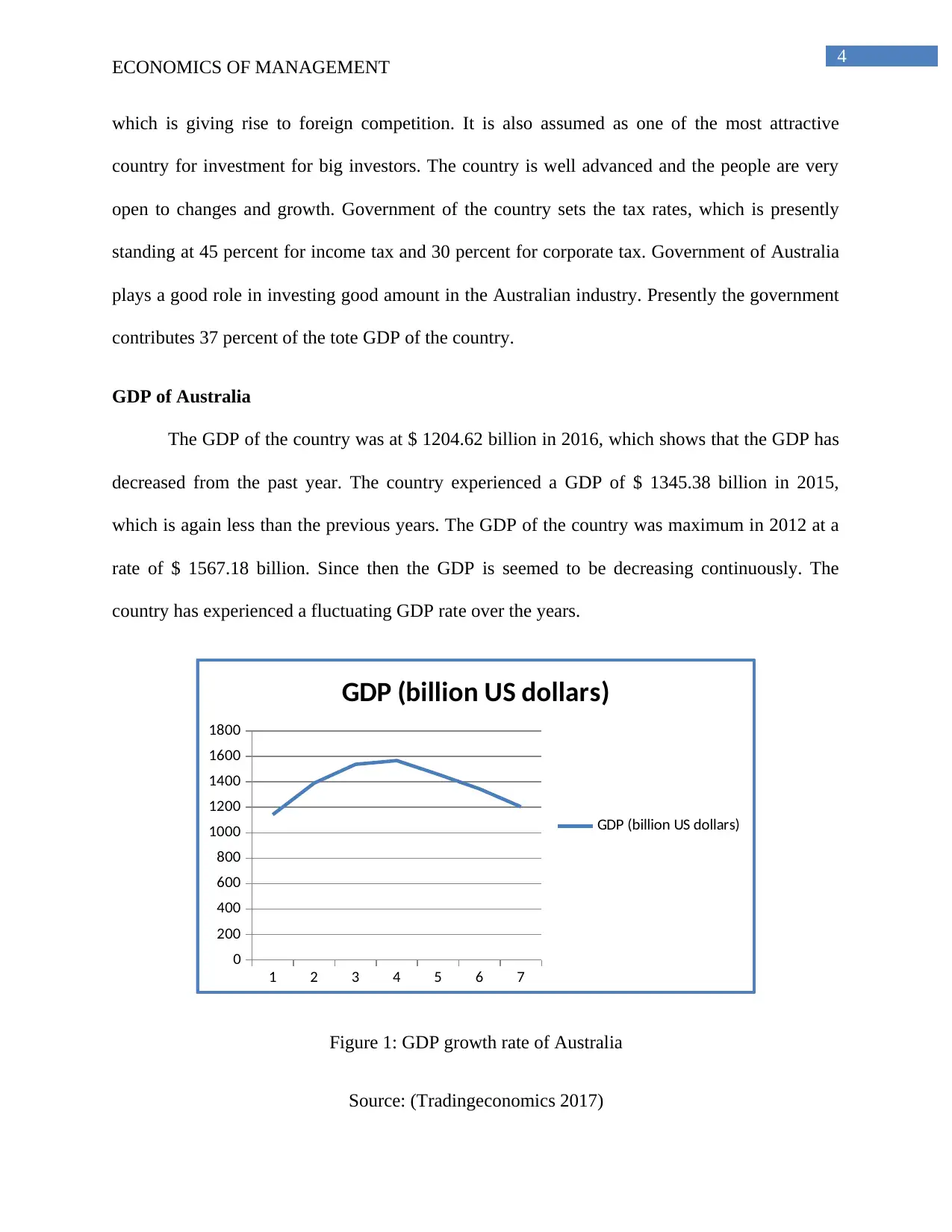
The GDP of the country was at $ 1204.62 billion in 2016, which shows that the GDP has
decreased from the past year. The country experienced a GDP of $ 1345.38 billion in 2015,
which is again less than the previous years. The GDP of the country was maximum in 2012 at a
rate of $ 1567.18 billion. Since then the GDP is seemed to be decreasing continuously. The
country has experienced a fluctuating GDP rate over the years.
1 2 3 4 5 6 7
0
200
400
600
800
1000
1200
1400
1600
1800
GDP (billion US dollars)
GDP (billion US dollars)
Figure 1: GDP growth rate of Australia
Source: (Tradingeconomics 2017)
ECONOMICS OF MANAGEMENT
which is giving rise to foreign competition. It is also assumed as one of the most attractive
country for investment for big investors. The country is well advanced and the people are very
open to changes and growth. Government of the country sets the tax rates, which is presently
standing at 45 percent for income tax and 30 percent for corporate tax. Government of Australia
plays a good role in investing good amount in the Australian industry. Presently the government
contributes 37 percent of the tote GDP of the country.
GDP of Australia
The GDP of the country was at $ 1204.62 billion in 2016, which shows that the GDP has
decreased from the past year. The country experienced a GDP of $ 1345.38 billion in 2015,
which is again less than the previous years. The GDP of the country was maximum in 2012 at a
rate of $ 1567.18 billion. Since then the GDP is seemed to be decreasing continuously. The
country has experienced a fluctuating GDP rate over the years.
1 2 3 4 5 6 7
0
200
400
600
800
1000
1200
1400
1600
1800
GDP (billion US dollars)
GDP (billion US dollars)
Figure 1: GDP growth rate of Australia
Source: (Tradingeconomics 2017)
5
ECONOMICS OF MANAGEMENT
From the above figure, it can be seen that the GDP of the country has increased initially
from 2010 till 2013 and since then the country is experiencing a fall in its GDP rate. It has a
fluctuating pattern in its GDP growth rate.
Inflation Rate
The next economic variable that affects an economy is its inflation rate. While analyzing
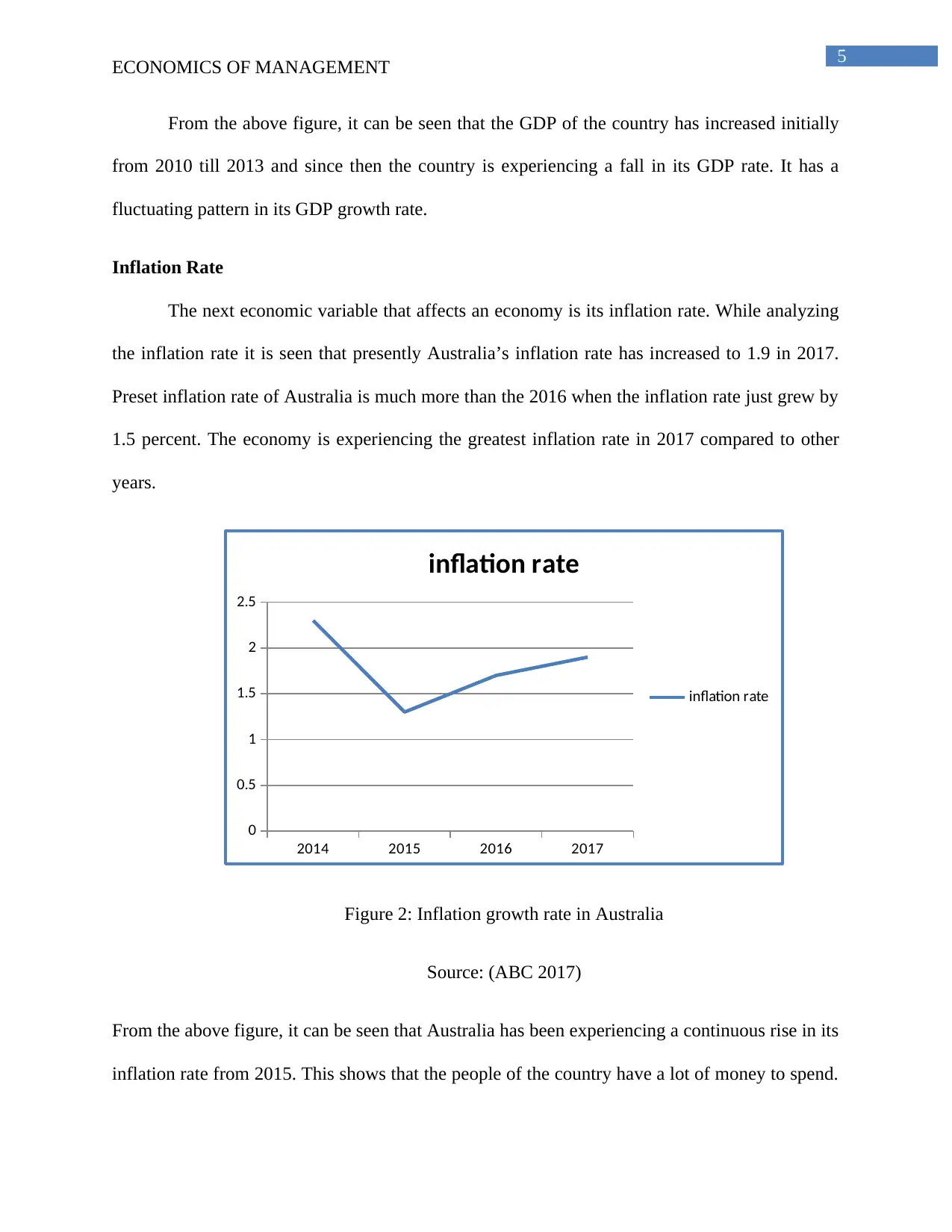
the inflation rate it is seen that presently Australia’s inflation rate has increased to 1.9 in 2017.
Preset inflation rate of Australia is much more than the 2016 when the inflation rate just grew by
1.5 percent. The economy is experiencing the greatest inflation rate in 2017 compared to other
years.
2014 2015 2016 2017
0
0.5
1
1.5
2
2.5
inflation rate
inflation rate
Figure 2: Inflation growth rate in Australia
Source: (ABC 2017)
From the above figure, it can be seen that Australia has been experiencing a continuous rise in its
inflation rate from 2015. This shows that the people of the country have a lot of money to spend.
ECONOMICS OF MANAGEMENT
From the above figure, it can be seen that the GDP of the country has increased initially
from 2010 till 2013 and since then the country is experiencing a fall in its GDP rate. It has a
fluctuating pattern in its GDP growth rate.
Inflation Rate
The next economic variable that affects an economy is its inflation rate. While analyzing
the inflation rate it is seen that presently Australia’s inflation rate has increased to 1.9 in 2017.
Preset inflation rate of Australia is much more than the 2016 when the inflation rate just grew by
1.5 percent. The economy is experiencing the greatest inflation rate in 2017 compared to other
years.
2014 2015 2016 2017
0
0.5
1
1.5
2
2.5
inflation rate
inflation rate
Figure 2: Inflation growth rate in Australia
Source: (ABC 2017)
From the above figure, it can be seen that Australia has been experiencing a continuous rise in its
inflation rate from 2015. This shows that the people of the country have a lot of money to spend.
⊘ This is a preview!⊘
Do you want full access?
Subscribe today to unlock all pages.
Trusted by 1+ million students worldwide
6
ECONOMICS OF MANAGEMENT
The purchasing power of the people in Australia has been increasing over the years. The rising
inflation in Australia has direct effect on the interest rate. With an increase in the inflation rate
the interest rate of the country is also increasing. The real interest rate of the country is 6.2677
percent in 2015 and it has increased compared to previous years. This shows that the lenders and
savers of the country expect to receive after deducting inflation from the nominal interest rate.
However, the increase is not much because the country is also experiencing an increase in
inflation rate.
Unemployment Rate
The next economic variable that affects the economy of Australia is the unemployment
rate. This is because the level of unemployment describes the inability of the country to take part
in productivity work and increase the GDP of the country. Australia has seen an increase in its
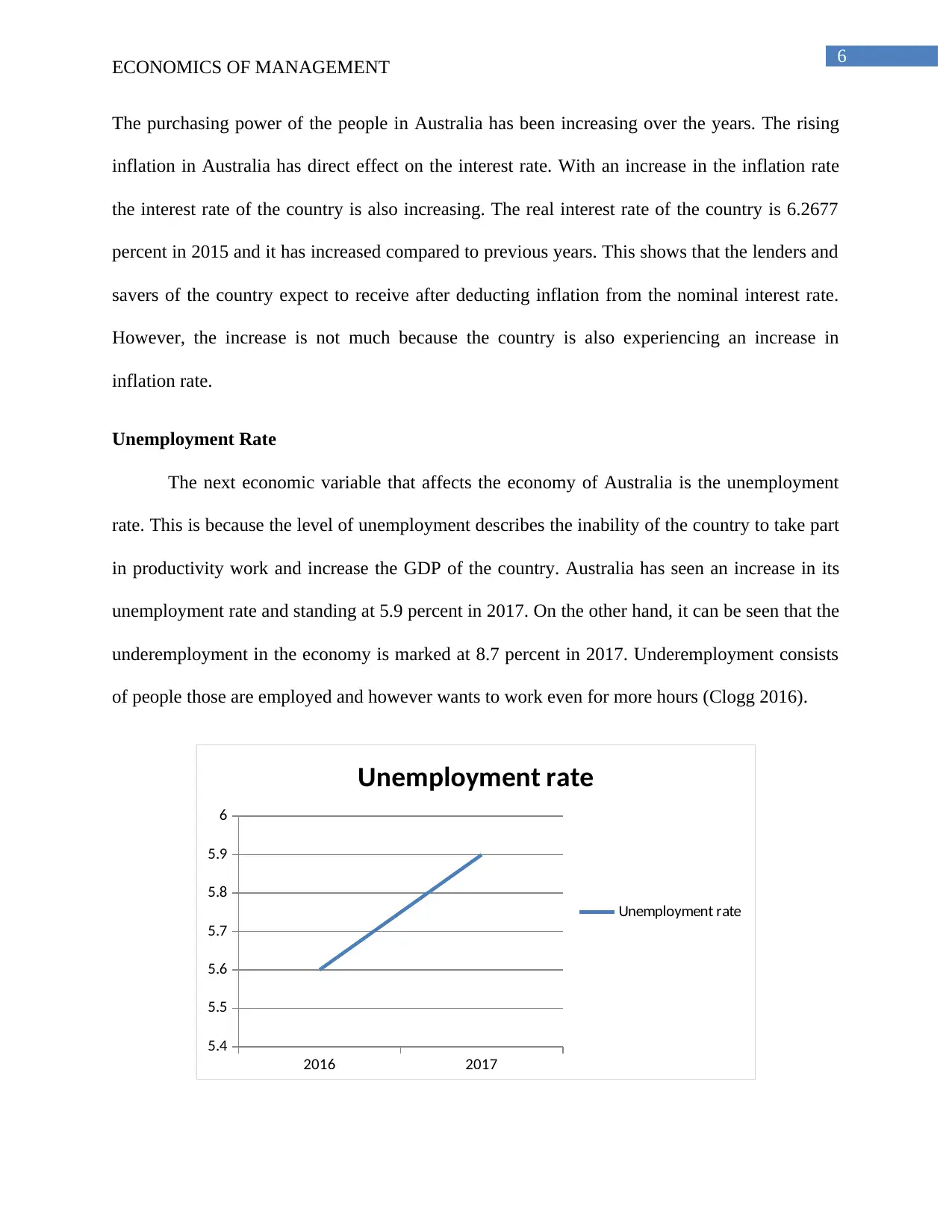
unemployment rate and standing at 5.9 percent in 2017. On the other hand, it can be seen that the
underemployment in the economy is marked at 8.7 percent in 2017. Underemployment consists
of people those are employed and however wants to work even for more hours (Clogg 2016).
2016 2017
5.4
5.5
5.6
5.7
5.8
5.9
6
Unemployment rate
Unemployment rate
ECONOMICS OF MANAGEMENT
The purchasing power of the people in Australia has been increasing over the years. The rising
inflation in Australia has direct effect on the interest rate. With an increase in the inflation rate
the interest rate of the country is also increasing. The real interest rate of the country is 6.2677
percent in 2015 and it has increased compared to previous years. This shows that the lenders and
savers of the country expect to receive after deducting inflation from the nominal interest rate.
However, the increase is not much because the country is also experiencing an increase in
inflation rate.
Unemployment Rate
The next economic variable that affects the economy of Australia is the unemployment
rate. This is because the level of unemployment describes the inability of the country to take part
in productivity work and increase the GDP of the country. Australia has seen an increase in its
unemployment rate and standing at 5.9 percent in 2017. On the other hand, it can be seen that the
underemployment in the economy is marked at 8.7 percent in 2017. Underemployment consists
of people those are employed and however wants to work even for more hours (Clogg 2016).
2016 2017
5.4
5.5
5.6
5.7
5.8
5.9
6
Unemployment rate
Unemployment rate
Paraphrase This Document
Need a fresh take? Get an instant paraphrase of this document with our AI Paraphraser
7
ECONOMICS OF MANAGEMENT
Figure 3: unemployment rate
Source: (Perthnow 2017)
Thus, from the above figure it can be seen that unemployment is rising on a faster rate in
Australia as compared to the previous years. This is not a good implication for the economy as
there is lack of job generation to support the increasing labor force. Thus, huge amour of labor is
being wasted.
Population Growth
Lastly, it is seen that population also has a lot of impact on the well being of the economy.
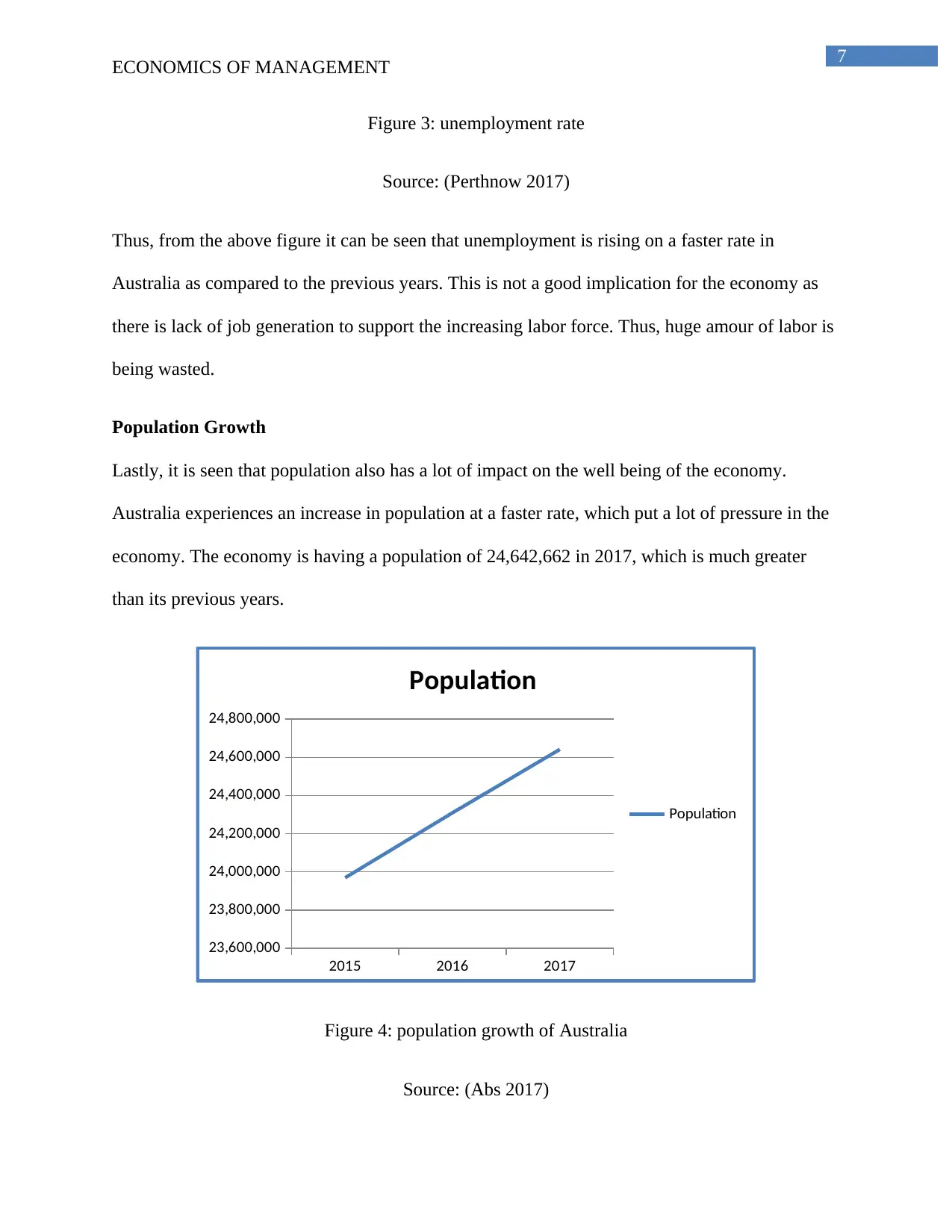
Australia experiences an increase in population at a faster rate, which put a lot of pressure in the
economy. The economy is having a population of 24,642,662 in 2017, which is much greater
than its previous years.
2015 2016 2017
23,600,000
23,800,000
24,000,000
24,200,000
24,400,000
24,600,000
24,800,000
Population
Population
Figure 4: population growth of Australia
Source: (Abs 2017)
ECONOMICS OF MANAGEMENT
Figure 3: unemployment rate
Source: (Perthnow 2017)
Thus, from the above figure it can be seen that unemployment is rising on a faster rate in
Australia as compared to the previous years. This is not a good implication for the economy as
there is lack of job generation to support the increasing labor force. Thus, huge amour of labor is
being wasted.
Population Growth
Lastly, it is seen that population also has a lot of impact on the well being of the economy.
Australia experiences an increase in population at a faster rate, which put a lot of pressure in the
economy. The economy is having a population of 24,642,662 in 2017, which is much greater
than its previous years.
2015 2016 2017
23,600,000
23,800,000
24,000,000
24,200,000
24,400,000
24,600,000
24,800,000
Population
Population
Figure 4: population growth of Australia
Source: (Abs 2017)
8
ECONOMICS OF MANAGEMENT
Thus, it is visible from the above diagram that Australia is experiencing an increase in its
population which is not a good sign for the company as it increase pressure on everything and
does not allows the policy makers of the economy to take necessary steps for the betterment for
the country.
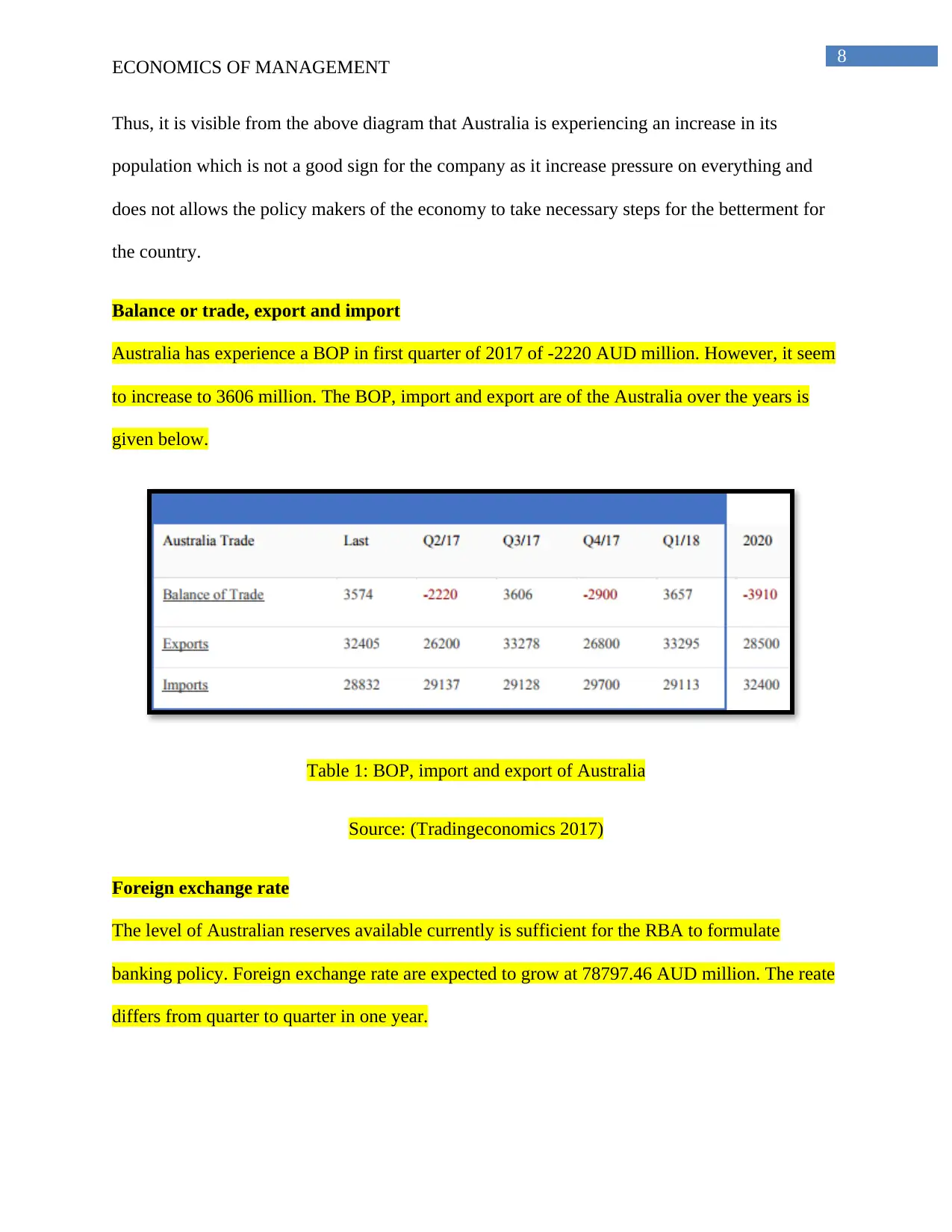
Balance or trade, export and import
Australia has experience a BOP in first quarter of 2017 of -2220 AUD million. However, it seem
to increase to 3606 million. The BOP, import and export are of the Australia over the years is
given below.
Table 1: BOP, import and export of Australia
Source: (Tradingeconomics 2017)
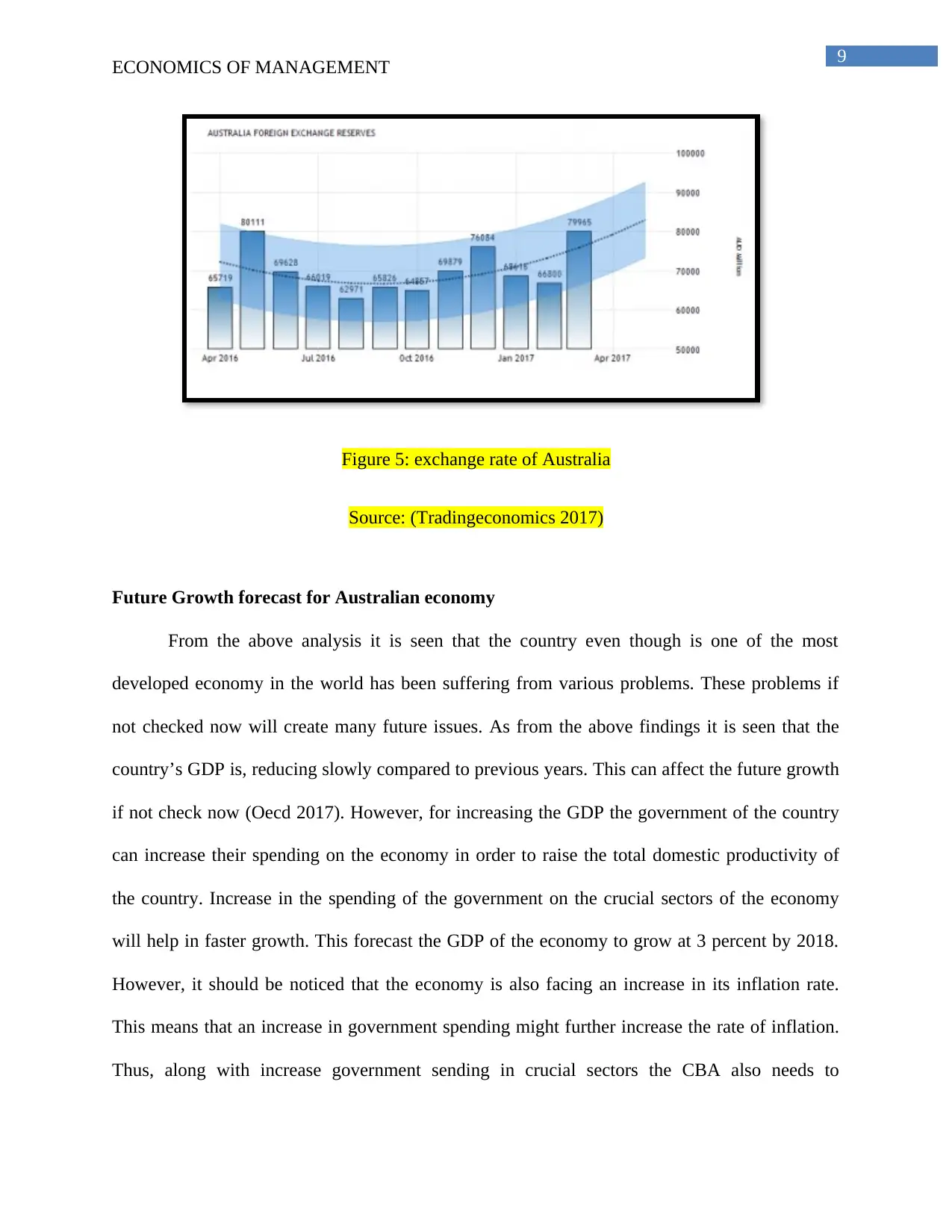
Foreign exchange rate
The level of Australian reserves available currently is sufficient for the RBA to formulate
banking policy. Foreign exchange rate are expected to grow at 78797.46 AUD million. The reate
differs from quarter to quarter in one year.
ECONOMICS OF MANAGEMENT
Thus, it is visible from the above diagram that Australia is experiencing an increase in its
population which is not a good sign for the company as it increase pressure on everything and
does not allows the policy makers of the economy to take necessary steps for the betterment for
the country.
Balance or trade, export and import
Australia has experience a BOP in first quarter of 2017 of -2220 AUD million. However, it seem
to increase to 3606 million. The BOP, import and export are of the Australia over the years is
given below.
Table 1: BOP, import and export of Australia
Source: (Tradingeconomics 2017)
Foreign exchange rate
The level of Australian reserves available currently is sufficient for the RBA to formulate
banking policy. Foreign exchange rate are expected to grow at 78797.46 AUD million. The reate
differs from quarter to quarter in one year.
⊘ This is a preview!⊘
Do you want full access?
Subscribe today to unlock all pages.
Trusted by 1+ million students worldwide
9
ECONOMICS OF MANAGEMENT
Figure 5: exchange rate of Australia
Source: (Tradingeconomics 2017)
Future Growth forecast for Australian economy
From the above analysis it is seen that the country even though is one of the most
developed economy in the world has been suffering from various problems. These problems if
not checked now will create many future issues. As from the above findings it is seen that the
country’s GDP is, reducing slowly compared to previous years. This can affect the future growth
if not check now (Oecd 2017). However, for increasing the GDP the government of the country
can increase their spending on the economy in order to raise the total domestic productivity of
the country. Increase in the spending of the government on the crucial sectors of the economy
will help in faster growth. This forecast the GDP of the economy to grow at 3 percent by 2018.
However, it should be noticed that the economy is also facing an increase in its inflation rate.
This means that an increase in government spending might further increase the rate of inflation.
Thus, along with increase government sending in crucial sectors the CBA also needs to
ECONOMICS OF MANAGEMENT
Figure 5: exchange rate of Australia
Source: (Tradingeconomics 2017)
Future Growth forecast for Australian economy
From the above analysis it is seen that the country even though is one of the most
developed economy in the world has been suffering from various problems. These problems if
not checked now will create many future issues. As from the above findings it is seen that the
country’s GDP is, reducing slowly compared to previous years. This can affect the future growth
if not check now (Oecd 2017). However, for increasing the GDP the government of the country
can increase their spending on the economy in order to raise the total domestic productivity of
the country. Increase in the spending of the government on the crucial sectors of the economy
will help in faster growth. This forecast the GDP of the economy to grow at 3 percent by 2018.
However, it should be noticed that the economy is also facing an increase in its inflation rate.
This means that an increase in government spending might further increase the rate of inflation.
Thus, along with increase government sending in crucial sectors the CBA also needs to
Paraphrase This Document
Need a fresh take? Get an instant paraphrase of this document with our AI Paraphraser
10
ECONOMICS OF MANAGEMENT
implement contractionary monetary policy to curb the extra amount of money from the hands of
the people (Bekaert, Hoerova and Duca 2013). These two policies will help the county to control
its GDP and Inflation rate. With a rising GDP rate and a controlled inflation rate will help the
economy to maintain its growth and avoid a decline in its performance. The country can also opt
for a tight fiscal policy by which it can increase the tax rate and curb the money from the hands
of the people to curb inflation (Hansen 2013).
The next issue faced by the country is its increasing unemployment rate, which might put
them back compared to other countries. Unemployment is caused due to lack of jobs compared
to the population. This in turn affects the total productivity and lack of skilled labor in the
economy. Thus, for proper growth Australia should construct policy to increase the job
opportunities for the people and stop them to move to another country in search of job. The
economy is also suffering from the issue of inequality, which is not a good sign for the economy.
Inequality means that the income of the country is concentrated in the hands of some people,
while the others are deprived of it. Thus, to grow at a faster rate the nation needs to make policy
to reduce inequality behavior. This will allow the disadvantage people to get better job
opportunity and contribute their part in the future (Alshahrani and Alsadiq 2014). Lastly, the
major problem that the nation needs to control is its increasing population. Population rise puts a
lot of pressure on the economy in the form of increasing demand, pressure on jobs and excessive
domestic competition. Thus, the government should take some policy towards reducing
population. Theyr should limit the number of family size in order to put a control on the
population. Other than controlling population growth, the country should also maintain good
health for the existing population so that more labor that is skilled is available to increase the
productivity. The cash rate of the central bank will reduce because of contractionary monetary
ECONOMICS OF MANAGEMENT
implement contractionary monetary policy to curb the extra amount of money from the hands of
the people (Bekaert, Hoerova and Duca 2013). These two policies will help the county to control
its GDP and Inflation rate. With a rising GDP rate and a controlled inflation rate will help the
economy to maintain its growth and avoid a decline in its performance. The country can also opt
for a tight fiscal policy by which it can increase the tax rate and curb the money from the hands
of the people to curb inflation (Hansen 2013).
The next issue faced by the country is its increasing unemployment rate, which might put
them back compared to other countries. Unemployment is caused due to lack of jobs compared
to the population. This in turn affects the total productivity and lack of skilled labor in the
economy. Thus, for proper growth Australia should construct policy to increase the job
opportunities for the people and stop them to move to another country in search of job. The
economy is also suffering from the issue of inequality, which is not a good sign for the economy.
Inequality means that the income of the country is concentrated in the hands of some people,
while the others are deprived of it. Thus, to grow at a faster rate the nation needs to make policy
to reduce inequality behavior. This will allow the disadvantage people to get better job
opportunity and contribute their part in the future (Alshahrani and Alsadiq 2014). Lastly, the
major problem that the nation needs to control is its increasing population. Population rise puts a
lot of pressure on the economy in the form of increasing demand, pressure on jobs and excessive
domestic competition. Thus, the government should take some policy towards reducing
population. Theyr should limit the number of family size in order to put a control on the
population. Other than controlling population growth, the country should also maintain good
health for the existing population so that more labor that is skilled is available to increase the
productivity. The cash rate of the central bank will reduce because of contractionary monetary
11
ECONOMICS OF MANAGEMENT
policy that the Central Bank is taking to reduce the increasing trend of the inflation rate and to
reduce the flow of cash coming from increased expenditure of the government (Shintani, Terada-
Hagiwara and Yabu 2013).
Conclusion
From the above analysis of the condition of the Australian economy and suggestion for
future growth, it can be deduced that Australia has been a growing economy over the years
compared to other developed countries. However, it is noticed that the country is presently
suffering many loopholes that might lead to their downfall. The GDP of the country is falling
from the past few years and on the other hand, it is experiencing an increase in inflation rate.
This is not a good sign for a country like Australia that has been growing from years. Moreover,
it is also facing a strong pressure from the rising number of population, which in turn effects the
employment of the country. The number of jobs is becoming less compared to the rising
population. This is because population is increasing and numbers of jobs are remaining constant.
This is also leading to an increase in inequality between different sections of the society as some
of them are getting good opportunities while the others are lagging behind. Thus, some policies
and ways have been suggested for the country to help them grow in the next six months. Some of
the policies are increased government spending, contractionary monetary policy, tight fiscal
policy and population control policy.
ECONOMICS OF MANAGEMENT
policy that the Central Bank is taking to reduce the increasing trend of the inflation rate and to
reduce the flow of cash coming from increased expenditure of the government (Shintani, Terada-
Hagiwara and Yabu 2013).
Conclusion
From the above analysis of the condition of the Australian economy and suggestion for
future growth, it can be deduced that Australia has been a growing economy over the years
compared to other developed countries. However, it is noticed that the country is presently
suffering many loopholes that might lead to their downfall. The GDP of the country is falling
from the past few years and on the other hand, it is experiencing an increase in inflation rate.
This is not a good sign for a country like Australia that has been growing from years. Moreover,
it is also facing a strong pressure from the rising number of population, which in turn effects the
employment of the country. The number of jobs is becoming less compared to the rising
population. This is because population is increasing and numbers of jobs are remaining constant.
This is also leading to an increase in inequality between different sections of the society as some
of them are getting good opportunities while the others are lagging behind. Thus, some policies
and ways have been suggested for the country to help them grow in the next six months. Some of
the policies are increased government spending, contractionary monetary policy, tight fiscal
policy and population control policy.
⊘ This is a preview!⊘
Do you want full access?
Subscribe today to unlock all pages.
Trusted by 1+ million students worldwide

1 out of 14


Related Documents


Your All-in-One AI-Powered Toolkit for Academic Success.
+13062052269
info@desklib.com
Available 24*7 on WhatsApp / Email
![[object Object]](/_next/static/media/star-bottom.7253800d.svg)
Unlock your academic potential
Copyright © 2020–2026 A2Z Services. All Rights Reserved. Developed and managed by ZUCOL.