Australian Economy Report: Interest Rates and Economic Factors

Verified

Added on  2021/10/07

|5
|968
|78
Report
AI Summary
This report provides an analysis of the Australian economy, specifically focusing on the Reserve Bank of Australia's decision to maintain the cash rate at 1.5%. The report examines how cash rates influence interest rates charged by commercial banks on loans and savings, explaining the direct impact on consumers. It argues that because the cash rate remained unchanged, interest rates were also expected to stay the same. The report supports its conclusion by referencing the positive economic activities in Australia, consistent GDP growth forecasts, and the stable global economic conditions that favor the Australian economy. Based on this analysis, the report advises a client to continue their business operations as usual, without adjusting strategies like pricing, as the factors affecting interest rates remain stable. This guidance aims to help the client maintain profitability and manage loan repayments effectively.
Document Page
AUSTRALIAN ECONOMY 1
AUSTRALIAN ECONOMY
Student Name
Institution Affiliation
Facilitator
Course
Date
tabler-icon-diamond-filled.svg

Paraphrase This Document

Need a fresh take? Get an instant paraphrase of this document with our AI Paraphraser
Document Page
AUSTRALIAN ECONOMY 2
One of the main sentiments coming out clearly from the records of the previous minutes
is the decision by the members to leave the cash rate unchanged at 1.5 per cent. In its simple
definition, Cash rates are the interest rates which are set by Reserve Banks with an aim of
defining wholesale prices for overnight loans. Since they directly affect commercial banks, their
effects are also equally conveyed to customers in the respective banks when it comes to the
interest rates charged on borrowing (mortgages, loans, credit cards) and what they are paid on
their savings (term deposits, savings accounts) (Robinson and Wang, 2018, p.10). In
consideration to the decision by the board to leave the cash rate unchanged at 1.5%, the interest
rates will remain the same.
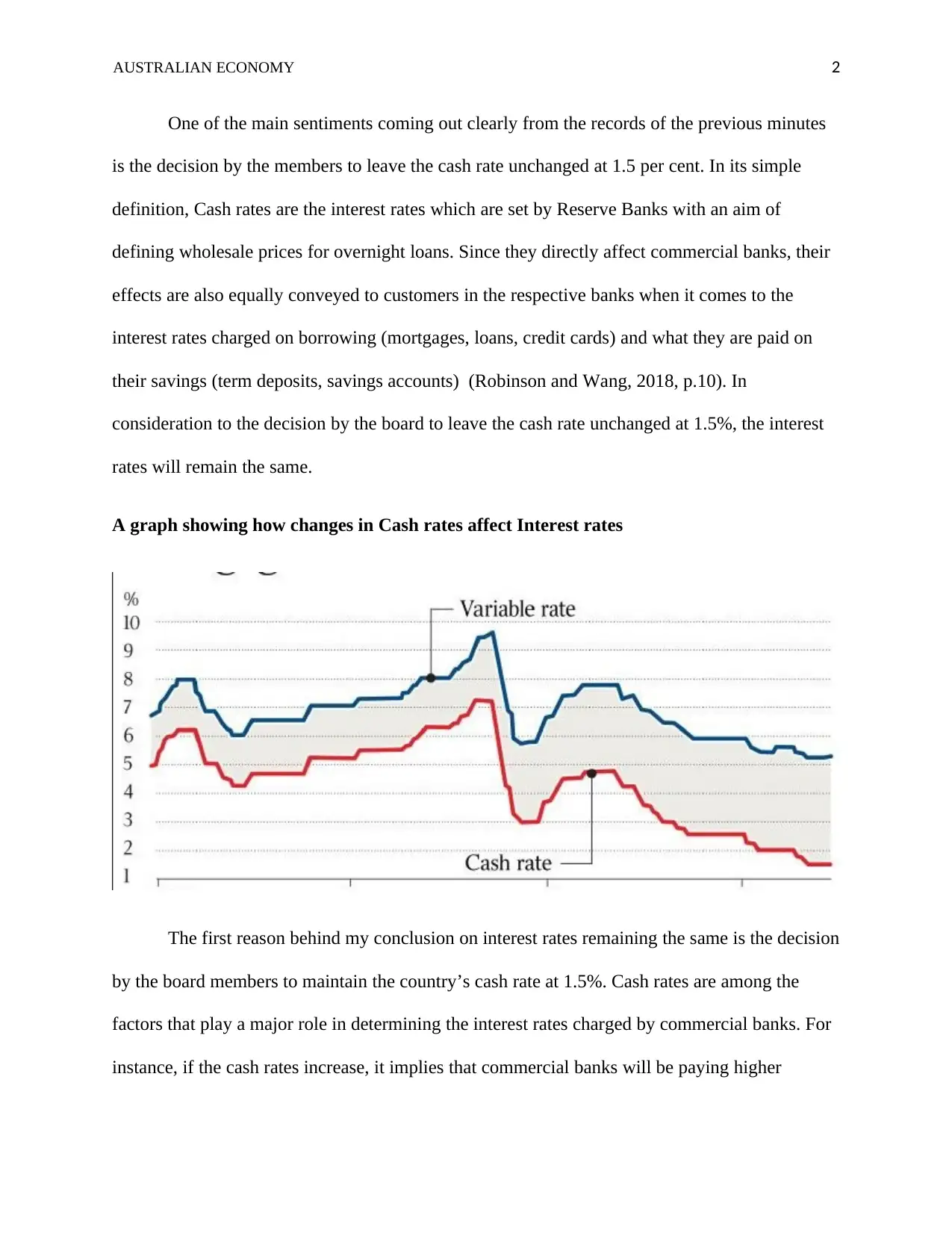
A graph showing how changes in Cash rates affect Interest rates
The first reason behind my conclusion on interest rates remaining the same is the decision
by the board members to maintain the country’s cash rate at 1.5%. Cash rates are among the
factors that play a major role in determining the interest rates charged by commercial banks. For
instance, if the cash rates increase, it implies that commercial banks will be paying higher
Document Page
AUSTRALIAN ECONOMY 3
interest rates to reserve banks when getting overnight loans (Kirchner, 2018). To balance that,
commercial banks on the other hand are forced to increase interest rates on their customers.
Similarly, if the cash rates are reduced, the burden of high interest rates on overnight loans is
reduced and that translates to commercial bank customers as well. So, being maintained at same
level will have no considerable impacts on interest rates.
An example of how this works
If the cash rate was initially 1.5%, a commercial bank which takes an overnight loan of $10000
will pay;
[$10000 + (1.5/100 x$10000)]=$10150
However, when the cash rate is increased to 2%
It will be
[$10000 + (2/100 x $10000)]=$10200
This implies that the profitability of the bank will have been affected by $50.
To adjust that, commercial banks increases their interest rates on the side of the customers
For that matter if the interest rates were 20.5%, they are expected to go up by 0.5 making them
21%
A customer who had a loan of $1000 and who was expected to pay back;
[$1000 + (20.5/100 x $1000)] =$1205
Will have his or her payback increased and will pay;
Document Page
AUSTRALIAN ECONOMY 4
[$1000 + (21/100 x $1000)]=$1210
The second reason behind my conclusion on interest rates remaining the same draws
from the economic activities in the economy of Australia whose data has implied to be on a
positive path and also consistent with GDP growth forecasts (Clark, McCracken and Mertens,
2018). The fact that the economy of Australia has not shown signs of instability clearly implies
that the banking sector has not been shaken in either way to call for readjustments which would
have been enacted through interest rates.
The third reason behind my conclusion on interest rates remaining the same draws from
the consideration of board members in regard to monetary policy stance (Gopinath and Stein,
2018, p.545). The members noted that the global economic conditions had continued to be
positive for the Australian economy. This is an implication that the global market was still
favoring the growth of Australian economy and therefore no external pressure which could affect
the banking sector to an extent of adjusting its interest rates.
From the discussion above I would advise my client to continue executing his business
operations normally because there were no changes expected in regard to his loan repayment
amounts. This is in consideration to the fact that most of the factors which would affect the
interest rates had been proved to work as expected. Such factors included cash rates,
deteriorating GDP and global market pressure. Being on a positive direction, the client was not
supposed to take any important steps in regard to how he operates his small business like
increasing prices since such measures would discourage his customers’ hence reducing
profitability. He should therefore stick to his initial modes of operation and strive to attract more
tabler-icon-diamond-filled.svg

Paraphrase This Document

Need a fresh take? Get an instant paraphrase of this document with our AI Paraphraser
Document Page
AUSTRALIAN ECONOMY 5
customers through approaches like variety of products, after sales services and the rest. This
would enable him repay his loan and ensure stability to his small business.
References
Clark, T.E., McCracken, M.W. and Mertens, E., 2018. Supplemental Appendix to “Modeling
Time-Varying Uncertainty of Multiple-Horizon Forecast Errors”.
Gopinath, G. and Stein, J.C., 2018. Trade invoicing, bank funding, and central bank reserve
holdings. In AEA Papers and Proceedings (Vol. 108, pp. 542-46).
Kirchner, S., 2018. Money too tight to mention: The Reserve Bank of Australia’s financial
stability mandate and low inflation. Economic Analysis and Policy.
Robinson, T. and Wang, J., 2018. The Australian Economy in 2017–2018: The Importance of
Stronger NonMining Business Investment Growth. Australian Economic Review, 51(1), pp.5-
20.
chevron_up_icon
1 out of 5
circle_padding
hide_on_mobile
zoom_out_icon
[object Object]