Essay: The Economic Impact of Small Businesses in Australia
VerifiedAdded on 2023/01/11
|7
|1594
|49
Essay
AI Summary
This essay evaluates the substantial contribution of small businesses to the Australian economy. It begins with an introduction defining small businesses and their importance, followed by an argumentative discussion supported by statistical data and academic sources. The essay highlights the significant impact of small businesses on employment, industry value added, and innovation, while also acknowledging potential challenges such as an aging business owner population and resource limitations for innovation compared to larger organizations. The conclusion emphasizes the crucial role of small businesses in both economic and social development, advocating for government support to foster their growth and further enhance their contributions to the Australian economy. The essay uses figures to depict business size and value added, and references key academic journals and online resources to support its arguments.
Small Businesses contribute
significantly to the fabric of Australian
society in many ways not the least
being economic as well as offering
opportunity and competition therefore
evaluate the proposition that Small
Business contributes significantly to
the Australian economy
significantly to the fabric of Australian
society in many ways not the least
being economic as well as offering
opportunity and competition therefore
evaluate the proposition that Small
Business contributes significantly to
the Australian economy
Paraphrase This Document
Need a fresh take? Get an instant paraphrase of this document with our AI Paraphraser

TABLE OF CONTENTS
INTRODUCTION...........................................................................................................................3
ESSAY.............................................................................................................................................3
CONCLUSION................................................................................................................................6
REFERENCES................................................................................................................................7
INTRODUCTION...........................................................................................................................3
ESSAY.............................................................................................................................................3
CONCLUSION................................................................................................................................6
REFERENCES................................................................................................................................7

INTRODUCTION
Small businesses are considered as the backbone of economy as well as key driving force
for the development of society as well. Thus the extent up to which small businesses contribute
to the Australian economy is significant (Altman, 2018). As per Australian economy small
businesses are defined as the organisations which have less than $2 million per annum turnover
with active GST role and which have Australian Business Number (ABN). Thought these
organisations have less than 20 employees but they impose great impact on social as well as
economic development. The essay will provide an argumentative description of proposition
which small business have on Australian economy.
ESSAY
According to Ayandibu and Houghton, (2017) small business have a small proportion of
contribution to total export value but it has considerable contribution in total industrial outputs.
These organisations have dynamic environment which allows entrepreneurs so that they can
pursue their dreams without any barriers from bureaucratic structures or strictures of large
organizations. In the same context Pandya and Sisombat, (2017) stated that the economic
contribution of these ventures can be evaluated by the statistical figures, however some of these
contributions are not measured by statistics. For instance the growing innovations and successful
entrepreneurship find its way through entrepreneurship and establishment of small sized
organisations Thus citizens of Australia can encapsulate nimbleness and agility only by initiating
and supporting such small start ups of ventures.
It has been observed that business size is also assumed as determinant of longevity of
business. This sector is highly volatile and quick resilience of small business leads to exploration
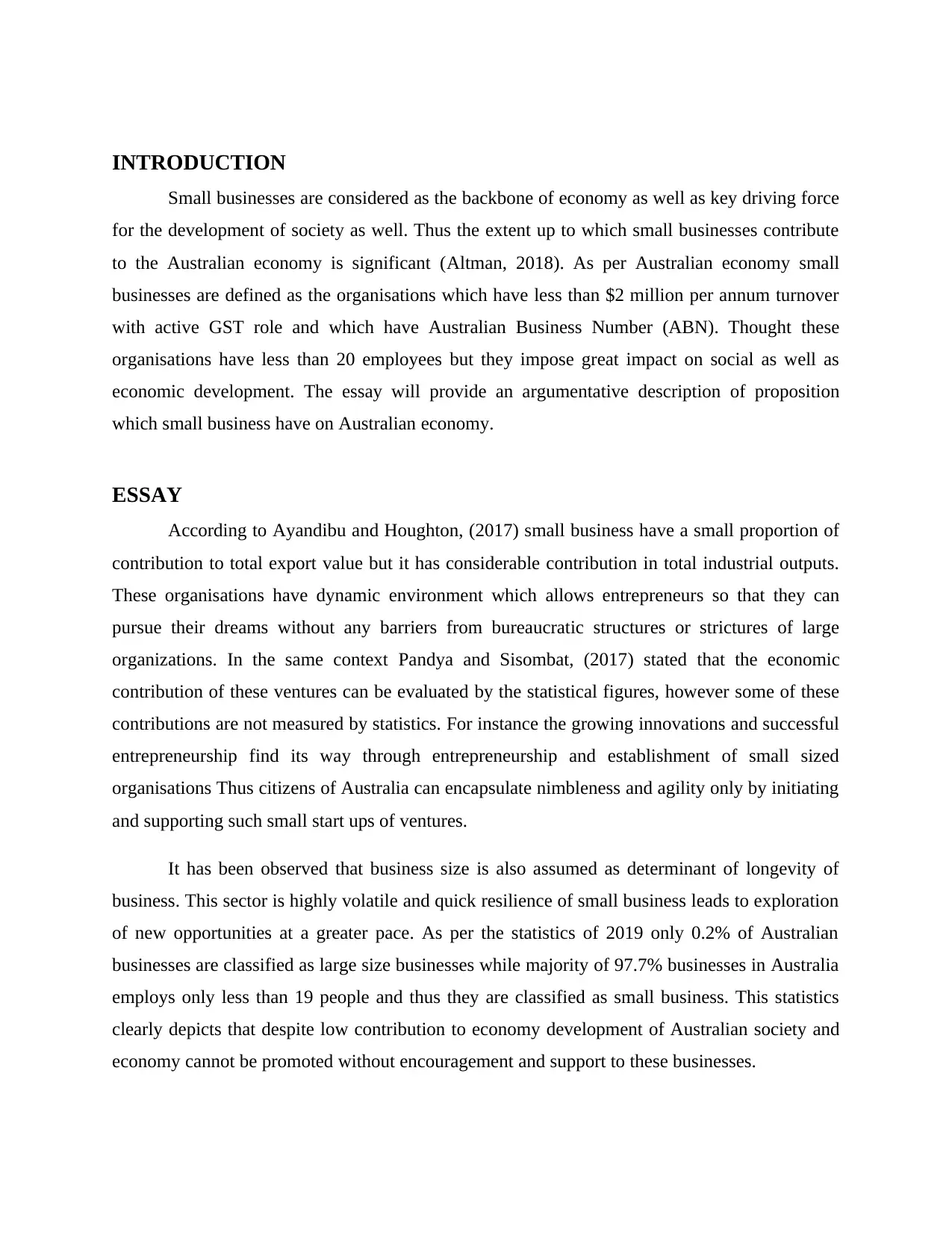
of new opportunities at a greater pace. As per the statistics of 2019 only 0.2% of Australian
businesses are classified as large size businesses while majority of 97.7% businesses in Australia
employs only less than 19 people and thus they are classified as small business. This statistics
clearly depicts that despite low contribution to economy development of Australian society and
economy cannot be promoted without encouragement and support to these businesses.
Small businesses are considered as the backbone of economy as well as key driving force
for the development of society as well. Thus the extent up to which small businesses contribute
to the Australian economy is significant (Altman, 2018). As per Australian economy small
businesses are defined as the organisations which have less than $2 million per annum turnover
with active GST role and which have Australian Business Number (ABN). Thought these
organisations have less than 20 employees but they impose great impact on social as well as
economic development. The essay will provide an argumentative description of proposition
which small business have on Australian economy.
ESSAY
According to Ayandibu and Houghton, (2017) small business have a small proportion of
contribution to total export value but it has considerable contribution in total industrial outputs.
These organisations have dynamic environment which allows entrepreneurs so that they can
pursue their dreams without any barriers from bureaucratic structures or strictures of large
organizations. In the same context Pandya and Sisombat, (2017) stated that the economic
contribution of these ventures can be evaluated by the statistical figures, however some of these
contributions are not measured by statistics. For instance the growing innovations and successful
entrepreneurship find its way through entrepreneurship and establishment of small sized
organisations Thus citizens of Australia can encapsulate nimbleness and agility only by initiating
and supporting such small start ups of ventures.
It has been observed that business size is also assumed as determinant of longevity of
business. This sector is highly volatile and quick resilience of small business leads to exploration
of new opportunities at a greater pace. As per the statistics of 2019 only 0.2% of Australian
businesses are classified as large size businesses while majority of 97.7% businesses in Australia
employs only less than 19 people and thus they are classified as small business. This statistics
clearly depicts that despite low contribution to economy development of Australian society and
economy cannot be promoted without encouragement and support to these businesses.
⊘ This is a preview!⊘
Do you want full access?
Subscribe today to unlock all pages.

Trusted by 1+ million students worldwide

Figure 1: Business size measured by employment
(Source: Small business in the Australian economy, 2019)
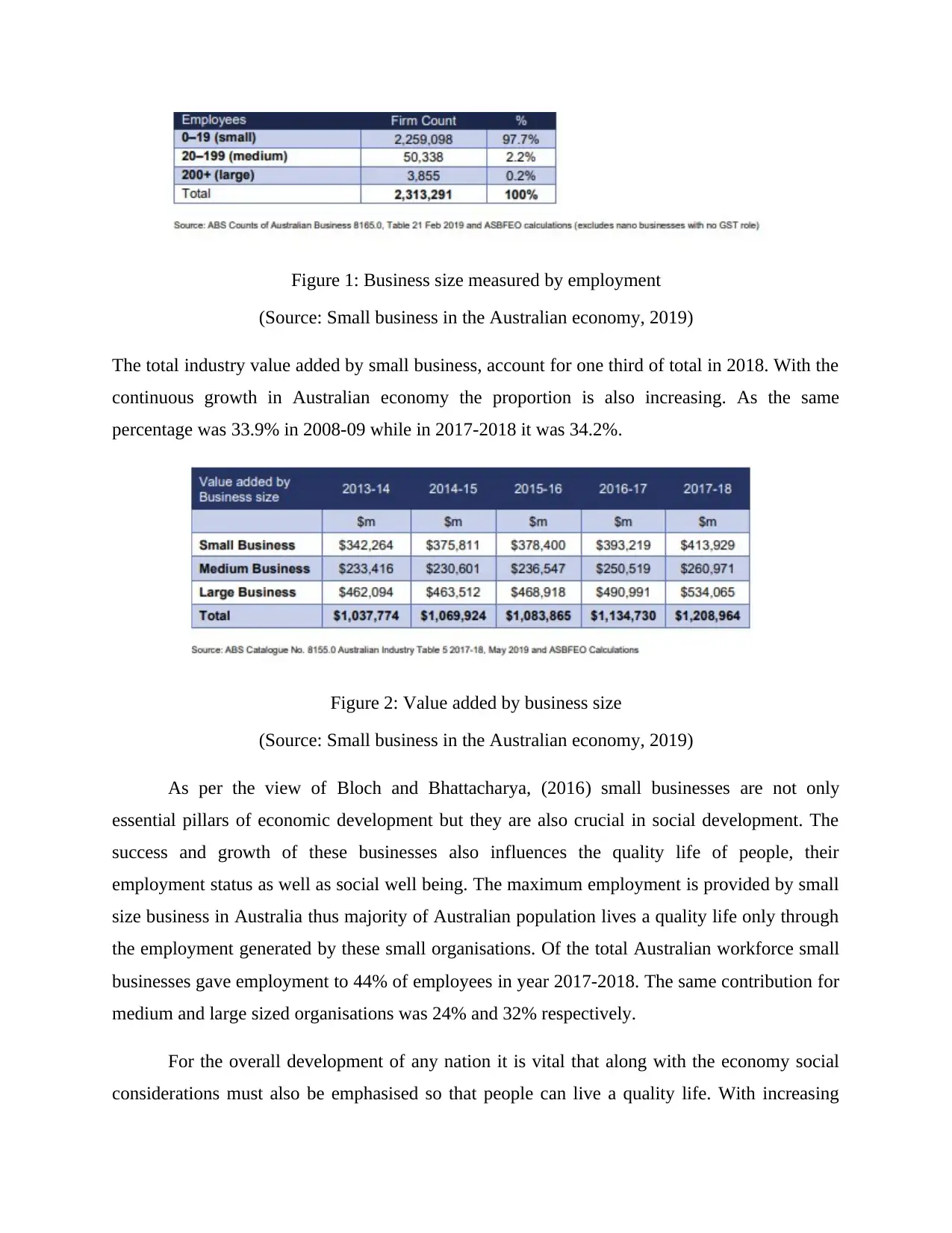
The total industry value added by small business, account for one third of total in 2018. With the
continuous growth in Australian economy the proportion is also increasing. As the same
percentage was 33.9% in 2008-09 while in 2017-2018 it was 34.2%.
Figure 2: Value added by business size
(Source: Small business in the Australian economy, 2019)
As per the view of Bloch and Bhattacharya, (2016) small businesses are not only
essential pillars of economic development but they are also crucial in social development. The
success and growth of these businesses also influences the quality life of people, their
employment status as well as social well being. The maximum employment is provided by small
size business in Australia thus majority of Australian population lives a quality life only through
the employment generated by these small organisations. Of the total Australian workforce small
businesses gave employment to 44% of employees in year 2017-2018. The same contribution for
medium and large sized organisations was 24% and 32% respectively.
For the overall development of any nation it is vital that along with the economy social
considerations must also be emphasised so that people can live a quality life. With increasing
(Source: Small business in the Australian economy, 2019)
The total industry value added by small business, account for one third of total in 2018. With the
continuous growth in Australian economy the proportion is also increasing. As the same
percentage was 33.9% in 2008-09 while in 2017-2018 it was 34.2%.
Figure 2: Value added by business size
(Source: Small business in the Australian economy, 2019)
As per the view of Bloch and Bhattacharya, (2016) small businesses are not only
essential pillars of economic development but they are also crucial in social development. The
success and growth of these businesses also influences the quality life of people, their
employment status as well as social well being. The maximum employment is provided by small
size business in Australia thus majority of Australian population lives a quality life only through
the employment generated by these small organisations. Of the total Australian workforce small
businesses gave employment to 44% of employees in year 2017-2018. The same contribution for
medium and large sized organisations was 24% and 32% respectively.
For the overall development of any nation it is vital that along with the economy social
considerations must also be emphasised so that people can live a quality life. With increasing
Paraphrase This Document
Need a fresh take? Get an instant paraphrase of this document with our AI Paraphraser

employment people lives a quality life and it also helps to eliminate social crimes or other health
concerns which may emerge due to increasing unemployment rates. Storey (2016) elucidated
that for the young generation training and development programs are an essential opportunity to
groom them and to contribute in the national economy by fully exploring their innovative and
productive ideas. However in terms of assisting in apprenticeship to graduates or young people
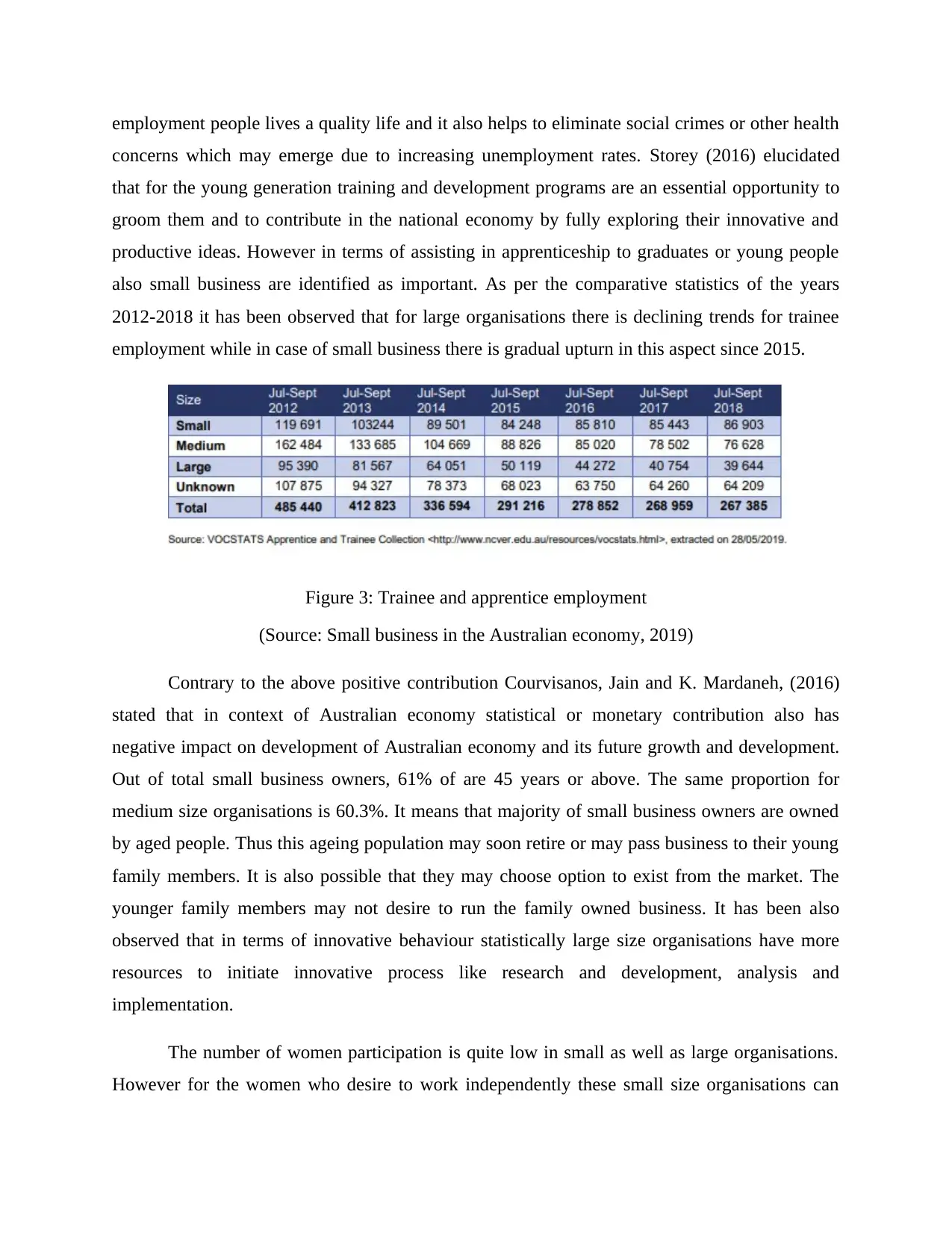
also small business are identified as important. As per the comparative statistics of the years
2012-2018 it has been observed that for large organisations there is declining trends for trainee
employment while in case of small business there is gradual upturn in this aspect since 2015.
Figure 3: Trainee and apprentice employment
(Source: Small business in the Australian economy, 2019)
Contrary to the above positive contribution Courvisanos, Jain and K. Mardaneh, (2016)
stated that in context of Australian economy statistical or monetary contribution also has
negative impact on development of Australian economy and its future growth and development.
Out of total small business owners, 61% of are 45 years or above. The same proportion for
medium size organisations is 60.3%. It means that majority of small business owners are owned
by aged people. Thus this ageing population may soon retire or may pass business to their young
family members. It is also possible that they may choose option to exist from the market. The
younger family members may not desire to run the family owned business. It has been also
observed that in terms of innovative behaviour statistically large size organisations have more
resources to initiate innovative process like research and development, analysis and
implementation.
The number of women participation is quite low in small as well as large organisations.
However for the women who desire to work independently these small size organisations can
concerns which may emerge due to increasing unemployment rates. Storey (2016) elucidated
that for the young generation training and development programs are an essential opportunity to
groom them and to contribute in the national economy by fully exploring their innovative and
productive ideas. However in terms of assisting in apprenticeship to graduates or young people
also small business are identified as important. As per the comparative statistics of the years
2012-2018 it has been observed that for large organisations there is declining trends for trainee
employment while in case of small business there is gradual upturn in this aspect since 2015.
Figure 3: Trainee and apprentice employment
(Source: Small business in the Australian economy, 2019)
Contrary to the above positive contribution Courvisanos, Jain and K. Mardaneh, (2016)
stated that in context of Australian economy statistical or monetary contribution also has
negative impact on development of Australian economy and its future growth and development.
Out of total small business owners, 61% of are 45 years or above. The same proportion for
medium size organisations is 60.3%. It means that majority of small business owners are owned
by aged people. Thus this ageing population may soon retire or may pass business to their young
family members. It is also possible that they may choose option to exist from the market. The
younger family members may not desire to run the family owned business. It has been also
observed that in terms of innovative behaviour statistically large size organisations have more
resources to initiate innovative process like research and development, analysis and
implementation.
The number of women participation is quite low in small as well as large organisations.
However for the women who desire to work independently these small size organisations can

serve as great option to them. These ventures require less investment and resources so these can
be easily established by women as well as young entrepreneurs who aim at achieving economic
independency and success on behalf of innovative ideas and their capabilities. The increasing
role of internet, online and digital services has also made it very easy for individuals to
communicate with each other and to explore new ideas and opportunities in the market. Small
size organisations have low capital requirements and lower risk factors involved in them. Thus
there are greater possibilities that Australian economy may witness significant rise in number of
such ventures (Courvisanos, Jain and K. Mardaneh, 2016). It may also enhance the industry
value contribution, tax contribution and employment rate in Australia. Thus it is required that
these small ventures must be encouraged and supported by appropriate tax policies and financial
assistance.
The innovations in industries are also promoted equally in all types of businesses. For
instance, on the basis of huge resources large size organisations are able to encourage and
implement new ideas very easily. However with small size business the generation of new ideas
can be quite low as compare to large size organisations but when they are assisted financially
then they can show great progress in terms of innovation and improvements.
CONCLUSION
It can be concluded from the above report that small businesses plays key role in the
development of nation. Thus it is very essential for the Australian government to support these
organizations so that their industry value, contribution to GDP and social development can be
increased and extended to a new level. It has been also analysed that small businesses need to
gain support from in terms of research and succession procedures. The increasing participation of
young people on start ups is helpful for the growth of economy as the gradual success to these
ventures can also help them to become large size organisations in future. Thus it can be
concluded that contribution of small business is extended to economic as well as social
development which is reflected in contemporary as well as future environment.
be easily established by women as well as young entrepreneurs who aim at achieving economic
independency and success on behalf of innovative ideas and their capabilities. The increasing
role of internet, online and digital services has also made it very easy for individuals to
communicate with each other and to explore new ideas and opportunities in the market. Small
size organisations have low capital requirements and lower risk factors involved in them. Thus
there are greater possibilities that Australian economy may witness significant rise in number of
such ventures (Courvisanos, Jain and K. Mardaneh, 2016). It may also enhance the industry
value contribution, tax contribution and employment rate in Australia. Thus it is required that
these small ventures must be encouraged and supported by appropriate tax policies and financial
assistance.
The innovations in industries are also promoted equally in all types of businesses. For
instance, on the basis of huge resources large size organisations are able to encourage and
implement new ideas very easily. However with small size business the generation of new ideas
can be quite low as compare to large size organisations but when they are assisted financially
then they can show great progress in terms of innovation and improvements.
CONCLUSION
It can be concluded from the above report that small businesses plays key role in the
development of nation. Thus it is very essential for the Australian government to support these
organizations so that their industry value, contribution to GDP and social development can be
increased and extended to a new level. It has been also analysed that small businesses need to
gain support from in terms of research and succession procedures. The increasing participation of
young people on start ups is helpful for the growth of economy as the gradual success to these
ventures can also help them to become large size organisations in future. Thus it can be
concluded that contribution of small business is extended to economic as well as social
development which is reflected in contemporary as well as future environment.
⊘ This is a preview!⊘
Do you want full access?
Subscribe today to unlock all pages.

Trusted by 1+ million students worldwide

REFERENCES
Books and Journals
Altman, J., 2018. Alleviating poverty in remote Indigenous Australia: The role of the hybrid
economy.
Ayandibu, A.O. and Houghton, J., 2017. The role of Small and Medium Scale Enterprise in local
economic development (LED). Journal of Business and Retail Management
Research. 11(2).
Bloch, H. and Bhattacharya, M., 2016. Promotion of innovation and job growth in small‐and
medium‐sized enterprises in Australia: Evidence and policy issues. Australian Economic
Review. 49(2). pp.192-199.
Courvisanos, J., Jain, A. and K. Mardaneh, K., 2016. Economic resilience of regions under
crises: A study of the Australian economy. Regional Studies. 50(4). pp.629-643.
Pandya, V. and Sisombat, S., 2017. Impacts of foreign direct investment on economic growth:
Empirical evidence from Australian economy. International Journal of Economics and
Finance. 9(5). pp.121-131.
Storey, D.J. ed., 2016. Entrepreneurship and New Firm: Theory and Policy. Routledge.
Online
Small business in the Australian economy. 2019.Australian small business and family enterprise
Ombudsman. [Online]. Accessed through
https://www.asbfeo.gov.au/sites/default/files/documents/ASBFEO-small-business-
counts2019.pdf.
Books and Journals
Altman, J., 2018. Alleviating poverty in remote Indigenous Australia: The role of the hybrid
economy.
Ayandibu, A.O. and Houghton, J., 2017. The role of Small and Medium Scale Enterprise in local
economic development (LED). Journal of Business and Retail Management
Research. 11(2).
Bloch, H. and Bhattacharya, M., 2016. Promotion of innovation and job growth in small‐and
medium‐sized enterprises in Australia: Evidence and policy issues. Australian Economic
Review. 49(2). pp.192-199.
Courvisanos, J., Jain, A. and K. Mardaneh, K., 2016. Economic resilience of regions under
crises: A study of the Australian economy. Regional Studies. 50(4). pp.629-643.
Pandya, V. and Sisombat, S., 2017. Impacts of foreign direct investment on economic growth:
Empirical evidence from Australian economy. International Journal of Economics and
Finance. 9(5). pp.121-131.
Storey, D.J. ed., 2016. Entrepreneurship and New Firm: Theory and Policy. Routledge.
Online
Small business in the Australian economy. 2019.Australian small business and family enterprise
Ombudsman. [Online]. Accessed through
https://www.asbfeo.gov.au/sites/default/files/documents/ASBFEO-small-business-
counts2019.pdf.
1 out of 7
Related Documents
Your All-in-One AI-Powered Toolkit for Academic Success.
+13062052269
info@desklib.com
Available 24*7 on WhatsApp / Email
Unlock your academic potential
Copyright © 2020–2025 A2Z Services. All Rights Reserved. Developed and managed by ZUCOL.