Employment in Australia: Average Earnings, Working Hours, and Wages
VerifiedAdded on 2023/02/01
|10
|2550
|77
Report
AI Summary
This report examines employment trends in Australia, focusing on the relationship between average earnings, working hours, and wage growth. The study explores the impact of variables such as gender and age on these relationships, as well as the effects on labor productivity. The methodology involves analyzing secondary data from the Australian Bureau of Statistics (ABS) using Excel for data analysis and potential regression analysis to determine the coefficients of the variables. The paper also includes a literature review of relevant policies associated with employment development in Australia and a Gantt chart for project management. The objective is to find the relationship between working hours, average earnings, and wage growth, dependency of the relationship on other variables, and the impact of the relationship on productivity.
Running head: EMPLOYMENT IN AUSTRALIA: AVERAGE EARNING AND
WORKING HOURS
Employment in Australia: Average Earning and Working Hours
Name of the Student:
Name of the University:
Author Note:
WORKING HOURS
Employment in Australia: Average Earning and Working Hours
Name of the Student:
Name of the University:
Author Note:

Paraphrase This Document
Need a fresh take? Get an instant paraphrase of this document with our AI Paraphraser
1EMPLOYMENT IN AUSTRALIA: AVERAGE EARNING AND WORKING HOURS
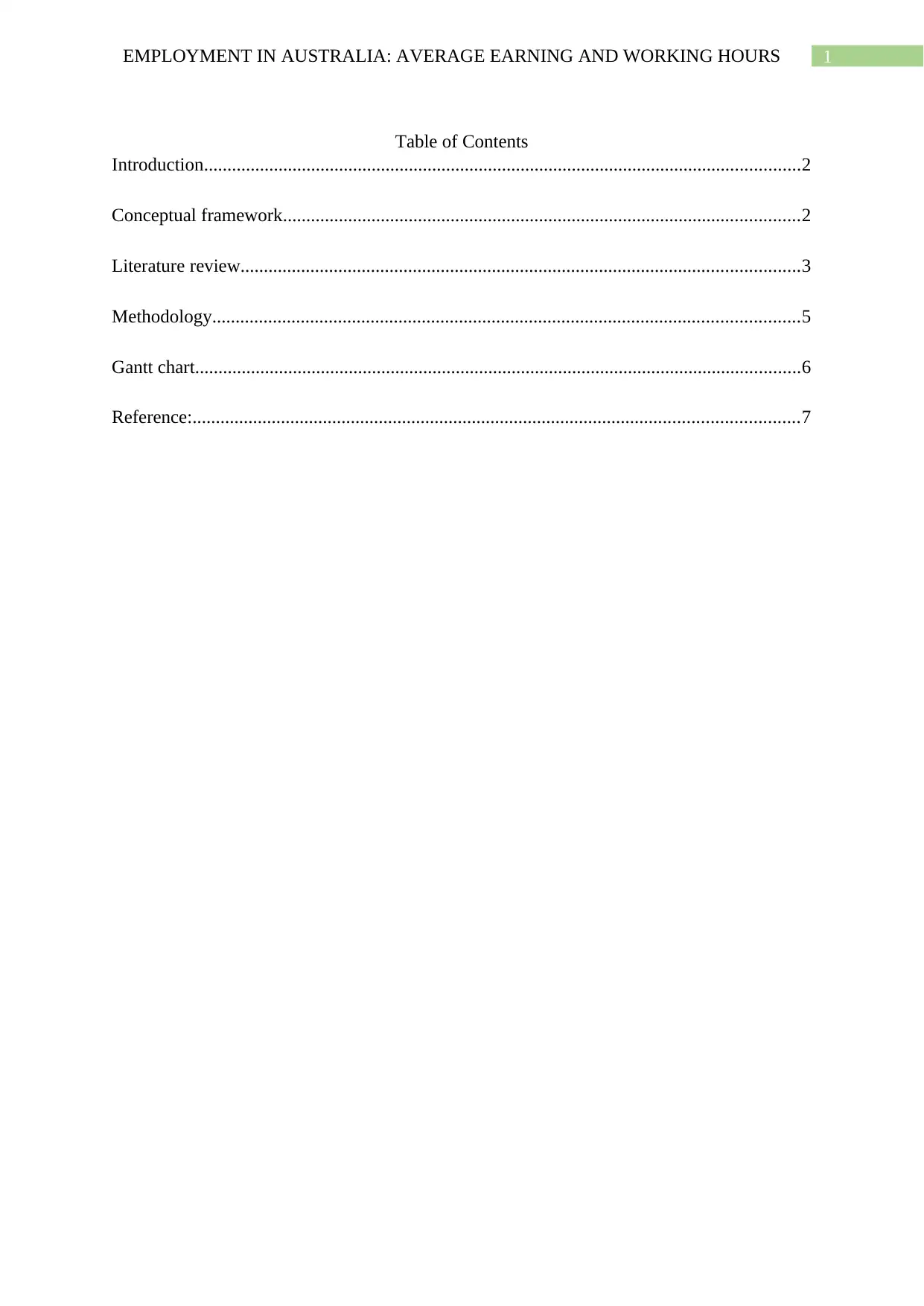
Table of Contents
Introduction................................................................................................................................2
Conceptual framework...............................................................................................................2
Literature review........................................................................................................................3
Methodology..............................................................................................................................5
Gantt chart..................................................................................................................................6
Reference:..................................................................................................................................7
Table of Contents
Introduction................................................................................................................................2
Conceptual framework...............................................................................................................2
Literature review........................................................................................................................3
Methodology..............................................................................................................................5
Gantt chart..................................................................................................................................6
Reference:..................................................................................................................................7
2EMPLOYMENT IN AUSTRALIA: AVERAGE EARNING AND WORKING HOURS
Introduction
This paper examines the employment generation in Australia and as per the
employment in Australia which grew by relative strong growth and the rate of unemployment
decreased in that case. In the past and the present study, it is found that part time employment
of the company has also increased which is about 32% of the employment Australia worked
as part time. The gender wage gap in Australia persist. The rule of “equal wage for equal
work” has been in traduced in 1969 in Australia. The gender wage gap is proportionately
steady that fluctuates in-between 160 and 190 over the past 20 years. In the month of
November in 2017, the average weekly earnings remained same in comparison of both the
genders in terms of men are working higher paying jobs on average. This comparison is an
average on the total wages of both men and women and not in terms of the average of men
and women in the exact same work and the same working hours. The labor productivity
measures the use of the labors as well as the equivalent growth of the output by considering
the growth in the labor inputs and it has a lot to do with the working hours. Labour
productivity of the Australia has dropped by 0.24% year on year in 2018 compared with a
growth of 0.13% in the previous quarter. CEIC measured the Growth of Labour Productivity
by dividing the quarterly real GDP with monthly Employment. The Australian Bureau of
Statistics gives the real GDP in local currency, at 216-17 employment and prices.
Here the objective of the paper is to find firstly, the relation between the working per
hour, average earning and the growth of wage, secondly, the dependency of the relationship
two major variables working per hour and the average earning on the other variables which
will be checked by incorporating variables like gender and age. Lastly, the effect of the
relationship on the productivity if possible. To estimate the growth of wage, unemployment
and the working per hour and other variables, an empirical analysis needs to be done on a
Introduction
This paper examines the employment generation in Australia and as per the
employment in Australia which grew by relative strong growth and the rate of unemployment
decreased in that case. In the past and the present study, it is found that part time employment
of the company has also increased which is about 32% of the employment Australia worked
as part time. The gender wage gap in Australia persist. The rule of “equal wage for equal
work” has been in traduced in 1969 in Australia. The gender wage gap is proportionately
steady that fluctuates in-between 160 and 190 over the past 20 years. In the month of
November in 2017, the average weekly earnings remained same in comparison of both the
genders in terms of men are working higher paying jobs on average. This comparison is an
average on the total wages of both men and women and not in terms of the average of men
and women in the exact same work and the same working hours. The labor productivity
measures the use of the labors as well as the equivalent growth of the output by considering
the growth in the labor inputs and it has a lot to do with the working hours. Labour
productivity of the Australia has dropped by 0.24% year on year in 2018 compared with a
growth of 0.13% in the previous quarter. CEIC measured the Growth of Labour Productivity
by dividing the quarterly real GDP with monthly Employment. The Australian Bureau of
Statistics gives the real GDP in local currency, at 216-17 employment and prices.
Here the objective of the paper is to find firstly, the relation between the working per
hour, average earning and the growth of wage, secondly, the dependency of the relationship
two major variables working per hour and the average earning on the other variables which
will be checked by incorporating variables like gender and age. Lastly, the effect of the
relationship on the productivity if possible. To estimate the growth of wage, unemployment
and the working per hour and other variables, an empirical analysis needs to be done on a
⊘ This is a preview!⊘
Do you want full access?
Subscribe today to unlock all pages.

Trusted by 1+ million students worldwide
3EMPLOYMENT IN AUSTRALIA: AVERAGE EARNING AND WORKING HOURS
precise and authentic data. This should establish the robustness of the estimates which is
going to be used in this paper.
Conceptual framework
Average earning of a worker
The average earning of a worker in a particular industry is defined as the total amount
of earning that is paid to the workers of a specific class by the employer in a particular
industry or economy divided by the total numbers of employment working in that specific
class in that particular industry or economy during a particular time.
The working hours
The working hour is defined as the amount of time that is spent by a particular worker at
work during a day. The working hour may differ from industry to industry and also may
differ by depending on the category or the nature within the industry. The workers are paid
for the nature of work and the spending of time at work. The definitions, itself describes that
there is some relationship between these two variables (Costa Dias, Joyce & Parodi 2018).
Conceptual workings
There exists a negative impact on working hours for the low-wage workers for introduction
of minimum wage on the low-wage workers’ working hours (Bossler & Gerner, 2016).
Depending on the gender of an employee and the nature of work, the relation between the
average earning and the working hour is affected. The unpaid services got more attention by
the female workers than the male workers. In this case, the average earning is too less than
the working hour that means the average earning is not getting too much affected by the
working hour. This type of relationship can be seen on the basis of gender of the worker. In
china, women workers spend more time than a male worker on unpaid care work. The study
suggest that for both the male and female workers, the worker with the most responsibility for
precise and authentic data. This should establish the robustness of the estimates which is
going to be used in this paper.
Conceptual framework
Average earning of a worker
The average earning of a worker in a particular industry is defined as the total amount
of earning that is paid to the workers of a specific class by the employer in a particular
industry or economy divided by the total numbers of employment working in that specific
class in that particular industry or economy during a particular time.
The working hours
The working hour is defined as the amount of time that is spent by a particular worker at
work during a day. The working hour may differ from industry to industry and also may
differ by depending on the category or the nature within the industry. The workers are paid
for the nature of work and the spending of time at work. The definitions, itself describes that
there is some relationship between these two variables (Costa Dias, Joyce & Parodi 2018).
Conceptual workings
There exists a negative impact on working hours for the low-wage workers for introduction
of minimum wage on the low-wage workers’ working hours (Bossler & Gerner, 2016).
Depending on the gender of an employee and the nature of work, the relation between the
average earning and the working hour is affected. The unpaid services got more attention by
the female workers than the male workers. In this case, the average earning is too less than
the working hour that means the average earning is not getting too much affected by the
working hour. This type of relationship can be seen on the basis of gender of the worker. In
china, women workers spend more time than a male worker on unpaid care work. The study
suggest that for both the male and female workers, the worker with the most responsibility for
Paraphrase This Document
Need a fresh take? Get an instant paraphrase of this document with our AI Paraphraser
4EMPLOYMENT IN AUSTRALIA: AVERAGE EARNING AND WORKING HOURS
child and eldercare like to spend more time for the unpaid care and in opposite they interrupt
the paid work with unpaid care work activities (Qi & Dong, 2016). On the basis of skilled
and unskilled employees the earning and the working hour changes. The skilled employee
works for the less time and earns more while the unskilled employee works for more hours
and get paid less than the skilled employee. In this case, depending on the skill of the
employee, average earning and working hour are negatively dependent. The average earning
is high while the working hour is less for the skilled employee and the average earning is low
while the working hour is high for the unskilled labour.
Additional variables
. There are too many variables that can affect the relationship of the average earnings
and working hours that reflects the important findings of the research motive and also to
make policies like different tax imposition depending on different variables like gender,
ethnicity and working class. These all variables can have greater impact on changing the
large macro-economic variables or indicators of development of a country or economy. The
most influenced indicators that can be incorporated, are GDP, GDP growth, employment and
employment rate. That means, the policies that can improve the countries macro-economic
situation can be made by investigating and analyzing the relevance incidences. A proper
policy can improve the employment, wage of an employee and the social issues related to the
economic society. One of the example of such policies is job training program. The job
training program and the investment in that program can significantly and steadily reduce the
investment in other employment schemes and on the other hand the income will rise through
wage increase. When the year passes in working at the same post in a company, the wages
goes high and the spending of hours at work constantly falls. The causes behind this incident
may appear in the form of an elderly aged employs productivity or the spending of working
hour at work improves the efficiency or both.
child and eldercare like to spend more time for the unpaid care and in opposite they interrupt
the paid work with unpaid care work activities (Qi & Dong, 2016). On the basis of skilled
and unskilled employees the earning and the working hour changes. The skilled employee
works for the less time and earns more while the unskilled employee works for more hours
and get paid less than the skilled employee. In this case, depending on the skill of the
employee, average earning and working hour are negatively dependent. The average earning
is high while the working hour is less for the skilled employee and the average earning is low
while the working hour is high for the unskilled labour.
Additional variables
. There are too many variables that can affect the relationship of the average earnings
and working hours that reflects the important findings of the research motive and also to
make policies like different tax imposition depending on different variables like gender,
ethnicity and working class. These all variables can have greater impact on changing the
large macro-economic variables or indicators of development of a country or economy. The
most influenced indicators that can be incorporated, are GDP, GDP growth, employment and
employment rate. That means, the policies that can improve the countries macro-economic
situation can be made by investigating and analyzing the relevance incidences. A proper
policy can improve the employment, wage of an employee and the social issues related to the
economic society. One of the example of such policies is job training program. The job
training program and the investment in that program can significantly and steadily reduce the
investment in other employment schemes and on the other hand the income will rise through
wage increase. When the year passes in working at the same post in a company, the wages
goes high and the spending of hours at work constantly falls. The causes behind this incident
may appear in the form of an elderly aged employs productivity or the spending of working
hour at work improves the efficiency or both.
5EMPLOYMENT IN AUSTRALIA: AVERAGE EARNING AND WORKING HOURS
Literature review
There are certain policies associated with the development of the employment
in Australia. There are variance in this model which have become the workhorse in the
dynamic macroeconomics and typically predicted that the wage, hours and the earning
profiles are quite interlinked with each other (Freedland et al., 2016). Effective wage profile
of the company tends to increase the overall life cycle with a weak tendency for reduction of
wages towards the end of the working period.
(Source: Econstor.eu. 2019)
From the above the real life situation of the employment rate has been depicted which
is like at the start of the schooling, the investments are higher. In case of the on job training
program the investment gradually decreases and on the other hand the income through wages
increases. Gradually when the year passes in case of working in a company the wages are
high and the hours worked constantly decreases (Hajkowicz et al., 2016). The reason behind
that is as the ages of the employee increases then that particular employees can’t able to
provide 100% work efficiency. The work efficiency of the labor decreases with the increase
in the number of days. At the time of retirement, the wages of the employee becomes
stagnant by giving minimal work effort.
Literature review
There are certain policies associated with the development of the employment
in Australia. There are variance in this model which have become the workhorse in the
dynamic macroeconomics and typically predicted that the wage, hours and the earning
profiles are quite interlinked with each other (Freedland et al., 2016). Effective wage profile
of the company tends to increase the overall life cycle with a weak tendency for reduction of
wages towards the end of the working period.
(Source: Econstor.eu. 2019)
From the above the real life situation of the employment rate has been depicted which
is like at the start of the schooling, the investments are higher. In case of the on job training
program the investment gradually decreases and on the other hand the income through wages
increases. Gradually when the year passes in case of working in a company the wages are
high and the hours worked constantly decreases (Hajkowicz et al., 2016). The reason behind
that is as the ages of the employee increases then that particular employees can’t able to
provide 100% work efficiency. The work efficiency of the labor decreases with the increase
in the number of days. At the time of retirement, the wages of the employee becomes
stagnant by giving minimal work effort.
⊘ This is a preview!⊘
Do you want full access?
Subscribe today to unlock all pages.
Trusted by 1+ million students worldwide
6EMPLOYMENT IN AUSTRALIA: AVERAGE EARNING AND WORKING HOURS
From the present and the past analysis it is found that the wages and working hours
are inversely related. The fact behind the opposite relation of wages and working hours is that
as the years goes by the efficiency of the labor in terms of productivity increases but the
working hours of the company decreases with the increase in the years of work experience
(Kifle, Kler & Shankar, 2018). At a particular time which is after retirement, the wages of the
employees in that time becomes stagnant.
The productivity lifecycle changes with the change in time as the employment
opportunity also changes as per the current economic situation of Australia. The analysis of
wages, hours and earning profiles in Australia further provides that the employment
opportunity in the country is increasing as per the current economic status (McDonald, 2015).
Economic growth of Australia is now flourishing which further improved the employment
opportunity along with the literacy growth. The human capital is very high which will
automatically increase the overall production of the country. Strong employment will
enhance the overall growth along with the gross domestic product of the country.
Methodology
In order to find the dependency and the correlation between the average earning and
working hours, the secondary data will be collected from the Australian Bureau of Statistics.
The researcher will read the definition and information about the variables of the available
data on the Australian Bureau of Statistics (AUSSTATS, 2019). In Excel, there will be a tab
that contains the data on the two important variables: the average earning and the working per
hour, on the basis of which the research will be conducted. These data will be used to
evaluate and examine the correlation between these two variables. There may arise a situation
where regression needs to be done to estimate the exact effects and determine the coefficients
of the variables that will indicate the exact change due to one unit change in the other
variable. It is expected that a linear regression needs to be operated as the both the dependent
From the present and the past analysis it is found that the wages and working hours
are inversely related. The fact behind the opposite relation of wages and working hours is that
as the years goes by the efficiency of the labor in terms of productivity increases but the
working hours of the company decreases with the increase in the years of work experience
(Kifle, Kler & Shankar, 2018). At a particular time which is after retirement, the wages of the
employees in that time becomes stagnant.
The productivity lifecycle changes with the change in time as the employment
opportunity also changes as per the current economic situation of Australia. The analysis of
wages, hours and earning profiles in Australia further provides that the employment
opportunity in the country is increasing as per the current economic status (McDonald, 2015).
Economic growth of Australia is now flourishing which further improved the employment
opportunity along with the literacy growth. The human capital is very high which will
automatically increase the overall production of the country. Strong employment will
enhance the overall growth along with the gross domestic product of the country.
Methodology
In order to find the dependency and the correlation between the average earning and
working hours, the secondary data will be collected from the Australian Bureau of Statistics.
The researcher will read the definition and information about the variables of the available
data on the Australian Bureau of Statistics (AUSSTATS, 2019). In Excel, there will be a tab
that contains the data on the two important variables: the average earning and the working per
hour, on the basis of which the research will be conducted. These data will be used to
evaluate and examine the correlation between these two variables. There may arise a situation
where regression needs to be done to estimate the exact effects and determine the coefficients
of the variables that will indicate the exact change due to one unit change in the other
variable. It is expected that a linear regression needs to be operated as the both the dependent
Paraphrase This Document
Need a fresh take? Get an instant paraphrase of this document with our AI Paraphraser
7EMPLOYMENT IN AUSTRALIA: AVERAGE EARNING AND WORKING HOURS
and independent variables, average earning and working per hour is continuous in nature and
it is expected that the working per hour is linearly dependent on the working per hours. Some
tests will be done to check the effect of independent variables like t-test, the best model fit
test and the various statistics like adjusted r2, standard error of the model, standard error of
the variables, p-values of the variables, t-statistic of the variable and the 95% confidence
interval. This all statistics are important to interpret a model consistently, unbiasedly,
efficiently and significantly.
Gantt chart
Task Name Start Day End Day Duration (Days)
Project Proposal 29-03-2019 25-04-2019 27
Literature Review 25-04-2019 15-04-2019 20
Data Collection 15-04-2019 22-05-2019 7
Data Analysis 22-05-2019 03-06-2019 12
Final Report Submission 03-06-2019 29-06-2019 26
Final Report Submission
Data Analysis
Data Collection
Literature Review
Project Proposal
0 10 20 30 40 50 60 70 80 90 100
Milestones and Deliverables
and independent variables, average earning and working per hour is continuous in nature and
it is expected that the working per hour is linearly dependent on the working per hours. Some
tests will be done to check the effect of independent variables like t-test, the best model fit
test and the various statistics like adjusted r2, standard error of the model, standard error of
the variables, p-values of the variables, t-statistic of the variable and the 95% confidence
interval. This all statistics are important to interpret a model consistently, unbiasedly,
efficiently and significantly.
Gantt chart
Task Name Start Day End Day Duration (Days)
Project Proposal 29-03-2019 25-04-2019 27
Literature Review 25-04-2019 15-04-2019 20
Data Collection 15-04-2019 22-05-2019 7
Data Analysis 22-05-2019 03-06-2019 12
Final Report Submission 03-06-2019 29-06-2019 26
Final Report Submission
Data Analysis
Data Collection
Literature Review
Project Proposal
0 10 20 30 40 50 60 70 80 90 100
Milestones and Deliverables
8EMPLOYMENT IN AUSTRALIA: AVERAGE EARNING AND WORKING HOURS
Reference:
AUSSTATS. (2019). 6306.0 - Employee Earnings and Hours, Australia, May 2018.
Retrieved from
https://www.abs.gov.au/AUSSTATS/abs@.nsf/DetailsPage/6306.0May%202018?
OpenDocument
Barrett, G. F., & Hamermesh, D. S. (2019). Labor Supply Elasticities Overcoming
Nonclassical Measurement Error Using More Accurate Hours Data. Journal of
Human Resources, 54(1), 255-265.
Bell, D. N., & Blanchflower, D. G. (2018). Underemployment and the Lack of Wage
Pressure in the UK. National Institute Economic Review, 243(1), R53-R61.
Bossler, M., & Gerner, H. D. (2016). Employment effects of the new German minimum wage:
Evidence from establishment-level micro data (No. 10/2016). IAB-Discussion paper.
Costa Dias, M., Joyce, R., & Parodi, F. (2018). The gender pay gap in the UK: children and
experience in work. Institute for Fiscal Studies. https://www. ifs. org.
uk/publications, 10356.
Denning, J. T., Jacob, B., Lefgren, L., & Lehn, C. V. (2019). The Return to Hours Worked
Within and Across Occupations: Implications for the Gender Wage Gap (No.
w25739). National Bureau of Economic Research.
Econstor.eu. (2019). Retrieved from
https://www.econstor.eu/bitstream/10419/159775/1/wp0936.pdf
Freedland, M., Bogg, A., Cabrelli, D., Collins, H., Countouris, N., Davies, A. C. L., ... &
Prassl, J. (Eds.). (2016). The contract of employment. Oxford University Press.
Reference:
AUSSTATS. (2019). 6306.0 - Employee Earnings and Hours, Australia, May 2018.
Retrieved from
https://www.abs.gov.au/AUSSTATS/abs@.nsf/DetailsPage/6306.0May%202018?
OpenDocument
Barrett, G. F., & Hamermesh, D. S. (2019). Labor Supply Elasticities Overcoming
Nonclassical Measurement Error Using More Accurate Hours Data. Journal of
Human Resources, 54(1), 255-265.
Bell, D. N., & Blanchflower, D. G. (2018). Underemployment and the Lack of Wage
Pressure in the UK. National Institute Economic Review, 243(1), R53-R61.
Bossler, M., & Gerner, H. D. (2016). Employment effects of the new German minimum wage:
Evidence from establishment-level micro data (No. 10/2016). IAB-Discussion paper.
Costa Dias, M., Joyce, R., & Parodi, F. (2018). The gender pay gap in the UK: children and
experience in work. Institute for Fiscal Studies. https://www. ifs. org.
uk/publications, 10356.
Denning, J. T., Jacob, B., Lefgren, L., & Lehn, C. V. (2019). The Return to Hours Worked
Within and Across Occupations: Implications for the Gender Wage Gap (No.
w25739). National Bureau of Economic Research.
Econstor.eu. (2019). Retrieved from
https://www.econstor.eu/bitstream/10419/159775/1/wp0936.pdf
Freedland, M., Bogg, A., Cabrelli, D., Collins, H., Countouris, N., Davies, A. C. L., ... &
Prassl, J. (Eds.). (2016). The contract of employment. Oxford University Press.
⊘ This is a preview!⊘
Do you want full access?
Subscribe today to unlock all pages.
Trusted by 1+ million students worldwide
9EMPLOYMENT IN AUSTRALIA: AVERAGE EARNING AND WORKING HOURS
Glauber, R. (2019). The Wage Penalty for Parental Caregiving: Has It Declined Over
Time?. Journal of Marriage and Family.
Hajkowicz, S. A., Reeson, A., Rudd, L., Bratanova, A., Hodgers, L., Mason, C., & Boughen,
N. (2016). Tomorrow’s digitally enabled workforce: Megatrends and scenarios for
jobs and employment in Australia over the coming twenty years. Australian Policy
Online.
Kifle, T., Kler, P., & Shankar, S. (2018). The Underemployment-Job Satisfaction Nexus: A
Study of Part-Time Employment in Australia. Social Indicators Research, 1-17.
McDonald, P. (2015). International migration and employment in Australia. Population
Review, 54(2).
Qi, L., & Dong, X. Y. (2016). Unpaid Care Work's Interference with Paid Work and the
Gender Earnings Gap in China. Feminist Economics, 22(2), 143-167.
Sabia, J. J., Pitts, M. M., & Argys, L. M. (2019). Are minimum wages a silent killer? New
evidence on drunk driving fatalities. Review of Economics and Statistics, 101(1), 192-
199.
Glauber, R. (2019). The Wage Penalty for Parental Caregiving: Has It Declined Over
Time?. Journal of Marriage and Family.
Hajkowicz, S. A., Reeson, A., Rudd, L., Bratanova, A., Hodgers, L., Mason, C., & Boughen,
N. (2016). Tomorrow’s digitally enabled workforce: Megatrends and scenarios for
jobs and employment in Australia over the coming twenty years. Australian Policy
Online.
Kifle, T., Kler, P., & Shankar, S. (2018). The Underemployment-Job Satisfaction Nexus: A
Study of Part-Time Employment in Australia. Social Indicators Research, 1-17.
McDonald, P. (2015). International migration and employment in Australia. Population
Review, 54(2).
Qi, L., & Dong, X. Y. (2016). Unpaid Care Work's Interference with Paid Work and the
Gender Earnings Gap in China. Feminist Economics, 22(2), 143-167.
Sabia, J. J., Pitts, M. M., & Argys, L. M. (2019). Are minimum wages a silent killer? New
evidence on drunk driving fatalities. Review of Economics and Statistics, 101(1), 192-
199.

1 out of 10


Related Documents


Your All-in-One AI-Powered Toolkit for Academic Success.
+13062052269
info@desklib.com
Available 24*7 on WhatsApp / Email
![[object Object]](/_next/static/media/star-bottom.7253800d.svg)
Unlock your academic potential
Copyright © 2020–2026 A2Z Services. All Rights Reserved. Developed and managed by ZUCOL.