Critical Review of Australia's Legislative Framework on Public Health
VerifiedAdded on 2022/09/09
|13
|2758
|25
Report
AI Summary
This report provides a critical review of Australia's legislative framework concerning public health, with a specific focus on the food regulatory system. It analyzes the implications of transitioning from prescriptive to outcome-based legislation, particularly for local government environmental health practitioners, examining compliance challenges and public health outcomes. The report assesses regulatory provisions, including Section 16 of the Food Act 1984, and explores options for effectively implementing environmental health legislation. Additionally, it examines the duties of authorized officers and the potential for negligence in cases of injury or harm, highlighting key implications for environmental health practitioners. The report incorporates various sources to support its analysis, providing a comprehensive overview of the subject matter.
Part A: Australia’s legislative framework – a critical review of outcome based
legislation
1
Student Name:
Student Number:
legislation
1
Student Name:
Student Number:

Paraphrase This Document
Need a fresh take? Get an instant paraphrase of this document with our AI Paraphraser
Australia legislative framework with its implications on public health:
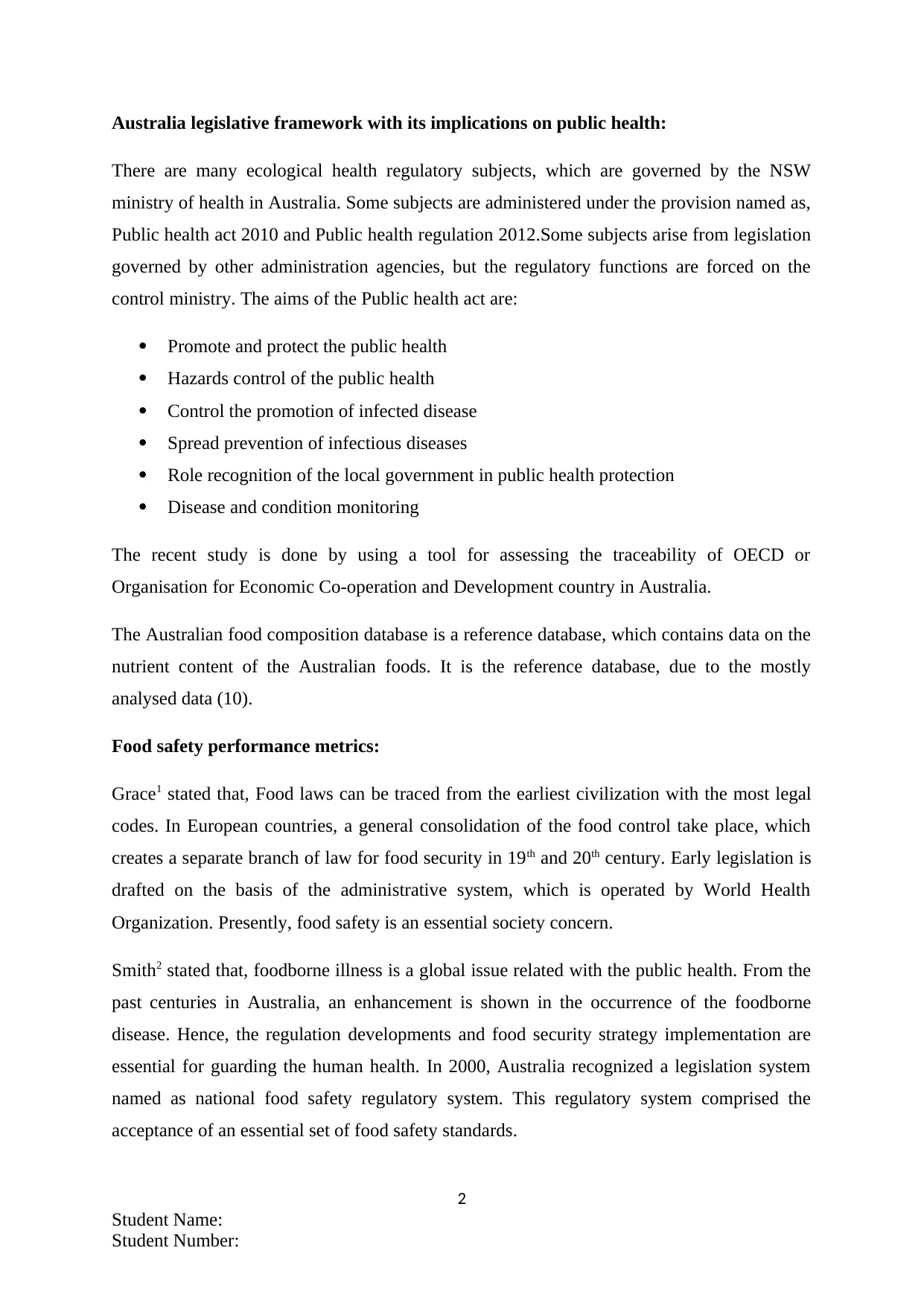
There are many ecological health regulatory subjects, which are governed by the NSW
ministry of health in Australia. Some subjects are administered under the provision named as,
Public health act 2010 and Public health regulation 2012.Some subjects arise from legislation
governed by other administration agencies, but the regulatory functions are forced on the
control ministry. The aims of the Public health act are:
Promote and protect the public health
Hazards control of the public health
Control the promotion of infected disease
Spread prevention of infectious diseases
Role recognition of the local government in public health protection
Disease and condition monitoring
The recent study is done by using a tool for assessing the traceability of OECD or
Organisation for Economic Co-operation and Development country in Australia.
The Australian food composition database is a reference database, which contains data on the
nutrient content of the Australian foods. It is the reference database, due to the mostly
analysed data (10).
Food safety performance metrics:
Grace1 stated that, Food laws can be traced from the earliest civilization with the most legal
codes. In European countries, a general consolidation of the food control take place, which
creates a separate branch of law for food security in 19th and 20th century. Early legislation is
drafted on the basis of the administrative system, which is operated by World Health
Organization. Presently, food safety is an essential society concern.
Smith2 stated that, foodborne illness is a global issue related with the public health. From the
past centuries in Australia, an enhancement is shown in the occurrence of the foodborne
disease. Hence, the regulation developments and food security strategy implementation are
essential for guarding the human health. In 2000, Australia recognized a legislation system
named as national food safety regulatory system. This regulatory system comprised the
acceptance of an essential set of food safety standards.
2
Student Name:
Student Number:
There are many ecological health regulatory subjects, which are governed by the NSW
ministry of health in Australia. Some subjects are administered under the provision named as,
Public health act 2010 and Public health regulation 2012.Some subjects arise from legislation
governed by other administration agencies, but the regulatory functions are forced on the
control ministry. The aims of the Public health act are:
Promote and protect the public health
Hazards control of the public health
Control the promotion of infected disease
Spread prevention of infectious diseases
Role recognition of the local government in public health protection
Disease and condition monitoring
The recent study is done by using a tool for assessing the traceability of OECD or
Organisation for Economic Co-operation and Development country in Australia.
The Australian food composition database is a reference database, which contains data on the
nutrient content of the Australian foods. It is the reference database, due to the mostly
analysed data (10).
Food safety performance metrics:
Grace1 stated that, Food laws can be traced from the earliest civilization with the most legal
codes. In European countries, a general consolidation of the food control take place, which
creates a separate branch of law for food security in 19th and 20th century. Early legislation is
drafted on the basis of the administrative system, which is operated by World Health
Organization. Presently, food safety is an essential society concern.
Smith2 stated that, foodborne illness is a global issue related with the public health. From the
past centuries in Australia, an enhancement is shown in the occurrence of the foodborne
disease. Hence, the regulation developments and food security strategy implementation are
essential for guarding the human health. In 2000, Australia recognized a legislation system
named as national food safety regulatory system. This regulatory system comprised the
acceptance of an essential set of food safety standards.
2
Student Name:
Student Number:
Outcomes based on food safety legislation:
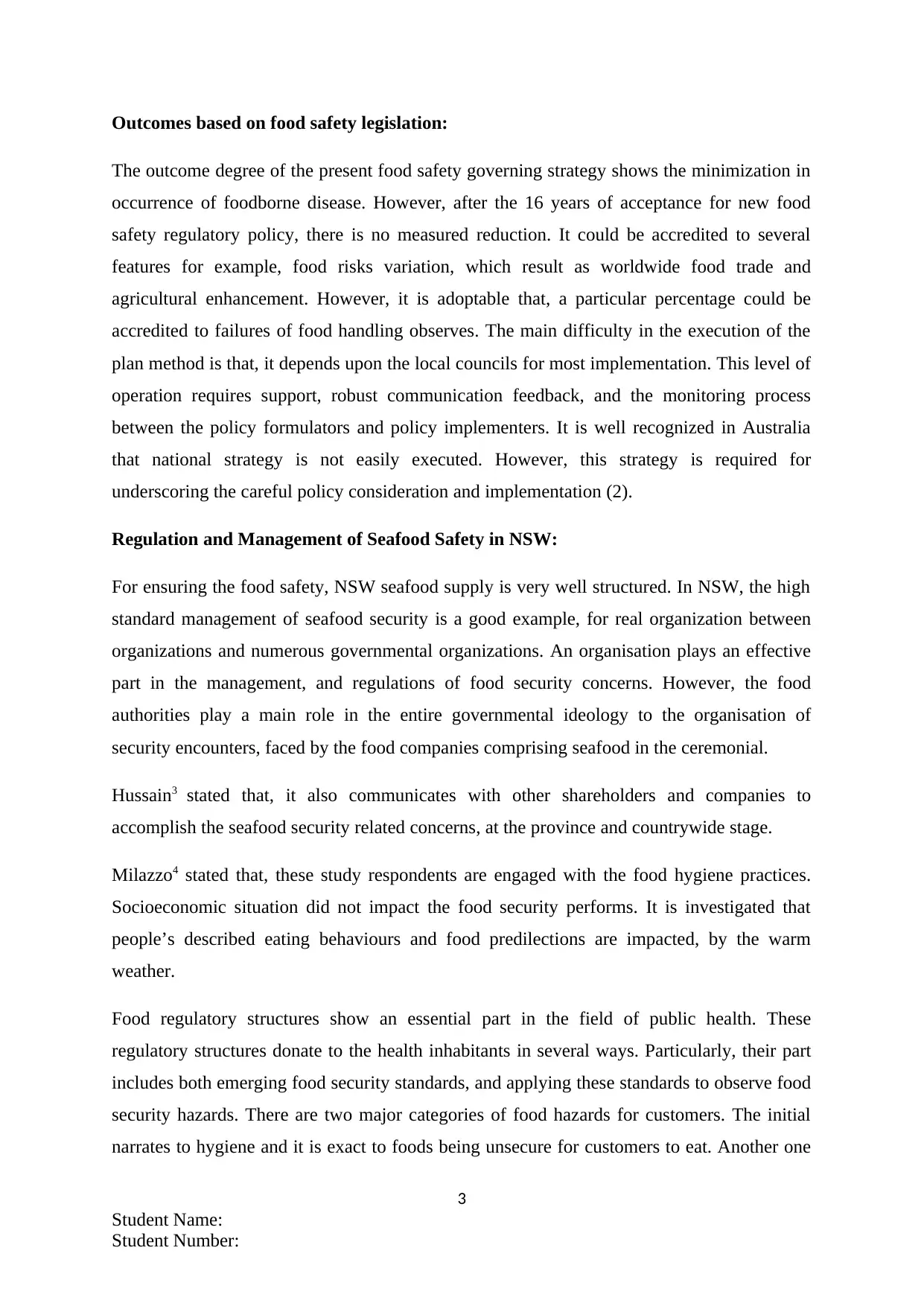
The outcome degree of the present food safety governing strategy shows the minimization in
occurrence of foodborne disease. However, after the 16 years of acceptance for new food
safety regulatory policy, there is no measured reduction. It could be accredited to several
features for example, food risks variation, which result as worldwide food trade and
agricultural enhancement. However, it is adoptable that, a particular percentage could be
accredited to failures of food handling observes. The main difficulty in the execution of the
plan method is that, it depends upon the local councils for most implementation. This level of
operation requires support, robust communication feedback, and the monitoring process
between the policy formulators and policy implementers. It is well recognized in Australia
that national strategy is not easily executed. However, this strategy is required for
underscoring the careful policy consideration and implementation (2).
Regulation and Management of Seafood Safety in NSW:
For ensuring the food safety, NSW seafood supply is very well structured. In NSW, the high
standard management of seafood security is a good example, for real organization between
organizations and numerous governmental organizations. An organisation plays an effective
part in the management, and regulations of food security concerns. However, the food
authorities play a main role in the entire governmental ideology to the organisation of
security encounters, faced by the food companies comprising seafood in the ceremonial.
Hussain3 stated that, it also communicates with other shareholders and companies to
accomplish the seafood security related concerns, at the province and countrywide stage.
Milazzo4 stated that, these study respondents are engaged with the food hygiene practices.
Socioeconomic situation did not impact the food security performs. It is investigated that
people’s described eating behaviours and food predilections are impacted, by the warm
weather.
Food regulatory structures show an essential part in the field of public health. These
regulatory structures donate to the health inhabitants in several ways. Particularly, their part
includes both emerging food security standards, and applying these standards to observe food
security hazards. There are two major categories of food hazards for customers. The initial
narrates to hygiene and it is exact to foods being unsecure for customers to eat. Another one
3
Student Name:
Student Number:
The outcome degree of the present food safety governing strategy shows the minimization in
occurrence of foodborne disease. However, after the 16 years of acceptance for new food
safety regulatory policy, there is no measured reduction. It could be accredited to several
features for example, food risks variation, which result as worldwide food trade and
agricultural enhancement. However, it is adoptable that, a particular percentage could be
accredited to failures of food handling observes. The main difficulty in the execution of the
plan method is that, it depends upon the local councils for most implementation. This level of
operation requires support, robust communication feedback, and the monitoring process
between the policy formulators and policy implementers. It is well recognized in Australia
that national strategy is not easily executed. However, this strategy is required for
underscoring the careful policy consideration and implementation (2).
Regulation and Management of Seafood Safety in NSW:
For ensuring the food safety, NSW seafood supply is very well structured. In NSW, the high
standard management of seafood security is a good example, for real organization between
organizations and numerous governmental organizations. An organisation plays an effective
part in the management, and regulations of food security concerns. However, the food
authorities play a main role in the entire governmental ideology to the organisation of
security encounters, faced by the food companies comprising seafood in the ceremonial.
Hussain3 stated that, it also communicates with other shareholders and companies to
accomplish the seafood security related concerns, at the province and countrywide stage.
Milazzo4 stated that, these study respondents are engaged with the food hygiene practices.
Socioeconomic situation did not impact the food security performs. It is investigated that
people’s described eating behaviours and food predilections are impacted, by the warm
weather.
Food regulatory structures show an essential part in the field of public health. These
regulatory structures donate to the health inhabitants in several ways. Particularly, their part
includes both emerging food security standards, and applying these standards to observe food
security hazards. There are two major categories of food hazards for customers. The initial
narrates to hygiene and it is exact to foods being unsecure for customers to eat. Another one
3
Student Name:
Student Number:
⊘ This is a preview!⊘
Do you want full access?
Subscribe today to unlock all pages.

Trusted by 1+ million students worldwide
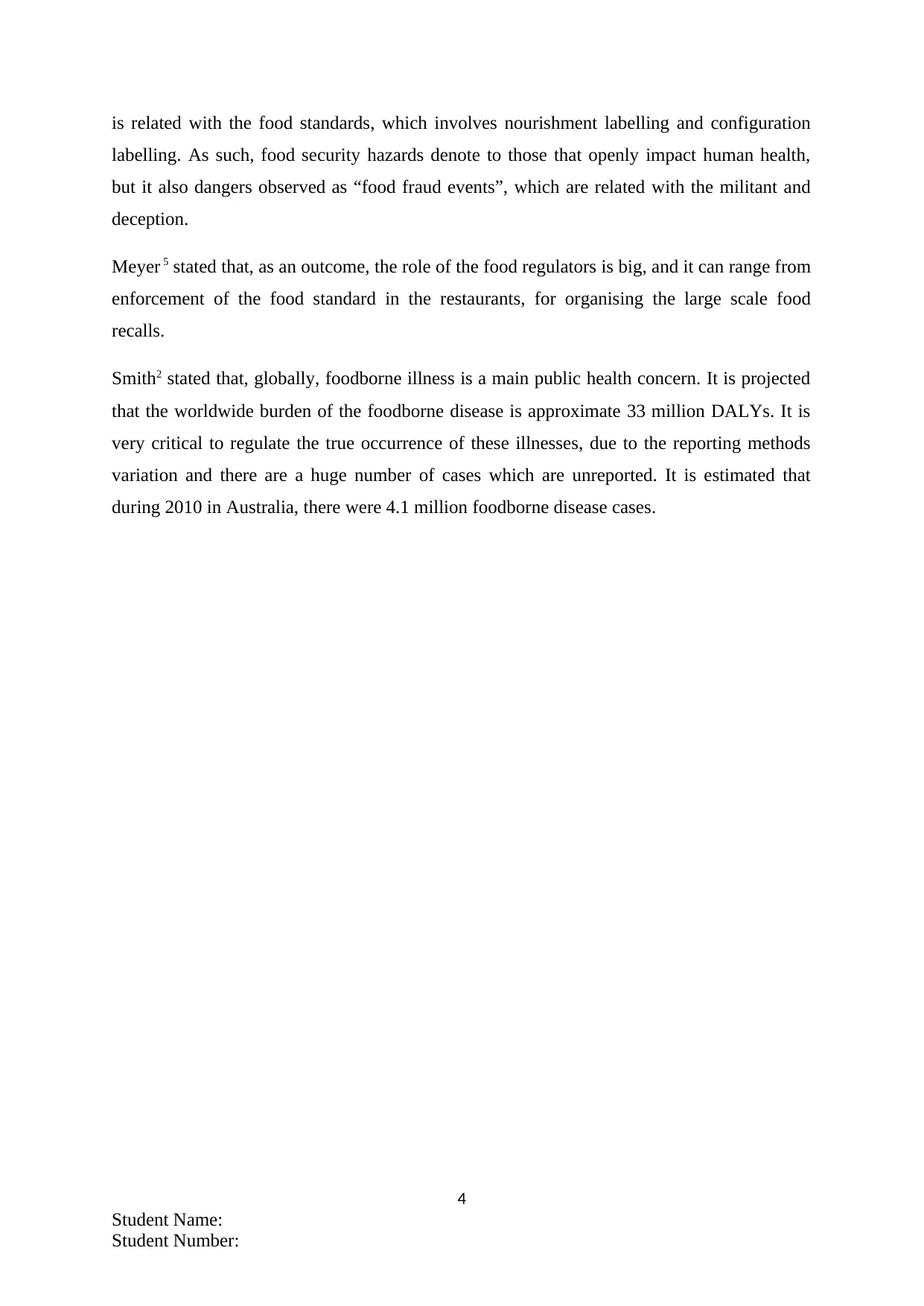
is related with the food standards, which involves nourishment labelling and configuration
labelling. As such, food security hazards denote to those that openly impact human health,
but it also dangers observed as “food fraud events”, which are related with the militant and
deception.
Meyer 5 stated that, as an outcome, the role of the food regulators is big, and it can range from
enforcement of the food standard in the restaurants, for organising the large scale food
recalls.
Smith2 stated that, globally, foodborne illness is a main public health concern. It is projected
that the worldwide burden of the foodborne disease is approximate 33 million DALYs. It is
very critical to regulate the true occurrence of these illnesses, due to the reporting methods
variation and there are a huge number of cases which are unreported. It is estimated that
during 2010 in Australia, there were 4.1 million foodborne disease cases.
4
Student Name:
Student Number:
labelling. As such, food security hazards denote to those that openly impact human health,
but it also dangers observed as “food fraud events”, which are related with the militant and
deception.
Meyer 5 stated that, as an outcome, the role of the food regulators is big, and it can range from
enforcement of the food standard in the restaurants, for organising the large scale food
recalls.
Smith2 stated that, globally, foodborne illness is a main public health concern. It is projected
that the worldwide burden of the foodborne disease is approximate 33 million DALYs. It is
very critical to regulate the true occurrence of these illnesses, due to the reporting methods
variation and there are a huge number of cases which are unreported. It is estimated that
during 2010 in Australia, there were 4.1 million foodborne disease cases.
4
Student Name:
Student Number:
Paraphrase This Document
Need a fresh take? Get an instant paraphrase of this document with our AI Paraphraser
Part B: Assessment of regulatory provisions and an analysis of regulatory options to
effectively implement environmental health legislation.
5
Student Name:
Student Number:
effectively implement environmental health legislation.
5
Student Name:
Student Number:
Steps for interpreting this section:
Richards6 stated that, this analysis seeks to make a contribution for reviewing the work of
ecological health officers by observing the decision making aspect. It is unsupportable about
the environmental health officer or EHO that he is capable for obtaining the certification
without the competency demonstration in the knowledge and skills needed by the statutory
decision process.
Statutory duty or power or offence provision:
It is an offence provision, as drawn penalty can be renowned on it.
Type of offence:
It is an offense for prepare and sell the injurious food.
Elements of offence:
Establishments of food safety
Proceeding of food acts.
Standard, requirements, types of evidence and mechanisms:
Section 16 of the Food Act 1984:
Agreement with Food Standards Code:
A person must conform to any of the need, which is forced on the person by an establishment
of the Food standards code in relation to the food business conduct or to food for sale or food
envisioned for the trade (11).
The drawn penalty will be $40 000 for an individual and $200 000 for a business.
Note to s. 16(1) inserted by No. 42/2009 s. 8.
Note:
Under section 37, a person conforms to the needs of the Food Standards code, which
are related with the notification. This notification is provided, if a tender for the
process of a food premises is created in correspondence with Part VI.
6
Student Name:
Student Number:
Richards6 stated that, this analysis seeks to make a contribution for reviewing the work of
ecological health officers by observing the decision making aspect. It is unsupportable about
the environmental health officer or EHO that he is capable for obtaining the certification
without the competency demonstration in the knowledge and skills needed by the statutory
decision process.
Statutory duty or power or offence provision:
It is an offence provision, as drawn penalty can be renowned on it.
Type of offence:
It is an offense for prepare and sell the injurious food.
Elements of offence:
Establishments of food safety
Proceeding of food acts.
Standard, requirements, types of evidence and mechanisms:
Section 16 of the Food Act 1984:
Agreement with Food Standards Code:
A person must conform to any of the need, which is forced on the person by an establishment
of the Food standards code in relation to the food business conduct or to food for sale or food
envisioned for the trade (11).
The drawn penalty will be $40 000 for an individual and $200 000 for a business.
Note to s. 16(1) inserted by No. 42/2009 s. 8.
Note:
Under section 37, a person conforms to the needs of the Food Standards code, which
are related with the notification. This notification is provided, if a tender for the
process of a food premises is created in correspondence with Part VI.
6
Student Name:
Student Number:
⊘ This is a preview!⊘
Do you want full access?
Subscribe today to unlock all pages.
Trusted by 1+ million students worldwide
A person is not authorised to sell the food, which is not observe with any obligation of
the Food Standard code relates with that food. The fine for this case is $40 000 in case
of an individual and $200 000 for a company.
A person is not authorised to promote or sell any food, which is labelled or packaged
in such a way that breaks a provision of the Food Standards code. The penalty for this
scenario is $40 000 for an individual and $200 000 for a corporation.
Court law, matters and administrative review:
S. 16(5) inserted by No. 60/2012 s. 53.
A person cannot break any endowment of this section, due to only fading to fulfil the
appropriate requirements of the Food Standard Code. If any person is excused from
acquiescence with that needs by an order made under section 5(5), then the penalty will be
drawn.
Note to s. 16 inserted by No. 13/2013 s. 24(5).
Note:
Section 51 B can be applied to an offense against the subsections (1), (2), (3) or (4).
On the basis of Food Act 1984, Section 16(1), a person must conform to any need forced on
the person by an endowment of the Food Standards Code in relation to conduct a food
intended or a food business for the food sale. Hence, it is an offence provision.
Difference between code and regulations:
The main difference between the regulation and the code is that the code is a technique to
show the data for several purposes such as, transmission, storage and the protection against
unauthorized access. However, the regulation is a general term for provisions which include
the self-regulations and the delegated legislations9.
FOOD ACT 1984 - SECT 19
Orders relating to food premises:
This section is applicable; if the relevant authority is satisfied from the authorized officer
report that:
7
Student Name:
Student Number:
the Food Standard code relates with that food. The fine for this case is $40 000 in case
of an individual and $200 000 for a company.
A person is not authorised to promote or sell any food, which is labelled or packaged
in such a way that breaks a provision of the Food Standards code. The penalty for this
scenario is $40 000 for an individual and $200 000 for a corporation.
Court law, matters and administrative review:
S. 16(5) inserted by No. 60/2012 s. 53.
A person cannot break any endowment of this section, due to only fading to fulfil the
appropriate requirements of the Food Standard Code. If any person is excused from
acquiescence with that needs by an order made under section 5(5), then the penalty will be
drawn.
Note to s. 16 inserted by No. 13/2013 s. 24(5).
Note:
Section 51 B can be applied to an offense against the subsections (1), (2), (3) or (4).
On the basis of Food Act 1984, Section 16(1), a person must conform to any need forced on
the person by an endowment of the Food Standards Code in relation to conduct a food
intended or a food business for the food sale. Hence, it is an offence provision.
Difference between code and regulations:
The main difference between the regulation and the code is that the code is a technique to
show the data for several purposes such as, transmission, storage and the protection against
unauthorized access. However, the regulation is a general term for provisions which include
the self-regulations and the delegated legislations9.
FOOD ACT 1984 - SECT 19
Orders relating to food premises:
This section is applicable; if the relevant authority is satisfied from the authorized officer
report that:
7
Student Name:
Student Number:
Paraphrase This Document
Need a fresh take? Get an instant paraphrase of this document with our AI Paraphraser
The food premises are not clean or in unsanitary position.
Food is prepared, sold or handled by the unsafe or unsuitable premises.
The food which is prepared, sold or handled is unsafe or unsuitable.
8
Student Name:
Student Number:
Food is prepared, sold or handled by the unsafe or unsuitable premises.
The food which is prepared, sold or handled is unsafe or unsuitable.
8
Student Name:
Student Number:
Part C: Failing to exercise duties
9
Student Name:
Student Number:
9
Student Name:
Student Number:
⊘ This is a preview!⊘
Do you want full access?
Subscribe today to unlock all pages.
Trusted by 1+ million students worldwide
Failing to Exercise Duties:
FOOD ACT 1984 - SECT 39B
Offence to fail to comply with registration condition
S. 39B amended by No. 14/2001 s. 26(d)(i)(ii):
If the process renewal, registration or the transmission of food locations is the topic of the
condition under section 39(A) 3, the owner of the locations must conform to the
circumstance. In this case, the penalty will be 50 penalty units for the first crime and 100
penalty units for the second or ensuing crime.
Note to s. 39B inserted by No. 13/2013 s. 24(9).
Note:
Section 51 B can be applied to an offence against this particular section.
This section, S. 39C is inserted by No. 46/2008 s. 255.
Authorised officer duties for various environmental health legislation:
An Authorised EHO or Environment Health Officer is tasked with confirming that entire
food trades meet their lawmaking duties and these whole food products vended and used are
accurately branded and secure to consume.
For performing these obligations, officers will visit the food industries for various operations
or inspections such as,
Investigate about the foodborne illness or allegations.
Audit or inspect the food business for food security performs
Examine the grievances about the product misrepresentation or labelling.
Deliver industries with the correctly information by succeeding the food standards or
food safety law.
Give suggestion about the improvement and development of food safety systems on
the basis of food construction and cataloguing needs.
Observe the compliance with or investigate breaches of food security legislation
Originate the implementation activities by the development notices, drawback notices
or the prohibition orders7.
10
Student Name:
Student Number:
FOOD ACT 1984 - SECT 39B
Offence to fail to comply with registration condition
S. 39B amended by No. 14/2001 s. 26(d)(i)(ii):
If the process renewal, registration or the transmission of food locations is the topic of the
condition under section 39(A) 3, the owner of the locations must conform to the
circumstance. In this case, the penalty will be 50 penalty units for the first crime and 100
penalty units for the second or ensuing crime.
Note to s. 39B inserted by No. 13/2013 s. 24(9).
Note:
Section 51 B can be applied to an offence against this particular section.
This section, S. 39C is inserted by No. 46/2008 s. 255.
Authorised officer duties for various environmental health legislation:
An Authorised EHO or Environment Health Officer is tasked with confirming that entire
food trades meet their lawmaking duties and these whole food products vended and used are
accurately branded and secure to consume.
For performing these obligations, officers will visit the food industries for various operations
or inspections such as,
Investigate about the foodborne illness or allegations.
Audit or inspect the food business for food security performs
Examine the grievances about the product misrepresentation or labelling.
Deliver industries with the correctly information by succeeding the food standards or
food safety law.
Give suggestion about the improvement and development of food safety systems on
the basis of food construction and cataloguing needs.
Observe the compliance with or investigate breaches of food security legislation
Originate the implementation activities by the development notices, drawback notices
or the prohibition orders7.
10
Student Name:
Student Number:
Paraphrase This Document
Need a fresh take? Get an instant paraphrase of this document with our AI Paraphraser
Circumstances a practitioner or council could be held liable in negligence for injury or
harm in cases:
A complaint is an allegation in writing which is created by a complainant due to the suffering
with damage or loss as an outcome of the service deficiency.
A complaint can be filled by various departments as shown below:
The district forum if the value of compensation claimed is less.
Before the state commission, if the value of goods and services are very higher.
Key implications of these findings for environmental health practitioners:
Shezi8 stated that, maximum of contributing EHPs (n = 48; 72.8%) had acknowledged formal
or informal exercise on weather variation and health. 39% of EHPs designated that they had a
climate variation and health-related group / occupied group in their section, a strategy or plan
(41.0%) and budget owed for climate change and health-related work (51.5%). A sum of
33.3% had contributed in climate change-related plans. Mainstream (62.2%) of EHPs
supposed that they should play a compassionate role in lecturing about the climate change
while 37.8% supposed that EHPs should play a foremost role.
The EHO or the environmental health practitioners are working with and alongside the other
public health professional. These are the key partners in national or the local impacts to
improve or protect the individuals are the communal quality of life. These practitioners play
an essential role for minimizing the health inequalities.
These practitioners maintain a direct relation with the public and apply their expertise for
responding the individuals’ requirements while them also tackling the broad determinants of
the public’s health. These are helpful in public health risks control.
Sinclair & Giorgi12 says that, the customer affairs Victoria plays an enhancing role in the
administration of Health Act Prescribed Accommodation and regulations.
References
11
Student Name:
Student Number:
harm in cases:
A complaint is an allegation in writing which is created by a complainant due to the suffering
with damage or loss as an outcome of the service deficiency.
A complaint can be filled by various departments as shown below:
The district forum if the value of compensation claimed is less.
Before the state commission, if the value of goods and services are very higher.
Key implications of these findings for environmental health practitioners:
Shezi8 stated that, maximum of contributing EHPs (n = 48; 72.8%) had acknowledged formal
or informal exercise on weather variation and health. 39% of EHPs designated that they had a
climate variation and health-related group / occupied group in their section, a strategy or plan
(41.0%) and budget owed for climate change and health-related work (51.5%). A sum of
33.3% had contributed in climate change-related plans. Mainstream (62.2%) of EHPs
supposed that they should play a compassionate role in lecturing about the climate change
while 37.8% supposed that EHPs should play a foremost role.
The EHO or the environmental health practitioners are working with and alongside the other
public health professional. These are the key partners in national or the local impacts to
improve or protect the individuals are the communal quality of life. These practitioners play
an essential role for minimizing the health inequalities.
These practitioners maintain a direct relation with the public and apply their expertise for
responding the individuals’ requirements while them also tackling the broad determinants of
the public’s health. These are helpful in public health risks control.
Sinclair & Giorgi12 says that, the customer affairs Victoria plays an enhancing role in the
administration of Health Act Prescribed Accommodation and regulations.
References
11
Student Name:
Student Number:
(1) Grace D, Domínguez-Salas P, Alonso S, Fahrion AS, Häsler B, Heilmann M,
Hoffmann V, Kang'ethe EK, Roesel K, Lore TA. Food safety metrics relevant to low
and middle income countries.
(2) Smith J, Ross K, Whiley H. Australian food safety policy changes from a “command
and control” to an “outcomes-based” approach: reflection on the effectiveness of its
implementation. Int j environ res public health. 2016; 13(12): 1-10.
(3) Hussain MA, Saputra T, Szabo EA, Nelan B. An overview of seafood supply, food
safety and regulation in New South Wales, Australia. Foods. 2017 Jul;6(7):52.
(4) Milazzo A, Giles LC, Zhang Y, Koehler AP, Hiller JE, Bi P. Factors influencing
knowledge, food safety practices and food preferences during warm weather of
Salmonella and Campylobacter cases in South Australia. Foodborne pathogens and
disease. 2017 Mar 1;14(3):125-31.
(5) Meyer SB, Wilson AM, Calnan M, Henderson J, Coveney J, McCullum D, Pearce
AR, Ward P, Webb T. In the interest of food safety: a qualitative study investigating
communication and trust between food regulators and food industry in the UK,
Australia and New Zealand. BMC public health. 2017 Dec;17(1):189.
(6) Richards E. A Time to Review Training in Statutory Decision-making. RESEARCH
AND THEORY [Internet]. 2002 [cited 2020Apr2];2:11–20. Available from:
https://www.eh.org.au/documents/item/72
(7) The Role of an Environmental Health Officer [Internet]. Australian Institute of Food
Safety. 2016 [cited 2020Apr2]. Available from:
https://www.foodsafety.com.au/blog/the-role-of-an-environmental-health-officer
(8) Shezi B. Environmental health practitioners potentially play a key role in helping
communities adapt to climate change. BMC Public Health [Internet]. 2019 [cited
2020Apr2];19. Available from:
https://www.ncbi.nlm.nih.gov/pmc/articles/PMC6330385/
(9) Code vs. Regulation [Internet]. Code vs. Regulation - What's the difference? | Ask
Difference. [cited 2020Apr2]. Available from: https://www.askdifference.com/code-
vs-regulation/
(10) Food businesses // [Internet]. Food businesses. 2019 [cited 2020Apr10].
Available from: https://www.foodstandards.gov.au/industry/Pages/default.aspx
(11) Department of Health & Human Services. Food safety [Internet]. State
Government of Victoria. Department of Health & Human Services; 2015 [cited
12
Student Name:
Student Number:
Hoffmann V, Kang'ethe EK, Roesel K, Lore TA. Food safety metrics relevant to low
and middle income countries.
(2) Smith J, Ross K, Whiley H. Australian food safety policy changes from a “command
and control” to an “outcomes-based” approach: reflection on the effectiveness of its
implementation. Int j environ res public health. 2016; 13(12): 1-10.
(3) Hussain MA, Saputra T, Szabo EA, Nelan B. An overview of seafood supply, food
safety and regulation in New South Wales, Australia. Foods. 2017 Jul;6(7):52.
(4) Milazzo A, Giles LC, Zhang Y, Koehler AP, Hiller JE, Bi P. Factors influencing
knowledge, food safety practices and food preferences during warm weather of
Salmonella and Campylobacter cases in South Australia. Foodborne pathogens and
disease. 2017 Mar 1;14(3):125-31.
(5) Meyer SB, Wilson AM, Calnan M, Henderson J, Coveney J, McCullum D, Pearce
AR, Ward P, Webb T. In the interest of food safety: a qualitative study investigating
communication and trust between food regulators and food industry in the UK,
Australia and New Zealand. BMC public health. 2017 Dec;17(1):189.
(6) Richards E. A Time to Review Training in Statutory Decision-making. RESEARCH
AND THEORY [Internet]. 2002 [cited 2020Apr2];2:11–20. Available from:
https://www.eh.org.au/documents/item/72
(7) The Role of an Environmental Health Officer [Internet]. Australian Institute of Food
Safety. 2016 [cited 2020Apr2]. Available from:
https://www.foodsafety.com.au/blog/the-role-of-an-environmental-health-officer
(8) Shezi B. Environmental health practitioners potentially play a key role in helping
communities adapt to climate change. BMC Public Health [Internet]. 2019 [cited
2020Apr2];19. Available from:
https://www.ncbi.nlm.nih.gov/pmc/articles/PMC6330385/
(9) Code vs. Regulation [Internet]. Code vs. Regulation - What's the difference? | Ask
Difference. [cited 2020Apr2]. Available from: https://www.askdifference.com/code-
vs-regulation/
(10) Food businesses // [Internet]. Food businesses. 2019 [cited 2020Apr10].
Available from: https://www.foodstandards.gov.au/industry/Pages/default.aspx
(11) Department of Health & Human Services. Food safety [Internet]. State
Government of Victoria. Department of Health & Human Services; 2015 [cited
12
Student Name:
Student Number:
⊘ This is a preview!⊘
Do you want full access?
Subscribe today to unlock all pages.
Trusted by 1+ million students worldwide

1 out of 13


Related Documents


Your All-in-One AI-Powered Toolkit for Academic Success.
+13062052269
info@desklib.com
Available 24*7 on WhatsApp / Email
![[object Object]](/_next/static/media/star-bottom.7253800d.svg)
Unlock your academic potential
Copyright © 2020–2026 A2Z Services. All Rights Reserved. Developed and managed by ZUCOL.