A Comprehensive Analysis of the Australian Healthcare System's Funding
VerifiedAdded on 2021/05/31
|9
|2800
|281
Report
AI Summary
This report provides a detailed analysis of the Australian healthcare system, exploring the interaction between public and private health care funding. It defines the healthcare system, discusses public and private funding mechanisms, and examines the complexities of the Australian system. The report highlights the role of Medicare, the involvement of private health insurance, and the shared responsibilities among different levels of government. It identifies weaknesses such as fragmentation in funding, poor coordination, and inequality issues. The report also explores the challenges posed by an aging population and the slow adoption of medical technology. Finally, it proposes strategies to address these weaknesses, including centralizing governance and funding, implementing a pay-for-performance system, and advocating for policies that keep people out of hospitals. The report references several academic sources to support its arguments and conclusions, providing a comprehensive overview of the Australian healthcare system.
Running Head: HEALTH CARE SYSTEM
Health care systems
Students Name
Institutional affiliation
Date
Health care systems
Students Name
Institutional affiliation
Date

Paraphrase This Document
Need a fresh take? Get an instant paraphrase of this document with our AI Paraphraser
1
HEALTH CARE SYSTEM
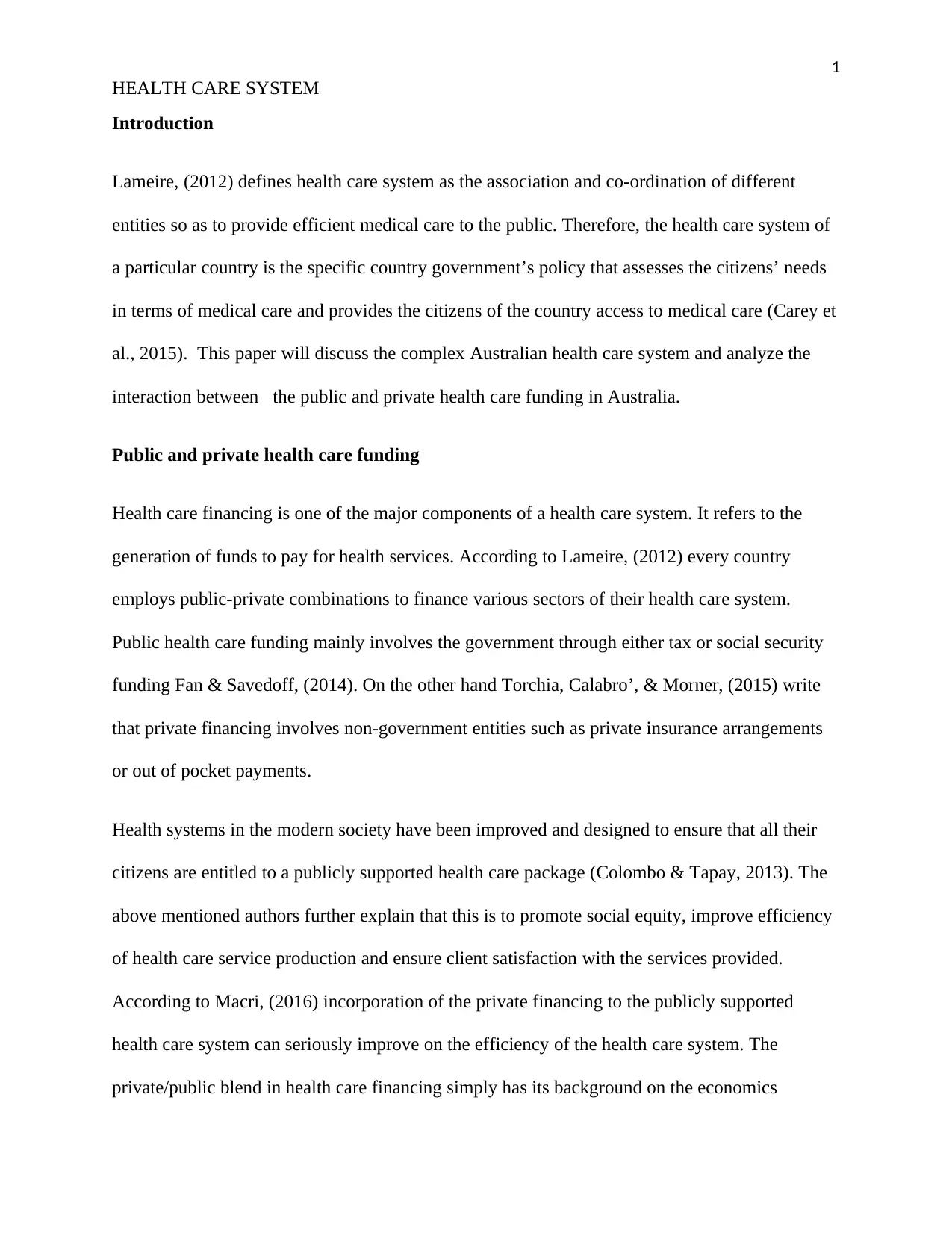
Introduction
Lameire, (2012) defines health care system as the association and co-ordination of different
entities so as to provide efficient medical care to the public. Therefore, the health care system of
a particular country is the specific country government’s policy that assesses the citizens’ needs
in terms of medical care and provides the citizens of the country access to medical care (Carey et
al., 2015). This paper will discuss the complex Australian health care system and analyze the
interaction between the public and private health care funding in Australia.
Public and private health care funding
Health care financing is one of the major components of a health care system. It refers to the
generation of funds to pay for health services. According to Lameire, (2012) every country
employs public-private combinations to finance various sectors of their health care system.
Public health care funding mainly involves the government through either tax or social security
funding Fan & Savedoff, (2014). On the other hand Torchia, Calabro’, & Morner, (2015) write
that private financing involves non-government entities such as private insurance arrangements
or out of pocket payments.
Health systems in the modern society have been improved and designed to ensure that all their
citizens are entitled to a publicly supported health care package (Colombo & Tapay, 2013). The
above mentioned authors further explain that this is to promote social equity, improve efficiency
of health care service production and ensure client satisfaction with the services provided.
According to Macri, (2016) incorporation of the private financing to the publicly supported
health care system can seriously improve on the efficiency of the health care system. The
private/public blend in health care financing simply has its background on the economics
HEALTH CARE SYSTEM
Introduction
Lameire, (2012) defines health care system as the association and co-ordination of different
entities so as to provide efficient medical care to the public. Therefore, the health care system of
a particular country is the specific country government’s policy that assesses the citizens’ needs
in terms of medical care and provides the citizens of the country access to medical care (Carey et
al., 2015). This paper will discuss the complex Australian health care system and analyze the
interaction between the public and private health care funding in Australia.
Public and private health care funding
Health care financing is one of the major components of a health care system. It refers to the
generation of funds to pay for health services. According to Lameire, (2012) every country
employs public-private combinations to finance various sectors of their health care system.
Public health care funding mainly involves the government through either tax or social security
funding Fan & Savedoff, (2014). On the other hand Torchia, Calabro’, & Morner, (2015) write
that private financing involves non-government entities such as private insurance arrangements
or out of pocket payments.
Health systems in the modern society have been improved and designed to ensure that all their
citizens are entitled to a publicly supported health care package (Colombo & Tapay, 2013). The
above mentioned authors further explain that this is to promote social equity, improve efficiency
of health care service production and ensure client satisfaction with the services provided.
According to Macri, (2016) incorporation of the private financing to the publicly supported
health care system can seriously improve on the efficiency of the health care system. The
private/public blend in health care financing simply has its background on the economics
2
HEALTH CARE SYSTEM
principle with the aim of maximizing benefits for the population as a whole from the existing
resources within the two sectors (Pannarunothai, 2012). This has led to a more compromising
debate of how to make both the systems work together.
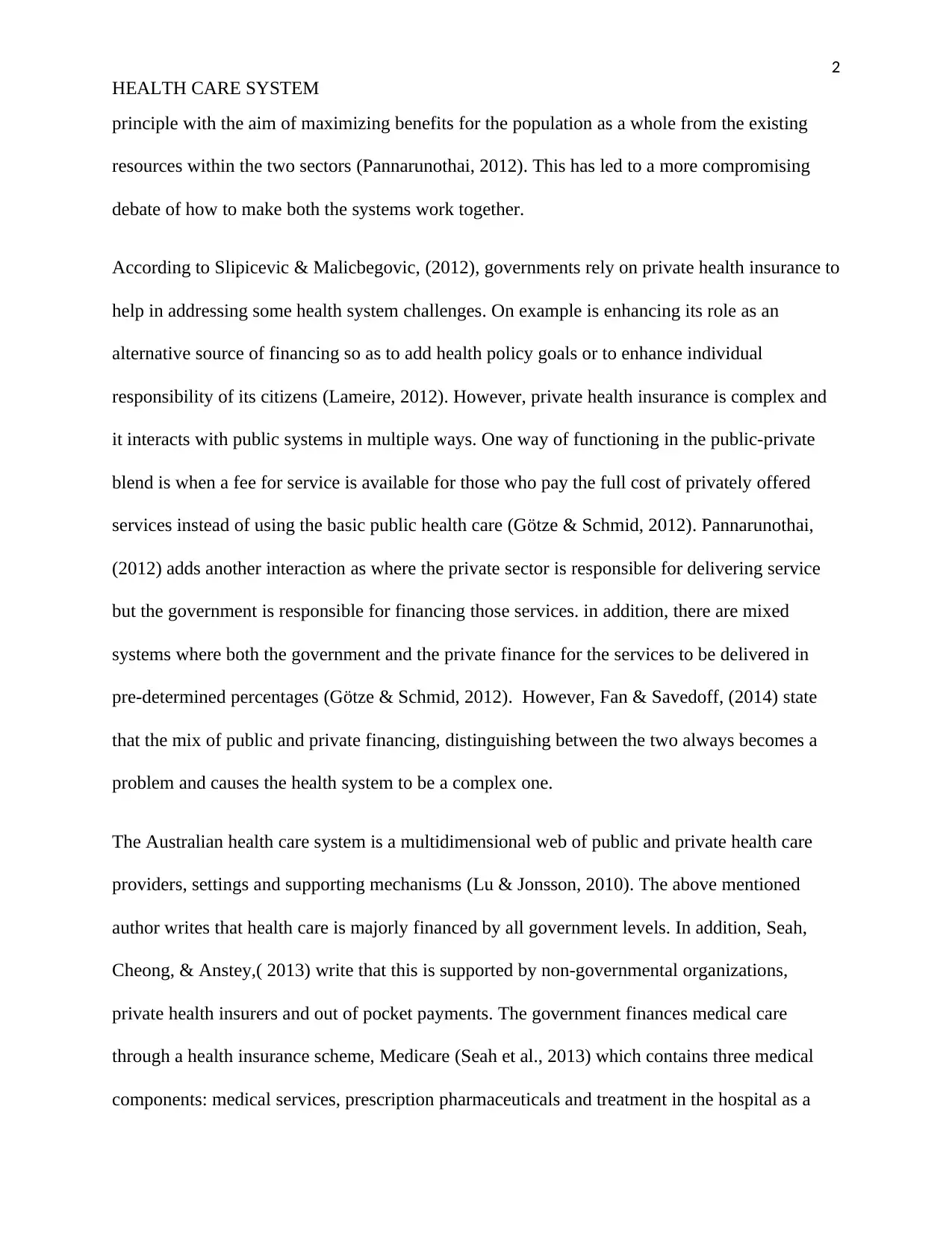
According to Slipicevic & Malicbegovic, (2012), governments rely on private health insurance to
help in addressing some health system challenges. On example is enhancing its role as an
alternative source of financing so as to add health policy goals or to enhance individual
responsibility of its citizens (Lameire, 2012). However, private health insurance is complex and
it interacts with public systems in multiple ways. One way of functioning in the public-private
blend is when a fee for service is available for those who pay the full cost of privately offered
services instead of using the basic public health care (Götze & Schmid, 2012). Pannarunothai,
(2012) adds another interaction as where the private sector is responsible for delivering service
but the government is responsible for financing those services. in addition, there are mixed
systems where both the government and the private finance for the services to be delivered in
pre-determined percentages (Götze & Schmid, 2012). However, Fan & Savedoff, (2014) state
that the mix of public and private financing, distinguishing between the two always becomes a
problem and causes the health system to be a complex one.
The Australian health care system is a multidimensional web of public and private health care
providers, settings and supporting mechanisms (Lu & Jonsson, 2010). The above mentioned
author writes that health care is majorly financed by all government levels. In addition, Seah,
Cheong, & Anstey,( 2013) write that this is supported by non-governmental organizations,
private health insurers and out of pocket payments. The government finances medical care
through a health insurance scheme, Medicare (Seah et al., 2013) which contains three medical
components: medical services, prescription pharmaceuticals and treatment in the hospital as a
HEALTH CARE SYSTEM
principle with the aim of maximizing benefits for the population as a whole from the existing
resources within the two sectors (Pannarunothai, 2012). This has led to a more compromising
debate of how to make both the systems work together.
According to Slipicevic & Malicbegovic, (2012), governments rely on private health insurance to
help in addressing some health system challenges. On example is enhancing its role as an
alternative source of financing so as to add health policy goals or to enhance individual
responsibility of its citizens (Lameire, 2012). However, private health insurance is complex and
it interacts with public systems in multiple ways. One way of functioning in the public-private
blend is when a fee for service is available for those who pay the full cost of privately offered
services instead of using the basic public health care (Götze & Schmid, 2012). Pannarunothai,
(2012) adds another interaction as where the private sector is responsible for delivering service
but the government is responsible for financing those services. in addition, there are mixed
systems where both the government and the private finance for the services to be delivered in
pre-determined percentages (Götze & Schmid, 2012). However, Fan & Savedoff, (2014) state
that the mix of public and private financing, distinguishing between the two always becomes a
problem and causes the health system to be a complex one.
The Australian health care system is a multidimensional web of public and private health care
providers, settings and supporting mechanisms (Lu & Jonsson, 2010). The above mentioned
author writes that health care is majorly financed by all government levels. In addition, Seah,
Cheong, & Anstey,( 2013) write that this is supported by non-governmental organizations,
private health insurers and out of pocket payments. The government finances medical care
through a health insurance scheme, Medicare (Seah et al., 2013) which contains three medical
components: medical services, prescription pharmaceuticals and treatment in the hospital as a
⊘ This is a preview!⊘
Do you want full access?
Subscribe today to unlock all pages.

Trusted by 1+ million students worldwide
3
HEALTH CARE SYSTEM
public patient . This system is supported by private medical insurance arrangements that are
optional. The private health insurance allows for one to be treated in hospital as a private patient
and also for additional services such as dental and physiotherapy services (Macri, 2016).
Complex Australian Health System
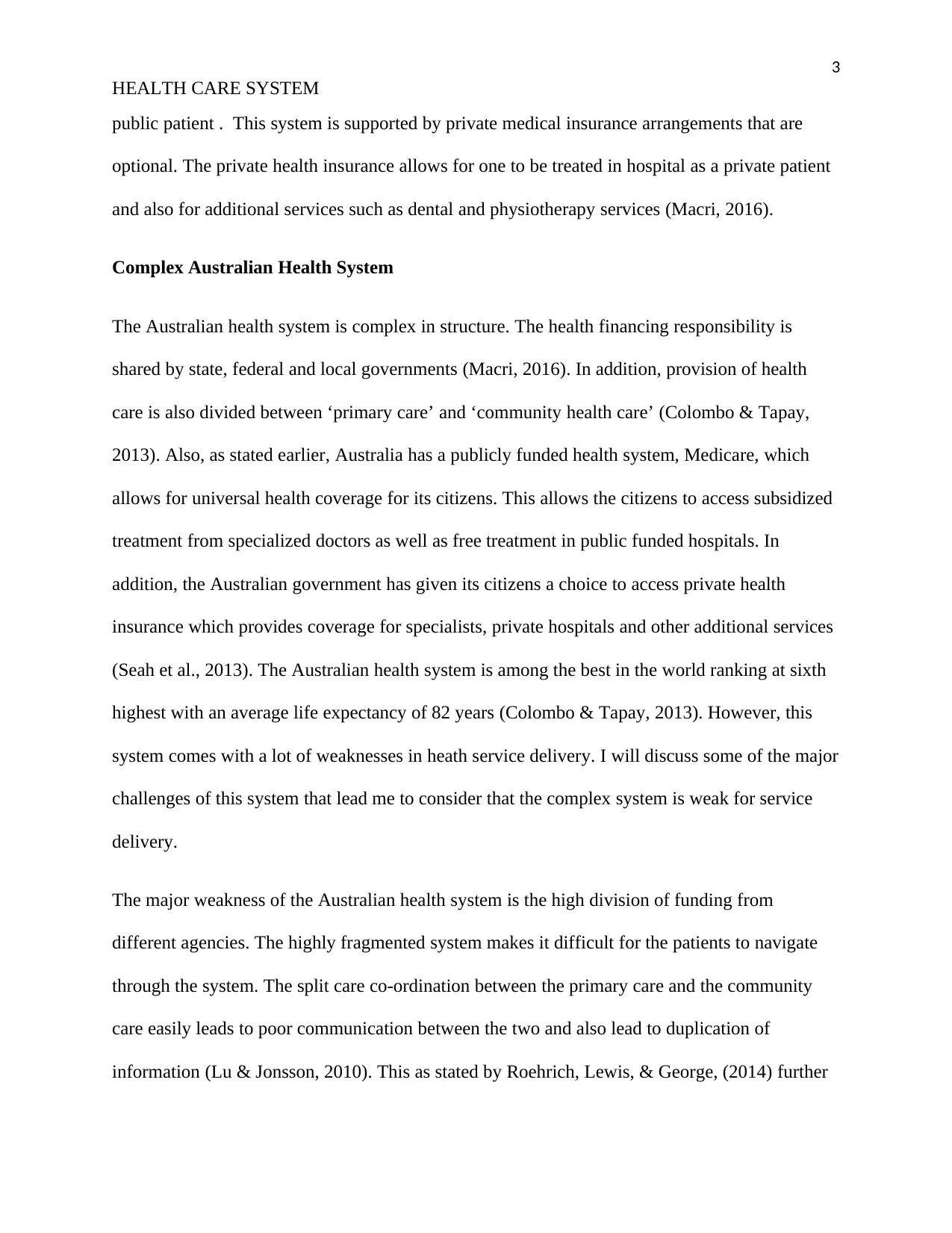
The Australian health system is complex in structure. The health financing responsibility is
shared by state, federal and local governments (Macri, 2016). In addition, provision of health
care is also divided between ‘primary care’ and ‘community health care’ (Colombo & Tapay,
2013). Also, as stated earlier, Australia has a publicly funded health system, Medicare, which
allows for universal health coverage for its citizens. This allows the citizens to access subsidized
treatment from specialized doctors as well as free treatment in public funded hospitals. In
addition, the Australian government has given its citizens a choice to access private health
insurance which provides coverage for specialists, private hospitals and other additional services
(Seah et al., 2013). The Australian health system is among the best in the world ranking at sixth
highest with an average life expectancy of 82 years (Colombo & Tapay, 2013). However, this
system comes with a lot of weaknesses in heath service delivery. I will discuss some of the major
challenges of this system that lead me to consider that the complex system is weak for service
delivery.
The major weakness of the Australian health system is the high division of funding from
different agencies. The highly fragmented system makes it difficult for the patients to navigate
through the system. The split care co-ordination between the primary care and the community
care easily leads to poor communication between the two and also lead to duplication of
information (Lu & Jonsson, 2010). This as stated by Roehrich, Lewis, & George, (2014) further
HEALTH CARE SYSTEM
public patient . This system is supported by private medical insurance arrangements that are
optional. The private health insurance allows for one to be treated in hospital as a private patient
and also for additional services such as dental and physiotherapy services (Macri, 2016).
Complex Australian Health System
The Australian health system is complex in structure. The health financing responsibility is
shared by state, federal and local governments (Macri, 2016). In addition, provision of health
care is also divided between ‘primary care’ and ‘community health care’ (Colombo & Tapay,
2013). Also, as stated earlier, Australia has a publicly funded health system, Medicare, which
allows for universal health coverage for its citizens. This allows the citizens to access subsidized
treatment from specialized doctors as well as free treatment in public funded hospitals. In
addition, the Australian government has given its citizens a choice to access private health
insurance which provides coverage for specialists, private hospitals and other additional services
(Seah et al., 2013). The Australian health system is among the best in the world ranking at sixth
highest with an average life expectancy of 82 years (Colombo & Tapay, 2013). However, this
system comes with a lot of weaknesses in heath service delivery. I will discuss some of the major
challenges of this system that lead me to consider that the complex system is weak for service
delivery.
The major weakness of the Australian health system is the high division of funding from
different agencies. The highly fragmented system makes it difficult for the patients to navigate
through the system. The split care co-ordination between the primary care and the community
care easily leads to poor communication between the two and also lead to duplication of
information (Lu & Jonsson, 2010). This as stated by Roehrich, Lewis, & George, (2014) further
Paraphrase This Document
Need a fresh take? Get an instant paraphrase of this document with our AI Paraphraser
4
HEALTH CARE SYSTEM
causes there to be lack of adequate and reliable data of the health patients exists in the system.
The system also allows for difficulties in funding since the high fragmentation leads to lack of
communication and cordination between the funding parties.
There have been reports of poor co-ordination of service panning and delivery. Dwyer, (2015)
where there are reported cases of ambulances being sent in the wrong direction or clients ending
up paying more out of pocket than what are required. In addition, Seah et al.,( 2013) writes that
the complexity of the health system also causes it to be poor in delivery of effective and timely
health care. This has been worsened with the current changes in demographics and health
problems facing the country. According to Dwyer, (2015) the increased numbers of the aging
population. The above mentioned author also reports of increasing risk factors of chronic
diseases such as high obesity levels and reduced physical activities. Chronic diseases have also
been on the rise.
According to Colombo & Tapay, (2013) the use of medical technology in the Australian system
has been extremely poor and slow. Poor co-ordination has also led to poor advancements in the
field of health care service and delivery as well as health research. Other than the high cost of
updating and implementing the use of technology in the system (Seah et al., 2013), Colombo &
Tapay, (2013) add that the poor organizational abilities in the different parties that are
responsible for financing health care have made it difficult for these advancements to be done.
In addition, Dwyer, (2015) writes that as much as the country has had a number of
internationally recognized medical breakthroughs, it lacks efficient structures and stakeholder
linkages that enable it to integrate national health and medical research plans.
HEALTH CARE SYSTEM
causes there to be lack of adequate and reliable data of the health patients exists in the system.
The system also allows for difficulties in funding since the high fragmentation leads to lack of
communication and cordination between the funding parties.
There have been reports of poor co-ordination of service panning and delivery. Dwyer, (2015)
where there are reported cases of ambulances being sent in the wrong direction or clients ending
up paying more out of pocket than what are required. In addition, Seah et al.,( 2013) writes that
the complexity of the health system also causes it to be poor in delivery of effective and timely
health care. This has been worsened with the current changes in demographics and health
problems facing the country. According to Dwyer, (2015) the increased numbers of the aging
population. The above mentioned author also reports of increasing risk factors of chronic
diseases such as high obesity levels and reduced physical activities. Chronic diseases have also
been on the rise.
According to Colombo & Tapay, (2013) the use of medical technology in the Australian system
has been extremely poor and slow. Poor co-ordination has also led to poor advancements in the
field of health care service and delivery as well as health research. Other than the high cost of
updating and implementing the use of technology in the system (Seah et al., 2013), Colombo &
Tapay, (2013) add that the poor organizational abilities in the different parties that are
responsible for financing health care have made it difficult for these advancements to be done.
In addition, Dwyer, (2015) writes that as much as the country has had a number of
internationally recognized medical breakthroughs, it lacks efficient structures and stakeholder
linkages that enable it to integrate national health and medical research plans.
5
HEALTH CARE SYSTEM
Finally the involvement of the public-private blend has led equality issues and inequality in the
provision of health care. The Australian health system has allowed the government to provide
incentives for the rich to pay for their own private health arrangements (Macri, 2016). This
arrangement allows the owners to access faster medical services as well as to choose the doctor
and specialists to treat them. It has led to a significant difference in the health care treatment that
affluent people receive as compared to that of the less affluent. Reports have shown that the life
expectancy of the indigenous Australian population to be at 70 years which is significantly lower
than that of the other people (Seah et al., 2013).
Strategies to address the weaknesses of the public-private health care funding
As much as the complex Australian Health system has been properly functional over the years,
there is need for some strategies to be put up in order to improve on the weaknesses that come
with the system.
First, the government should centralize the governance and funding of health care in the country
(McPake & Hanson, 2016). In the current health care system, funding, care delivery, policy-
making and governance of health care delivery and funding is highly fragmented and therefore
very complicated. If we take the example of a patient with a chronic disease, he/she needs
community care that is supported by the state government. The same patient also needs
specialized treatment that is accessible through private insurance. It is therefore the work of the
patient to bring together all this. A centralized system will allow easy governance and funding of
the health services in the country (Roehrich et al., 2014). It will make it easier for patients to
move through health care deliver. Implementing this policy will also enable the Australian
HEALTH CARE SYSTEM
Finally the involvement of the public-private blend has led equality issues and inequality in the
provision of health care. The Australian health system has allowed the government to provide
incentives for the rich to pay for their own private health arrangements (Macri, 2016). This
arrangement allows the owners to access faster medical services as well as to choose the doctor
and specialists to treat them. It has led to a significant difference in the health care treatment that
affluent people receive as compared to that of the less affluent. Reports have shown that the life
expectancy of the indigenous Australian population to be at 70 years which is significantly lower
than that of the other people (Seah et al., 2013).
Strategies to address the weaknesses of the public-private health care funding
As much as the complex Australian Health system has been properly functional over the years,
there is need for some strategies to be put up in order to improve on the weaknesses that come
with the system.
First, the government should centralize the governance and funding of health care in the country
(McPake & Hanson, 2016). In the current health care system, funding, care delivery, policy-
making and governance of health care delivery and funding is highly fragmented and therefore
very complicated. If we take the example of a patient with a chronic disease, he/she needs
community care that is supported by the state government. The same patient also needs
specialized treatment that is accessible through private insurance. It is therefore the work of the
patient to bring together all this. A centralized system will allow easy governance and funding of
the health services in the country (Roehrich et al., 2014). It will make it easier for patients to
move through health care deliver. Implementing this policy will also enable the Australian
⊘ This is a preview!⊘
Do you want full access?
Subscribe today to unlock all pages.
Trusted by 1+ million students worldwide
6
HEALTH CARE SYSTEM
government to have proper records of the health services, health funding and health expenditure
in the country
A second policy that can help improve the Australian health system is pay for performance
system (McPake & Hanson, 2016). This simply means that a doctor is paid according to the
delivery he makes. In such a system the government and the private insurers join up and work
together to pay doctors. The doctors are then required to see a set number of patients and produce
adequate performance to be paid. It is a difficult policy to implement but it will go a long way in
reducing the gap of health service delivery between the affluent and the less affluent people in
the country. Still using the example above, a person with a chronic illness who requires
specialized treatment but does not have private insurance will not be able to get the treatment.
This patient may end up no getting health care or end up paying out of pocket. In a system where
the doctor is paid for performance, the doctor is allowed to see all patients regardless of whether
or not they have private insurance arrangements (Colombo & Tapay, 2013). This will help
ensure all Australians receive equal health care services at all times.
Finally, the Australian government can adopt a policy that advocates for keeping people out of
hospital. In this case, the government supports primary health care at the community level and
offers support to clinicians. This will reduce the bulk of people in the hospitals and allow for
adequate and efficient use of available resources in the hospitals. In addition, clinicians can be
used to monitor and assist the changing health needs of the Australian population especially
during the demographic changes of the citizens. It also promotes home and community care of
patients with chronic diseases and allows for people to visit hospital or be admitted only when
there is need to. Clinicians and clinics will be available and accessible to all people regardless of
their social status in the community.
HEALTH CARE SYSTEM
government to have proper records of the health services, health funding and health expenditure
in the country
A second policy that can help improve the Australian health system is pay for performance
system (McPake & Hanson, 2016). This simply means that a doctor is paid according to the
delivery he makes. In such a system the government and the private insurers join up and work
together to pay doctors. The doctors are then required to see a set number of patients and produce
adequate performance to be paid. It is a difficult policy to implement but it will go a long way in
reducing the gap of health service delivery between the affluent and the less affluent people in
the country. Still using the example above, a person with a chronic illness who requires
specialized treatment but does not have private insurance will not be able to get the treatment.
This patient may end up no getting health care or end up paying out of pocket. In a system where
the doctor is paid for performance, the doctor is allowed to see all patients regardless of whether
or not they have private insurance arrangements (Colombo & Tapay, 2013). This will help
ensure all Australians receive equal health care services at all times.
Finally, the Australian government can adopt a policy that advocates for keeping people out of
hospital. In this case, the government supports primary health care at the community level and
offers support to clinicians. This will reduce the bulk of people in the hospitals and allow for
adequate and efficient use of available resources in the hospitals. In addition, clinicians can be
used to monitor and assist the changing health needs of the Australian population especially
during the demographic changes of the citizens. It also promotes home and community care of
patients with chronic diseases and allows for people to visit hospital or be admitted only when
there is need to. Clinicians and clinics will be available and accessible to all people regardless of
their social status in the community.
Paraphrase This Document
Need a fresh take? Get an instant paraphrase of this document with our AI Paraphraser
7
HEALTH CARE SYSTEM
REFERENCES
Carey, G., Malbon, E., Carey, N., Joyce, A., Crammond, B., & Carey, A. (2015). Systems
science and systems thinking for public health: a systematic review of the field. BMJ Open
(online). 5(12). Available from: https://www.ncbi.nlm.nih.gov/pmc/articles/PMC4710830/.
(Accessed 18 May, 2018)
Colombo, F., & Tapay, N. (2013). OECD HEALTH WORKING PAPERS (online). Available
from: www.oecd.org, (Accessed 17 May, 2018).
Dwyer, J. M. (2015). Australian health system restructuring – what problem is being solved?
Australia and New Zealand Health Policy (online). Available from:
https://www.ncbi.nlm.nih.gov/pmc/articles/PMC544964/ (Accessed 18 May, 2018)
Fan, V. Y., & Savedoff, W. D. (2014). The health financing transition: A conceptual framework
and empirical evidence. Social Science & Medicine (online). 105. Available from:
http://www.sciencedirect.com/science/article/pii/S0277953614000392 (Accessed 18 May, 2018)
Götze, R., & Schmid, A. (2012). Healthcare Financing in OECD Countries beyond the Public-
Private Split (online). Available from: https://papers.ssrn.com/abstract=1998037 (Accessed 18
May, 2018).
Lameire, N. (2012). Healthcare systems--an international review: an overview. Nephrology
Dialysis Transplantation (online). 14 (6). Available from: https://academic.oup.com/ndt/article-
lookup/doi/10.1093/ndt/14.suppl_6.3 (Accessed 18 May, 2018).
Lu, M., & Jonsson, E. (2010). Financing Health Care: New Ideas for a Changing Society
(online). USA: John Wiley & Sons. Available from: https://www.Google-Books-ID.com
(Accessed 17 May, 2018)
Macri, J. (2016). Australia’s Health System: Some Issues and Challenges. Journal of Health &
Medical Economics (online). 2(2). Available from: http://www.imedpub.com (Accessed 17 May
2018).
McPake, B., & Hanson, K. (2016). Managing the public–private mix to achieve universal health
coverage. The Lancet (online). 388(10044). Available from:
http://www.sciencedirect.com/science/article/pii/S0140673616003445 (Accessed 18 May, 2018)
HEALTH CARE SYSTEM
REFERENCES
Carey, G., Malbon, E., Carey, N., Joyce, A., Crammond, B., & Carey, A. (2015). Systems
science and systems thinking for public health: a systematic review of the field. BMJ Open
(online). 5(12). Available from: https://www.ncbi.nlm.nih.gov/pmc/articles/PMC4710830/.
(Accessed 18 May, 2018)
Colombo, F., & Tapay, N. (2013). OECD HEALTH WORKING PAPERS (online). Available
from: www.oecd.org, (Accessed 17 May, 2018).
Dwyer, J. M. (2015). Australian health system restructuring – what problem is being solved?
Australia and New Zealand Health Policy (online). Available from:
https://www.ncbi.nlm.nih.gov/pmc/articles/PMC544964/ (Accessed 18 May, 2018)
Fan, V. Y., & Savedoff, W. D. (2014). The health financing transition: A conceptual framework
and empirical evidence. Social Science & Medicine (online). 105. Available from:
http://www.sciencedirect.com/science/article/pii/S0277953614000392 (Accessed 18 May, 2018)
Götze, R., & Schmid, A. (2012). Healthcare Financing in OECD Countries beyond the Public-
Private Split (online). Available from: https://papers.ssrn.com/abstract=1998037 (Accessed 18
May, 2018).
Lameire, N. (2012). Healthcare systems--an international review: an overview. Nephrology
Dialysis Transplantation (online). 14 (6). Available from: https://academic.oup.com/ndt/article-
lookup/doi/10.1093/ndt/14.suppl_6.3 (Accessed 18 May, 2018).
Lu, M., & Jonsson, E. (2010). Financing Health Care: New Ideas for a Changing Society
(online). USA: John Wiley & Sons. Available from: https://www.Google-Books-ID.com
(Accessed 17 May, 2018)
Macri, J. (2016). Australia’s Health System: Some Issues and Challenges. Journal of Health &
Medical Economics (online). 2(2). Available from: http://www.imedpub.com (Accessed 17 May
2018).
McPake, B., & Hanson, K. (2016). Managing the public–private mix to achieve universal health
coverage. The Lancet (online). 388(10044). Available from:
http://www.sciencedirect.com/science/article/pii/S0140673616003445 (Accessed 18 May, 2018)
8
HEALTH CARE SYSTEM
Pannarunothai, S. (2012). Researching the public/private mix in health care in a Thai urban area:
methodological approaches. Health Policy and Planning (online). 13(3). Available from:
https://academic.oup.com/heapol/article-lookup/doi/10.1093/heapol/13.3.234 (Accessed 18 May,
2018).
Roehrich, J. K., Lewis, M. A., & George, G. (2014). Are public–private partnerships a healthy
option? A systematic literature review. Social Science & Medicine (online). 113. Available from:
http://www.sciencedirect.com/science/article/pii/S0277953614002871 (Accessed 17 May,
2018).
Seah, D. S. E., Cheong, T. Z., & Anstey, M. H. R. (2013). The hidden cost of private health
insurance in Australia. Australian Health Review (online). 37(1). Available from:
http://www.publish.csiro.au/?paper=AH11126 (Accessed 18 May, 2018).
Slipicevic, O., & Malicbegovic, A. (2012). Public and Private Sector in the Health Care System
of the Federation Bosnia and Herzegovina: Policy and Strategy. Materia Socio-Medica (online).
24(1). Available from: https://www.ncbi.nlm.nih.gov/pmc/articles/PMC3633389/ (Accessed on
18 May, 2018).
Torchia, M., Calabro’, A., & Morner, M. (2015). Public–Private Partnerships in the Health Care
Sector: A systematic review of the literature. Public Management Review (online). 17(2).
Available from: http://www.sciencedirect.com/science/ (Accessed 18 May, 2018).
HEALTH CARE SYSTEM
Pannarunothai, S. (2012). Researching the public/private mix in health care in a Thai urban area:
methodological approaches. Health Policy and Planning (online). 13(3). Available from:
https://academic.oup.com/heapol/article-lookup/doi/10.1093/heapol/13.3.234 (Accessed 18 May,
2018).
Roehrich, J. K., Lewis, M. A., & George, G. (2014). Are public–private partnerships a healthy
option? A systematic literature review. Social Science & Medicine (online). 113. Available from:
http://www.sciencedirect.com/science/article/pii/S0277953614002871 (Accessed 17 May,
2018).
Seah, D. S. E., Cheong, T. Z., & Anstey, M. H. R. (2013). The hidden cost of private health
insurance in Australia. Australian Health Review (online). 37(1). Available from:
http://www.publish.csiro.au/?paper=AH11126 (Accessed 18 May, 2018).
Slipicevic, O., & Malicbegovic, A. (2012). Public and Private Sector in the Health Care System
of the Federation Bosnia and Herzegovina: Policy and Strategy. Materia Socio-Medica (online).
24(1). Available from: https://www.ncbi.nlm.nih.gov/pmc/articles/PMC3633389/ (Accessed on
18 May, 2018).
Torchia, M., Calabro’, A., & Morner, M. (2015). Public–Private Partnerships in the Health Care
Sector: A systematic review of the literature. Public Management Review (online). 17(2).
Available from: http://www.sciencedirect.com/science/ (Accessed 18 May, 2018).
⊘ This is a preview!⊘
Do you want full access?
Subscribe today to unlock all pages.
Trusted by 1+ million students worldwide

1 out of 9


Related Documents


Your All-in-One AI-Powered Toolkit for Academic Success.
+13062052269
info@desklib.com
Available 24*7 on WhatsApp / Email
![[object Object]](/_next/static/media/star-bottom.7253800d.svg)
Unlock your academic potential
Copyright © 2020–2026 A2Z Services. All Rights Reserved. Developed and managed by ZUCOL.