Impact of Healthcare Policies on Nursing Practices: An Analysis
VerifiedAdded on 2021/02/20
|7
|2310
|69
Report
AI Summary
This report analyzes the impact of Australian healthcare policies on nursing practices. It examines the effects of the smoke-free healthcare policy, the National Cancer Prevention Policy, and the Obesity Policy Coalition (OPC) on nursing staff and their professional responsibilities. The report highlights how these policies influence the daily activities of nurses, including patient care, awareness programs, and community engagement. It discusses the positive and negative impacts of these policies, emphasizing the need for nurses to adapt to changing healthcare environments and address emerging professional challenges. The report concludes that changes in health policies directly affect the practices of nursing staff, emphasizing the need for professionals to address issues to minimize their influence. The report also provides a comprehensive overview of the policies and their influence on the nursing practices.
Professional Issues

Paraphrase This Document
Need a fresh take? Get an instant paraphrase of this document with our AI Paraphraser
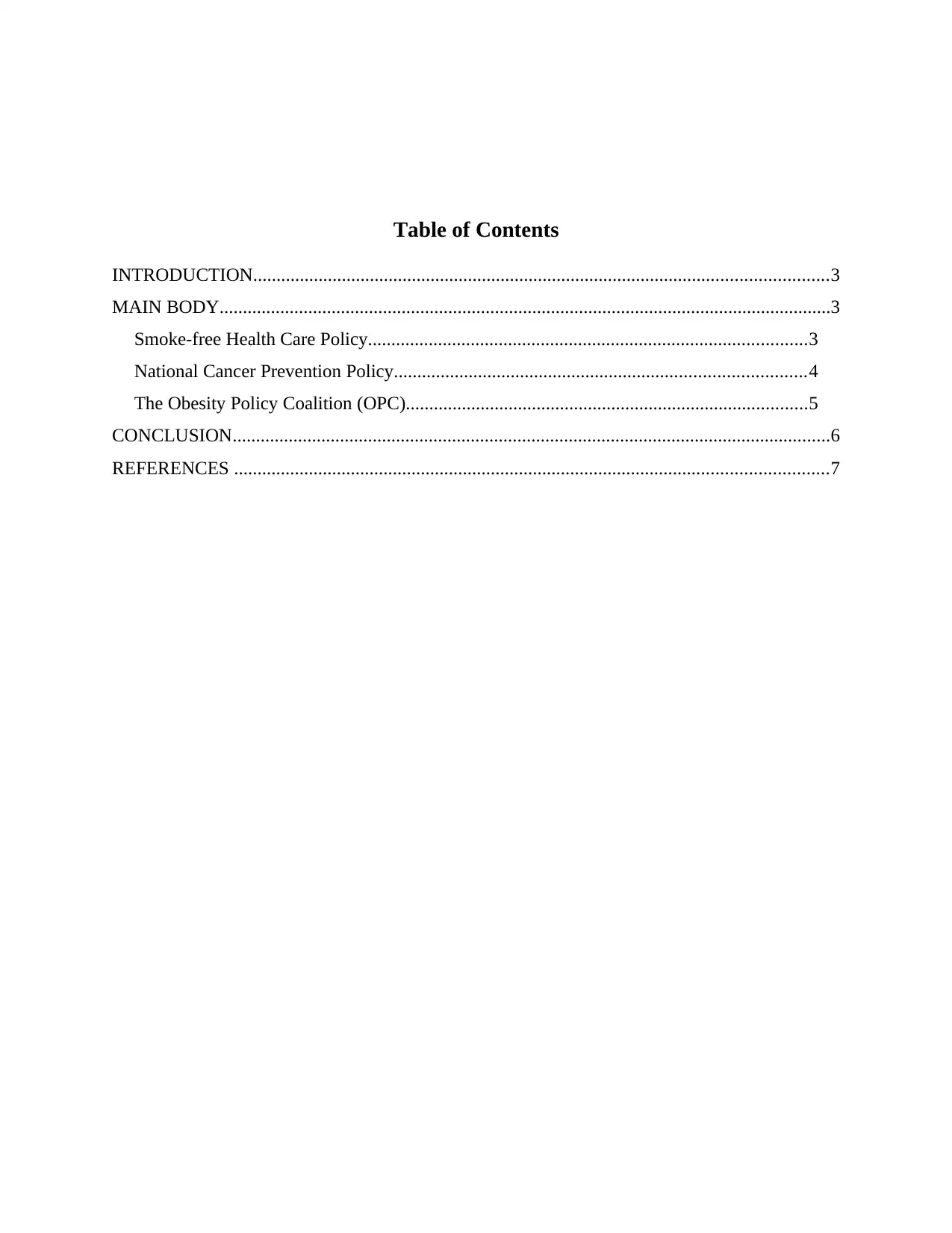
Table of Contents
INTRODUCTION...........................................................................................................................3
MAIN BODY...................................................................................................................................3
Smoke-free Health Care Policy..............................................................................................3
National Cancer Prevention Policy........................................................................................4
The Obesity Policy Coalition (OPC)......................................................................................5
CONCLUSION................................................................................................................................6
REFERENCES ...............................................................................................................................7
INTRODUCTION...........................................................................................................................3
MAIN BODY...................................................................................................................................3
Smoke-free Health Care Policy..............................................................................................3
National Cancer Prevention Policy........................................................................................4
The Obesity Policy Coalition (OPC)......................................................................................5
CONCLUSION................................................................................................................................6
REFERENCES ...............................................................................................................................7
INTRODUCTION
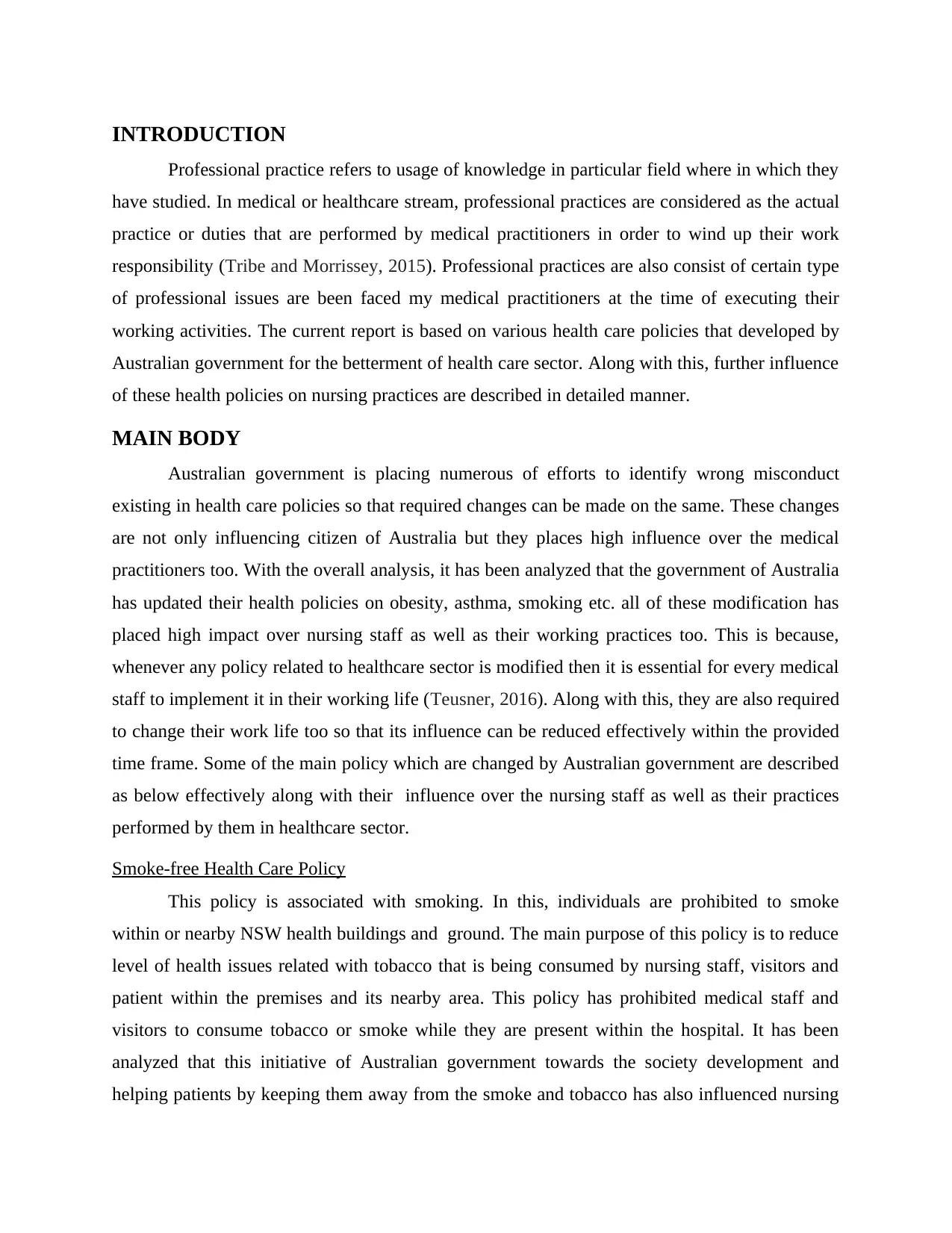
Professional practice refers to usage of knowledge in particular field where in which they
have studied. In medical or healthcare stream, professional practices are considered as the actual
practice or duties that are performed by medical practitioners in order to wind up their work
responsibility (Tribe and Morrissey, 2015). Professional practices are also consist of certain type
of professional issues are been faced my medical practitioners at the time of executing their
working activities. The current report is based on various health care policies that developed by
Australian government for the betterment of health care sector. Along with this, further influence
of these health policies on nursing practices are described in detailed manner.
MAIN BODY
Australian government is placing numerous of efforts to identify wrong misconduct
existing in health care policies so that required changes can be made on the same. These changes
are not only influencing citizen of Australia but they places high influence over the medical
practitioners too. With the overall analysis, it has been analyzed that the government of Australia
has updated their health policies on obesity, asthma, smoking etc. all of these modification has
placed high impact over nursing staff as well as their working practices too. This is because,
whenever any policy related to healthcare sector is modified then it is essential for every medical
staff to implement it in their working life (Teusner, 2016). Along with this, they are also required
to change their work life too so that its influence can be reduced effectively within the provided
time frame. Some of the main policy which are changed by Australian government are described
as below effectively along with their influence over the nursing staff as well as their practices
performed by them in healthcare sector.
Smoke-free Health Care Policy
This policy is associated with smoking. In this, individuals are prohibited to smoke
within or nearby NSW health buildings and ground. The main purpose of this policy is to reduce
level of health issues related with tobacco that is being consumed by nursing staff, visitors and
patient within the premises and its nearby area. This policy has prohibited medical staff and
visitors to consume tobacco or smoke while they are present within the hospital. It has been
analyzed that this initiative of Australian government towards the society development and
helping patients by keeping them away from the smoke and tobacco has also influenced nursing
Professional practice refers to usage of knowledge in particular field where in which they
have studied. In medical or healthcare stream, professional practices are considered as the actual
practice or duties that are performed by medical practitioners in order to wind up their work
responsibility (Tribe and Morrissey, 2015). Professional practices are also consist of certain type
of professional issues are been faced my medical practitioners at the time of executing their
working activities. The current report is based on various health care policies that developed by
Australian government for the betterment of health care sector. Along with this, further influence
of these health policies on nursing practices are described in detailed manner.
MAIN BODY
Australian government is placing numerous of efforts to identify wrong misconduct
existing in health care policies so that required changes can be made on the same. These changes
are not only influencing citizen of Australia but they places high influence over the medical
practitioners too. With the overall analysis, it has been analyzed that the government of Australia
has updated their health policies on obesity, asthma, smoking etc. all of these modification has
placed high impact over nursing staff as well as their working practices too. This is because,
whenever any policy related to healthcare sector is modified then it is essential for every medical
staff to implement it in their working life (Teusner, 2016). Along with this, they are also required
to change their work life too so that its influence can be reduced effectively within the provided
time frame. Some of the main policy which are changed by Australian government are described
as below effectively along with their influence over the nursing staff as well as their practices
performed by them in healthcare sector.
Smoke-free Health Care Policy
This policy is associated with smoking. In this, individuals are prohibited to smoke
within or nearby NSW health buildings and ground. The main purpose of this policy is to reduce
level of health issues related with tobacco that is being consumed by nursing staff, visitors and
patient within the premises and its nearby area. This policy has prohibited medical staff and
visitors to consume tobacco or smoke while they are present within the hospital. It has been
analyzed that this initiative of Australian government towards the society development and
helping patients by keeping them away from the smoke and tobacco has also influenced nursing
⊘ This is a preview!⊘
Do you want full access?
Subscribe today to unlock all pages.

Trusted by 1+ million students worldwide
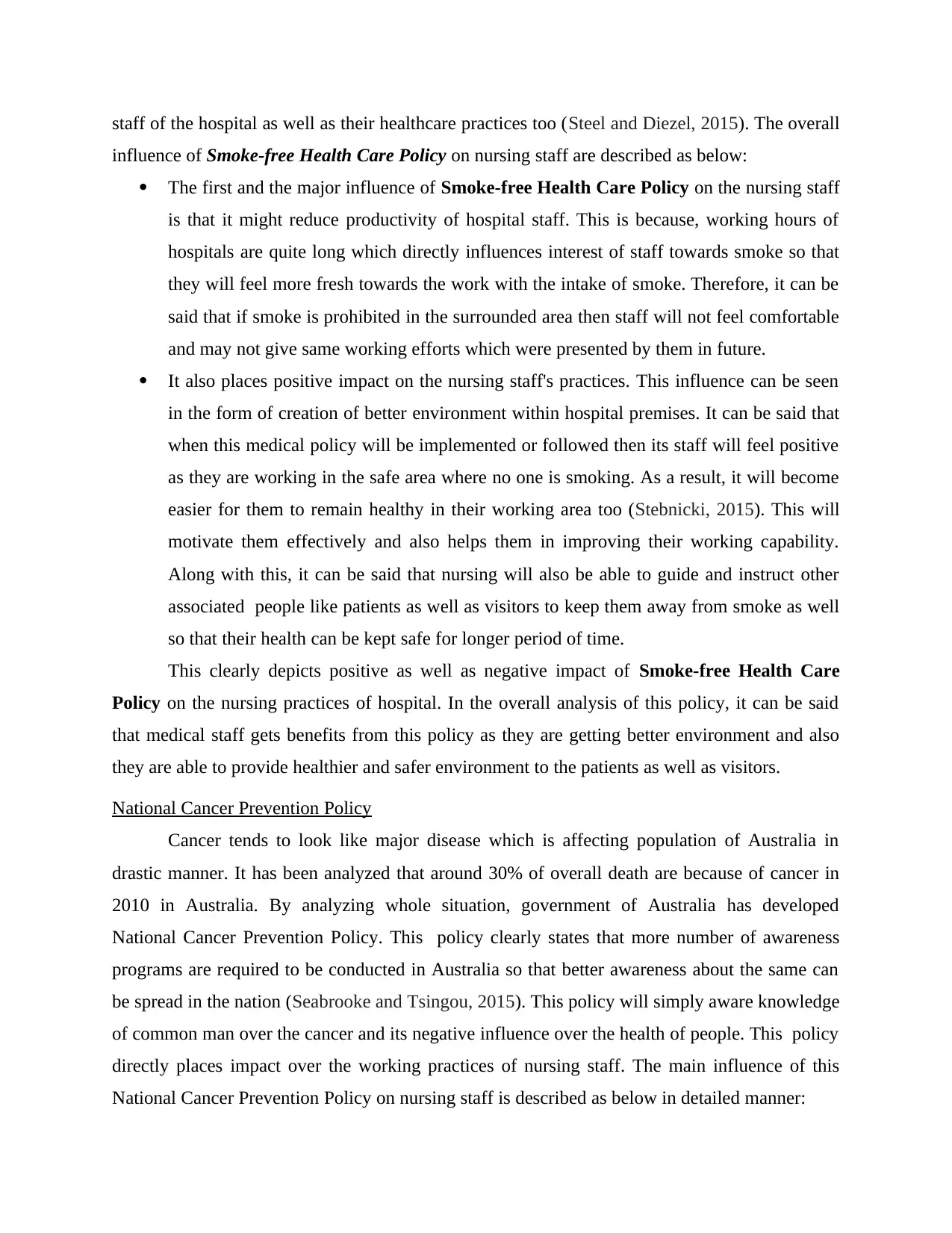
staff of the hospital as well as their healthcare practices too (Steel and Diezel, 2015). The overall
influence of Smoke-free Health Care Policy on nursing staff are described as below:
The first and the major influence of Smoke-free Health Care Policy on the nursing staff
is that it might reduce productivity of hospital staff. This is because, working hours of
hospitals are quite long which directly influences interest of staff towards smoke so that
they will feel more fresh towards the work with the intake of smoke. Therefore, it can be
said that if smoke is prohibited in the surrounded area then staff will not feel comfortable
and may not give same working efforts which were presented by them in future.
It also places positive impact on the nursing staff's practices. This influence can be seen
in the form of creation of better environment within hospital premises. It can be said that
when this medical policy will be implemented or followed then its staff will feel positive
as they are working in the safe area where no one is smoking. As a result, it will become
easier for them to remain healthy in their working area too (Stebnicki, 2015). This will
motivate them effectively and also helps them in improving their working capability.
Along with this, it can be said that nursing will also be able to guide and instruct other
associated people like patients as well as visitors to keep them away from smoke as well
so that their health can be kept safe for longer period of time.
This clearly depicts positive as well as negative impact of Smoke-free Health Care
Policy on the nursing practices of hospital. In the overall analysis of this policy, it can be said
that medical staff gets benefits from this policy as they are getting better environment and also
they are able to provide healthier and safer environment to the patients as well as visitors.
National Cancer Prevention Policy
Cancer tends to look like major disease which is affecting population of Australia in
drastic manner. It has been analyzed that around 30% of overall death are because of cancer in
2010 in Australia. By analyzing whole situation, government of Australia has developed
National Cancer Prevention Policy. This policy clearly states that more number of awareness
programs are required to be conducted in Australia so that better awareness about the same can
be spread in the nation (Seabrooke and Tsingou, 2015). This policy will simply aware knowledge
of common man over the cancer and its negative influence over the health of people. This policy
directly places impact over the working practices of nursing staff. The main influence of this
National Cancer Prevention Policy on nursing staff is described as below in detailed manner:
influence of Smoke-free Health Care Policy on nursing staff are described as below:
The first and the major influence of Smoke-free Health Care Policy on the nursing staff
is that it might reduce productivity of hospital staff. This is because, working hours of
hospitals are quite long which directly influences interest of staff towards smoke so that
they will feel more fresh towards the work with the intake of smoke. Therefore, it can be
said that if smoke is prohibited in the surrounded area then staff will not feel comfortable
and may not give same working efforts which were presented by them in future.
It also places positive impact on the nursing staff's practices. This influence can be seen
in the form of creation of better environment within hospital premises. It can be said that
when this medical policy will be implemented or followed then its staff will feel positive
as they are working in the safe area where no one is smoking. As a result, it will become
easier for them to remain healthy in their working area too (Stebnicki, 2015). This will
motivate them effectively and also helps them in improving their working capability.
Along with this, it can be said that nursing will also be able to guide and instruct other
associated people like patients as well as visitors to keep them away from smoke as well
so that their health can be kept safe for longer period of time.
This clearly depicts positive as well as negative impact of Smoke-free Health Care
Policy on the nursing practices of hospital. In the overall analysis of this policy, it can be said
that medical staff gets benefits from this policy as they are getting better environment and also
they are able to provide healthier and safer environment to the patients as well as visitors.
National Cancer Prevention Policy
Cancer tends to look like major disease which is affecting population of Australia in
drastic manner. It has been analyzed that around 30% of overall death are because of cancer in
2010 in Australia. By analyzing whole situation, government of Australia has developed
National Cancer Prevention Policy. This policy clearly states that more number of awareness
programs are required to be conducted in Australia so that better awareness about the same can
be spread in the nation (Seabrooke and Tsingou, 2015). This policy will simply aware knowledge
of common man over the cancer and its negative influence over the health of people. This policy
directly places impact over the working practices of nursing staff. The main influence of this
National Cancer Prevention Policy on nursing staff is described as below in detailed manner:
Paraphrase This Document
Need a fresh take? Get an instant paraphrase of this document with our AI Paraphraser
Nursing staff is required to conduct more number of awareness programs within their
hospital premises as well as the near by area where more number of people are available.
This is because, according to the National Cancer Prevention Policy it is essential; for the
hospitals to aware maximum number of people about cancer and its related issues so that
they can take preventive measures for the same in order to cure themselves. Along with
this, it will also create requirement of more number of medical staffs or nursing staff so
that they can aware maximum number of people about cancer (Schaltegger and Burritt,
2017). As a result, this awareness will help Australian community about cancer and its
related affects on their lifestyle.
The Obesity Policy Coalition (OPC)
Obesity
It is disease that is all around the world and hence it is a treatable sickness and hence is
found round the body that means the excess fat around the waist and it is basically happens due
to genetic causes as well as environmental factors and even uncontrollable diet used by the
people. This disease can be diagnosed easily in any health care department the maximum body
which is need to be cured by making dieting chats in effective way. In many countries this type
of diseases can be healed in effective way many clinic centres and their treatment which can be
manageable.
The Obesity Policy Coalition (OPC) : This policies is regarding to overweight and
unhealthy diets which is under taken in Australia hence according to many researchers it has
been observed that this diseases which is been seen in many children and their parents which is
not taking care about this matter so government of Australia taking such steps by making
policies to prevent the people in effective manner (Salifu and Agbenyega, 2016). This policy
which was made to make the people aware about this diseases in deep way. So the of the
communities of Australia need take adopt this type of policies to avoid the risk from life.
Impact of this policy on Nursing practises working
Campaigns programs, the Australia nursing staff they can prompt this activities like drive
program which will help many people and society about this diseases which will guide
the patiences in effective manner more over the major part of the nursing staff they
should hold this activity by making children's, parents and community get knowledge
hospital premises as well as the near by area where more number of people are available.
This is because, according to the National Cancer Prevention Policy it is essential; for the
hospitals to aware maximum number of people about cancer and its related issues so that
they can take preventive measures for the same in order to cure themselves. Along with
this, it will also create requirement of more number of medical staffs or nursing staff so
that they can aware maximum number of people about cancer (Schaltegger and Burritt,
2017). As a result, this awareness will help Australian community about cancer and its
related affects on their lifestyle.
The Obesity Policy Coalition (OPC)
Obesity
It is disease that is all around the world and hence it is a treatable sickness and hence is
found round the body that means the excess fat around the waist and it is basically happens due
to genetic causes as well as environmental factors and even uncontrollable diet used by the
people. This disease can be diagnosed easily in any health care department the maximum body
which is need to be cured by making dieting chats in effective way. In many countries this type
of diseases can be healed in effective way many clinic centres and their treatment which can be
manageable.
The Obesity Policy Coalition (OPC) : This policies is regarding to overweight and
unhealthy diets which is under taken in Australia hence according to many researchers it has
been observed that this diseases which is been seen in many children and their parents which is
not taking care about this matter so government of Australia taking such steps by making
policies to prevent the people in effective manner (Salifu and Agbenyega, 2016). This policy
which was made to make the people aware about this diseases in deep way. So the of the
communities of Australia need take adopt this type of policies to avoid the risk from life.
Impact of this policy on Nursing practises working
Campaigns programs, the Australia nursing staff they can prompt this activities like drive
program which will help many people and society about this diseases which will guide
the patiences in effective manner more over the major part of the nursing staff they
should hold this activity by making children's, parents and community get knowledge
about it. Through these drives it will be helpful to may people by award of this big issues
that is faced by each and every person in life (Millar, Crute and Hargie, 2017).
Social media Awareness, Another impact is that the nursing staffs of Australia which can
make social welfare work and hence it can be promoted through digital form which will
help enhance more people around the world. Now a days social media and technologies
that making huge impact on the people round the global. Social is best source through
which people will get more knowledge about this matter and hence the major part of the
of availing this type of disease which can collected through this way. Hence through
many ways promotional activity can be done but advertisements which will able to attract
the customer to make aware about it.
Well trained and Knowledgeable, this disease impact will upon the nurse of Australia
which will trained staffs in effective way. Hospitals clinic staff they should take sessions
about this policies and should be presentation and its impact on the society as well as on
community in negative manner so proper training and development facility that will help
aid to increase the growth of the clinic and even policies can also be sold (McCann and
Brown, 2018). Trained staff will look after this mater in easily and effective manner
which take growth of many clinics.
CONCLUSION
On the basis of above described report, it has been concluded that every professional
issues are required to be addressed by professionals at same time so that their influence can be
minimized. Along with this, it has also been identified that what so ever changes are made by
government on health policy, it simply places affect on the practices of nursing staff. Changes is
smoking policies has made nursing staff too to not smoke within the hospital premises as if they
will smoke it will definitely affect nearer environment. This simply states activities performed by
medical practitioner directly affects health condition of patients in negative manner.
that is faced by each and every person in life (Millar, Crute and Hargie, 2017).
Social media Awareness, Another impact is that the nursing staffs of Australia which can
make social welfare work and hence it can be promoted through digital form which will
help enhance more people around the world. Now a days social media and technologies
that making huge impact on the people round the global. Social is best source through
which people will get more knowledge about this matter and hence the major part of the
of availing this type of disease which can collected through this way. Hence through
many ways promotional activity can be done but advertisements which will able to attract
the customer to make aware about it.
Well trained and Knowledgeable, this disease impact will upon the nurse of Australia
which will trained staffs in effective way. Hospitals clinic staff they should take sessions
about this policies and should be presentation and its impact on the society as well as on
community in negative manner so proper training and development facility that will help
aid to increase the growth of the clinic and even policies can also be sold (McCann and
Brown, 2018). Trained staff will look after this mater in easily and effective manner
which take growth of many clinics.
CONCLUSION
On the basis of above described report, it has been concluded that every professional
issues are required to be addressed by professionals at same time so that their influence can be
minimized. Along with this, it has also been identified that what so ever changes are made by
government on health policy, it simply places affect on the practices of nursing staff. Changes is
smoking policies has made nursing staff too to not smoke within the hospital premises as if they
will smoke it will definitely affect nearer environment. This simply states activities performed by
medical practitioner directly affects health condition of patients in negative manner.
⊘ This is a preview!⊘
Do you want full access?
Subscribe today to unlock all pages.
Trusted by 1+ million students worldwide
REFERENCES
Books and Journals
Arnold, E. C. & Boggs, K .U., (2019). Interpersonal Relationships E-Book: Professional
Communication Skills for Nurses. Elsevier Health Sciences.
Blair, K .A. & Jansen, M. P. eds., (2015). Advanced practice nursing: Core concepts for
professional role development. Springer Publishing Company.
Caron, J .G. & Bloom, G .A., (2015). Ethical issues surrounding concussions and player safety in
professional ice hockey. Neuroethics. 8(1). pp.5-13.
Fullagar, H. H., Duffield, R., Skorski, S., et. al. (2015). Sleep and recovery in team sport: current
sleep-related issues facing professional team-sport athletes. International journal of
sports physiology and performance. 10(8). pp.950-957.
Mangan, C., Miller, R. & Ward, C., (2015). Knowing me, knowing you: inter-professional
working between general practice and social care. Journal of Integrated Care. 23(2).
pp.62-73.
McCann, E. & Brown, M., (2018). The inclusion of LGBT+ health issues within undergraduate
healthcare education and professional training programmes: A systematic review. Nurse
education today. 64. pp.204-214.
Millar, R., Crute, V. & Hargie, O., (2017). Professional interviewing. Routledge.
Salifu, I. and Agbenyega, J. S., 2016. Teacher motivation and identity formation: Issues affecting
professional practice. MIER Journal of Educational Studies, Trends and Practices.
3(1).
Schaltegger, S. & Burritt, R., (2017). Contemporary environmental accounting: issues, concepts
and practice. Routledge.
Seabrooke, L. & Tsingou, E., (2015). Professional emergence on transnational issues: Linked
ecologies on demographic change. Journal of Professions and Organization. 2(1). pp.1-
18.
Stebnicki, M. A., (2015). The professional counselor's desk reference. Springer Publishing
Company.
Steel, A., Frawley, J., Adams, J. & Diezel, H., (2015). Trained or professional doulas in the
support and care of pregnant and birthing women: a critical integrative review. Health &
social care in the community. 23(3). pp.225-241.
Teusner, A., (2016). Insider research, validity issues, and the OHS professional: One person’s
journey. International Journal of Social Research Methodology. 19(1). pp.85-96.
Tribe, R. & Morrissey, J. eds., (2015). Handbook of professional and ethical practice for
psychologists, counsellors and psychotherapists. Routledge.
Van Haecke, D .D. A. & de Montgolfier, S., (2016). Genetic test results and disclosure to family
members: qualitative interviews of healthcare professionals’ perceptions of ethical and
professional issues in France. Journal of genetic counseling. 25(3). pp.483-494.
Books and Journals
Arnold, E. C. & Boggs, K .U., (2019). Interpersonal Relationships E-Book: Professional
Communication Skills for Nurses. Elsevier Health Sciences.
Blair, K .A. & Jansen, M. P. eds., (2015). Advanced practice nursing: Core concepts for
professional role development. Springer Publishing Company.
Caron, J .G. & Bloom, G .A., (2015). Ethical issues surrounding concussions and player safety in
professional ice hockey. Neuroethics. 8(1). pp.5-13.
Fullagar, H. H., Duffield, R., Skorski, S., et. al. (2015). Sleep and recovery in team sport: current
sleep-related issues facing professional team-sport athletes. International journal of
sports physiology and performance. 10(8). pp.950-957.
Mangan, C., Miller, R. & Ward, C., (2015). Knowing me, knowing you: inter-professional
working between general practice and social care. Journal of Integrated Care. 23(2).
pp.62-73.
McCann, E. & Brown, M., (2018). The inclusion of LGBT+ health issues within undergraduate
healthcare education and professional training programmes: A systematic review. Nurse
education today. 64. pp.204-214.
Millar, R., Crute, V. & Hargie, O., (2017). Professional interviewing. Routledge.
Salifu, I. and Agbenyega, J. S., 2016. Teacher motivation and identity formation: Issues affecting
professional practice. MIER Journal of Educational Studies, Trends and Practices.
3(1).
Schaltegger, S. & Burritt, R., (2017). Contemporary environmental accounting: issues, concepts
and practice. Routledge.
Seabrooke, L. & Tsingou, E., (2015). Professional emergence on transnational issues: Linked
ecologies on demographic change. Journal of Professions and Organization. 2(1). pp.1-
18.
Stebnicki, M. A., (2015). The professional counselor's desk reference. Springer Publishing
Company.
Steel, A., Frawley, J., Adams, J. & Diezel, H., (2015). Trained or professional doulas in the
support and care of pregnant and birthing women: a critical integrative review. Health &
social care in the community. 23(3). pp.225-241.
Teusner, A., (2016). Insider research, validity issues, and the OHS professional: One person’s
journey. International Journal of Social Research Methodology. 19(1). pp.85-96.
Tribe, R. & Morrissey, J. eds., (2015). Handbook of professional and ethical practice for
psychologists, counsellors and psychotherapists. Routledge.
Van Haecke, D .D. A. & de Montgolfier, S., (2016). Genetic test results and disclosure to family
members: qualitative interviews of healthcare professionals’ perceptions of ethical and
professional issues in France. Journal of genetic counseling. 25(3). pp.483-494.

1 out of 7


Related Documents


Your All-in-One AI-Powered Toolkit for Academic Success.
+13062052269
info@desklib.com
Available 24*7 on WhatsApp / Email
![[object Object]](/_next/static/media/star-bottom.7253800d.svg)
Unlock your academic potential
Copyright © 2020–2026 A2Z Services. All Rights Reserved. Developed and managed by ZUCOL.