Analyzing Health and Wellbeing of Australian Indigenous Young Peoples
VerifiedAdded on 2022/11/25
|12
|3039
|262
Essay
AI Summary
This essay provides a comprehensive analysis of the health status of Australian Indigenous young people. It begins by contrasting their health before European invasion with their current health, highlighting significant disparities. The essay explores the impact of the 1961 assimilation policy, examining its role in perpetuating racism and identity issues, which negatively affect health outcomes. Key determinants of health are discussed, including racism, smoking during pregnancy, and challenges to traditional birthing rights. The essay also addresses the impact of education and employment opportunities, noting the barriers faced by Indigenous youth. Finally, it emphasizes the importance of cultural safety in healthcare and offers recommendations for improving health outcomes, advocating for addressing systemic issues and promoting culturally appropriate care. The essay uses studies to support the arguments.
Australian Aboriginal Youths 1
AUSTRALIAN INDIGENOUS YOUNG PEOPLES
by [NAME]
Course
Professor’s Name
Institution
Location of Institution
Date
AUSTRALIAN INDIGENOUS YOUNG PEOPLES
by [NAME]
Course
Professor’s Name
Institution
Location of Institution
Date

Paraphrase This Document
Need a fresh take? Get an instant paraphrase of this document with our AI Paraphraser
Australian Aboriginal Youths 2
Australian Indigenous Young Peoples
Health Status before Invasion
Before the invasion of Australia by the Europeans, the Australian indigenous young populations
were very healthy hunters and gatherers. This lifestyle of hunting wild animals and gathering
fruits promoted good health especially among the young people because they were the most
active in these activities. Studies about illnesses among the aboriginal people have not given a lot
of proof that the Australian indigenous young peoples suffered from illnesses such as diabetes,
hypertension, cancer, arthritis, or any other diseases that are common nowadays. Reports have
even suggested that before the invasion, the aboriginal young population were healthier than the
average person in other parts of Europe (Jackson and Ward, 2019). The coming of the
Europeans, however, decimated the Australian indigenous young people because they introduced
diseases that had not been heard of before in Australia.
Current Health Status
The health status of Australian Indigenous Young Peoples is poor when compared to the entire
Australian population. Reports indicate that the rate of death for the aboriginals is two times that
of the non-aboriginal Australians (Humanrights.gov.au, 2019). This is because they lack an equal
opportunity to quality health as their non-indigenous counterparts. This, however, is in contrast
to how the indigenous young Australians interpret health. They believe that health is not entirely
about the physical wellbeing of an individual but it is the social, cultural, and emotional wellness
of the community as a whole (Australian Indigenous HealthInfoNet, 2019). Despite reports
indicating that Australian Indigenous Young People’s health status is poor, a study conducted
Australian Indigenous Young Peoples
Health Status before Invasion
Before the invasion of Australia by the Europeans, the Australian indigenous young populations
were very healthy hunters and gatherers. This lifestyle of hunting wild animals and gathering
fruits promoted good health especially among the young people because they were the most
active in these activities. Studies about illnesses among the aboriginal people have not given a lot
of proof that the Australian indigenous young peoples suffered from illnesses such as diabetes,
hypertension, cancer, arthritis, or any other diseases that are common nowadays. Reports have
even suggested that before the invasion, the aboriginal young population were healthier than the
average person in other parts of Europe (Jackson and Ward, 2019). The coming of the
Europeans, however, decimated the Australian indigenous young people because they introduced
diseases that had not been heard of before in Australia.
Current Health Status
The health status of Australian Indigenous Young Peoples is poor when compared to the entire
Australian population. Reports indicate that the rate of death for the aboriginals is two times that
of the non-aboriginal Australians (Humanrights.gov.au, 2019). This is because they lack an equal
opportunity to quality health as their non-indigenous counterparts. This, however, is in contrast
to how the indigenous young Australians interpret health. They believe that health is not entirely
about the physical wellbeing of an individual but it is the social, cultural, and emotional wellness
of the community as a whole (Australian Indigenous HealthInfoNet, 2019). Despite reports
indicating that Australian Indigenous Young People’s health status is poor, a study conducted
Australian Aboriginal Youths 3
between 2012 and 2013 indicated that 60% of indigenous youths believed that their health status
was excellent or very good (Australian Institute of Health and Welfare, 2019).
Assimilation Policy of 1961
The assimilation policy of 1961 was aimed at absorbing the indigenous Australians into the
white society. The main intent of this policy was to make the aborigines to abandon their culture
and traditional practices. The government was so intent on eliminating the aboriginal race and
this was done by introducing laws that governed their ways of life and cultural practices
(Kőrösiová, 2010). The measures that were put in place with this policy were discriminatory and
oppressive. This policy proposed that indigenous Australians be allowed to die out through
natural elimination. The impact of this policy I felt by the current Australian Indigenous Young
Peoples (Kőrösiová, 2010). Some of the policies included town curfews, lower wages, and
separate education for children of aboriginal Australians.
Identity and Racism
The assimilation policy of 1961 intended to rob the Australian indigenous young people of their
identity and absorb them into the white society. The policy intended to make them abandon the
cultural and traditional practices that they identified with. The impacts of this policy are still felt
in the modern world. The health disparity between Australian indigenous population and the
non-indigenous population is still very wide (Anne Van Herk et al., 2011, p. 60). The life
expectancy of Australian indigenous young people is shorter in comparison to their non-
indigenous counterparts. The desire to preserve cultural identity has led to discrimination at
hospitals and other healthcare facilities. This leads to poor health outcomes because the
indigenous population does not receive quality care like others.
between 2012 and 2013 indicated that 60% of indigenous youths believed that their health status
was excellent or very good (Australian Institute of Health and Welfare, 2019).
Assimilation Policy of 1961
The assimilation policy of 1961 was aimed at absorbing the indigenous Australians into the
white society. The main intent of this policy was to make the aborigines to abandon their culture
and traditional practices. The government was so intent on eliminating the aboriginal race and
this was done by introducing laws that governed their ways of life and cultural practices
(Kőrösiová, 2010). The measures that were put in place with this policy were discriminatory and
oppressive. This policy proposed that indigenous Australians be allowed to die out through
natural elimination. The impact of this policy I felt by the current Australian Indigenous Young
Peoples (Kőrösiová, 2010). Some of the policies included town curfews, lower wages, and
separate education for children of aboriginal Australians.
Identity and Racism
The assimilation policy of 1961 intended to rob the Australian indigenous young people of their
identity and absorb them into the white society. The policy intended to make them abandon the
cultural and traditional practices that they identified with. The impacts of this policy are still felt
in the modern world. The health disparity between Australian indigenous population and the
non-indigenous population is still very wide (Anne Van Herk et al., 2011, p. 60). The life
expectancy of Australian indigenous young people is shorter in comparison to their non-
indigenous counterparts. The desire to preserve cultural identity has led to discrimination at
hospitals and other healthcare facilities. This leads to poor health outcomes because the
indigenous population does not receive quality care like others.
⊘ This is a preview!⊘
Do you want full access?
Subscribe today to unlock all pages.

Trusted by 1+ million students worldwide
Australian Aboriginal Youths 4
Identifying as an Australian indigenous young person is like a unifying factor that brings these
young indigenous Australians together. They, therefore, have expectations that they have to
conform with. They are always very reluctant to conform to anything that might be judged to
belittle their cultural identity (Anne Van Herk et al., 2011, p.64). This affects the health behavior
of the young indigenous Australians because they only promote practices that are considered to
be culturally appropriate while at the same time diminishing culturally inappropriate behaviors.
Racism
Racism is identified as a health determinant for the Australian Indigenous Young People in
modern society. The assimilation policy that was established in 1961 perpetuated racial
discrimination that has manifested itself in the modern world. The Australian Indigenous Young
Peoples have for a very long time experienced considerable disadvantage when compared to the
general population. It is important to note that racism negatively affects the health and wellbeing
of the aboriginal Australians (Priest et al., 2011, p. 568). This prejudice based on race has also
led to social exclusion where the young Australian aboriginals are not afforded the same
opportunity to access resources and participate in activities that improve their skills.
Health outcomes are thus poor because of the discrimination at care facilities. This leads to the
poor health status of the young Australian aboriginals and shorter life expectancy. The
continuing racial discrimination can have adverse effects on the mental and physical health of the
young Australian aboriginals (Kelaher et al., 2014, p. 45). Colonization that came with
oppression, as well as historical and contemporary racism, are some of the factors that have
contributed to the inequalities that are experienced in modern-day Australia. This discrimination
and inequality extend to the healthcare setting thus leading to poor health outcomes for the
Australian Indigenous Young People.
Identifying as an Australian indigenous young person is like a unifying factor that brings these
young indigenous Australians together. They, therefore, have expectations that they have to
conform with. They are always very reluctant to conform to anything that might be judged to
belittle their cultural identity (Anne Van Herk et al., 2011, p.64). This affects the health behavior
of the young indigenous Australians because they only promote practices that are considered to
be culturally appropriate while at the same time diminishing culturally inappropriate behaviors.
Racism
Racism is identified as a health determinant for the Australian Indigenous Young People in
modern society. The assimilation policy that was established in 1961 perpetuated racial
discrimination that has manifested itself in the modern world. The Australian Indigenous Young
Peoples have for a very long time experienced considerable disadvantage when compared to the
general population. It is important to note that racism negatively affects the health and wellbeing
of the aboriginal Australians (Priest et al., 2011, p. 568). This prejudice based on race has also
led to social exclusion where the young Australian aboriginals are not afforded the same
opportunity to access resources and participate in activities that improve their skills.
Health outcomes are thus poor because of the discrimination at care facilities. This leads to the
poor health status of the young Australian aboriginals and shorter life expectancy. The
continuing racial discrimination can have adverse effects on the mental and physical health of the
young Australian aboriginals (Kelaher et al., 2014, p. 45). Colonization that came with
oppression, as well as historical and contemporary racism, are some of the factors that have
contributed to the inequalities that are experienced in modern-day Australia. This discrimination
and inequality extend to the healthcare setting thus leading to poor health outcomes for the
Australian Indigenous Young People.
Paraphrase This Document
Need a fresh take? Get an instant paraphrase of this document with our AI Paraphraser
Australian Aboriginal Youths 5
Smoking during Pregnancy
The assimilation policy of 1961 took land from the Australian aboriginals leaving most of them
homeless and with housing problems. Discrimination was very mainstream during the period of
colonization and most of the indigenous people were brutalized. This discrimination has
extended to modern-day and most of the Australian Indigenous Young Peoples lack employment
and housing. There is a very huge socio-economic inequality that exists in Australia despite the
government’s attempt to reduce the gap. This inequality together with discrimination can be very
stressful. As a result, most young Australian aboriginals smoke to calm down and relieve stress.
Studies have revealed that smoking is very high among the aboriginal pregnant young women in
comparison to their non-indigenous counterparts (Passey et al., 2011, p. 55).
The rates of smoking are very high among indigenous Australians. It is important to note that
there are strong social norms among the aboriginal communities that support smoking.
According to their traditional beliefs, smoking is acceptable and society rarely condemns it. The
assimilation policy created a gap between the indigenous and the non-indigenous communities.
According to Gould et al., (2017), smoking is thus viewed as a way the Australian Indigenous
Young Peoples can create social relationships and create a sense of belonging among themselves
(p. 30).
Traditional Birthing Rights
The Australian Indigenous Young Women experience worse maternal health outcomes when
compared to the non-indigenous populations. The prejudice and discrimination brought by the
colonizers through the assimilation policy still live on. The health status of the young aboriginal
women is worse compared to that of the non-aboriginals. The likelihood of aboriginal women
Smoking during Pregnancy
The assimilation policy of 1961 took land from the Australian aboriginals leaving most of them
homeless and with housing problems. Discrimination was very mainstream during the period of
colonization and most of the indigenous people were brutalized. This discrimination has
extended to modern-day and most of the Australian Indigenous Young Peoples lack employment
and housing. There is a very huge socio-economic inequality that exists in Australia despite the
government’s attempt to reduce the gap. This inequality together with discrimination can be very
stressful. As a result, most young Australian aboriginals smoke to calm down and relieve stress.
Studies have revealed that smoking is very high among the aboriginal pregnant young women in
comparison to their non-indigenous counterparts (Passey et al., 2011, p. 55).
The rates of smoking are very high among indigenous Australians. It is important to note that
there are strong social norms among the aboriginal communities that support smoking.
According to their traditional beliefs, smoking is acceptable and society rarely condemns it. The
assimilation policy created a gap between the indigenous and the non-indigenous communities.
According to Gould et al., (2017), smoking is thus viewed as a way the Australian Indigenous
Young Peoples can create social relationships and create a sense of belonging among themselves
(p. 30).
Traditional Birthing Rights
The Australian Indigenous Young Women experience worse maternal health outcomes when
compared to the non-indigenous populations. The prejudice and discrimination brought by the
colonizers through the assimilation policy still live on. The health status of the young aboriginal
women is worse compared to that of the non-aboriginals. The likelihood of aboriginal women
Australian Aboriginal Youths 6
benefiting from maternal services is very low (Un.org, 2019). Due to discrimination, the
possibility of an Australian indigenous woman attending an antenatal visit during the first
trimester is very low. As a result, they are twice as likely to die of childbirth-related
complications as their non-aboriginal counterparts.
In aboriginal culture, older women are believed to be adequately skilled when it comes to
delivering babies. Women in labor are attended to by strictly other women and no man is
allowed anywhere close. This culture has been carried forward by some young aboriginal women
and they feel strongly about childbirth (Skye, 2010). They do not go for hospital deliveries
because they consider it very shameful for a man to witness a woman giving birth. They request
for female doctors so that their longstanding culture can be preserved.
Attainment of Higher Education
The foundation for a successful life is based on a good and quality education. The Australian
government has been working to narrow the gap between the educated aboriginals and the
educated non-aboriginals. More Australian Indigenous Young People are getting support from
the government to complete their year 12 before joining higher education. The rates at which
indigenous young Australians attend school have been stable at approximately 83% since 2014
(Pmc.gov.au, 2019). The Department of Education Employment and Workplace Relations
established an Indigenous Education Action Plan whose main aim is to bridge the gaps in the
educational outcomes for the Australian Indigenous Young People.
It is, however, important to note that several factors affect education outcomes of these young
aboriginal Australians. Firstly racism affects the mental wellbeing of the young aboriginals.
Once they are mentally disoriented, they cannot perform well in school or compete with their
benefiting from maternal services is very low (Un.org, 2019). Due to discrimination, the
possibility of an Australian indigenous woman attending an antenatal visit during the first
trimester is very low. As a result, they are twice as likely to die of childbirth-related
complications as their non-aboriginal counterparts.
In aboriginal culture, older women are believed to be adequately skilled when it comes to
delivering babies. Women in labor are attended to by strictly other women and no man is
allowed anywhere close. This culture has been carried forward by some young aboriginal women
and they feel strongly about childbirth (Skye, 2010). They do not go for hospital deliveries
because they consider it very shameful for a man to witness a woman giving birth. They request
for female doctors so that their longstanding culture can be preserved.
Attainment of Higher Education
The foundation for a successful life is based on a good and quality education. The Australian
government has been working to narrow the gap between the educated aboriginals and the
educated non-aboriginals. More Australian Indigenous Young People are getting support from
the government to complete their year 12 before joining higher education. The rates at which
indigenous young Australians attend school have been stable at approximately 83% since 2014
(Pmc.gov.au, 2019). The Department of Education Employment and Workplace Relations
established an Indigenous Education Action Plan whose main aim is to bridge the gaps in the
educational outcomes for the Australian Indigenous Young People.
It is, however, important to note that several factors affect education outcomes of these young
aboriginal Australians. Firstly racism affects the mental wellbeing of the young aboriginals.
Once they are mentally disoriented, they cannot perform well in school or compete with their
⊘ This is a preview!⊘
Do you want full access?
Subscribe today to unlock all pages.
Trusted by 1+ million students worldwide
Australian Aboriginal Youths 7
non-indigenous counterparts who enjoy a lot of privileges. Secondly, poor health is closely
linked to poor education outcomes (Pmc.gov.au, 2019). The Australian Indigenous Young
People have poor health statuses as compared to their non-indigenous counterparts thus affecting
their grades in school eventually leading to poor education outcomes.
Professional Employment Opportunities
The aboriginal population has a high rate of unemployment as compared to non-aboriginals in
Australia. This high rate of unemployment can be attributed to factors like inadequate education,
discrimination, lack of training, and poor health status among others (Jens Korff, 2019). It is
important to note that the assimilation policy of 1961 did not give the indigenous Australians a
lot of privileges. Since the period of colonization, the aboriginals have been greatly
discriminated against and viewed as the lesser beings. All the top job opportunities have been
taken by the non-indigenous Australians who enjoy several privileges like quality health and
good education.
Some Australian indigenous Young People lack the necessities to secure employment. The
assimilation policy left most aboriginals landless and homeless. Ever since they have
experienced housing problems. Lacking a good house for shelter makes learning and attaining
good education outcomes very difficult. Without education, securing employment becomes
almost impossible. Inadequate training to attain the necessary skills in the job market is also
another challenge when it comes to professional employment (Jens Korff, 2019). Most
aboriginals lack the skills demanded by the job market because they never get the opportunity to
familiarize with some of the tools and machines used to perform duties. Poor government
policies that discriminate against the aboriginals have made most of the Australian Indigenous
Young People unemployable (Jens Korff, 2019).
non-indigenous counterparts who enjoy a lot of privileges. Secondly, poor health is closely
linked to poor education outcomes (Pmc.gov.au, 2019). The Australian Indigenous Young
People have poor health statuses as compared to their non-indigenous counterparts thus affecting
their grades in school eventually leading to poor education outcomes.
Professional Employment Opportunities
The aboriginal population has a high rate of unemployment as compared to non-aboriginals in
Australia. This high rate of unemployment can be attributed to factors like inadequate education,
discrimination, lack of training, and poor health status among others (Jens Korff, 2019). It is
important to note that the assimilation policy of 1961 did not give the indigenous Australians a
lot of privileges. Since the period of colonization, the aboriginals have been greatly
discriminated against and viewed as the lesser beings. All the top job opportunities have been
taken by the non-indigenous Australians who enjoy several privileges like quality health and
good education.
Some Australian indigenous Young People lack the necessities to secure employment. The
assimilation policy left most aboriginals landless and homeless. Ever since they have
experienced housing problems. Lacking a good house for shelter makes learning and attaining
good education outcomes very difficult. Without education, securing employment becomes
almost impossible. Inadequate training to attain the necessary skills in the job market is also
another challenge when it comes to professional employment (Jens Korff, 2019). Most
aboriginals lack the skills demanded by the job market because they never get the opportunity to
familiarize with some of the tools and machines used to perform duties. Poor government
policies that discriminate against the aboriginals have made most of the Australian Indigenous
Young People unemployable (Jens Korff, 2019).
Paraphrase This Document
Need a fresh take? Get an instant paraphrase of this document with our AI Paraphraser
Australian Aboriginal Youths 8
Working With Australian Indigenous Young Peoples
It is important to practice cultural safety to help in narrowing the gap between Australian
Indigenous Peoples and the non-indigenous population. Cultural safety involves finding ways of
addressing racism in the environment to ensure effective policy delivery to the aboriginals. It is
important to note that cultural safety is not entirely about culture but also sovereignty and racism
(Taylor and Guerin, 2019, p. 23). As a nurse, it is, therefore, important to commit to a healthcare
system that does not discriminate against the Aboriginal and Torres Strait Islanders in any way.
It is important that as a nurse, one tries to unlearn the unconscious bias that is held against the
aboriginals, otherwise, it becomes almost impossible to deliver culturally safe care.
It is important to note that cultural safety is a very fundamental aspect of clinical safety because
it is almost impossible to be clinically safe if the attending registered nurse is unconsciously
biased against the Aboriginal and Torres Strait Islanders. To close the gap between the
aboriginals and the non-aboriginals requires more than just workforce training programs. Apart
from the nurse being appropriately informed, the workplace culture of the hospital must be
defined including the policies that influence health outcomes (Rigby et al., 2011, p. 24). It is
important that as a nurse, any decision being made for the Aboriginal and Torres Strait Islanders
is left to be made by the aboriginal leaders who understand the aboriginal values, health
paradigms, and culture.
The delivery of care for Aboriginal and Torres Strait Islanders can be very challenging for
nurses and other health practitioners. The aboriginals have deep-lying social problems that need
special consideration to solve. Additionally, the indigenous communities differ sometimes and
Working With Australian Indigenous Young Peoples
It is important to practice cultural safety to help in narrowing the gap between Australian
Indigenous Peoples and the non-indigenous population. Cultural safety involves finding ways of
addressing racism in the environment to ensure effective policy delivery to the aboriginals. It is
important to note that cultural safety is not entirely about culture but also sovereignty and racism
(Taylor and Guerin, 2019, p. 23). As a nurse, it is, therefore, important to commit to a healthcare
system that does not discriminate against the Aboriginal and Torres Strait Islanders in any way.
It is important that as a nurse, one tries to unlearn the unconscious bias that is held against the
aboriginals, otherwise, it becomes almost impossible to deliver culturally safe care.
It is important to note that cultural safety is a very fundamental aspect of clinical safety because
it is almost impossible to be clinically safe if the attending registered nurse is unconsciously
biased against the Aboriginal and Torres Strait Islanders. To close the gap between the
aboriginals and the non-aboriginals requires more than just workforce training programs. Apart
from the nurse being appropriately informed, the workplace culture of the hospital must be
defined including the policies that influence health outcomes (Rigby et al., 2011, p. 24). It is
important that as a nurse, any decision being made for the Aboriginal and Torres Strait Islanders
is left to be made by the aboriginal leaders who understand the aboriginal values, health
paradigms, and culture.
The delivery of care for Aboriginal and Torres Strait Islanders can be very challenging for
nurses and other health practitioners. The aboriginals have deep-lying social problems that need
special consideration to solve. Additionally, the indigenous communities differ sometimes and
Australian Aboriginal Youths 9
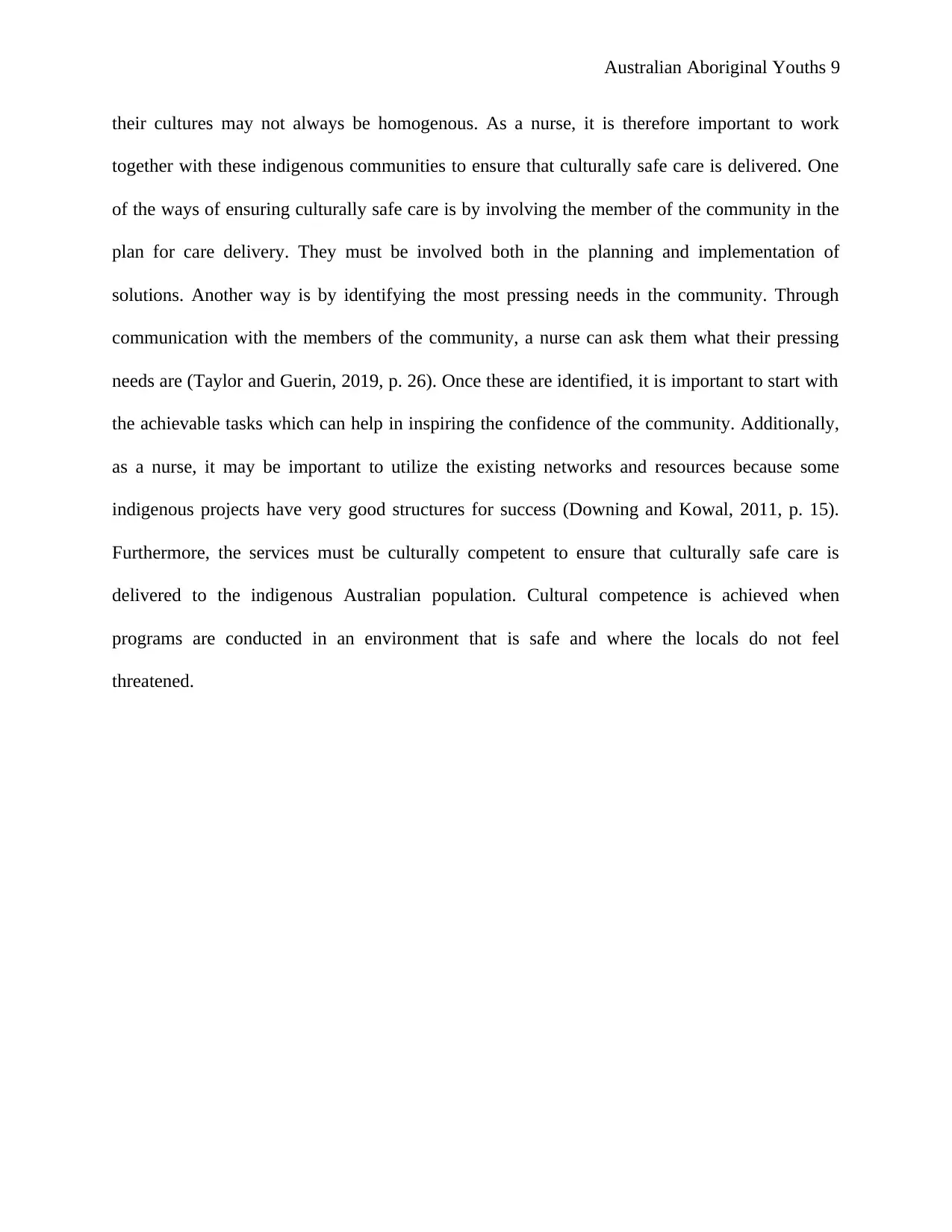
their cultures may not always be homogenous. As a nurse, it is therefore important to work
together with these indigenous communities to ensure that culturally safe care is delivered. One
of the ways of ensuring culturally safe care is by involving the member of the community in the
plan for care delivery. They must be involved both in the planning and implementation of
solutions. Another way is by identifying the most pressing needs in the community. Through
communication with the members of the community, a nurse can ask them what their pressing
needs are (Taylor and Guerin, 2019, p. 26). Once these are identified, it is important to start with
the achievable tasks which can help in inspiring the confidence of the community. Additionally,
as a nurse, it may be important to utilize the existing networks and resources because some
indigenous projects have very good structures for success (Downing and Kowal, 2011, p. 15).
Furthermore, the services must be culturally competent to ensure that culturally safe care is
delivered to the indigenous Australian population. Cultural competence is achieved when
programs are conducted in an environment that is safe and where the locals do not feel
threatened.
their cultures may not always be homogenous. As a nurse, it is therefore important to work
together with these indigenous communities to ensure that culturally safe care is delivered. One
of the ways of ensuring culturally safe care is by involving the member of the community in the
plan for care delivery. They must be involved both in the planning and implementation of
solutions. Another way is by identifying the most pressing needs in the community. Through
communication with the members of the community, a nurse can ask them what their pressing
needs are (Taylor and Guerin, 2019, p. 26). Once these are identified, it is important to start with
the achievable tasks which can help in inspiring the confidence of the community. Additionally,
as a nurse, it may be important to utilize the existing networks and resources because some
indigenous projects have very good structures for success (Downing and Kowal, 2011, p. 15).
Furthermore, the services must be culturally competent to ensure that culturally safe care is
delivered to the indigenous Australian population. Cultural competence is achieved when
programs are conducted in an environment that is safe and where the locals do not feel
threatened.
⊘ This is a preview!⊘
Do you want full access?
Subscribe today to unlock all pages.
Trusted by 1+ million students worldwide
Australian Aboriginal Youths 10
References
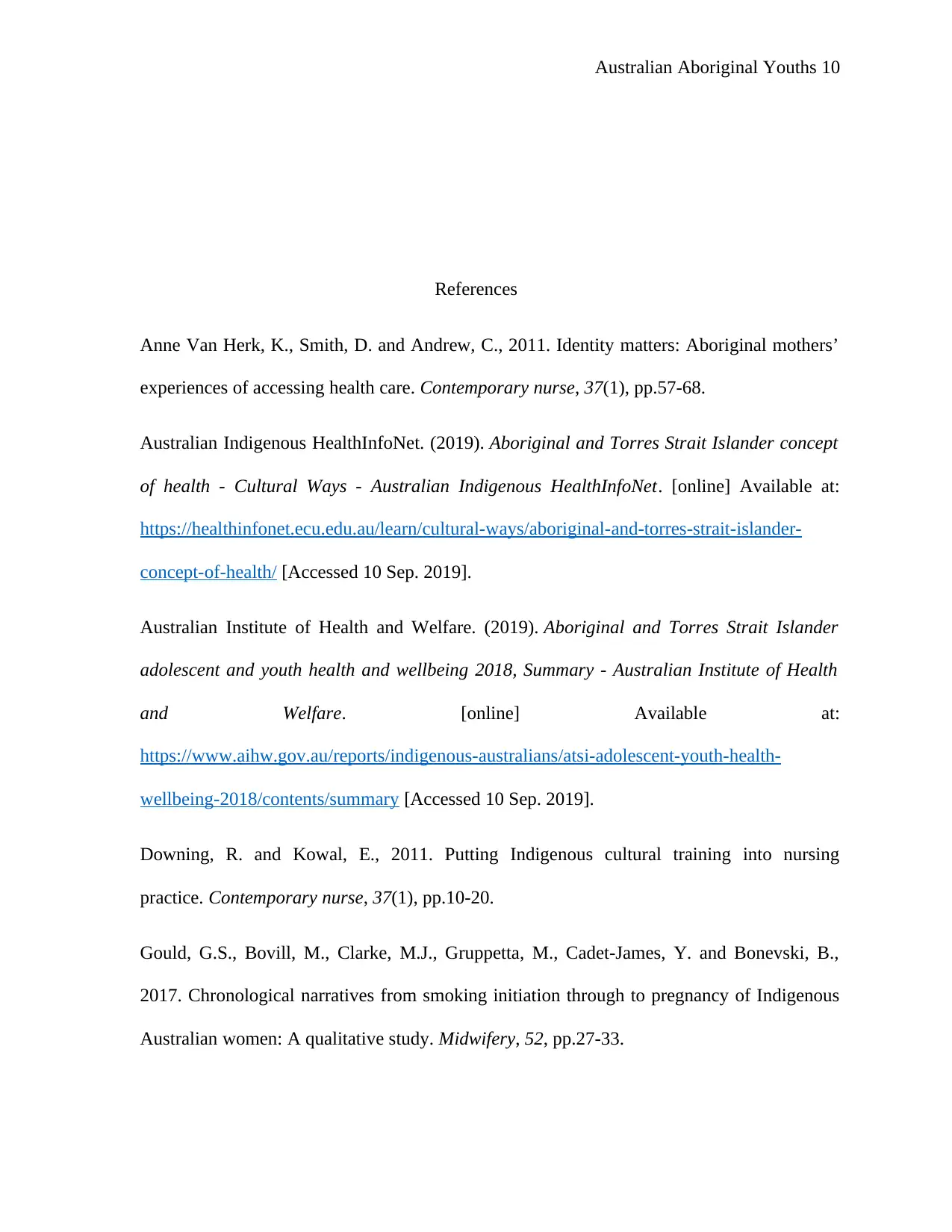
Anne Van Herk, K., Smith, D. and Andrew, C., 2011. Identity matters: Aboriginal mothers’
experiences of accessing health care. Contemporary nurse, 37(1), pp.57-68.
Australian Indigenous HealthInfoNet. (2019). Aboriginal and Torres Strait Islander concept
of health - Cultural Ways - Australian Indigenous HealthInfoNet. [online] Available at:
https://healthinfonet.ecu.edu.au/learn/cultural-ways/aboriginal-and-torres-strait-islander-
concept-of-health/ [Accessed 10 Sep. 2019].
Australian Institute of Health and Welfare. (2019). Aboriginal and Torres Strait Islander
adolescent and youth health and wellbeing 2018, Summary - Australian Institute of Health
and Welfare. [online] Available at:
https://www.aihw.gov.au/reports/indigenous-australians/atsi-adolescent-youth-health-
wellbeing-2018/contents/summary [Accessed 10 Sep. 2019].
Downing, R. and Kowal, E., 2011. Putting Indigenous cultural training into nursing
practice. Contemporary nurse, 37(1), pp.10-20.
Gould, G.S., Bovill, M., Clarke, M.J., Gruppetta, M., Cadet-James, Y. and Bonevski, B.,
2017. Chronological narratives from smoking initiation through to pregnancy of Indigenous
Australian women: A qualitative study. Midwifery, 52, pp.27-33.
References
Anne Van Herk, K., Smith, D. and Andrew, C., 2011. Identity matters: Aboriginal mothers’
experiences of accessing health care. Contemporary nurse, 37(1), pp.57-68.
Australian Indigenous HealthInfoNet. (2019). Aboriginal and Torres Strait Islander concept
of health - Cultural Ways - Australian Indigenous HealthInfoNet. [online] Available at:
https://healthinfonet.ecu.edu.au/learn/cultural-ways/aboriginal-and-torres-strait-islander-
concept-of-health/ [Accessed 10 Sep. 2019].
Australian Institute of Health and Welfare. (2019). Aboriginal and Torres Strait Islander
adolescent and youth health and wellbeing 2018, Summary - Australian Institute of Health
and Welfare. [online] Available at:
https://www.aihw.gov.au/reports/indigenous-australians/atsi-adolescent-youth-health-
wellbeing-2018/contents/summary [Accessed 10 Sep. 2019].
Downing, R. and Kowal, E., 2011. Putting Indigenous cultural training into nursing
practice. Contemporary nurse, 37(1), pp.10-20.
Gould, G.S., Bovill, M., Clarke, M.J., Gruppetta, M., Cadet-James, Y. and Bonevski, B.,
2017. Chronological narratives from smoking initiation through to pregnancy of Indigenous
Australian women: A qualitative study. Midwifery, 52, pp.27-33.
Paraphrase This Document
Need a fresh take? Get an instant paraphrase of this document with our AI Paraphraser
Australian Aboriginal Youths 11
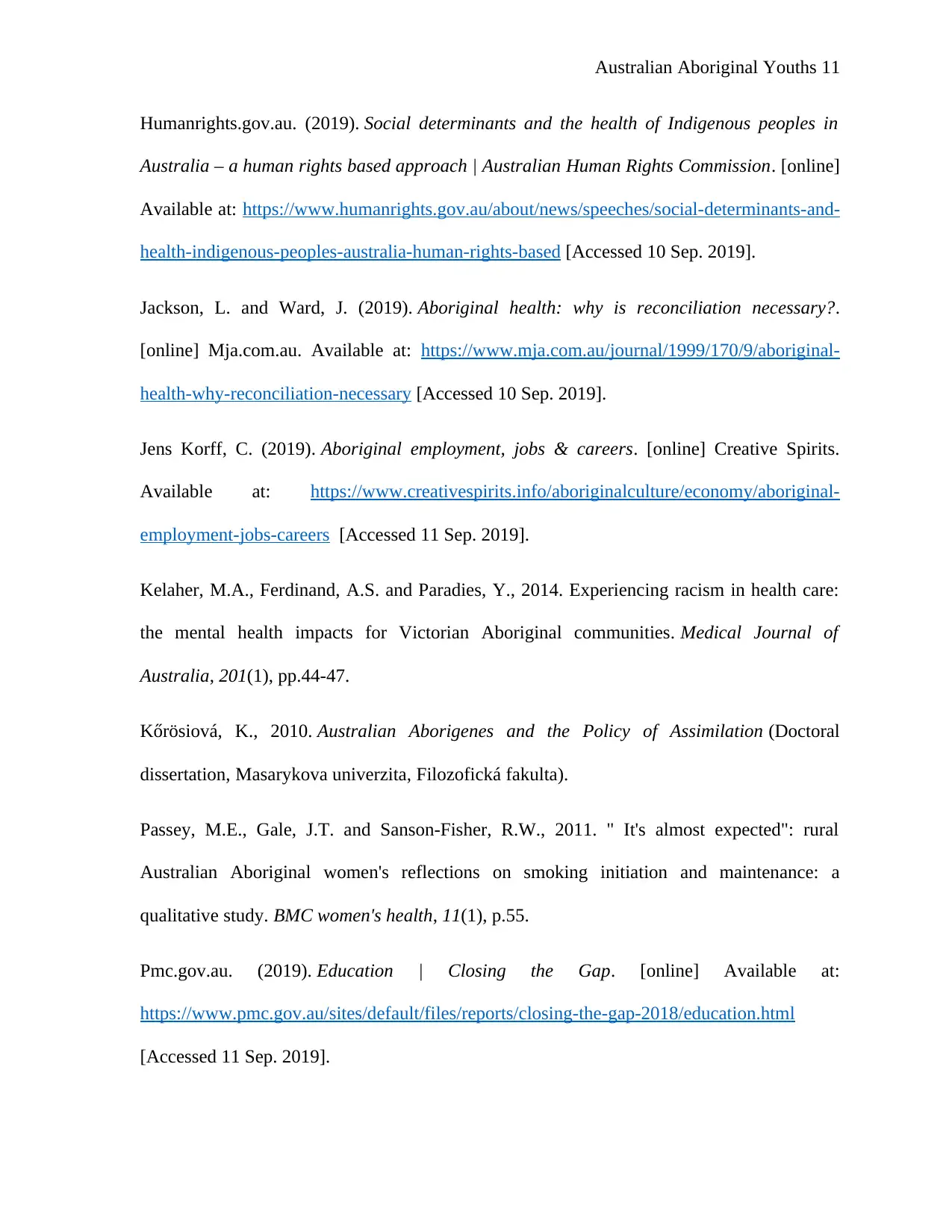
Humanrights.gov.au. (2019). Social determinants and the health of Indigenous peoples in
Australia – a human rights based approach | Australian Human Rights Commission. [online]
Available at: https://www.humanrights.gov.au/about/news/speeches/social-determinants-and-
health-indigenous-peoples-australia-human-rights-based [Accessed 10 Sep. 2019].
Jackson, L. and Ward, J. (2019). Aboriginal health: why is reconciliation necessary?.
[online] Mja.com.au. Available at: https://www.mja.com.au/journal/1999/170/9/aboriginal-
health-why-reconciliation-necessary [Accessed 10 Sep. 2019].
Jens Korff, C. (2019). Aboriginal employment, jobs & careers. [online] Creative Spirits.
Available at: https://www.creativespirits.info/aboriginalculture/economy/aboriginal-
employment-jobs-careers [Accessed 11 Sep. 2019].
Kelaher, M.A., Ferdinand, A.S. and Paradies, Y., 2014. Experiencing racism in health care:
the mental health impacts for Victorian Aboriginal communities. Medical Journal of
Australia, 201(1), pp.44-47.
Kőrösiová, K., 2010. Australian Aborigenes and the Policy of Assimilation (Doctoral
dissertation, Masarykova univerzita, Filozofická fakulta).
Passey, M.E., Gale, J.T. and Sanson-Fisher, R.W., 2011. " It's almost expected": rural
Australian Aboriginal women's reflections on smoking initiation and maintenance: a
qualitative study. BMC women's health, 11(1), p.55.
Pmc.gov.au. (2019). Education | Closing the Gap. [online] Available at:
https://www.pmc.gov.au/sites/default/files/reports/closing-the-gap-2018/education.html
[Accessed 11 Sep. 2019].
Humanrights.gov.au. (2019). Social determinants and the health of Indigenous peoples in
Australia – a human rights based approach | Australian Human Rights Commission. [online]
Available at: https://www.humanrights.gov.au/about/news/speeches/social-determinants-and-
health-indigenous-peoples-australia-human-rights-based [Accessed 10 Sep. 2019].
Jackson, L. and Ward, J. (2019). Aboriginal health: why is reconciliation necessary?.
[online] Mja.com.au. Available at: https://www.mja.com.au/journal/1999/170/9/aboriginal-
health-why-reconciliation-necessary [Accessed 10 Sep. 2019].
Jens Korff, C. (2019). Aboriginal employment, jobs & careers. [online] Creative Spirits.
Available at: https://www.creativespirits.info/aboriginalculture/economy/aboriginal-
employment-jobs-careers [Accessed 11 Sep. 2019].
Kelaher, M.A., Ferdinand, A.S. and Paradies, Y., 2014. Experiencing racism in health care:
the mental health impacts for Victorian Aboriginal communities. Medical Journal of
Australia, 201(1), pp.44-47.
Kőrösiová, K., 2010. Australian Aborigenes and the Policy of Assimilation (Doctoral
dissertation, Masarykova univerzita, Filozofická fakulta).
Passey, M.E., Gale, J.T. and Sanson-Fisher, R.W., 2011. " It's almost expected": rural
Australian Aboriginal women's reflections on smoking initiation and maintenance: a
qualitative study. BMC women's health, 11(1), p.55.
Pmc.gov.au. (2019). Education | Closing the Gap. [online] Available at:
https://www.pmc.gov.au/sites/default/files/reports/closing-the-gap-2018/education.html
[Accessed 11 Sep. 2019].
Australian Aboriginal Youths 12
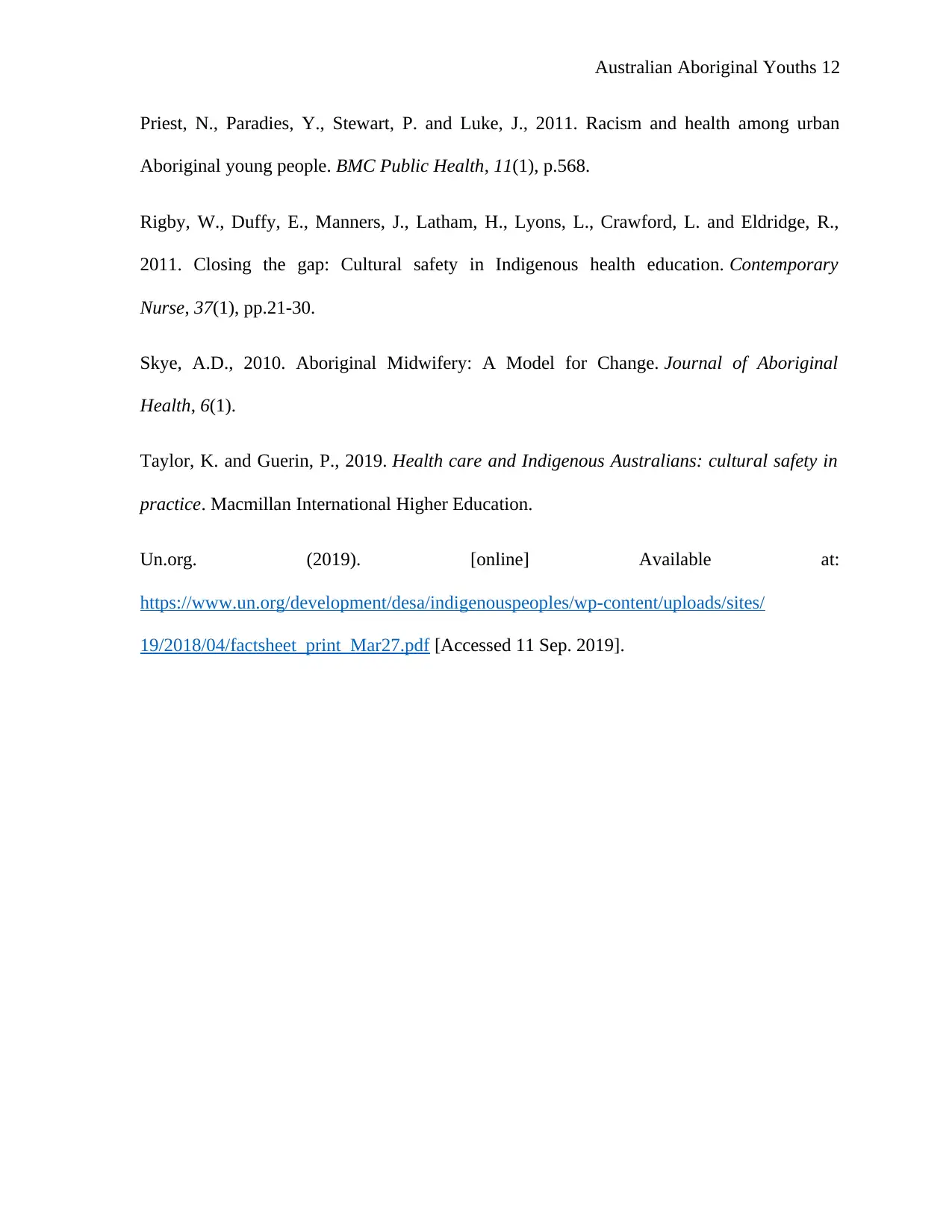
Priest, N., Paradies, Y., Stewart, P. and Luke, J., 2011. Racism and health among urban
Aboriginal young people. BMC Public Health, 11(1), p.568.
Rigby, W., Duffy, E., Manners, J., Latham, H., Lyons, L., Crawford, L. and Eldridge, R.,
2011. Closing the gap: Cultural safety in Indigenous health education. Contemporary
Nurse, 37(1), pp.21-30.
Skye, A.D., 2010. Aboriginal Midwifery: A Model for Change. Journal of Aboriginal
Health, 6(1).
Taylor, K. and Guerin, P., 2019. Health care and Indigenous Australians: cultural safety in
practice. Macmillan International Higher Education.
Un.org. (2019). [online] Available at:
https://www.un.org/development/desa/indigenouspeoples/wp-content/uploads/sites/
19/2018/04/factsheet_print_Mar27.pdf [Accessed 11 Sep. 2019].
Priest, N., Paradies, Y., Stewart, P. and Luke, J., 2011. Racism and health among urban
Aboriginal young people. BMC Public Health, 11(1), p.568.
Rigby, W., Duffy, E., Manners, J., Latham, H., Lyons, L., Crawford, L. and Eldridge, R.,
2011. Closing the gap: Cultural safety in Indigenous health education. Contemporary
Nurse, 37(1), pp.21-30.
Skye, A.D., 2010. Aboriginal Midwifery: A Model for Change. Journal of Aboriginal
Health, 6(1).
Taylor, K. and Guerin, P., 2019. Health care and Indigenous Australians: cultural safety in
practice. Macmillan International Higher Education.
Un.org. (2019). [online] Available at:
https://www.un.org/development/desa/indigenouspeoples/wp-content/uploads/sites/
19/2018/04/factsheet_print_Mar27.pdf [Accessed 11 Sep. 2019].
⊘ This is a preview!⊘
Do you want full access?
Subscribe today to unlock all pages.
Trusted by 1+ million students worldwide

1 out of 12


Related Documents


Your All-in-One AI-Powered Toolkit for Academic Success.
+13062052269
info@desklib.com
Available 24*7 on WhatsApp / Email
![[object Object]](/_next/static/media/star-bottom.7253800d.svg)
Unlock your academic potential
Copyright © 2020–2026 A2Z Services. All Rights Reserved. Developed and managed by ZUCOL.