Australian Migration Law: Visa Cancellation and Granting

Verified

Added on  2023/06/04

|6
|1598
|65
Essay
AI Summary
This essay provides an analysis of Australian migration law, specifically examining the processes of visa cancellation and granting. It explores the legal framework, including the Migration Act 1958, and the powers vested in the Minister of Immigration. The essay addresses the circumstances under which a permanent resident's visa can be cancelled, such as involvement in criminal activities or failure of the character test, and the factors considered in such decisions. It also details the procedures for visa granting, referencing relevant sections of the Act, including conditions for application and refusal. The essay highlights the significance of ministerial discretion and the limitations imposed by the law, concluding with a discussion on how legal arguments might be presented in visa-related cases. The analysis is supported by references to legal articles and legislation.
Document Page
Running head: AUSTRALIAN MIGRATION LAW
1
Australian Migration Law
Name:
Institutional Affiliation:
tabler-icon-diamond-filled.svg

Paraphrase This Document

Need a fresh take? Get an instant paraphrase of this document with our AI Paraphraser
Document Page
AUSTRALIAN MIGRATION LAW 2
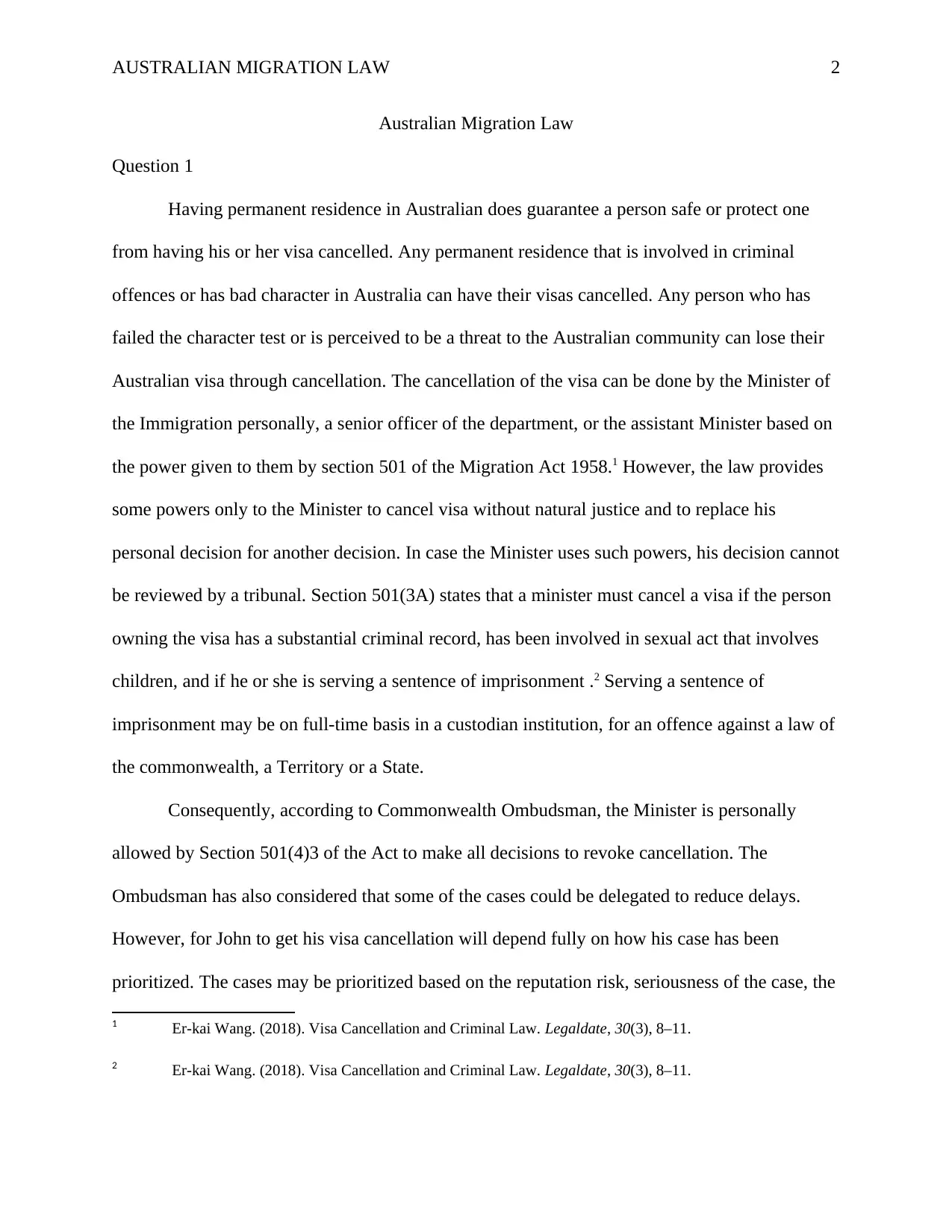
Australian Migration Law
Question 1
Having permanent residence in Australian does guarantee a person safe or protect one
from having his or her visa cancelled. Any permanent residence that is involved in criminal
offences or has bad character in Australia can have their visas cancelled. Any person who has
failed the character test or is perceived to be a threat to the Australian community can lose their
Australian visa through cancellation. The cancellation of the visa can be done by the Minister of
the Immigration personally, a senior officer of the department, or the assistant Minister based on
the power given to them by section 501 of the Migration Act 1958.1 However, the law provides
some powers only to the Minister to cancel visa without natural justice and to replace his
personal decision for another decision. In case the Minister uses such powers, his decision cannot
be reviewed by a tribunal. Section 501(3A) states that a minister must cancel a visa if the person
owning the visa has a substantial criminal record, has been involved in sexual act that involves
children, and if he or she is serving a sentence of imprisonment .2 Serving a sentence of
imprisonment may be on full-time basis in a custodian institution, for an offence against a law of
the commonwealth, a Territory or a State.
Consequently, according to Commonwealth Ombudsman, the Minister is personally
allowed by Section 501(4)3 of the Act to make all decisions to revoke cancellation. The
Ombudsman has also considered that some of the cases could be delegated to reduce delays.
However, for John to get his visa cancellation will depend fully on how his case has been
prioritized. The cases may be prioritized based on the reputation risk, seriousness of the case, the
1 Er-kai Wang. (2018). Visa Cancellation and Criminal Law. Legaldate, 30(3), 8–11.
2 Er-kai Wang. (2018). Visa Cancellation and Criminal Law. Legaldate, 30(3), 8–11.
Document Page
AUSTRALIAN MIGRATION LAW 3
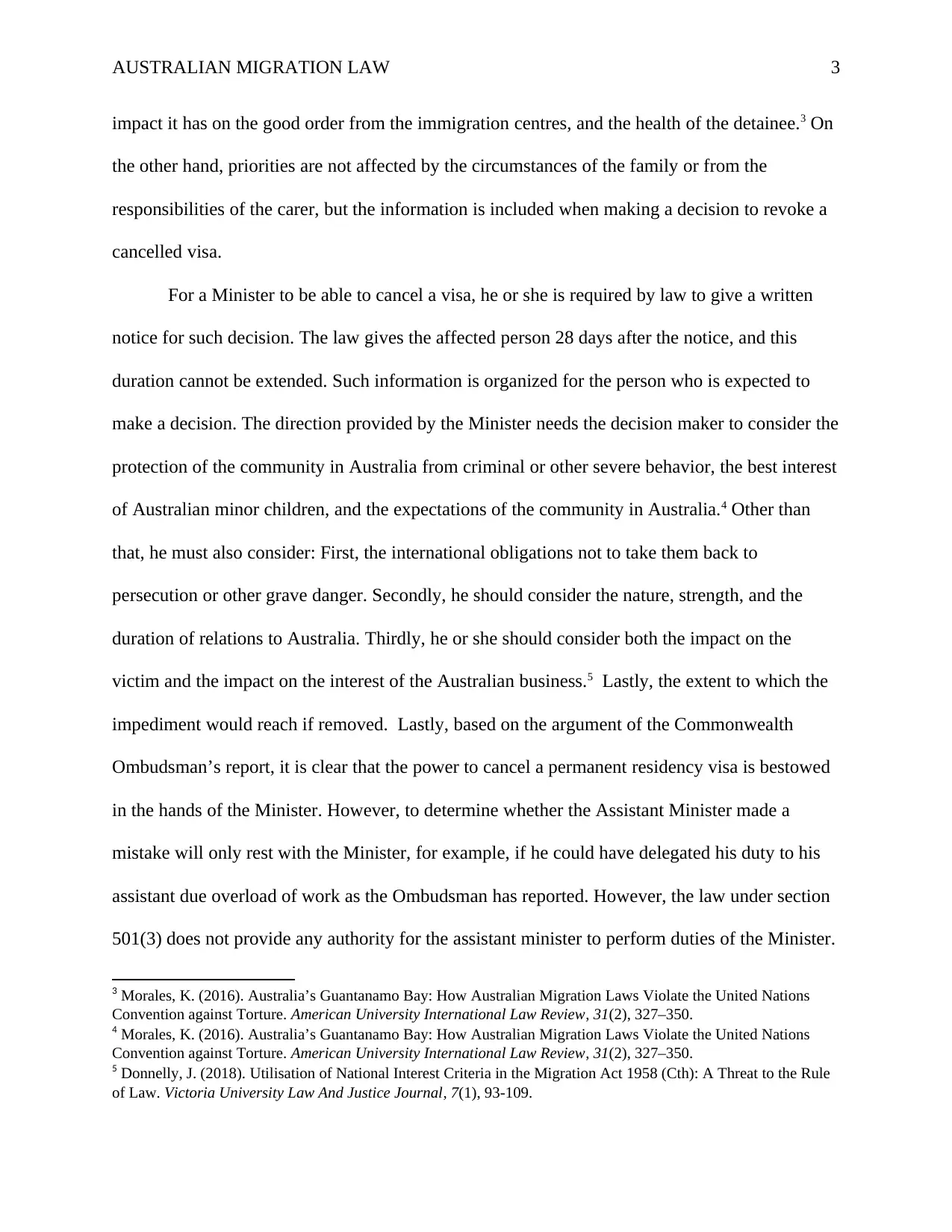
impact it has on the good order from the immigration centres, and the health of the detainee.3 On
the other hand, priorities are not affected by the circumstances of the family or from the
responsibilities of the carer, but the information is included when making a decision to revoke a
cancelled visa.
For a Minister to be able to cancel a visa, he or she is required by law to give a written
notice for such decision. The law gives the affected person 28 days after the notice, and this
duration cannot be extended. Such information is organized for the person who is expected to
make a decision. The direction provided by the Minister needs the decision maker to consider the
protection of the community in Australia from criminal or other severe behavior, the best interest
of Australian minor children, and the expectations of the community in Australia.4 Other than
that, he must also consider: First, the international obligations not to take them back to
persecution or other grave danger. Secondly, he should consider the nature, strength, and the
duration of relations to Australia. Thirdly, he or she should consider both the impact on the
victim and the impact on the interest of the Australian business.5 Lastly, the extent to which the
impediment would reach if removed. Lastly, based on the argument of the Commonwealth
Ombudsman’s report, it is clear that the power to cancel a permanent residency visa is bestowed
in the hands of the Minister. However, to determine whether the Assistant Minister made a
mistake will only rest with the Minister, for example, if he could have delegated his duty to his
assistant due overload of work as the Ombudsman has reported. However, the law under section
501(3) does not provide any authority for the assistant minister to perform duties of the Minister.
3 Morales, K. (2016). Australia’s Guantanamo Bay: How Australian Migration Laws Violate the United Nations
Convention against Torture. American University International Law Review, 31(2), 327–350.
4 Morales, K. (2016). Australia’s Guantanamo Bay: How Australian Migration Laws Violate the United Nations
Convention against Torture. American University International Law Review, 31(2), 327–350.
5 Donnelly, J. (2018). Utilisation of National Interest Criteria in the Migration Act 1958 (Cth): A Threat to the Rule
of Law. Victoria University Law And Justice Journal, 7(1), 93-109.
Document Page
AUSTRALIAN MIGRATION LAW 4
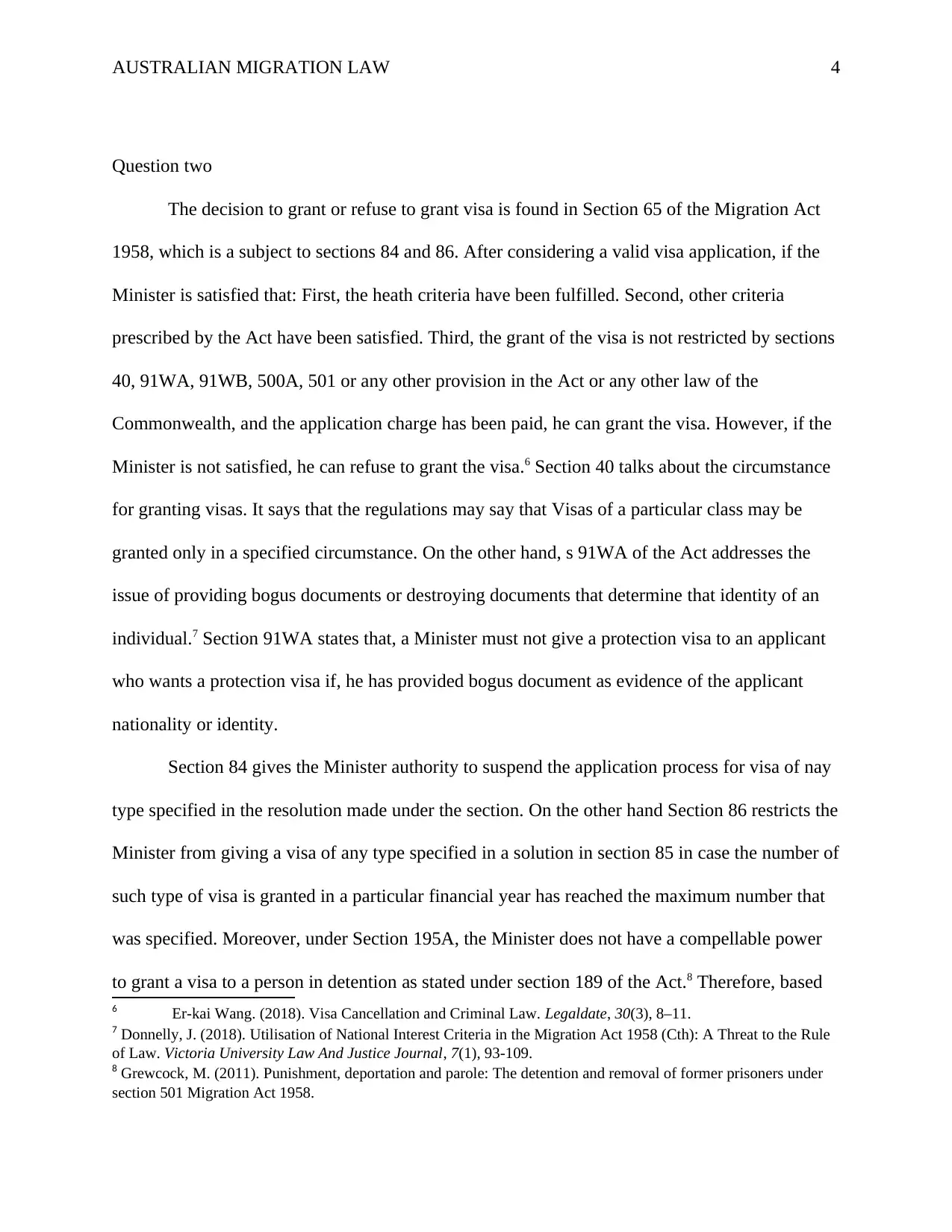
Question two
The decision to grant or refuse to grant visa is found in Section 65 of the Migration Act
1958, which is a subject to sections 84 and 86. After considering a valid visa application, if the
Minister is satisfied that: First, the heath criteria have been fulfilled. Second, other criteria
prescribed by the Act have been satisfied. Third, the grant of the visa is not restricted by sections
40, 91WA, 91WB, 500A, 501 or any other provision in the Act or any other law of the
Commonwealth, and the application charge has been paid, he can grant the visa. However, if the
Minister is not satisfied, he can refuse to grant the visa.6 Section 40 talks about the circumstance
for granting visas. It says that the regulations may say that Visas of a particular class may be
granted only in a specified circumstance. On the other hand, s 91WA of the Act addresses the
issue of providing bogus documents or destroying documents that determine that identity of an
individual.7 Section 91WA states that, a Minister must not give a protection visa to an applicant
who wants a protection visa if, he has provided bogus document as evidence of the applicant
nationality or identity.
Section 84 gives the Minister authority to suspend the application process for visa of nay
type specified in the resolution made under the section. On the other hand Section 86 restricts the
Minister from giving a visa of any type specified in a solution in section 85 in case the number of
such type of visa is granted in a particular financial year has reached the maximum number that
was specified. Moreover, under Section 195A, the Minister does not have a compellable power
to grant a visa to a person in detention as stated under section 189 of the Act.8 Therefore, based
6 Er-kai Wang. (2018). Visa Cancellation and Criminal Law. Legaldate, 30(3), 8–11.
7 Donnelly, J. (2018). Utilisation of National Interest Criteria in the Migration Act 1958 (Cth): A Threat to the Rule
of Law. Victoria University Law And Justice Journal, 7(1), 93-109.
8 Grewcock, M. (2011). Punishment, deportation and parole: The detention and removal of former prisoners under
section 501 Migration Act 1958.
tabler-icon-diamond-filled.svg

Paraphrase This Document

Need a fresh take? Get an instant paraphrase of this document with our AI Paraphraser
Document Page
AUSTRALIAN MIGRATION LAW 5
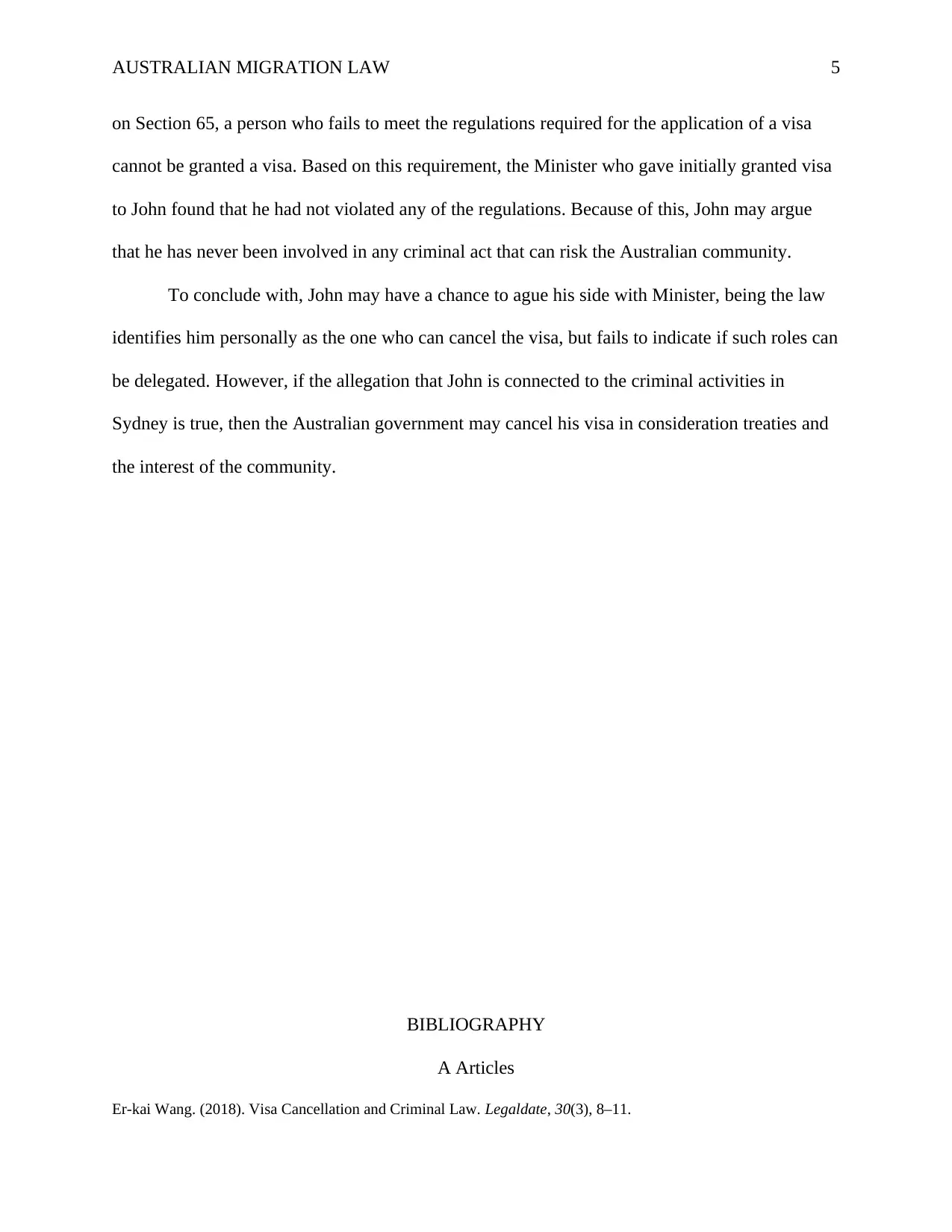
on Section 65, a person who fails to meet the regulations required for the application of a visa
cannot be granted a visa. Based on this requirement, the Minister who gave initially granted visa
to John found that he had not violated any of the regulations. Because of this, John may argue
that he has never been involved in any criminal act that can risk the Australian community.
To conclude with, John may have a chance to ague his side with Minister, being the law
identifies him personally as the one who can cancel the visa, but fails to indicate if such roles can
be delegated. However, if the allegation that John is connected to the criminal activities in
Sydney is true, then the Australian government may cancel his visa in consideration treaties and
the interest of the community.
BIBLIOGRAPHY
A Articles
Er-kai Wang. (2018). Visa Cancellation and Criminal Law. Legaldate, 30(3), 8–11.
Document Page
AUSTRALIAN MIGRATION LAW 6
Grewcock, M. (2011). Punishment, deportation and parole: The detention and removal of former prisoners under
section 501 Migration Act 1958.
Morales, K. (2016). Australia’s Guantanamo Bay: How Australian Migration Laws Violate the United Nations
Convention against Torture. American University International Law Review, 31(2), 327–350.
Donnelly, J. (2018). Utilisation of National Interest Criteria in the Migration Act 1958 (Cth): A Threat to the Rule of
Law. Victoria University Law And Justice Journal, 7(1), 93-109.
B Legislation
Migration Act 1958 (Cth)
chevron_up_icon
1 out of 6
circle_padding
hide_on_mobile
zoom_out_icon
[object Object]