Holmes Institute HI5003: Economics of the Australian Mining Industry

Verified

Added on  2022/11/10

|14
|848
|223
Report
AI Summary
This report analyzes the Australian mining industry, focusing on its economic aspects. It begins with an introduction to Australia's resource wealth, particularly in minerals, and the significance of the mining industry, which contributes significantly to exports and GDP. The report outlines the mining industry's background, including key minerals and its oligopolistic market structure dominated by a few large firms. It then delves into the resource boom that started in 2003, examining its causes and impacts on the mining industry, such as increased production, employment, and revenue, as well as the broader Australian economy, including impacts on GDP, employment, and living standards. The report also discusses government policy during the boom and concludes by emphasizing the mining industry's crucial role in Australia's economy. The analysis includes figures illustrating exports, market structure, demand and supply dynamics, and macroeconomic equilibrium, supported by references to relevant academic sources.

Document Page
Economics for Business
Name of the Student
Name of the University
Author Note
tabler-icon-diamond-filled.svg

Paraphrase This Document

Need a fresh take? Get an instant paraphrase of this document with our AI Paraphraser
Document Page
INTRODUCTION
Australia: enviable amount of wealth
Abandon stock of resources
Raw material for most industries
Minerals export comprises 35 percent of export
World largest exporter of coal
Nickel, copper, aluminum, silver, diamonds and other precious metals
Resources boom started since 2003
Document Page
MINING INDUSTRY’S BACKGROUND
Several minerals, hydrocarbon and non-mineral reserves
A well-developed mining industry
Iron ore, gold, zinc, lead and nickel
Contribute 50 to 60 percent of total export
7 percent of Australia’s GDP
370 acting mining sites
Western Australia, New South Wales and Queensland
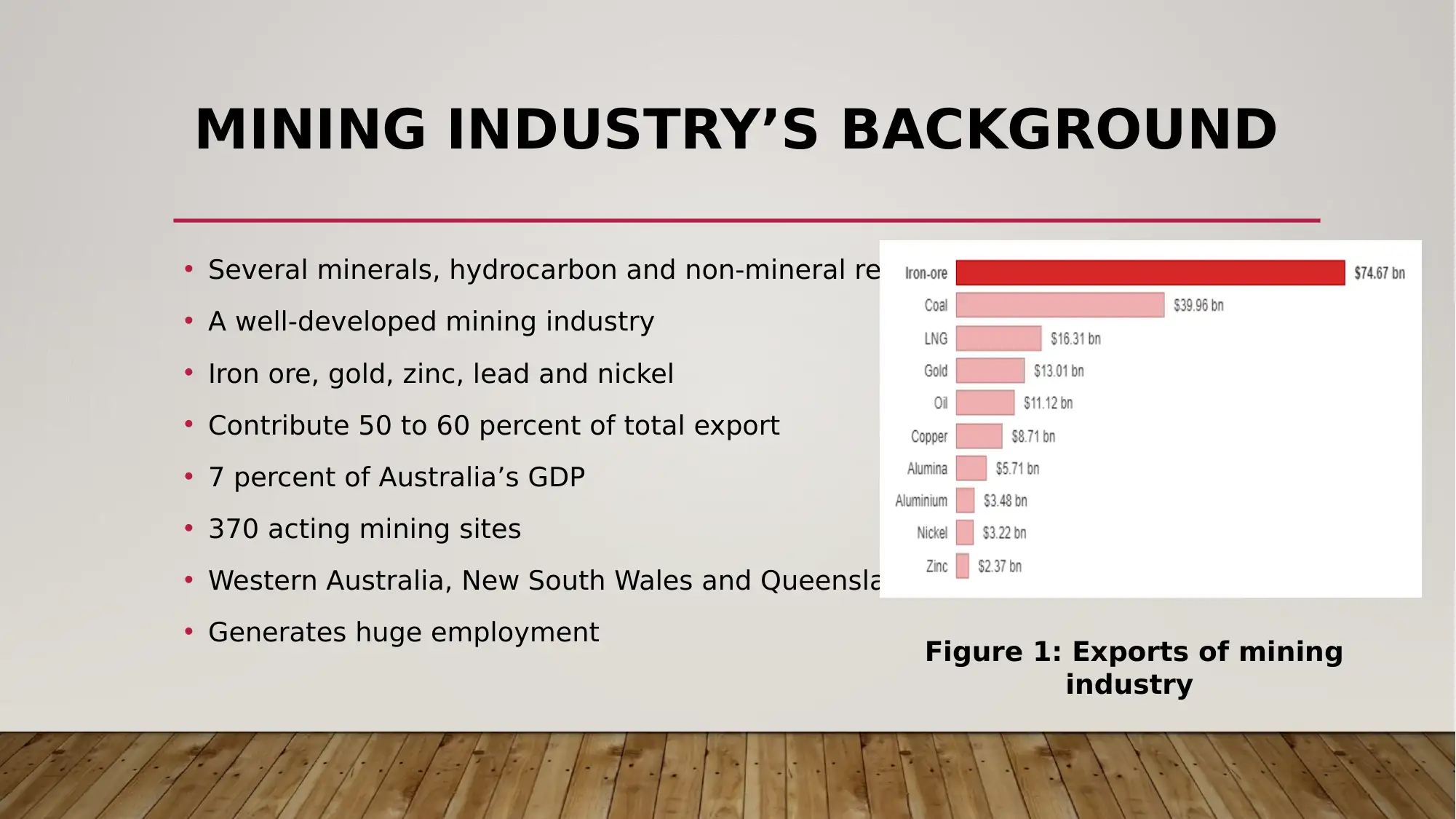
Generates huge employment Figure 1: Exports of mining
industry
Document Page
MARKET STRUCTURE OF MINING
INDUSTRY
High concentration ratio in mining
Concentrated among few firms
1300 mining companies
Few large firms dominate
BHP Billiton, Shell, Chevron and Rio Tinto
Homogenous oligopoly market.
Restricted entry: huge capital requirement.
tabler-icon-diamond-filled.svg

Paraphrase This Document

Need a fresh take? Get an instant paraphrase of this document with our AI Paraphraser
Document Page
RESOURCE BOOM IN AUSTRALIA
Resource boom
Most important event
Began since 2003
Favorable terms of trade and exchange rate
Growing resource demand from emerging Asia
Increase in global commodity
Growing investment in resource sector
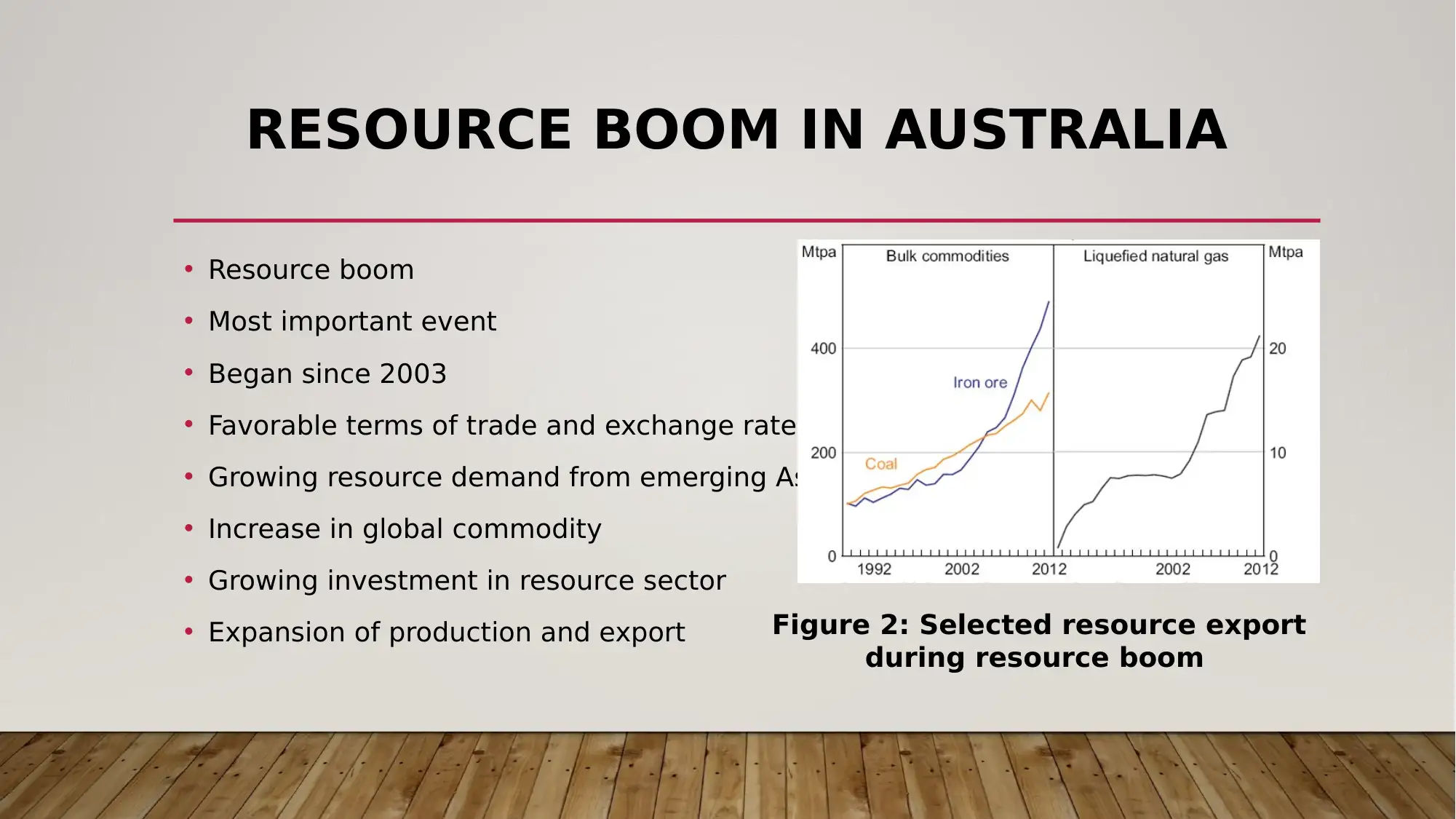
Expansion of production and export Figure 2: Selected resource export
during resource boom
Document Page
IMPACT ON MINING INDUSTRY
Long standing implication for mining industry
Mining related construction and business service expanded
Mining companies benefitted significantly
Enjoyed economies of scale
Rapid increase in price of coal and iron ore
Focus shifted towards these two sub sectors.
Contribution to GDP increased
Document Page
IMPACT ON MINING INDUSTRY
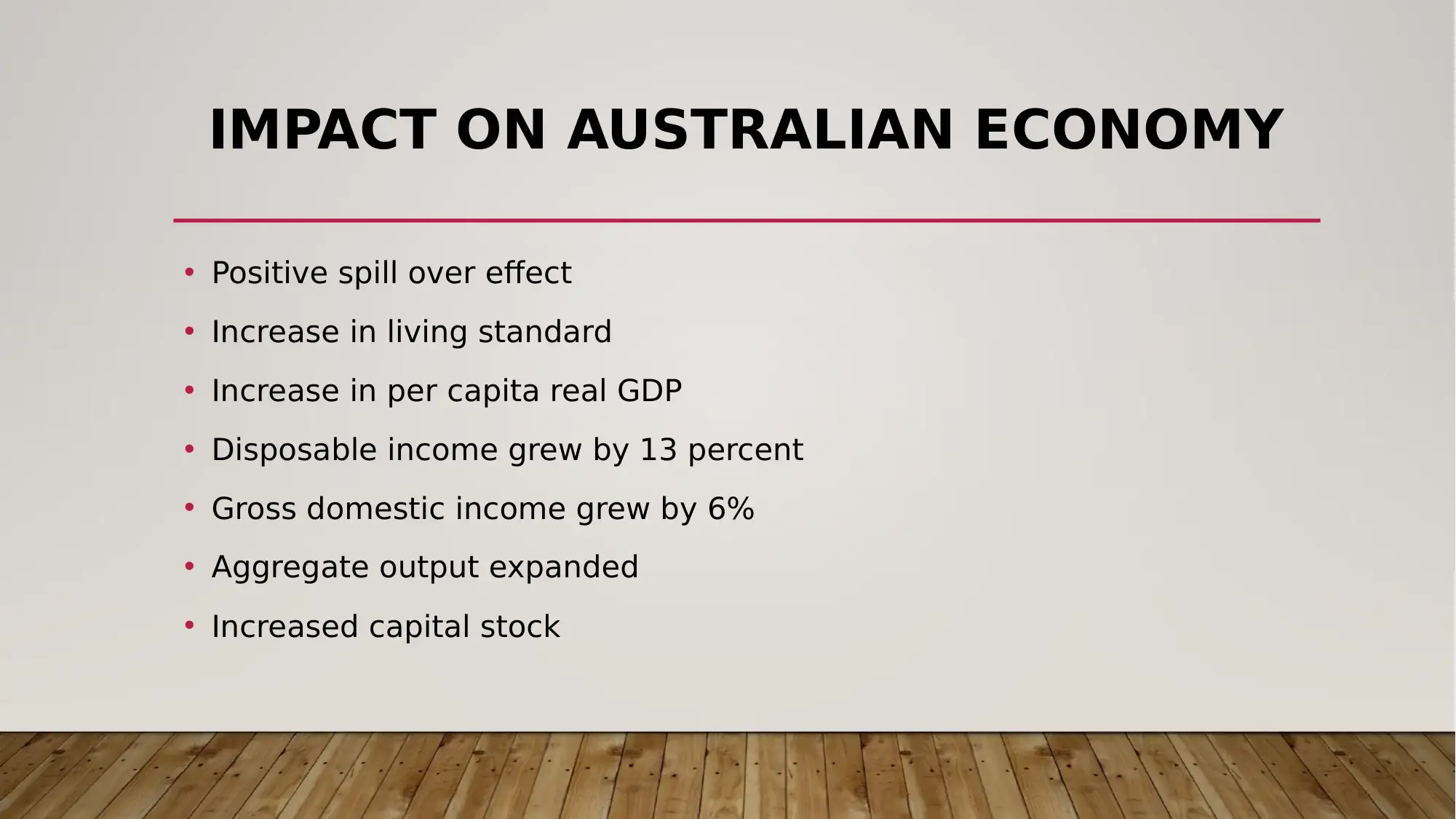
Account 14% of GDP by end of resource boom
Revenue increased
Investment expanded
Increase in employment opportunities
Employment grew by 0.7%
Mining output grew by 3%
Increased demand, higher growth of the sector
Figure 3: Demand and supply
analysis of mining industry
tabler-icon-diamond-filled.svg

Paraphrase This Document

Need a fresh take? Get an instant paraphrase of this document with our AI Paraphraser
Document Page
IMPACT ON AUSTRALIAN ECONOMY
Positive spill over effect
Increase in living standard
Increase in per capita real GDP
Disposable income grew by 13 percent
Gross domestic income grew by 6%
Aggregate output expanded
Increased capital stock
Document Page
IMPACT ON AUSTRALIAN ECONOMY
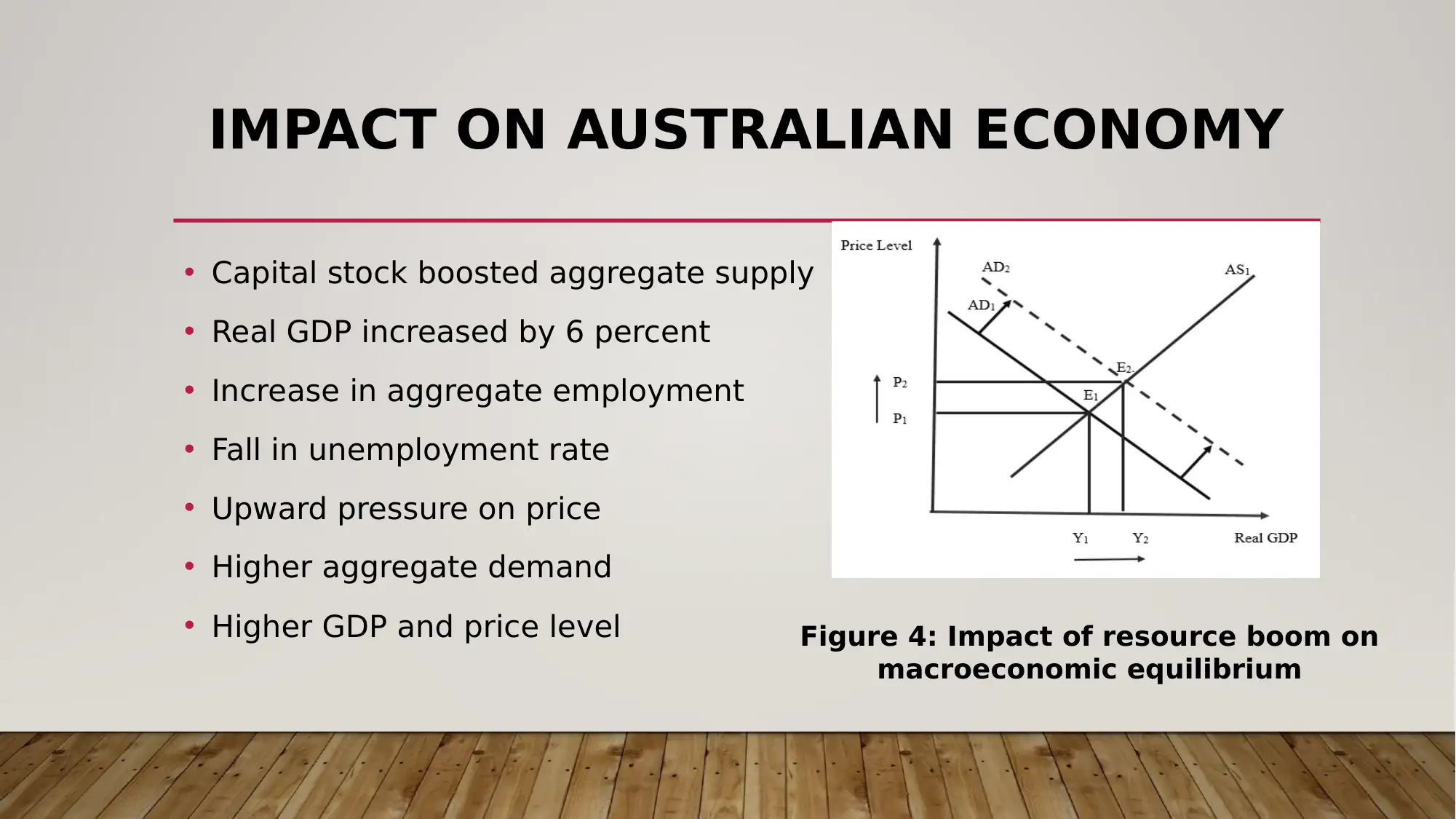
Capital stock boosted aggregate supply
Real GDP increased by 6 percent
Increase in aggregate employment
Fall in unemployment rate
Upward pressure on price
Higher aggregate demand
Higher GDP and price level Figure 4: Impact of resource boom on
macroeconomic equilibrium
Document Page
GOVERNMENT POLICY
Appropriate policy measure during resource boom
Strong fiscal position
Net debt: only 6.1% of GDP
More restrictive fiscal policy
Lower government expenditure
Government withdrawn nearly $50 billion
Fund to be invested during recession
tabler-icon-diamond-filled.svg

Paraphrase This Document

Need a fresh take? Get an instant paraphrase of this document with our AI Paraphraser
Document Page
CONCLUSION
Mining industry: one crucial sector
Huge stock of natural resources
Contribute to GDP, employment and export earning
Oligopolistic market structure
Resource boom since 2000
Favorable terms of trade, exchange rate, increase in global commodity
price
Expansion of mining sector and the Australian economy
Document Page
REFERENCES
Bashar, O.H., 2015. The Trickle‐down Effect of the Mining Boom in Australia: Fact or
Myth?. Economic record, 91, pp.94-108.
Besanko, D. and Braeutigam, R., 2013. Microeconomics. John Wiley & Sons.
Brueckner, M., Durey, A., Mayes, R. and Pforr, C., 2013. The mining boom and Western Australia’s
changing landscape: Towards sustainability or business as usual?. Rural Society, 22(2), pp.111-
124.
Connolly, E. and Orsmond, D. 2013. The Mining Industry: From Bust to Boom. [online]
Rba.gov.au. Available at: https://www.rba.gov.au/publications/confs/2011/pdf/connolly-
orsmond.pdf [Accessed 18 Sep. 2019].
Ergas, H. and Pincus, J., 2014. Have mining royalties been beneficial to Australia?. Economic
Papers: A journal of applied economics and policy, 33(1), pp.13-28.
chevron_up_icon
1 out of 14
circle_padding
hide_on_mobile
zoom_out_icon
[object Object]