Australian Public Sector: Key Influencers of Employee Engagement
VerifiedAdded on 2023/04/24
|19
|4685
|259
Report
AI Summary
This report investigates the factors influencing employee engagement within the Australian Public Sector, utilizing data from the Public Sector Commission and the 2018 Employee Perception Survey. It highlights the significance of employee engagement for organizational success, noting the correlation between engagement levels and financial performance. The research identifies key drivers of engagement, including communication, recognition, career development opportunities, organizational commitment, culture, and leadership. The methodology employs a causal research design, targeting employees in public sector agencies and using structured questionnaires for data collection. Statistical analyses, including reliability tests, Pearson correlation, and multiple regression analysis, were used to analyze the data and identify significant factors impacting employee engagement. The study model focuses on the impact of factors such as supervisor performance, team dynamics, job empowerment, and ethical behavior on employee engagement.
RUNNING HEADER: INFLUENCERS OF EMPLOYEE ENGAGEMENT IN THE AUSTRALIAN PUBLIC SECTOR 1
Influencers of employee engagement in the Australian Public Sector
Student’s name:
Student’s ID:
Institution:
Influencers of employee engagement in the Australian Public Sector
Student’s name:
Student’s ID:
Institution:

Paraphrase This Document
Need a fresh take? Get an instant paraphrase of this document with our AI Paraphraser
Influencers of Employee Engagement in the Australian Public Sector 2
INTRODUCTION
Background
Employee engagement is referred to like the outcome of the perception of employees with
regards to their work, organization’s leadership, the rewards and recognition they receive and the
ethos of communication of their organization (Sanchez, 2007). Hence, employee engagement can
be deduced to be the desirable circumstances which have the intentions of an organization which
represents commitment, passion, enthusiasm, focused energy, effort, and involvement. As a
result, employee engagement contains both behavioral and attitudinal aspects.
In the contemporary world, employee engagement is new. Majority of the organization perceive
that the staff work for the salary or wages which they are given. On the contrary, this rational is
faulty and outdated. Employee engagement is affected by other non-financial factors which
include autonomy, advancement, environment, employer commitment, civilized treatment,
praise, exposure to senior people, support, the feeling of working on important tasks, the feeling
of working for a dependable organization, the feeling of being challenged and trusted, and the
feeling of esteem in work-life balance (Anitha, 2014). According to Bhuvanaiah & Raya (2015),
most of the major companies are providing tools that assess the drivers which enrich employee
engagement.
According to Cook et al (2013), the Social Exchange Theory (SE) claims that a series of
interactions between parties has the ability to generate obligations which are in mutual
interdependence state. Relationships are believed to develop into a loyal, mutual and trusting
commitment which can be paid back by individuals to the organizations through employee
engagement (Shiau & Luo (2012). According to (Soieb, Othman & D’Silva, 2013), a linkage
INTRODUCTION
Background
Employee engagement is referred to like the outcome of the perception of employees with
regards to their work, organization’s leadership, the rewards and recognition they receive and the
ethos of communication of their organization (Sanchez, 2007). Hence, employee engagement can
be deduced to be the desirable circumstances which have the intentions of an organization which
represents commitment, passion, enthusiasm, focused energy, effort, and involvement. As a
result, employee engagement contains both behavioral and attitudinal aspects.
In the contemporary world, employee engagement is new. Majority of the organization perceive
that the staff work for the salary or wages which they are given. On the contrary, this rational is
faulty and outdated. Employee engagement is affected by other non-financial factors which
include autonomy, advancement, environment, employer commitment, civilized treatment,
praise, exposure to senior people, support, the feeling of working on important tasks, the feeling
of working for a dependable organization, the feeling of being challenged and trusted, and the
feeling of esteem in work-life balance (Anitha, 2014). According to Bhuvanaiah & Raya (2015),
most of the major companies are providing tools that assess the drivers which enrich employee
engagement.
According to Cook et al (2013), the Social Exchange Theory (SE) claims that a series of
interactions between parties has the ability to generate obligations which are in mutual
interdependence state. Relationships are believed to develop into a loyal, mutual and trusting
commitment which can be paid back by individuals to the organizations through employee
engagement (Shiau & Luo (2012). According to (Soieb, Othman & D’Silva, 2013), a linkage
Influencers of Employee Engagement in the Australian Public Sector 3
between employee engagement and leadership needs to exist to act as the best success source.
According to Fahy, Weiner & Roche (2005), engaged staff always feel eager in their work
thereby providing an enhancement in supporting the company advance onward.
Justification
Engagement is vital in an organization since detachment of any worker results in a deficiency of
motivation and an absence of commitment to work by employees. Ideally, highly engaged staff
accomplish 20% more than staff with a typical engagement level (Council, 2004). Moreover,
Kompaso & Sridevi (2010) show that organizations which have higher levels of engagement
noticed an increase in operating margin by 3.74 percent and an increase in profits by 2.06 percent
in a one-year period. On the other hand, organizations with lower engagement levels had a fall in
operating margin and profits by 2 percent and 1.38 percent respectively. According to Seijts &
Crim (2006) with an increase of 7 percent in employee engagement, there is a 5 percent increase
in operating margin. Hence, an employee who is highly engaged provides an output that is
beyond the expectations. Research carried out by Harter, Schmidt & Hayes (2002) found out that
five staff approve that they have a chance to do what they do best daily. Hence, employee
engagement is vital to the triumph of any company. With the globalization of organizations and
dependency technologies in the latest, there is a need to always engage employees to present
them a company’s identity (Vazirani, 2007).
The significance of the research
The following research focuses on current employee engagement in the Australia public sector.
The causes of disengagement among employees will be identified to help companies choose
between employee engagement and leadership needs to exist to act as the best success source.
According to Fahy, Weiner & Roche (2005), engaged staff always feel eager in their work
thereby providing an enhancement in supporting the company advance onward.
Justification
Engagement is vital in an organization since detachment of any worker results in a deficiency of
motivation and an absence of commitment to work by employees. Ideally, highly engaged staff
accomplish 20% more than staff with a typical engagement level (Council, 2004). Moreover,
Kompaso & Sridevi (2010) show that organizations which have higher levels of engagement
noticed an increase in operating margin by 3.74 percent and an increase in profits by 2.06 percent
in a one-year period. On the other hand, organizations with lower engagement levels had a fall in
operating margin and profits by 2 percent and 1.38 percent respectively. According to Seijts &
Crim (2006) with an increase of 7 percent in employee engagement, there is a 5 percent increase
in operating margin. Hence, an employee who is highly engaged provides an output that is
beyond the expectations. Research carried out by Harter, Schmidt & Hayes (2002) found out that
five staff approve that they have a chance to do what they do best daily. Hence, employee
engagement is vital to the triumph of any company. With the globalization of organizations and
dependency technologies in the latest, there is a need to always engage employees to present
them a company’s identity (Vazirani, 2007).
The significance of the research
The following research focuses on current employee engagement in the Australia public sector.
The causes of disengagement among employees will be identified to help companies choose
⊘ This is a preview!⊘
Do you want full access?
Subscribe today to unlock all pages.

Trusted by 1+ million students worldwide
Influencers of Employee Engagement in the Australian Public Sector 4
appropriate strategies. Data for the research was derived from the Public Sector Commission.
The Public Sector Commission is committed to engagement of employees and selection of
practices which are according to the needs and wants of the employees that are very
indispensable for achieving the goals of an organization.
Research aim and objectives
Aim
To recognize the factors which influence employee engagement among in the public
sector in Australia
Research questions
What are the current levels of employee engagement in the public sector in Australia?
What set of practices aid employee engagement in the public sector in Australia?
LITERATURE REVIEW
According to Verčič, Verčič, & Sriramesh (2012). employees appreciate their roles better when
there is better communication which contributes to an organizations success. A study by CIPD
showed that having a progression in one’s career and being well-versed are the two greatest
drivers of engagement. The research shows that employees need to be communicated to
efficiently regarding the modifications that need to be made in the organization beforehand so as
to evade confusion among employees. Communication plays a crucial part and is an employee
appropriate strategies. Data for the research was derived from the Public Sector Commission.
The Public Sector Commission is committed to engagement of employees and selection of
practices which are according to the needs and wants of the employees that are very
indispensable for achieving the goals of an organization.
Research aim and objectives
Aim
To recognize the factors which influence employee engagement among in the public
sector in Australia
Research questions
What are the current levels of employee engagement in the public sector in Australia?
What set of practices aid employee engagement in the public sector in Australia?
LITERATURE REVIEW
According to Verčič, Verčič, & Sriramesh (2012). employees appreciate their roles better when
there is better communication which contributes to an organizations success. A study by CIPD
showed that having a progression in one’s career and being well-versed are the two greatest
drivers of engagement. The research shows that employees need to be communicated to
efficiently regarding the modifications that need to be made in the organization beforehand so as
to evade confusion among employees. Communication plays a crucial part and is an employee
Paraphrase This Document
Need a fresh take? Get an instant paraphrase of this document with our AI Paraphraser
Influencers of Employee Engagement in the Australian Public Sector 5
engagement key driver. According to Hoffman & Tschinda, (2007), an effective and efficient
company need to know how to communicate its objective and goals to its workforce. According
to Popli & Rizvi (2016), employees need to feel that their efforts needs to be recognized in the
form of daily casual recognition. Apart from this, appropriate recognition helps in building a
psychological contract where the employers value their employees and the employees feel that
they are being appreciated. Hence, it surges the commitment of employees which in turn leads to
an improved work rate and reduced employees’ turnover. According to Lockwood (2007), an
organization which communicates its company goals and objectives clearly and effectively
improves its employer and employee relations thereby leading to better engagement.
ASTD research conducted on employee engagement showed that more than 50 percent of the
staff claimed that the training quality and earning prospects have a strong influence on employee
engagement. ASTD’s study found out that majority of the employees seek for some appreciation
for their work which acts as an extra mm rather than placing too much stress on their
weaknesses. Conversely (Bernthal & Erker, 2004) provided evidence which showed that most
employees leave the organization for opportunities of career growth which are obtainable by
other organizations. According to Harrison (2012), the majority of the staff feel enthusiastic at
the workroom when there is a space for building and learning new investments and skills in
growth curricula which relate to the financial accomplishment of an organization.
According to Pandey & Khare (2012), the commitment of an organization has major significance
in the study of engagement of employees. Organizational commitment entails the physiological
attachment of an individual to a company and the desire to remain part of it. There is three
component of commitment as defined by Meyer & Maltin (2010). The first, affective
engagement key driver. According to Hoffman & Tschinda, (2007), an effective and efficient
company need to know how to communicate its objective and goals to its workforce. According
to Popli & Rizvi (2016), employees need to feel that their efforts needs to be recognized in the
form of daily casual recognition. Apart from this, appropriate recognition helps in building a
psychological contract where the employers value their employees and the employees feel that
they are being appreciated. Hence, it surges the commitment of employees which in turn leads to
an improved work rate and reduced employees’ turnover. According to Lockwood (2007), an
organization which communicates its company goals and objectives clearly and effectively
improves its employer and employee relations thereby leading to better engagement.
ASTD research conducted on employee engagement showed that more than 50 percent of the
staff claimed that the training quality and earning prospects have a strong influence on employee
engagement. ASTD’s study found out that majority of the employees seek for some appreciation
for their work which acts as an extra mm rather than placing too much stress on their
weaknesses. Conversely (Bernthal & Erker, 2004) provided evidence which showed that most
employees leave the organization for opportunities of career growth which are obtainable by
other organizations. According to Harrison (2012), the majority of the staff feel enthusiastic at
the workroom when there is a space for building and learning new investments and skills in
growth curricula which relate to the financial accomplishment of an organization.
According to Pandey & Khare (2012), the commitment of an organization has major significance
in the study of engagement of employees. Organizational commitment entails the physiological
attachment of an individual to a company and the desire to remain part of it. There is three
component of commitment as defined by Meyer & Maltin (2010). The first, affective
Influencers of Employee Engagement in the Australian Public Sector 6
commitment entails positive emotional attachment of staff within the organization while there is
the continuance commitment which entails employee’s commitment since he or she does not
want to leave the company. Finally, the normative commitment is where an employee remains
commitment since he or she has a feeling of obligation. Hence, according to Mehta & Mehta
(2013), an employee can be committed if he or she finds opportunities for job security and
growth. Organizational commitment is directly associated with employee engagement hence
organizational commitment increases satisfaction, decreases employee turnover, decreases
absenteeism and intention to search for other employers, and decreases employee intention to
leave the company (Shahid & Azhar, 2013).
Organizational culture has a major effect on the engagement of employees. According to
Fleming & Asplund (2007), employee engagement is key in capturing the minds, hearts,
attitudes, and intentions of an employee. A key driver for employee engagement is the
organizational environment where an environment that is friendly in a company to its employees
would be more engaged. The culture of an organization provides the environment for employee
engagement and assists in strengthening the commitment of the employees.
Effective leadership inspires employees to remain with the company and become engaged and
responsible. According to Huczynski & Buchanan (2001), effective leadership entails the course
of manipulating the actions of an organized group in its efforts aimed at setting and achieving a
set goal. The leadership style directs the culture of an organization. Leadership entails guiding
and influencing the course, opinion or action. Galanou (2000) argues that the emotional
leadership aspect enables leaders to inspire, motivate, persuade and guide employees in
achieving the goal of an organization. According to Burnes & By (2012), in the contemporary
commitment entails positive emotional attachment of staff within the organization while there is
the continuance commitment which entails employee’s commitment since he or she does not
want to leave the company. Finally, the normative commitment is where an employee remains
commitment since he or she has a feeling of obligation. Hence, according to Mehta & Mehta
(2013), an employee can be committed if he or she finds opportunities for job security and
growth. Organizational commitment is directly associated with employee engagement hence
organizational commitment increases satisfaction, decreases employee turnover, decreases
absenteeism and intention to search for other employers, and decreases employee intention to
leave the company (Shahid & Azhar, 2013).
Organizational culture has a major effect on the engagement of employees. According to
Fleming & Asplund (2007), employee engagement is key in capturing the minds, hearts,
attitudes, and intentions of an employee. A key driver for employee engagement is the
organizational environment where an environment that is friendly in a company to its employees
would be more engaged. The culture of an organization provides the environment for employee
engagement and assists in strengthening the commitment of the employees.
Effective leadership inspires employees to remain with the company and become engaged and
responsible. According to Huczynski & Buchanan (2001), effective leadership entails the course
of manipulating the actions of an organized group in its efforts aimed at setting and achieving a
set goal. The leadership style directs the culture of an organization. Leadership entails guiding
and influencing the course, opinion or action. Galanou (2000) argues that the emotional
leadership aspect enables leaders to inspire, motivate, persuade and guide employees in
achieving the goal of an organization. According to Burnes & By (2012), in the contemporary
⊘ This is a preview!⊘
Do you want full access?
Subscribe today to unlock all pages.
Trusted by 1+ million students worldwide
Influencers of Employee Engagement in the Australian Public Sector 7
world, the management and leadership as all about the future. A vital factor which impacts
employee engagement is leader and employee relationship (Lockwood, 2007).
Maslach, Schaufelli & Leiter (2001) pointed out six work areas which result in burnout and
disengagement in the workplace. They include workload, rewards and recognition, feelings of
control and choice, meaningful and valued work, perceived fairness, and community and social
support. Research by Shuck & Wolard (2010) also supports Maslach, Schaufelli & Leiter (2001)
research whereby valued and meaningful work is associated with engagement.
Study Model
The identified dependent variable is employee engagement. The independent variables were
obtained through a factor analysis of the collected data. A factor analysis was conducted by the
Public Service Commission with the aim of explaining the relationships in the data. Factor
analysis identifies factors which have an impact on engagement statistically and significant. The
2018 survey identified eight factors. The eight factors were supervisors’’ performance, team
dynamics, job empowerment, productivity, change management, culture and leadership, ethical
behavior, and diversity and inclusion. The top two questions from each factor which had the
highest effect on engagement were picked for the multiple regression.
METHODOLOGY
Introduction
The methodology is aimed at explaining what was utilized in executing the research in order to
ensure that it is a success (Kothari, 2004). The following section is aimed at describing the
world, the management and leadership as all about the future. A vital factor which impacts
employee engagement is leader and employee relationship (Lockwood, 2007).
Maslach, Schaufelli & Leiter (2001) pointed out six work areas which result in burnout and
disengagement in the workplace. They include workload, rewards and recognition, feelings of
control and choice, meaningful and valued work, perceived fairness, and community and social
support. Research by Shuck & Wolard (2010) also supports Maslach, Schaufelli & Leiter (2001)
research whereby valued and meaningful work is associated with engagement.
Study Model
The identified dependent variable is employee engagement. The independent variables were
obtained through a factor analysis of the collected data. A factor analysis was conducted by the
Public Service Commission with the aim of explaining the relationships in the data. Factor
analysis identifies factors which have an impact on engagement statistically and significant. The
2018 survey identified eight factors. The eight factors were supervisors’’ performance, team
dynamics, job empowerment, productivity, change management, culture and leadership, ethical
behavior, and diversity and inclusion. The top two questions from each factor which had the
highest effect on engagement were picked for the multiple regression.
METHODOLOGY
Introduction
The methodology is aimed at explaining what was utilized in executing the research in order to
ensure that it is a success (Kothari, 2004). The following section is aimed at describing the
Paraphrase This Document
Need a fresh take? Get an instant paraphrase of this document with our AI Paraphraser
Influencers of Employee Engagement in the Australian Public Sector 8
design of the research, the site of the research, the population targeted, the design of sampling,
the tools, and procedures used in collecting the data, analysis of the data and the presentation.
Research Design
A causal design was used for this study since it has the ability to evaluate what impact of an
exact change has on a prevailing assumption and norm (Blossfeld, 2001). Causal explanations
are sought after since they reflect the test of the hypothesis (Woodward, 2005). Causal effect
ensues when deviations in one phenomenon which is usually an independent variable result of a
disparity in another phenomenon (dependent variable). A causal design was necessary since
there is a valid conclusion which can be based on finding the connection a between the
dependent and the independent variable.
Target population
The study conducted was targeted on people who are employed in the public sector agencies.
The employees were the part of the workforce which are under the jurisdiction of the Australian
Public Sector Commission.
Research instruments
The main tools for data collection were questionnaires which are structured. The questionnaires
were self-administered online and had both closed-ended questions. The items of the
questionnaires were developed in such a way that could draw responses that were in line with the
goals and study objectives. On the other hand, Likert scale questions were used because they
give a deeper insight into what the respondents are thinking and how they feel (Norman, 2010).
Since the tool for collecting information was easily administered, it was able to capture huge
design of the research, the site of the research, the population targeted, the design of sampling,
the tools, and procedures used in collecting the data, analysis of the data and the presentation.
Research Design
A causal design was used for this study since it has the ability to evaluate what impact of an
exact change has on a prevailing assumption and norm (Blossfeld, 2001). Causal explanations
are sought after since they reflect the test of the hypothesis (Woodward, 2005). Causal effect
ensues when deviations in one phenomenon which is usually an independent variable result of a
disparity in another phenomenon (dependent variable). A causal design was necessary since
there is a valid conclusion which can be based on finding the connection a between the
dependent and the independent variable.
Target population
The study conducted was targeted on people who are employed in the public sector agencies.
The employees were the part of the workforce which are under the jurisdiction of the Australian
Public Sector Commission.
Research instruments
The main tools for data collection were questionnaires which are structured. The questionnaires
were self-administered online and had both closed-ended questions. The items of the
questionnaires were developed in such a way that could draw responses that were in line with the
goals and study objectives. On the other hand, Likert scale questions were used because they
give a deeper insight into what the respondents are thinking and how they feel (Norman, 2010).
Since the tool for collecting information was easily administered, it was able to capture huge
Influencers of Employee Engagement in the Australian Public Sector 9
quantities of information while enabling the responses to be given in a short time (Fricker &
Schonlau, 2002). Consequently, the researcher selected this method of collecting information
since it was possible to store the information gathered further for future references. Moreover,
using an online tool made it possible to administer the questionnaires at a low cost compared to
other methods of collecting information.
Data Analysis
Various methods were used in analyzing the collected data. They include the use of a reliability
test, a Pearson correlation, and a multiple regression analysis. The collected data was scanned to
ensure it was complete. Moreover, all the instructions had to ensure that they had to be followed
by the respondents. Having passed all the reliability tests, the analysis was conducted using the
IBM SPSS Statistical Software. A Pearson correlation was used to test the association between
the independent variables and the dependent variables. A reliability test was also carried out to
evaluate the degree to which the tests are consistent and stable in measuring what is intended to
be measured (Tavakol & Denick, 2011). Multiple regression was used since it is used in defining
the relationship between a dependent variable and two or more independent variables.
SUMMARY OF FINDINGS
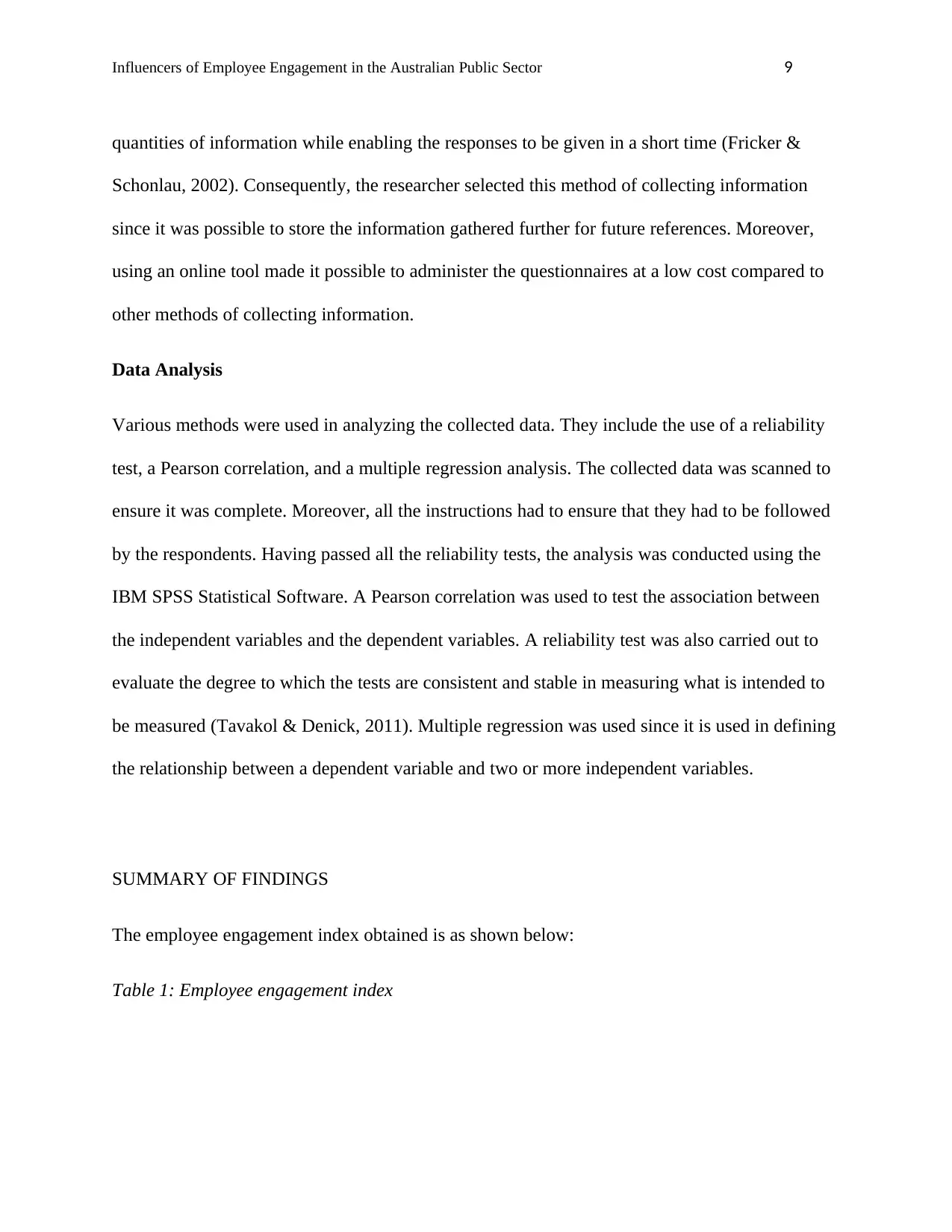
The employee engagement index obtained is as shown below:
Table 1: Employee engagement index
quantities of information while enabling the responses to be given in a short time (Fricker &
Schonlau, 2002). Consequently, the researcher selected this method of collecting information
since it was possible to store the information gathered further for future references. Moreover,
using an online tool made it possible to administer the questionnaires at a low cost compared to
other methods of collecting information.
Data Analysis
Various methods were used in analyzing the collected data. They include the use of a reliability
test, a Pearson correlation, and a multiple regression analysis. The collected data was scanned to
ensure it was complete. Moreover, all the instructions had to ensure that they had to be followed
by the respondents. Having passed all the reliability tests, the analysis was conducted using the
IBM SPSS Statistical Software. A Pearson correlation was used to test the association between
the independent variables and the dependent variables. A reliability test was also carried out to
evaluate the degree to which the tests are consistent and stable in measuring what is intended to
be measured (Tavakol & Denick, 2011). Multiple regression was used since it is used in defining
the relationship between a dependent variable and two or more independent variables.
SUMMARY OF FINDINGS
The employee engagement index obtained is as shown below:
Table 1: Employee engagement index
⊘ This is a preview!⊘
Do you want full access?
Subscribe today to unlock all pages.
Trusted by 1+ million students worldwide
Influencers of Employee Engagement in the Australian Public Sector 10
The employee engagement index for 2018 was 59% as shown in above.
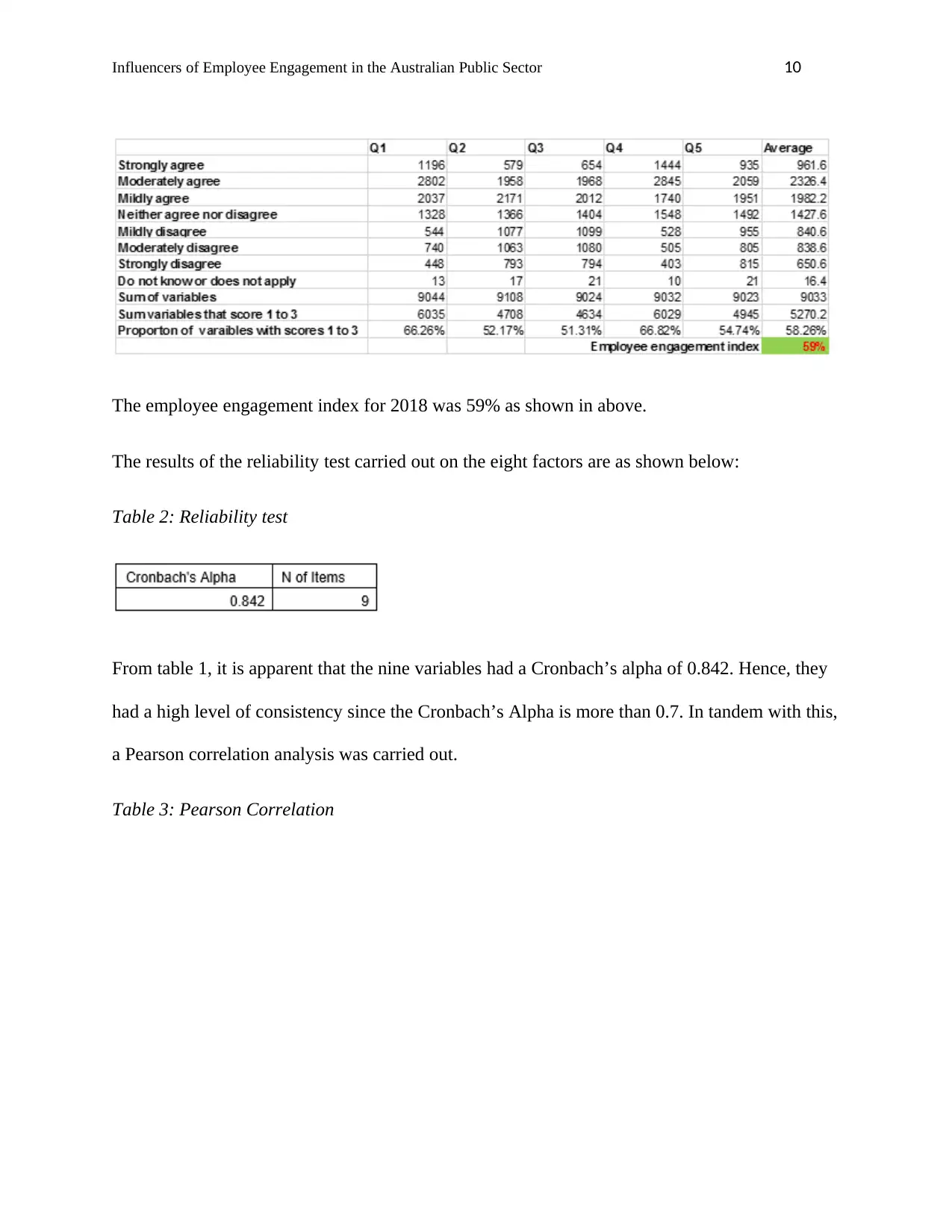
The results of the reliability test carried out on the eight factors are as shown below:
Table 2: Reliability test
From table 1, it is apparent that the nine variables had a Cronbach’s alpha of 0.842. Hence, they
had a high level of consistency since the Cronbach’s Alpha is more than 0.7. In tandem with this,
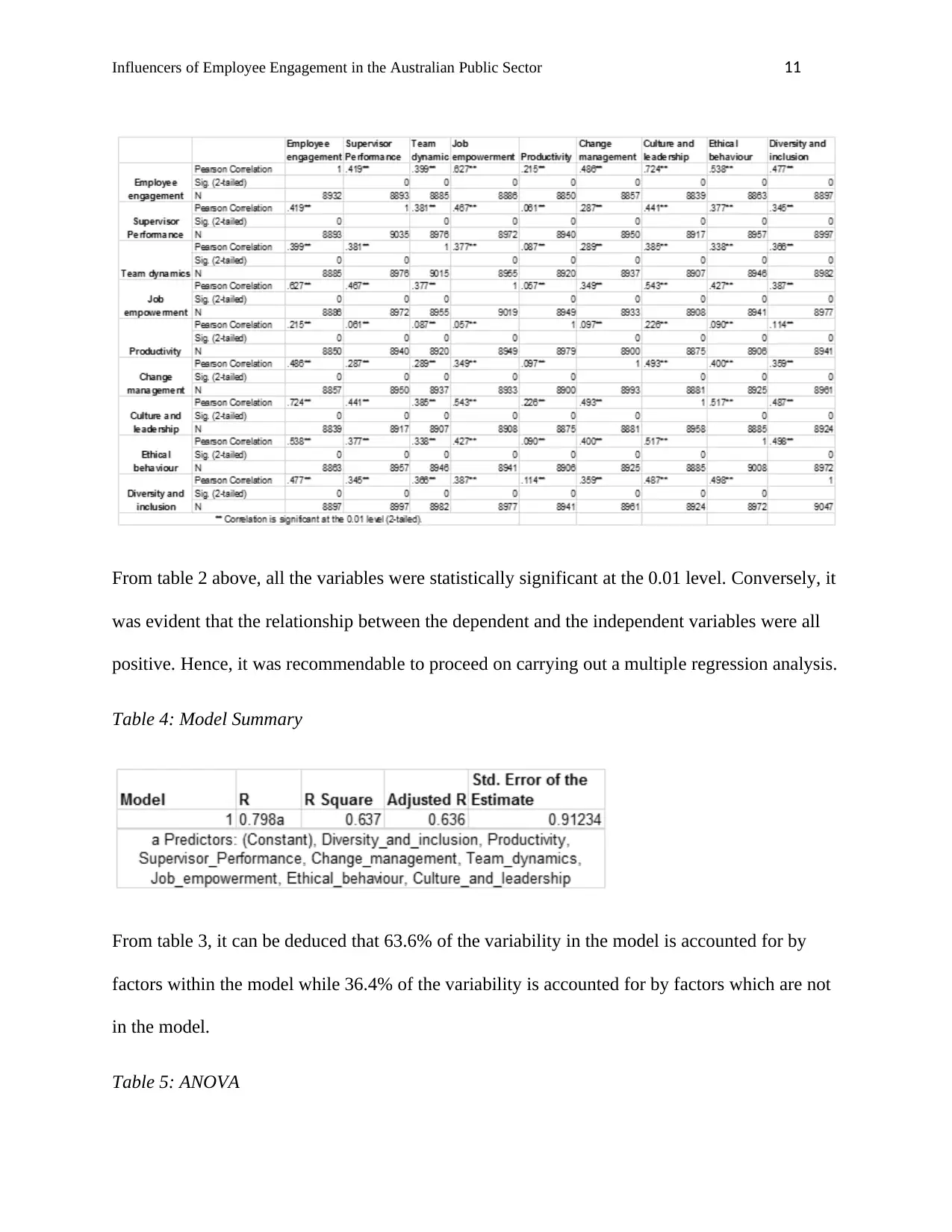
a Pearson correlation analysis was carried out.
Table 3: Pearson Correlation
The employee engagement index for 2018 was 59% as shown in above.
The results of the reliability test carried out on the eight factors are as shown below:
Table 2: Reliability test
From table 1, it is apparent that the nine variables had a Cronbach’s alpha of 0.842. Hence, they
had a high level of consistency since the Cronbach’s Alpha is more than 0.7. In tandem with this,
a Pearson correlation analysis was carried out.
Table 3: Pearson Correlation
Paraphrase This Document
Need a fresh take? Get an instant paraphrase of this document with our AI Paraphraser
Influencers of Employee Engagement in the Australian Public Sector 11
From table 2 above, all the variables were statistically significant at the 0.01 level. Conversely, it
was evident that the relationship between the dependent and the independent variables were all
positive. Hence, it was recommendable to proceed on carrying out a multiple regression analysis.
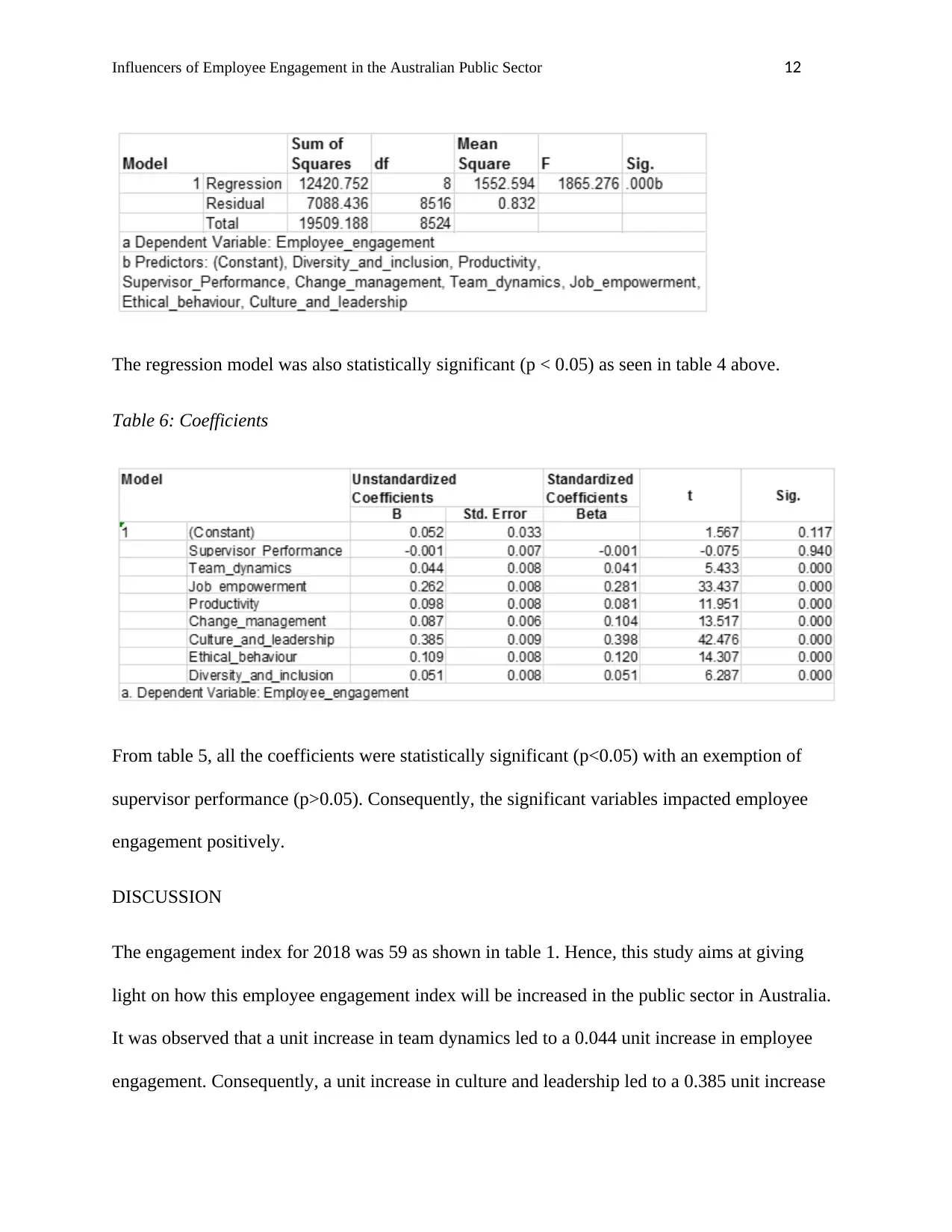
Table 4: Model Summary
From table 3, it can be deduced that 63.6% of the variability in the model is accounted for by
factors within the model while 36.4% of the variability is accounted for by factors which are not
in the model.
Table 5: ANOVA
From table 2 above, all the variables were statistically significant at the 0.01 level. Conversely, it
was evident that the relationship between the dependent and the independent variables were all
positive. Hence, it was recommendable to proceed on carrying out a multiple regression analysis.
Table 4: Model Summary
From table 3, it can be deduced that 63.6% of the variability in the model is accounted for by
factors within the model while 36.4% of the variability is accounted for by factors which are not
in the model.
Table 5: ANOVA
Influencers of Employee Engagement in the Australian Public Sector 12
The regression model was also statistically significant (p < 0.05) as seen in table 4 above.
Table 6: Coefficients
From table 5, all the coefficients were statistically significant (p<0.05) with an exemption of
supervisor performance (p>0.05). Consequently, the significant variables impacted employee
engagement positively.
DISCUSSION
The engagement index for 2018 was 59 as shown in table 1. Hence, this study aims at giving
light on how this employee engagement index will be increased in the public sector in Australia.
It was observed that a unit increase in team dynamics led to a 0.044 unit increase in employee
engagement. Consequently, a unit increase in culture and leadership led to a 0.385 unit increase
The regression model was also statistically significant (p < 0.05) as seen in table 4 above.
Table 6: Coefficients
From table 5, all the coefficients were statistically significant (p<0.05) with an exemption of
supervisor performance (p>0.05). Consequently, the significant variables impacted employee
engagement positively.
DISCUSSION
The engagement index for 2018 was 59 as shown in table 1. Hence, this study aims at giving
light on how this employee engagement index will be increased in the public sector in Australia.
It was observed that a unit increase in team dynamics led to a 0.044 unit increase in employee
engagement. Consequently, a unit increase in culture and leadership led to a 0.385 unit increase
⊘ This is a preview!⊘
Do you want full access?
Subscribe today to unlock all pages.
Trusted by 1+ million students worldwide

1 out of 19


Related Documents


Your All-in-One AI-Powered Toolkit for Academic Success.
+13062052269
info@desklib.com
Available 24*7 on WhatsApp / Email
![[object Object]](/_next/static/media/star-bottom.7253800d.svg)
Unlock your academic potential
Copyright © 2020–2026 A2Z Services. All Rights Reserved. Developed and managed by ZUCOL.