An Analysis of Ethical Practices in the Australian Retail Sector
VerifiedAdded on 2020/03/16
|13
|3953
|39
Report
AI Summary
This report analyzes ethical considerations in the Australian retail industry, focusing on the pressures faced by retailers, particularly in the context of cost reduction and profit generation. It explores case studies of major players like Coles and Wesfarmers, highlighting issues such as delayed payments to suppliers and the implications of 'at risk' remuneration. The report emphasizes the importance of integrated reporting, stakeholder management, and sustainable growth over short-term gains. It examines the role of accountants during poor performance and declining performance, and the challenges associated with rebate-driven inventory. The study concludes that ethical practices, including a focus on non-financial factors, are crucial for long-term business success and sustainable growth in the Australian retail sector. The report also provides answers to case study questions, covering topics such as the impact of delayed payments, the benefits of integrated reporting, and the role of stakeholders.
ACCOUNTANTS IN THE PRFOESSION

Paraphrase This Document
Need a fresh take? Get an instant paraphrase of this document with our AI Paraphraser

Australian retail industry
Contents
1. Abstract..........................................................................................................................................2
2. Introduction....................................................................................................................................2
3. Case Questions...............................................................................................................................4
4. Conclusion....................................................................................................................................10
References............................................................................................................................................11
2
Contents
1. Abstract..........................................................................................................................................2
2. Introduction....................................................................................................................................2
3. Case Questions...............................................................................................................................4
4. Conclusion....................................................................................................................................10
References............................................................................................................................................11
2
Australian retail industry
1. Abstract
Ethics play a pivotal role in the development and growth of the business. The current study
pertains to the ethics of profit in the Australian retail industry. There are a number of forces
that exert pressure on the retail industry. Moreover, examples of a leader in the retail industry
have been provided in the study below where different aspects have been touched. The
answers to the questions have been provided by adequate research to the case study and
various other materials or resources that are in tune with the Australian retail industry. The
case study answers reveal that the companies should put emphasis on the non-financial factor
with the financial factors because that will aid the progress of the company in the long run.
Moreover, the business should use the resources in a manner that will help in the sustainable
growth. The business must respond to the external factor and scenario in a manner that will
provide a strong boost. Integrated reporting should be the need of the hour and that this
segment must be looked after in a strong manner by the management. The success of the
business depends not only on the profit-making ability rather should have a deep emphasis on
the benefits that need to be provided to the society.
2. Introduction
The study reveals the enormous pressure that is vested on the retail industry of Australia. The
study sheds light on the fact that many high profile brands have failed to owe to various
scenarios. The only remedy to this lies in the concept of cost reduction. The ethics of the
decision are a major consideration when it comes to the concept of decision making and
taking decisions. The study projects that the management judgment does not reside in reaping
profits rather in the manner in which the profit is generated. This implies that the success
criterion is multidimensional in nature. The study projects the Australian retail industry and
the pressure that is vested while taking crucial decisions. Retailers are operating under
immense pressure and this can be best cited with the fact that major giants like Coles and
Woolworths have failed by 1.5 and 2% during 2015-16. Among all, the best mechanism is to
reduce costs that help the business to attain a better position.
3
1. Abstract
Ethics play a pivotal role in the development and growth of the business. The current study
pertains to the ethics of profit in the Australian retail industry. There are a number of forces
that exert pressure on the retail industry. Moreover, examples of a leader in the retail industry
have been provided in the study below where different aspects have been touched. The
answers to the questions have been provided by adequate research to the case study and
various other materials or resources that are in tune with the Australian retail industry. The
case study answers reveal that the companies should put emphasis on the non-financial factor
with the financial factors because that will aid the progress of the company in the long run.
Moreover, the business should use the resources in a manner that will help in the sustainable
growth. The business must respond to the external factor and scenario in a manner that will
provide a strong boost. Integrated reporting should be the need of the hour and that this
segment must be looked after in a strong manner by the management. The success of the
business depends not only on the profit-making ability rather should have a deep emphasis on
the benefits that need to be provided to the society.
2. Introduction
The study reveals the enormous pressure that is vested on the retail industry of Australia. The
study sheds light on the fact that many high profile brands have failed to owe to various
scenarios. The only remedy to this lies in the concept of cost reduction. The ethics of the
decision are a major consideration when it comes to the concept of decision making and
taking decisions. The study projects that the management judgment does not reside in reaping
profits rather in the manner in which the profit is generated. This implies that the success
criterion is multidimensional in nature. The study projects the Australian retail industry and
the pressure that is vested while taking crucial decisions. Retailers are operating under
immense pressure and this can be best cited with the fact that major giants like Coles and
Woolworths have failed by 1.5 and 2% during 2015-16. Among all, the best mechanism is to
reduce costs that help the business to attain a better position.
3
⊘ This is a preview!⊘
Do you want full access?
Subscribe today to unlock all pages.

Trusted by 1+ million students worldwide
Australian retail industry
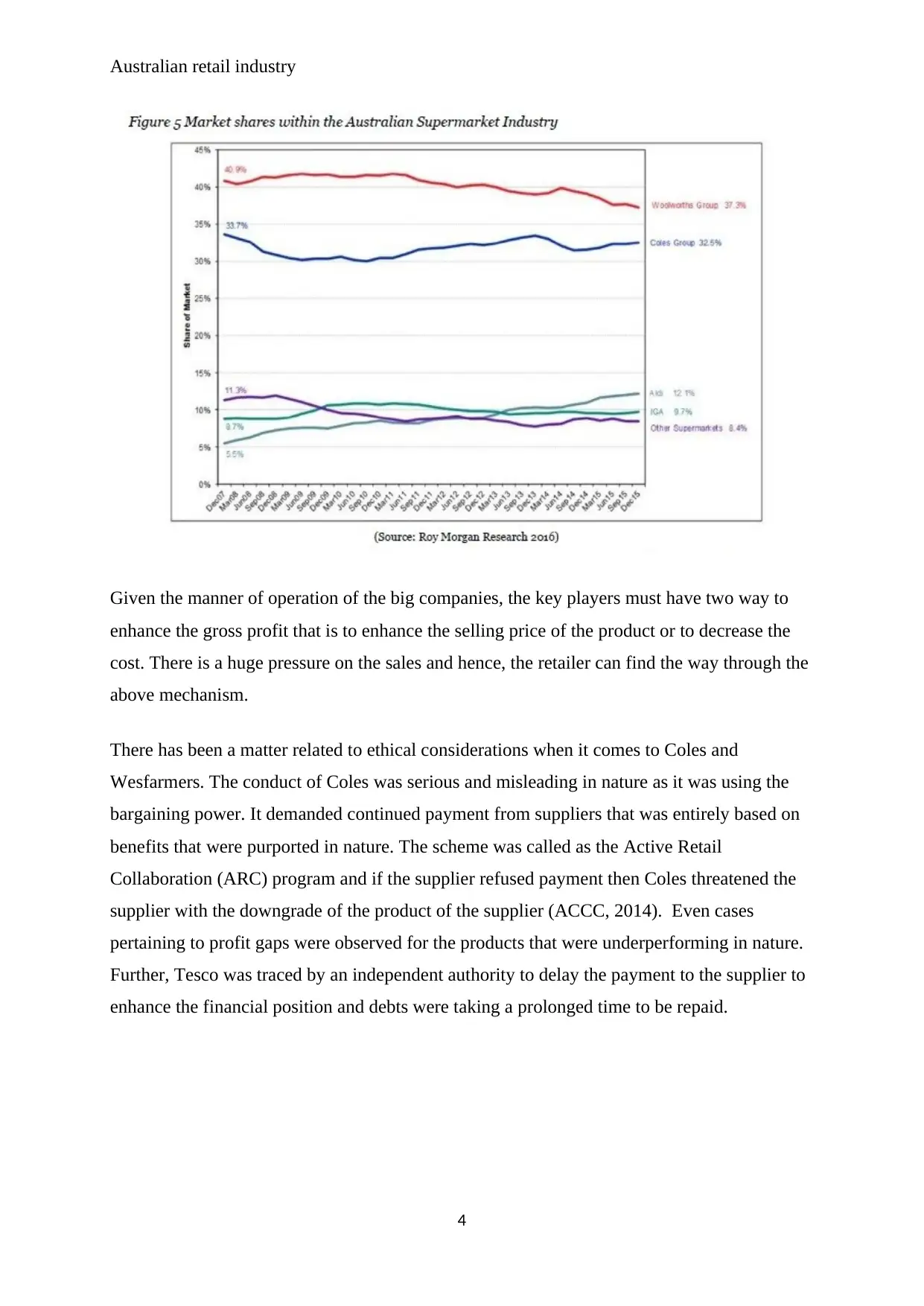
Given the manner of operation of the big companies, the key players must have two way to
enhance the gross profit that is to enhance the selling price of the product or to decrease the
cost. There is a huge pressure on the sales and hence, the retailer can find the way through the
above mechanism.
There has been a matter related to ethical considerations when it comes to Coles and
Wesfarmers. The conduct of Coles was serious and misleading in nature as it was using the
bargaining power. It demanded continued payment from suppliers that was entirely based on
benefits that were purported in nature. The scheme was called as the Active Retail
Collaboration (ARC) program and if the supplier refused payment then Coles threatened the
supplier with the downgrade of the product of the supplier (ACCC, 2014). Even cases
pertaining to profit gaps were observed for the products that were underperforming in nature.
Further, Tesco was traced by an independent authority to delay the payment to the supplier to
enhance the financial position and debts were taking a prolonged time to be repaid.
4
Given the manner of operation of the big companies, the key players must have two way to
enhance the gross profit that is to enhance the selling price of the product or to decrease the
cost. There is a huge pressure on the sales and hence, the retailer can find the way through the
above mechanism.
There has been a matter related to ethical considerations when it comes to Coles and
Wesfarmers. The conduct of Coles was serious and misleading in nature as it was using the
bargaining power. It demanded continued payment from suppliers that was entirely based on
benefits that were purported in nature. The scheme was called as the Active Retail
Collaboration (ARC) program and if the supplier refused payment then Coles threatened the
supplier with the downgrade of the product of the supplier (ACCC, 2014). Even cases
pertaining to profit gaps were observed for the products that were underperforming in nature.
Further, Tesco was traced by an independent authority to delay the payment to the supplier to
enhance the financial position and debts were taking a prolonged time to be repaid.
4
Paraphrase This Document
Need a fresh take? Get an instant paraphrase of this document with our AI Paraphraser
Australian retail industry
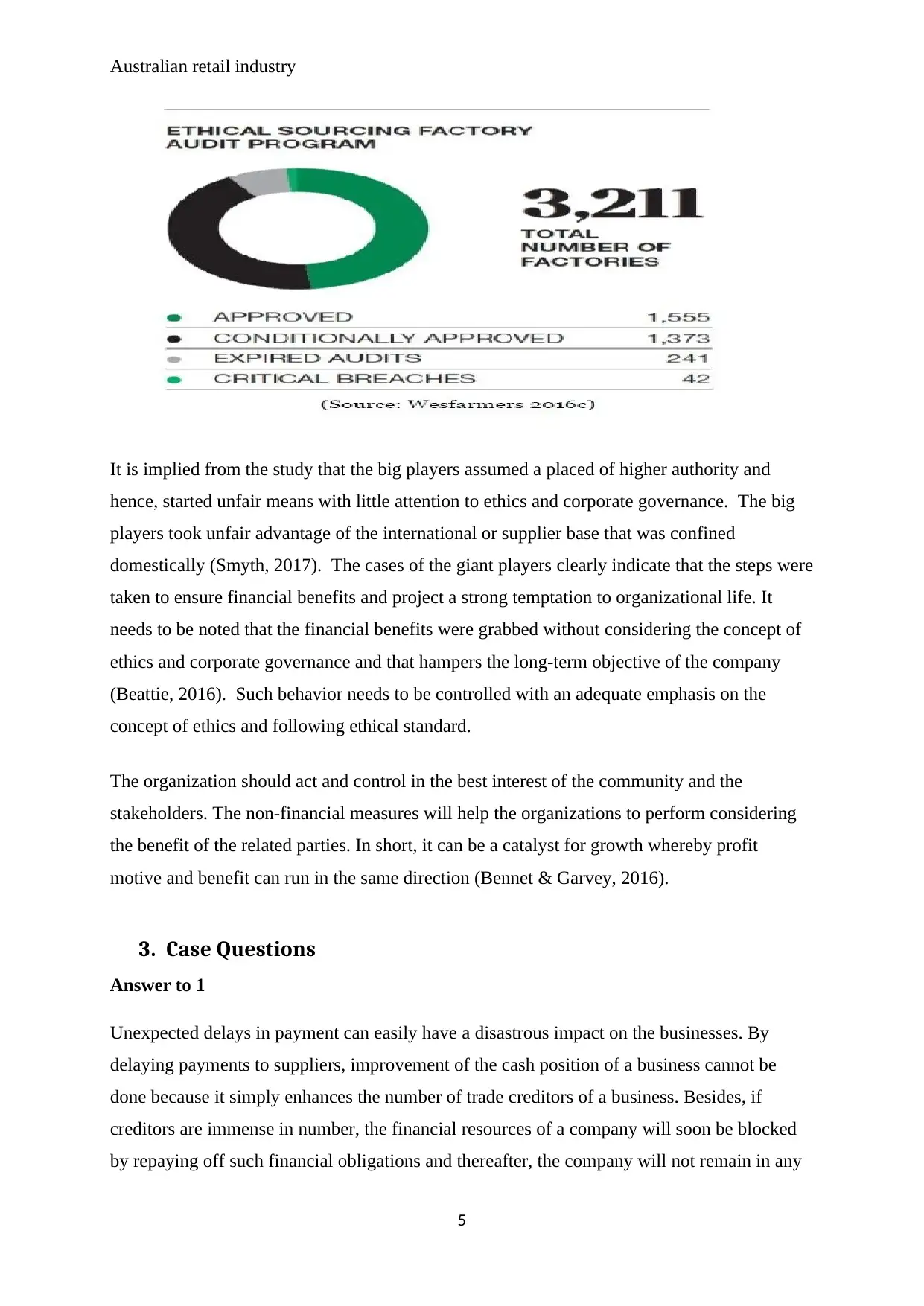
It is implied from the study that the big players assumed a placed of higher authority and
hence, started unfair means with little attention to ethics and corporate governance. The big
players took unfair advantage of the international or supplier base that was confined
domestically (Smyth, 2017). The cases of the giant players clearly indicate that the steps were
taken to ensure financial benefits and project a strong temptation to organizational life. It
needs to be noted that the financial benefits were grabbed without considering the concept of
ethics and corporate governance and that hampers the long-term objective of the company
(Beattie, 2016). Such behavior needs to be controlled with an adequate emphasis on the
concept of ethics and following ethical standard.
The organization should act and control in the best interest of the community and the
stakeholders. The non-financial measures will help the organizations to perform considering
the benefit of the related parties. In short, it can be a catalyst for growth whereby profit
motive and benefit can run in the same direction (Bennet & Garvey, 2016).
3. Case Questions
Answer to 1
Unexpected delays in payment can easily have a disastrous impact on the businesses. By
delaying payments to suppliers, improvement of the cash position of a business cannot be
done because it simply enhances the number of trade creditors of a business. Besides, if
creditors are immense in number, the financial resources of a company will soon be blocked
by repaying off such financial obligations and thereafter, the company will not remain in any
5
It is implied from the study that the big players assumed a placed of higher authority and
hence, started unfair means with little attention to ethics and corporate governance. The big
players took unfair advantage of the international or supplier base that was confined
domestically (Smyth, 2017). The cases of the giant players clearly indicate that the steps were
taken to ensure financial benefits and project a strong temptation to organizational life. It
needs to be noted that the financial benefits were grabbed without considering the concept of
ethics and corporate governance and that hampers the long-term objective of the company
(Beattie, 2016). Such behavior needs to be controlled with an adequate emphasis on the
concept of ethics and following ethical standard.
The organization should act and control in the best interest of the community and the
stakeholders. The non-financial measures will help the organizations to perform considering
the benefit of the related parties. In short, it can be a catalyst for growth whereby profit
motive and benefit can run in the same direction (Bennet & Garvey, 2016).
3. Case Questions
Answer to 1
Unexpected delays in payment can easily have a disastrous impact on the businesses. By
delaying payments to suppliers, improvement of the cash position of a business cannot be
done because it simply enhances the number of trade creditors of a business. Besides, if
creditors are immense in number, the financial resources of a company will soon be blocked
by repaying off such financial obligations and thereafter, the company will not remain in any
5
Australian retail industry
condition to maintain its working capital requirements, as its entire resources are being
blocked in paying the obligations. Another reason is that larger organizations have
innumerable transactions occurring every day. Therefore, if payments to suppliers or creditors
are stretched, it may happen that because of complications, duplicate payments are made to
the suppliers. If this happens, the crunch of cash will surely incur within the company and it
will face liquidity issues. In addition, by delaying payments to suppliers, cash flow issues will
occur to them and as a result, they are more likely to cut connections with the company that
will be a negative indicator (Bhattacharya & Sen, 2010). Therefore, considering these issues,
it is assured that delayed payments cannot enhance cash position, instead, it will result in
other complications.
Answer to 2
Integrated reporting can be defined as an approach that intends to incorporate a wider range of
measures in order to assist in obtaining long-term value. It also plays a major role in
contributing towards the role an organization play in the overall society. Moreover, such
value is subjected to various factors like social reputation, dependence on the environment,
human capital skills, etc. Such value creation is the major job of integrated reporting and
based on studies, it is believed that it can not only enhance the quality of corporate reporting
but also change the performance of companies (Kacperczy, 2009). Furthermore, it is well
known that incentives and remuneration system of a business enterprise is directly associated
with value creation in the medium, long, and short-term. In relation to this, integrated
reporting further plays a major role by benefitting a wider range of stakeholders, as it intends
to transform the inputs of an organization into outputs that can fulfill all the desired goals or
objectives. Nevertheless, integrated reporting starts from the point that any created value
irrespective of whether it becomes an intangible or tangible asset, in order to convert it into
enhanced performance, thereby affecting market value as a whole (Mangena, 2007).
Answer to 3
The concept of ‘at risk’ remuneration concept is subject to performance conditions being met.
Companies have their employees indulge in such pay-at-risk plan wherein they interlink a part
of their employees’ income to their performance. Moreover, while such system means huge
paychecks for the employees when the company is performing enormously great, it also
signifies that employees are at risk when the company is underperforming (Pilbeam, 2009).
Nevertheless, even though such strategies may not be popular, yet they are generally lawful in
6
condition to maintain its working capital requirements, as its entire resources are being
blocked in paying the obligations. Another reason is that larger organizations have
innumerable transactions occurring every day. Therefore, if payments to suppliers or creditors
are stretched, it may happen that because of complications, duplicate payments are made to
the suppliers. If this happens, the crunch of cash will surely incur within the company and it
will face liquidity issues. In addition, by delaying payments to suppliers, cash flow issues will
occur to them and as a result, they are more likely to cut connections with the company that
will be a negative indicator (Bhattacharya & Sen, 2010). Therefore, considering these issues,
it is assured that delayed payments cannot enhance cash position, instead, it will result in
other complications.
Answer to 2
Integrated reporting can be defined as an approach that intends to incorporate a wider range of
measures in order to assist in obtaining long-term value. It also plays a major role in
contributing towards the role an organization play in the overall society. Moreover, such
value is subjected to various factors like social reputation, dependence on the environment,
human capital skills, etc. Such value creation is the major job of integrated reporting and
based on studies, it is believed that it can not only enhance the quality of corporate reporting
but also change the performance of companies (Kacperczy, 2009). Furthermore, it is well
known that incentives and remuneration system of a business enterprise is directly associated
with value creation in the medium, long, and short-term. In relation to this, integrated
reporting further plays a major role by benefitting a wider range of stakeholders, as it intends
to transform the inputs of an organization into outputs that can fulfill all the desired goals or
objectives. Nevertheless, integrated reporting starts from the point that any created value
irrespective of whether it becomes an intangible or tangible asset, in order to convert it into
enhanced performance, thereby affecting market value as a whole (Mangena, 2007).
Answer to 3
The concept of ‘at risk’ remuneration concept is subject to performance conditions being met.
Companies have their employees indulge in such pay-at-risk plan wherein they interlink a part
of their employees’ income to their performance. Moreover, while such system means huge
paychecks for the employees when the company is performing enormously great, it also
signifies that employees are at risk when the company is underperforming (Pilbeam, 2009).
Nevertheless, even though such strategies may not be popular, yet they are generally lawful in
6
⊘ This is a preview!⊘
Do you want full access?
Subscribe today to unlock all pages.
Trusted by 1+ million students worldwide
Australian retail industry
nature. However, if specific mandatory requirements in relation to the same are not fulfilled,
employees can take necessary actions against the same. The reason why ‘at risk’ appears to be
a larger component of net remuneration for senior management and staff is agency dilemma
that prevails in larger organizations (Hoque, 2016). This dilemma is the segregation of
shareholders of the company from the directors due to development of the modern
organization. Furthermore, because of this, management often makes decisions that can result
in short-term benefits for their own self-interests but by disregarding the impacts, it would
possess in the long run enhancing the remuneration at the risk of the entire business (Bennet
& Garvey, 2016). Thus, such component appears to be a bigger component of total
remuneration for every senior management and CEO’s.
Answer to 4
Stakeholders are basically an individual, organization, and society at large that possess some
stake in the organization. They can affect or can get affected by the company’s objectives,
actions, and policies. Besides, having a stake means possessing a vital interest in the
company’s activities and its business as a whole. The stakeholders of a large supermarket
company are the employees, management, creditors, owners, suppliers, etc (Carol et. al,
2016).
When an organization is working with proper ethical standards, employees are the ones who
follow their footsteps. In simple words, employees make significant decisions in a lesser time
when ethical standards are followed (Paradise & Rogoff, 2009). This can not only enhance the
productivity of the organization but also improve employee morale as a whole. Besides, if
such happens, the entire organization is benefitted in terms of both financial and non-financial
aspects. Furthermore, management and shareholders work as agencies in an organization.
Therefore, if there is a conflict of interest betwixt both these stakeholders, the agent may
perform in his own interests instead of performing for the effectiveness of the principal
(Hoque, 2016). This may altogether result in ineffective practices prevailing within the
company, thereby hampering the entire working environment as a whole. Therefore, this
concept is relevant to ideas concerning the moral behavior of organizations.
Answer to 5
The CEO of Wesfarmers has commented that a long-term sustainable growth is vital over the
short term gain and this can be done when the management is strong enough to make
7
nature. However, if specific mandatory requirements in relation to the same are not fulfilled,
employees can take necessary actions against the same. The reason why ‘at risk’ appears to be
a larger component of net remuneration for senior management and staff is agency dilemma
that prevails in larger organizations (Hoque, 2016). This dilemma is the segregation of
shareholders of the company from the directors due to development of the modern
organization. Furthermore, because of this, management often makes decisions that can result
in short-term benefits for their own self-interests but by disregarding the impacts, it would
possess in the long run enhancing the remuneration at the risk of the entire business (Bennet
& Garvey, 2016). Thus, such component appears to be a bigger component of total
remuneration for every senior management and CEO’s.
Answer to 4
Stakeholders are basically an individual, organization, and society at large that possess some
stake in the organization. They can affect or can get affected by the company’s objectives,
actions, and policies. Besides, having a stake means possessing a vital interest in the
company’s activities and its business as a whole. The stakeholders of a large supermarket
company are the employees, management, creditors, owners, suppliers, etc (Carol et. al,
2016).
When an organization is working with proper ethical standards, employees are the ones who
follow their footsteps. In simple words, employees make significant decisions in a lesser time
when ethical standards are followed (Paradise & Rogoff, 2009). This can not only enhance the
productivity of the organization but also improve employee morale as a whole. Besides, if
such happens, the entire organization is benefitted in terms of both financial and non-financial
aspects. Furthermore, management and shareholders work as agencies in an organization.
Therefore, if there is a conflict of interest betwixt both these stakeholders, the agent may
perform in his own interests instead of performing for the effectiveness of the principal
(Hoque, 2016). This may altogether result in ineffective practices prevailing within the
company, thereby hampering the entire working environment as a whole. Therefore, this
concept is relevant to ideas concerning the moral behavior of organizations.
Answer to 5
The CEO of Wesfarmers has commented that a long-term sustainable growth is vital over the
short term gain and this can be done when the management is strong enough to make
7
Paraphrase This Document
Need a fresh take? Get an instant paraphrase of this document with our AI Paraphraser
Australian retail industry
optimum use of resources. The challenge of establishing a sustainable growth is not an easy
task given the rapidly changing competitive, economic, and political trends. These trends
present a unique challenge to all the business leaders seeking sustainable growth. In relation
to this, researchers and modern economists have stated that the culture of managing long-term
sustainable growth over short-term gain cannot be developed inside an organization if they do
not focus upon twin cornerstones that are growth capability and growth strategy. In simple
words, companies that pay lesser attention to one of these aspects are more likely to attain
failure in their attempts to achieve sustainable growth over short-term gains. Another way is
to understand how vital it is to establish brand equity and emotional contacts with the
consumers. If companies are able to do the same, then sustainable growth is not difficult to be
attained over short-term gains. Besides, ecosystems are also vital for attaining sustainable
growth as they play a key role in offering a structure that supports and surrounds the
businesses within them. Therefore, this can also serve as a way for organizations like
Wesfarmers to develop a culture that prioritizes sustainable growth over short-term profits.
Nevertheless, this can altogether result in maximization of goodwill as a whole.
Answer to 6
When it comes to the process of poor and declining performance, it can be commented that
such an incident exerts heavy pressure on the decision-making process and that the
accountants need special emphasis. Moreover, it becomes difficult to trace the stock that has
rebate attached to it and the rebate leads to an increment in the inventory. Hence, the
accountant is faced with challenges in tune to the stocks that are based on a rebate. Since
accountants are not directly involved in this, the accountant’s needs to stress upon some
important factors like the performance of the stock and the manner in which the stock has
behaved or performed (Parker et. al, 2011). Secondly, the accountant should keep a strong
emphasis on the inventory level because rebate driven buying tends to enhance the build-up
inventory. Therefore, the accountants must have a track of the stock and should consider the
rebate based buying. This can help the accountant in providing a better remedy and can,
therefore, manage the system with ease and flexibility (Kruger, 2015).
Answer to 7
The reason why management accounting promotes the idea of not relying on financial
measures only can be attributed to the fact that non-financial measures can also provide better
information regarding the company’s performance. Furthermore, it results in employee
8
optimum use of resources. The challenge of establishing a sustainable growth is not an easy
task given the rapidly changing competitive, economic, and political trends. These trends
present a unique challenge to all the business leaders seeking sustainable growth. In relation
to this, researchers and modern economists have stated that the culture of managing long-term
sustainable growth over short-term gain cannot be developed inside an organization if they do
not focus upon twin cornerstones that are growth capability and growth strategy. In simple
words, companies that pay lesser attention to one of these aspects are more likely to attain
failure in their attempts to achieve sustainable growth over short-term gains. Another way is
to understand how vital it is to establish brand equity and emotional contacts with the
consumers. If companies are able to do the same, then sustainable growth is not difficult to be
attained over short-term gains. Besides, ecosystems are also vital for attaining sustainable
growth as they play a key role in offering a structure that supports and surrounds the
businesses within them. Therefore, this can also serve as a way for organizations like
Wesfarmers to develop a culture that prioritizes sustainable growth over short-term profits.
Nevertheless, this can altogether result in maximization of goodwill as a whole.
Answer to 6
When it comes to the process of poor and declining performance, it can be commented that
such an incident exerts heavy pressure on the decision-making process and that the
accountants need special emphasis. Moreover, it becomes difficult to trace the stock that has
rebate attached to it and the rebate leads to an increment in the inventory. Hence, the
accountant is faced with challenges in tune to the stocks that are based on a rebate. Since
accountants are not directly involved in this, the accountant’s needs to stress upon some
important factors like the performance of the stock and the manner in which the stock has
behaved or performed (Parker et. al, 2011). Secondly, the accountant should keep a strong
emphasis on the inventory level because rebate driven buying tends to enhance the build-up
inventory. Therefore, the accountants must have a track of the stock and should consider the
rebate based buying. This can help the accountant in providing a better remedy and can,
therefore, manage the system with ease and flexibility (Kruger, 2015).
Answer to 7
The reason why management accounting promotes the idea of not relying on financial
measures only can be attributed to the fact that non-financial measures can also provide better
information regarding the company’s performance. Furthermore, it results in employee
8
Australian retail industry
satisfaction because if an organization intends to enhance the working environment, the
employees will know that their company does not care only about money. Therefore, if an
organization focuses on employee satisfaction, it can easily establish a team of loyal and
engaged employees (Hemmer & Labro, 2008). Another reason is enhancing the quality of
products offered by the company. In relation to this, it must be noted that if an organization
focuses on such non-financial measure, it can easily maximize the number of profits attained
by it, thereby resulting in enhancement of goodwill as a whole. Hence, enhancing the quality
of products and focusing on employee welfare can prove to be beneficial non-financial
measures to a specific retailer (Benabou & Tirole, 2010). The relevance of this concept is that
if an organization or a specific retailer focuses on non-financial measures, they can not only
cater to the stakeholders but also redress the grievances of the entire community, thereby
serving as an ethical organization respectively.
Answer to 8
For a Chief Financial Officer, the best possible performance measurement would be the
utilization of a balanced scorecard system. The reason behind this can be attributed to the fact
that financial measures like TSR have become outdated in nature and can only assist in
tracking financial performance. In simple words, such measures cannot assist in tracking the
overall progress of a CFO over time. As a result, the outcome attained through utilization of
financial measures like TSR would fail to develop effective action plans in order to frame a
strategic direction. Besides, using a balanced set of measures is more likely to depict a
balanced assessment of the overall performance of a CFO, which includes both financial and
non-financial aspects.
Similarly, when it comes to the performance measurement of a junior accounting officer,
using common Key performance indicators to monitor their performance will be more
suitable. Therefore, a balanced set of measures will be more feasible in this regard, because
financial measures cannot capture the outputs given by such officers and the impact of their
work on the organization. It will be a grave mistake for companies to use simple tactics like
TSR to evaluate the performance of such officers, as such methods cannot offer best results.
Answer to 9
9
satisfaction because if an organization intends to enhance the working environment, the
employees will know that their company does not care only about money. Therefore, if an
organization focuses on employee satisfaction, it can easily establish a team of loyal and
engaged employees (Hemmer & Labro, 2008). Another reason is enhancing the quality of
products offered by the company. In relation to this, it must be noted that if an organization
focuses on such non-financial measure, it can easily maximize the number of profits attained
by it, thereby resulting in enhancement of goodwill as a whole. Hence, enhancing the quality
of products and focusing on employee welfare can prove to be beneficial non-financial
measures to a specific retailer (Benabou & Tirole, 2010). The relevance of this concept is that
if an organization or a specific retailer focuses on non-financial measures, they can not only
cater to the stakeholders but also redress the grievances of the entire community, thereby
serving as an ethical organization respectively.
Answer to 8
For a Chief Financial Officer, the best possible performance measurement would be the
utilization of a balanced scorecard system. The reason behind this can be attributed to the fact
that financial measures like TSR have become outdated in nature and can only assist in
tracking financial performance. In simple words, such measures cannot assist in tracking the
overall progress of a CFO over time. As a result, the outcome attained through utilization of
financial measures like TSR would fail to develop effective action plans in order to frame a
strategic direction. Besides, using a balanced set of measures is more likely to depict a
balanced assessment of the overall performance of a CFO, which includes both financial and
non-financial aspects.
Similarly, when it comes to the performance measurement of a junior accounting officer,
using common Key performance indicators to monitor their performance will be more
suitable. Therefore, a balanced set of measures will be more feasible in this regard, because
financial measures cannot capture the outputs given by such officers and the impact of their
work on the organization. It will be a grave mistake for companies to use simple tactics like
TSR to evaluate the performance of such officers, as such methods cannot offer best results.
Answer to 9
9
⊘ This is a preview!⊘
Do you want full access?
Subscribe today to unlock all pages.
Trusted by 1+ million students worldwide
Australian retail industry
Business ethics represents the acceptable behavior an organization expects from the
employees. Therefore, the requirements of ethical decision-making cannot be distinct in the
case of management or financial accounting, or internal and external audit. In all these
measures, both the management and its employees are liable to exercise ethical behavior so
that any other party is not harmed (Benabou & Tirole, 2010). In simple words, all business
decisions whether it is management or financial is directly associated with a moral or ethical
dimension because they have an influence upon the stakeholders. However, there may be
some common principles when it comes to financial and management accounting or internal
and external audit. The ethical decision may be slightly different in these areas because
management accounting only focuses on internal issues but by being ethical (Benabou &
Tirole, 2010). Similarly, the internal audit also focuses on internal management by being
ethical. In contrast to this, external auditing and financial accounting focus on both internal
and external issues by exercising moral affairs. Furthermore, the only difference is that
management accounting is optional in nature that restricts ethical practices whereas financial
accounting is mandatory that gives due regard to ethical conduct (Saber, 2013).
Answer to 10
There are various ways of incorporating aspects of CSR and sustainable development into the
concept of the balanced scorecard. Firstly, by integrating all the social and environmental
segments of the company into the scorecard so that the major drivers or indicators of
performance can be added by utilizing the top-down strategy for introducing the social and
environmental segments. Secondly, by introducing another perspective into the scorecard that
is the viewpoint of CSR and sustainable development (Bauer & Hann, 2010). With such
addition, an organization can enhance the reporting quality through such balanced scorecard
as it can facilitate the better measurement of performance, thereby proving ethical to the
organization. Thirdly, by deriving a particular addition from the basic scorecard in order to
focus on the assumption that the ascertained social or environmental scorecard cannot be
framed parallel with another scorecard. In simple words, the significance is that the
ascertained social or environmental scorecard is a development of the prior two concepts
(Manoharan, 2011). Nevertheless, practices that are beneficial for the society and
environment may prove negative for corporate profitability but integrating ethical and
sustainability issues into a balanced scorecard can offer a clearer picture of the
interconnection among sustainable practices, profitability, and strategies of a company.
10
Business ethics represents the acceptable behavior an organization expects from the
employees. Therefore, the requirements of ethical decision-making cannot be distinct in the
case of management or financial accounting, or internal and external audit. In all these
measures, both the management and its employees are liable to exercise ethical behavior so
that any other party is not harmed (Benabou & Tirole, 2010). In simple words, all business
decisions whether it is management or financial is directly associated with a moral or ethical
dimension because they have an influence upon the stakeholders. However, there may be
some common principles when it comes to financial and management accounting or internal
and external audit. The ethical decision may be slightly different in these areas because
management accounting only focuses on internal issues but by being ethical (Benabou &
Tirole, 2010). Similarly, the internal audit also focuses on internal management by being
ethical. In contrast to this, external auditing and financial accounting focus on both internal
and external issues by exercising moral affairs. Furthermore, the only difference is that
management accounting is optional in nature that restricts ethical practices whereas financial
accounting is mandatory that gives due regard to ethical conduct (Saber, 2013).
Answer to 10
There are various ways of incorporating aspects of CSR and sustainable development into the
concept of the balanced scorecard. Firstly, by integrating all the social and environmental
segments of the company into the scorecard so that the major drivers or indicators of
performance can be added by utilizing the top-down strategy for introducing the social and
environmental segments. Secondly, by introducing another perspective into the scorecard that
is the viewpoint of CSR and sustainable development (Bauer & Hann, 2010). With such
addition, an organization can enhance the reporting quality through such balanced scorecard
as it can facilitate the better measurement of performance, thereby proving ethical to the
organization. Thirdly, by deriving a particular addition from the basic scorecard in order to
focus on the assumption that the ascertained social or environmental scorecard cannot be
framed parallel with another scorecard. In simple words, the significance is that the
ascertained social or environmental scorecard is a development of the prior two concepts
(Manoharan, 2011). Nevertheless, practices that are beneficial for the society and
environment may prove negative for corporate profitability but integrating ethical and
sustainability issues into a balanced scorecard can offer a clearer picture of the
interconnection among sustainable practices, profitability, and strategies of a company.
10
Paraphrase This Document
Need a fresh take? Get an instant paraphrase of this document with our AI Paraphraser
Australian retail industry
Conclusion
Going by the overall study, it can be pointed how the retail brand operated and made profits at
the expense of the supplier. The weak bargaining capacity was the major loophole that aided
the practice. An apt example in this scenario is of the 7Eleven, Wesfarmers, Tesco, etc. An
important consideration in this scenario is that the employment link should not be projected as
an expense item in the income statement and needs a proper consideration in the long term.
Another consideration that can be taken into consideration is that commercial decision
making cannot be considered as profit criteria. The short-term motive of the company should
be towards cost reduction and stress that the consideration. Moreover, accountants are always
in a critical position in terms of control. They are into a critical position to define, promote
and to implement the performance measurement and report the drivers that are not only driven
in terms of profit but related to decision making. However, the accountants can always
assume a special position and help in controlling the market by defining, promoting, and
implementing the performance measurement. This can help the company to have a major
hold on the profit-making ability and even the decision-making process. This will be a major
landmark in the process of ethics, however; the entire process is laced with immense
challenges.
11
Conclusion
Going by the overall study, it can be pointed how the retail brand operated and made profits at
the expense of the supplier. The weak bargaining capacity was the major loophole that aided
the practice. An apt example in this scenario is of the 7Eleven, Wesfarmers, Tesco, etc. An
important consideration in this scenario is that the employment link should not be projected as
an expense item in the income statement and needs a proper consideration in the long term.
Another consideration that can be taken into consideration is that commercial decision
making cannot be considered as profit criteria. The short-term motive of the company should
be towards cost reduction and stress that the consideration. Moreover, accountants are always
in a critical position in terms of control. They are into a critical position to define, promote
and to implement the performance measurement and report the drivers that are not only driven
in terms of profit but related to decision making. However, the accountants can always
assume a special position and help in controlling the market by defining, promoting, and
implementing the performance measurement. This can help the company to have a major
hold on the profit-making ability and even the decision-making process. This will be a major
landmark in the process of ethics, however; the entire process is laced with immense
challenges.
11
Australian retail industry
References
Australian Competition and Consumer Commission (ACCC) 2014, Court finds Coles
engaged in unconscionable conduct and orders Coles to pay $10 million penalties, viewed 15
October 2017 https://www.accc.gov.au/media-release/court-finds-coles-engaged-in-
unconscionable-conduct-and-orders-coles-pay-10-million-penalties
Bauer, R & Hann, D 2010, Corporate environmental management and credit risk, Maastricht
University.
Beattie F2016, Wesfarmers confirms Target scandal, viewed 15 October 2017
https://www.businessnews.com.au/article/Wesfarmers-confirms-Target-scandal
Benabou, R & Tirole, R 2010, ‘Individual and Corporate Social responsibility’, Ecnomica
vol.11, pp. 1-19
Bennet, M & Garvey, P 2016, CBA hit with bonus backlash, viewed 15 October 2017
http://www.smh.com.au/business/banking-and-finance/cba-facing-investor-backlash-on-
executive-pay-20161103-gshs0g.html
Bhattacharya, Du S & Sen S, CB 2010, ‘Maximizing business returns to corporate social
responsibility (CSR): The role of CSR communication’, Management Review vol. 12, no. 8,
pp. 19-26
Carol, A.A, Brad, P , Prakash J. S, & Jodi Y 2016, ‘Exploring the implications of integrated
reporting for social investment (disclosures)’, The British Accounting Review, vol. 48, no. 3,
pp. 283–296
Hemmer, T & Labro, E 2008, On the optimal relation between the properties of managerial
and financial reporting systems, Journal of Accounting Research, vol. 46, pp. 1209–1240.
Hoque, F 2016, The 7 Fundamentals Of Sustainable Business Growth, viewed 15
October 2017 https://www.fastcompany.com/3049856/the-7-fundamentals-of-sustainable-
business-growth
Kacperczyk, A 2009, ‘With greater power comes greater responsibility? Takeover protection
and corporate attention to stakeholders’, Strategic Management vol. 30, pp. 251–285.
12
References
Australian Competition and Consumer Commission (ACCC) 2014, Court finds Coles
engaged in unconscionable conduct and orders Coles to pay $10 million penalties, viewed 15
October 2017 https://www.accc.gov.au/media-release/court-finds-coles-engaged-in-
unconscionable-conduct-and-orders-coles-pay-10-million-penalties
Bauer, R & Hann, D 2010, Corporate environmental management and credit risk, Maastricht
University.
Beattie F2016, Wesfarmers confirms Target scandal, viewed 15 October 2017
https://www.businessnews.com.au/article/Wesfarmers-confirms-Target-scandal
Benabou, R & Tirole, R 2010, ‘Individual and Corporate Social responsibility’, Ecnomica
vol.11, pp. 1-19
Bennet, M & Garvey, P 2016, CBA hit with bonus backlash, viewed 15 October 2017
http://www.smh.com.au/business/banking-and-finance/cba-facing-investor-backlash-on-
executive-pay-20161103-gshs0g.html
Bhattacharya, Du S & Sen S, CB 2010, ‘Maximizing business returns to corporate social
responsibility (CSR): The role of CSR communication’, Management Review vol. 12, no. 8,
pp. 19-26
Carol, A.A, Brad, P , Prakash J. S, & Jodi Y 2016, ‘Exploring the implications of integrated
reporting for social investment (disclosures)’, The British Accounting Review, vol. 48, no. 3,
pp. 283–296
Hemmer, T & Labro, E 2008, On the optimal relation between the properties of managerial
and financial reporting systems, Journal of Accounting Research, vol. 46, pp. 1209–1240.
Hoque, F 2016, The 7 Fundamentals Of Sustainable Business Growth, viewed 15
October 2017 https://www.fastcompany.com/3049856/the-7-fundamentals-of-sustainable-
business-growth
Kacperczyk, A 2009, ‘With greater power comes greater responsibility? Takeover protection
and corporate attention to stakeholders’, Strategic Management vol. 30, pp. 251–285.
12
⊘ This is a preview!⊘
Do you want full access?
Subscribe today to unlock all pages.
Trusted by 1+ million students worldwide

1 out of 13


Related Documents


Your All-in-One AI-Powered Toolkit for Academic Success.
+13062052269
info@desklib.com
Available 24*7 on WhatsApp / Email
![[object Object]](/_next/static/media/star-bottom.7253800d.svg)
Unlock your academic potential
Copyright © 2020–2026 A2Z Services. All Rights Reserved. Developed and managed by ZUCOL.