Comprehensive Analysis of Small Business Taxation Law in Australia
VerifiedAdded on 2020/06/06
|9
|2628
|32
Report
AI Summary
This report provides a detailed overview of taxation law as it pertains to small businesses in Australia. It begins with a definition of small businesses within the context of taxation law, considering factors such as company assets, employee structure, and turnover. The report then explores various tax treatments for business income, including cash and accrual accounting methods, foreign income, personal service income, and crowdfunding. It also examines tax treatments for income from properties, including capital gains. Furthermore, the report delves into tax offsets and deductions available to small businesses, such as the unincorporated small business tax discount and deductions for travel expenses, asset costs, and home-based businesses. The report concludes by outlining other tax concessions, including income tax concessions, CGT concessions, PAYG instalment concessions, FBT concessions, and GST and Excise concessions, providing a comprehensive guide to the tax landscape for small businesses in New South Wales.
TAXATION LAW

Paraphrase This Document
Need a fresh take? Get an instant paraphrase of this document with our AI Paraphraser
Table of Contents
INTRODUCTION...........................................................................................................................1
1. Definition of small business in taxation law...........................................................................1
2. Tax treatments for income from business for small business.................................................2
4. Tax treatments for offsets and deductions for small businesses.............................................3
5. Other tax concessions for small business................................................................................5
CONCLUSION................................................................................................................................6
REFERENCES................................................................................................................................7
INTRODUCTION...........................................................................................................................1
1. Definition of small business in taxation law...........................................................................1
2. Tax treatments for income from business for small business.................................................2
4. Tax treatments for offsets and deductions for small businesses.............................................3
5. Other tax concessions for small business................................................................................5
CONCLUSION................................................................................................................................6
REFERENCES................................................................................................................................7
INTRODUCTION
Taxation laws are mainly identified as legislations development by governing bodies and
parliament that relates to the treatments of tax which needs to be paid the every business
enterprise in countries (Main, 2016). It is also considered as governmental assessment on
property values, estates of the deceased, granting licences or income and import duties from for
overseas nations. It is usally charged by government on earnings of a individual, trust and
organization along with the value of property. In present scenario, taxation laws and act that
prevails under the NSW are studied and analysed in order to determine the meaning small
business enterprise under the taxation law. Further, analysis taxation administration act 1967 is
also done to identified the tax treatments for income earned by small business enterprise along
with the tax treatments for income from property.
1. Definition of small business in taxation law
Small business are generally defined as a structure that are not public companies or a
larger firm but in term of taxation law definition may differ which is based on assets of company,
employees structure, turnover, partnership of the firm etc.
Small business use cash method to make report of income and expenditure. Small business have
gross receipt of less than $10 million in three previous years. Small business accrue the bad debts
being anticipated. Small business can deduct the cost of capital improvement. Big firms has to
pay alternative minimum tax if it is more than their regular tax liability (Main, 2015). But small
businesses do not have to do so. They are being exempted from the same. Small businesses are
those which enjoys the advantage of hybrid retirement plan which is clubbed with pension plan.
Small business are those having five hundred or few employees. In large organisation the cost of
coverage is being included whether paid by the company or an employee while small firms are
exempted from this. They enjoy its advantage and are devoid of it. They are not required to give
welfare coverage to its employees. Some small businesses pay continue wages to the employees
can opt tax credit up-to some set limit.
1
Taxation laws are mainly identified as legislations development by governing bodies and
parliament that relates to the treatments of tax which needs to be paid the every business
enterprise in countries (Main, 2016). It is also considered as governmental assessment on
property values, estates of the deceased, granting licences or income and import duties from for
overseas nations. It is usally charged by government on earnings of a individual, trust and
organization along with the value of property. In present scenario, taxation laws and act that
prevails under the NSW are studied and analysed in order to determine the meaning small
business enterprise under the taxation law. Further, analysis taxation administration act 1967 is
also done to identified the tax treatments for income earned by small business enterprise along
with the tax treatments for income from property.
1. Definition of small business in taxation law
Small business are generally defined as a structure that are not public companies or a
larger firm but in term of taxation law definition may differ which is based on assets of company,
employees structure, turnover, partnership of the firm etc.
Small business use cash method to make report of income and expenditure. Small business have
gross receipt of less than $10 million in three previous years. Small business accrue the bad debts
being anticipated. Small business can deduct the cost of capital improvement. Big firms has to
pay alternative minimum tax if it is more than their regular tax liability (Main, 2015). But small
businesses do not have to do so. They are being exempted from the same. Small businesses are
those which enjoys the advantage of hybrid retirement plan which is clubbed with pension plan.
Small business are those having five hundred or few employees. In large organisation the cost of
coverage is being included whether paid by the company or an employee while small firms are
exempted from this. They enjoy its advantage and are devoid of it. They are not required to give
welfare coverage to its employees. Some small businesses pay continue wages to the employees
can opt tax credit up-to some set limit.
1
⊘ This is a preview!⊘
Do you want full access?
Subscribe today to unlock all pages.

Trusted by 1+ million students worldwide
2. Tax treatments for income from business for small business
There are several accounting methods have been used by small business for treatments of
tax which is to paid on income earned from different sources. These accounting methods have
been taken that needs to be taken in to consideration. The amount which are included will need
to be assess-able income which in any financial year based on whether the account for income of
enterprise on cash basis or accruals basis.
Cash basis: As per taxation act 1967, if the organization is account for actionable income on the
basis of cash that they can include payments which they have earned at the time of financial year
regardless of the time on which they have accomplished the work (Williams, 2017). The
organization can only income which they have actually received from payment for during the
year as the assess-able income.
Accrual basis: Under taxation act 1967: this accounting system involve all the earning received
at the time financial year even if organization has not received the money for the
accomplishment of task. Small business enterprise under this can also include all amounts
which they have earned during the year as assess-able income.
Further, there some important income have been determined which it has need to be include in
the organization. Like
Foreign income: Organization needs to report all the income to government which they will
receive from overseas business operations while filing an Australian tax return in the
organization has its existing in Australia (Robinson, 2016). Tax treatments of this income
depends upon the number of factors such as whether operations of organization are carried out in
listed country like UK. There are some listed countries' comes under foreign income like Canada
, France, Germany, Japan, New zealand , UK and USA etc.
Personal service earning: It is also an income which is earned mainly by small business
enterprise an individual's personal skills or efforts. These are also considered income which is
earned by organization by selling personal services of any individuals. Income classified in PSI
if it more than 50% of amount received from the by the organization for contract was for an
individual labor, skills will taxable.
Crowdfunding: It is practice which is based on use of internet social media for findings the
investors and getting funds for project or business. It is significant for enterprise to disclose
whether the income which they have received through crowdfunding is income and whether they
2
There are several accounting methods have been used by small business for treatments of
tax which is to paid on income earned from different sources. These accounting methods have
been taken that needs to be taken in to consideration. The amount which are included will need
to be assess-able income which in any financial year based on whether the account for income of
enterprise on cash basis or accruals basis.
Cash basis: As per taxation act 1967, if the organization is account for actionable income on the
basis of cash that they can include payments which they have earned at the time of financial year
regardless of the time on which they have accomplished the work (Williams, 2017). The
organization can only income which they have actually received from payment for during the
year as the assess-able income.
Accrual basis: Under taxation act 1967: this accounting system involve all the earning received
at the time financial year even if organization has not received the money for the
accomplishment of task. Small business enterprise under this can also include all amounts
which they have earned during the year as assess-able income.
Further, there some important income have been determined which it has need to be include in
the organization. Like
Foreign income: Organization needs to report all the income to government which they will
receive from overseas business operations while filing an Australian tax return in the
organization has its existing in Australia (Robinson, 2016). Tax treatments of this income
depends upon the number of factors such as whether operations of organization are carried out in
listed country like UK. There are some listed countries' comes under foreign income like Canada
, France, Germany, Japan, New zealand , UK and USA etc.
Personal service earning: It is also an income which is earned mainly by small business
enterprise an individual's personal skills or efforts. These are also considered income which is
earned by organization by selling personal services of any individuals. Income classified in PSI
if it more than 50% of amount received from the by the organization for contract was for an
individual labor, skills will taxable.
Crowdfunding: It is practice which is based on use of internet social media for findings the
investors and getting funds for project or business. It is significant for enterprise to disclose
whether the income which they have received through crowdfunding is income and whether they
2
Paraphrase This Document
Need a fresh take? Get an instant paraphrase of this document with our AI Paraphraser
need to consider it in GST. Further, if its income then organization will require including it under
tax return and it will also be entitled to claim deduction of tax under same.
Other there are also some other source of income that needs to be consider by enterprise for
filing returns like income from sharing economy, Bartering and barter exchanges and
Government payments etc.
3. Tax treatments for income from properties for small business.
As per above effective analysis of Taxation representation act 1967, it has been
considered that organization needs to understand the level of effectiveness that needs to include d
for filing income tax return etc. Assess-able income are also classified that there are some
important income that comes under the tax treatments that needs to be taken in to consideration.
It is also considered as effective business analysis that needs to be taken in to consideration that
needs to be taken in to consideration (1de Flamingh and Bell, 2017). The income tax offset for
small business are also referred as unincorporated small business tax discount. The tax offset can
reduce amount of tax payable by AU $1000 each year. Accounting methods have been taken that
needs to be taken in to consideration. The amount which are included will need to be assess-able
income which in any financial year based on whether the account for income of enterprise on
cash basis or accruals basis.
In present scenario, Income which is earned by the enterprise from the house property has been
considered as under capital gains. It is also considered as increase in the value of capital asset
which provides it is higher values to the organization. A capital gain may be short-term (one year
or less) or long-term (more than one year) and must be claimed on income taxes.
4. Tax treatments for offsets and deductions for small businesses
Small businesses are currently blooming in the market economy of Australia. Government of
Australia, currently implementing various methods in order to increase their motivation so that
they can be promulgates and thus positively impacts on the national economy (Chikritzhs and
et.al., 2016). The tax treatments for offsets and deductions regulated in NSW taxation law act are
described below:
Tax treatments for offsets for small businesses
The income tax offset for small business are also referred as unincorporated small
business tax discount. The tax offset can reduce amount of tax payable by AU $1000 each year.
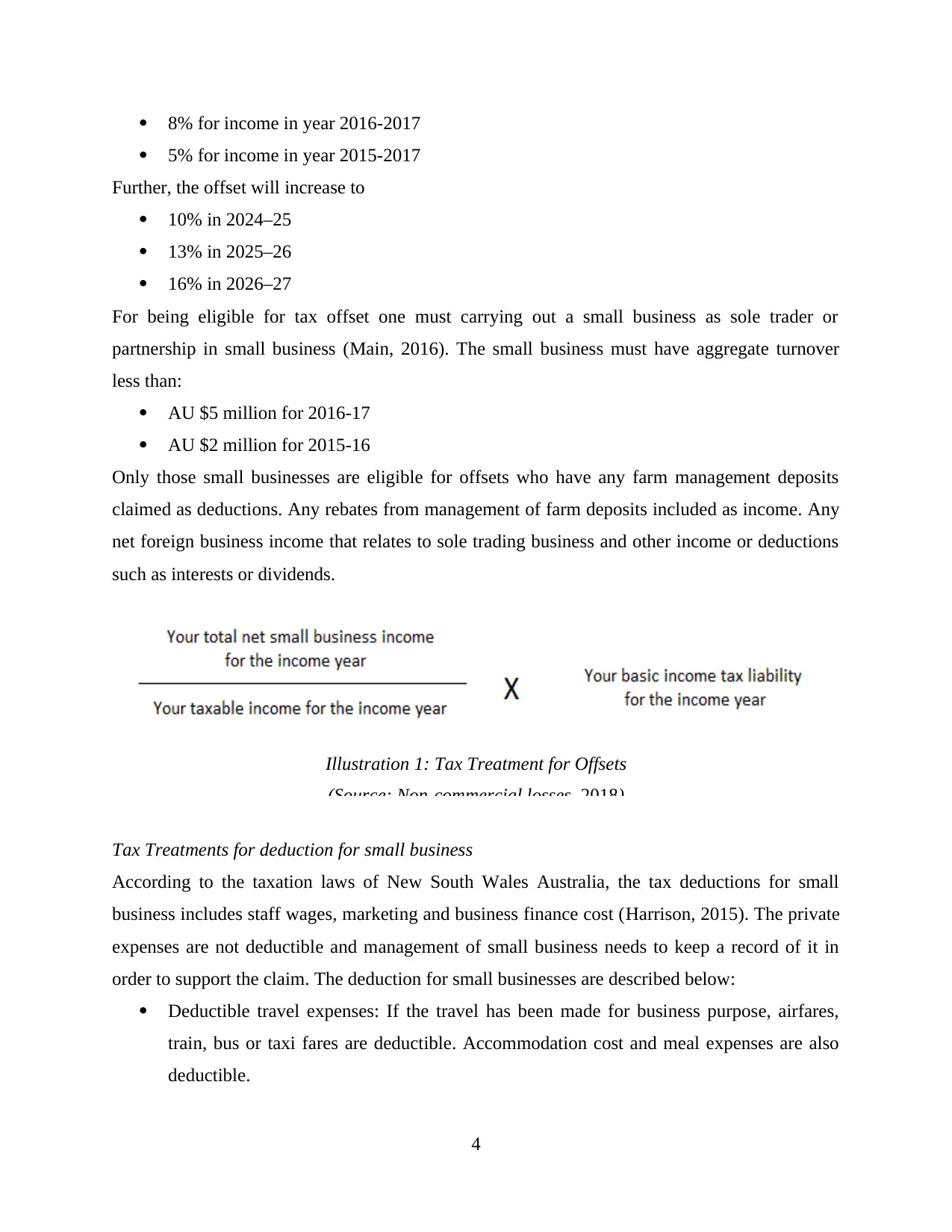
The offset which is worked out on the proportion of tax payable on small business income is
3
tax return and it will also be entitled to claim deduction of tax under same.
Other there are also some other source of income that needs to be consider by enterprise for
filing returns like income from sharing economy, Bartering and barter exchanges and
Government payments etc.
3. Tax treatments for income from properties for small business.
As per above effective analysis of Taxation representation act 1967, it has been
considered that organization needs to understand the level of effectiveness that needs to include d
for filing income tax return etc. Assess-able income are also classified that there are some
important income that comes under the tax treatments that needs to be taken in to consideration.
It is also considered as effective business analysis that needs to be taken in to consideration that
needs to be taken in to consideration (1de Flamingh and Bell, 2017). The income tax offset for
small business are also referred as unincorporated small business tax discount. The tax offset can
reduce amount of tax payable by AU $1000 each year. Accounting methods have been taken that
needs to be taken in to consideration. The amount which are included will need to be assess-able
income which in any financial year based on whether the account for income of enterprise on
cash basis or accruals basis.
In present scenario, Income which is earned by the enterprise from the house property has been
considered as under capital gains. It is also considered as increase in the value of capital asset
which provides it is higher values to the organization. A capital gain may be short-term (one year
or less) or long-term (more than one year) and must be claimed on income taxes.
4. Tax treatments for offsets and deductions for small businesses
Small businesses are currently blooming in the market economy of Australia. Government of
Australia, currently implementing various methods in order to increase their motivation so that
they can be promulgates and thus positively impacts on the national economy (Chikritzhs and
et.al., 2016). The tax treatments for offsets and deductions regulated in NSW taxation law act are
described below:
Tax treatments for offsets for small businesses
The income tax offset for small business are also referred as unincorporated small
business tax discount. The tax offset can reduce amount of tax payable by AU $1000 each year.
The offset which is worked out on the proportion of tax payable on small business income is
3
8% for income in year 2016-2017
5% for income in year 2015-2017
Further, the offset will increase to
10% in 2024–25
13% in 2025–26
16% in 2026–27
For being eligible for tax offset one must carrying out a small business as sole trader or
partnership in small business (Main, 2016). The small business must have aggregate turnover
less than:
AU $5 million for 2016-17
AU $2 million for 2015-16
Only those small businesses are eligible for offsets who have any farm management deposits
claimed as deductions. Any rebates from management of farm deposits included as income. Any
net foreign business income that relates to sole trading business and other income or deductions
such as interests or dividends.
Tax Treatments for deduction for small business
According to the taxation laws of New South Wales Australia, the tax deductions for small
business includes staff wages, marketing and business finance cost (Harrison, 2015). The private
expenses are not deductible and management of small business needs to keep a record of it in
order to support the claim. The deduction for small businesses are described below:
Deductible travel expenses: If the travel has been made for business purpose, airfares,
train, bus or taxi fares are deductible. Accommodation cost and meal expenses are also
deductible.
4
Illustration 1: Tax Treatment for Offsets
(Source: Non-commercial losses, 2018)
5% for income in year 2015-2017
Further, the offset will increase to
10% in 2024–25
13% in 2025–26
16% in 2026–27
For being eligible for tax offset one must carrying out a small business as sole trader or
partnership in small business (Main, 2016). The small business must have aggregate turnover
less than:
AU $5 million for 2016-17
AU $2 million for 2015-16
Only those small businesses are eligible for offsets who have any farm management deposits
claimed as deductions. Any rebates from management of farm deposits included as income. Any
net foreign business income that relates to sole trading business and other income or deductions
such as interests or dividends.
Tax Treatments for deduction for small business
According to the taxation laws of New South Wales Australia, the tax deductions for small
business includes staff wages, marketing and business finance cost (Harrison, 2015). The private
expenses are not deductible and management of small business needs to keep a record of it in
order to support the claim. The deduction for small businesses are described below:
Deductible travel expenses: If the travel has been made for business purpose, airfares,
train, bus or taxi fares are deductible. Accommodation cost and meal expenses are also
deductible.
4
Illustration 1: Tax Treatment for Offsets
(Source: Non-commercial losses, 2018)
⊘ This is a preview!⊘
Do you want full access?
Subscribe today to unlock all pages.
Trusted by 1+ million students worldwide
Deduction cost of assets: Depreciating asset costing less than AU $20000 each can be
deductible immediately. Small business pool can be deductible over time.
Deduction for home based business: Mortgage interests and electricity expenses are
deductible if an individual has established home businesses (Holmes and Gupta, 2015).
5. Other tax concessions for small business
As small businesses are currently blooming in the market economy of Australia, the government
of the country making efforts by allowing various concessions in their taxation policies. In
accordance with this context, other tax concessions for small businesses as per NSW taxation
laws act are listed below:
Income Tax Concessions: Income tax concessions are provided to the small business
organisations from 1 July 2016 whose turnover is less than $5 million for the Small
business income tax offset ad $10 million for all other income tax concessions. Further,
depreciation for primary producers is deductible under the tax law of NSW (West and
Lam, 2016). As on 1 July 2015, small business are entitled to deduction related with
professional expenses for start ups. If small business change their legal structure, they are
allowing for tax deduction as per the law. The restructure roll-over will allow them for
income tax deductions.
CGT Concessions: CGT stands for capital gain tax. Small businesses are eligible for CGT
concessions for AU $2 million threshold. There is a CGT exemption on the sale of an
active business asset, up to a lifetime limit of $500,000. If you are under 55, money from
the disposal of the asset must be paid into a complying superannuation fund or a
retirement savings account (Chikritzhs and et.al., 2016). Disposing or buying replacement
assets allow small business owners to reduce there tax liability. They are allow income
tax deduction on disposal or renewal of assets.
PAYG instalment concessions: Small businesses in New South Wales have an option to
pay as you go (PAYG) by instalments using an amount work out for. This helps in saving
time and cost to the organisation and they can easily get deduction in the following
legislation (Main, 2016). To acquire benefits from this, the turnover threshold for this
concession is $10 million from 1 July 2016 and $2 million up to 30 June 2016. In this
way, the management of small business organisation will able to get another income tax
concession easily and efficiently.
5
deductible immediately. Small business pool can be deductible over time.
Deduction for home based business: Mortgage interests and electricity expenses are
deductible if an individual has established home businesses (Holmes and Gupta, 2015).
5. Other tax concessions for small business
As small businesses are currently blooming in the market economy of Australia, the government
of the country making efforts by allowing various concessions in their taxation policies. In
accordance with this context, other tax concessions for small businesses as per NSW taxation
laws act are listed below:
Income Tax Concessions: Income tax concessions are provided to the small business
organisations from 1 July 2016 whose turnover is less than $5 million for the Small
business income tax offset ad $10 million for all other income tax concessions. Further,
depreciation for primary producers is deductible under the tax law of NSW (West and
Lam, 2016). As on 1 July 2015, small business are entitled to deduction related with
professional expenses for start ups. If small business change their legal structure, they are
allowing for tax deduction as per the law. The restructure roll-over will allow them for
income tax deductions.
CGT Concessions: CGT stands for capital gain tax. Small businesses are eligible for CGT
concessions for AU $2 million threshold. There is a CGT exemption on the sale of an
active business asset, up to a lifetime limit of $500,000. If you are under 55, money from
the disposal of the asset must be paid into a complying superannuation fund or a
retirement savings account (Chikritzhs and et.al., 2016). Disposing or buying replacement
assets allow small business owners to reduce there tax liability. They are allow income
tax deduction on disposal or renewal of assets.
PAYG instalment concessions: Small businesses in New South Wales have an option to
pay as you go (PAYG) by instalments using an amount work out for. This helps in saving
time and cost to the organisation and they can easily get deduction in the following
legislation (Main, 2016). To acquire benefits from this, the turnover threshold for this
concession is $10 million from 1 July 2016 and $2 million up to 30 June 2016. In this
way, the management of small business organisation will able to get another income tax
concession easily and efficiently.
5
Paraphrase This Document
Need a fresh take? Get an instant paraphrase of this document with our AI Paraphraser
FBT concessions: FBT stands for Fringe Benefits Tax. The small business are enabled for
FBT. The turnover threshold for FBT concession is $10 million from 1 April 2017 and $2
million up to 31st March 2017. There are various deduction small business owners can
enjoy such as car parking exemptions, etc.
GST and Excise concessions
Super Concessions
CONCLUSION
In this report, small business are generally defined as a structure that are not public
companies or a larger firm but in term of taxation law definition may differ which is based on
assets of company, employees structure, turnover, partnership of the firm etc. There are several
accounting methods have been used by small business for treatments of tax which is to paid on
income earned from different sources. These accounting methods have been taken that needs to
be taken in to consideration. Assess-able income are also classified that there are some important
income that comes under the tax treatments that needs to be taken in to consideration. It is also
considered as effective business analysis that needs to be taken in to consideration that needs to
be taken in to consideration.
6
FBT. The turnover threshold for FBT concession is $10 million from 1 April 2017 and $2
million up to 31st March 2017. There are various deduction small business owners can
enjoy such as car parking exemptions, etc.
GST and Excise concessions
Super Concessions
CONCLUSION
In this report, small business are generally defined as a structure that are not public
companies or a larger firm but in term of taxation law definition may differ which is based on
assets of company, employees structure, turnover, partnership of the firm etc. There are several
accounting methods have been used by small business for treatments of tax which is to paid on
income earned from different sources. These accounting methods have been taken that needs to
be taken in to consideration. Assess-able income are also classified that there are some important
income that comes under the tax treatments that needs to be taken in to consideration. It is also
considered as effective business analysis that needs to be taken in to consideration that needs to
be taken in to consideration.
6
REFERENCES
Books and Journals
Chikritzhs, T., and et.al (2016). SUBMISSION TO THE INDEPENDENT REVIEW OF THE
IMPACT OF LIQUOR LAW REFORMS IN NSW.
de Flamingh, J. and Bell, C., 2017. Employment law:'Corporate avoidance'of the'Fair work
Act'. LSJ: Law Society of NSW Journal, (39), p.74.
Harrison, L. (2015). Property investment through discretionary trusts. Taxation in
Australia, 50(2), 84.
Holmes, S., & Gupta, D. (2015). Opening Aladdin’s Cave: Unpacking the Factors Impacting on
Small Businesses. In RBA Annual Conference Volume. Reserve Bank of Australia.
Main, J. (2016). Taxation: Why you must consider GST: Before closing a deal. LSJ: Law Society
of NSW Journal, (27), 92.
Main, J., 2015. Taxation: One business deal, multiple contracts: GST and stamp duty stings
await. LSJ: Law Society of NSW Journal, (11), p.81.
Main, J., 2016. Taxation: Why you must consider GST: Before closing a deal. LSJ: Law Society
of NSW Journal, (27), p.92.
Robinson, M., 2016. Conducting an administrative law case in NSW. Precedent (Sydney, NSW),
(136), p.4.
West, M., & Lam, D. (2016). Small business restructure roll-over-Opportunities and
traps. Taxation in Australia, 50(9), 521.
Williams, L., 2017. Risk: Real property changes: Risk management tips for solicitors. LSJ: Law
Society of NSW Journal, (30), p.76.
Online
Non-commercial losses, 2018 [Online]. Available
through:<https://www.ato.gov.au/business/income-and-deductions-for-business/in-detail/
small-business-income-tax-offset/?page=4#Non_commercial_losses>
7
Books and Journals
Chikritzhs, T., and et.al (2016). SUBMISSION TO THE INDEPENDENT REVIEW OF THE
IMPACT OF LIQUOR LAW REFORMS IN NSW.
de Flamingh, J. and Bell, C., 2017. Employment law:'Corporate avoidance'of the'Fair work
Act'. LSJ: Law Society of NSW Journal, (39), p.74.
Harrison, L. (2015). Property investment through discretionary trusts. Taxation in
Australia, 50(2), 84.
Holmes, S., & Gupta, D. (2015). Opening Aladdin’s Cave: Unpacking the Factors Impacting on
Small Businesses. In RBA Annual Conference Volume. Reserve Bank of Australia.
Main, J. (2016). Taxation: Why you must consider GST: Before closing a deal. LSJ: Law Society
of NSW Journal, (27), 92.
Main, J., 2015. Taxation: One business deal, multiple contracts: GST and stamp duty stings
await. LSJ: Law Society of NSW Journal, (11), p.81.
Main, J., 2016. Taxation: Why you must consider GST: Before closing a deal. LSJ: Law Society
of NSW Journal, (27), p.92.
Robinson, M., 2016. Conducting an administrative law case in NSW. Precedent (Sydney, NSW),
(136), p.4.
West, M., & Lam, D. (2016). Small business restructure roll-over-Opportunities and
traps. Taxation in Australia, 50(9), 521.
Williams, L., 2017. Risk: Real property changes: Risk management tips for solicitors. LSJ: Law
Society of NSW Journal, (30), p.76.
Online
Non-commercial losses, 2018 [Online]. Available
through:<https://www.ato.gov.au/business/income-and-deductions-for-business/in-detail/
small-business-income-tax-offset/?page=4#Non_commercial_losses>
7
⊘ This is a preview!⊘
Do you want full access?
Subscribe today to unlock all pages.
Trusted by 1+ million students worldwide

1 out of 9


Related Documents


Your All-in-One AI-Powered Toolkit for Academic Success.
+13062052269
info@desklib.com
Available 24*7 on WhatsApp / Email
![[object Object]](/_next/static/media/star-bottom.7253800d.svg)
Unlock your academic potential
Copyright © 2020–2026 A2Z Services. All Rights Reserved. Developed and managed by ZUCOL.