MMS716: Critical Analysis of Australian Sports Commission Theory
VerifiedAdded on 2023/06/12
|20
|4901
|169
Essay
AI Summary
This essay critically analyzes the Australian Sports Commission (ASC) through the framework of sports organization theory, examining its structure, function, and various aspects. It delves into organizational theory and research, goals, effectiveness, strategy, strategic alliances, and the ASC's response to change. The analysis covers the ASC's role as a social entity within the sports industry, its goal-directed focus, structured activity system, and identifiable boundaries. It also discusses the differences between sports and organizational behavior, highlighting the importance of both micro and macro perspectives in understanding the ASC's functioning. The essay further emphasizes the significance of interdisciplinary research in addressing complex problems within the sports industry, particularly in the context of the ASC's national role. Desklib provides access to similar solved assignments and resources for students.
Running head: SPORTS ORGANIZATION THEORY
SPORTS ORGANIZATION THEORY
Name of student:
Name of university:
Author note:
SPORTS ORGANIZATION THEORY
Name of student:
Name of university:
Author note:

Paraphrase This Document
Need a fresh take? Get an instant paraphrase of this document with our AI Paraphraser
1
SPORTS ORGANIZATION THEORY
Table of Contents
Introduction:...............................................................................................................................2
Australian Sports Organization: Overview............................................................................2
Discussion:.................................................................................................................................3
Organizational theory and research:.......................................................................................3
Goals, structure and effectiveness:.........................................................................................9
Strategy and strategic alliances:...........................................................................................14
Sports organizations and chance:.........................................................................................15
Conclusion................................................................................................................................16
References................................................................................................................................17
Introduction:
SPORTS ORGANIZATION THEORY
Table of Contents
Introduction:...............................................................................................................................2
Australian Sports Organization: Overview............................................................................2
Discussion:.................................................................................................................................3
Organizational theory and research:.......................................................................................3
Goals, structure and effectiveness:.........................................................................................9
Strategy and strategic alliances:...........................................................................................14
Sports organizations and chance:.........................................................................................15
Conclusion................................................................................................................................16
References................................................................................................................................17
Introduction:
2
SPORTS ORGANIZATION THEORY
The aim of this paper is to understanding the functioning, structure and various
aspects of the Australian Sports Commission through the framework of the theory, concepts,
paradigm, and model of sports organization. The critical analysis of this case organization
will be helpful in deepening our understanding about the organizational behaviour of sport.
The paper will discuss on the aspects of organizational theory and research, goals,
effectiveness and structure, strategy and strategy alliances, and sport organizations and
change. Through investigation into each of these aspects, there will be an examination and
exploration of the role, functioning and core values of ASC (Australian Sports Commission).
These aspects will provide a deeper insight into the functioning of the Australian
Sports Association (ASC) and it will be accomplished through a wealth of literature
concerning the domain of Sports Organization Theory.
Australian Sports Organization: Overview
The Australian Sports Organization (ASC) is a major sports agency that supports,
develops, and invests in sports at different levels. This organization was founded in the year
1985 and is currently operational under the Australian Sports Commission Act 1989 (ASC,
2017). The goal of Australian Sports Commission is to strengthen the Australian Sport and
create opportunities for more interested sportspersons to engage in sports and bolster the
athletes to achieve success at the global level. Australian Sports Commission is directly
associated with the sports organizations, peak bodies and the different territory departments,
academic institutions, organizations, institutions of sports and also the business sector
(Agnihotri, 2016). Its objective is to create alignment with through the Australian sports
sector with the aim to drive the unified vision of participation growth. The organization has
shown its commitment to espouse the principles of integrity and respect, promotion of
teamwork and contribution to the high-functioning team to produce excellent service. The
SPORTS ORGANIZATION THEORY
The aim of this paper is to understanding the functioning, structure and various
aspects of the Australian Sports Commission through the framework of the theory, concepts,
paradigm, and model of sports organization. The critical analysis of this case organization
will be helpful in deepening our understanding about the organizational behaviour of sport.
The paper will discuss on the aspects of organizational theory and research, goals,
effectiveness and structure, strategy and strategy alliances, and sport organizations and
change. Through investigation into each of these aspects, there will be an examination and
exploration of the role, functioning and core values of ASC (Australian Sports Commission).
These aspects will provide a deeper insight into the functioning of the Australian
Sports Association (ASC) and it will be accomplished through a wealth of literature
concerning the domain of Sports Organization Theory.
Australian Sports Organization: Overview
The Australian Sports Organization (ASC) is a major sports agency that supports,
develops, and invests in sports at different levels. This organization was founded in the year
1985 and is currently operational under the Australian Sports Commission Act 1989 (ASC,
2017). The goal of Australian Sports Commission is to strengthen the Australian Sport and
create opportunities for more interested sportspersons to engage in sports and bolster the
athletes to achieve success at the global level. Australian Sports Commission is directly
associated with the sports organizations, peak bodies and the different territory departments,
academic institutions, organizations, institutions of sports and also the business sector
(Agnihotri, 2016). Its objective is to create alignment with through the Australian sports
sector with the aim to drive the unified vision of participation growth. The organization has
shown its commitment to espouse the principles of integrity and respect, promotion of
teamwork and contribution to the high-functioning team to produce excellent service. The
⊘ This is a preview!⊘
Do you want full access?
Subscribe today to unlock all pages.

Trusted by 1+ million students worldwide
3
SPORTS ORGANIZATION THEORY
broader objective of Australian Sports Commission is to imbue leadership in the national
sports sector and support the national sports organizations and different other partners to
create a culture of sports in Australia. In Australia, AC has more than 90 National Sporting
Organization for people who are disabled (NSOD’s). The Australian Sports Commission
understands the importance of excellence in the field of sports journalism and the
broadcasting on an yearly basis through the ASC Media Awards. This is completely
dedicated o AC Media Awards. The governing body of ASC is known for its corporate
structure that consists of three divisions- Australian Institute of Sports, Participation&
Sustainable Sports, and Corporate Operations. These divisions are entrusted with different
roles and responsibilities; this in turn contributes in the key objectives of the organization.
The headquarter of Australian Sports Commission is in Canberra, however being the central
body for sport in Australia it has their staff placed at different parts of the country.
Discussion:
Organizational theory and research:
The term sports organization is defined a social entity that is engaged in the sport
industry and this requires the goal to be directed. This is to be done with consciously
structured activity system that are operating under the relatively identifiable boundary. There
are five key aspects of this the definition in the context of Australian Sports Commission.
Social entity- Australian Sports Commission fulfils the criterion of being a social
entity according to te definition of the states regarding a sports organization that
should consist of people or groups who interacts with one another. This interaction is
done with the aim of satiating the objectives of the organization. Australian Sports
Commission comprises of 517 staff members who have their base throughout
SPORTS ORGANIZATION THEORY
broader objective of Australian Sports Commission is to imbue leadership in the national
sports sector and support the national sports organizations and different other partners to
create a culture of sports in Australia. In Australia, AC has more than 90 National Sporting
Organization for people who are disabled (NSOD’s). The Australian Sports Commission
understands the importance of excellence in the field of sports journalism and the
broadcasting on an yearly basis through the ASC Media Awards. This is completely
dedicated o AC Media Awards. The governing body of ASC is known for its corporate
structure that consists of three divisions- Australian Institute of Sports, Participation&
Sustainable Sports, and Corporate Operations. These divisions are entrusted with different
roles and responsibilities; this in turn contributes in the key objectives of the organization.
The headquarter of Australian Sports Commission is in Canberra, however being the central
body for sport in Australia it has their staff placed at different parts of the country.
Discussion:
Organizational theory and research:
The term sports organization is defined a social entity that is engaged in the sport
industry and this requires the goal to be directed. This is to be done with consciously
structured activity system that are operating under the relatively identifiable boundary. There
are five key aspects of this the definition in the context of Australian Sports Commission.
Social entity- Australian Sports Commission fulfils the criterion of being a social
entity according to te definition of the states regarding a sports organization that
should consist of people or groups who interacts with one another. This interaction is
done with the aim of satiating the objectives of the organization. Australian Sports
Commission comprises of 517 staff members who have their base throughout
Paraphrase This Document
Need a fresh take? Get an instant paraphrase of this document with our AI Paraphraser
4
SPORTS ORGANIZATION THEORY
Australia and most of them are situated in the in the headquarters of Canberra (ASC,
2015). Since the Australian Sports Commission knows its employees who are located
in different parts of the world, there is evidence that there are prior planning
regarding the requirement of staff at every venue so that the organization functions
and objectives are fulfilled without much hassle.
Involvement of the sports Industry- Slack & Parent (2006) states that the hallmark
of a sports organization is its direct involvement with more than one aspect of sports.
Australian Sports Commission is a commonwealth entity subsumed under the
government of Australia and its bard members are directly accountable t the Ministry
of Sport in Australia. This qualifies the statement that it is an organization that is
associated with the sports industry. This distinguishes the sports organization from
other organizations. Keeping in mind the aims and objectives of the Australian
Sports Commission to enhance the number of participants to embrace sports and
deliver high-sport performances throughout Australia, it can be stated that Australian
Sports Commission is the central body of sports for the country.
Goal directed focus- The core value of th sports organization is to have a focussed
approach within the industry of sports and the goals should be either connected to
profit or achieving victory in international events or increasing the number of
participants. Australian Sports Commission can be considered as goal oriented as it
is diligent in its approach towards increasing the number of participants as well as
securing a large number of medals for the country through their performance
programs (Lunenburg, 2012). Therefore, it can be stated that Australian Sports
Commission is goal directed and the objectives if the organization is to transform the
sporting culture of the country by creating competent players who would be an asset
to the organization and the country.
SPORTS ORGANIZATION THEORY
Australia and most of them are situated in the in the headquarters of Canberra (ASC,
2015). Since the Australian Sports Commission knows its employees who are located
in different parts of the world, there is evidence that there are prior planning
regarding the requirement of staff at every venue so that the organization functions
and objectives are fulfilled without much hassle.
Involvement of the sports Industry- Slack & Parent (2006) states that the hallmark
of a sports organization is its direct involvement with more than one aspect of sports.
Australian Sports Commission is a commonwealth entity subsumed under the
government of Australia and its bard members are directly accountable t the Ministry
of Sport in Australia. This qualifies the statement that it is an organization that is
associated with the sports industry. This distinguishes the sports organization from
other organizations. Keeping in mind the aims and objectives of the Australian
Sports Commission to enhance the number of participants to embrace sports and
deliver high-sport performances throughout Australia, it can be stated that Australian
Sports Commission is the central body of sports for the country.
Goal directed focus- The core value of th sports organization is to have a focussed
approach within the industry of sports and the goals should be either connected to
profit or achieving victory in international events or increasing the number of
participants. Australian Sports Commission can be considered as goal oriented as it
is diligent in its approach towards increasing the number of participants as well as
securing a large number of medals for the country through their performance
programs (Lunenburg, 2012). Therefore, it can be stated that Australian Sports
Commission is goal directed and the objectives if the organization is to transform the
sporting culture of the country by creating competent players who would be an asset
to the organization and the country.
5
SPORTS ORGANIZATION THEORY
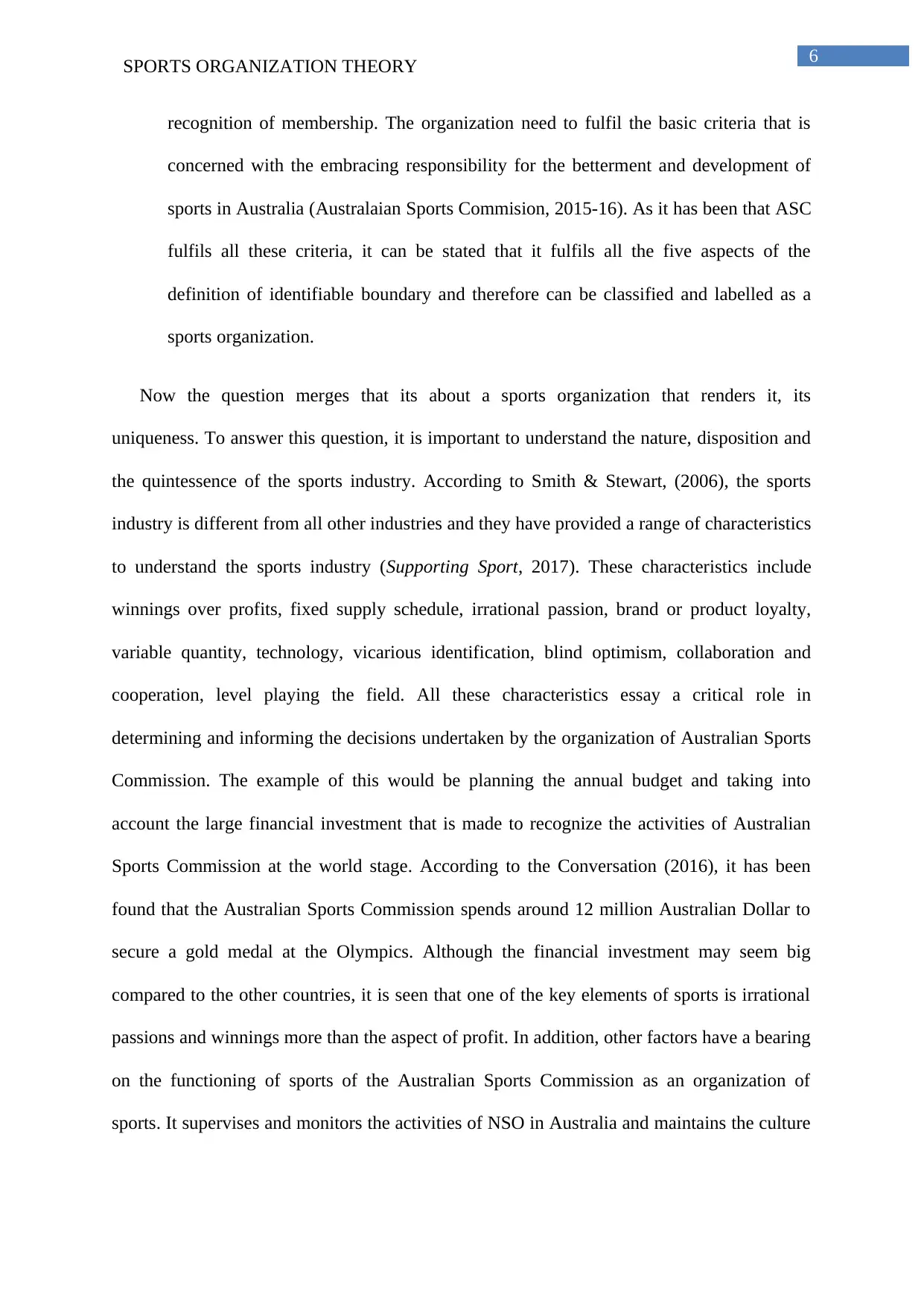
Structured activity system- Structured activity system connotes that an organization
needs to have a structured activity system that clearly defines the variegated
organizational responsibilities and the roles. This includes the role of the HR,
Marketing, and finance and so on. The clear-cut organizational structure of the ASC
can be witnessed through the multiple roles accomplished by each of the departments
and the fulfilment of the objectives.
ORGANIZATION STRUCTURE OF AUSTRALIAN SPORTS COMMISSION
Identifiable boundary- Sports organizations must have the capability of
distinguishing between its members and the others. The Australian Sports
Organization by keeping a tab on the member NSOD or NSO to fulfil the eligibility
criteria accomplishes this. ASC follows a strict and criteria for looking the
SPORTS ORGANIZATION THEORY
Structured activity system- Structured activity system connotes that an organization
needs to have a structured activity system that clearly defines the variegated
organizational responsibilities and the roles. This includes the role of the HR,
Marketing, and finance and so on. The clear-cut organizational structure of the ASC
can be witnessed through the multiple roles accomplished by each of the departments
and the fulfilment of the objectives.
ORGANIZATION STRUCTURE OF AUSTRALIAN SPORTS COMMISSION
Identifiable boundary- Sports organizations must have the capability of
distinguishing between its members and the others. The Australian Sports
Organization by keeping a tab on the member NSOD or NSO to fulfil the eligibility
criteria accomplishes this. ASC follows a strict and criteria for looking the
⊘ This is a preview!⊘
Do you want full access?
Subscribe today to unlock all pages.
Trusted by 1+ million students worldwide
6
SPORTS ORGANIZATION THEORY
recognition of membership. The organization need to fulfil the basic criteria that is
concerned with the embracing responsibility for the betterment and development of
sports in Australia (Australaian Sports Commision, 2015-16). As it has been that ASC
fulfils all these criteria, it can be stated that it fulfils all the five aspects of the
definition of identifiable boundary and therefore can be classified and labelled as a
sports organization.
Now the question merges that its about a sports organization that renders it, its
uniqueness. To answer this question, it is important to understand the nature, disposition and
the quintessence of the sports industry. According to Smith & Stewart, (2006), the sports
industry is different from all other industries and they have provided a range of characteristics
to understand the sports industry (Supporting Sport, 2017). These characteristics include
winnings over profits, fixed supply schedule, irrational passion, brand or product loyalty,
variable quantity, technology, vicarious identification, blind optimism, collaboration and
cooperation, level playing the field. All these characteristics essay a critical role in
determining and informing the decisions undertaken by the organization of Australian Sports
Commission. The example of this would be planning the annual budget and taking into
account the large financial investment that is made to recognize the activities of Australian
Sports Commission at the world stage. According to the Conversation (2016), it has been
found that the Australian Sports Commission spends around 12 million Australian Dollar to
secure a gold medal at the Olympics. Although the financial investment may seem big
compared to the other countries, it is seen that one of the key elements of sports is irrational
passions and winnings more than the aspect of profit. In addition, other factors have a bearing
on the functioning of sports of the Australian Sports Commission as an organization of
sports. It supervises and monitors the activities of NSO in Australia and maintains the culture
SPORTS ORGANIZATION THEORY
recognition of membership. The organization need to fulfil the basic criteria that is
concerned with the embracing responsibility for the betterment and development of
sports in Australia (Australaian Sports Commision, 2015-16). As it has been that ASC
fulfils all these criteria, it can be stated that it fulfils all the five aspects of the
definition of identifiable boundary and therefore can be classified and labelled as a
sports organization.
Now the question merges that its about a sports organization that renders it, its
uniqueness. To answer this question, it is important to understand the nature, disposition and
the quintessence of the sports industry. According to Smith & Stewart, (2006), the sports
industry is different from all other industries and they have provided a range of characteristics
to understand the sports industry (Supporting Sport, 2017). These characteristics include
winnings over profits, fixed supply schedule, irrational passion, brand or product loyalty,
variable quantity, technology, vicarious identification, blind optimism, collaboration and
cooperation, level playing the field. All these characteristics essay a critical role in
determining and informing the decisions undertaken by the organization of Australian Sports
Commission. The example of this would be planning the annual budget and taking into
account the large financial investment that is made to recognize the activities of Australian
Sports Commission at the world stage. According to the Conversation (2016), it has been
found that the Australian Sports Commission spends around 12 million Australian Dollar to
secure a gold medal at the Olympics. Although the financial investment may seem big
compared to the other countries, it is seen that one of the key elements of sports is irrational
passions and winnings more than the aspect of profit. In addition, other factors have a bearing
on the functioning of sports of the Australian Sports Commission as an organization of
sports. It supervises and monitors the activities of NSO in Australia and maintains the culture
Paraphrase This Document
Need a fresh take? Get an instant paraphrase of this document with our AI Paraphraser
7
SPORTS ORGANIZATION THEORY
of a level playing field. This is doe to ensure that the sports remain competitive and that
participation increases in the specific sport.
Difference between sport and the organizational behaviour
Scholars have found key differences between the organization theory and the
behaviour of sports. The core value of organization behaviour is that it is completely focused
towards the macro perspective. It is embedded in Sociology and its domains of research
include strategy, design and structure, and so on. Another feature of the organization
behaviour is that it also focuses on the micro perspective, the foundation f which is premised
on social psychology and the domains of research include job satisfaction, team building and
so on. The characteristic of organizational behaviour and organizational theory can be
understood through the following illustration of Kate Palmer, the first female CEO of
Australian Sports Commission. In the world of sports, there is a glaring absence of women
from both leadership positions as well as participation (Doherty, 2012). The application of
the Organizational Behaviour is that it can be explained through the examination of the
personality of the individual and their level of motivation. On the other hand, the
Organizational Theory approach looks navigates and analyses the structural conditions that
informs the lifeworld of women and restrains their lifechances. In this case, structural
constraints, that prevents women from seeking leadership position and membership in sports
organizations. The Australian Government has adopted the Organizational Theory approach
by deciding to appoint a female CEO for the Australian Sports commission and also by
making a provision that there should be 40 per cent reservation of female on the boards by
the year 2019 (Balcescu & Blage, 2016). This step undertaken by the Australian Government
and the Australian Sports Commission follows the code of the Organization theory approach.
In this case, the theory of Organizational Behaviour is also important o understand the
present structure of ASC. It is being predicted by scholars that after her appointment, Palmer
SPORTS ORGANIZATION THEORY
of a level playing field. This is doe to ensure that the sports remain competitive and that
participation increases in the specific sport.
Difference between sport and the organizational behaviour
Scholars have found key differences between the organization theory and the
behaviour of sports. The core value of organization behaviour is that it is completely focused
towards the macro perspective. It is embedded in Sociology and its domains of research
include strategy, design and structure, and so on. Another feature of the organization
behaviour is that it also focuses on the micro perspective, the foundation f which is premised
on social psychology and the domains of research include job satisfaction, team building and
so on. The characteristic of organizational behaviour and organizational theory can be
understood through the following illustration of Kate Palmer, the first female CEO of
Australian Sports Commission. In the world of sports, there is a glaring absence of women
from both leadership positions as well as participation (Doherty, 2012). The application of
the Organizational Behaviour is that it can be explained through the examination of the
personality of the individual and their level of motivation. On the other hand, the
Organizational Theory approach looks navigates and analyses the structural conditions that
informs the lifeworld of women and restrains their lifechances. In this case, structural
constraints, that prevents women from seeking leadership position and membership in sports
organizations. The Australian Government has adopted the Organizational Theory approach
by deciding to appoint a female CEO for the Australian Sports commission and also by
making a provision that there should be 40 per cent reservation of female on the boards by
the year 2019 (Balcescu & Blage, 2016). This step undertaken by the Australian Government
and the Australian Sports Commission follows the code of the Organization theory approach.
In this case, the theory of Organizational Behaviour is also important o understand the
present structure of ASC. It is being predicted by scholars that after her appointment, Palmer
8
SPORTS ORGANIZATION THEORY
will adopt both the Organizational Theory and Organizational Behaviour approach to ensure
a smooth functioning of the organization. The adoption of the Organizational behaviour is
important to keep the motivation level of all the employees high and therefore, ensure the
satisfaction of the workforce. On the other hand, the adoption of the Organizational Theory
approach will be useful in ensuring the organization fulfils the objectives and set values with
efficiency and finesse.
Critical thinking and interdisciplinary approach
Scholars have identified the significance of theory in the past research in the domain
of sports management. They have emphasized on the application of theory, research and
practice and that teaching will help in advancing the domain of sports management.
According to Doherty (2013), individuals and organizations have employed a theory based
approach. In this, theory is used for critically examining the variegated aspects of the
business of sports. These aspects consist of critical thinking that are self-explanatory and
include setting the question, collection of information, application of information,
consideration about the potential outcomes and exploration of the perspectives and
alternatives. There are certain advantages of using the interdisciplinary research as against the
disciplinary and multidisciplinary research to understand the problem in a critical manner.
The logic is that several researchers working on the same issue from different perspectives
will guarantee a much more holistic and refined understanding than a singular viewpoint in
understanding the problem (Balcescu & Blage, 2016). This is particularly useful in
addressing complex problems that require a nuanced approach. Since the Australian Sports
Commission is the central body of the country, it is important to adopt an interdisciplinary
approach as against a disciplinary or multidisciplinary approach in analyzing the complex
decisions taken by the organization that would have long-term impact in running the sports
industry in Australia. Therefore, there isn an interdisciplinary approach with the aim of
SPORTS ORGANIZATION THEORY
will adopt both the Organizational Theory and Organizational Behaviour approach to ensure
a smooth functioning of the organization. The adoption of the Organizational behaviour is
important to keep the motivation level of all the employees high and therefore, ensure the
satisfaction of the workforce. On the other hand, the adoption of the Organizational Theory
approach will be useful in ensuring the organization fulfils the objectives and set values with
efficiency and finesse.
Critical thinking and interdisciplinary approach
Scholars have identified the significance of theory in the past research in the domain
of sports management. They have emphasized on the application of theory, research and
practice and that teaching will help in advancing the domain of sports management.
According to Doherty (2013), individuals and organizations have employed a theory based
approach. In this, theory is used for critically examining the variegated aspects of the
business of sports. These aspects consist of critical thinking that are self-explanatory and
include setting the question, collection of information, application of information,
consideration about the potential outcomes and exploration of the perspectives and
alternatives. There are certain advantages of using the interdisciplinary research as against the
disciplinary and multidisciplinary research to understand the problem in a critical manner.
The logic is that several researchers working on the same issue from different perspectives
will guarantee a much more holistic and refined understanding than a singular viewpoint in
understanding the problem (Balcescu & Blage, 2016). This is particularly useful in
addressing complex problems that require a nuanced approach. Since the Australian Sports
Commission is the central body of the country, it is important to adopt an interdisciplinary
approach as against a disciplinary or multidisciplinary approach in analyzing the complex
decisions taken by the organization that would have long-term impact in running the sports
industry in Australia. Therefore, there isn an interdisciplinary approach with the aim of
⊘ This is a preview!⊘
Do you want full access?
Subscribe today to unlock all pages.
Trusted by 1+ million students worldwide
9
SPORTS ORGANIZATION THEORY
ensuring that the multiple stakeholders of the ASC like participation, human resources,
finance and so are on the same platform thereby creating a coordination and effective
planning.
Goals, structure and effectiveness:
Goals can be understood as statements that provides the synopsis and articulate about
the objectives of an organization. Goals provide direction to the sports managers and assist
them in the decision making process through the minimization of uncertainty, direction and
motivation of the employees, and establishment of legitimacy from the external groups
through the accomplishment of the goal.
Currently, the objectives of ASC are
Increase in participation of sports
Sustainable sport
Increase in the internal success
Enhancement of the capability of ASC to lead, support and partner
Currently, the top three goals of the ASC are focussed on the external goals. This indicates
achieving a quantifiable desired goal along with the management of the objective. This is
focussed on the ways in which ASC as an organization operates itself rather than trying to
achieve it. According to Slack & Parent (2006), there are mainly two types of goals in an
organization. These two goals are operative and official. Official goal indicates that the goal
is objective in nature and provides a description of the current plans of the organization. On
the other hand, operative goal indicates that the goal is subjective in nature and provides a
description of the reason for the existence of the organization. According to the current
corporate report of ASC (2015), the goal will be to enhance the participation in sports, boos
the number of sports related schools, encouragement of sports in schools, create demand for
SPORTS ORGANIZATION THEORY
ensuring that the multiple stakeholders of the ASC like participation, human resources,
finance and so are on the same platform thereby creating a coordination and effective
planning.
Goals, structure and effectiveness:
Goals can be understood as statements that provides the synopsis and articulate about
the objectives of an organization. Goals provide direction to the sports managers and assist
them in the decision making process through the minimization of uncertainty, direction and
motivation of the employees, and establishment of legitimacy from the external groups
through the accomplishment of the goal.
Currently, the objectives of ASC are
Increase in participation of sports
Sustainable sport
Increase in the internal success
Enhancement of the capability of ASC to lead, support and partner
Currently, the top three goals of the ASC are focussed on the external goals. This indicates
achieving a quantifiable desired goal along with the management of the objective. This is
focussed on the ways in which ASC as an organization operates itself rather than trying to
achieve it. According to Slack & Parent (2006), there are mainly two types of goals in an
organization. These two goals are operative and official. Official goal indicates that the goal
is objective in nature and provides a description of the current plans of the organization. On
the other hand, operative goal indicates that the goal is subjective in nature and provides a
description of the reason for the existence of the organization. According to the current
corporate report of ASC (2015), the goal will be to enhance the participation in sports, boos
the number of sports related schools, encouragement of sports in schools, create demand for
Paraphrase This Document
Need a fresh take? Get an instant paraphrase of this document with our AI Paraphraser
10
SPORTS ORGANIZATION THEORY
the participation in sports and overall attempt to understand the fate of sports. With the aim to
overview international success, ASC has secured Top 5 positions in the Olympics and
Paralympics, more than 20 world championship and the number one spot in the Gold coast
2018. These goals are quantifiable and objective therefore these are official goals. On the
other hand, the last two objectives of ASC are subjective, as they cannot be quantified. It is
difficult to measure their success and the ways it will be evaluated in 2019 according to the
current corporate plan. Therefore, the objective of achieving greater success is operative and
the goals that can be quantifiable in terms of winning medals can be stated as official.
Resource management in the sport organizations
On an average day to day basis, organizations struggle to manage the resources that
are available to them with the aim of achieving the goals. The strategy of the Australian
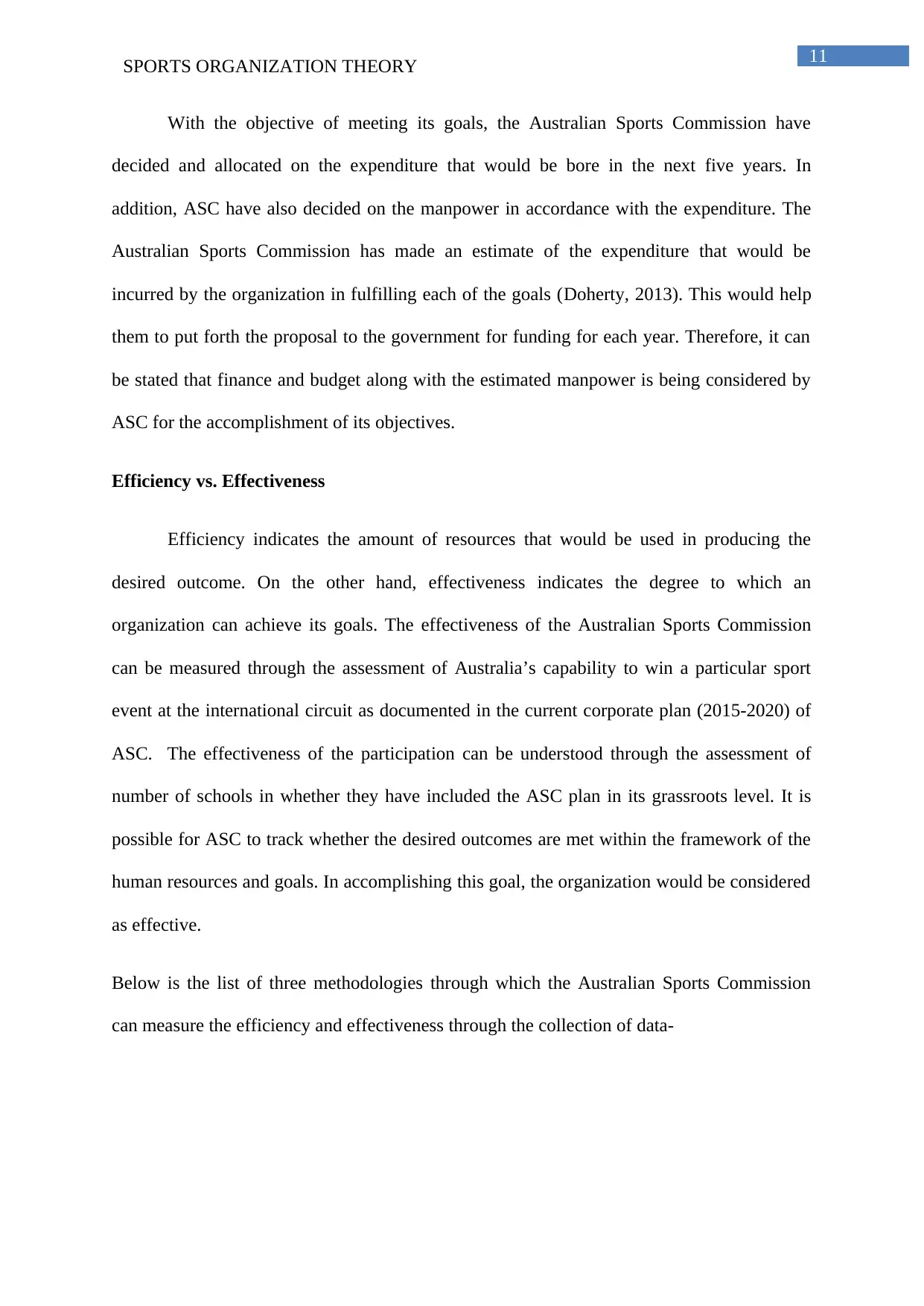
Sports Commission in the management of resources is through the allocation of the fixed
annual budget to achieve the outcome of each of their goals.
ANNUAL BUDGET OF ASC TO INCREASE TEH PARTICIPATION IN SPORT
SPORTS ORGANIZATION THEORY
the participation in sports and overall attempt to understand the fate of sports. With the aim to
overview international success, ASC has secured Top 5 positions in the Olympics and
Paralympics, more than 20 world championship and the number one spot in the Gold coast
2018. These goals are quantifiable and objective therefore these are official goals. On the
other hand, the last two objectives of ASC are subjective, as they cannot be quantified. It is
difficult to measure their success and the ways it will be evaluated in 2019 according to the
current corporate plan. Therefore, the objective of achieving greater success is operative and
the goals that can be quantifiable in terms of winning medals can be stated as official.
Resource management in the sport organizations
On an average day to day basis, organizations struggle to manage the resources that
are available to them with the aim of achieving the goals. The strategy of the Australian
Sports Commission in the management of resources is through the allocation of the fixed
annual budget to achieve the outcome of each of their goals.
ANNUAL BUDGET OF ASC TO INCREASE TEH PARTICIPATION IN SPORT
11
SPORTS ORGANIZATION THEORY
With the objective of meeting its goals, the Australian Sports Commission have
decided and allocated on the expenditure that would be bore in the next five years. In
addition, ASC have also decided on the manpower in accordance with the expenditure. The
Australian Sports Commission has made an estimate of the expenditure that would be
incurred by the organization in fulfilling each of the goals (Doherty, 2013). This would help
them to put forth the proposal to the government for funding for each year. Therefore, it can
be stated that finance and budget along with the estimated manpower is being considered by
ASC for the accomplishment of its objectives.
Efficiency vs. Effectiveness
Efficiency indicates the amount of resources that would be used in producing the
desired outcome. On the other hand, effectiveness indicates the degree to which an
organization can achieve its goals. The effectiveness of the Australian Sports Commission
can be measured through the assessment of Australia’s capability to win a particular sport
event at the international circuit as documented in the current corporate plan (2015-2020) of
ASC. The effectiveness of the participation can be understood through the assessment of
number of schools in whether they have included the ASC plan in its grassroots level. It is
possible for ASC to track whether the desired outcomes are met within the framework of the
human resources and goals. In accomplishing this goal, the organization would be considered
as effective.
Below is the list of three methodologies through which the Australian Sports Commission
can measure the efficiency and effectiveness through the collection of data-
SPORTS ORGANIZATION THEORY
With the objective of meeting its goals, the Australian Sports Commission have
decided and allocated on the expenditure that would be bore in the next five years. In
addition, ASC have also decided on the manpower in accordance with the expenditure. The
Australian Sports Commission has made an estimate of the expenditure that would be
incurred by the organization in fulfilling each of the goals (Doherty, 2013). This would help
them to put forth the proposal to the government for funding for each year. Therefore, it can
be stated that finance and budget along with the estimated manpower is being considered by
ASC for the accomplishment of its objectives.
Efficiency vs. Effectiveness
Efficiency indicates the amount of resources that would be used in producing the
desired outcome. On the other hand, effectiveness indicates the degree to which an
organization can achieve its goals. The effectiveness of the Australian Sports Commission
can be measured through the assessment of Australia’s capability to win a particular sport
event at the international circuit as documented in the current corporate plan (2015-2020) of
ASC. The effectiveness of the participation can be understood through the assessment of
number of schools in whether they have included the ASC plan in its grassroots level. It is
possible for ASC to track whether the desired outcomes are met within the framework of the
human resources and goals. In accomplishing this goal, the organization would be considered
as effective.
Below is the list of three methodologies through which the Australian Sports Commission
can measure the efficiency and effectiveness through the collection of data-
⊘ This is a preview!⊘
Do you want full access?
Subscribe today to unlock all pages.
Trusted by 1+ million students worldwide

1 out of 20


Related Documents


Your All-in-One AI-Powered Toolkit for Academic Success.
+13062052269
info@desklib.com
Available 24*7 on WhatsApp / Email
![[object Object]](/_next/static/media/star-bottom.7253800d.svg)
Unlock your academic potential
Copyright © 2020–2026 A2Z Services. All Rights Reserved. Developed and managed by ZUCOL.