Individual Assignment: Australian Taxation Law, Holmes Institute
VerifiedAdded on 2022/08/22
|11
|2461
|17
Homework Assignment
AI Summary
This document presents a comprehensive solution to an Australian Taxation Law assignment, addressing two key questions. The first question focuses on Capital Gains Tax (CGT), requiring the student to advise on the tax implications of various transactions, including the sale of land, shares, a stamp collection, and a guitar. It involves identifying material facts, applying relevant CGT legislation (including ITAA 1997 sections), calculating the cost base of assets, and determining capital gains or losses, considering exemptions and deductions. The second question delves into allowable deductions for an individual, Ava, who has relocated for work. The analysis examines expenses related to job interviews, relocation, workwear, childcare, phone calls, food, speeding fines, and travel, applying relevant case law (such as FCT v Maddalena) and ATO rulings to determine which expenses are deductible under the general deduction rule and related provisions of ITAA 1997 and ITAA 1936. The solution provides a detailed breakdown of each expense, justifying the deductibility or non-deductibility based on the applicable legal principles.
Running head: AUSTRALIAN TAXATION LAW
Australian Taxation Law
Name of the Student
Name of the University
Author Note
Australian Taxation Law
Name of the Student
Name of the University
Author Note

Paraphrase This Document
Need a fresh take? Get an instant paraphrase of this document with our AI Paraphraser
1AUSTRALIAN TAXATION LAW
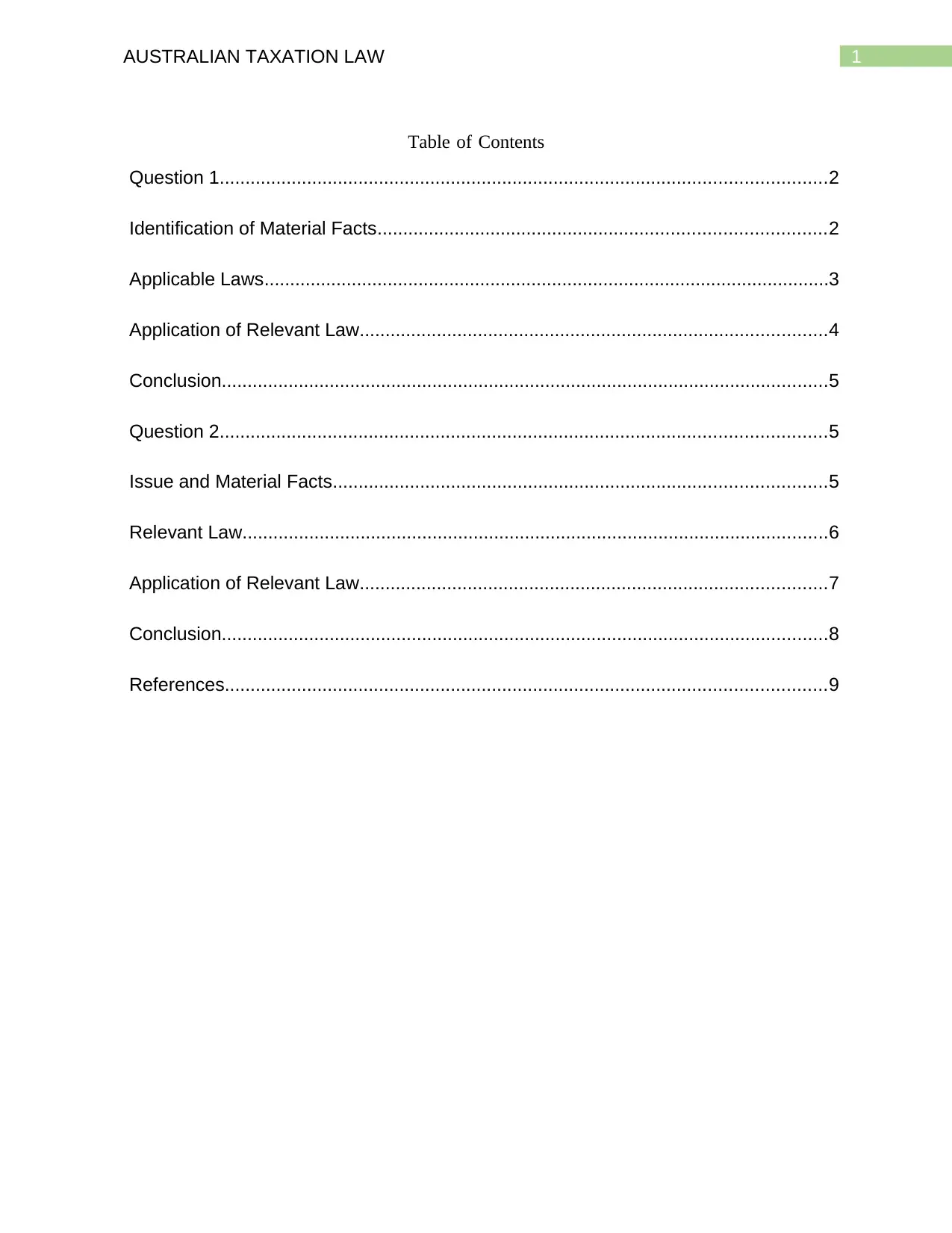
Table of Contents
Question 1......................................................................................................................2
Identification of Material Facts.......................................................................................2
Applicable Laws..............................................................................................................3
Application of Relevant Law...........................................................................................4
Conclusion......................................................................................................................5
Question 2......................................................................................................................5
Issue and Material Facts................................................................................................5
Relevant Law..................................................................................................................6
Application of Relevant Law...........................................................................................7
Conclusion......................................................................................................................8
References.....................................................................................................................9
Table of Contents
Question 1......................................................................................................................2
Identification of Material Facts.......................................................................................2
Applicable Laws..............................................................................................................3
Application of Relevant Law...........................................................................................4
Conclusion......................................................................................................................5
Question 2......................................................................................................................5
Issue and Material Facts................................................................................................5
Relevant Law..................................................................................................................6
Application of Relevant Law...........................................................................................7
Conclusion......................................................................................................................8
References.....................................................................................................................9
2AUSTRALIAN TAXATION LAW
Question 1
Identification of Material Facts
Sophia is an Australian resident who wants to complete her income tax return for
the year 2018. However, she mostly needs advice about the taxation of the CGT
transactions entered into by her. Apart from stating whether CGT would be applicable
on the transactions entered into by her, advice also needs to be provided to her about
the exemptions that would be eligible to her on them. She has sold a block of land in
Ninety Mile Beach and received $80000. There are various costs incurred by her in
relation to this asset. While purchasing the asset in 1991, she paid $130000 to acquire
it. Other relevant costs include the $800 stamp duty and $1200 legal fees paid by her. In
order to procure the asset successfully, she also took a bank loan and the total interest
charged on this loan was $27000. Additional legislative expenditure included the water
rates, council rates and municipal taxes of $18500. Due to a dispute arising with a
neighbour, she also had to pay $8000 to continue maintaining the ownership of the
property. Prior to the sale of the property, she spent $1500 to remove a large number of
pine trees that had grown on the land. This cost was incurred to improve the saleability
of the land. Some other expenses incurred by her include the advertising, legal and
agent’s fees of $2500 paid on the sale of the land. The other assets owned by her
included shares in ABC Co, a stamp collection purchased from a private collector and a
Bob Marley Guitar. The sale of these shares took place for $32.20 per share. They were
acquired for $1.50 per share in 1983. She also paid 1% brokerage fees on the sale of
the shares. The stamp collection was purchased for $3300 and sold for $23000. The
Question 1
Identification of Material Facts
Sophia is an Australian resident who wants to complete her income tax return for
the year 2018. However, she mostly needs advice about the taxation of the CGT
transactions entered into by her. Apart from stating whether CGT would be applicable
on the transactions entered into by her, advice also needs to be provided to her about
the exemptions that would be eligible to her on them. She has sold a block of land in
Ninety Mile Beach and received $80000. There are various costs incurred by her in
relation to this asset. While purchasing the asset in 1991, she paid $130000 to acquire
it. Other relevant costs include the $800 stamp duty and $1200 legal fees paid by her. In
order to procure the asset successfully, she also took a bank loan and the total interest
charged on this loan was $27000. Additional legislative expenditure included the water
rates, council rates and municipal taxes of $18500. Due to a dispute arising with a
neighbour, she also had to pay $8000 to continue maintaining the ownership of the
property. Prior to the sale of the property, she spent $1500 to remove a large number of
pine trees that had grown on the land. This cost was incurred to improve the saleability
of the land. Some other expenses incurred by her include the advertising, legal and
agent’s fees of $2500 paid on the sale of the land. The other assets owned by her
included shares in ABC Co, a stamp collection purchased from a private collector and a
Bob Marley Guitar. The sale of these shares took place for $32.20 per share. They were
acquired for $1.50 per share in 1983. She also paid 1% brokerage fees on the sale of
the shares. The stamp collection was purchased for $3300 and sold for $23000. The
⊘ This is a preview!⊘
Do you want full access?
Subscribe today to unlock all pages.

Trusted by 1+ million students worldwide
3AUSTRALIAN TAXATION LAW
auction fees paid by her was totalled $3000. The Bob Marley guitar was acquired in
2003 for $70000 and sold for $45000.
Applicable Laws
According to s102-5 ITAA 1997, the net capital gains earned by an individual are
the statutory income earned by an individual and hence also form a part of the
assessable income on which tax is to be levied for a given income tax year
(Legislation.gov.au. 2020). However, CGT is applicable only in case of a selected group
of assets. Most of the CGT assets purchased on or after 20 September 1985 are
taxable under CGT. A majority of the assets acquired prior to this date are not charged
under the capital gains tax (Ato.gov.au. 2020). As per s104-10(1) ITAA 1997, an
occurrence of a CGT event is considered only from the time of the disposal of the asset.
An excess of the sale proceeds over the cost base of the asset results in capital gains
for the seller whereas a higher cost base of the asset results in the seller incurring
capital losses as defined by s104-10(2). According to FCT v Hubert’s Island Pty Ltd., tax
on the income from the sale of land would be charged as ordinary income under s6-5(1)
ITAA 1997 if it is the business of the taxpayer (Ato.gov.au. 2020). However, in case of
sellers selling the product under other situations, tax would be levied under CGT. The
capital gains or losses on the sale of land are to be determined after calculating the total
cost base of the asset. As per Subdivision 110-A of ITAA 1997, there are five elements
involved in the cost of the asset (Ato.gov.au. 2020). All of them need to be added to
calculate the accurate cost base of the asset. S110-25(2) ITAA 1997 states that costs
paid for acquiring the asset are a part of the cost base of the asset. Others include
incidental costs under s110-35, and costs incurred to retain ownership under s110-
auction fees paid by her was totalled $3000. The Bob Marley guitar was acquired in
2003 for $70000 and sold for $45000.
Applicable Laws
According to s102-5 ITAA 1997, the net capital gains earned by an individual are
the statutory income earned by an individual and hence also form a part of the
assessable income on which tax is to be levied for a given income tax year
(Legislation.gov.au. 2020). However, CGT is applicable only in case of a selected group
of assets. Most of the CGT assets purchased on or after 20 September 1985 are
taxable under CGT. A majority of the assets acquired prior to this date are not charged
under the capital gains tax (Ato.gov.au. 2020). As per s104-10(1) ITAA 1997, an
occurrence of a CGT event is considered only from the time of the disposal of the asset.
An excess of the sale proceeds over the cost base of the asset results in capital gains
for the seller whereas a higher cost base of the asset results in the seller incurring
capital losses as defined by s104-10(2). According to FCT v Hubert’s Island Pty Ltd., tax
on the income from the sale of land would be charged as ordinary income under s6-5(1)
ITAA 1997 if it is the business of the taxpayer (Ato.gov.au. 2020). However, in case of
sellers selling the product under other situations, tax would be levied under CGT. The
capital gains or losses on the sale of land are to be determined after calculating the total
cost base of the asset. As per Subdivision 110-A of ITAA 1997, there are five elements
involved in the cost of the asset (Ato.gov.au. 2020). All of them need to be added to
calculate the accurate cost base of the asset. S110-25(2) ITAA 1997 states that costs
paid for acquiring the asset are a part of the cost base of the asset. Others include
incidental costs under s110-35, and costs incurred to retain ownership under s110-
Paraphrase This Document
Need a fresh take? Get an instant paraphrase of this document with our AI Paraphraser
4AUSTRALIAN TAXATION LAW
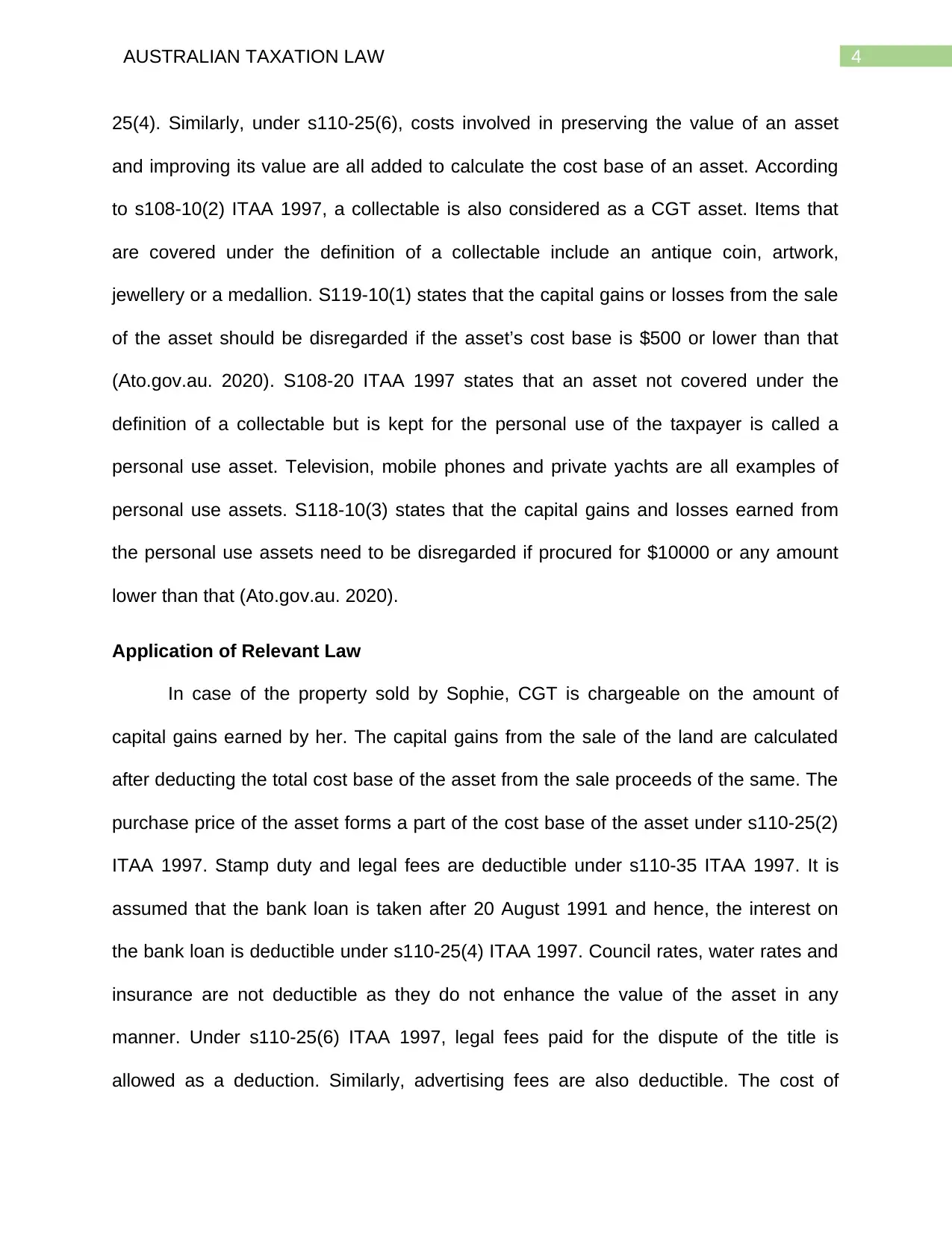
25(4). Similarly, under s110-25(6), costs involved in preserving the value of an asset
and improving its value are all added to calculate the cost base of an asset. According
to s108-10(2) ITAA 1997, a collectable is also considered as a CGT asset. Items that
are covered under the definition of a collectable include an antique coin, artwork,
jewellery or a medallion. S119-10(1) states that the capital gains or losses from the sale
of the asset should be disregarded if the asset’s cost base is $500 or lower than that
(Ato.gov.au. 2020). S108-20 ITAA 1997 states that an asset not covered under the
definition of a collectable but is kept for the personal use of the taxpayer is called a
personal use asset. Television, mobile phones and private yachts are all examples of
personal use assets. S118-10(3) states that the capital gains and losses earned from
the personal use assets need to be disregarded if procured for $10000 or any amount
lower than that (Ato.gov.au. 2020).
Application of Relevant Law
In case of the property sold by Sophie, CGT is chargeable on the amount of
capital gains earned by her. The capital gains from the sale of the land are calculated
after deducting the total cost base of the asset from the sale proceeds of the same. The
purchase price of the asset forms a part of the cost base of the asset under s110-25(2)
ITAA 1997. Stamp duty and legal fees are deductible under s110-35 ITAA 1997. It is
assumed that the bank loan is taken after 20 August 1991 and hence, the interest on
the bank loan is deductible under s110-25(4) ITAA 1997. Council rates, water rates and
insurance are not deductible as they do not enhance the value of the asset in any
manner. Under s110-25(6) ITAA 1997, legal fees paid for the dispute of the title is
allowed as a deduction. Similarly, advertising fees are also deductible. The cost of
25(4). Similarly, under s110-25(6), costs involved in preserving the value of an asset
and improving its value are all added to calculate the cost base of an asset. According
to s108-10(2) ITAA 1997, a collectable is also considered as a CGT asset. Items that
are covered under the definition of a collectable include an antique coin, artwork,
jewellery or a medallion. S119-10(1) states that the capital gains or losses from the sale
of the asset should be disregarded if the asset’s cost base is $500 or lower than that
(Ato.gov.au. 2020). S108-20 ITAA 1997 states that an asset not covered under the
definition of a collectable but is kept for the personal use of the taxpayer is called a
personal use asset. Television, mobile phones and private yachts are all examples of
personal use assets. S118-10(3) states that the capital gains and losses earned from
the personal use assets need to be disregarded if procured for $10000 or any amount
lower than that (Ato.gov.au. 2020).
Application of Relevant Law
In case of the property sold by Sophie, CGT is chargeable on the amount of
capital gains earned by her. The capital gains from the sale of the land are calculated
after deducting the total cost base of the asset from the sale proceeds of the same. The
purchase price of the asset forms a part of the cost base of the asset under s110-25(2)
ITAA 1997. Stamp duty and legal fees are deductible under s110-35 ITAA 1997. It is
assumed that the bank loan is taken after 20 August 1991 and hence, the interest on
the bank loan is deductible under s110-25(4) ITAA 1997. Council rates, water rates and
insurance are not deductible as they do not enhance the value of the asset in any
manner. Under s110-25(6) ITAA 1997, legal fees paid for the dispute of the title is
allowed as a deduction. Similarly, advertising fees are also deductible. The cost of
5AUSTRALIAN TAXATION LAW
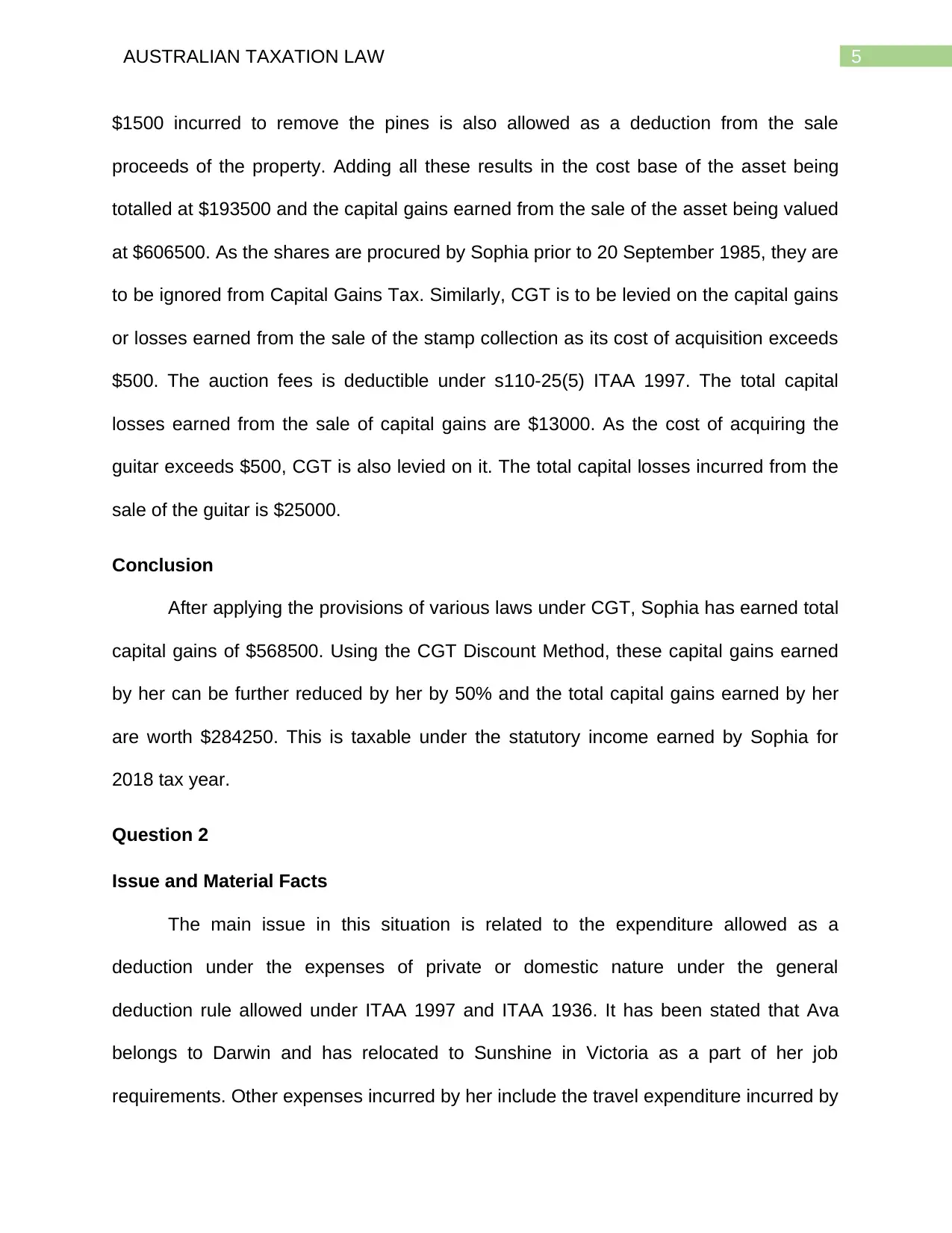
$1500 incurred to remove the pines is also allowed as a deduction from the sale
proceeds of the property. Adding all these results in the cost base of the asset being
totalled at $193500 and the capital gains earned from the sale of the asset being valued
at $606500. As the shares are procured by Sophia prior to 20 September 1985, they are
to be ignored from Capital Gains Tax. Similarly, CGT is to be levied on the capital gains
or losses earned from the sale of the stamp collection as its cost of acquisition exceeds
$500. The auction fees is deductible under s110-25(5) ITAA 1997. The total capital
losses earned from the sale of capital gains are $13000. As the cost of acquiring the
guitar exceeds $500, CGT is also levied on it. The total capital losses incurred from the
sale of the guitar is $25000.
Conclusion
After applying the provisions of various laws under CGT, Sophia has earned total
capital gains of $568500. Using the CGT Discount Method, these capital gains earned
by her can be further reduced by her by 50% and the total capital gains earned by her
are worth $284250. This is taxable under the statutory income earned by Sophia for
2018 tax year.
Question 2
Issue and Material Facts
The main issue in this situation is related to the expenditure allowed as a
deduction under the expenses of private or domestic nature under the general
deduction rule allowed under ITAA 1997 and ITAA 1936. It has been stated that Ava
belongs to Darwin and has relocated to Sunshine in Victoria as a part of her job
requirements. Other expenses incurred by her include the travel expenditure incurred by
$1500 incurred to remove the pines is also allowed as a deduction from the sale
proceeds of the property. Adding all these results in the cost base of the asset being
totalled at $193500 and the capital gains earned from the sale of the asset being valued
at $606500. As the shares are procured by Sophia prior to 20 September 1985, they are
to be ignored from Capital Gains Tax. Similarly, CGT is to be levied on the capital gains
or losses earned from the sale of the stamp collection as its cost of acquisition exceeds
$500. The auction fees is deductible under s110-25(5) ITAA 1997. The total capital
losses earned from the sale of capital gains are $13000. As the cost of acquiring the
guitar exceeds $500, CGT is also levied on it. The total capital losses incurred from the
sale of the guitar is $25000.
Conclusion
After applying the provisions of various laws under CGT, Sophia has earned total
capital gains of $568500. Using the CGT Discount Method, these capital gains earned
by her can be further reduced by her by 50% and the total capital gains earned by her
are worth $284250. This is taxable under the statutory income earned by Sophia for
2018 tax year.
Question 2
Issue and Material Facts
The main issue in this situation is related to the expenditure allowed as a
deduction under the expenses of private or domestic nature under the general
deduction rule allowed under ITAA 1997 and ITAA 1936. It has been stated that Ava
belongs to Darwin and has relocated to Sunshine in Victoria as a part of her job
requirements. Other expenses incurred by her include the travel expenditure incurred by
⊘ This is a preview!⊘
Do you want full access?
Subscribe today to unlock all pages.
Trusted by 1+ million students worldwide
6AUSTRALIAN TAXATION LAW
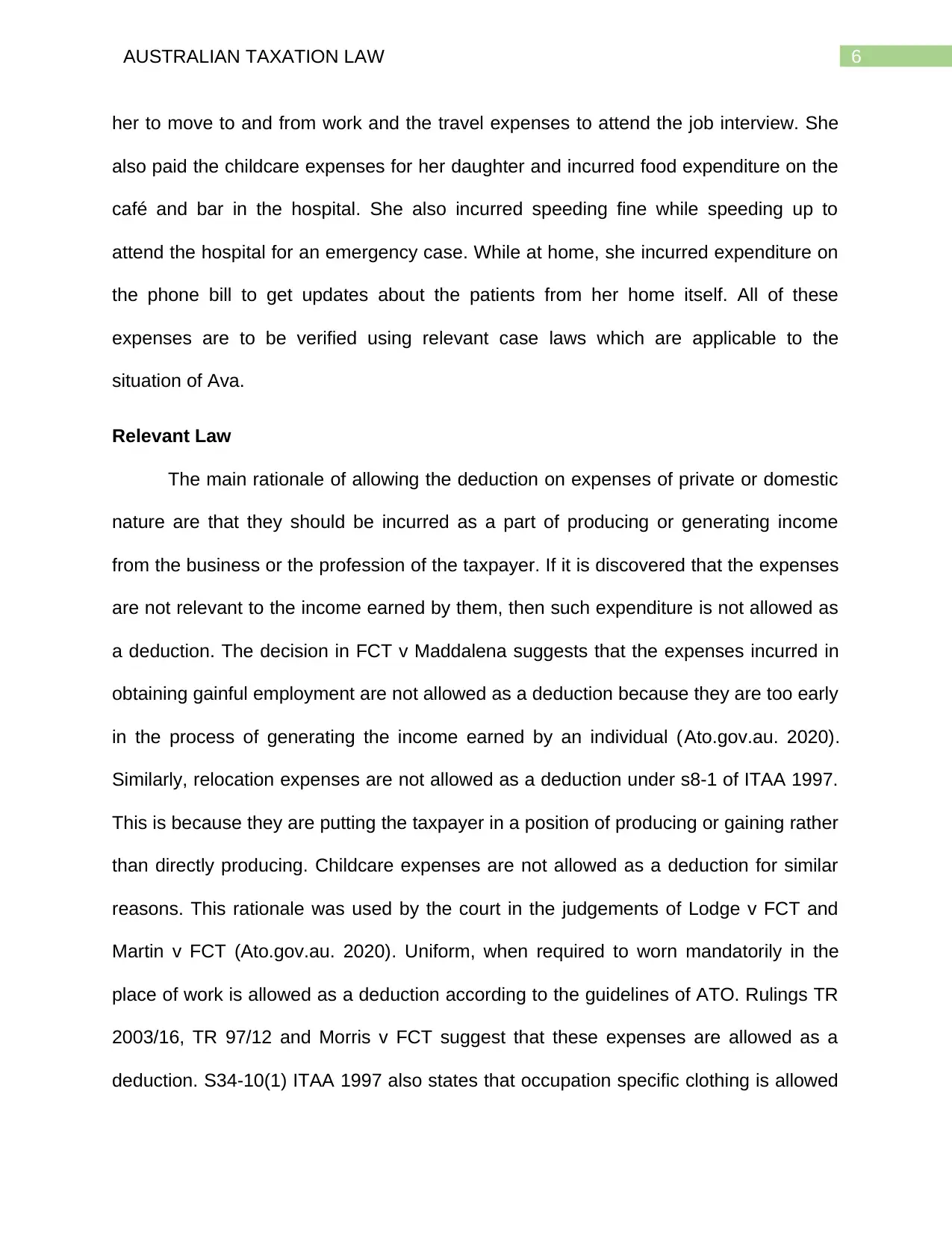
her to move to and from work and the travel expenses to attend the job interview. She
also paid the childcare expenses for her daughter and incurred food expenditure on the
café and bar in the hospital. She also incurred speeding fine while speeding up to
attend the hospital for an emergency case. While at home, she incurred expenditure on
the phone bill to get updates about the patients from her home itself. All of these
expenses are to be verified using relevant case laws which are applicable to the
situation of Ava.
Relevant Law
The main rationale of allowing the deduction on expenses of private or domestic
nature are that they should be incurred as a part of producing or generating income
from the business or the profession of the taxpayer. If it is discovered that the expenses
are not relevant to the income earned by them, then such expenditure is not allowed as
a deduction. The decision in FCT v Maddalena suggests that the expenses incurred in
obtaining gainful employment are not allowed as a deduction because they are too early
in the process of generating the income earned by an individual (Ato.gov.au. 2020).
Similarly, relocation expenses are not allowed as a deduction under s8-1 of ITAA 1997.
This is because they are putting the taxpayer in a position of producing or gaining rather
than directly producing. Childcare expenses are not allowed as a deduction for similar
reasons. This rationale was used by the court in the judgements of Lodge v FCT and
Martin v FCT (Ato.gov.au. 2020). Uniform, when required to worn mandatorily in the
place of work is allowed as a deduction according to the guidelines of ATO. Rulings TR
2003/16, TR 97/12 and Morris v FCT suggest that these expenses are allowed as a
deduction. S34-10(1) ITAA 1997 also states that occupation specific clothing is allowed
her to move to and from work and the travel expenses to attend the job interview. She
also paid the childcare expenses for her daughter and incurred food expenditure on the
café and bar in the hospital. She also incurred speeding fine while speeding up to
attend the hospital for an emergency case. While at home, she incurred expenditure on
the phone bill to get updates about the patients from her home itself. All of these
expenses are to be verified using relevant case laws which are applicable to the
situation of Ava.
Relevant Law
The main rationale of allowing the deduction on expenses of private or domestic
nature are that they should be incurred as a part of producing or generating income
from the business or the profession of the taxpayer. If it is discovered that the expenses
are not relevant to the income earned by them, then such expenditure is not allowed as
a deduction. The decision in FCT v Maddalena suggests that the expenses incurred in
obtaining gainful employment are not allowed as a deduction because they are too early
in the process of generating the income earned by an individual (Ato.gov.au. 2020).
Similarly, relocation expenses are not allowed as a deduction under s8-1 of ITAA 1997.
This is because they are putting the taxpayer in a position of producing or gaining rather
than directly producing. Childcare expenses are not allowed as a deduction for similar
reasons. This rationale was used by the court in the judgements of Lodge v FCT and
Martin v FCT (Ato.gov.au. 2020). Uniform, when required to worn mandatorily in the
place of work is allowed as a deduction according to the guidelines of ATO. Rulings TR
2003/16, TR 97/12 and Morris v FCT suggest that these expenses are allowed as a
deduction. S34-10(1) ITAA 1997 also states that occupation specific clothing is allowed
Paraphrase This Document
Need a fresh take? Get an instant paraphrase of this document with our AI Paraphraser
7AUSTRALIAN TAXATION LAW
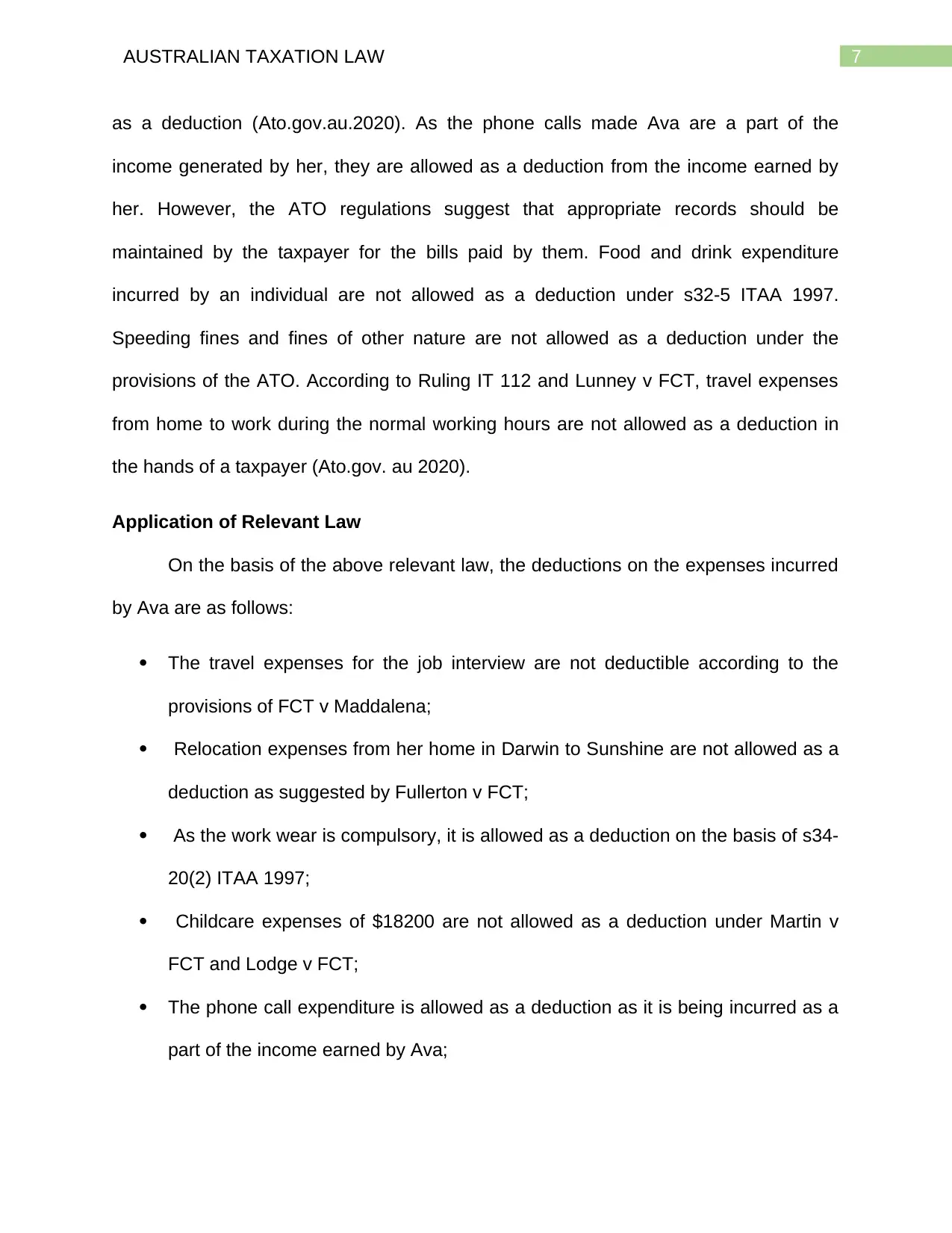
as a deduction (Ato.gov.au.2020). As the phone calls made Ava are a part of the
income generated by her, they are allowed as a deduction from the income earned by
her. However, the ATO regulations suggest that appropriate records should be
maintained by the taxpayer for the bills paid by them. Food and drink expenditure
incurred by an individual are not allowed as a deduction under s32-5 ITAA 1997.
Speeding fines and fines of other nature are not allowed as a deduction under the
provisions of the ATO. According to Ruling IT 112 and Lunney v FCT, travel expenses
from home to work during the normal working hours are not allowed as a deduction in
the hands of a taxpayer (Ato.gov. au 2020).
Application of Relevant Law
On the basis of the above relevant law, the deductions on the expenses incurred
by Ava are as follows:
The travel expenses for the job interview are not deductible according to the
provisions of FCT v Maddalena;
Relocation expenses from her home in Darwin to Sunshine are not allowed as a
deduction as suggested by Fullerton v FCT;
As the work wear is compulsory, it is allowed as a deduction on the basis of s34-
20(2) ITAA 1997;
Childcare expenses of $18200 are not allowed as a deduction under Martin v
FCT and Lodge v FCT;
The phone call expenditure is allowed as a deduction as it is being incurred as a
part of the income earned by Ava;
as a deduction (Ato.gov.au.2020). As the phone calls made Ava are a part of the
income generated by her, they are allowed as a deduction from the income earned by
her. However, the ATO regulations suggest that appropriate records should be
maintained by the taxpayer for the bills paid by them. Food and drink expenditure
incurred by an individual are not allowed as a deduction under s32-5 ITAA 1997.
Speeding fines and fines of other nature are not allowed as a deduction under the
provisions of the ATO. According to Ruling IT 112 and Lunney v FCT, travel expenses
from home to work during the normal working hours are not allowed as a deduction in
the hands of a taxpayer (Ato.gov. au 2020).
Application of Relevant Law
On the basis of the above relevant law, the deductions on the expenses incurred
by Ava are as follows:
The travel expenses for the job interview are not deductible according to the
provisions of FCT v Maddalena;
Relocation expenses from her home in Darwin to Sunshine are not allowed as a
deduction as suggested by Fullerton v FCT;
As the work wear is compulsory, it is allowed as a deduction on the basis of s34-
20(2) ITAA 1997;
Childcare expenses of $18200 are not allowed as a deduction under Martin v
FCT and Lodge v FCT;
The phone call expenditure is allowed as a deduction as it is being incurred as a
part of the income earned by Ava;
8AUSTRALIAN TAXATION LAW
The food expenditure is not allowed as a deduction under s32-10(1) of ITAA
1997;
Speeding fines are not allowed as a deduction under the guidelines of the ATO;
and
The expenditure incurred to travel from work to home are not allowed as a
deduction under Ruling IT 112.
Conclusion
From the application of the relevant provisions, it is evident that the total
expenses allowed as a deduction in the hands of Ava are worth $400 because they are
being incurred as a part of the income generated by her from profession as a doctor.
The other expenses are not allowed as a deduction because they do not directly
contribute towards generating income but are putting her in a position of generating
income.
The food expenditure is not allowed as a deduction under s32-10(1) of ITAA
1997;
Speeding fines are not allowed as a deduction under the guidelines of the ATO;
and
The expenditure incurred to travel from work to home are not allowed as a
deduction under Ruling IT 112.
Conclusion
From the application of the relevant provisions, it is evident that the total
expenses allowed as a deduction in the hands of Ava are worth $400 because they are
being incurred as a part of the income generated by her from profession as a doctor.
The other expenses are not allowed as a deduction because they do not directly
contribute towards generating income but are putting her in a position of generating
income.
⊘ This is a preview!⊘
Do you want full access?
Subscribe today to unlock all pages.
Trusted by 1+ million students worldwide
9AUSTRALIAN TAXATION LAW
References
Ato.gov.au. (2020). CGT assets and exemptions. [online] Available at:
https://www.ato.gov.au/general/capital-gains-tax/cgt-assets-and-exemptions/ [Accessed
28 Jan. 2020].
Ato.gov.au. (2020). Legal Database. [online] Available at:
https://www.ato.gov.au/law/view/document?Docid=ITR/IT2670/NAT/ATO/00001
[Accessed 28 Jan. 2020].
Ato.gov.au. (2020). Legal Database. [online] Available at:
https://www.ato.gov.au/law/view/document?DocID=TXD/TD200035/NAT/ATO/
00001&PiT=99991231235958 [Accessed 28 Jan. 2020].
Ato.gov.au. (2020). Legal Database. [online] Available at:
https://www.ato.gov.au/law/view/document?DocID=TXR/TR989/NAT/ATO/00001
[Accessed 28 Jan. 2020].
Ato.gov.au. (2020). Legal Database. [online] Available at:
https://www.ato.gov.au/law/view/document?docid=ITR/IT2217/NAT/ATO/00001
[Accessed 28 Jan. 2020].
Ato.gov.au. (2020). Legal Database. [online] Available at:
https://www.ato.gov.au/law/view/document?DocID=TXR/TR200316/NAT/ATO/00001
[Accessed 28 Jan. 2020].
Ato.gov.au. (2020). Legal Database. [online] Available at:
https://www.ato.gov.au/law/view/document?DocID=TXR/TR9534/NAT/ATO/00001
[Accessed 28 Jan. 2020].
References
Ato.gov.au. (2020). CGT assets and exemptions. [online] Available at:
https://www.ato.gov.au/general/capital-gains-tax/cgt-assets-and-exemptions/ [Accessed
28 Jan. 2020].
Ato.gov.au. (2020). Legal Database. [online] Available at:
https://www.ato.gov.au/law/view/document?Docid=ITR/IT2670/NAT/ATO/00001
[Accessed 28 Jan. 2020].
Ato.gov.au. (2020). Legal Database. [online] Available at:
https://www.ato.gov.au/law/view/document?DocID=TXD/TD200035/NAT/ATO/
00001&PiT=99991231235958 [Accessed 28 Jan. 2020].
Ato.gov.au. (2020). Legal Database. [online] Available at:
https://www.ato.gov.au/law/view/document?DocID=TXR/TR989/NAT/ATO/00001
[Accessed 28 Jan. 2020].
Ato.gov.au. (2020). Legal Database. [online] Available at:
https://www.ato.gov.au/law/view/document?docid=ITR/IT2217/NAT/ATO/00001
[Accessed 28 Jan. 2020].
Ato.gov.au. (2020). Legal Database. [online] Available at:
https://www.ato.gov.au/law/view/document?DocID=TXR/TR200316/NAT/ATO/00001
[Accessed 28 Jan. 2020].
Ato.gov.au. (2020). Legal Database. [online] Available at:
https://www.ato.gov.au/law/view/document?DocID=TXR/TR9534/NAT/ATO/00001
[Accessed 28 Jan. 2020].
Paraphrase This Document
Need a fresh take? Get an instant paraphrase of this document with our AI Paraphraser
10AUSTRALIAN TAXATION LAW
Legislation.gov.au. (2020). Income Tax Assessment Act 1997 . [online] Available at:
https://www.legislation.gov.au/Details/C2017C00336/Controls/ [Accessed 28 Jan.
2020].
Legislation.gov.au. (2020). Income Tax Assessment Act 1997 . [online] Available at:
https://www.legislation.gov.au/Details/C2017C00336/Controls/ [Accessed 28 Jan.
2020].

1 out of 11


Related Documents


Your All-in-One AI-Powered Toolkit for Academic Success.
+13062052269
info@desklib.com
Available 24*7 on WhatsApp / Email
![[object Object]](/_next/static/media/star-bottom.7253800d.svg)
Unlock your academic potential
Copyright © 2020–2026 A2Z Services. All Rights Reserved. Developed and managed by ZUCOL.