Federation University: Australian Taxation Law Report - Summer 2019/20

Verified

Added on  2022/08/23

|7
|1493
|39
Report
AI Summary
This report analyzes key aspects of Australian taxation law, focusing on payroll tax and capital gains tax (CGT). The report begins with an overview of the Australian taxation system, highlighting various tax types like income tax, corporate tax, and GST, while emphasizing the significance of payroll tax as a revenue source for state governments. It details payroll tax administration, rates, and exemptions across different Australian states and territories, along with the challenges posed by the two-tier government system and the complexities of payroll tax for businesses. Part C of the report then delves into the application of CGT to residential properties used for both residential and rental purposes, addressing issues related to assessable income, deductions, and the application of GST. The conclusion summarizes the tax implications for property sales involving mixed-use residential and commercial aspects. The report references relevant academic sources to support its analysis.
Document Page
Running Head: Australia Taxation Law
Australia Taxation Law
Name of the Student:
Name of the University:
Author Note:
tabler-icon-diamond-filled.svg

Paraphrase This Document

Need a fresh take? Get an instant paraphrase of this document with our AI Paraphraser
Document Page
1
Australia Taxation Law
Table of Contents
Part B...................................................................................................................................2
Part C...................................................................................................................................4
Reference list.......................................................................................................................5
Document Page
2
Australia Taxation Law
Part B
Australian taxation system is designed as per the need of the administrative concern
rather the principle of equity. Australian government makes significant changes in their tax
system every year to get the benefit from different sectors. Their key tax reform in past 25 year is
between the personal and business taxation. This change in the taxation system is led due to the
change in the social and demographical changes. There are different form of taxes like income
tax, capital gain tax, corporate tax, trustee tax, property tax, department tax, excise tax, custom
duties, payroll tax, fringe benefit tax, superannuation tax and GST (Braithwaite & Reinhart,
2019). Australian state government controls the land and income tax while the customs and
excise duties are held by the central government. Introduction of the income tax in different
states of Australia at different rates to different categories of income.
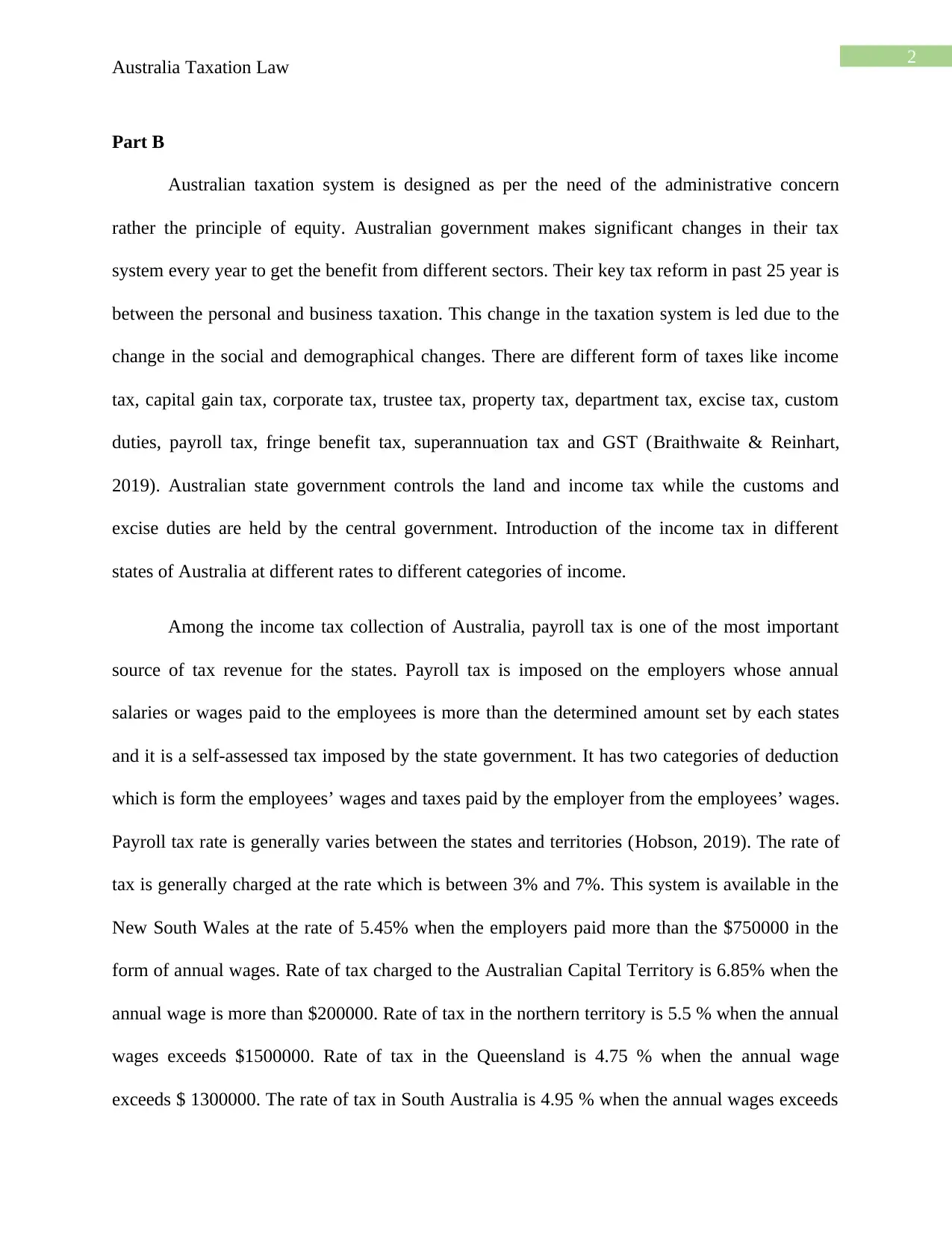
Among the income tax collection of Australia, payroll tax is one of the most important
source of tax revenue for the states. Payroll tax is imposed on the employers whose annual
salaries or wages paid to the employees is more than the determined amount set by each states
and it is a self-assessed tax imposed by the state government. It has two categories of deduction
which is form the employees’ wages and taxes paid by the employer from the employees’ wages.
Payroll tax rate is generally varies between the states and territories (Hobson, 2019). The rate of
tax is generally charged at the rate which is between 3% and 7%. This system is available in the
New South Wales at the rate of 5.45% when the employers paid more than the $750000 in the
form of annual wages. Rate of tax charged to the Australian Capital Territory is 6.85% when the
annual wage is more than $200000. Rate of tax in the northern territory is 5.5 % when the annual
wages exceeds $1500000. Rate of tax in the Queensland is 4.75 % when the annual wage
exceeds $ 1300000. The rate of tax in South Australia is 4.95 % when the annual wages exceeds
Document Page
3
Australia Taxation Law
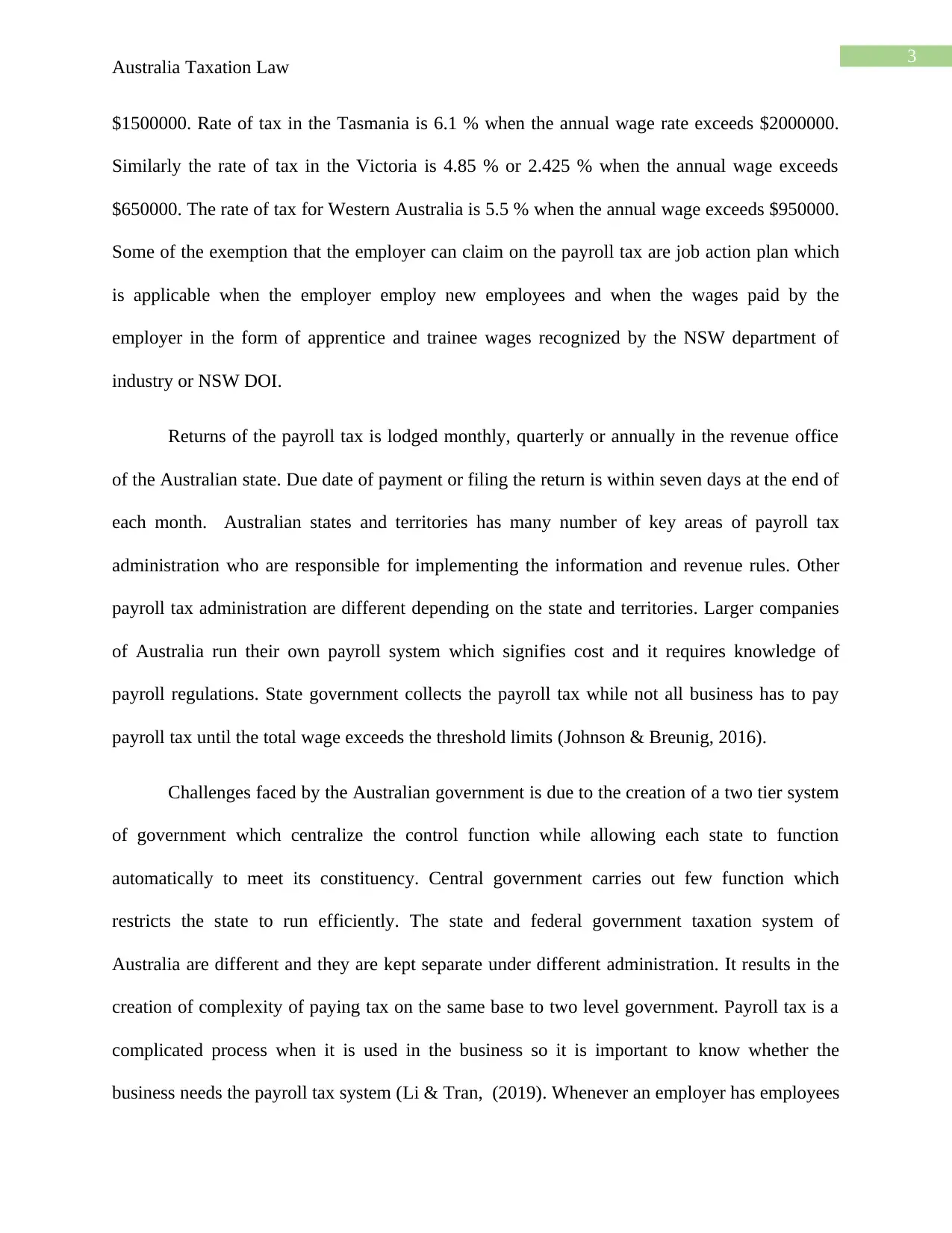
$1500000. Rate of tax in the Tasmania is 6.1 % when the annual wage rate exceeds $2000000.
Similarly the rate of tax in the Victoria is 4.85 % or 2.425 % when the annual wage exceeds
$650000. The rate of tax for Western Australia is 5.5 % when the annual wage exceeds $950000.
Some of the exemption that the employer can claim on the payroll tax are job action plan which
is applicable when the employer employ new employees and when the wages paid by the
employer in the form of apprentice and trainee wages recognized by the NSW department of
industry or NSW DOI.
Returns of the payroll tax is lodged monthly, quarterly or annually in the revenue office
of the Australian state. Due date of payment or filing the return is within seven days at the end of
each month. Australian states and territories has many number of key areas of payroll tax
administration who are responsible for implementing the information and revenue rules. Other
payroll tax administration are different depending on the state and territories. Larger companies
of Australia run their own payroll system which signifies cost and it requires knowledge of
payroll regulations. State government collects the payroll tax while not all business has to pay
payroll tax until the total wage exceeds the threshold limits (Johnson & Breunig, 2016).
Challenges faced by the Australian government is due to the creation of a two tier system
of government which centralize the control function while allowing each state to function
automatically to meet its constituency. Central government carries out few function which
restricts the state to run efficiently. The state and federal government taxation system of
Australia are different and they are kept separate under different administration. It results in the
creation of complexity of paying tax on the same base to two level government. Payroll tax is a
complicated process when it is used in the business so it is important to know whether the
business needs the payroll tax system (Li & Tran, (2019). Whenever an employer has employees
tabler-icon-diamond-filled.svg

Paraphrase This Document

Need a fresh take? Get an instant paraphrase of this document with our AI Paraphraser
Document Page
4
Australia Taxation Law
working in more than one state than he or she need to register in each state of the Australia as the
national wages are combined. It must be removed and form a single tax registered system so that
their does not need any multiple registration. Payroll tax rate is determined on the basis of annual
wage and the rate is comparatively higher. So the tax rate need to be reduced so that the
employers does not face any problem or difficulty in paying. There is penalties for delay in
return filling which is sometime in excess.
Part C
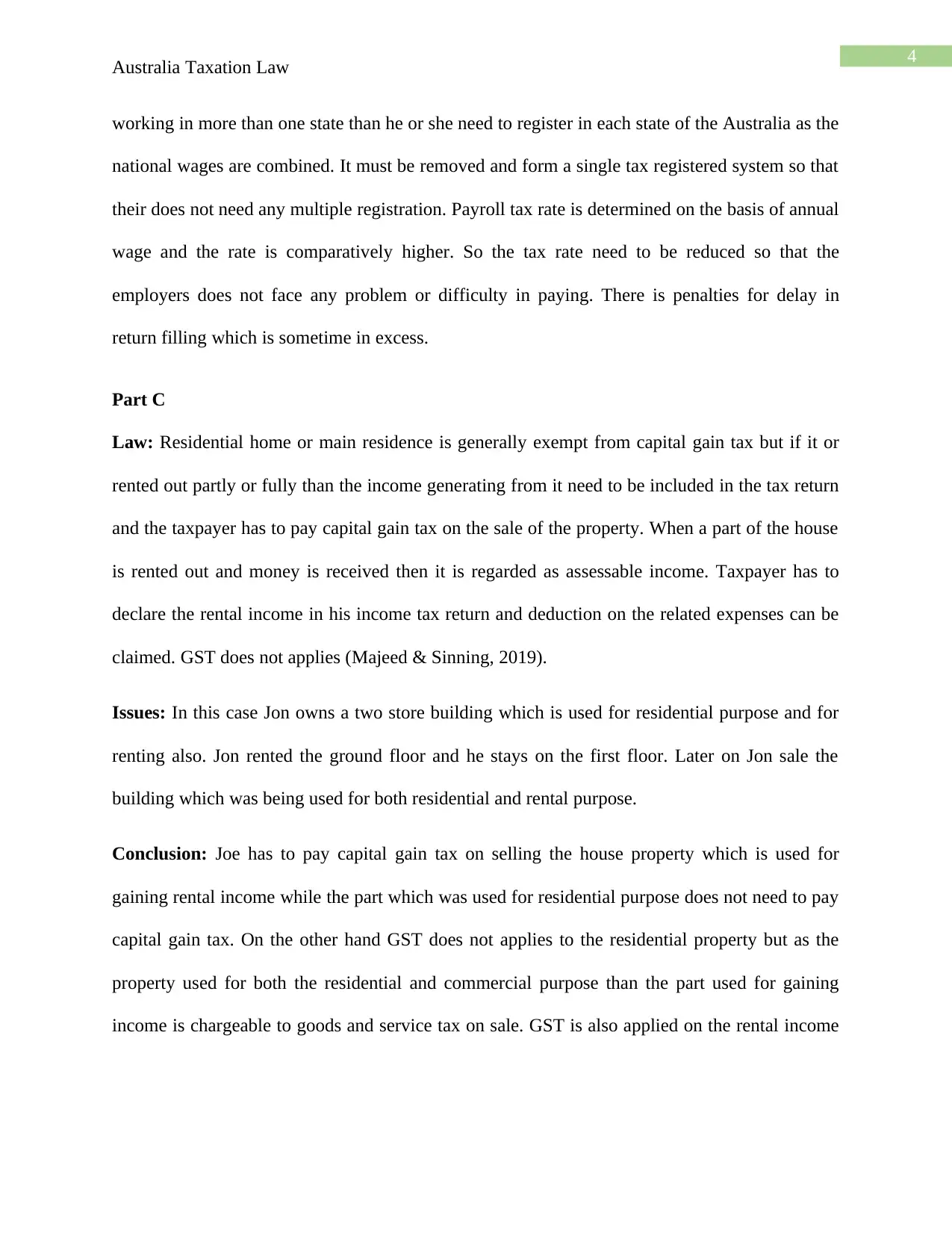
Law: Residential home or main residence is generally exempt from capital gain tax but if it or
rented out partly or fully than the income generating from it need to be included in the tax return
and the taxpayer has to pay capital gain tax on the sale of the property. When a part of the house
is rented out and money is received then it is regarded as assessable income. Taxpayer has to
declare the rental income in his income tax return and deduction on the related expenses can be
claimed. GST does not applies (Majeed & Sinning, 2019).
Issues: In this case Jon owns a two store building which is used for residential purpose and for
renting also. Jon rented the ground floor and he stays on the first floor. Later on Jon sale the
building which was being used for both residential and rental purpose.
Conclusion: Joe has to pay capital gain tax on selling the house property which is used for
gaining rental income while the part which was used for residential purpose does not need to pay
capital gain tax. On the other hand GST does not applies to the residential property but as the
property used for both the residential and commercial purpose than the part used for gaining
income is chargeable to goods and service tax on sale. GST is also applied on the rental income
Document Page
5
Australia Taxation Law
which is received by the individual. Rental related incomes is included in the form of goods and
services.
Document Page
6
Australia Taxation Law
Reference list
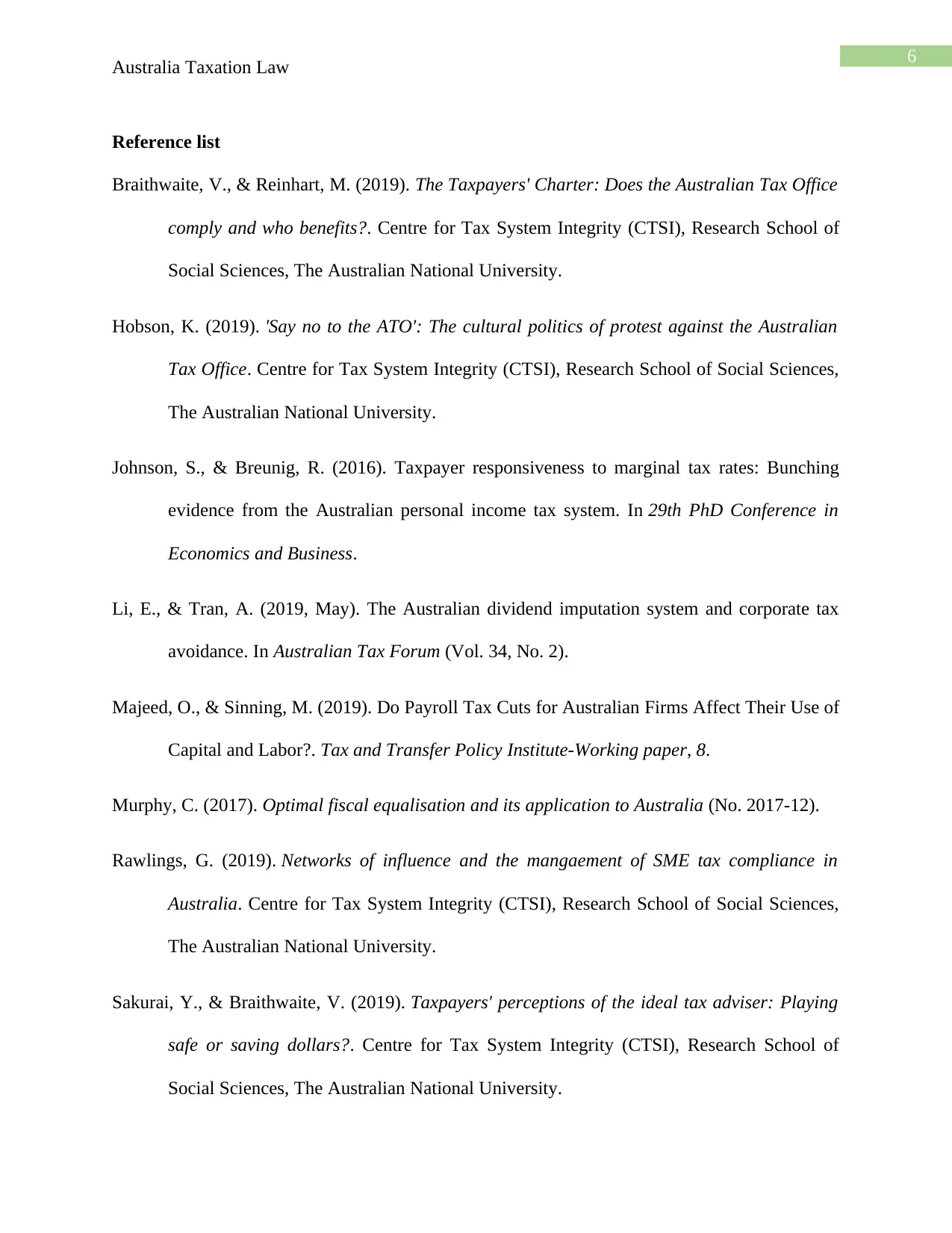
Braithwaite, V., & Reinhart, M. (2019). The Taxpayers' Charter: Does the Australian Tax Office
comply and who benefits?. Centre for Tax System Integrity (CTSI), Research School of
Social Sciences, The Australian National University.
Hobson, K. (2019). 'Say no to the ATO': The cultural politics of protest against the Australian
Tax Office. Centre for Tax System Integrity (CTSI), Research School of Social Sciences,
The Australian National University.
Johnson, S., & Breunig, R. (2016). Taxpayer responsiveness to marginal tax rates: Bunching
evidence from the Australian personal income tax system. In 29th PhD Conference in
Economics and Business.
Li, E., & Tran, A. (2019, May). The Australian dividend imputation system and corporate tax
avoidance. In Australian Tax Forum (Vol. 34, No. 2).
Majeed, O., & Sinning, M. (2019). Do Payroll Tax Cuts for Australian Firms Affect Their Use of
Capital and Labor?. Tax and Transfer Policy Institute-Working paper, 8.
Murphy, C. (2017). Optimal fiscal equalisation and its application to Australia (No. 2017-12).
Rawlings, G. (2019). Networks of influence and the mangaement of SME tax compliance in
Australia. Centre for Tax System Integrity (CTSI), Research School of Social Sciences,
The Australian National University.
Sakurai, Y., & Braithwaite, V. (2019). Taxpayers' perceptions of the ideal tax adviser: Playing
safe or saving dollars?. Centre for Tax System Integrity (CTSI), Research School of
Social Sciences, The Australian National University.
chevron_up_icon
1 out of 7
circle_padding
hide_on_mobile
zoom_out_icon
[object Object]