Automated Vehicle Ethics: Programming, Manufacturers, and Buyers

Verified

Added on  2022/10/16

|4
|744
|67
Essay
AI Summary
This essay delves into the ethical complexities surrounding automated vehicles, particularly focusing on the "trolley problem" scenario where a self-driving car must make life-or-death decisions. It explores how these vehicles should be programmed to respond in such situations, considering ethical theories like utilitarianism and deontology. The essay examines the roles of manufacturers in developing ethical programming and the responsibilities of consumers in using automated vehicles, especially in high-risk environments. It highlights the need for advancements in machine ethics to mitigate life risks and discusses the current legal and ethical vacuum that prevents widespread deployment of autonomous vehicles. The essay emphasizes that while safety features can reduce risks, they cannot eliminate the possibility of life endangerment and that ethical considerations must be at the forefront of automated vehicle development.
Document Page
Running head: QUESTION OF ETHICS IN AUTOMATED VEHICLES
QUESTION OF ETHICS IN AUTOMATED VEHICLES
Name of the student
Name of the University
Author note
tabler-icon-diamond-filled.svg

Paraphrase This Document

Need a fresh take? Get an instant paraphrase of this document with our AI Paraphraser
Document Page
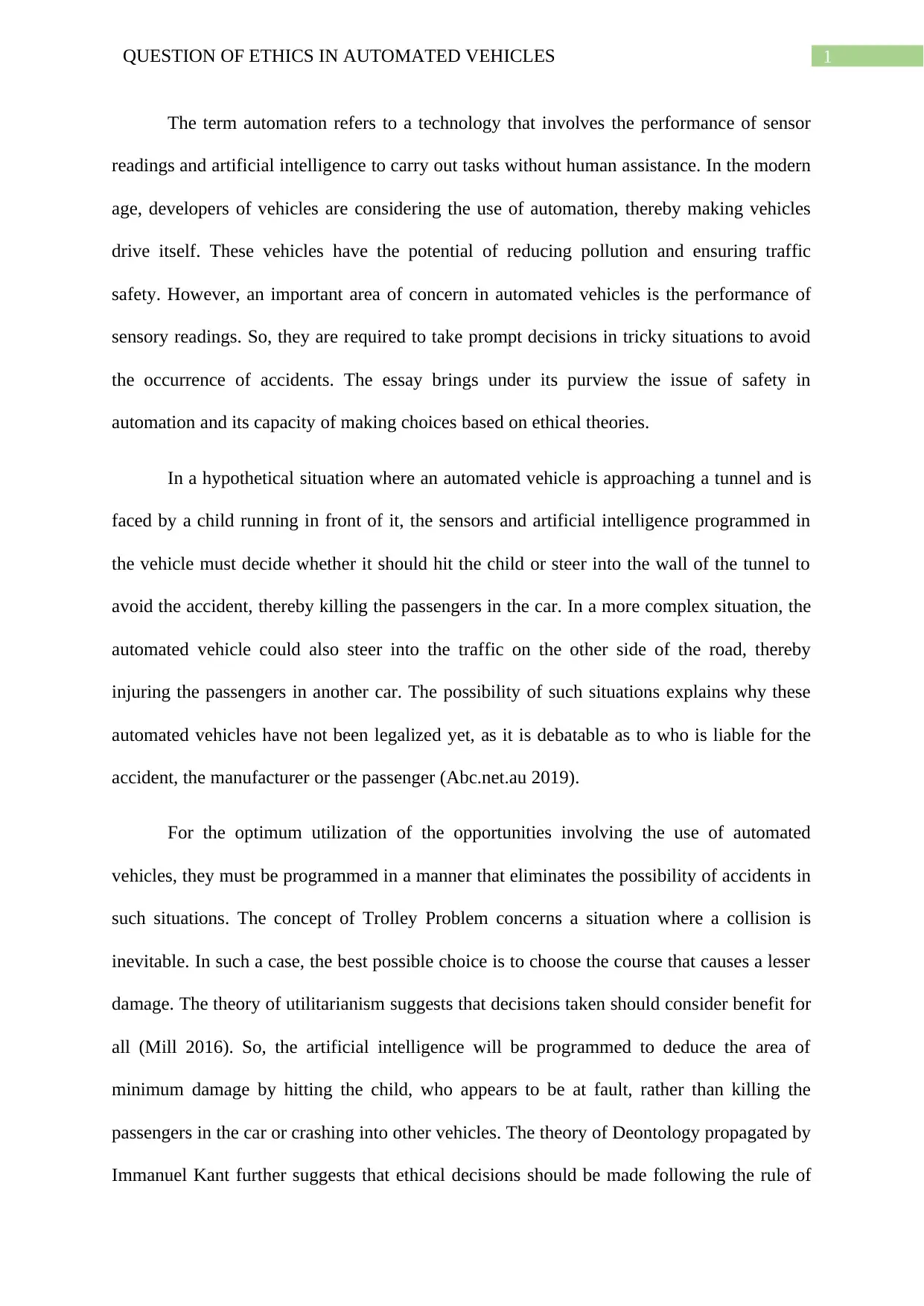
1QUESTION OF ETHICS IN AUTOMATED VEHICLES
The term automation refers to a technology that involves the performance of sensor
readings and artificial intelligence to carry out tasks without human assistance. In the modern
age, developers of vehicles are considering the use of automation, thereby making vehicles
drive itself. These vehicles have the potential of reducing pollution and ensuring traffic
safety. However, an important area of concern in automated vehicles is the performance of
sensory readings. So, they are required to take prompt decisions in tricky situations to avoid
the occurrence of accidents. The essay brings under its purview the issue of safety in
automation and its capacity of making choices based on ethical theories.
In a hypothetical situation where an automated vehicle is approaching a tunnel and is
faced by a child running in front of it, the sensors and artificial intelligence programmed in
the vehicle must decide whether it should hit the child or steer into the wall of the tunnel to
avoid the accident, thereby killing the passengers in the car. In a more complex situation, the
automated vehicle could also steer into the traffic on the other side of the road, thereby
injuring the passengers in another car. The possibility of such situations explains why these
automated vehicles have not been legalized yet, as it is debatable as to who is liable for the
accident, the manufacturer or the passenger (Abc.net.au 2019).
For the optimum utilization of the opportunities involving the use of automated
vehicles, they must be programmed in a manner that eliminates the possibility of accidents in
such situations. The concept of Trolley Problem concerns a situation where a collision is
inevitable. In such a case, the best possible choice is to choose the course that causes a lesser
damage. The theory of utilitarianism suggests that decisions taken should consider benefit for
all (Mill 2016). So, the artificial intelligence will be programmed to deduce the area of
minimum damage by hitting the child, who appears to be at fault, rather than killing the
passengers in the car or crashing into other vehicles. The theory of Deontology propagated by
Immanuel Kant further suggests that ethical decisions should be made following the rule of
Document Page
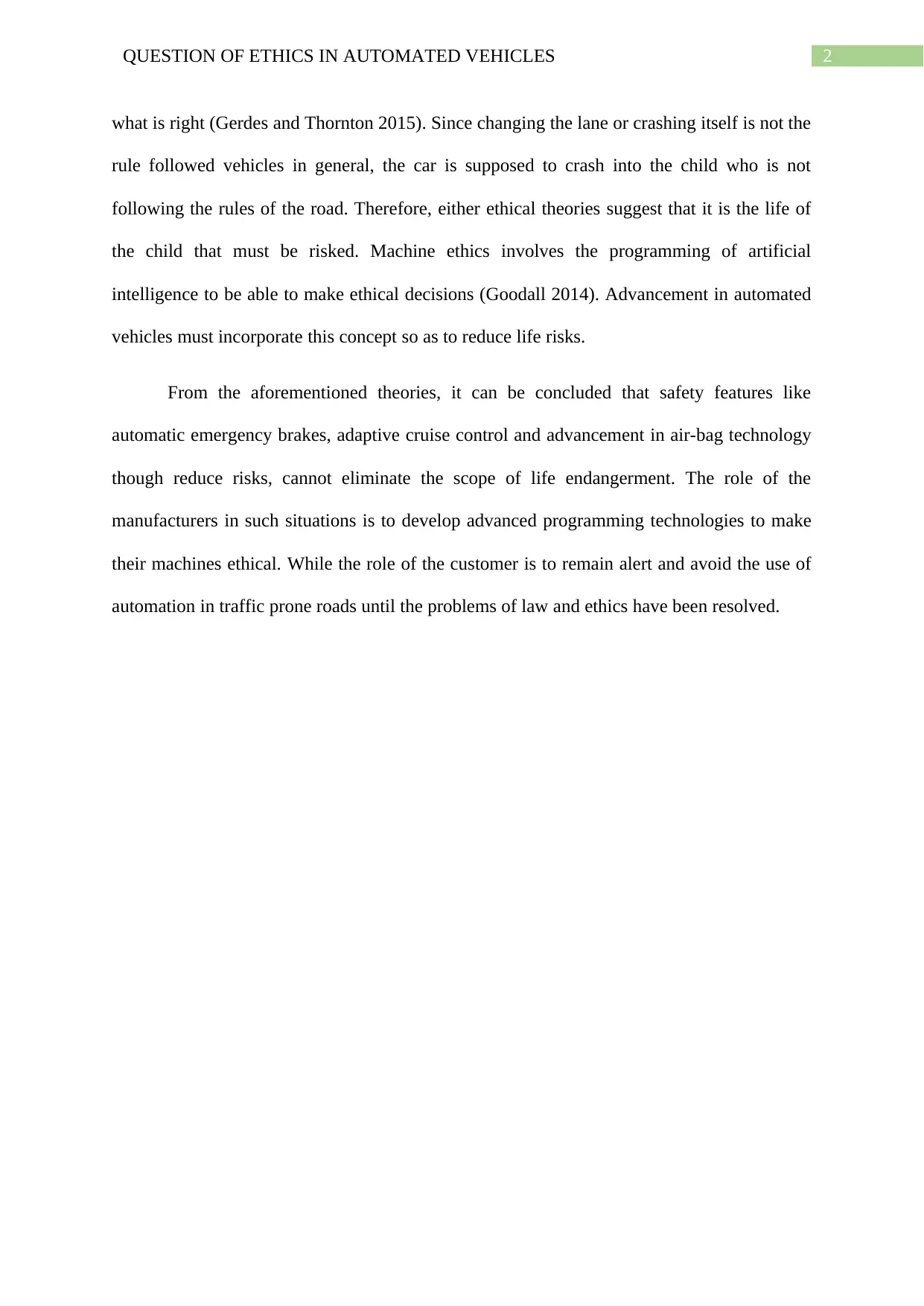
2QUESTION OF ETHICS IN AUTOMATED VEHICLES
what is right (Gerdes and Thornton 2015). Since changing the lane or crashing itself is not the
rule followed vehicles in general, the car is supposed to crash into the child who is not
following the rules of the road. Therefore, either ethical theories suggest that it is the life of
the child that must be risked. Machine ethics involves the programming of artificial
intelligence to be able to make ethical decisions (Goodall 2014). Advancement in automated
vehicles must incorporate this concept so as to reduce life risks.
From the aforementioned theories, it can be concluded that safety features like
automatic emergency brakes, adaptive cruise control and advancement in air-bag technology
though reduce risks, cannot eliminate the scope of life endangerment. The role of the
manufacturers in such situations is to develop advanced programming technologies to make
their machines ethical. While the role of the customer is to remain alert and avoid the use of
automation in traffic prone roads until the problems of law and ethics have been resolved.
Document Page
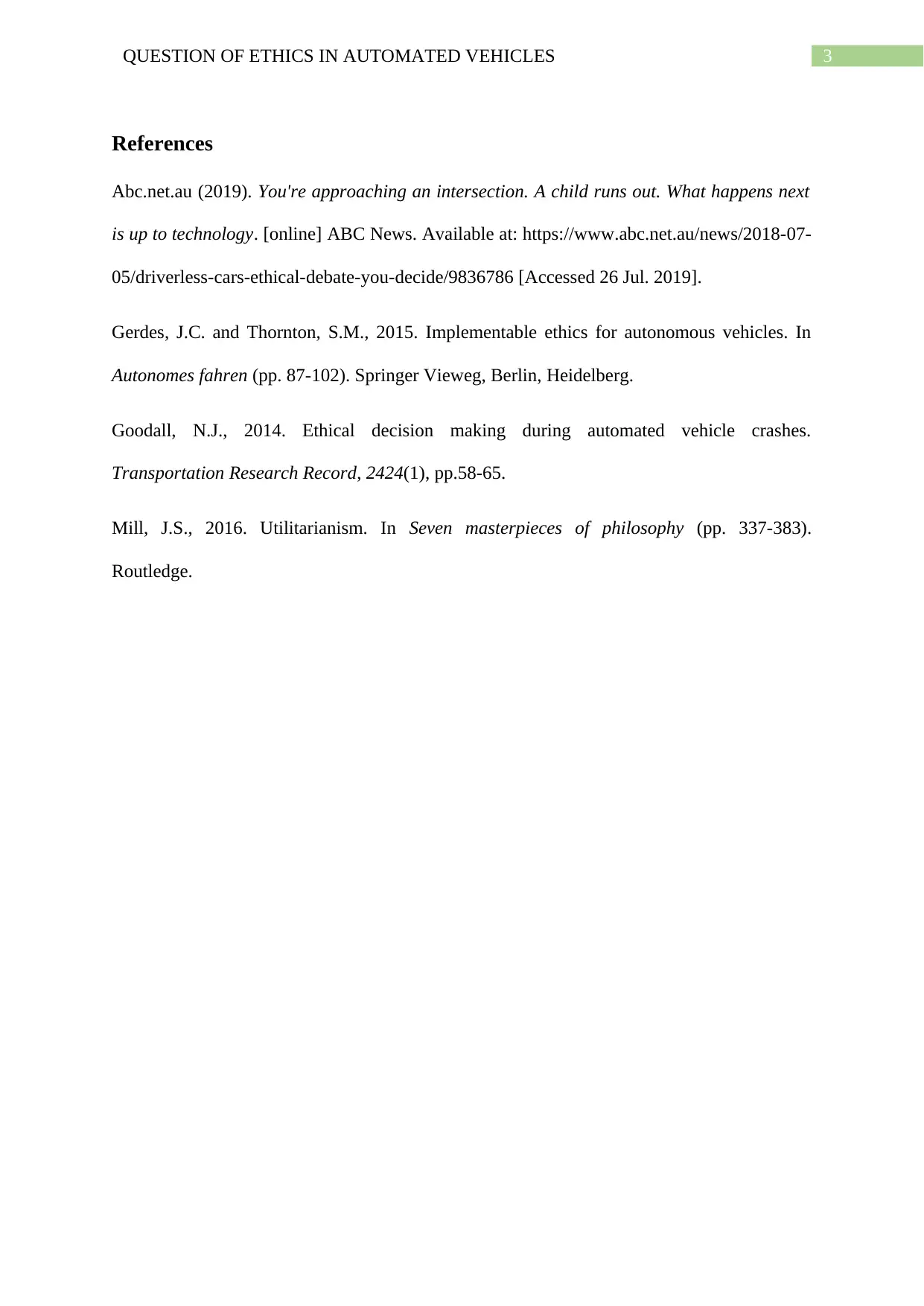
3QUESTION OF ETHICS IN AUTOMATED VEHICLES
References
Abc.net.au (2019). You're approaching an intersection. A child runs out. What happens next
is up to technology. [online] ABC News. Available at: https://www.abc.net.au/news/2018-07-
05/driverless-cars-ethical-debate-you-decide/9836786 [Accessed 26 Jul. 2019].
Gerdes, J.C. and Thornton, S.M., 2015. Implementable ethics for autonomous vehicles. In
Autonomes fahren (pp. 87-102). Springer Vieweg, Berlin, Heidelberg.
Goodall, N.J., 2014. Ethical decision making during automated vehicle crashes.
Transportation Research Record, 2424(1), pp.58-65.
Mill, J.S., 2016. Utilitarianism. In Seven masterpieces of philosophy (pp. 337-383).
Routledge.
chevron_up_icon
1 out of 4
circle_padding
hide_on_mobile
zoom_out_icon
[object Object]