The 'End of Work' Myth: An Analysis of Dundon and Howcroft's Article

Verified

Added on  2023/04/25

|6
|1137
|110
Report
AI Summary
This report analyzes the article by Dundon and Howcroft, which explores the complex relationship between automation, robots, and the perceived 'end of work' myth. The report examines the authors' main ideas, including the notion that technological advancements do not necessarily lead to a reduction in labor. It provides context by discussing the prevalent fears surrounding job displacement due to artificial intelligence. The analysis supports the authors' views by drawing parallels with Karl Marx's philosophies, particularly regarding the control of technology and its societal impact. The report also considers the potential publication location and supporting perspectives, including video analyses, while highlighting the usefulness of the article for related research topics. The conclusion emphasizes the importance of understanding the nuanced effects of automation in various economic and social contexts.
Document Page
Running head: READING DUNDON AND HOWCROFT
Reading Dundon and Howcroft
Name of the Student-
Name of the University-
Author note-
tabler-icon-diamond-filled.svg

Paraphrase This Document

Need a fresh take? Get an instant paraphrase of this document with our AI Paraphraser
Document Page
1READING DUNDON AND HOWCROFT
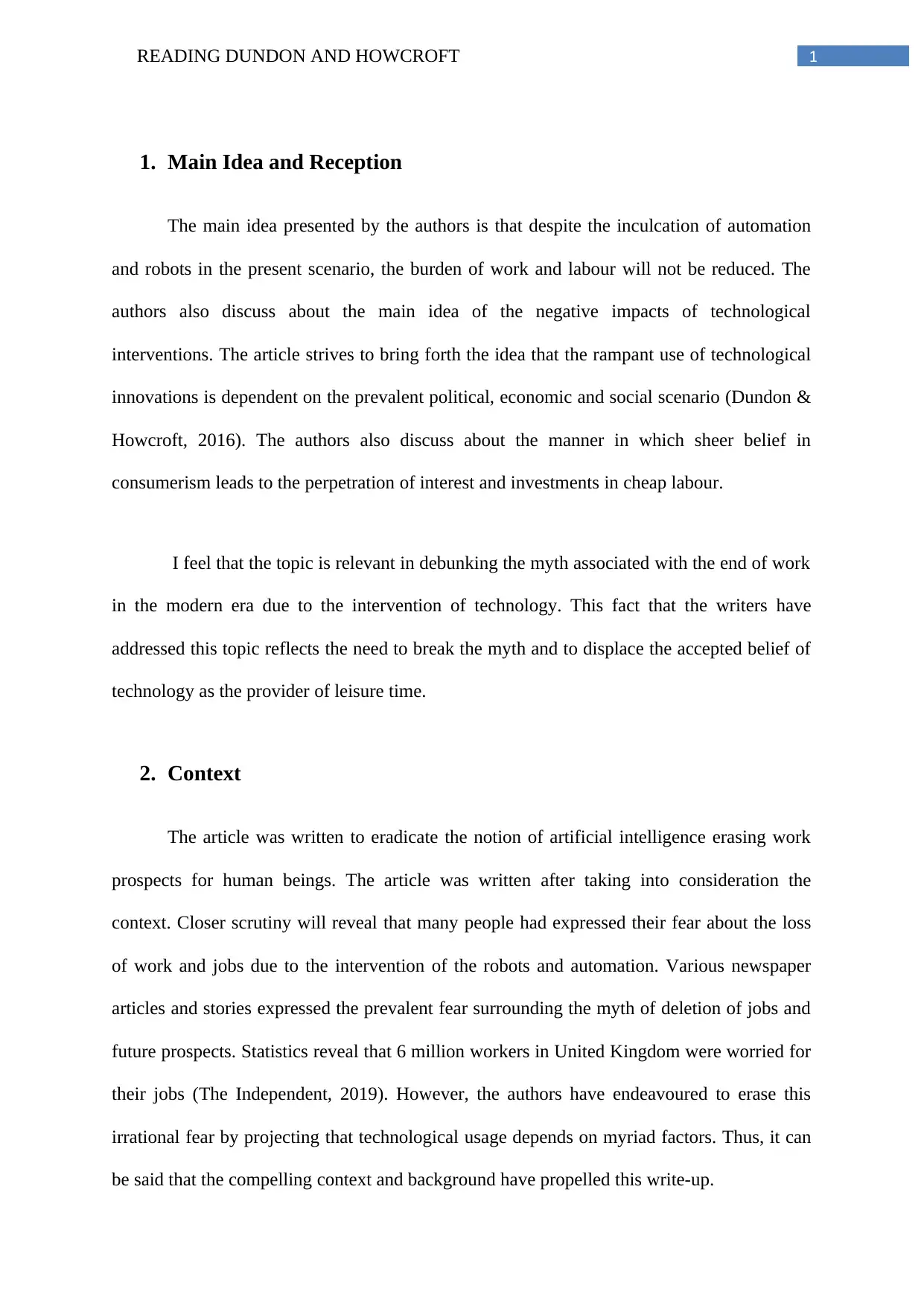
1. Main Idea and Reception
The main idea presented by the authors is that despite the inculcation of automation
and robots in the present scenario, the burden of work and labour will not be reduced. The
authors also discuss about the main idea of the negative impacts of technological
interventions. The article strives to bring forth the idea that the rampant use of technological
innovations is dependent on the prevalent political, economic and social scenario (Dundon &
Howcroft, 2016). The authors also discuss about the manner in which sheer belief in
consumerism leads to the perpetration of interest and investments in cheap labour.
I feel that the topic is relevant in debunking the myth associated with the end of work
in the modern era due to the intervention of technology. This fact that the writers have
addressed this topic reflects the need to break the myth and to displace the accepted belief of
technology as the provider of leisure time.
2. Context
The article was written to eradicate the notion of artificial intelligence erasing work
prospects for human beings. The article was written after taking into consideration the
context. Closer scrutiny will reveal that many people had expressed their fear about the loss
of work and jobs due to the intervention of the robots and automation. Various newspaper
articles and stories expressed the prevalent fear surrounding the myth of deletion of jobs and
future prospects. Statistics reveal that 6 million workers in United Kingdom were worried for
their jobs (The Independent, 2019). However, the authors have endeavoured to erase this
irrational fear by projecting that technological usage depends on myriad factors. Thus, it can
be said that the compelling context and background have propelled this write-up.
Document Page
2READING DUNDON AND HOWCROFT
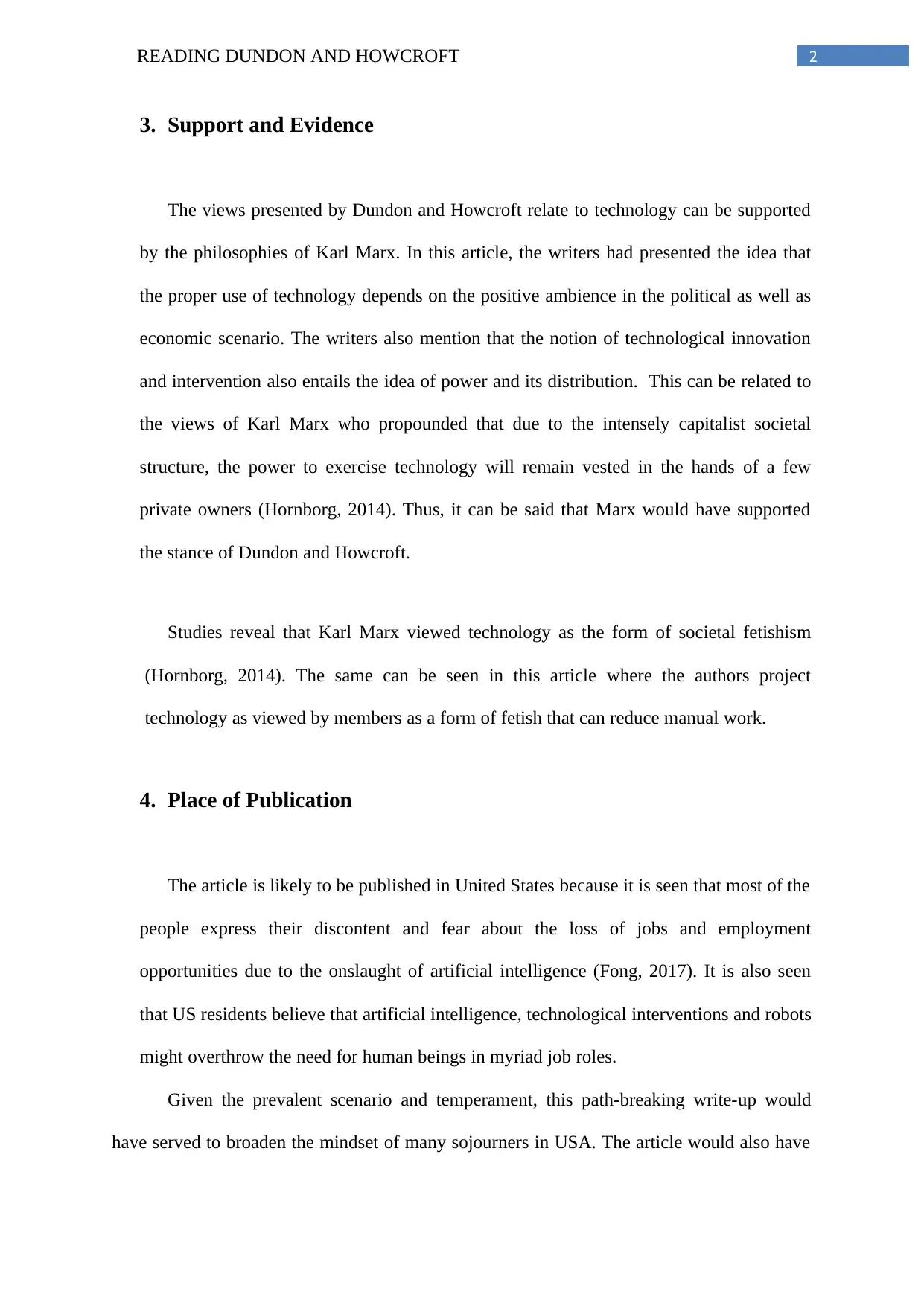
3. Support and Evidence
The views presented by Dundon and Howcroft relate to technology can be supported
by the philosophies of Karl Marx. In this article, the writers had presented the idea that
the proper use of technology depends on the positive ambience in the political as well as
economic scenario. The writers also mention that the notion of technological innovation
and intervention also entails the idea of power and its distribution. This can be related to
the views of Karl Marx who propounded that due to the intensely capitalist societal
structure, the power to exercise technology will remain vested in the hands of a few
private owners (Hornborg, 2014). Thus, it can be said that Marx would have supported
the stance of Dundon and Howcroft.
Studies reveal that Karl Marx viewed technology as the form of societal fetishism
(Hornborg, 2014). The same can be seen in this article where the authors project
technology as viewed by members as a form of fetish that can reduce manual work.
4. Place of Publication
The article is likely to be published in United States because it is seen that most of the
people express their discontent and fear about the loss of jobs and employment
opportunities due to the onslaught of artificial intelligence (Fong, 2017). It is also seen
that US residents believe that artificial intelligence, technological interventions and robots
might overthrow the need for human beings in myriad job roles.
Given the prevalent scenario and temperament, this path-breaking write-up would
have served to broaden the mindset of many sojourners in USA. The article would also have
Document Page
3READING DUNDON AND HOWCROFT
strived to break the myth and enable the people to view technology as the means of control
exercised by the masters. This article also sheds light on the manner in which the business
organizations in USA fail to imbibe technology and robots despite possessing the ability to
exercise and implement these advanced measures (Dundon & Howcroft, 2016). This is
reflective of the manner in which control is exercised over technology.
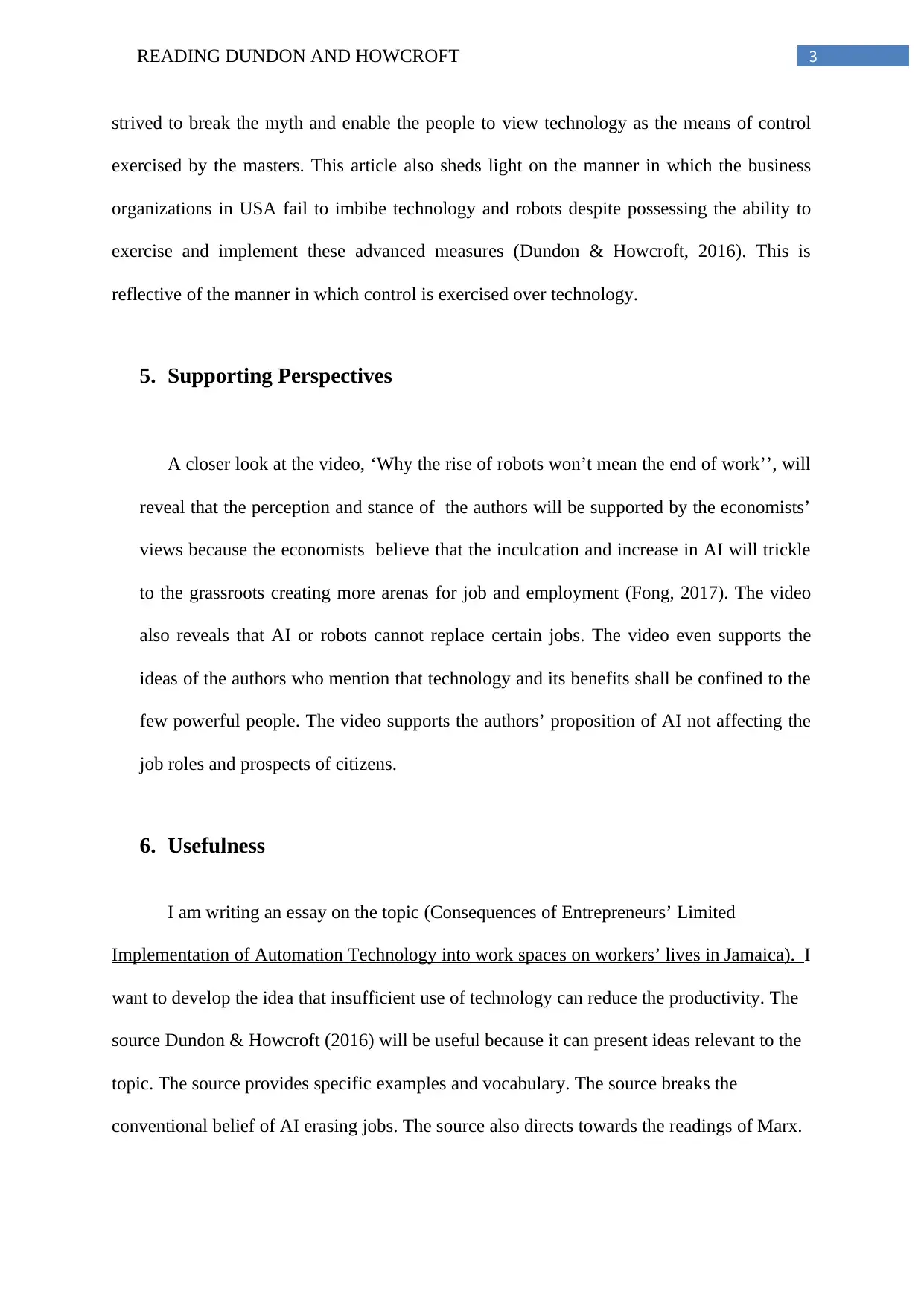
5. Supporting Perspectives
A closer look at the video, ‘Why the rise of robots won’t mean the end of work’’, will
reveal that the perception and stance of the authors will be supported by the economists’
views because the economists believe that the inculcation and increase in AI will trickle
to the grassroots creating more arenas for job and employment (Fong, 2017). The video
also reveals that AI or robots cannot replace certain jobs. The video even supports the
ideas of the authors who mention that technology and its benefits shall be confined to the
few powerful people. The video supports the authors’ proposition of AI not affecting the
job roles and prospects of citizens.
6. Usefulness
I am writing an essay on the topic (Consequences of Entrepreneurs’ Limited
Implementation of Automation Technology into work spaces on workers’ lives in Jamaica). I
want to develop the idea that insufficient use of technology can reduce the productivity. The
source Dundon & Howcroft (2016) will be useful because it can present ideas relevant to the
topic. The source provides specific examples and vocabulary. The source breaks the
conventional belief of AI erasing jobs. The source also directs towards the readings of Marx.
tabler-icon-diamond-filled.svg

Paraphrase This Document

Need a fresh take? Get an instant paraphrase of this document with our AI Paraphraser
Document Page
4READING DUNDON AND HOWCROFT
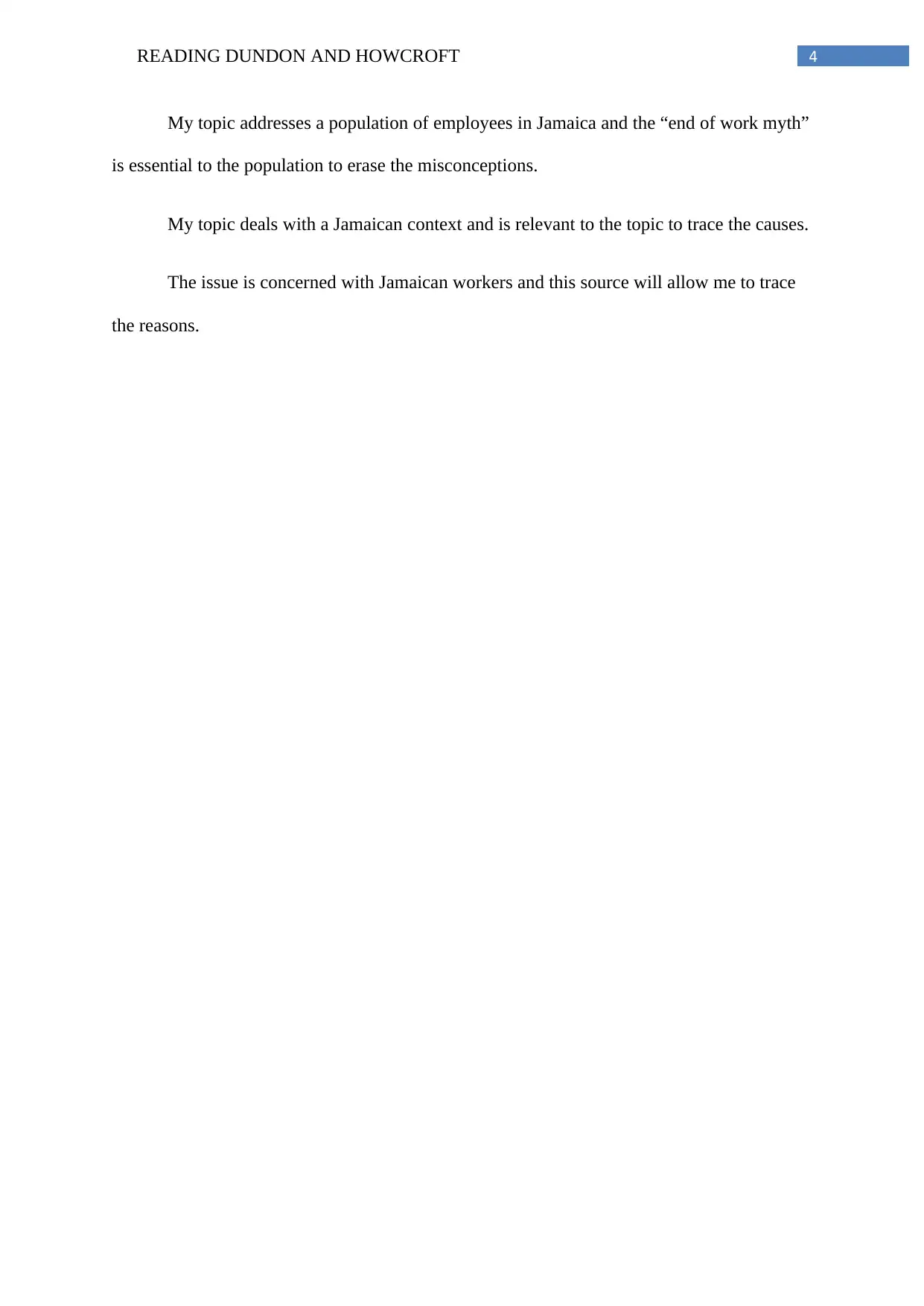
My topic addresses a population of employees in Jamaica and the “end of work myth”
is essential to the population to erase the misconceptions.
My topic deals with a Jamaican context and is relevant to the topic to trace the causes.
The issue is concerned with Jamaican workers and this source will allow me to trace
the reasons.
Document Page
5READING DUNDON AND HOWCROFT
References
Dundon, T., & Howcroft, D. (2016). [Blog]. Retrieved from
https://theconversation.com/automation-robots-and-the-end-of-work-myth-89619
Fong, J. (2017). [Video]. Retrieved from
https://www.vox.com/videos/2017/11/13/16635360/automation-robot-jobs-
unemployment-debate
Hornborg, A. (2014). Technology as fetish: Marx, Latour, and the cultural foundations of
capitalism. Theory, Culture & Society, 31(4), 119-140.
The Independent (2019). Thanks to AI, the need for humans to work for survival could soon
be at an end. [online] The Independent. Available at:
https://www.independent.co.uk/news/long_reads/ai-automation-robots-human-work-
survive-end-food-existence-a8504721.html [Accessed 26 Jan. 2019].
.
chevron_up_icon
1 out of 6
circle_padding
hide_on_mobile
zoom_out_icon
[object Object]