Research Project on Aviation Engineering's Role in Aircraft Management
VerifiedAdded on 2020/03/23
|12
|2755
|289
Project
AI Summary
This research project delves into the critical role of aviation engineering in enhancing aircraft management, particularly focusing on mitigating risks associated with older aircraft and improving customer satisfaction. The study investigates the implementation of corrosion control strategies, voice sensors, and training programs to address issues such as structural damages and accidents. The project analyzes the application of agency theory to understand stakeholder relationships and the effectiveness of technological advancements in aviation. The research includes a literature review, research design, and analysis of data collection methods, including survey questionnaires. The findings highlight the importance of technological innovations and employee training in improving aircraft safety and overall management within the aviation industry. Furthermore, it addresses the challenges faced by the Australian construction industry in relation to aircraft safety and management, offering recommendations for improvement. The project concludes by emphasizing the need for continuous advancements in aviation engineering to ensure the safety and efficiency of aircraft operations, which can be found on Desklib.
Running head: RESEARCH PROJECT
Research Project
Name of the Student
Name of the University
Author’s Note
Research Project
Name of the Student
Name of the University
Author’s Note

Paraphrase This Document
Need a fresh take? Get an instant paraphrase of this document with our AI Paraphraser
1RESEARCH PROJECT
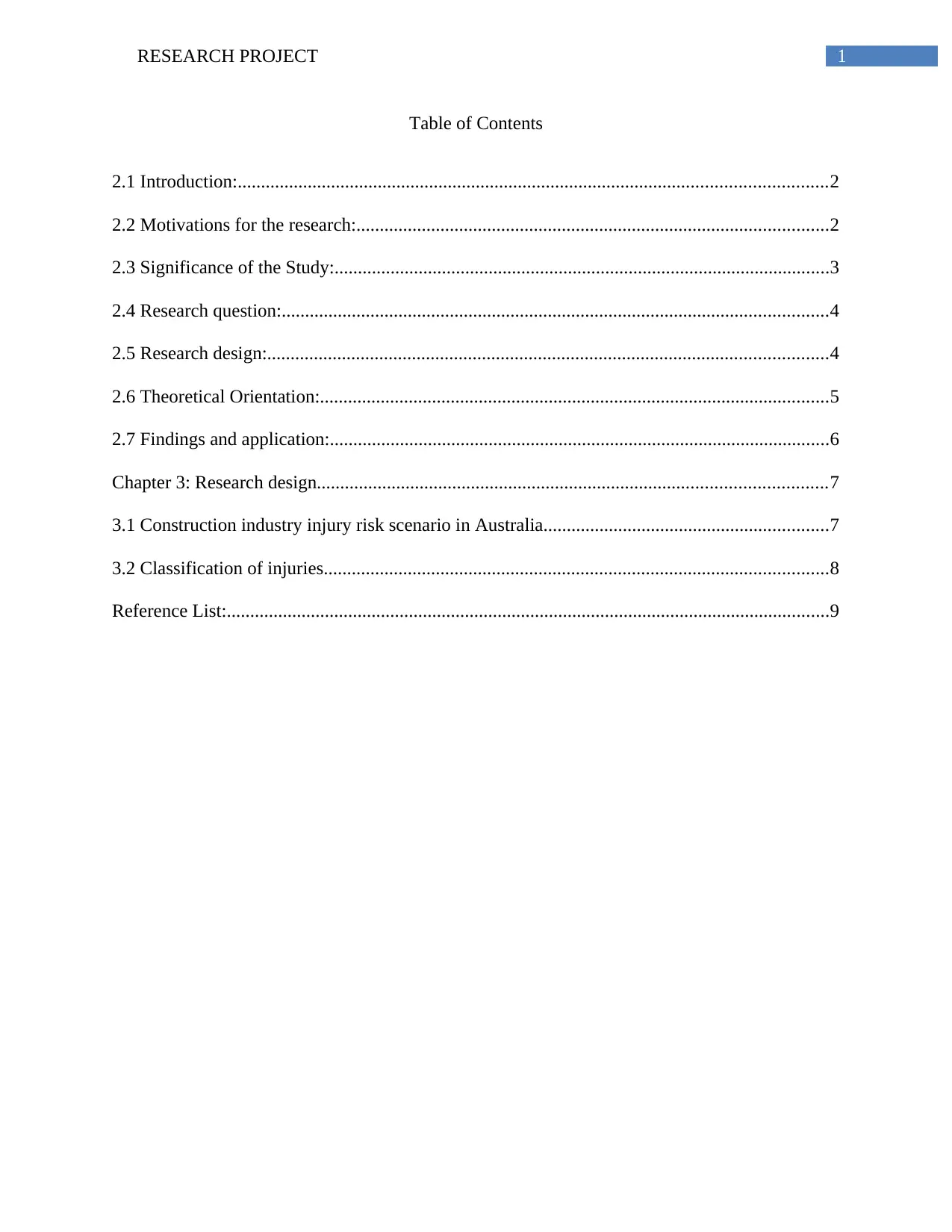
Table of Contents
2.1 Introduction:..............................................................................................................................2
2.2 Motivations for the research:.....................................................................................................2
2.3 Significance of the Study:..........................................................................................................3
2.4 Research question:.....................................................................................................................4
2.5 Research design:........................................................................................................................4
2.6 Theoretical Orientation:.............................................................................................................5
2.7 Findings and application:...........................................................................................................6
Chapter 3: Research design.............................................................................................................7
3.1 Construction industry injury risk scenario in Australia.............................................................7
3.2 Classification of injuries............................................................................................................8
Reference List:.................................................................................................................................9
Table of Contents
2.1 Introduction:..............................................................................................................................2
2.2 Motivations for the research:.....................................................................................................2
2.3 Significance of the Study:..........................................................................................................3
2.4 Research question:.....................................................................................................................4
2.5 Research design:........................................................................................................................4
2.6 Theoretical Orientation:.............................................................................................................5
2.7 Findings and application:...........................................................................................................6
Chapter 3: Research design.............................................................................................................7
3.1 Construction industry injury risk scenario in Australia.............................................................7
3.2 Classification of injuries............................................................................................................8
Reference List:.................................................................................................................................9
2RESEARCH PROJECT
Chapter 2: Literature Review
Topic: Impact of aviation engineering on aircraft management
2.1 Introduction:
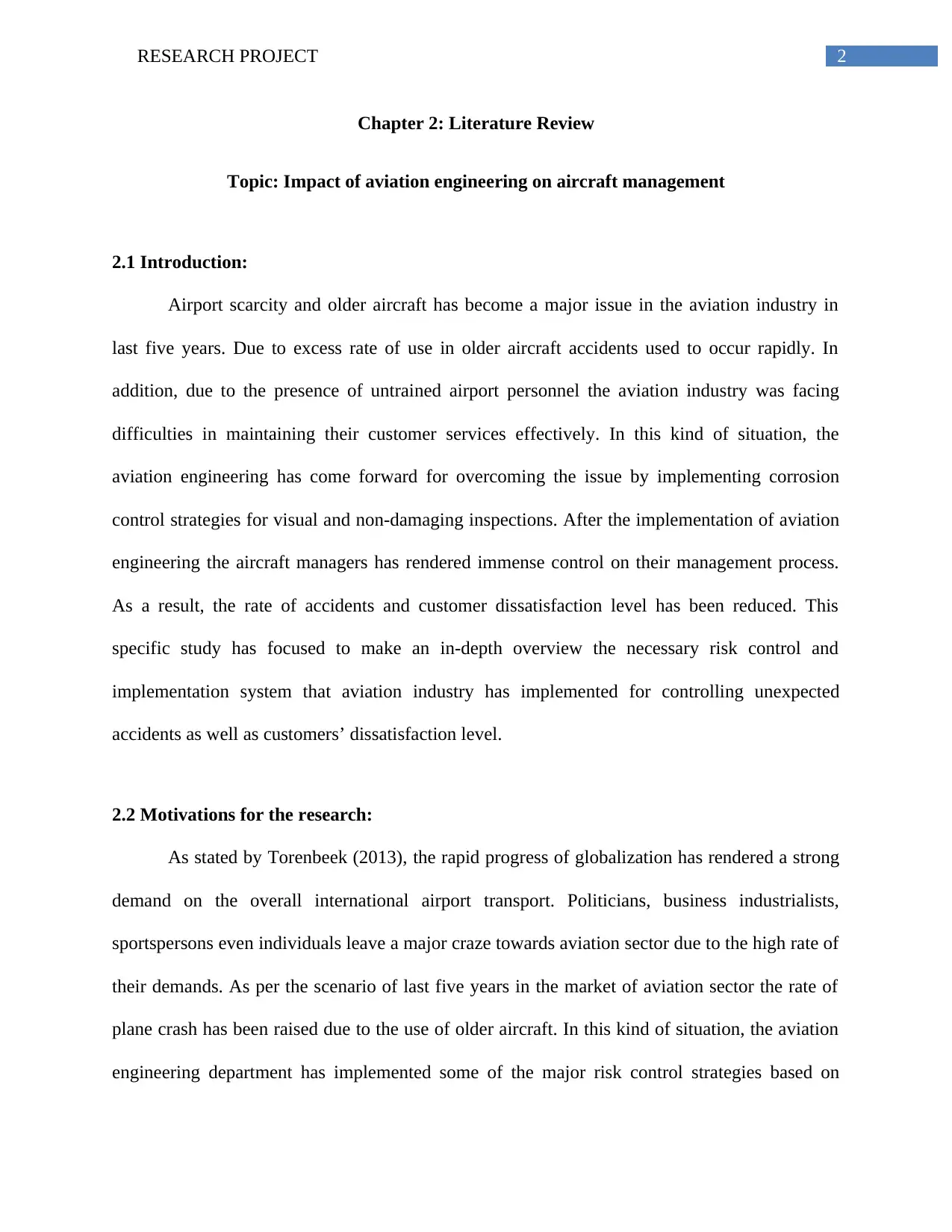
Airport scarcity and older aircraft has become a major issue in the aviation industry in
last five years. Due to excess rate of use in older aircraft accidents used to occur rapidly. In
addition, due to the presence of untrained airport personnel the aviation industry was facing
difficulties in maintaining their customer services effectively. In this kind of situation, the
aviation engineering has come forward for overcoming the issue by implementing corrosion
control strategies for visual and non-damaging inspections. After the implementation of aviation
engineering the aircraft managers has rendered immense control on their management process.
As a result, the rate of accidents and customer dissatisfaction level has been reduced. This
specific study has focused to make an in-depth overview the necessary risk control and
implementation system that aviation industry has implemented for controlling unexpected
accidents as well as customers’ dissatisfaction level.
2.2 Motivations for the research:
As stated by Torenbeek (2013), the rapid progress of globalization has rendered a strong
demand on the overall international airport transport. Politicians, business industrialists,
sportspersons even individuals leave a major craze towards aviation sector due to the high rate of
their demands. As per the scenario of last five years in the market of aviation sector the rate of
plane crash has been raised due to the use of older aircraft. In this kind of situation, the aviation
engineering department has implemented some of the major risk control strategies based on
Chapter 2: Literature Review
Topic: Impact of aviation engineering on aircraft management
2.1 Introduction:
Airport scarcity and older aircraft has become a major issue in the aviation industry in
last five years. Due to excess rate of use in older aircraft accidents used to occur rapidly. In
addition, due to the presence of untrained airport personnel the aviation industry was facing
difficulties in maintaining their customer services effectively. In this kind of situation, the
aviation engineering has come forward for overcoming the issue by implementing corrosion
control strategies for visual and non-damaging inspections. After the implementation of aviation
engineering the aircraft managers has rendered immense control on their management process.
As a result, the rate of accidents and customer dissatisfaction level has been reduced. This
specific study has focused to make an in-depth overview the necessary risk control and
implementation system that aviation industry has implemented for controlling unexpected
accidents as well as customers’ dissatisfaction level.
2.2 Motivations for the research:
As stated by Torenbeek (2013), the rapid progress of globalization has rendered a strong
demand on the overall international airport transport. Politicians, business industrialists,
sportspersons even individuals leave a major craze towards aviation sector due to the high rate of
their demands. As per the scenario of last five years in the market of aviation sector the rate of
plane crash has been raised due to the use of older aircraft. In this kind of situation, the aviation
engineering department has implemented some of the major risk control strategies based on
⊘ This is a preview!⊘
Do you want full access?
Subscribe today to unlock all pages.

Trusted by 1+ million students worldwide
3RESEARCH PROJECT
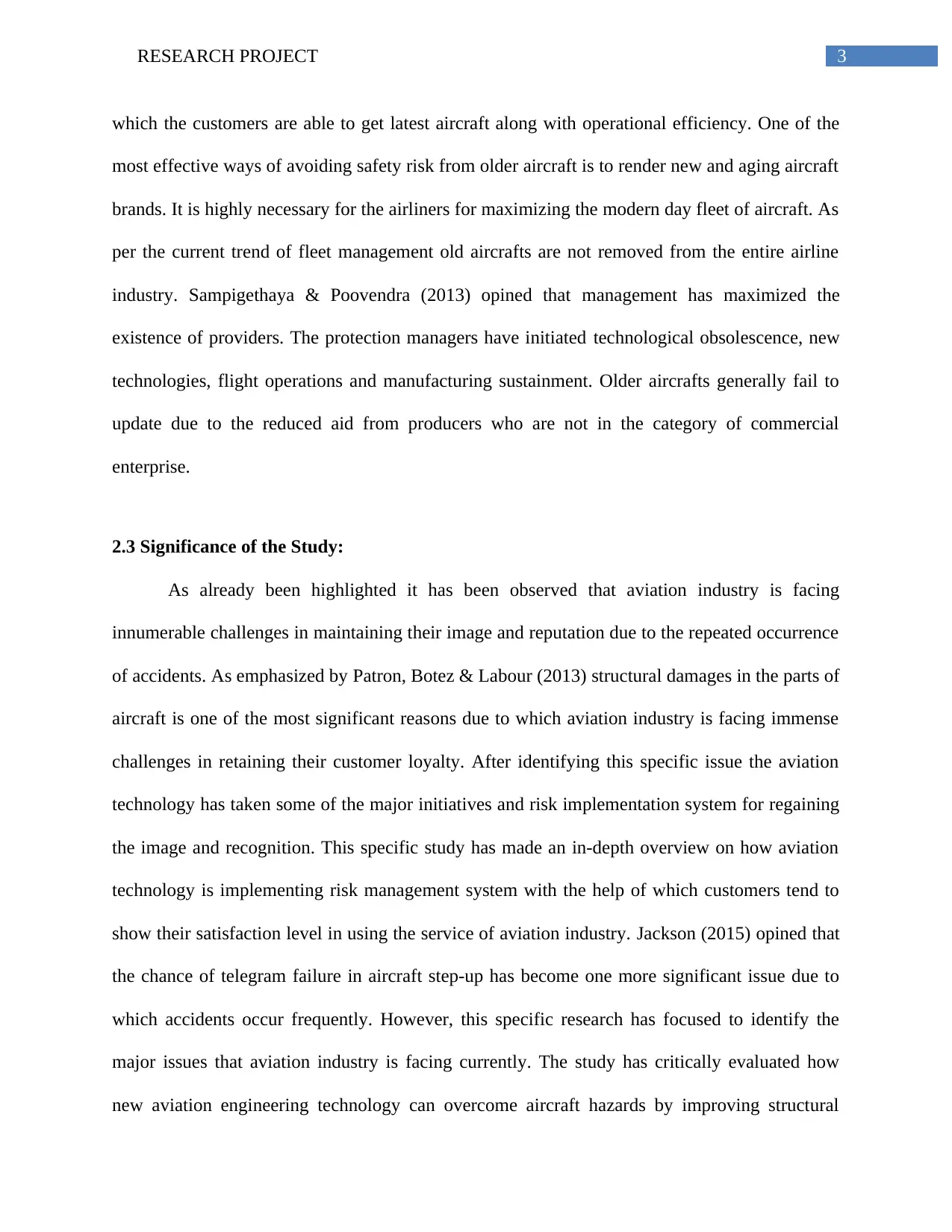
which the customers are able to get latest aircraft along with operational efficiency. One of the
most effective ways of avoiding safety risk from older aircraft is to render new and aging aircraft
brands. It is highly necessary for the airliners for maximizing the modern day fleet of aircraft. As
per the current trend of fleet management old aircrafts are not removed from the entire airline
industry. Sampigethaya & Poovendra (2013) opined that management has maximized the
existence of providers. The protection managers have initiated technological obsolescence, new
technologies, flight operations and manufacturing sustainment. Older aircrafts generally fail to
update due to the reduced aid from producers who are not in the category of commercial
enterprise.
2.3 Significance of the Study:
As already been highlighted it has been observed that aviation industry is facing
innumerable challenges in maintaining their image and reputation due to the repeated occurrence
of accidents. As emphasized by Patron, Botez & Labour (2013) structural damages in the parts of
aircraft is one of the most significant reasons due to which aviation industry is facing immense
challenges in retaining their customer loyalty. After identifying this specific issue the aviation
technology has taken some of the major initiatives and risk implementation system for regaining
the image and recognition. This specific study has made an in-depth overview on how aviation
technology is implementing risk management system with the help of which customers tend to
show their satisfaction level in using the service of aviation industry. Jackson (2015) opined that
the chance of telegram failure in aircraft step-up has become one more significant issue due to
which accidents occur frequently. However, this specific research has focused to identify the
major issues that aviation industry is facing currently. The study has critically evaluated how
new aviation engineering technology can overcome aircraft hazards by improving structural
which the customers are able to get latest aircraft along with operational efficiency. One of the
most effective ways of avoiding safety risk from older aircraft is to render new and aging aircraft
brands. It is highly necessary for the airliners for maximizing the modern day fleet of aircraft. As
per the current trend of fleet management old aircrafts are not removed from the entire airline
industry. Sampigethaya & Poovendra (2013) opined that management has maximized the
existence of providers. The protection managers have initiated technological obsolescence, new
technologies, flight operations and manufacturing sustainment. Older aircrafts generally fail to
update due to the reduced aid from producers who are not in the category of commercial
enterprise.
2.3 Significance of the Study:
As already been highlighted it has been observed that aviation industry is facing
innumerable challenges in maintaining their image and reputation due to the repeated occurrence
of accidents. As emphasized by Patron, Botez & Labour (2013) structural damages in the parts of
aircraft is one of the most significant reasons due to which aviation industry is facing immense
challenges in retaining their customer loyalty. After identifying this specific issue the aviation
technology has taken some of the major initiatives and risk implementation system for regaining
the image and recognition. This specific study has made an in-depth overview on how aviation
technology is implementing risk management system with the help of which customers tend to
show their satisfaction level in using the service of aviation industry. Jackson (2015) opined that
the chance of telegram failure in aircraft step-up has become one more significant issue due to
which accidents occur frequently. However, this specific research has focused to identify the
major issues that aviation industry is facing currently. The study has critically evaluated how
new aviation engineering technology can overcome aircraft hazards by improving structural
Paraphrase This Document
Need a fresh take? Get an instant paraphrase of this document with our AI Paraphraser
4RESEARCH PROJECT
damages of older plane. At the same time some of the major the recommendations for improving
aircraft management within aviation industry has also been portrayed in this specific study.
2.4 Research question:
The research questions for this specific study are as follows:
Can new aviation engineering technology overcome aircraft hazards by improving structural
damages of older plane?
What are the new technologies that aviation engineering can apply for overcoming the rate of
accidents?
What can be the recommendations for improving aircraft management within aviation
industry?
2.5 Research design:
In order to conduct the entire research work the research has to follow some effective
methodological tools with the help of which necessary data and information is collected from
various reliable sources (Nagel et al., 2012). In this specific research proposal the study would
focus to use positivism research philosophy in order to make an in-depth and keen observation
about the research issue. In order to accomplish the entire research successfully primary source
of data collection technique would be used.
2.6 Theoretical Orientation:
Customers are showing their intense level of dissatisfaction for using the services of
airlines. In this kind of situation, the managers belonging to aviation industry has implemented
new technology for reducing the risk factors that has been grown for using older aircraft. The
damages of older plane. At the same time some of the major the recommendations for improving
aircraft management within aviation industry has also been portrayed in this specific study.
2.4 Research question:
The research questions for this specific study are as follows:
Can new aviation engineering technology overcome aircraft hazards by improving structural
damages of older plane?
What are the new technologies that aviation engineering can apply for overcoming the rate of
accidents?
What can be the recommendations for improving aircraft management within aviation
industry?
2.5 Research design:
In order to conduct the entire research work the research has to follow some effective
methodological tools with the help of which necessary data and information is collected from
various reliable sources (Nagel et al., 2012). In this specific research proposal the study would
focus to use positivism research philosophy in order to make an in-depth and keen observation
about the research issue. In order to accomplish the entire research successfully primary source
of data collection technique would be used.
2.6 Theoretical Orientation:
Customers are showing their intense level of dissatisfaction for using the services of
airlines. In this kind of situation, the managers belonging to aviation industry has implemented
new technology for reducing the risk factors that has been grown for using older aircraft. The
5RESEARCH PROJECT
concept of agency theory implies that the business managers before implementing risk control
system within aviation industry has focused to make an in-depth evaluation on how the
stakeholders can be attracted towards using the services of airline industry. In order to overcome
the risk factors the agency has implemented new technology for avoiding risks. Verhagen et al.
(2012) stated that the personnel within the aviation industry has been provided an effective
training session in order to enhance their professional skill and competency level. As a result,
customers do not have to feel insecure while using the services. This particular risk management
theory has been implemented in this specific study for making a good rapport with the
stakeholder so that stakeholders do not show their reluctant attitude in using the services.
2.7 Findings and application:
As a result, the rate of customer dissatisfaction is getting raised day by day. Henderson,
Martins & Perez (2012) opined that the business organizations have to face innumerable
difficulties for dealing with the customers effectively. In order to overcome this kind of crisis the
aviation technology has focused to implement corrosion control strategies for visual and non-
damaging inspections. Implementation of voice sensor is one of the most significant initiatives
for dealing with the situation effectively. The protection managers have initiated technological
obsolescence, new technologies, flight operations and manufacturing sustainment. As a result,
the rate of accidents has been checked. New technology has rendered a rapid growth on the
overall aviation industry. Customers have showed their positive outlook for use the services.
Ramasamy et al. (2013) stated that the industry personnel have enhanced their professional skill
and competency level. Automatically, the service providers and the service users share a good
rapport in between them. After the initiatives taken by aviation engineers the business
organizations have showed a positive result.
concept of agency theory implies that the business managers before implementing risk control
system within aviation industry has focused to make an in-depth evaluation on how the
stakeholders can be attracted towards using the services of airline industry. In order to overcome
the risk factors the agency has implemented new technology for avoiding risks. Verhagen et al.
(2012) stated that the personnel within the aviation industry has been provided an effective
training session in order to enhance their professional skill and competency level. As a result,
customers do not have to feel insecure while using the services. This particular risk management
theory has been implemented in this specific study for making a good rapport with the
stakeholder so that stakeholders do not show their reluctant attitude in using the services.
2.7 Findings and application:
As a result, the rate of customer dissatisfaction is getting raised day by day. Henderson,
Martins & Perez (2012) opined that the business organizations have to face innumerable
difficulties for dealing with the customers effectively. In order to overcome this kind of crisis the
aviation technology has focused to implement corrosion control strategies for visual and non-
damaging inspections. Implementation of voice sensor is one of the most significant initiatives
for dealing with the situation effectively. The protection managers have initiated technological
obsolescence, new technologies, flight operations and manufacturing sustainment. As a result,
the rate of accidents has been checked. New technology has rendered a rapid growth on the
overall aviation industry. Customers have showed their positive outlook for use the services.
Ramasamy et al. (2013) stated that the industry personnel have enhanced their professional skill
and competency level. Automatically, the service providers and the service users share a good
rapport in between them. After the initiatives taken by aviation engineers the business
organizations have showed a positive result.
⊘ This is a preview!⊘
Do you want full access?
Subscribe today to unlock all pages.
Trusted by 1+ million students worldwide
6RESEARCH PROJECT
Chapter 3: Research design
3.1 Construction industry injury risk scenario in Australia
Australia is facing innumerable developing issues for maturing the populace of airplane armada.
The professionals are not very much efficient in fulfilling the needs and demands of customers.
The professionals fail to maintain an effective communication with the customers due to the lack
of skill. In addition, Australia is using maturing airplane which is influenced by erosion and
weakness (Katnam, Da Silva and Young, 2013).
3.1.2 Classification of injuries
The injuries that construction industry of Australia is facing currently include damages in
stockpiling area, flying machine, overall airship administration and so on. In order to overcome
the damages in mechanical parts the aviation engineers have implemented new technology for
overcoming the crisis. On the other hand, in order to overcome administrative constraints the
managers have rendered change management within administration so that the business
executives can keep a constant control over the entire process of services (Gardi et al., 2014).
3.1.3 High rise scenario
This particular factor signifies enormous danger for the travelers. In addition, Australia
aircrafts are facing immense structural damages that rendered a major negative impact on the
overall business reputation. In order to overcome this kind of situation, the business managers
can provide a professional training to the employees of Australia aviation sector for maintaining
a balance between customers demand and supply. At the same time, construction industry of
Australia should some major initiatives as well including flying hours, fabricate principles,
confirmation premise, support models, repairs benchmarks, pressurization cycles and so many.
Chapter 3: Research design
3.1 Construction industry injury risk scenario in Australia
Australia is facing innumerable developing issues for maturing the populace of airplane armada.
The professionals are not very much efficient in fulfilling the needs and demands of customers.
The professionals fail to maintain an effective communication with the customers due to the lack
of skill. In addition, Australia is using maturing airplane which is influenced by erosion and
weakness (Katnam, Da Silva and Young, 2013).
3.1.2 Classification of injuries
The injuries that construction industry of Australia is facing currently include damages in
stockpiling area, flying machine, overall airship administration and so on. In order to overcome
the damages in mechanical parts the aviation engineers have implemented new technology for
overcoming the crisis. On the other hand, in order to overcome administrative constraints the
managers have rendered change management within administration so that the business
executives can keep a constant control over the entire process of services (Gardi et al., 2014).
3.1.3 High rise scenario
This particular factor signifies enormous danger for the travelers. In addition, Australia
aircrafts are facing immense structural damages that rendered a major negative impact on the
overall business reputation. In order to overcome this kind of situation, the business managers
can provide a professional training to the employees of Australia aviation sector for maintaining
a balance between customers demand and supply. At the same time, construction industry of
Australia should some major initiatives as well including flying hours, fabricate principles,
confirmation premise, support models, repairs benchmarks, pressurization cycles and so many.
Paraphrase This Document
Need a fresh take? Get an instant paraphrase of this document with our AI Paraphraser
7RESEARCH PROJECT
3.1.4 Conclusion
This specific study has focused to make an in-depth overview about the importance of
using deductive approach along with descriptive research design in order to accomplish the
entire research work successfully. While making an effective research design the researcher
focuses to follow the ethical considerations with the help of which the data will be collected by
following proper value and belief. While collecting proper data and information from various
employees of aviation industry the participants should not be forced for providing necessary
responses (Alexander, 2013).
3.2 Introduction:
In order to implement some major risk management factors the study has focused to use
effective risk management theories among which the implication of agency theory is the most
prominent. As critically evaluated by Reason (2016), agency theory signifies the relationship
between principals and agents. In this specific study, the researcher has focused to make a co-
relation between managers and stakeholders. After the frequent occurrence of accidents aviation
industry is going through the challenging phase.
3.2.1 Gap of literature review:
This particular literature review has focused to make an in-depth evaluation about the
impact of aviation engineering on aircraft management. It is at the same time undeniable that the
researcher could have focused to discuss about the necessary factors that hamper highly in
maintaining aircraft management in the aviation sector.
3.2.2 Research overview:
3.1.4 Conclusion
This specific study has focused to make an in-depth overview about the importance of
using deductive approach along with descriptive research design in order to accomplish the
entire research work successfully. While making an effective research design the researcher
focuses to follow the ethical considerations with the help of which the data will be collected by
following proper value and belief. While collecting proper data and information from various
employees of aviation industry the participants should not be forced for providing necessary
responses (Alexander, 2013).
3.2 Introduction:
In order to implement some major risk management factors the study has focused to use
effective risk management theories among which the implication of agency theory is the most
prominent. As critically evaluated by Reason (2016), agency theory signifies the relationship
between principals and agents. In this specific study, the researcher has focused to make a co-
relation between managers and stakeholders. After the frequent occurrence of accidents aviation
industry is going through the challenging phase.
3.2.1 Gap of literature review:
This particular literature review has focused to make an in-depth evaluation about the
impact of aviation engineering on aircraft management. It is at the same time undeniable that the
researcher could have focused to discuss about the necessary factors that hamper highly in
maintaining aircraft management in the aviation sector.
3.2.2 Research overview:
8RESEARCH PROJECT
After identifying this specific issue innumerable practitioners have showed their interest
in conducting an effective research on aircraft management. Gudmundsson (2013) opined that
the aviation technology has decided to make a spy of failed aircraft shape regularly. As a result,
the personnel can take a major prevention from being occurring frequent accidents. In addition, a
voice sensor has been implemented from rectifying the structural damages. In addition, the
managers have implemented training and development session for enhancing the professional
skill and competency of personnel. As a result, the customers would be able to show their level
of interest for using the services of airline industry.
3.3 Hypothesis
H0: Aviation engineering does not leave a major impact on aircraft management
H1: Aviation engineering leaves a major impact on aircraft management
3.4 Research question:
The research questions for this specific study are as follows:
Can new aviation engineering technology overcome aircraft hazards by improving structural
damages of older plane?
What are the new technologies that aviation engineering can apply for overcoming the rate of
accidents?
What can be the recommendations for improving aircraft management within aviation
industry?
3.5 Research design analysis
After identifying this specific issue innumerable practitioners have showed their interest
in conducting an effective research on aircraft management. Gudmundsson (2013) opined that
the aviation technology has decided to make a spy of failed aircraft shape regularly. As a result,
the personnel can take a major prevention from being occurring frequent accidents. In addition, a
voice sensor has been implemented from rectifying the structural damages. In addition, the
managers have implemented training and development session for enhancing the professional
skill and competency of personnel. As a result, the customers would be able to show their level
of interest for using the services of airline industry.
3.3 Hypothesis
H0: Aviation engineering does not leave a major impact on aircraft management
H1: Aviation engineering leaves a major impact on aircraft management
3.4 Research question:
The research questions for this specific study are as follows:
Can new aviation engineering technology overcome aircraft hazards by improving structural
damages of older plane?
What are the new technologies that aviation engineering can apply for overcoming the rate of
accidents?
What can be the recommendations for improving aircraft management within aviation
industry?
3.5 Research design analysis
⊘ This is a preview!⊘
Do you want full access?
Subscribe today to unlock all pages.
Trusted by 1+ million students worldwide
9RESEARCH PROJECT
After making an effective quantitative data collection procedure the study would focus to
gather data from 50 employees associated with aviation industry. As a result, the employees
would be able to provide a direct feedback to the researcher. An immediate feedback is highly
effective for accomplishing the entire process of work successfully (Sadraey, 2012). At the same
time, the research work will focus to use non-probability sampling technique in order to gather
appropriate data from specific number of respondents.
3.6 Research instrument
In order to conduct the research the study focuses to use survey questionnaires based on
which 50 employees have to be thrown necessary questions regarding the research issue. In
addition, translators, recorders and software tools are the necessary instruments that are used for
conducting the entire research work.
3.7 Conclusion
After evaluating the entire study it can be analyzed that aviation engineering should
implement some of the major strategies and policies for controlling the risk factors happening
with older aircrafts. A professional training on communication skill as well as technological skill
is sufficient enough in making the entire administration structure effective. As a result,
customers would like to show their interest in using the service process of Australia aviation
sector.
After making an effective quantitative data collection procedure the study would focus to
gather data from 50 employees associated with aviation industry. As a result, the employees
would be able to provide a direct feedback to the researcher. An immediate feedback is highly
effective for accomplishing the entire process of work successfully (Sadraey, 2012). At the same
time, the research work will focus to use non-probability sampling technique in order to gather
appropriate data from specific number of respondents.
3.6 Research instrument
In order to conduct the research the study focuses to use survey questionnaires based on
which 50 employees have to be thrown necessary questions regarding the research issue. In
addition, translators, recorders and software tools are the necessary instruments that are used for
conducting the entire research work.
3.7 Conclusion
After evaluating the entire study it can be analyzed that aviation engineering should
implement some of the major strategies and policies for controlling the risk factors happening
with older aircrafts. A professional training on communication skill as well as technological skill
is sufficient enough in making the entire administration structure effective. As a result,
customers would like to show their interest in using the service process of Australia aviation
sector.
Paraphrase This Document
Need a fresh take? Get an instant paraphrase of this document with our AI Paraphraser
10RESEARCH PROJECT
Reference List:
Alexander, D. (2013). Volcanic ash in the atmosphere and risks for civil aviation: a study in
European crisis management. International Journal of Disaster Risk Science, 4(1), 9-19.
Gardi, A., Sabatini, R., Ramasamy, S., & Kistan, T. (2014). Real-time trajectory optimisation
models for next generation air traffic management systems. In Applied Mechanics and
Materials (Vol. 629, pp. 327-332). Trans Tech Publications.
Gudmundsson, S. (2013). General aviation aircraft design: Applied Methods and Procedures.
Butterworth-Heinemann.
Henderson, R. P., Martins, J. R., & Perez, R. E. (2012). Aircraft conceptual design for optimal
environmental performance. The Aeronautical Journal, 116(1175), 1-22.
Jackson, M. S. (2015). Systems Engineering for Commercial Aircraft: A Domain-specific
Adaptation. Ashgate Publishing, Ltd..
Katnam, K. B., Da Silva, L. F. M., & Young, T. M. (2013). Bonded repair of composite aircraft
structures: A review of scientific challenges and opportunities. Progress in Aerospace
Sciences, 61, 26-42.
Nagel, B., Böhnke, D., Gollnick, V., Schmollgruber, P., Rizzi, A., La Rocca, G., & Alonso, J. J.
(2012, September). Communication in aircraft design: Can we establish a common
language. In 28th International Congress Of The Aeronautical Sciences, Brisbane.
Reference List:
Alexander, D. (2013). Volcanic ash in the atmosphere and risks for civil aviation: a study in
European crisis management. International Journal of Disaster Risk Science, 4(1), 9-19.
Gardi, A., Sabatini, R., Ramasamy, S., & Kistan, T. (2014). Real-time trajectory optimisation
models for next generation air traffic management systems. In Applied Mechanics and
Materials (Vol. 629, pp. 327-332). Trans Tech Publications.
Gudmundsson, S. (2013). General aviation aircraft design: Applied Methods and Procedures.
Butterworth-Heinemann.
Henderson, R. P., Martins, J. R., & Perez, R. E. (2012). Aircraft conceptual design for optimal
environmental performance. The Aeronautical Journal, 116(1175), 1-22.
Jackson, M. S. (2015). Systems Engineering for Commercial Aircraft: A Domain-specific
Adaptation. Ashgate Publishing, Ltd..
Katnam, K. B., Da Silva, L. F. M., & Young, T. M. (2013). Bonded repair of composite aircraft
structures: A review of scientific challenges and opportunities. Progress in Aerospace
Sciences, 61, 26-42.
Nagel, B., Böhnke, D., Gollnick, V., Schmollgruber, P., Rizzi, A., La Rocca, G., & Alonso, J. J.
(2012, September). Communication in aircraft design: Can we establish a common
language. In 28th International Congress Of The Aeronautical Sciences, Brisbane.
11RESEARCH PROJECT
Patron, R. F., Botez, R. M., & Labour, D. (2013). New altitude optimisation algorithm for the
flight management system CMA-9000 improvement on the A310 and L-1011
aircraft. The Aeronautical Journal, 117(1194), 787-805.
Ramasamy, S., Sabatini, R., Gardi, A., & Liu, Y. (2013, August). Novel flight management
system for real-time 4-dimensional trajectory based operations. In proceedings of AIAA
Guidance, Navigation, and Control Conference (pp. 58-60).
Reason, J. (2016). Managing the risks of organizational accidents. Routledge.
Sadraey, M. H. (2012). Aircraft design: A systems engineering approach. John Wiley & Sons.
Sampigethaya, K., & Poovendran, R. (2013). Aviation cyber–physical systems: Foundations for
future aircraft and air transport. Proceedings of the IEEE, 101(8), 1834-1855.
Torenbeek, E. (2013). Synthesis of subsonic airplane design: an introduction to the preliminary
design of subsonic general aviation and transport aircraft, with emphasis on layout,
aerodynamic design, propulsion and performance. Springer Science & Business Media.
Verhagen, W. J., Bermell-Garcia, P., van Dijk, R. E., & Curran, R. (2012). A critical review of
Knowledge-Based Engineering: An identification of research challenges. Advanced
Engineering Informatics, 26(1), 5-15.
Patron, R. F., Botez, R. M., & Labour, D. (2013). New altitude optimisation algorithm for the
flight management system CMA-9000 improvement on the A310 and L-1011
aircraft. The Aeronautical Journal, 117(1194), 787-805.
Ramasamy, S., Sabatini, R., Gardi, A., & Liu, Y. (2013, August). Novel flight management
system for real-time 4-dimensional trajectory based operations. In proceedings of AIAA
Guidance, Navigation, and Control Conference (pp. 58-60).
Reason, J. (2016). Managing the risks of organizational accidents. Routledge.
Sadraey, M. H. (2012). Aircraft design: A systems engineering approach. John Wiley & Sons.
Sampigethaya, K., & Poovendran, R. (2013). Aviation cyber–physical systems: Foundations for
future aircraft and air transport. Proceedings of the IEEE, 101(8), 1834-1855.
Torenbeek, E. (2013). Synthesis of subsonic airplane design: an introduction to the preliminary
design of subsonic general aviation and transport aircraft, with emphasis on layout,
aerodynamic design, propulsion and performance. Springer Science & Business Media.
Verhagen, W. J., Bermell-Garcia, P., van Dijk, R. E., & Curran, R. (2012). A critical review of
Knowledge-Based Engineering: An identification of research challenges. Advanced
Engineering Informatics, 26(1), 5-15.
⊘ This is a preview!⊘
Do you want full access?
Subscribe today to unlock all pages.
Trusted by 1+ million students worldwide

1 out of 12


Related Documents


Your All-in-One AI-Powered Toolkit for Academic Success.
+13062052269
info@desklib.com
Available 24*7 on WhatsApp / Email
![[object Object]](/_next/static/media/star-bottom.7253800d.svg)
Unlock your academic potential
Copyright © 2020–2026 A2Z Services. All Rights Reserved. Developed and managed by ZUCOL.