Commercial Aviation Management Report: Heathrow Airport Analysis
VerifiedAdded on 2021/04/21
|14
|2366
|40
Report
AI Summary
This report presents a comprehensive analysis of Heathrow Airport's financial and operational performance. It begins with an introduction to the airport, followed by a detailed financial analysis using various ratios such as the current ratio, debt-equity ratio, debt-asset ratio, and return on equity, evaluating the airport's financial health and solvency. The operational performance analysis assesses the airport's efficiency, including waiting times, emissions reductions, and aircraft handling capacity. A SWOT analysis is then conducted to identify the airport's strengths, weaknesses, opportunities, and threats, providing insights into its strategic position within the industry. The report concludes with suggestions and recommendations for improving the airport's financial structure, operational capacity, and customer experience. References and appendices support the analysis.
Running head: COMMERCIAL AVIATION MANAGEMENT
Commercial Aviation Management
Name of the Student:
Name of the University:
Author Note
Commercial Aviation Management
Name of the Student:
Name of the University:
Author Note

Paraphrase This Document
Need a fresh take? Get an instant paraphrase of this document with our AI Paraphraser
1
COMMERCIAL AVIATION MANAGEMENT
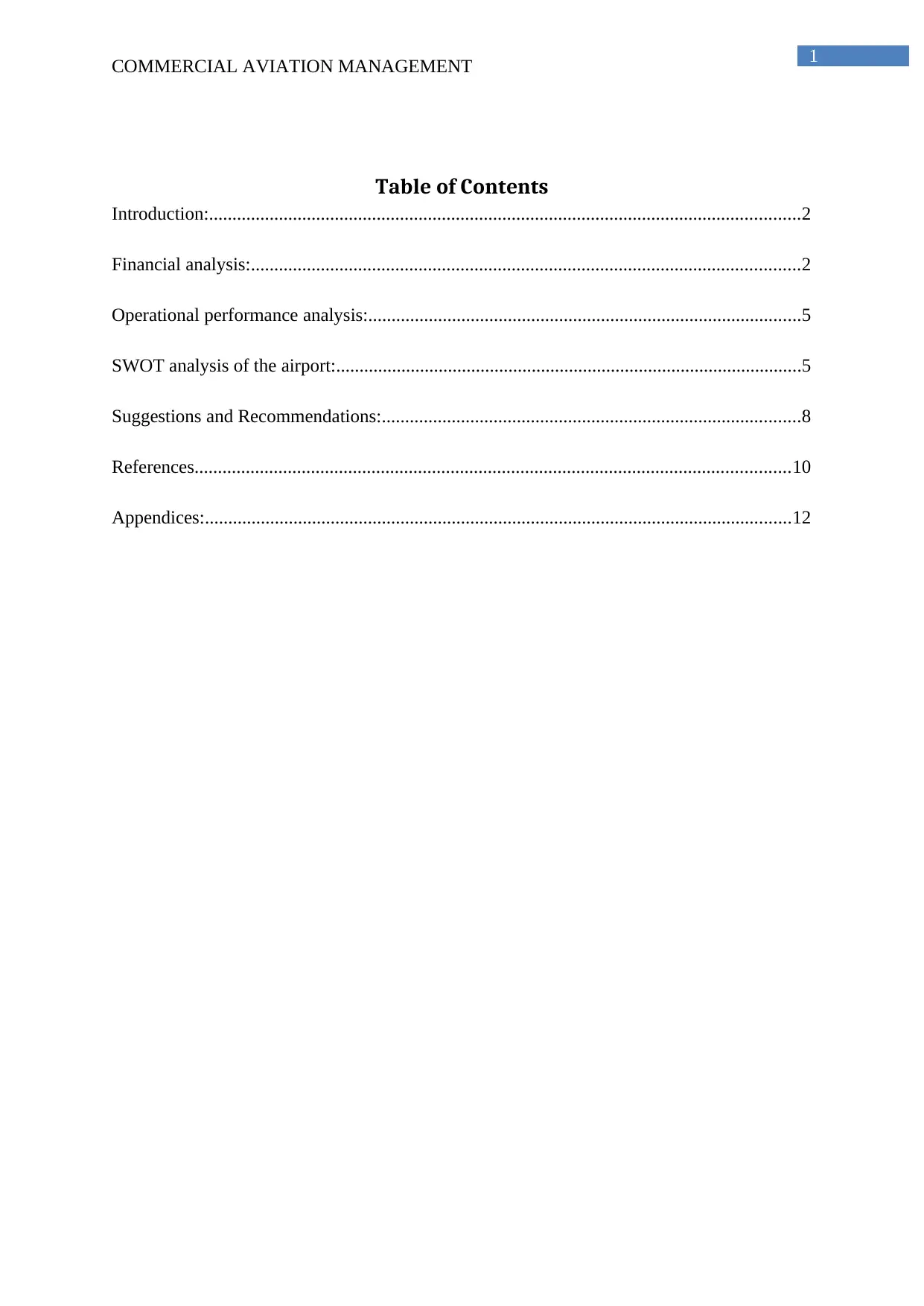
Table of Contents
Introduction:...............................................................................................................................2
Financial analysis:......................................................................................................................2
Operational performance analysis:.............................................................................................5
SWOT analysis of the airport:....................................................................................................5
Suggestions and Recommendations:..........................................................................................8
References................................................................................................................................10
Appendices:..............................................................................................................................12
COMMERCIAL AVIATION MANAGEMENT
Table of Contents
Introduction:...............................................................................................................................2
Financial analysis:......................................................................................................................2
Operational performance analysis:.............................................................................................5
SWOT analysis of the airport:....................................................................................................5
Suggestions and Recommendations:..........................................................................................8
References................................................................................................................................10
Appendices:..............................................................................................................................12
2
COMMERCIAL AVIATION MANAGEMENT
Introduction:
In this report, an effort has been made to conduct a financial and operational analysis
of the airport and determine the state of operations and financial health of the company. The
analysis will be done with the help of various financial ratios of the airport and detailed
analysis of the key performance indicators of the airport. The conclusion drawn from the
results of the analysis of the financial and operational indicators will enable suggestions and
recommendations to the company.
Heathrow airport is one of the major airports in all of United Kingdom. It is in fact the
world’s second busiest airport. In addition to this it is the busiest airport in all of Europe.
Financial analysis:
The financial analysis will comprise of study of various type of ratios the results of which
will have a direct implication with respect to the financial and non-financial performance of
the airport (Wensveen, 2018). For being able to lead within any industry an entity is supposed
to have a very strong financial performance base.
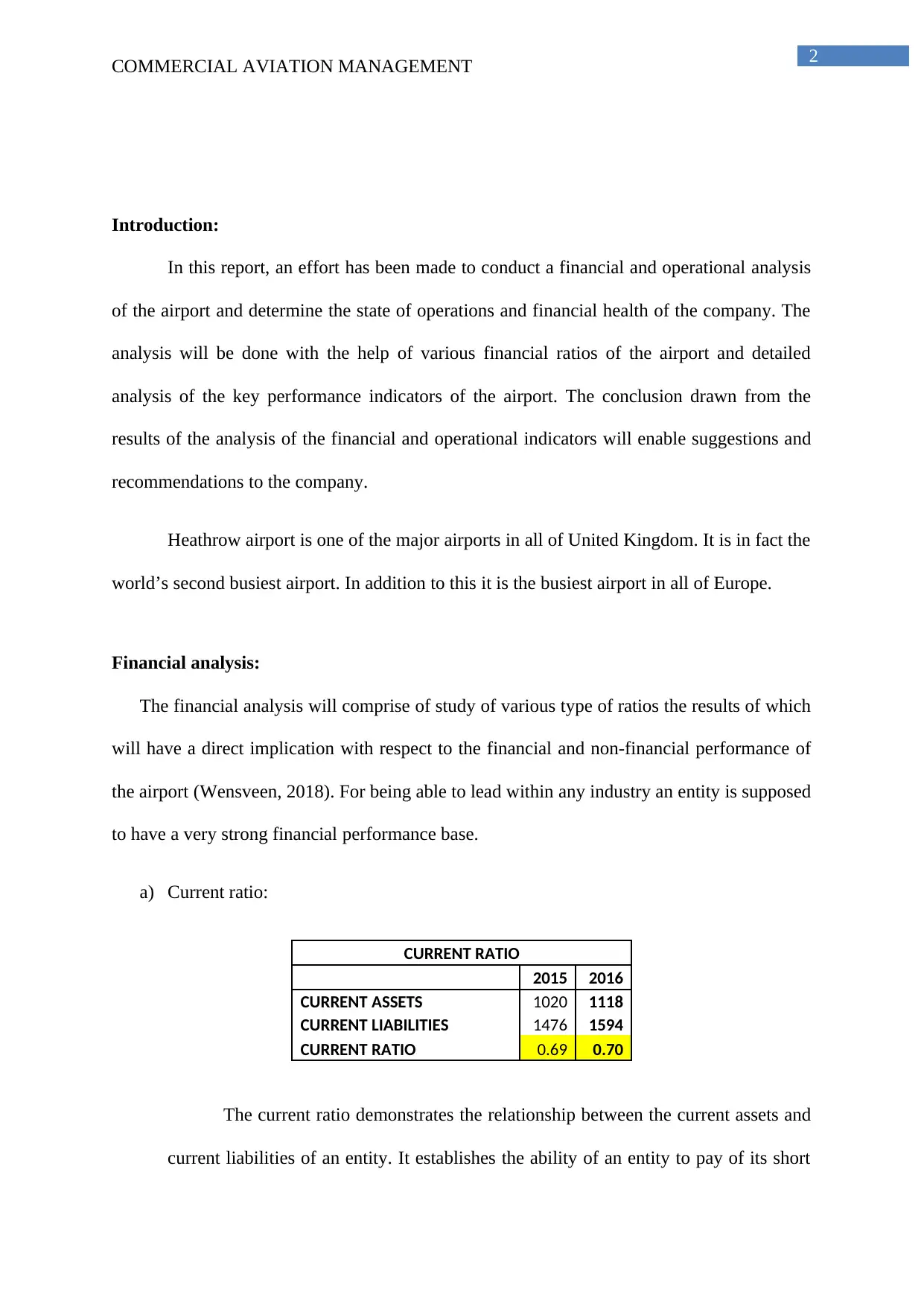
a) Current ratio:
CURRENT RATIO
2015 2016
CURRENT ASSETS 1020 1118
CURRENT LIABILITIES 1476 1594
CURRENT RATIO 0.69 0.70
The current ratio demonstrates the relationship between the current assets and
current liabilities of an entity. It establishes the ability of an entity to pay of its short
COMMERCIAL AVIATION MANAGEMENT
Introduction:
In this report, an effort has been made to conduct a financial and operational analysis
of the airport and determine the state of operations and financial health of the company. The
analysis will be done with the help of various financial ratios of the airport and detailed
analysis of the key performance indicators of the airport. The conclusion drawn from the
results of the analysis of the financial and operational indicators will enable suggestions and
recommendations to the company.
Heathrow airport is one of the major airports in all of United Kingdom. It is in fact the
world’s second busiest airport. In addition to this it is the busiest airport in all of Europe.
Financial analysis:
The financial analysis will comprise of study of various type of ratios the results of which
will have a direct implication with respect to the financial and non-financial performance of
the airport (Wensveen, 2018). For being able to lead within any industry an entity is supposed
to have a very strong financial performance base.
a) Current ratio:
CURRENT RATIO
2015 2016
CURRENT ASSETS 1020 1118
CURRENT LIABILITIES 1476 1594
CURRENT RATIO 0.69 0.70
The current ratio demonstrates the relationship between the current assets and
current liabilities of an entity. It establishes the ability of an entity to pay of its short
⊘ This is a preview!⊘
Do you want full access?
Subscribe today to unlock all pages.

Trusted by 1+ million students worldwide
3
COMMERCIAL AVIATION MANAGEMENT
term liabilities with the help of its current assets like cash and cash equivalents. It can
be easily deciphered that the current ratio of the company is very low. It is not a good
performance indicator as it implies that the entity might become incapable to pay its
short term debt in the near future due to non-availability of current or liquid assets
(Madavan caes et al., 2016).
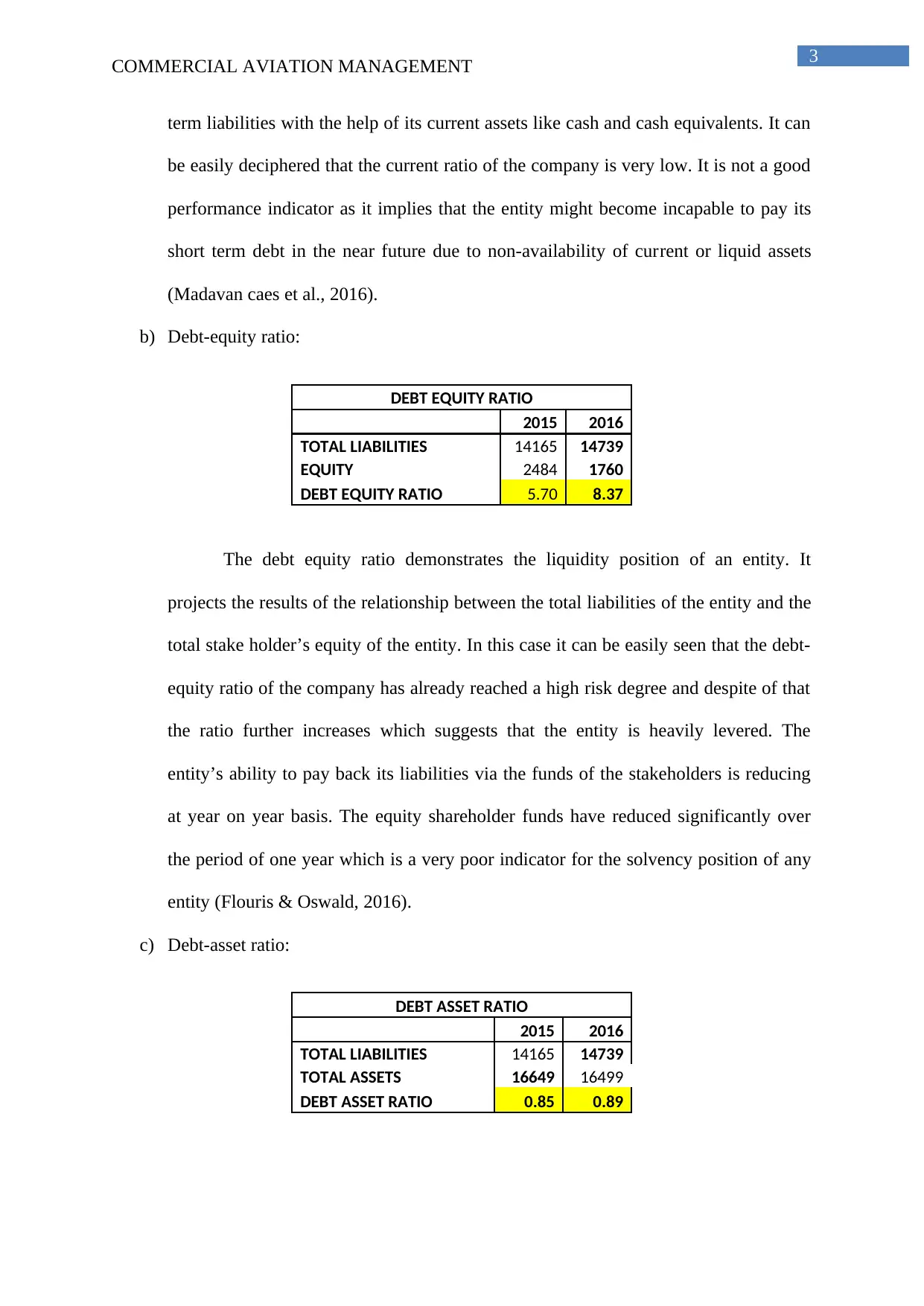
b) Debt-equity ratio:
DEBT EQUITY RATIO
2015 2016
TOTAL LIABILITIES 14165 14739
EQUITY 2484 1760
DEBT EQUITY RATIO 5.70 8.37
The debt equity ratio demonstrates the liquidity position of an entity. It
projects the results of the relationship between the total liabilities of the entity and the
total stake holder’s equity of the entity. In this case it can be easily seen that the debt-
equity ratio of the company has already reached a high risk degree and despite of that
the ratio further increases which suggests that the entity is heavily levered. The
entity’s ability to pay back its liabilities via the funds of the stakeholders is reducing
at year on year basis. The equity shareholder funds have reduced significantly over
the period of one year which is a very poor indicator for the solvency position of any
entity (Flouris & Oswald, 2016).
c) Debt-asset ratio:
DEBT ASSET RATIO
2015 2016
TOTAL LIABILITIES 14165 14739
TOTAL ASSETS 16649 16499
DEBT ASSET RATIO 0.85 0.89
COMMERCIAL AVIATION MANAGEMENT
term liabilities with the help of its current assets like cash and cash equivalents. It can
be easily deciphered that the current ratio of the company is very low. It is not a good
performance indicator as it implies that the entity might become incapable to pay its
short term debt in the near future due to non-availability of current or liquid assets
(Madavan caes et al., 2016).
b) Debt-equity ratio:
DEBT EQUITY RATIO
2015 2016
TOTAL LIABILITIES 14165 14739
EQUITY 2484 1760
DEBT EQUITY RATIO 5.70 8.37
The debt equity ratio demonstrates the liquidity position of an entity. It
projects the results of the relationship between the total liabilities of the entity and the
total stake holder’s equity of the entity. In this case it can be easily seen that the debt-
equity ratio of the company has already reached a high risk degree and despite of that
the ratio further increases which suggests that the entity is heavily levered. The
entity’s ability to pay back its liabilities via the funds of the stakeholders is reducing
at year on year basis. The equity shareholder funds have reduced significantly over
the period of one year which is a very poor indicator for the solvency position of any
entity (Flouris & Oswald, 2016).
c) Debt-asset ratio:
DEBT ASSET RATIO
2015 2016
TOTAL LIABILITIES 14165 14739
TOTAL ASSETS 16649 16499
DEBT ASSET RATIO 0.85 0.89
Paraphrase This Document
Need a fresh take? Get an instant paraphrase of this document with our AI Paraphraser
4
COMMERCIAL AVIATION MANAGEMENT
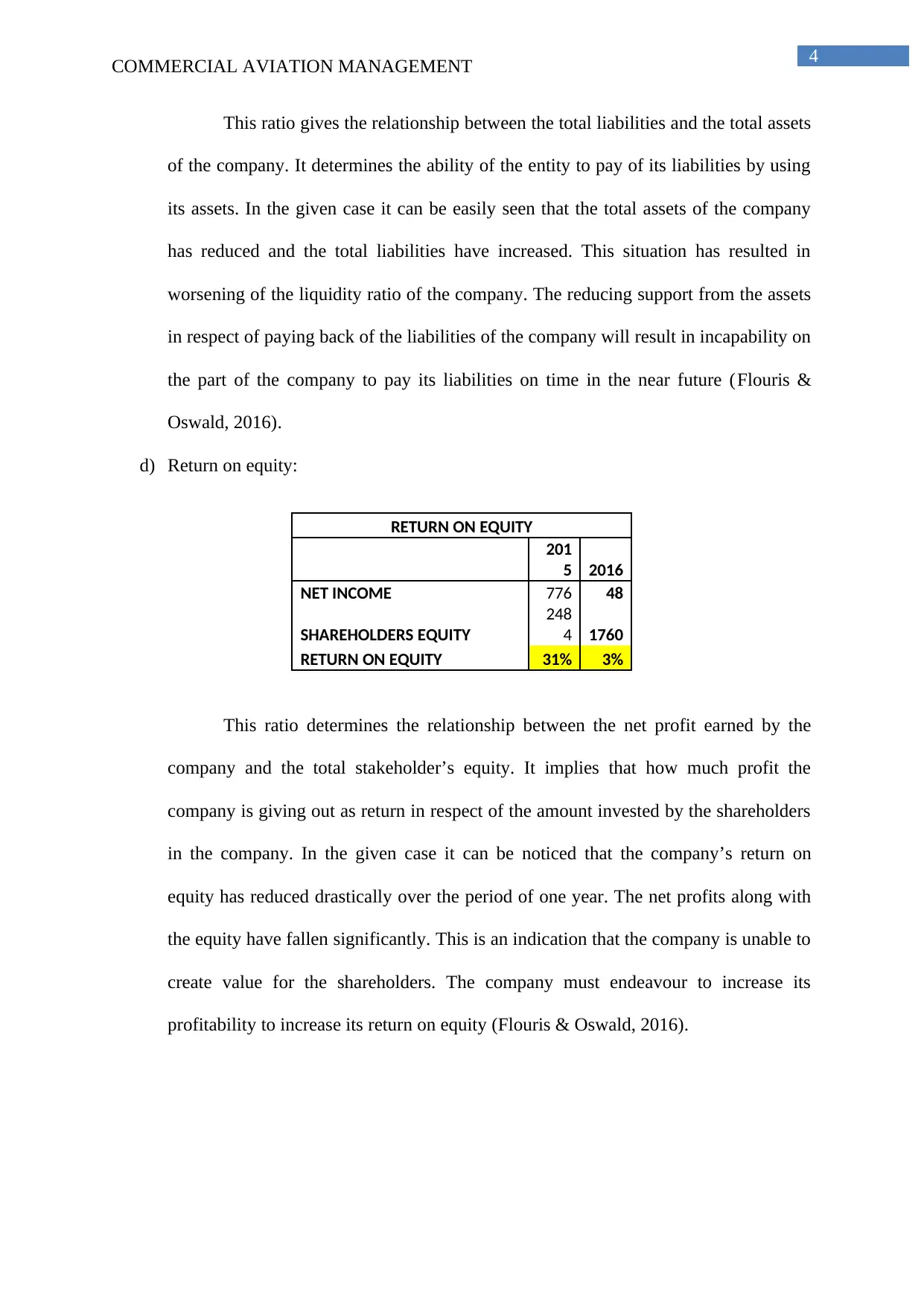
This ratio gives the relationship between the total liabilities and the total assets
of the company. It determines the ability of the entity to pay of its liabilities by using
its assets. In the given case it can be easily seen that the total assets of the company
has reduced and the total liabilities have increased. This situation has resulted in
worsening of the liquidity ratio of the company. The reducing support from the assets
in respect of paying back of the liabilities of the company will result in incapability on
the part of the company to pay its liabilities on time in the near future (Flouris &
Oswald, 2016).
d) Return on equity:
RETURN ON EQUITY
201
5 2016
NET INCOME 776 48
SHAREHOLDERS EQUITY
248
4 1760
RETURN ON EQUITY 31% 3%
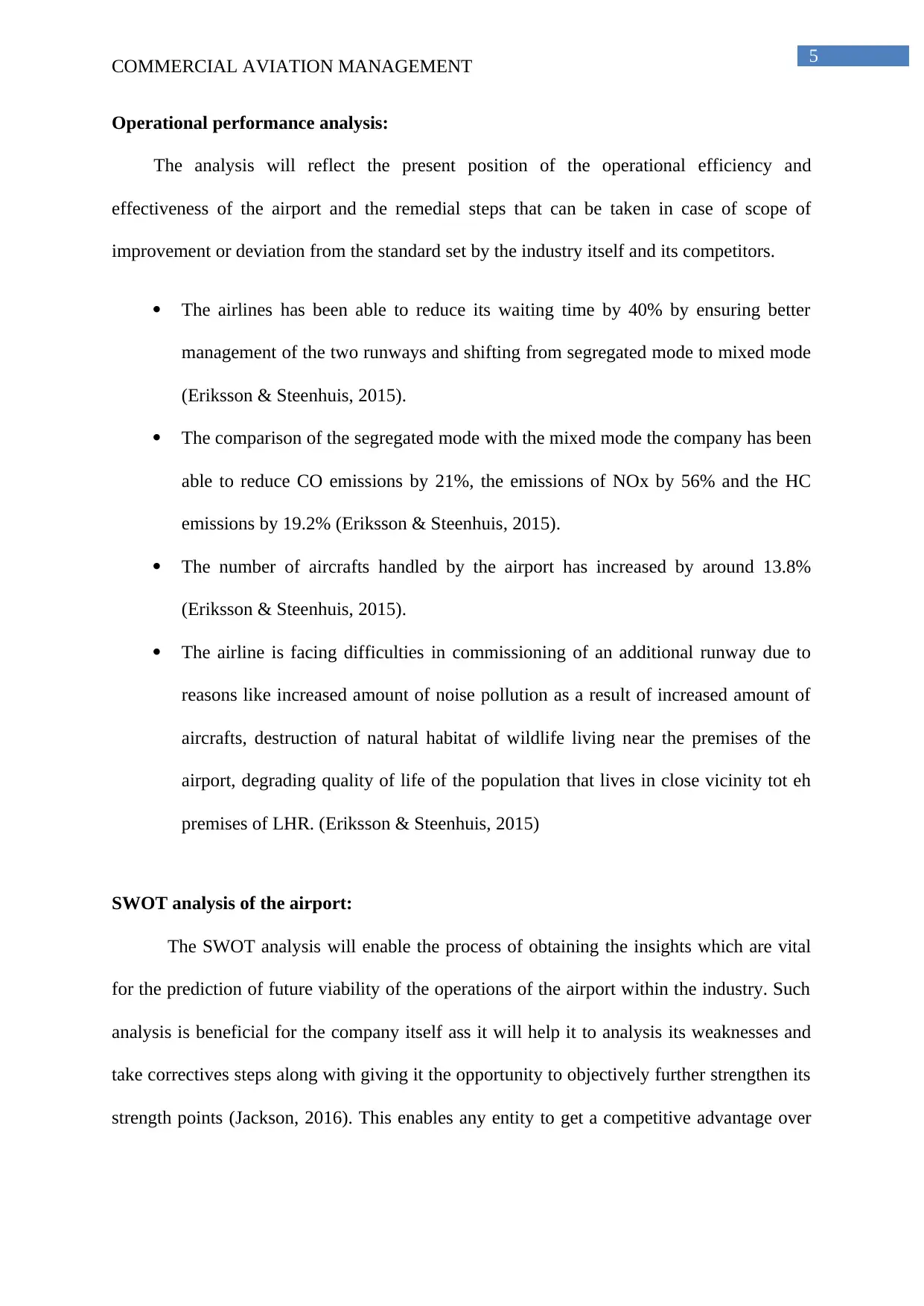
This ratio determines the relationship between the net profit earned by the
company and the total stakeholder’s equity. It implies that how much profit the
company is giving out as return in respect of the amount invested by the shareholders
in the company. In the given case it can be noticed that the company’s return on
equity has reduced drastically over the period of one year. The net profits along with
the equity have fallen significantly. This is an indication that the company is unable to
create value for the shareholders. The company must endeavour to increase its
profitability to increase its return on equity (Flouris & Oswald, 2016).
COMMERCIAL AVIATION MANAGEMENT
This ratio gives the relationship between the total liabilities and the total assets
of the company. It determines the ability of the entity to pay of its liabilities by using
its assets. In the given case it can be easily seen that the total assets of the company
has reduced and the total liabilities have increased. This situation has resulted in
worsening of the liquidity ratio of the company. The reducing support from the assets
in respect of paying back of the liabilities of the company will result in incapability on
the part of the company to pay its liabilities on time in the near future (Flouris &
Oswald, 2016).
d) Return on equity:
RETURN ON EQUITY
201
5 2016
NET INCOME 776 48
SHAREHOLDERS EQUITY
248
4 1760
RETURN ON EQUITY 31% 3%
This ratio determines the relationship between the net profit earned by the
company and the total stakeholder’s equity. It implies that how much profit the
company is giving out as return in respect of the amount invested by the shareholders
in the company. In the given case it can be noticed that the company’s return on
equity has reduced drastically over the period of one year. The net profits along with
the equity have fallen significantly. This is an indication that the company is unable to
create value for the shareholders. The company must endeavour to increase its
profitability to increase its return on equity (Flouris & Oswald, 2016).
5
COMMERCIAL AVIATION MANAGEMENT
Operational performance analysis:
The analysis will reflect the present position of the operational efficiency and
effectiveness of the airport and the remedial steps that can be taken in case of scope of
improvement or deviation from the standard set by the industry itself and its competitors.
The airlines has been able to reduce its waiting time by 40% by ensuring better
management of the two runways and shifting from segregated mode to mixed mode
(Eriksson & Steenhuis, 2015).
The comparison of the segregated mode with the mixed mode the company has been
able to reduce CO emissions by 21%, the emissions of NOx by 56% and the HC
emissions by 19.2% (Eriksson & Steenhuis, 2015).
The number of aircrafts handled by the airport has increased by around 13.8%
(Eriksson & Steenhuis, 2015).
The airline is facing difficulties in commissioning of an additional runway due to
reasons like increased amount of noise pollution as a result of increased amount of
aircrafts, destruction of natural habitat of wildlife living near the premises of the
airport, degrading quality of life of the population that lives in close vicinity tot eh
premises of LHR. (Eriksson & Steenhuis, 2015)
SWOT analysis of the airport:
The SWOT analysis will enable the process of obtaining the insights which are vital
for the prediction of future viability of the operations of the airport within the industry. Such
analysis is beneficial for the company itself ass it will help it to analysis its weaknesses and
take correctives steps along with giving it the opportunity to objectively further strengthen its
strength points (Jackson, 2016). This enables any entity to get a competitive advantage over
COMMERCIAL AVIATION MANAGEMENT
Operational performance analysis:
The analysis will reflect the present position of the operational efficiency and
effectiveness of the airport and the remedial steps that can be taken in case of scope of
improvement or deviation from the standard set by the industry itself and its competitors.
The airlines has been able to reduce its waiting time by 40% by ensuring better
management of the two runways and shifting from segregated mode to mixed mode
(Eriksson & Steenhuis, 2015).
The comparison of the segregated mode with the mixed mode the company has been
able to reduce CO emissions by 21%, the emissions of NOx by 56% and the HC
emissions by 19.2% (Eriksson & Steenhuis, 2015).
The number of aircrafts handled by the airport has increased by around 13.8%
(Eriksson & Steenhuis, 2015).
The airline is facing difficulties in commissioning of an additional runway due to
reasons like increased amount of noise pollution as a result of increased amount of
aircrafts, destruction of natural habitat of wildlife living near the premises of the
airport, degrading quality of life of the population that lives in close vicinity tot eh
premises of LHR. (Eriksson & Steenhuis, 2015)
SWOT analysis of the airport:
The SWOT analysis will enable the process of obtaining the insights which are vital
for the prediction of future viability of the operations of the airport within the industry. Such
analysis is beneficial for the company itself ass it will help it to analysis its weaknesses and
take correctives steps along with giving it the opportunity to objectively further strengthen its
strength points (Jackson, 2016). This enables any entity to get a competitive advantage over
⊘ This is a preview!⊘
Do you want full access?
Subscribe today to unlock all pages.
Trusted by 1+ million students worldwide
6
COMMERCIAL AVIATION MANAGEMENT
its competitors in the industry and also to perform better in order to increase the value
creation for its stakeholders (Turney, 2017).
STRENGTHS:
The airport has taken initiative to become the airport of choice in all of Europe. In
pursuance of this huge amount of capital expenditure has been incurred by the
company in order to modernise its facilities to comprehensively improve their
functionality
The customer base of network carriers enjoyed by Heathrow is brilliant. It gives it an
added advantage due to the fact that all the three top global alliances in the airlines
industry have significant operations at Heathrow. It has become the centre of
operations for many of the major alliances over the years.
The most important and significant advantage of Heathrow is its location. It caters to
the customers coming belong to America, Europe, Asia and Africa. The prime
location facilitates connectivity for local demand as well as to the international
demand of large international markets and economic centres of the world. It is
currently providing leading connectivity to 70 long haul destinations that are
unattainable from other UK airports.
WEAKNESSES:
The UK government decided against the opening of new runways in the south east. In
the near foreseeable future Heathrow airport is going to have make do with two
runways only. The fact that the airport is presently operating near to the limit of its
operational capability it will be unable to launch new flights.
At present Heathrow airport has only 4 operational terminals. Hence, due to the
constraints the connectivity between the customers and their baggage’s between some
COMMERCIAL AVIATION MANAGEMENT
its competitors in the industry and also to perform better in order to increase the value
creation for its stakeholders (Turney, 2017).
STRENGTHS:
The airport has taken initiative to become the airport of choice in all of Europe. In
pursuance of this huge amount of capital expenditure has been incurred by the
company in order to modernise its facilities to comprehensively improve their
functionality
The customer base of network carriers enjoyed by Heathrow is brilliant. It gives it an
added advantage due to the fact that all the three top global alliances in the airlines
industry have significant operations at Heathrow. It has become the centre of
operations for many of the major alliances over the years.
The most important and significant advantage of Heathrow is its location. It caters to
the customers coming belong to America, Europe, Asia and Africa. The prime
location facilitates connectivity for local demand as well as to the international
demand of large international markets and economic centres of the world. It is
currently providing leading connectivity to 70 long haul destinations that are
unattainable from other UK airports.
WEAKNESSES:
The UK government decided against the opening of new runways in the south east. In
the near foreseeable future Heathrow airport is going to have make do with two
runways only. The fact that the airport is presently operating near to the limit of its
operational capability it will be unable to launch new flights.
At present Heathrow airport has only 4 operational terminals. Hence, due to the
constraints the connectivity between the customers and their baggage’s between some
Paraphrase This Document
Need a fresh take? Get an instant paraphrase of this document with our AI Paraphraser
7
COMMERCIAL AVIATION MANAGEMENT
terminals is not smooth. In fact they are much weaker than most of the other leading
European hubs. Therefore the minimum connectivity time is not as low as compared
to its competitor hubs.
Heathrow doesn’t have the required amount of airport runway capacity to facilitate
the arrivals and departures of flights all day long and hence is unable to offer enough
operational resilience. Heathrow also possess only a half of the footprint enjoyed by
other European hubs like the Frankfurt. It often results in higher construction costs.
OPPORTUNITIES’:
Heathrow has an immense opportunity of developing its two runway masterplan. This
will enhance the connectivity across the campus and improve the experience of the
customers in respect of minimum connectivity time. The customers will also benefit
from leading edge hub facilities.
As a near future opportunity the company is fostering over the plans of operational
freedoms and airline consolidation. Operational freedoms refer to the package of
measures developed by the airline to meet the objectives of the South East Airports
task force that are designed for the more resilient use of runways of the airport and the
air space capacity. Airline consolidation refers to the recent acquisition of the BMI by
IAG which present the opportunity of exploiting more efficient use of the scarce slot
resources at Heathrow.
The airport in parallel to increasing the capacity of its operations is focussing on
improving the customer experience of using Heathrow as their preferred air travel
means.
THREATS:
COMMERCIAL AVIATION MANAGEMENT
terminals is not smooth. In fact they are much weaker than most of the other leading
European hubs. Therefore the minimum connectivity time is not as low as compared
to its competitor hubs.
Heathrow doesn’t have the required amount of airport runway capacity to facilitate
the arrivals and departures of flights all day long and hence is unable to offer enough
operational resilience. Heathrow also possess only a half of the footprint enjoyed by
other European hubs like the Frankfurt. It often results in higher construction costs.
OPPORTUNITIES’:
Heathrow has an immense opportunity of developing its two runway masterplan. This
will enhance the connectivity across the campus and improve the experience of the
customers in respect of minimum connectivity time. The customers will also benefit
from leading edge hub facilities.
As a near future opportunity the company is fostering over the plans of operational
freedoms and airline consolidation. Operational freedoms refer to the package of
measures developed by the airline to meet the objectives of the South East Airports
task force that are designed for the more resilient use of runways of the airport and the
air space capacity. Airline consolidation refers to the recent acquisition of the BMI by
IAG which present the opportunity of exploiting more efficient use of the scarce slot
resources at Heathrow.
The airport in parallel to increasing the capacity of its operations is focussing on
improving the customer experience of using Heathrow as their preferred air travel
means.
THREATS:
8
COMMERCIAL AVIATION MANAGEMENT
The competing hubs in Europe with more runway capacity are continuously adding
new destinations to their portfolio of destinations. They are way ahead in offering
flights to fast emerging markets like the Africa, Middle East and Asia. Its competitors
like Paris and Frankfurt are already offering 1000 more flights than it to three largest
cities in China.
The European hubs are continuously leveraging their less constrained capacity in
offering more comprehensive network of European short haul feeder routes. Many of
the regional hubs of UK outside of south east are served by major European hubs
other than Heathrow.
The hubs of Middle East have already invested heavily on infrastructure. The hubs are
fighting or European regional routes along with routes that fly over Europe like those
linking the USA with India. The loss of such critical connections will be very
detrimental to the interests of Heathrow.
Suggestions and Recommendations:
After conducting a detailed analysis of the financial, operational and SWOT analysis
with respect to the Heathrow airport and studying the implications of the results obtained
some suggestions and recommendations are made in respect of its operations.
1) The company should immediately change or modify its capital structure. In doing so it
should focus on reducing the amount of debt and increasing the amount of
stakeholder’s funds. This is because of the fact that the company is already having a
degraded state of solvency and the ratio is degrading year on year basis.
2) The company with immediate effect try to increase its capacity. Otherwise not only
will it be overtaken by its competitors within Europe the Middle Eastern airlines will
COMMERCIAL AVIATION MANAGEMENT
The competing hubs in Europe with more runway capacity are continuously adding
new destinations to their portfolio of destinations. They are way ahead in offering
flights to fast emerging markets like the Africa, Middle East and Asia. Its competitors
like Paris and Frankfurt are already offering 1000 more flights than it to three largest
cities in China.
The European hubs are continuously leveraging their less constrained capacity in
offering more comprehensive network of European short haul feeder routes. Many of
the regional hubs of UK outside of south east are served by major European hubs
other than Heathrow.
The hubs of Middle East have already invested heavily on infrastructure. The hubs are
fighting or European regional routes along with routes that fly over Europe like those
linking the USA with India. The loss of such critical connections will be very
detrimental to the interests of Heathrow.
Suggestions and Recommendations:
After conducting a detailed analysis of the financial, operational and SWOT analysis
with respect to the Heathrow airport and studying the implications of the results obtained
some suggestions and recommendations are made in respect of its operations.
1) The company should immediately change or modify its capital structure. In doing so it
should focus on reducing the amount of debt and increasing the amount of
stakeholder’s funds. This is because of the fact that the company is already having a
degraded state of solvency and the ratio is degrading year on year basis.
2) The company with immediate effect try to increase its capacity. Otherwise not only
will it be overtaken by its competitors within Europe the Middle Eastern airlines will
⊘ This is a preview!⊘
Do you want full access?
Subscribe today to unlock all pages.
Trusted by 1+ million students worldwide
9
COMMERCIAL AVIATION MANAGEMENT
take up the important and rather critical routes from it. That will result in the airport
losing its footprint to a disastrous extent.
3) In addition to increasing its operational capacity the airport must foster in the spirit of
optimisation of the current facilities within the entity like improving the connectivity
between the terminals which has become an eyesore for the company due to the
presence of only four functional terminals.
COMMERCIAL AVIATION MANAGEMENT
take up the important and rather critical routes from it. That will result in the airport
losing its footprint to a disastrous extent.
3) In addition to increasing its operational capacity the airport must foster in the spirit of
optimisation of the current facilities within the entity like improving the connectivity
between the terminals which has become an eyesore for the company due to the
presence of only four functional terminals.
Paraphrase This Document
Need a fresh take? Get an instant paraphrase of this document with our AI Paraphraser
10
COMMERCIAL AVIATION MANAGEMENT
References
Albers, S., Baum, H., Auerbach, S., & Delfmann, W. (2017). Strategic Management in the
Aviation Industry. Routledge.
Davis, T., & Davis, L. (2017). Commercial Aviation Cyber Security: Current State and
Essential Reading. SAE International.
Eriksson, S., & Steenhuis, H. J. (Eds.). (2015). The global commercial aviation industry.
Routledge.
Flouris, T. G., & Oswald, S. L. (2016). Designing and executing strategy in aviation
management. Routledge.
Jackson, S. (2016). Systems engineering for commercial aircraft. Routledge.
Liao, M. Y. (2015). Safety Culture in commercial aviation: Differences in perspective
between Chinese and Western pilots. Safety science, 79, 193-205.
Madavan, N., Heidmann, J., Bowman, C., Kascak, P., Jankovsky, A., & Jansen, R. (2016,
April). A nasa perspective on electric propulsion technologies for commercial
aviation. In Workshop on Technology Roadmap for Large Electric Machines (pp. 5-
6).
Patankar, M. S., & Taylor, J. C. (2017). Risk management and error reduction in aviation
maintenance. Routledge.
Skeete, A., Mobin, M., & Salmon, C. (2015, January). Aviation technical publication content
management system selection using integrated fuzzy-grey MCDM method. In IIE
Annual Conference. Proceedings (p. 86). Institute of Industrial and Systems
Engineers (IISE).
COMMERCIAL AVIATION MANAGEMENT
References
Albers, S., Baum, H., Auerbach, S., & Delfmann, W. (2017). Strategic Management in the
Aviation Industry. Routledge.
Davis, T., & Davis, L. (2017). Commercial Aviation Cyber Security: Current State and
Essential Reading. SAE International.
Eriksson, S., & Steenhuis, H. J. (Eds.). (2015). The global commercial aviation industry.
Routledge.
Flouris, T. G., & Oswald, S. L. (2016). Designing and executing strategy in aviation
management. Routledge.
Jackson, S. (2016). Systems engineering for commercial aircraft. Routledge.
Liao, M. Y. (2015). Safety Culture in commercial aviation: Differences in perspective
between Chinese and Western pilots. Safety science, 79, 193-205.
Madavan, N., Heidmann, J., Bowman, C., Kascak, P., Jankovsky, A., & Jansen, R. (2016,
April). A nasa perspective on electric propulsion technologies for commercial
aviation. In Workshop on Technology Roadmap for Large Electric Machines (pp. 5-
6).
Patankar, M. S., & Taylor, J. C. (2017). Risk management and error reduction in aviation
maintenance. Routledge.
Skeete, A., Mobin, M., & Salmon, C. (2015, January). Aviation technical publication content
management system selection using integrated fuzzy-grey MCDM method. In IIE
Annual Conference. Proceedings (p. 86). Institute of Industrial and Systems
Engineers (IISE).

11
COMMERCIAL AVIATION MANAGEMENT
Stolzer, A. J. (2017). Safety management systems in aviation. Routledge.
Turney, M. A. (2017). Tapping diverse talent in aviation: Culture, gender, and diversity.
Routledge.
Wensveen, J. (2018). Air transportation: A management perspective. Routledge.
COMMERCIAL AVIATION MANAGEMENT
Stolzer, A. J. (2017). Safety management systems in aviation. Routledge.
Turney, M. A. (2017). Tapping diverse talent in aviation: Culture, gender, and diversity.
Routledge.
Wensveen, J. (2018). Air transportation: A management perspective. Routledge.
⊘ This is a preview!⊘
Do you want full access?
Subscribe today to unlock all pages.
Trusted by 1+ million students worldwide

1 out of 14


Related Documents


Your All-in-One AI-Powered Toolkit for Academic Success.
+13062052269
info@desklib.com
Available 24*7 on WhatsApp / Email
![[object Object]](/_next/static/media/star-bottom.7253800d.svg)
Unlock your academic potential
Copyright © 2020–2026 A2Z Services. All Rights Reserved. Developed and managed by ZUCOL.