Aviation Passenger Operations: Ground Handling, Regulations Report
VerifiedAdded on 2023/01/12
|9
|2613
|1
Report
AI Summary
This report provides a comprehensive overview of aviation passenger operations, focusing on ground handling facilities and their role in meeting the needs of different airlines, including low-cost, full-service, and charter carriers. It examines the operations at Amsterdam Airport Schiphol, detailing various ground handling services like immigration, baggage handling, check-in, and fuelling. The report further explores the legal and regulatory processes for arriving, departing, and transferring passengers, as well as the distinctions between airline staff and passengers. It highlights the differences between airline services and the roles of landside and airside areas within an airport, while also referencing the Civil Aviation Authority (CAA) and its regulatory functions. The report concludes by summarizing the key aspects of passenger airline operations, emphasizing the diversity of airline types, passenger categories, and the importance of effective ground handling.
Aviation passenger
operations written
report
operations written
report

Paraphrase This Document
Need a fresh take? Get an instant paraphrase of this document with our AI Paraphraser
Table of Contents
INTRODUCTION...........................................................................................................................1
TASK 1............................................................................................................................................1
How various ground handling facilities meet the needs of different airlines, with evidence of
undertaking primary and secondary research..............................................................................1
TASK 2 ...........................................................................................................................................3
Legal and regulatory process for arriving, departing and transferring passengers and for the
airlines.........................................................................................................................................3
CONCLUSION................................................................................................................................5
REFERENCES................................................................................................................................7
INTRODUCTION...........................................................................................................................1
TASK 1............................................................................................................................................1
How various ground handling facilities meet the needs of different airlines, with evidence of
undertaking primary and secondary research..............................................................................1
TASK 2 ...........................................................................................................................................3
Legal and regulatory process for arriving, departing and transferring passengers and for the
airlines.........................................................................................................................................3
CONCLUSION................................................................................................................................5
REFERENCES................................................................................................................................7
.
TASK 1
How various ground handling facilities meet the needs of different airlines, with evidence of
undertaking primary and secondary research
Passenger airline is an airline which dedicated to transport of passengers (Wagner and
Walton, 2016). There are several type of passenger airlines such as mainline airlines, regional
airlines, low-cost carriers, business class airline, charter airlines, flag carriers, legacy carriers.
This report is based on Amsterdam Airport Schiphol which is informally known as Schiphol
Airport and it is main international airport of Netherlands. It was opened on 16th September 1916
as a military airbase. Respective report is divided within 2 part, in which first one analyse
various ground handling facilities for meeting needs of different airlines.
Type of airlines
Low cost airlines – It is an airline which operates in high emphasis on minimising
operating cost and without traditional services as well as amenities provided in the fare because
all these result in lower fares with less comforts (Henriksen and Ponte, 2018). To make up for
revenue lost within decreased ticket prices the airlines companies can charge extra fees like
carry on baggage. Moreover, there are several low cost airlines some of them are as follows :-
Ryanair – It is an Low cost or budget airline which was founded in 1984 as well as
headquartered at Dublin Airport, Ireland. Ryanair was largest European budget airline by
scheduled flown of passengers as well as they carry more passengers in comparison of
other airlines.
Scoot – It is an Singaporean low cost airline which was commenced on 2012. Scoot is
headquarter at 4 Airline Road Changi Airport, Singapore.
Full service companies – A full service airline companies provide several facilities to
passenger in flight such as entertainment, meals, beverages, checked baggage as well as comforts
like blankets and pillow within ticket price. Moreover, within full service airlines seats are more
recline in comparison of low cost carrier and also have more leg room. Along with this, it offer
choice of business class travel or economy as well as in some flight there is premium economy
and first class also (Zhou and et. al., 2016). There are several full service airlines companies
which are as follows :-
1
TASK 1
How various ground handling facilities meet the needs of different airlines, with evidence of
undertaking primary and secondary research
Passenger airline is an airline which dedicated to transport of passengers (Wagner and
Walton, 2016). There are several type of passenger airlines such as mainline airlines, regional
airlines, low-cost carriers, business class airline, charter airlines, flag carriers, legacy carriers.
This report is based on Amsterdam Airport Schiphol which is informally known as Schiphol
Airport and it is main international airport of Netherlands. It was opened on 16th September 1916
as a military airbase. Respective report is divided within 2 part, in which first one analyse
various ground handling facilities for meeting needs of different airlines.
Type of airlines
Low cost airlines – It is an airline which operates in high emphasis on minimising
operating cost and without traditional services as well as amenities provided in the fare because
all these result in lower fares with less comforts (Henriksen and Ponte, 2018). To make up for
revenue lost within decreased ticket prices the airlines companies can charge extra fees like
carry on baggage. Moreover, there are several low cost airlines some of them are as follows :-
Ryanair – It is an Low cost or budget airline which was founded in 1984 as well as
headquartered at Dublin Airport, Ireland. Ryanair was largest European budget airline by
scheduled flown of passengers as well as they carry more passengers in comparison of
other airlines.
Scoot – It is an Singaporean low cost airline which was commenced on 2012. Scoot is
headquarter at 4 Airline Road Changi Airport, Singapore.
Full service companies – A full service airline companies provide several facilities to
passenger in flight such as entertainment, meals, beverages, checked baggage as well as comforts
like blankets and pillow within ticket price. Moreover, within full service airlines seats are more
recline in comparison of low cost carrier and also have more leg room. Along with this, it offer
choice of business class travel or economy as well as in some flight there is premium economy
and first class also (Zhou and et. al., 2016). There are several full service airlines companies
which are as follows :-
1
⊘ This is a preview!⊘
Do you want full access?
Subscribe today to unlock all pages.

Trusted by 1+ million students worldwide
Turkish Airlines – It is national flag carrier airline of turkey as well as founded in 1933.
There are approx. 35,275 staff members in Turkish Airlines as well as airline's corporate
headquarters are at the Turkish Airlines General Management Building on the grounds of
Istanbul Atatürk Airport in Yeşilköy, Bakırköy, Istanbul.
Emirates – It is airlines organisation which is operating in approx. 150 cities in 80
countries across six continents. Emirates is fourth largest airlines of globe as well as
second largest in term of freight tonne Kilometers flow.
Charter – It is not an scheduled flight as well as charters are not part of regular airline
routing. With charter flight individual can rent entire aircraft and can fix its arrival location and
times according to them (Karaman, Kilic and Uyar, 2018). There are several type of charters
such as private charters, single entity, Affinity and public charter. Apart from this there are
numerous organisations which offering charter services such as Air charter Scotland, Blink, Flair
jet and so on.
Type of passengers
Departure passengers - Departure is the act of leaving somewhere and when it comes in
term of airport it have departure gates for passengers outgoing as well as an arrival area
for people flying in. Moreover, departure simply is act of leaving and in airport
terminology departure means outbound flights.
Arriving passengers - In airport terminology arrival means inbound flight which simply
means coming in the airport.
Ground Handling – It is the service of an aircraft when it is on ground as well as parked at
terminal gate of airport. Ground handling refers to range of services which provided to
passengers for facilitating aircraft flight preparation, repositioning as well as also conclusion of
flight which involve customer and ramp service both (Dougan, 2016). There are several ground
handling services explanation of these are as follows :-
Immigration – It is related to the people who are travelling from one nation to another.
Sometimes immigration is also named as passport control or border control which
depending on the airport. In most of the airport, immigration is compulsory procedure
which include talking with immigration officer who will stamps on passport. Passengers
will go through immigration process without luggage.
2
There are approx. 35,275 staff members in Turkish Airlines as well as airline's corporate
headquarters are at the Turkish Airlines General Management Building on the grounds of
Istanbul Atatürk Airport in Yeşilköy, Bakırköy, Istanbul.
Emirates – It is airlines organisation which is operating in approx. 150 cities in 80
countries across six continents. Emirates is fourth largest airlines of globe as well as
second largest in term of freight tonne Kilometers flow.
Charter – It is not an scheduled flight as well as charters are not part of regular airline
routing. With charter flight individual can rent entire aircraft and can fix its arrival location and
times according to them (Karaman, Kilic and Uyar, 2018). There are several type of charters
such as private charters, single entity, Affinity and public charter. Apart from this there are
numerous organisations which offering charter services such as Air charter Scotland, Blink, Flair
jet and so on.
Type of passengers
Departure passengers - Departure is the act of leaving somewhere and when it comes in
term of airport it have departure gates for passengers outgoing as well as an arrival area
for people flying in. Moreover, departure simply is act of leaving and in airport
terminology departure means outbound flights.
Arriving passengers - In airport terminology arrival means inbound flight which simply
means coming in the airport.
Ground Handling – It is the service of an aircraft when it is on ground as well as parked at
terminal gate of airport. Ground handling refers to range of services which provided to
passengers for facilitating aircraft flight preparation, repositioning as well as also conclusion of
flight which involve customer and ramp service both (Dougan, 2016). There are several ground
handling services explanation of these are as follows :-
Immigration – It is related to the people who are travelling from one nation to another.
Sometimes immigration is also named as passport control or border control which
depending on the airport. In most of the airport, immigration is compulsory procedure
which include talking with immigration officer who will stamps on passport. Passengers
will go through immigration process without luggage.
2
Paraphrase This Document
Need a fresh take? Get an instant paraphrase of this document with our AI Paraphraser
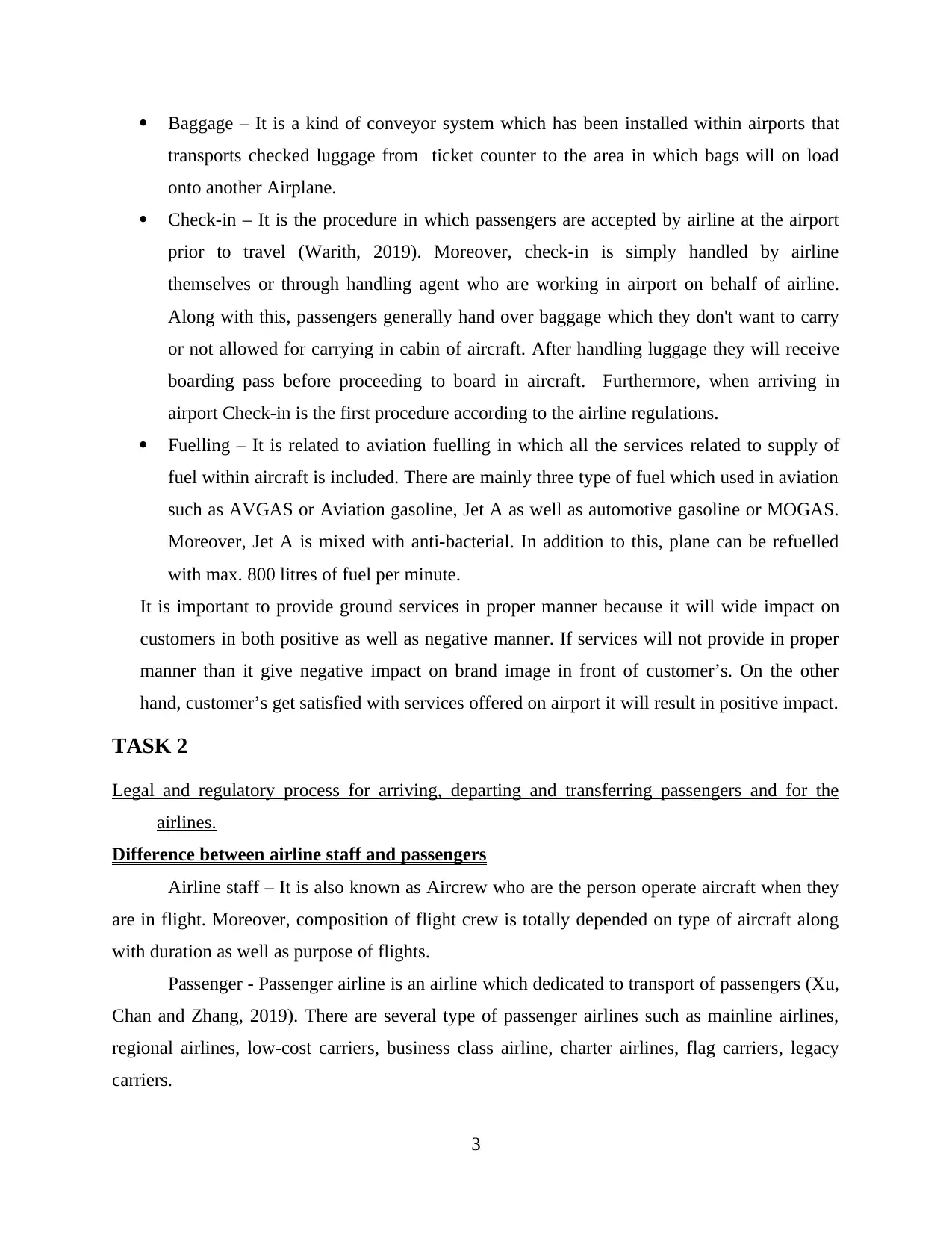
Baggage – It is a kind of conveyor system which has been installed within airports that
transports checked luggage from ticket counter to the area in which bags will on load
onto another Airplane.
Check-in – It is the procedure in which passengers are accepted by airline at the airport
prior to travel (Warith, 2019). Moreover, check-in is simply handled by airline
themselves or through handling agent who are working in airport on behalf of airline.
Along with this, passengers generally hand over baggage which they don't want to carry
or not allowed for carrying in cabin of aircraft. After handling luggage they will receive
boarding pass before proceeding to board in aircraft. Furthermore, when arriving in
airport Check-in is the first procedure according to the airline regulations.
Fuelling – It is related to aviation fuelling in which all the services related to supply of
fuel within aircraft is included. There are mainly three type of fuel which used in aviation
such as AVGAS or Aviation gasoline, Jet A as well as automotive gasoline or MOGAS.
Moreover, Jet A is mixed with anti-bacterial. In addition to this, plane can be refuelled
with max. 800 litres of fuel per minute.
It is important to provide ground services in proper manner because it will wide impact on
customers in both positive as well as negative manner. If services will not provide in proper
manner than it give negative impact on brand image in front of customer’s. On the other
hand, customer’s get satisfied with services offered on airport it will result in positive impact.
TASK 2
Legal and regulatory process for arriving, departing and transferring passengers and for the
airlines.
Difference between airline staff and passengers
Airline staff – It is also known as Aircrew who are the person operate aircraft when they
are in flight. Moreover, composition of flight crew is totally depended on type of aircraft along
with duration as well as purpose of flights.
Passenger - Passenger airline is an airline which dedicated to transport of passengers (Xu,
Chan and Zhang, 2019). There are several type of passenger airlines such as mainline airlines,
regional airlines, low-cost carriers, business class airline, charter airlines, flag carriers, legacy
carriers.
3
transports checked luggage from ticket counter to the area in which bags will on load
onto another Airplane.
Check-in – It is the procedure in which passengers are accepted by airline at the airport
prior to travel (Warith, 2019). Moreover, check-in is simply handled by airline
themselves or through handling agent who are working in airport on behalf of airline.
Along with this, passengers generally hand over baggage which they don't want to carry
or not allowed for carrying in cabin of aircraft. After handling luggage they will receive
boarding pass before proceeding to board in aircraft. Furthermore, when arriving in
airport Check-in is the first procedure according to the airline regulations.
Fuelling – It is related to aviation fuelling in which all the services related to supply of
fuel within aircraft is included. There are mainly three type of fuel which used in aviation
such as AVGAS or Aviation gasoline, Jet A as well as automotive gasoline or MOGAS.
Moreover, Jet A is mixed with anti-bacterial. In addition to this, plane can be refuelled
with max. 800 litres of fuel per minute.
It is important to provide ground services in proper manner because it will wide impact on
customers in both positive as well as negative manner. If services will not provide in proper
manner than it give negative impact on brand image in front of customer’s. On the other
hand, customer’s get satisfied with services offered on airport it will result in positive impact.
TASK 2
Legal and regulatory process for arriving, departing and transferring passengers and for the
airlines.
Difference between airline staff and passengers
Airline staff – It is also known as Aircrew who are the person operate aircraft when they
are in flight. Moreover, composition of flight crew is totally depended on type of aircraft along
with duration as well as purpose of flights.
Passenger - Passenger airline is an airline which dedicated to transport of passengers (Xu,
Chan and Zhang, 2019). There are several type of passenger airlines such as mainline airlines,
regional airlines, low-cost carriers, business class airline, charter airlines, flag carriers, legacy
carriers.
3
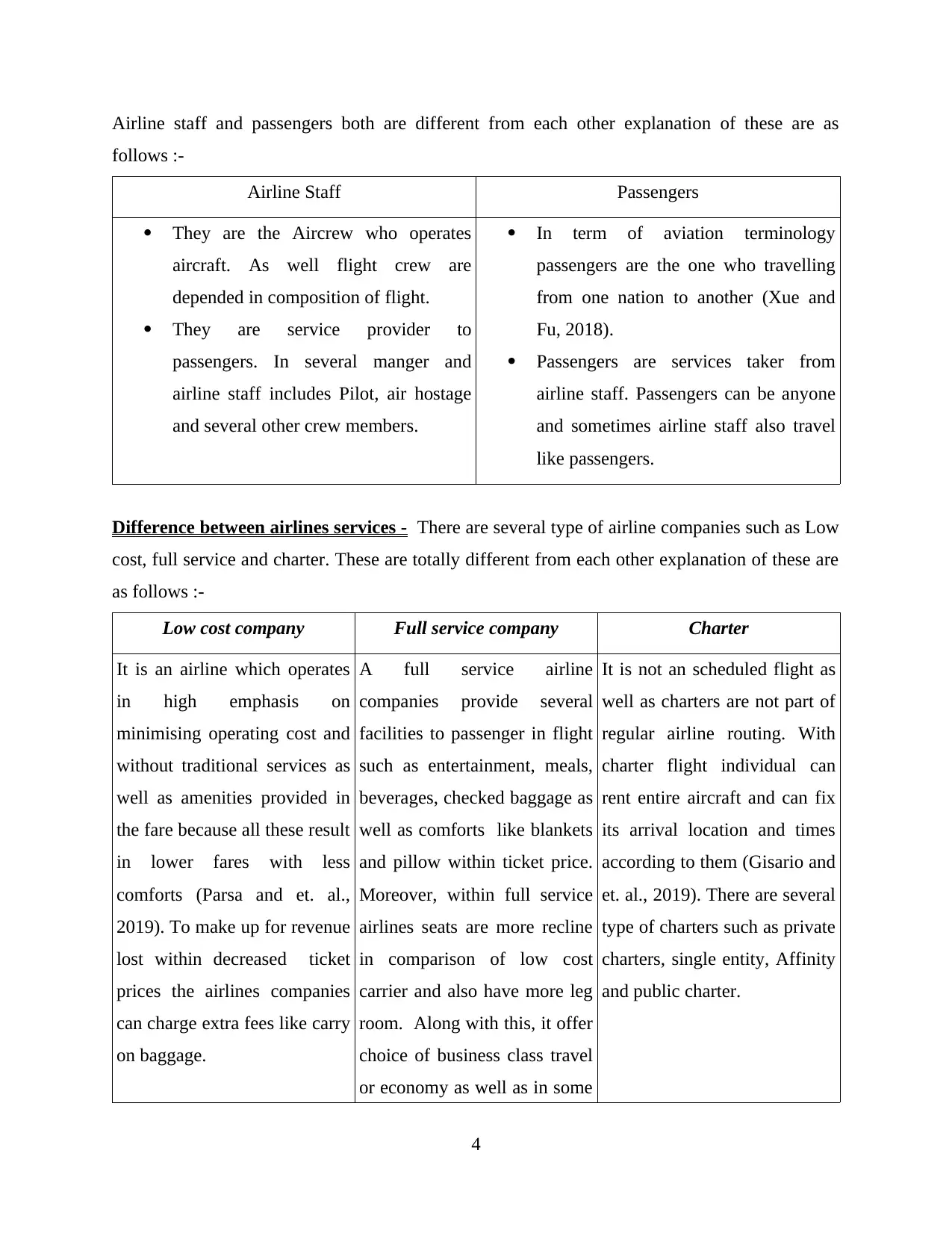
Airline staff and passengers both are different from each other explanation of these are as
follows :-
Airline Staff Passengers
They are the Aircrew who operates
aircraft. As well flight crew are
depended in composition of flight.
They are service provider to
passengers. In several manger and
airline staff includes Pilot, air hostage
and several other crew members.
In term of aviation terminology
passengers are the one who travelling
from one nation to another (Xue and
Fu, 2018).
Passengers are services taker from
airline staff. Passengers can be anyone
and sometimes airline staff also travel
like passengers.
Difference between airlines services - There are several type of airline companies such as Low
cost, full service and charter. These are totally different from each other explanation of these are
as follows :-
Low cost company Full service company Charter
It is an airline which operates
in high emphasis on
minimising operating cost and
without traditional services as
well as amenities provided in
the fare because all these result
in lower fares with less
comforts (Parsa and et. al.,
2019). To make up for revenue
lost within decreased ticket
prices the airlines companies
can charge extra fees like carry
on baggage.
A full service airline
companies provide several
facilities to passenger in flight
such as entertainment, meals,
beverages, checked baggage as
well as comforts like blankets
and pillow within ticket price.
Moreover, within full service
airlines seats are more recline
in comparison of low cost
carrier and also have more leg
room. Along with this, it offer
choice of business class travel
or economy as well as in some
It is not an scheduled flight as
well as charters are not part of
regular airline routing. With
charter flight individual can
rent entire aircraft and can fix
its arrival location and times
according to them (Gisario and
et. al., 2019). There are several
type of charters such as private
charters, single entity, Affinity
and public charter.
4
follows :-
Airline Staff Passengers
They are the Aircrew who operates
aircraft. As well flight crew are
depended in composition of flight.
They are service provider to
passengers. In several manger and
airline staff includes Pilot, air hostage
and several other crew members.
In term of aviation terminology
passengers are the one who travelling
from one nation to another (Xue and
Fu, 2018).
Passengers are services taker from
airline staff. Passengers can be anyone
and sometimes airline staff also travel
like passengers.
Difference between airlines services - There are several type of airline companies such as Low
cost, full service and charter. These are totally different from each other explanation of these are
as follows :-
Low cost company Full service company Charter
It is an airline which operates
in high emphasis on
minimising operating cost and
without traditional services as
well as amenities provided in
the fare because all these result
in lower fares with less
comforts (Parsa and et. al.,
2019). To make up for revenue
lost within decreased ticket
prices the airlines companies
can charge extra fees like carry
on baggage.
A full service airline
companies provide several
facilities to passenger in flight
such as entertainment, meals,
beverages, checked baggage as
well as comforts like blankets
and pillow within ticket price.
Moreover, within full service
airlines seats are more recline
in comparison of low cost
carrier and also have more leg
room. Along with this, it offer
choice of business class travel
or economy as well as in some
It is not an scheduled flight as
well as charters are not part of
regular airline routing. With
charter flight individual can
rent entire aircraft and can fix
its arrival location and times
according to them (Gisario and
et. al., 2019). There are several
type of charters such as private
charters, single entity, Affinity
and public charter.
4
⊘ This is a preview!⊘
Do you want full access?
Subscribe today to unlock all pages.
Trusted by 1+ million students worldwide
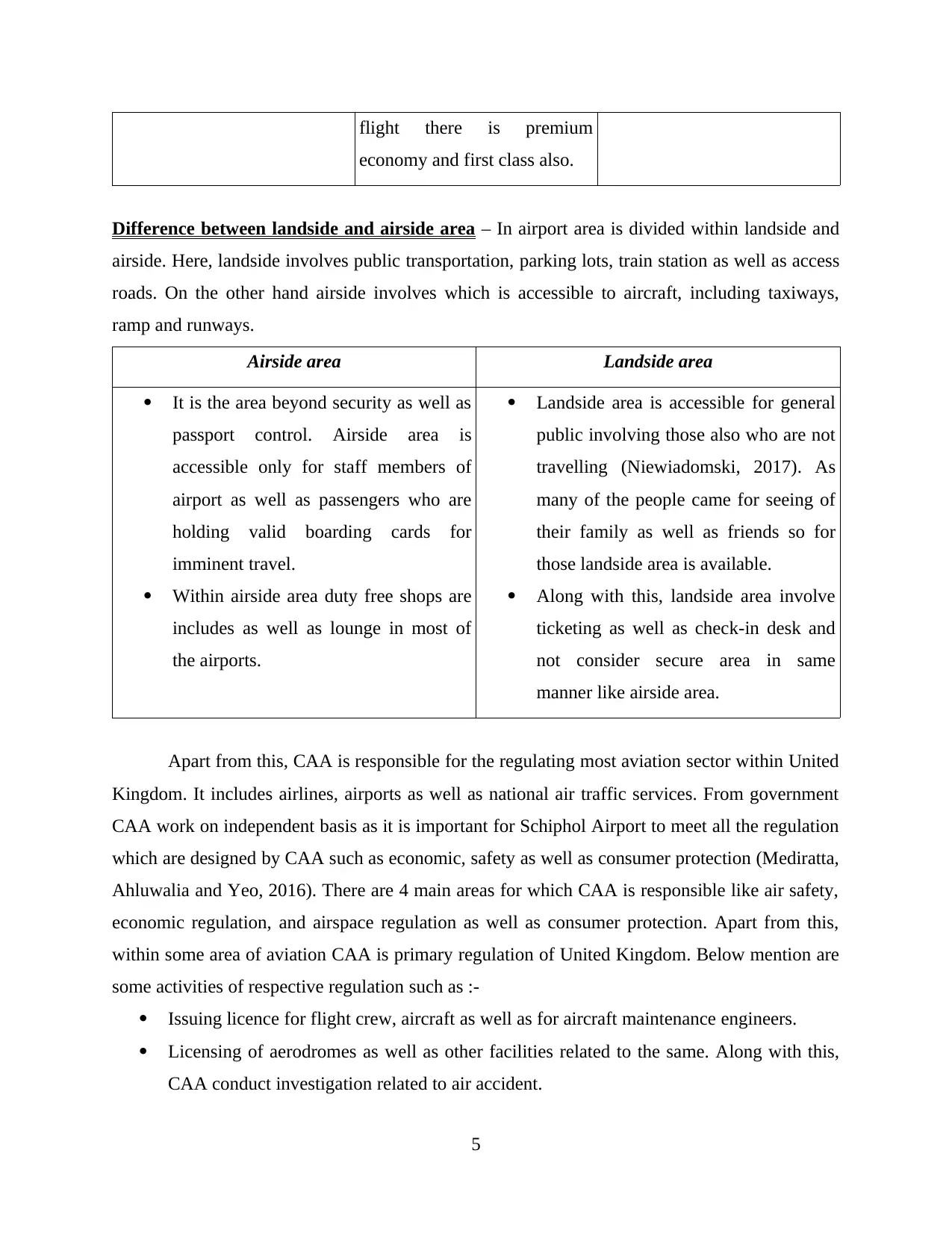
flight there is premium
economy and first class also.
Difference between landside and airside area – In airport area is divided within landside and
airside. Here, landside involves public transportation, parking lots, train station as well as access
roads. On the other hand airside involves which is accessible to aircraft, including taxiways,
ramp and runways.
Airside area Landside area
It is the area beyond security as well as
passport control. Airside area is
accessible only for staff members of
airport as well as passengers who are
holding valid boarding cards for
imminent travel.
Within airside area duty free shops are
includes as well as lounge in most of
the airports.
Landside area is accessible for general
public involving those also who are not
travelling (Niewiadomski, 2017). As
many of the people came for seeing of
their family as well as friends so for
those landside area is available.
Along with this, landside area involve
ticketing as well as check-in desk and
not consider secure area in same
manner like airside area.
Apart from this, CAA is responsible for the regulating most aviation sector within United
Kingdom. It includes airlines, airports as well as national air traffic services. From government
CAA work on independent basis as it is important for Schiphol Airport to meet all the regulation
which are designed by CAA such as economic, safety as well as consumer protection (Mediratta,
Ahluwalia and Yeo, 2016). There are 4 main areas for which CAA is responsible like air safety,
economic regulation, and airspace regulation as well as consumer protection. Apart from this,
within some area of aviation CAA is primary regulation of United Kingdom. Below mention are
some activities of respective regulation such as :-
Issuing licence for flight crew, aircraft as well as for aircraft maintenance engineers.
Licensing of aerodromes as well as other facilities related to the same. Along with this,
CAA conduct investigation related to air accident.
5
economy and first class also.
Difference between landside and airside area – In airport area is divided within landside and
airside. Here, landside involves public transportation, parking lots, train station as well as access
roads. On the other hand airside involves which is accessible to aircraft, including taxiways,
ramp and runways.
Airside area Landside area
It is the area beyond security as well as
passport control. Airside area is
accessible only for staff members of
airport as well as passengers who are
holding valid boarding cards for
imminent travel.
Within airside area duty free shops are
includes as well as lounge in most of
the airports.
Landside area is accessible for general
public involving those also who are not
travelling (Niewiadomski, 2017). As
many of the people came for seeing of
their family as well as friends so for
those landside area is available.
Along with this, landside area involve
ticketing as well as check-in desk and
not consider secure area in same
manner like airside area.
Apart from this, CAA is responsible for the regulating most aviation sector within United
Kingdom. It includes airlines, airports as well as national air traffic services. From government
CAA work on independent basis as it is important for Schiphol Airport to meet all the regulation
which are designed by CAA such as economic, safety as well as consumer protection (Mediratta,
Ahluwalia and Yeo, 2016). There are 4 main areas for which CAA is responsible like air safety,
economic regulation, and airspace regulation as well as consumer protection. Apart from this,
within some area of aviation CAA is primary regulation of United Kingdom. Below mention are
some activities of respective regulation such as :-
Issuing licence for flight crew, aircraft as well as for aircraft maintenance engineers.
Licensing of aerodromes as well as other facilities related to the same. Along with this,
CAA conduct investigation related to air accident.
5
Paraphrase This Document
Need a fresh take? Get an instant paraphrase of this document with our AI Paraphraser
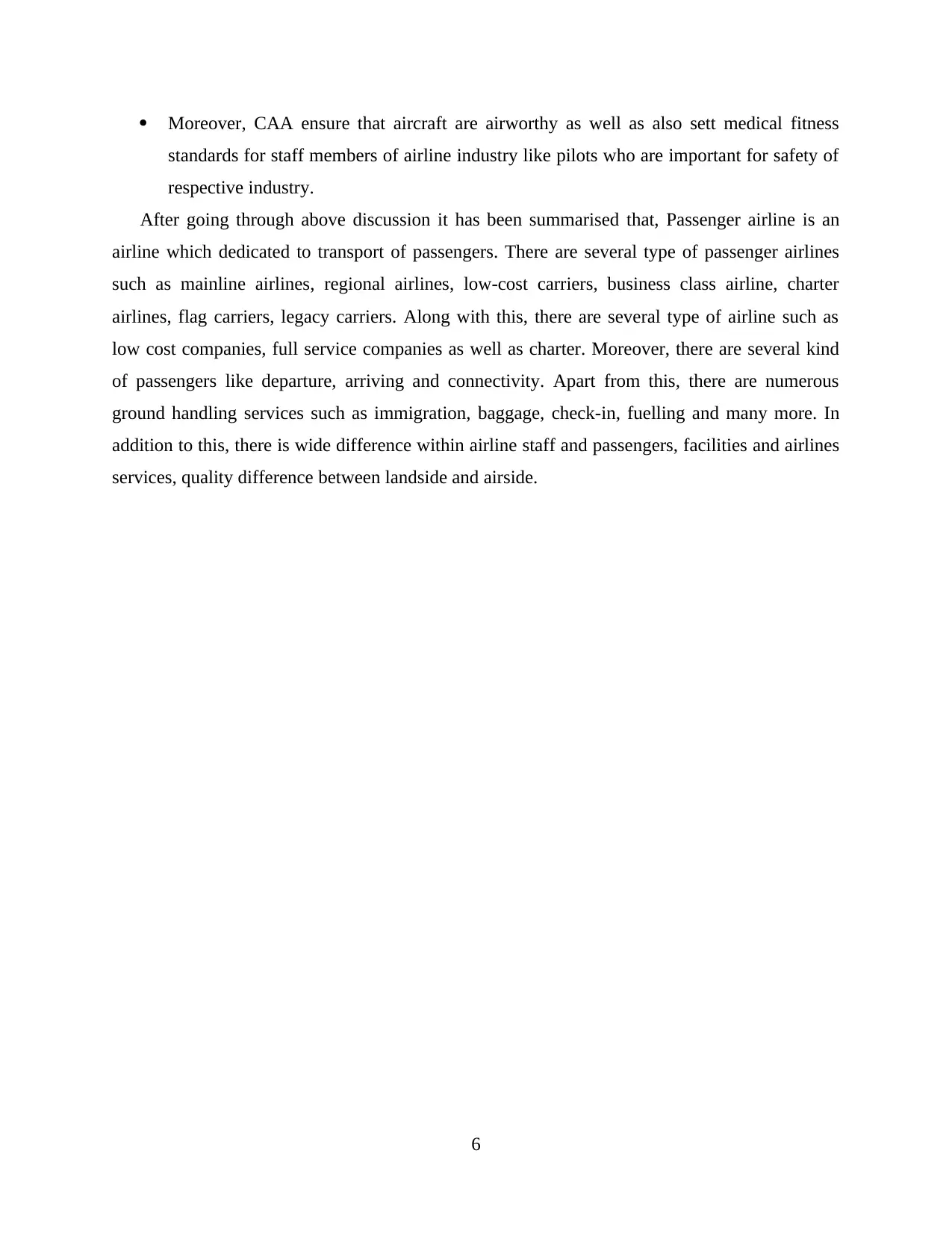
Moreover, CAA ensure that aircraft are airworthy as well as also sett medical fitness
standards for staff members of airline industry like pilots who are important for safety of
respective industry.
After going through above discussion it has been summarised that, Passenger airline is an
airline which dedicated to transport of passengers. There are several type of passenger airlines
such as mainline airlines, regional airlines, low-cost carriers, business class airline, charter
airlines, flag carriers, legacy carriers. Along with this, there are several type of airline such as
low cost companies, full service companies as well as charter. Moreover, there are several kind
of passengers like departure, arriving and connectivity. Apart from this, there are numerous
ground handling services such as immigration, baggage, check-in, fuelling and many more. In
addition to this, there is wide difference within airline staff and passengers, facilities and airlines
services, quality difference between landside and airside.
6
standards for staff members of airline industry like pilots who are important for safety of
respective industry.
After going through above discussion it has been summarised that, Passenger airline is an
airline which dedicated to transport of passengers. There are several type of passenger airlines
such as mainline airlines, regional airlines, low-cost carriers, business class airline, charter
airlines, flag carriers, legacy carriers. Along with this, there are several type of airline such as
low cost companies, full service companies as well as charter. Moreover, there are several kind
of passengers like departure, arriving and connectivity. Apart from this, there are numerous
ground handling services such as immigration, baggage, check-in, fuelling and many more. In
addition to this, there is wide difference within airline staff and passengers, facilities and airlines
services, quality difference between landside and airside.
6
REFERENCES
Books and Journals
Wagner, S. M. and Walton, R. O., 2016. Additive manufacturing’s impact and future in the
aviation industry. Production Planning & Control. 27(13), pp.1124-1130.
Henriksen, L. F. and Ponte, S., 2018. Public orchestration, social networks, and transnational
environmental governance: Lessons from the aviation industry. Regulation &
governance. 12(1), pp.23-45.
Zhou, W. and et. al., 2016. Scenario analysis of CO2 emissions from China’s civil aviation
industry through 2030. Applied energy. 175, pp.100-108.
Karaman, A. S., Kilic, M. and Uyar, A., 2018. Sustainability reporting in the aviation industry:
worldwide evidence. Sustainability Accounting, Management and Policy Journal.
Dougan, M., 2016. A political economy analysis of China's civil aviation industry. Routledge.
Warith, M.F.A., 2019. Assessment of Green IT/IS Within the Aviation Industry Using the
Analytic Network Process Approach. International Journal of Hospitality & Tourism
Systems. 12(1).
Xu, S., Chan, H. K. and Zhang, T., 2019. Forecasting the demand of the aviation industry using
hybrid time series SARIMA-SVR approach. Transportation Research Part E: Logistics
and Transportation Review. 122, pp.169-180.
Xue, Y. and Fu, G., 2018. A modified accident analysis and investigation model for the general
aviation industry: Emphasizing on human and organizational factors. Journal of safety
research. 67, pp.1-15.
Parsa, M. and et. al., 2019. Green hub-and-spoke network design for aviation industry. Journal of
cleaner production. 229, pp.1377-1396.
Niewiadomski, P., 2017. Global production networks in the passenger aviation industry.
Geoforum. 87, pp.1-14.
Mediratta, R., Ahluwalia, K. and Yeo, S. H., 2016. State-of-the-art on vibratory finishing in the
aviation industry: an industrial and academic perspective. The International Journal of
Advanced Manufacturing Technology. 85(1-4), pp.415-429.
Gisario, A. and et. al., 2019. Metal additive manufacturing in the commercial aviation industry: a
review. Journal of Manufacturing Systems. 53, pp.124-149.
7
Books and Journals
Wagner, S. M. and Walton, R. O., 2016. Additive manufacturing’s impact and future in the
aviation industry. Production Planning & Control. 27(13), pp.1124-1130.
Henriksen, L. F. and Ponte, S., 2018. Public orchestration, social networks, and transnational
environmental governance: Lessons from the aviation industry. Regulation &
governance. 12(1), pp.23-45.
Zhou, W. and et. al., 2016. Scenario analysis of CO2 emissions from China’s civil aviation
industry through 2030. Applied energy. 175, pp.100-108.
Karaman, A. S., Kilic, M. and Uyar, A., 2018. Sustainability reporting in the aviation industry:
worldwide evidence. Sustainability Accounting, Management and Policy Journal.
Dougan, M., 2016. A political economy analysis of China's civil aviation industry. Routledge.
Warith, M.F.A., 2019. Assessment of Green IT/IS Within the Aviation Industry Using the
Analytic Network Process Approach. International Journal of Hospitality & Tourism
Systems. 12(1).
Xu, S., Chan, H. K. and Zhang, T., 2019. Forecasting the demand of the aviation industry using
hybrid time series SARIMA-SVR approach. Transportation Research Part E: Logistics
and Transportation Review. 122, pp.169-180.
Xue, Y. and Fu, G., 2018. A modified accident analysis and investigation model for the general
aviation industry: Emphasizing on human and organizational factors. Journal of safety
research. 67, pp.1-15.
Parsa, M. and et. al., 2019. Green hub-and-spoke network design for aviation industry. Journal of
cleaner production. 229, pp.1377-1396.
Niewiadomski, P., 2017. Global production networks in the passenger aviation industry.
Geoforum. 87, pp.1-14.
Mediratta, R., Ahluwalia, K. and Yeo, S. H., 2016. State-of-the-art on vibratory finishing in the
aviation industry: an industrial and academic perspective. The International Journal of
Advanced Manufacturing Technology. 85(1-4), pp.415-429.
Gisario, A. and et. al., 2019. Metal additive manufacturing in the commercial aviation industry: a
review. Journal of Manufacturing Systems. 53, pp.124-149.
7
⊘ This is a preview!⊘
Do you want full access?
Subscribe today to unlock all pages.
Trusted by 1+ million students worldwide

1 out of 9


Related Documents


Your All-in-One AI-Powered Toolkit for Academic Success.
+13062052269
info@desklib.com
Available 24*7 on WhatsApp / Email
![[object Object]](/_next/static/media/star-bottom.7253800d.svg)
Unlock your academic potential
Copyright © 2020–2026 A2Z Services. All Rights Reserved. Developed and managed by ZUCOL.