Contemporary Developments in Business and Management: Aviva UK Report
VerifiedAdded on 2020/04/21
|23
|5730
|87
Report
AI Summary
This report provides a comprehensive analysis of Aviva UK, a leading multinational insurance company, focusing on its financial and insurance activities, ethical practices, and corporate social responsibility (CSR) initiatives. The report begins with an executive summary highlighting the importance of ethics and CSR in business operations, particularly within the context of stakeholder engagement and environmental considerations. It then delves into the primary external influences affecting Aviva, including a PESTLE analysis of the UK's political, economic, social, technological, legal, and environmental factors. The report further examines Aviva's ethical code, CSR policies, and the company's responses to these external factors. It evaluates Aviva's performance in areas such as ethical conduct, financial disclosures, and adherence to regulations. Finally, the report offers recommendations for Aviva, focusing on sustaining its ethical practices and demonstrating governance leadership in the insurance industry. The analysis covers Aviva's operations, its compliance with ethical standards, and its commitment to corporate social responsibility, alongside an assessment of its responses to external environmental factors, including the impact of Brexit and other socio-economic trends.
Contemporary
Developments in
Business and
Management
Financial and Insurance Activities
Developments in
Business and
Management
Financial and Insurance Activities

Paraphrase This Document
Need a fresh take? Get an instant paraphrase of this document with our AI Paraphraser
REPORT 2
Executive Summary
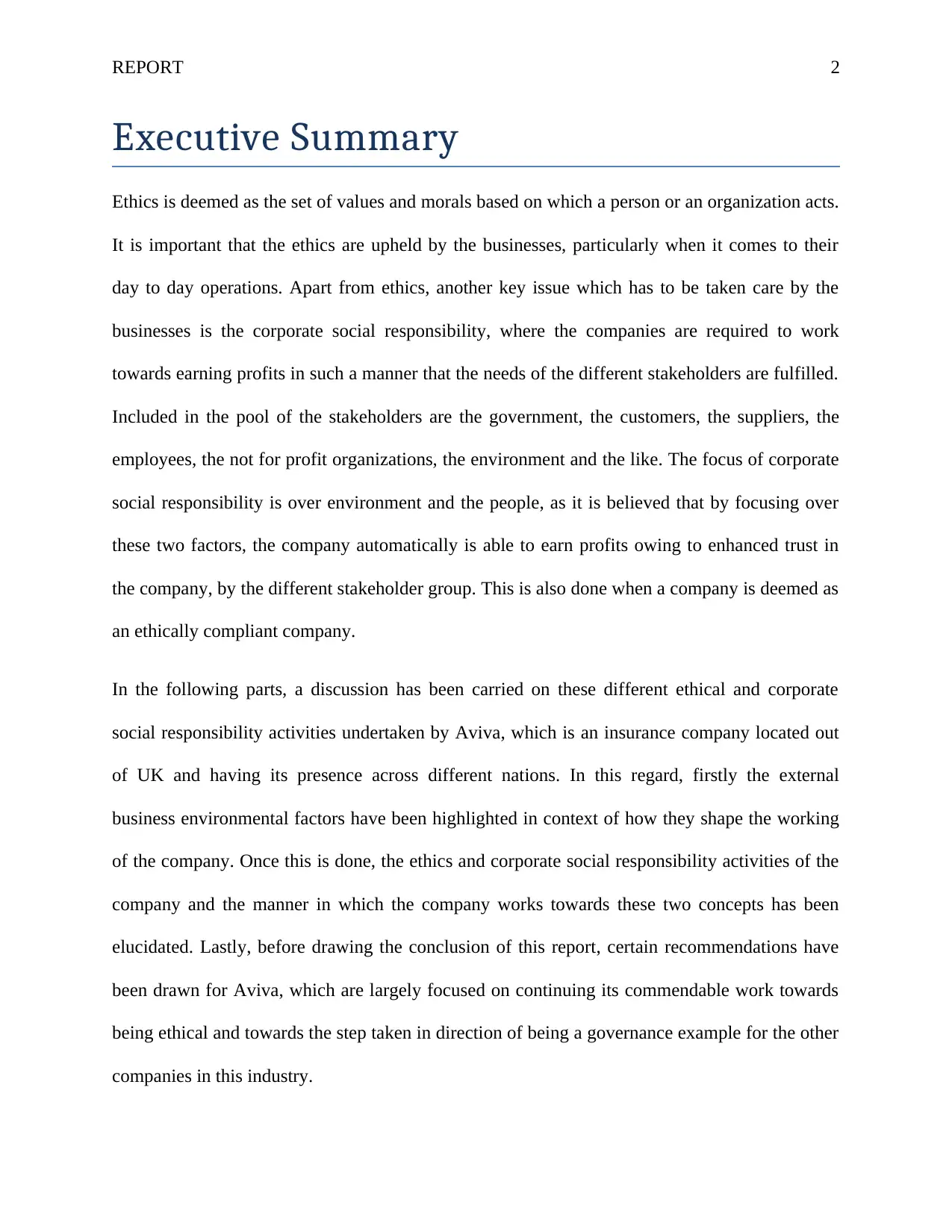
Ethics is deemed as the set of values and morals based on which a person or an organization acts.
It is important that the ethics are upheld by the businesses, particularly when it comes to their
day to day operations. Apart from ethics, another key issue which has to be taken care by the
businesses is the corporate social responsibility, where the companies are required to work
towards earning profits in such a manner that the needs of the different stakeholders are fulfilled.
Included in the pool of the stakeholders are the government, the customers, the suppliers, the
employees, the not for profit organizations, the environment and the like. The focus of corporate
social responsibility is over environment and the people, as it is believed that by focusing over
these two factors, the company automatically is able to earn profits owing to enhanced trust in
the company, by the different stakeholder group. This is also done when a company is deemed as
an ethically compliant company.
In the following parts, a discussion has been carried on these different ethical and corporate
social responsibility activities undertaken by Aviva, which is an insurance company located out
of UK and having its presence across different nations. In this regard, firstly the external
business environmental factors have been highlighted in context of how they shape the working
of the company. Once this is done, the ethics and corporate social responsibility activities of the
company and the manner in which the company works towards these two concepts has been
elucidated. Lastly, before drawing the conclusion of this report, certain recommendations have
been drawn for Aviva, which are largely focused on continuing its commendable work towards
being ethical and towards the step taken in direction of being a governance example for the other
companies in this industry.
Executive Summary
Ethics is deemed as the set of values and morals based on which a person or an organization acts.
It is important that the ethics are upheld by the businesses, particularly when it comes to their
day to day operations. Apart from ethics, another key issue which has to be taken care by the
businesses is the corporate social responsibility, where the companies are required to work
towards earning profits in such a manner that the needs of the different stakeholders are fulfilled.
Included in the pool of the stakeholders are the government, the customers, the suppliers, the
employees, the not for profit organizations, the environment and the like. The focus of corporate
social responsibility is over environment and the people, as it is believed that by focusing over
these two factors, the company automatically is able to earn profits owing to enhanced trust in
the company, by the different stakeholder group. This is also done when a company is deemed as
an ethically compliant company.
In the following parts, a discussion has been carried on these different ethical and corporate
social responsibility activities undertaken by Aviva, which is an insurance company located out
of UK and having its presence across different nations. In this regard, firstly the external
business environmental factors have been highlighted in context of how they shape the working
of the company. Once this is done, the ethics and corporate social responsibility activities of the
company and the manner in which the company works towards these two concepts has been
elucidated. Lastly, before drawing the conclusion of this report, certain recommendations have
been drawn for Aviva, which are largely focused on continuing its commendable work towards
being ethical and towards the step taken in direction of being a governance example for the other
companies in this industry.
REPORT 3
Table of Contents
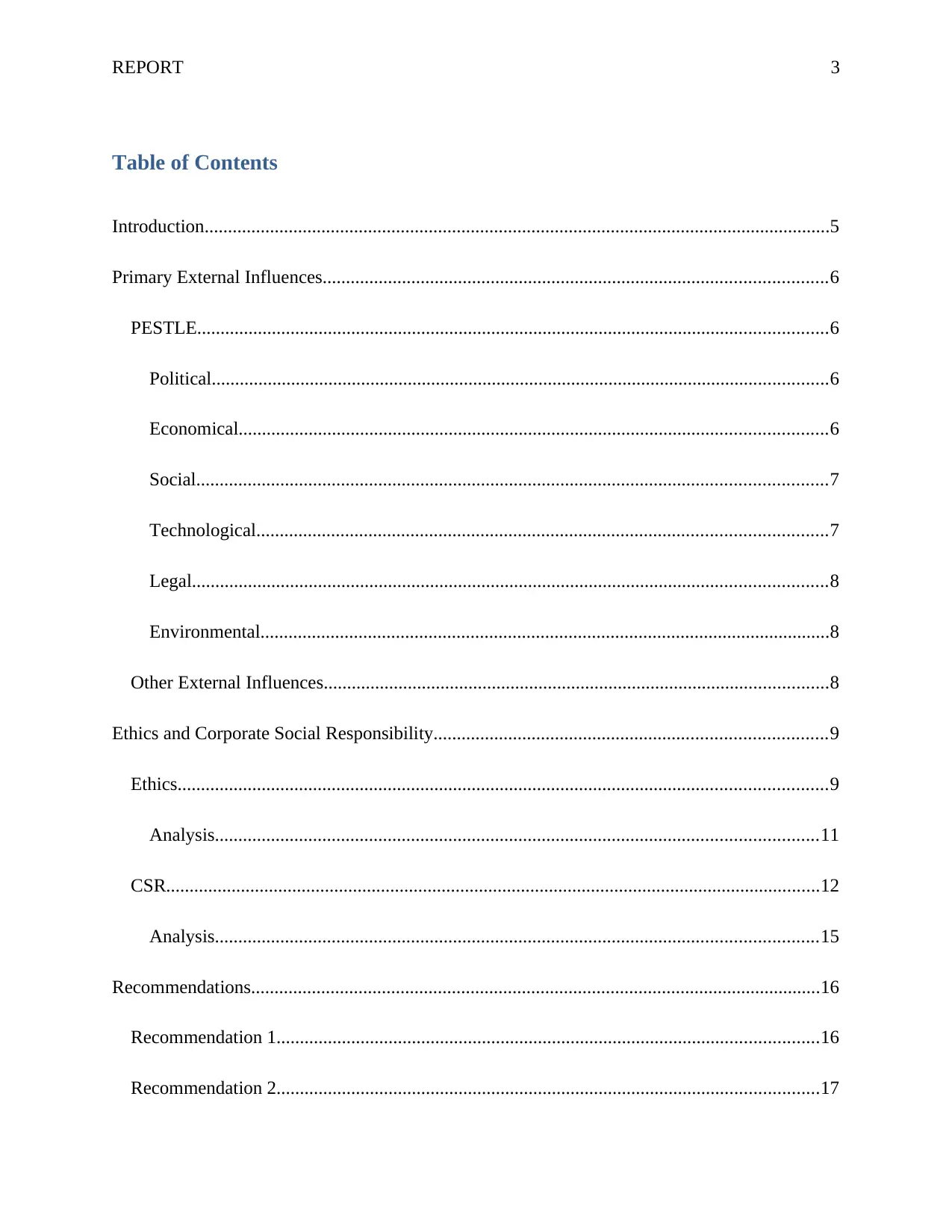
Introduction......................................................................................................................................5
Primary External Influences............................................................................................................6
PESTLE.......................................................................................................................................6
Political....................................................................................................................................6
Economical..............................................................................................................................6
Social.......................................................................................................................................7
Technological..........................................................................................................................7
Legal........................................................................................................................................8
Environmental..........................................................................................................................8
Other External Influences............................................................................................................8
Ethics and Corporate Social Responsibility....................................................................................9
Ethics...........................................................................................................................................9
Analysis.................................................................................................................................11
CSR............................................................................................................................................12
Analysis.................................................................................................................................15
Recommendations..........................................................................................................................16
Recommendation 1....................................................................................................................16
Recommendation 2....................................................................................................................17
Table of Contents
Introduction......................................................................................................................................5
Primary External Influences............................................................................................................6
PESTLE.......................................................................................................................................6
Political....................................................................................................................................6
Economical..............................................................................................................................6
Social.......................................................................................................................................7
Technological..........................................................................................................................7
Legal........................................................................................................................................8
Environmental..........................................................................................................................8
Other External Influences............................................................................................................8
Ethics and Corporate Social Responsibility....................................................................................9
Ethics...........................................................................................................................................9
Analysis.................................................................................................................................11
CSR............................................................................................................................................12
Analysis.................................................................................................................................15
Recommendations..........................................................................................................................16
Recommendation 1....................................................................................................................16
Recommendation 2....................................................................................................................17
⊘ This is a preview!⊘
Do you want full access?
Subscribe today to unlock all pages.

Trusted by 1+ million students worldwide
REPORT 4
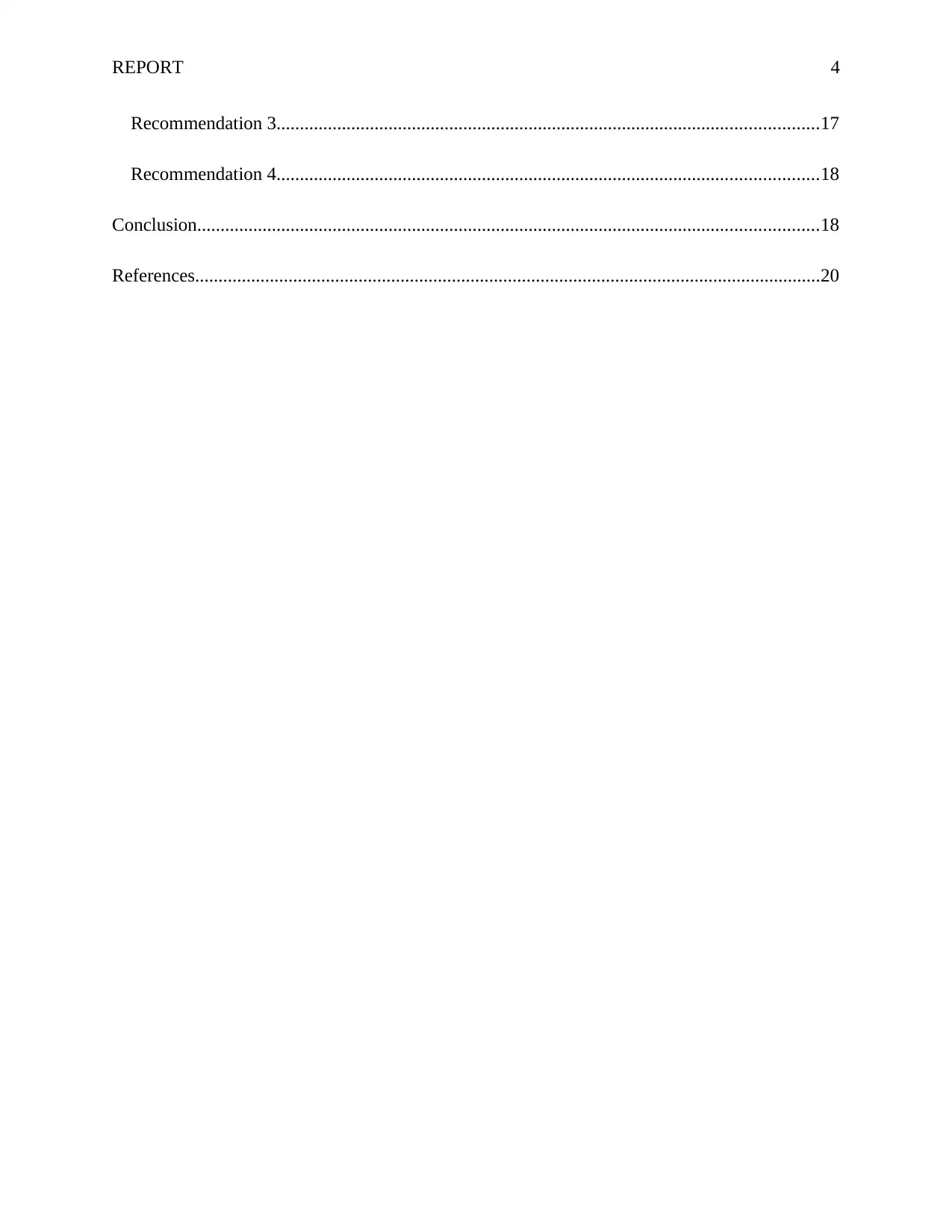
Recommendation 3....................................................................................................................17
Recommendation 4....................................................................................................................18
Conclusion.....................................................................................................................................18
References......................................................................................................................................20
Recommendation 3....................................................................................................................17
Recommendation 4....................................................................................................................18
Conclusion.....................................................................................................................................18
References......................................................................................................................................20
Paraphrase This Document
Need a fresh take? Get an instant paraphrase of this document with our AI Paraphraser
REPORT 5
Introduction
Aviva Plc is a leading multinational insurance company of Britain and has it’s headquarter at
London, United Kingdom. The company has approximately 33 million customers, which are
spread in sixteen nations (Aviva, 2017a). In the United Kingdom, the company is the largest
general insurer, and is also the leading pensions and life provider. Apart from this, the company
has their focus over five markets in Asia and Europe and the focus of the company is growing in
the South Eastern Asia and China. In Canada, the company is the second largest general insurer
(Caproasia, 2017). It is also a constituent of FTSE 100 Index and has primary listing on London
Stock Exchange (Kwiboo, 2015).
Having its business widespread over different nations, a lot of factors affect the business of the
company. This makes it necessary for the need of assessing the impact of the external business
environmental factors over the company. There is also a need of evaluating the position of the
company and its responses to these environmental factors. Through this report, an attempt has
been made to firstly highlight the primary external influences which the organization is subjected
to, followed by explaining their significance in context of Aviva. Once this is done, the focus of
the discussion would be on the ethics and corporate social responsibility of the company, in
terms of the policies of the company, the effectiveness of the repose of the company, and
identification of the areas of improvement for the company. All this is done in order to present
the factors influencing the company and the manner in which these factors mould the operations
of the company in the nation.
Introduction
Aviva Plc is a leading multinational insurance company of Britain and has it’s headquarter at
London, United Kingdom. The company has approximately 33 million customers, which are
spread in sixteen nations (Aviva, 2017a). In the United Kingdom, the company is the largest
general insurer, and is also the leading pensions and life provider. Apart from this, the company
has their focus over five markets in Asia and Europe and the focus of the company is growing in
the South Eastern Asia and China. In Canada, the company is the second largest general insurer
(Caproasia, 2017). It is also a constituent of FTSE 100 Index and has primary listing on London
Stock Exchange (Kwiboo, 2015).
Having its business widespread over different nations, a lot of factors affect the business of the
company. This makes it necessary for the need of assessing the impact of the external business
environmental factors over the company. There is also a need of evaluating the position of the
company and its responses to these environmental factors. Through this report, an attempt has
been made to firstly highlight the primary external influences which the organization is subjected
to, followed by explaining their significance in context of Aviva. Once this is done, the focus of
the discussion would be on the ethics and corporate social responsibility of the company, in
terms of the policies of the company, the effectiveness of the repose of the company, and
identification of the areas of improvement for the company. All this is done in order to present
the factors influencing the company and the manner in which these factors mould the operations
of the company in the nation.
REPORT 6
Primary External Influences
In order to present an overview over the primary external influences which Aviva is subjected to,
firstly a PESTLE Analysis of UK has been conducted. This is followed by the analysis of the
other factors affecting the company.
PESTLE
Political
Aviva has its global presence and having is core in UK, it is affected by the political environment
of the nation, in addition to that across the globe. The world presently is in a state of turmoil
owing to the erratic behaviours of the governments, the rules and the key factors controlling
governments (Crisis Group, 2017). The present day political conditions of UK are not better and
this is primarily owing to Brexit. The adoption of Brexit, the early elections and the shocking
results of recent elections presented a new picture altogether. It was highlighted that the plans of
Theresa May, the present PM of UK, fell backwards, as instead of getting more support, she lost
support, even though retaining her position, depicting that the proponents of Brexit are against
Hard Brexit (Davies and Addley, 2017). This political turmoil and the upcoming worries about
final Brexit plan continue to be a factor of worry for the company.
Economical
When it comes to the economic factors, the businesses are directly affected by it. At the present
day, the key economic factor which impacts the revenues of the company is the cost of labour,
followed by deploying heavy sums for cost of employment. The costs have been raised for the
company owing to reforms like the national minimum wages being increased (Munbodh, 2017).
Primary External Influences
In order to present an overview over the primary external influences which Aviva is subjected to,
firstly a PESTLE Analysis of UK has been conducted. This is followed by the analysis of the
other factors affecting the company.
PESTLE
Political
Aviva has its global presence and having is core in UK, it is affected by the political environment
of the nation, in addition to that across the globe. The world presently is in a state of turmoil
owing to the erratic behaviours of the governments, the rules and the key factors controlling
governments (Crisis Group, 2017). The present day political conditions of UK are not better and
this is primarily owing to Brexit. The adoption of Brexit, the early elections and the shocking
results of recent elections presented a new picture altogether. It was highlighted that the plans of
Theresa May, the present PM of UK, fell backwards, as instead of getting more support, she lost
support, even though retaining her position, depicting that the proponents of Brexit are against
Hard Brexit (Davies and Addley, 2017). This political turmoil and the upcoming worries about
final Brexit plan continue to be a factor of worry for the company.
Economical
When it comes to the economic factors, the businesses are directly affected by it. At the present
day, the key economic factor which impacts the revenues of the company is the cost of labour,
followed by deploying heavy sums for cost of employment. The costs have been raised for the
company owing to reforms like the national minimum wages being increased (Munbodh, 2017).
⊘ This is a preview!⊘
Do you want full access?
Subscribe today to unlock all pages.
Trusted by 1+ million students worldwide
REPORT 7
The fiscal policies of the government, the availability of credit and the rate of inflation are some
of the other factors which continue to impact the company.
Social
Another crucial impact over the company is that of the society. The factors which favour the
company include the dense population of the nation, the availability of free public services like
the National Health Services, the high standards of living and the high migration rates, which
bring more and more people to the nation (Pettinger, 2016). All these help the company in
widening its pool of customers, resulting in higher revenues. However, this factor is also marked
with the increasing dependency ratio owing to the old population of the nation, and the social
unrest with regards to the ethnic and migration groups (ONS Digital, 2015).
Technological
UK has pretty good access to technology; and as a result of this, the work of the company has
been eased up to a great extent. This has attributed to quality innovation skills, and expertise in
information technology and science. This has allowed the company to tap the market through
running its business online and through mobile apps. However, this advantage is easily imitable
by the competitors owing to technological advancement and its rampant usage. And only such
technological advancement proves to be advantageous which is hard to copy (Lamb, 2012).
Though, it is expected that through technological innovations, the company can still outshine
making it an advantage for the company (Flavin, 2017).
The fiscal policies of the government, the availability of credit and the rate of inflation are some
of the other factors which continue to impact the company.
Social
Another crucial impact over the company is that of the society. The factors which favour the
company include the dense population of the nation, the availability of free public services like
the National Health Services, the high standards of living and the high migration rates, which
bring more and more people to the nation (Pettinger, 2016). All these help the company in
widening its pool of customers, resulting in higher revenues. However, this factor is also marked
with the increasing dependency ratio owing to the old population of the nation, and the social
unrest with regards to the ethnic and migration groups (ONS Digital, 2015).
Technological
UK has pretty good access to technology; and as a result of this, the work of the company has
been eased up to a great extent. This has attributed to quality innovation skills, and expertise in
information technology and science. This has allowed the company to tap the market through
running its business online and through mobile apps. However, this advantage is easily imitable
by the competitors owing to technological advancement and its rampant usage. And only such
technological advancement proves to be advantageous which is hard to copy (Lamb, 2012).
Though, it is expected that through technological innovations, the company can still outshine
making it an advantage for the company (Flavin, 2017).
Paraphrase This Document
Need a fresh take? Get an instant paraphrase of this document with our AI Paraphraser
REPORT 8
Legal
There are a number of legislations, regulations, statutory instruments and rules which have to be
followed by the insurance companies. In UK alone, the company has to adhere to the regulations
related to financial industry and insurance norms, in addition to the general legislations relating
to employment, taxation, competition, and health and safety of workers. When these laws are not
followed, not only civil liabilities are raised, but the criminal liabilities in certain cases can crop
up too (Marson and Ferris, 2015). This is followed by the changes brought in the law through
Brexit particularly owing to the rebates and concessions possibly being withdrawn with
implementation of Brexit (Morphet, 2017).
Environmental
Owing to the growing awareness and concepts like corporate governance and corporate social
responsibility, the need of paying heed to environment and its needs have increased (Aras and
Crowther, 2016). This has been detailed more in the later part of this report.
Other External Influences
The other external influences which have an impact over the work of a company and impact the
crucial functions and processes of the company include the competitors, government
departments, trade bodies, pressure groups and regulators (Aviva, 2017b). In short, these factors
include the different stakeholders of the company. The external stakeholders of the company in
particularly, i.e., the customers, suppliers, government agencies and the unions have a direct
impact over the strategic decision making of the company. As the company is dependent on the
external environment for its resources, for the sale of its products/ services, and for its
legitimacy, the external groups hold power over the company, which has an impact over the
Legal
There are a number of legislations, regulations, statutory instruments and rules which have to be
followed by the insurance companies. In UK alone, the company has to adhere to the regulations
related to financial industry and insurance norms, in addition to the general legislations relating
to employment, taxation, competition, and health and safety of workers. When these laws are not
followed, not only civil liabilities are raised, but the criminal liabilities in certain cases can crop
up too (Marson and Ferris, 2015). This is followed by the changes brought in the law through
Brexit particularly owing to the rebates and concessions possibly being withdrawn with
implementation of Brexit (Morphet, 2017).
Environmental
Owing to the growing awareness and concepts like corporate governance and corporate social
responsibility, the need of paying heed to environment and its needs have increased (Aras and
Crowther, 2016). This has been detailed more in the later part of this report.
Other External Influences
The other external influences which have an impact over the work of a company and impact the
crucial functions and processes of the company include the competitors, government
departments, trade bodies, pressure groups and regulators (Aviva, 2017b). In short, these factors
include the different stakeholders of the company. The external stakeholders of the company in
particularly, i.e., the customers, suppliers, government agencies and the unions have a direct
impact over the strategic decision making of the company. As the company is dependent on the
external environment for its resources, for the sale of its products/ services, and for its
legitimacy, the external groups hold power over the company, which has an impact over the
REPORT 9
decisions taken by the management (Funk, 2016). The manner in which the different issues
affect the external stakeholders, also translate into the business of the company.
For instance, one of the stakeholder groups for the company is its consumers. The family income
and savings in UK have been highest since 2010 as in 2016 they rose by £128 in comparison to
previous winters. There was a growth in savings of a typical family by 42% the confidence in the
job security was raised. However, even these positive factors were charred by the increase in
burden of debt, where the same increased in comparison to previous years. The uncertainty
surrounding Brexit has resulted in great concerns for the families in managing their finances. All
these factors ultimately have an impact on the business of the company. An improved position
means the chances of taking a high insurance but being debt ridden makes this possibility low
(Aviva, 2016a).
Ethics and Corporate Social Responsibility
Ethics
Aviva has a Code of Ethics, particularly drawn for its senior managers, and a Business Ethics
Code which is applicable on all the employees of the company (Aviva, 2016c). These codes set
out ethical standards for the company. The code has been adopted in compliance to Section 406
of the Sarbanes-Oxley Act of 2002, apart from the Item 16B of Form 20-F which is propagate by
the U.S. Securities and Exchange Commission where the companies registered with the
commission are required to follow code of ethics. Through the code, the company has adopted
certain general principles. The code promotes ethical and honest conduct, which includes the
ethical handling of the possible or actual conflicts of interest between professional and personal
decisions taken by the management (Funk, 2016). The manner in which the different issues
affect the external stakeholders, also translate into the business of the company.
For instance, one of the stakeholder groups for the company is its consumers. The family income
and savings in UK have been highest since 2010 as in 2016 they rose by £128 in comparison to
previous winters. There was a growth in savings of a typical family by 42% the confidence in the
job security was raised. However, even these positive factors were charred by the increase in
burden of debt, where the same increased in comparison to previous years. The uncertainty
surrounding Brexit has resulted in great concerns for the families in managing their finances. All
these factors ultimately have an impact on the business of the company. An improved position
means the chances of taking a high insurance but being debt ridden makes this possibility low
(Aviva, 2016a).
Ethics and Corporate Social Responsibility
Ethics
Aviva has a Code of Ethics, particularly drawn for its senior managers, and a Business Ethics
Code which is applicable on all the employees of the company (Aviva, 2016c). These codes set
out ethical standards for the company. The code has been adopted in compliance to Section 406
of the Sarbanes-Oxley Act of 2002, apart from the Item 16B of Form 20-F which is propagate by
the U.S. Securities and Exchange Commission where the companies registered with the
commission are required to follow code of ethics. Through the code, the company has adopted
certain general principles. The code promotes ethical and honest conduct, which includes the
ethical handling of the possible or actual conflicts of interest between professional and personal
⊘ This is a preview!⊘
Do you want full access?
Subscribe today to unlock all pages.
Trusted by 1+ million students worldwide
REPORT 10
relationships; promotion of timely, understandable, accurate, fair and full disclosure of the
financial results of the company, and the other public communications; promotion of
compliances with the applicable laws, regulations and rules of government; and the requirement
of prompt internal reporting of breaches of, apart from the accountability related to the adherence
of the code (Aviva, 2017c).
Apart from this, the senior managers are strictly prohibited from using, exploiting, disclosing,
communicating or causing unauthorized disclosures of confidential information which relates to
the company, or using this in a manner which is detrimental or prejudicial for the company.
There also has been a limit set for the gifts which the senior managers can receive from different
suppliers and officials. These gifts and hospitality has to be properly recorded and accounted for
in the Global Hospitality Register and there is also a restriction on gifts being accepted from
public officials (Aviva, 2017c).
There is also a need of making timely, accurate, fair and full disclosures where all the legitimate
requests are fulfilled by the company, while at the same time, the confidentiality is maintained.
There is a restriction placed on the senior managers from taking any such action which is
fraudulent, misleading, manipulative, or coercive particularly towards the external auditors, so
that no misleading of financial statements is undertaken. There are strict norms related to
reporting by the senior manager towards the breaches of this code, whether the same has taken
place or is a possibility. The company is also strict on the compliance with the different laws,
rules and regulations in the nations where the operations are being conducted (Aviva, 2017c).
relationships; promotion of timely, understandable, accurate, fair and full disclosure of the
financial results of the company, and the other public communications; promotion of
compliances with the applicable laws, regulations and rules of government; and the requirement
of prompt internal reporting of breaches of, apart from the accountability related to the adherence
of the code (Aviva, 2017c).
Apart from this, the senior managers are strictly prohibited from using, exploiting, disclosing,
communicating or causing unauthorized disclosures of confidential information which relates to
the company, or using this in a manner which is detrimental or prejudicial for the company.
There also has been a limit set for the gifts which the senior managers can receive from different
suppliers and officials. These gifts and hospitality has to be properly recorded and accounted for
in the Global Hospitality Register and there is also a restriction on gifts being accepted from
public officials (Aviva, 2017c).
There is also a need of making timely, accurate, fair and full disclosures where all the legitimate
requests are fulfilled by the company, while at the same time, the confidentiality is maintained.
There is a restriction placed on the senior managers from taking any such action which is
fraudulent, misleading, manipulative, or coercive particularly towards the external auditors, so
that no misleading of financial statements is undertaken. There are strict norms related to
reporting by the senior manager towards the breaches of this code, whether the same has taken
place or is a possibility. The company is also strict on the compliance with the different laws,
rules and regulations in the nations where the operations are being conducted (Aviva, 2017c).
Paraphrase This Document
Need a fresh take? Get an instant paraphrase of this document with our AI Paraphraser
REPORT 11
Analysis
Owing to the rising concerns globally on the matters revolving around the conduct of the senior
managers, particularly due to the rising cases of scandals, the companies have adopted a stringent
approach towards the ethics being followed by the senior management of the companies. The
government has also become stricter in this regard, which is seen as a factor contributing to the
enhanced steps taken by the companies for improving their ethical conduct.
This is the reason why Aviva has drawn up two codes of conduct, one for its employees and one
specifically for its senior managers. The company expects its senior managers to act in a manner
where integrity and honesty is depicted. In this regard, there is a strict prohibition on the senior
managers from giving or receiving bribes, improper advantages, financial gains, and the
decision-making powers. In UK, bribery is deemed as a criminal offence based on Bribery Act,
2010 (Raphael, 2010). This is the reason why the code of conduct for the senior management has
been drawn in this matter, so that the government and regulators as stakeholders can be satisfied.
The steps taken by the company in context of its full disclosure of financial statements, while
upholding the confidentiality of the different stakeholders, show the commitment of the company
towards its consumers. These steps are taken in the backdrop of blunders which took place in
WorldCom and Enron, where major gaffes were made by the senior management with regards to
financial statements disclosers. This again depicts the commitment of the company to serve its
stakeholders in the best possible manner, by being ethical, instead of being focused on their
personal interests, which could make the company unethical and prone to disasters like
WorldCom. All these steps have been undertaken to have a strong ethical policy of the company.
Analysis
Owing to the rising concerns globally on the matters revolving around the conduct of the senior
managers, particularly due to the rising cases of scandals, the companies have adopted a stringent
approach towards the ethics being followed by the senior management of the companies. The
government has also become stricter in this regard, which is seen as a factor contributing to the
enhanced steps taken by the companies for improving their ethical conduct.
This is the reason why Aviva has drawn up two codes of conduct, one for its employees and one
specifically for its senior managers. The company expects its senior managers to act in a manner
where integrity and honesty is depicted. In this regard, there is a strict prohibition on the senior
managers from giving or receiving bribes, improper advantages, financial gains, and the
decision-making powers. In UK, bribery is deemed as a criminal offence based on Bribery Act,
2010 (Raphael, 2010). This is the reason why the code of conduct for the senior management has
been drawn in this matter, so that the government and regulators as stakeholders can be satisfied.
The steps taken by the company in context of its full disclosure of financial statements, while
upholding the confidentiality of the different stakeholders, show the commitment of the company
towards its consumers. These steps are taken in the backdrop of blunders which took place in
WorldCom and Enron, where major gaffes were made by the senior management with regards to
financial statements disclosers. This again depicts the commitment of the company to serve its
stakeholders in the best possible manner, by being ethical, instead of being focused on their
personal interests, which could make the company unethical and prone to disasters like
WorldCom. All these steps have been undertaken to have a strong ethical policy of the company.
REPORT 12
CSR
In the words of Kristine Cooper, the Company Secretary and General Counsel of Aviva, the
company acts in a sustainable and responsible manner in order to deliver its strategies and for
aligning with the values. For 2016, the company had a total community investment of £11.3
million; the company had reduced its CO2e since 2016 by 46%; the Business Ethics Code 2016
had been read, understood and accepted by 98% of the employees of the company; and the
company paid £34.4 billion. The company also has an Aviva Community Fund, which operates
live in six nations where the inspirational projects from the local communities are invited in
order to give them a proper backing (Aviva, 2017d).
The company has a strategic framework which focuses on the consumers and the things which
matter. The company is completely focused on the three aspects of corporate social responsibility
as it strives to work towards being a corporate that fulfils its responsibilities towards the society.
In true sense, Aviva works towards the triple bottom line of people, plant and profit (King and
Lawley, 2016). With regards to the environmental impact, the company had, by 2015 reduced its
CO2e by 39%, and by 2016, this was 46%. The aims of the company have been raised due to this
and the company now has set a target of 50% reduction by 2020, and 70% by 2030 as its
ambitions (Aviva, 2017e).
The company always works towards the supporting of communities and in this regard is included
the Aviva Community Fund, its continued support for carbon offsetting projects1 and the
strategic partnership with British Red Cross (Aviva, 2016b). For 2015, the figure of people who
had been benefited from the activities of the company across the globe was 587,200 and this
figure stood at 939,000 for 2016. The company has also worked towards their own people and in
CSR
In the words of Kristine Cooper, the Company Secretary and General Counsel of Aviva, the
company acts in a sustainable and responsible manner in order to deliver its strategies and for
aligning with the values. For 2016, the company had a total community investment of £11.3
million; the company had reduced its CO2e since 2016 by 46%; the Business Ethics Code 2016
had been read, understood and accepted by 98% of the employees of the company; and the
company paid £34.4 billion. The company also has an Aviva Community Fund, which operates
live in six nations where the inspirational projects from the local communities are invited in
order to give them a proper backing (Aviva, 2017d).
The company has a strategic framework which focuses on the consumers and the things which
matter. The company is completely focused on the three aspects of corporate social responsibility
as it strives to work towards being a corporate that fulfils its responsibilities towards the society.
In true sense, Aviva works towards the triple bottom line of people, plant and profit (King and
Lawley, 2016). With regards to the environmental impact, the company had, by 2015 reduced its
CO2e by 39%, and by 2016, this was 46%. The aims of the company have been raised due to this
and the company now has set a target of 50% reduction by 2020, and 70% by 2030 as its
ambitions (Aviva, 2017e).
The company always works towards the supporting of communities and in this regard is included
the Aviva Community Fund, its continued support for carbon offsetting projects1 and the
strategic partnership with British Red Cross (Aviva, 2016b). For 2015, the figure of people who
had been benefited from the activities of the company across the globe was 587,200 and this
figure stood at 939,000 for 2016. The company has also worked towards their own people and in
⊘ This is a preview!⊘
Do you want full access?
Subscribe today to unlock all pages.
Trusted by 1+ million students worldwide

1 out of 23


Related Documents


Your All-in-One AI-Powered Toolkit for Academic Success.
+13062052269
info@desklib.com
Available 24*7 on WhatsApp / Email
![[object Object]](/_next/static/media/star-bottom.7253800d.svg)
Unlock your academic potential
Copyright © 2020–2026 A2Z Services. All Rights Reserved. Developed and managed by ZUCOL.