AVIVA PLC: Governance, PESTLE and Business Structure Report
VerifiedAdded on 2020/10/22
|15
|3817
|271
Report
AI Summary
This report provides a comprehensive analysis of AVIVA PLC, a prominent UK-based insurance company. It begins with an introduction and an overview of Aviva, including its history and organizational structure. The report then delves into the company's governance, examining stakeholders such as shareholders, employees, and the public. A key component is the PESTLE analysis, which assesses the political, economic, social, technological, environmental, and legal factors influencing Aviva's operations. The report explores each element of the PESTLE framework, providing specific examples and insights into how these factors impact the company. The analysis covers areas like political risks, economic indicators, social trends, technological advancements, environmental considerations, and legal regulations. The report concludes with a summary of the findings, highlighting the key takeaways from the analysis and emphasizing the factors crucial to Aviva's success in the insurance market.

AVIVA PLC

Paraphrase This Document
Need a fresh take? Get an instant paraphrase of this document with our AI Paraphraser
TABLE OF CONTENTS
1. INTRODUCTION.......................................................................................................................3
2. AVIVA PLC................................................................................................................................3
2.1 Aviva overview......................................................................................................................3
2.2 History....................................................................................................................................3
2.2 Organisation Structure of Aviva............................................................................................4
3. HOW COMPANY IS GOVERNED...........................................................................................6
3.1 Stakeholders ..........................................................................................................................6
3.2 Shareholders...........................................................................................................................6
3.3 Employees .............................................................................................................................6
3.4 Public.....................................................................................................................................6
4. PESTLE ANALYSIS..................................................................................................................7
5. ELEMENTS OF PESTLE ANALYSIS ....................................................................................7
5.1 Political..................................................................................................................................7
5.2 Economical............................................................................................................................7
5.3 Social......................................................................................................................................8
5.4 Technological factor..............................................................................................................8
5.5 Environmental factor.............................................................................................................9
5.6 Legal factor..........................................................................................................................10
6. CONCLUSION..........................................................................................................................10
REFERENCES..............................................................................................................................11
1. INTRODUCTION.......................................................................................................................3
2. AVIVA PLC................................................................................................................................3
2.1 Aviva overview......................................................................................................................3
2.2 History....................................................................................................................................3
2.2 Organisation Structure of Aviva............................................................................................4
3. HOW COMPANY IS GOVERNED...........................................................................................6
3.1 Stakeholders ..........................................................................................................................6
3.2 Shareholders...........................................................................................................................6
3.3 Employees .............................................................................................................................6
3.4 Public.....................................................................................................................................6
4. PESTLE ANALYSIS..................................................................................................................7
5. ELEMENTS OF PESTLE ANALYSIS ....................................................................................7
5.1 Political..................................................................................................................................7
5.2 Economical............................................................................................................................7
5.3 Social......................................................................................................................................8
5.4 Technological factor..............................................................................................................8
5.5 Environmental factor.............................................................................................................9
5.6 Legal factor..........................................................................................................................10
6. CONCLUSION..........................................................................................................................10
REFERENCES..............................................................................................................................11
1. INTRODUCTION
This report is in context to AVIVA Plc which is an insurance company in the UK. The
study will discuss about company and its structure in order to determine how it was established.
Factors influencing the chosen organisation will also be analysed in this report with the help of
PESTLE analysis. Furthermore, shareholders, stakeholders and employees associated with
AVIVA Plc will be examined in the present report.
2. AVIVA PLC
2.1 Aviva overview
Aviva is a British multinational or international insurance corporation that is situated in
the United Kingdom. It is a public limited organisation that serves 33 million customers in more
than 17 countries. It acts as a large general insurer and pension provider. It has main focus on
five markets in Europe and in Asia. Majorly, company is considering on the growth market of
China and south East Asia. It estimated that it has more than $49653 million revenue and $3068
million operating income. Firm has total 30021 number of skilled and multi-talented workforce
who contribute in company’s growth and productivity
Mission and Vision of the company
Aviva’s long term vision is to lead the digital revolution of insurance industry in order to
deliver effective benefits to customers, shareholders, partners and employees. It has an aim to
deliver the most reliable and effective services to customers and meet expectations of all
stakeholders. It desires to become one of most profitable firms in the industry and wants to
become number one Corporation across world in sector of financial services. It has an objective
to meet customer’s demands and needs regarding financial services and facilities in high
standard as it delivers customers with life, general accident, health and asset insurance. It focuses
upon the resources through which it can perform in an excellent manner in competitive business
environment (Galbraith, 2014). It consider upon the numbers if market and business lies where it
can acquire profitability, competitive advantage and large scale of economy.
Aviva Plc’s target is to operate EPS targeting greater than 5% growth in 2018. Its target is of
50% dividend pay-out ratio in 2017 moving to 55%-60% by 2020. It desires to enhance cash
settlements £8bn from 2016 to 2018.
3Anwar, K., 2017. FACTORS AFFECTING STOCK EXCHANGE INVESTMENT IN
KURDISTAN. The International Journal of Accounting and Business Society, 25(1), pp.32-37.
This report is in context to AVIVA Plc which is an insurance company in the UK. The
study will discuss about company and its structure in order to determine how it was established.
Factors influencing the chosen organisation will also be analysed in this report with the help of
PESTLE analysis. Furthermore, shareholders, stakeholders and employees associated with
AVIVA Plc will be examined in the present report.
2. AVIVA PLC
2.1 Aviva overview
Aviva is a British multinational or international insurance corporation that is situated in
the United Kingdom. It is a public limited organisation that serves 33 million customers in more
than 17 countries. It acts as a large general insurer and pension provider. It has main focus on
five markets in Europe and in Asia. Majorly, company is considering on the growth market of
China and south East Asia. It estimated that it has more than $49653 million revenue and $3068
million operating income. Firm has total 30021 number of skilled and multi-talented workforce
who contribute in company’s growth and productivity
Mission and Vision of the company
Aviva’s long term vision is to lead the digital revolution of insurance industry in order to
deliver effective benefits to customers, shareholders, partners and employees. It has an aim to
deliver the most reliable and effective services to customers and meet expectations of all
stakeholders. It desires to become one of most profitable firms in the industry and wants to
become number one Corporation across world in sector of financial services. It has an objective
to meet customer’s demands and needs regarding financial services and facilities in high
standard as it delivers customers with life, general accident, health and asset insurance. It focuses
upon the resources through which it can perform in an excellent manner in competitive business
environment (Galbraith, 2014). It consider upon the numbers if market and business lies where it
can acquire profitability, competitive advantage and large scale of economy.
Aviva Plc’s target is to operate EPS targeting greater than 5% growth in 2018. Its target is of
50% dividend pay-out ratio in 2017 moving to 55%-60% by 2020. It desires to enhance cash
settlements £8bn from 2016 to 2018.
3Anwar, K., 2017. FACTORS AFFECTING STOCK EXCHANGE INVESTMENT IN
KURDISTAN. The International Journal of Accounting and Business Society, 25(1), pp.32-37.
⊘ This is a preview!⊘
Do you want full access?
Subscribe today to unlock all pages.

Trusted by 1+ million students worldwide
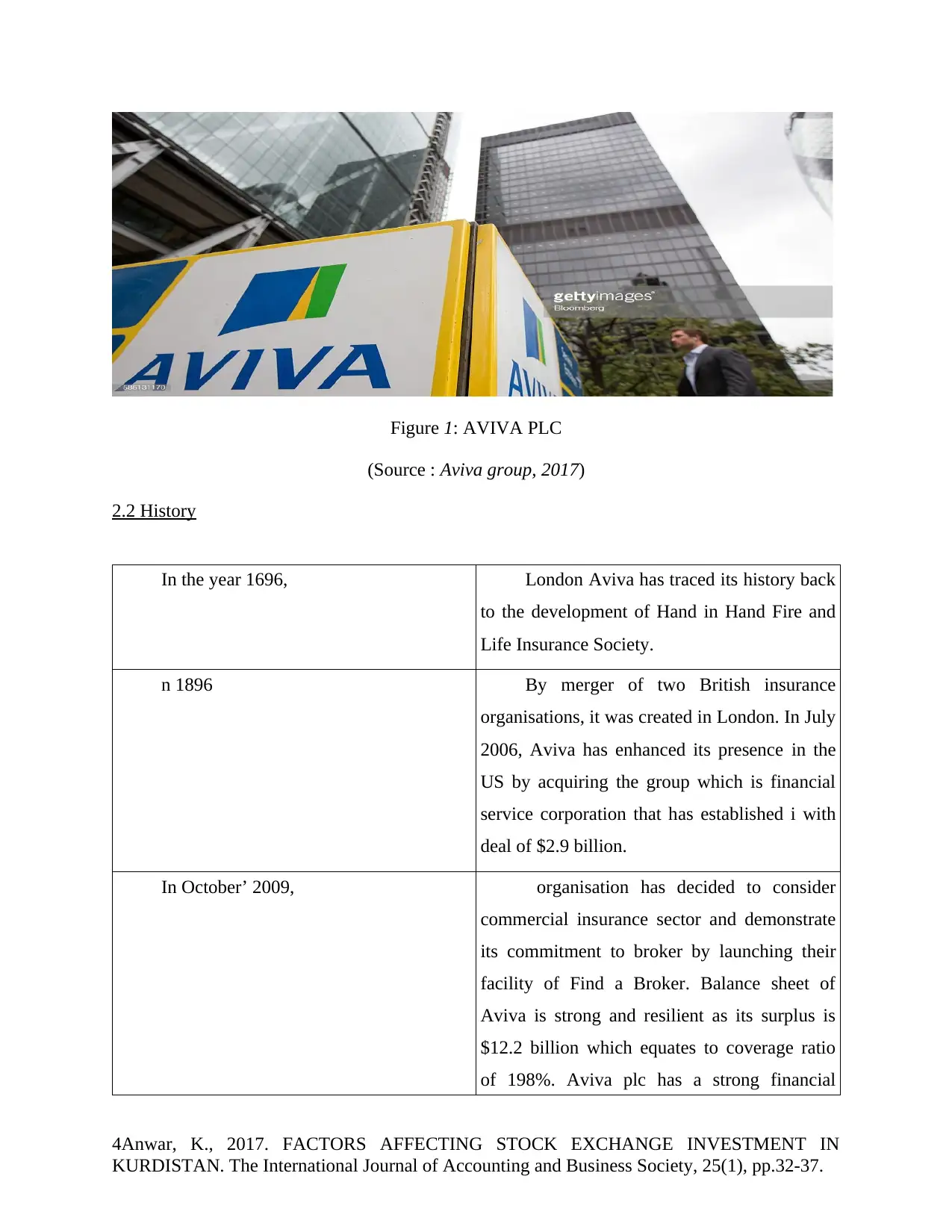
Figure 1: AVIVA PLC
(Source : Aviva group, 2017)
2.2 History
In the year 1696, London Aviva has traced its history back
to the development of Hand in Hand Fire and
Life Insurance Society.
n 1896 By merger of two British insurance
organisations, it was created in London. In July
2006, Aviva has enhanced its presence in the
US by acquiring the group which is financial
service corporation that has established i with
deal of $2.9 billion.
In October’ 2009, organisation has decided to consider
commercial insurance sector and demonstrate
its commitment to broker by launching their
facility of Find a Broker. Balance sheet of
Aviva is strong and resilient as its surplus is
$12.2 billion which equates to coverage ratio
of 198%. Aviva plc has a strong financial
4Anwar, K., 2017. FACTORS AFFECTING STOCK EXCHANGE INVESTMENT IN
KURDISTAN. The International Journal of Accounting and Business Society, 25(1), pp.32-37.
(Source : Aviva group, 2017)
2.2 History
In the year 1696, London Aviva has traced its history back
to the development of Hand in Hand Fire and
Life Insurance Society.
n 1896 By merger of two British insurance
organisations, it was created in London. In July
2006, Aviva has enhanced its presence in the
US by acquiring the group which is financial
service corporation that has established i with
deal of $2.9 billion.
In October’ 2009, organisation has decided to consider
commercial insurance sector and demonstrate
its commitment to broker by launching their
facility of Find a Broker. Balance sheet of
Aviva is strong and resilient as its surplus is
$12.2 billion which equates to coverage ratio
of 198%. Aviva plc has a strong financial
4Anwar, K., 2017. FACTORS AFFECTING STOCK EXCHANGE INVESTMENT IN
KURDISTAN. The International Journal of Accounting and Business Society, 25(1), pp.32-37.
Paraphrase This Document
Need a fresh take? Get an instant paraphrase of this document with our AI Paraphraser
position, resilience and diversity as well as it is
well insulated from external events. It has an
ability to provide key commitment to cash flow
and growth. Its surplus capital position delivers
financial flexibility and the capacity to
accelerate growth and progress. Corporation
has developed a successful track record of
consistent and reliable progress in context of
dividend and operating revenue.
It has been estimated on the basis of
report 2012 that
it has total dividend per share 27.4p that
enhance of 83% since 2013 (De Visscher,
2016).\
5Anwar, K., 2017. FACTORS AFFECTING STOCK EXCHANGE INVESTMENT IN
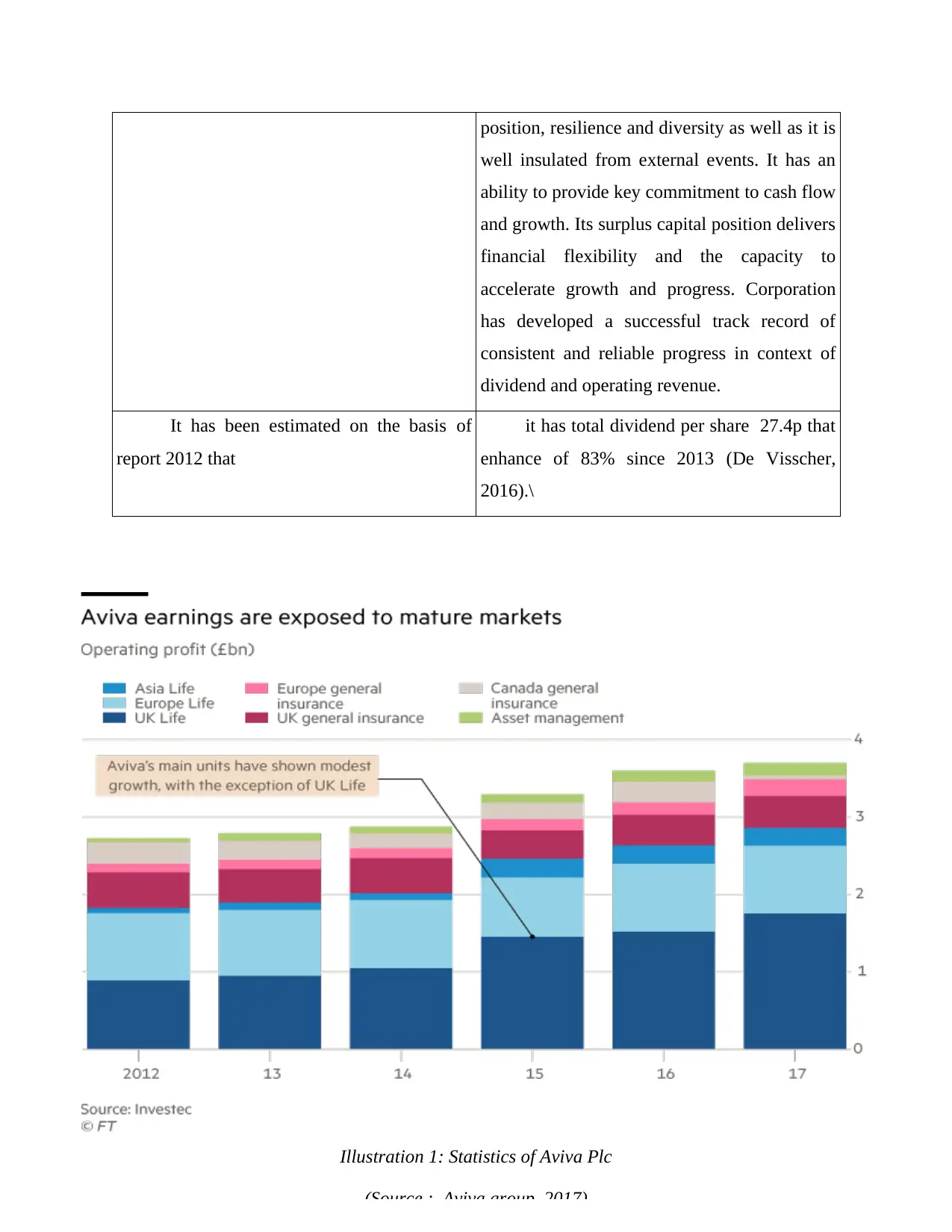
KURDISTAN. The International Journal of Accounting and Business Society, 25(1), pp.32-37.Illustration 1: Statistics of Aviva Plc
(Source : Aviva group, 2017)
well insulated from external events. It has an
ability to provide key commitment to cash flow
and growth. Its surplus capital position delivers
financial flexibility and the capacity to
accelerate growth and progress. Corporation
has developed a successful track record of
consistent and reliable progress in context of
dividend and operating revenue.
It has been estimated on the basis of
report 2012 that
it has total dividend per share 27.4p that
enhance of 83% since 2013 (De Visscher,
2016).\
5Anwar, K., 2017. FACTORS AFFECTING STOCK EXCHANGE INVESTMENT IN
KURDISTAN. The International Journal of Accounting and Business Society, 25(1), pp.32-37.Illustration 1: Statistics of Aviva Plc
(Source : Aviva group, 2017)
The above table summarised that operating profit of the Aviva Plc has been increasing
constantly since 2012. The maximum operating profit earned in the UK market, second
profitable market is Europe. The assets management is not much effective for the organisation.
Overall the illustration demonstrate that Aviva Plc is continuously achieving growth and
development in each and every aspects.
2.2 Organisation Structure of Aviva
It can be stated that organisation structure is a form that defines that how task should
allocate within company and how coordination should develop among various functional
department. Organisation can be structured in various manners and it depends upon its goal.
With help of structure, management can determine the modes and ways to operate the business
activities and functions (Soto-Acosta, Popa and Palacios-Marqués, 2016.). Organisation structure
allows the expressed allocation of responsibilities for various functions and procedure to various
entities such as individual, work group, department and branch. Aviva Plc is made up of different
senior executives and executive directors. They meet twice a month where the chief executive
officers talk about different financial, technical, repute matters sand strategies for the company,
chairman, the chief financial officer, the international chief executive officer. It also includes
several independent officers who design, evolve and utilize distinct strategies for Aviva Plc. An
effective organisation structure affects organisation actions in major two criteria that are
discussed below-
It identifies that which employees need to involve in the decision making procedure and
thus to what extent their views shape the actions of company (Khan and Quaddus, 2015).
It delivers a systematic way and criteria to allocate the roles and responsibility to each
and every functional department through which employees can get knowledge about how
much they needed to put afford for achieve business objective.
Following is the organisational structure -
Tall organisation structure-Tall organisation structure is the largest and complex structure
within business entity. In this structure, top management develop several level of functional
department and there is multiple level of management in the taller hierarchy (Wetherly and Otter,
6Anwar, K., 2017. FACTORS AFFECTING STOCK EXCHANGE INVESTMENT IN
KURDISTAN. The International Journal of Accounting and Business Society, 25(1), pp.32-37.
constantly since 2012. The maximum operating profit earned in the UK market, second
profitable market is Europe. The assets management is not much effective for the organisation.
Overall the illustration demonstrate that Aviva Plc is continuously achieving growth and
development in each and every aspects.
2.2 Organisation Structure of Aviva
It can be stated that organisation structure is a form that defines that how task should
allocate within company and how coordination should develop among various functional
department. Organisation can be structured in various manners and it depends upon its goal.
With help of structure, management can determine the modes and ways to operate the business
activities and functions (Soto-Acosta, Popa and Palacios-Marqués, 2016.). Organisation structure
allows the expressed allocation of responsibilities for various functions and procedure to various
entities such as individual, work group, department and branch. Aviva Plc is made up of different
senior executives and executive directors. They meet twice a month where the chief executive
officers talk about different financial, technical, repute matters sand strategies for the company,
chairman, the chief financial officer, the international chief executive officer. It also includes
several independent officers who design, evolve and utilize distinct strategies for Aviva Plc. An
effective organisation structure affects organisation actions in major two criteria that are
discussed below-
It identifies that which employees need to involve in the decision making procedure and
thus to what extent their views shape the actions of company (Khan and Quaddus, 2015).
It delivers a systematic way and criteria to allocate the roles and responsibility to each
and every functional department through which employees can get knowledge about how
much they needed to put afford for achieve business objective.
Following is the organisational structure -
Tall organisation structure-Tall organisation structure is the largest and complex structure
within business entity. In this structure, top management develop several level of functional
department and there is multiple level of management in the taller hierarchy (Wetherly and Otter,
6Anwar, K., 2017. FACTORS AFFECTING STOCK EXCHANGE INVESTMENT IN
KURDISTAN. The International Journal of Accounting and Business Society, 25(1), pp.32-37.
⊘ This is a preview!⊘
Do you want full access?
Subscribe today to unlock all pages.
Trusted by 1+ million students worldwide
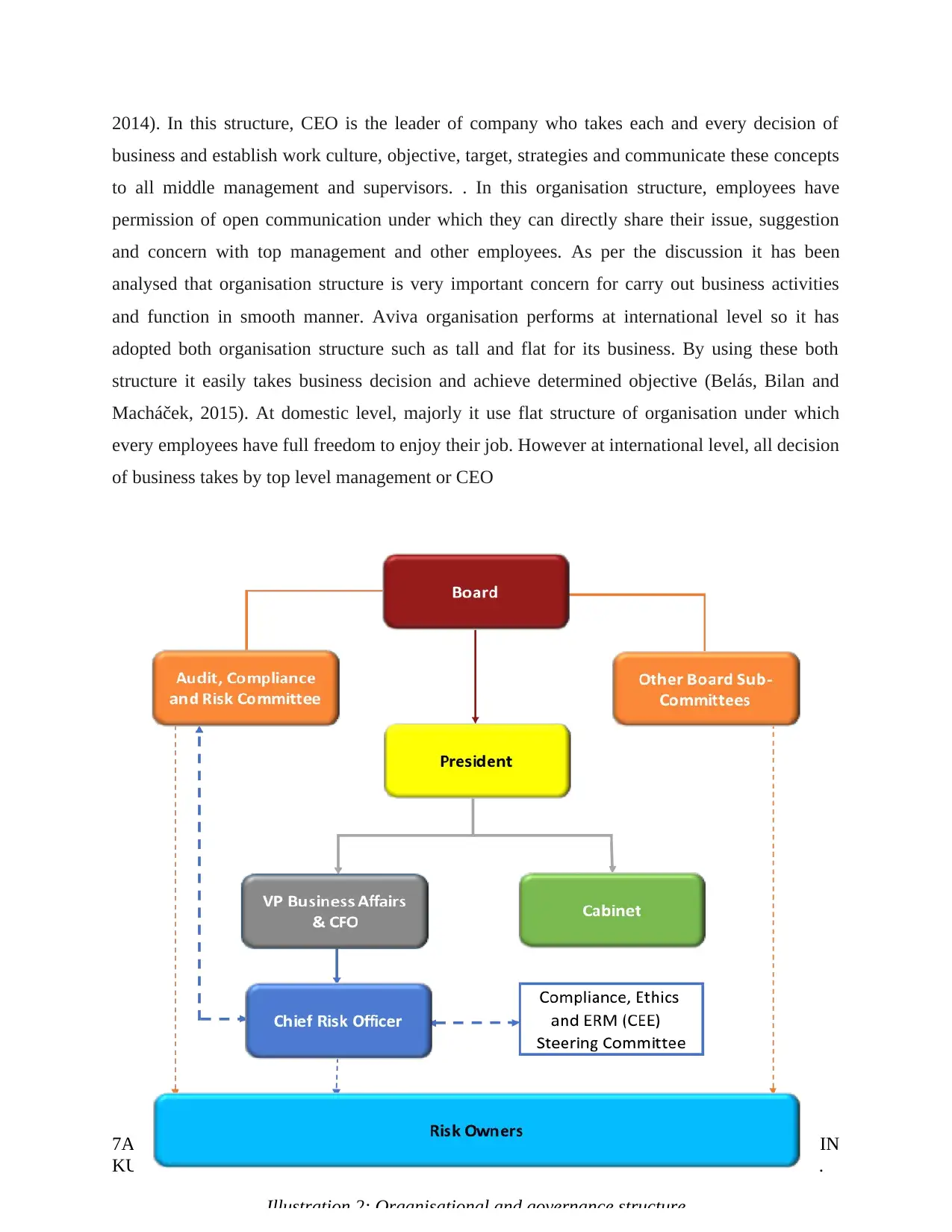
2014). In this structure, CEO is the leader of company who takes each and every decision of
business and establish work culture, objective, target, strategies and communicate these concepts
to all middle management and supervisors. . In this organisation structure, employees have
permission of open communication under which they can directly share their issue, suggestion
and concern with top management and other employees. As per the discussion it has been
analysed that organisation structure is very important concern for carry out business activities
and function in smooth manner. Aviva organisation performs at international level so it has
adopted both organisation structure such as tall and flat for its business. By using these both
structure it easily takes business decision and achieve determined objective (Belás, Bilan and
Macháček, 2015). At domestic level, majorly it use flat structure of organisation under which
every employees have full freedom to enjoy their job. However at international level, all decision
of business takes by top level management or CEO
7Anwar, K., 2017. FACTORS AFFECTING STOCK EXCHANGE INVESTMENT IN
KURDISTAN. The International Journal of Accounting and Business Society, 25(1), pp.32-37.
Illustration 2: Organisational and governance structure
business and establish work culture, objective, target, strategies and communicate these concepts
to all middle management and supervisors. . In this organisation structure, employees have
permission of open communication under which they can directly share their issue, suggestion
and concern with top management and other employees. As per the discussion it has been
analysed that organisation structure is very important concern for carry out business activities
and function in smooth manner. Aviva organisation performs at international level so it has
adopted both organisation structure such as tall and flat for its business. By using these both
structure it easily takes business decision and achieve determined objective (Belás, Bilan and
Macháček, 2015). At domestic level, majorly it use flat structure of organisation under which
every employees have full freedom to enjoy their job. However at international level, all decision
of business takes by top level management or CEO
7Anwar, K., 2017. FACTORS AFFECTING STOCK EXCHANGE INVESTMENT IN
KURDISTAN. The International Journal of Accounting and Business Society, 25(1), pp.32-37.
Illustration 2: Organisational and governance structure
Paraphrase This Document
Need a fresh take? Get an instant paraphrase of this document with our AI Paraphraser
Aviva is managed across various countries with the help and support of its international
chief executives in various departments and regions of the company. These international
executives focus on analysing global markets and develop effective strategies for the company..
3. HOW COMPANY IS GOVERNED
Aviva Plc is made up of various senior executives and executive directors. They meet
twice a month where the chief executive offices discuss various financial, commercial,
reputational matters sand strategies for the company. On 12 September 2014 Sir Adrian
Montague was appointed as the chairman of company, Thomas Stoddard is the chief financial
officer, Maurice Tulloch is the international chief executive officer. It also includes various
independent officers who design, develop and implement distinct strategies for Aviva Plc. The
company has around 29,600 employees, along with 3 executive directors and 4 non-executive
directors.
3.1 Stakeholders
A person or party with an interest or concern in something, mainly business, stakeholders
can get influenced by organisational activities objectives and policies. For example – Creditors,
employees, directors, Owners or shareholders, etc (Omeje, 2017).
3.2 Shareholders
Shareholders and Board of directors are two main but entirely different bodies of an
organisation. Shareholders are the owner of a business and board of directors manage that
business (Amihud and Stoyanov, 2017). For examples internal stakeholders of Aviva company are
employees , investors , board of directors etc.
3.3 Employees
Aviva Plc has around 30,000 employees who work together to achieve the organisational
goals and objectives of the company. It is very important to have a strong relationship between
the staff and Board of directors. This relation can be major sources of success for the
organisation. The employees are rewarded by directors with monetary and non-monetary benefits
such as bonus, incentives, promotions, appraisal etc. For example – commission on insurance
policies. For example managers (Botha, Kourie and Snyman, 2014).
8Anwar, K., 2017. FACTORS AFFECTING STOCK EXCHANGE INVESTMENT IN
KURDISTAN. The International Journal of Accounting and Business Society, 25(1), pp.32-37.
chief executives in various departments and regions of the company. These international
executives focus on analysing global markets and develop effective strategies for the company..
3. HOW COMPANY IS GOVERNED
Aviva Plc is made up of various senior executives and executive directors. They meet
twice a month where the chief executive offices discuss various financial, commercial,
reputational matters sand strategies for the company. On 12 September 2014 Sir Adrian
Montague was appointed as the chairman of company, Thomas Stoddard is the chief financial
officer, Maurice Tulloch is the international chief executive officer. It also includes various
independent officers who design, develop and implement distinct strategies for Aviva Plc. The
company has around 29,600 employees, along with 3 executive directors and 4 non-executive
directors.
3.1 Stakeholders
A person or party with an interest or concern in something, mainly business, stakeholders
can get influenced by organisational activities objectives and policies. For example – Creditors,
employees, directors, Owners or shareholders, etc (Omeje, 2017).
3.2 Shareholders
Shareholders and Board of directors are two main but entirely different bodies of an
organisation. Shareholders are the owner of a business and board of directors manage that
business (Amihud and Stoyanov, 2017). For examples internal stakeholders of Aviva company are
employees , investors , board of directors etc.
3.3 Employees
Aviva Plc has around 30,000 employees who work together to achieve the organisational
goals and objectives of the company. It is very important to have a strong relationship between
the staff and Board of directors. This relation can be major sources of success for the
organisation. The employees are rewarded by directors with monetary and non-monetary benefits
such as bonus, incentives, promotions, appraisal etc. For example – commission on insurance
policies. For example managers (Botha, Kourie and Snyman, 2014).
8Anwar, K., 2017. FACTORS AFFECTING STOCK EXCHANGE INVESTMENT IN
KURDISTAN. The International Journal of Accounting and Business Society, 25(1), pp.32-37.
3.4 Public
Public refers to the customers or potential buyers of products and services offered by the
organisation. There is no direct relationship between public and board members but the directors
of any company such as Aviva plc communicate with the public (Lippmann, 2017).. The methods
of interacting with the people include advertisements, sponsorships, feedbacks etc. All this ways
help the organisation to understand the needs of the customers and create a strong relationship
with them to gain more profits.
4. PESTLE ANALYSIS
Pestle analysis is a strategic technique that helps in analysing macro environment of an
organisation. PESTLE sands for Political, Economic, Social, Technological, Environmental and
Legal factors that affect the macro environment of Aviva Plc (Pestle analysis, 2017). Various
changes in the macro environment factors can directly affect Aviva Plc or any other organisation
in insurance business. There are various factors Aviva Plc needs to analyse to sustain in the
business environment as mentioned below –
5. ELEMENTS OF PESTLE ANALYSIS
5.1 Political
Political components assume a huge job in deciding the variables that can affect Aviva
Plc's long haul benefit in a specific nation or market (Pestle analysis, 2017). Aviva Plc is
working in Insurance in excess of dozen nations and open itself to various sorts of political
condition and political framework dangers. The make progress in such a dynamic Insurance
industry crosswise over different nations is to differentiate the efficient dangers of political
condition.
1. Risk of military invasion
2. Legal framework for contract enforcement
3. Trade Tariffs and regulations related to financials
4. Level of corruption mainly levels of regulation in financial sector
For example – Change in government lead to change in taxation and other policies that influence
the price of products in Aviva leading to change in profitability and performance.
9Anwar, K., 2017. FACTORS AFFECTING STOCK EXCHANGE INVESTMENT IN
KURDISTAN. The International Journal of Accounting and Business Society, 25(1), pp.32-37.
Public refers to the customers or potential buyers of products and services offered by the
organisation. There is no direct relationship between public and board members but the directors
of any company such as Aviva plc communicate with the public (Lippmann, 2017).. The methods
of interacting with the people include advertisements, sponsorships, feedbacks etc. All this ways
help the organisation to understand the needs of the customers and create a strong relationship
with them to gain more profits.
4. PESTLE ANALYSIS
Pestle analysis is a strategic technique that helps in analysing macro environment of an
organisation. PESTLE sands for Political, Economic, Social, Technological, Environmental and
Legal factors that affect the macro environment of Aviva Plc (Pestle analysis, 2017). Various
changes in the macro environment factors can directly affect Aviva Plc or any other organisation
in insurance business. There are various factors Aviva Plc needs to analyse to sustain in the
business environment as mentioned below –
5. ELEMENTS OF PESTLE ANALYSIS
5.1 Political
Political components assume a huge job in deciding the variables that can affect Aviva
Plc's long haul benefit in a specific nation or market (Pestle analysis, 2017). Aviva Plc is
working in Insurance in excess of dozen nations and open itself to various sorts of political
condition and political framework dangers. The make progress in such a dynamic Insurance
industry crosswise over different nations is to differentiate the efficient dangers of political
condition.
1. Risk of military invasion
2. Legal framework for contract enforcement
3. Trade Tariffs and regulations related to financials
4. Level of corruption mainly levels of regulation in financial sector
For example – Change in government lead to change in taxation and other policies that influence
the price of products in Aviva leading to change in profitability and performance.
9Anwar, K., 2017. FACTORS AFFECTING STOCK EXCHANGE INVESTMENT IN
KURDISTAN. The International Journal of Accounting and Business Society, 25(1), pp.32-37.
⊘ This is a preview!⊘
Do you want full access?
Subscribe today to unlock all pages.
Trusted by 1+ million students worldwide
5.2 Economic
The Macro condition factors, for example, – expansion rate, funds rate, loan cost and
remote conversion standard and monetary cycle decide the total interest and total interest in an
economy. While small scale condition factors, for example, rivalry standards affect the upper
hand of the firm (Pestle analysis, 2017). Aviva Plc can utilize nation's financial factor, for
example, development rate, expansion and industry's monetary pointers, for example, Insurance
industry development rate, shopper spending and so forth to estimate the development direction
of - sector name- - segment as well as that of the association.
The various economic factors affecting Aviva Plc are as follows:
1. Government intervention in the free market and other related financials
2. Stability and Exchange rates of host nation’s currency
3. Education level in the economy
4. Growth rate of the economy
5. Productivity and cost of labour in the economy
For example – Aviva plc needs to change consider the inflation rate and cost of labour while
recruiting the human resources.
Economic factors includes change in exchange rate, fluctuations in prices of
products, interest rate, etc. these variables have direct as well as significant impact on the
profitability of an organization. Increase in price of products also have direct effect on
the demand for companies products or services. These factors also influence the buying
power of company. It is required by manager in Aviva Plc to develop the strategies for
dealing with such changes.
5.3 Social
Society's way of life and method for doing things affect the way of life of an association
in a situation. Shared convictions and states of mind of the population assume an awesome job in
how advertisers at Aviva Plc will comprehend the customers of a given market and how they
plan the showcasing message for Insurance industry buyers (Benson, Morgan and Filippaios,
2014). The various social factors influencing Aviva Plc are mentioned as below –
1. Skills level and demographics of the population
10Anwar, K., 2017. FACTORS AFFECTING STOCK EXCHANGE INVESTMENT IN
KURDISTAN. The International Journal of Accounting and Business Society, 25(1), pp.32-37.
The Macro condition factors, for example, – expansion rate, funds rate, loan cost and
remote conversion standard and monetary cycle decide the total interest and total interest in an
economy. While small scale condition factors, for example, rivalry standards affect the upper
hand of the firm (Pestle analysis, 2017). Aviva Plc can utilize nation's financial factor, for
example, development rate, expansion and industry's monetary pointers, for example, Insurance
industry development rate, shopper spending and so forth to estimate the development direction
of - sector name- - segment as well as that of the association.
The various economic factors affecting Aviva Plc are as follows:
1. Government intervention in the free market and other related financials
2. Stability and Exchange rates of host nation’s currency
3. Education level in the economy
4. Growth rate of the economy
5. Productivity and cost of labour in the economy
For example – Aviva plc needs to change consider the inflation rate and cost of labour while
recruiting the human resources.
Economic factors includes change in exchange rate, fluctuations in prices of
products, interest rate, etc. these variables have direct as well as significant impact on the
profitability of an organization. Increase in price of products also have direct effect on
the demand for companies products or services. These factors also influence the buying
power of company. It is required by manager in Aviva Plc to develop the strategies for
dealing with such changes.
5.3 Social
Society's way of life and method for doing things affect the way of life of an association
in a situation. Shared convictions and states of mind of the population assume an awesome job in
how advertisers at Aviva Plc will comprehend the customers of a given market and how they
plan the showcasing message for Insurance industry buyers (Benson, Morgan and Filippaios,
2014). The various social factors influencing Aviva Plc are mentioned as below –
1. Skills level and demographics of the population
10Anwar, K., 2017. FACTORS AFFECTING STOCK EXCHANGE INVESTMENT IN
KURDISTAN. The International Journal of Accounting and Business Society, 25(1), pp.32-37.
Paraphrase This Document
Need a fresh take? Get an instant paraphrase of this document with our AI Paraphraser
2. Hierarchy, class structure and power structure in the society
3. Culture, gender roles, social convention etc.
4. Environmental consciousness, Attitudes, Health etc.
For example – Lifestyle of people, culture etc.
Changes in taste and preference of customers trends, have direct as well as significant
impact on the demand for companies product in the market. It is required by manager in Aviva
company to develop product or services according to the need of customers, as this strategy will
assist an organisation in increasing sustainability in highly competitive business enviroment.
5.4 Technological
This is main consideration that will influence Aviva organization in the global market.
Country has high calibre and advancement ability individuals and aptitude in science and IT that
will strengthen organization in enhancing its business execution and efficiency. Moreover, there
are powerful laws as to protected innovation through which Aviva can keep secure its licensed
innovation from risk and threat. Be that as it may, because of moderate innovative advancement
in the correlation with United State, some methodology of business can adversely impact
(Granger and Schroeder, 2013). Aviva must need to consider mechanical condition before enter
in the UK advertise so as it will ready to smooth maintaining its business. In the universal
market, mechanical part is real concern. Aviva needs to embrace that innovations and types of
gear which are accessible in the universal market. Changing innovation may create the issue for
organization so organization ought to successfully break down this segment. This is an extremely
visit changing perspective in the nation consequently organization need to think about this factor
in a compelling way. The significant favourable position of the innovation is that organization
can improve its advertising, client network, etc.
The various technological factors that are influencing Aviva Plc are as mentioned below -
1. Impact on value chain structure in insurance industry
2. Rate of technological diffusion
3. Impact of technology of product offering
4. Impact on cost structure within the insurance sector
11Anwar, K., 2017. FACTORS AFFECTING STOCK EXCHANGE INVESTMENT IN
KURDISTAN. The International Journal of Accounting and Business Society, 25(1), pp.32-37.
3. Culture, gender roles, social convention etc.
4. Environmental consciousness, Attitudes, Health etc.
For example – Lifestyle of people, culture etc.
Changes in taste and preference of customers trends, have direct as well as significant
impact on the demand for companies product in the market. It is required by manager in Aviva
company to develop product or services according to the need of customers, as this strategy will
assist an organisation in increasing sustainability in highly competitive business enviroment.
5.4 Technological
This is main consideration that will influence Aviva organization in the global market.
Country has high calibre and advancement ability individuals and aptitude in science and IT that
will strengthen organization in enhancing its business execution and efficiency. Moreover, there
are powerful laws as to protected innovation through which Aviva can keep secure its licensed
innovation from risk and threat. Be that as it may, because of moderate innovative advancement
in the correlation with United State, some methodology of business can adversely impact
(Granger and Schroeder, 2013). Aviva must need to consider mechanical condition before enter
in the UK advertise so as it will ready to smooth maintaining its business. In the universal
market, mechanical part is real concern. Aviva needs to embrace that innovations and types of
gear which are accessible in the universal market. Changing innovation may create the issue for
organization so organization ought to successfully break down this segment. This is an extremely
visit changing perspective in the nation consequently organization need to think about this factor
in a compelling way. The significant favourable position of the innovation is that organization
can improve its advertising, client network, etc.
The various technological factors that are influencing Aviva Plc are as mentioned below -
1. Impact on value chain structure in insurance industry
2. Rate of technological diffusion
3. Impact of technology of product offering
4. Impact on cost structure within the insurance sector
11Anwar, K., 2017. FACTORS AFFECTING STOCK EXCHANGE INVESTMENT IN
KURDISTAN. The International Journal of Accounting and Business Society, 25(1), pp.32-37.
For example – Aviva Plc can use new technologies such as online marketing, mobile
applications etc to provide effective service to their customers, it helps in increasing the
satisfaction level and leading towards high profitability.
5.5 Environmental
This factor considers ecological conditions inside nation, for example, climate,
atmosphere, common assets, water air and so forth that will straightforwardly influence
generation and assembling technique of organisation.Uk now and then faces challenges with
regards to climate conditions. Organization ought to evaluate and investigate ecological state of
UK so as it can easily do its exercises and capacity in UK market. These every regular asset
influence the business task in substantial way since all creation and operational movement of
organization is relies on these common assets. Aviva guarantee that their exercises never
mischief to any condition. Customers are exceedingly fulfils by organization products through
viable quality. Along these lines, it has beneficial outcome on the organization results in
methodical way (Pestle analysis, 2017). Be that as it may, contenders of the referred to firm
make negative effect on them. This is obvious that, they are substitutes which give similar
products and administrations to their Customers at low cost. Therefore, Customers can move
towards the other organization
Different environmental factors influencing Aviva Plc are mentioned as below:
1. Climatic changes
2. Weather
3. Water and Air pollution regulations in insurance industry
4. Management of waste in financial sector
5. Support and Attitudes toward renewable energy
For example – Aviva plc can promote environmental safety which can attract customers in the
market. It helps in developing good image in the market.
5.6 Legal
This factor keeps secures the association's item, administrations and entire business.
Country have powerful enactment, standards and laws in regards to Customers, individuals,
12Anwar, K., 2017. FACTORS AFFECTING STOCK EXCHANGE INVESTMENT IN
KURDISTAN. The International Journal of Accounting and Business Society, 25(1), pp.32-37.
applications etc to provide effective service to their customers, it helps in increasing the
satisfaction level and leading towards high profitability.
5.5 Environmental
This factor considers ecological conditions inside nation, for example, climate,
atmosphere, common assets, water air and so forth that will straightforwardly influence
generation and assembling technique of organisation.Uk now and then faces challenges with
regards to climate conditions. Organization ought to evaluate and investigate ecological state of
UK so as it can easily do its exercises and capacity in UK market. These every regular asset
influence the business task in substantial way since all creation and operational movement of
organization is relies on these common assets. Aviva guarantee that their exercises never
mischief to any condition. Customers are exceedingly fulfils by organization products through
viable quality. Along these lines, it has beneficial outcome on the organization results in
methodical way (Pestle analysis, 2017). Be that as it may, contenders of the referred to firm
make negative effect on them. This is obvious that, they are substitutes which give similar
products and administrations to their Customers at low cost. Therefore, Customers can move
towards the other organization
Different environmental factors influencing Aviva Plc are mentioned as below:
1. Climatic changes
2. Weather
3. Water and Air pollution regulations in insurance industry
4. Management of waste in financial sector
5. Support and Attitudes toward renewable energy
For example – Aviva plc can promote environmental safety which can attract customers in the
market. It helps in developing good image in the market.
5.6 Legal
This factor keeps secures the association's item, administrations and entire business.
Country have powerful enactment, standards and laws in regards to Customers, individuals,
12Anwar, K., 2017. FACTORS AFFECTING STOCK EXCHANGE INVESTMENT IN
KURDISTAN. The International Journal of Accounting and Business Society, 25(1), pp.32-37.
⊘ This is a preview!⊘
Do you want full access?
Subscribe today to unlock all pages.
Trusted by 1+ million students worldwide

1 out of 15


Related Documents


Your All-in-One AI-Powered Toolkit for Academic Success.
+13062052269
info@desklib.com
Available 24*7 on WhatsApp / Email
![[object Object]](/_next/static/media/star-bottom.7253800d.svg)
Unlock your academic potential
Copyright © 2020–2026 A2Z Services. All Rights Reserved. Developed and managed by ZUCOL.