Research Project: Early Intervention Parental Awareness & Involvement
VerifiedAdded on 2022/01/22
|135
|23968
|427
Project
AI Summary
This project investigates the awareness and involvement of parents in early intervention programs for children with developmental disabilities. The study begins by establishing the context of early intervention services, emphasizing their significance in addressing developmental delays across physical, cognitive, communication, social-emotional, sensory, and adaptive domains. The project highlights the need for early intervention, citing the critical periods in early childhood development and the potential for these services to maximize a child's potential. It also discusses the impact on families, including the reduction of stress and improved attitudes, and the benefits to society through decreased dependence on social institutions. The scope of the study focuses on parental awareness and involvement, with the aim of providing recommendations for early intervention centers and families. The research aims to ascertain the level of awareness and involvement of parents. Specific objectives include assessing parental awareness of early intervention importance, parental involvement, developmental disabilities, and early intervention services. The study employs a descriptive survey design, with a sample of 110 parents from early intervention centers in Kottayam and Ernakulam. The project also formulates hypotheses regarding the influence of socio-demographic variables on parental awareness and involvement. The methodology will involve collecting data through surveys to determine the level of awareness and involvement of parents in early intervention for children with developmental disabilities.
1
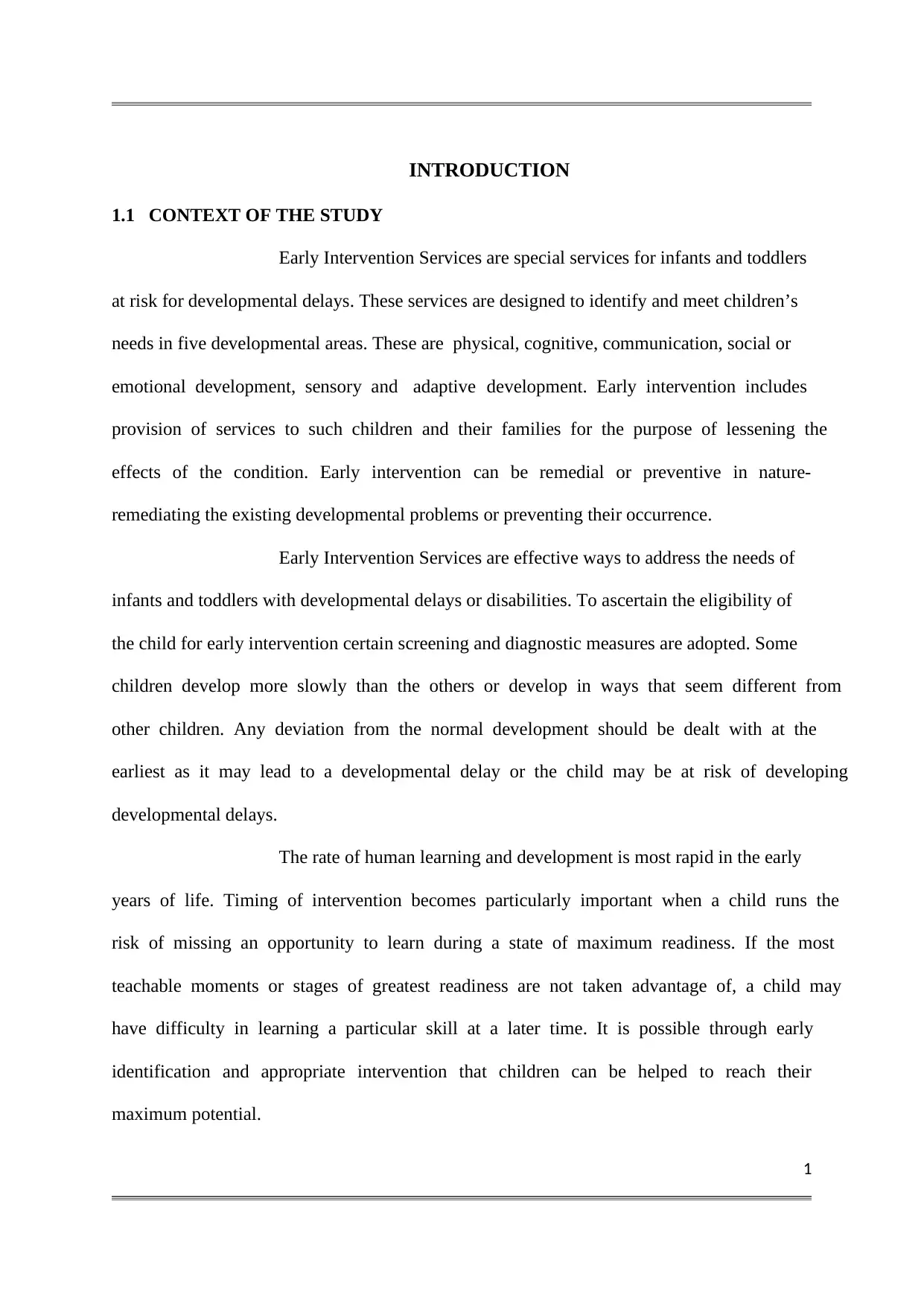
INTRODUCTION
1.1 CONTEXT OF THE STUDY
Early Intervention Services are special services for infants and toddlers
at risk for developmental delays. These services are designed to identify and meet children’s
needs in five developmental areas. These are physical, cognitive, communication, social or
emotional development, sensory and adaptive development. Early intervention includes
provision of services to such children and their families for the purpose of lessening the
effects of the condition. Early intervention can be remedial or preventive in nature-
remediating the existing developmental problems or preventing their occurrence.
Early Intervention Services are effective ways to address the needs of
infants and toddlers with developmental delays or disabilities. To ascertain the eligibility of
the child for early intervention certain screening and diagnostic measures are adopted. Some
children develop more slowly than the others or develop in ways that seem different from
other children. Any deviation from the normal development should be dealt with at the
earliest as it may lead to a developmental delay or the child may be at risk of developing
developmental delays.
The rate of human learning and development is most rapid in the early
years of life. Timing of intervention becomes particularly important when a child runs the
risk of missing an opportunity to learn during a state of maximum readiness. If the most
teachable moments or stages of greatest readiness are not taken advantage of, a child may
have difficulty in learning a particular skill at a later time. It is possible through early
identification and appropriate intervention that children can be helped to reach their
maximum potential.
INTRODUCTION
1.1 CONTEXT OF THE STUDY
Early Intervention Services are special services for infants and toddlers
at risk for developmental delays. These services are designed to identify and meet children’s
needs in five developmental areas. These are physical, cognitive, communication, social or
emotional development, sensory and adaptive development. Early intervention includes
provision of services to such children and their families for the purpose of lessening the
effects of the condition. Early intervention can be remedial or preventive in nature-
remediating the existing developmental problems or preventing their occurrence.
Early Intervention Services are effective ways to address the needs of
infants and toddlers with developmental delays or disabilities. To ascertain the eligibility of
the child for early intervention certain screening and diagnostic measures are adopted. Some
children develop more slowly than the others or develop in ways that seem different from
other children. Any deviation from the normal development should be dealt with at the
earliest as it may lead to a developmental delay or the child may be at risk of developing
developmental delays.
The rate of human learning and development is most rapid in the early
years of life. Timing of intervention becomes particularly important when a child runs the
risk of missing an opportunity to learn during a state of maximum readiness. If the most
teachable moments or stages of greatest readiness are not taken advantage of, a child may
have difficulty in learning a particular skill at a later time. It is possible through early
identification and appropriate intervention that children can be helped to reach their
maximum potential.

Paraphrase This Document
Need a fresh take? Get an instant paraphrase of this document with our AI Paraphraser
2
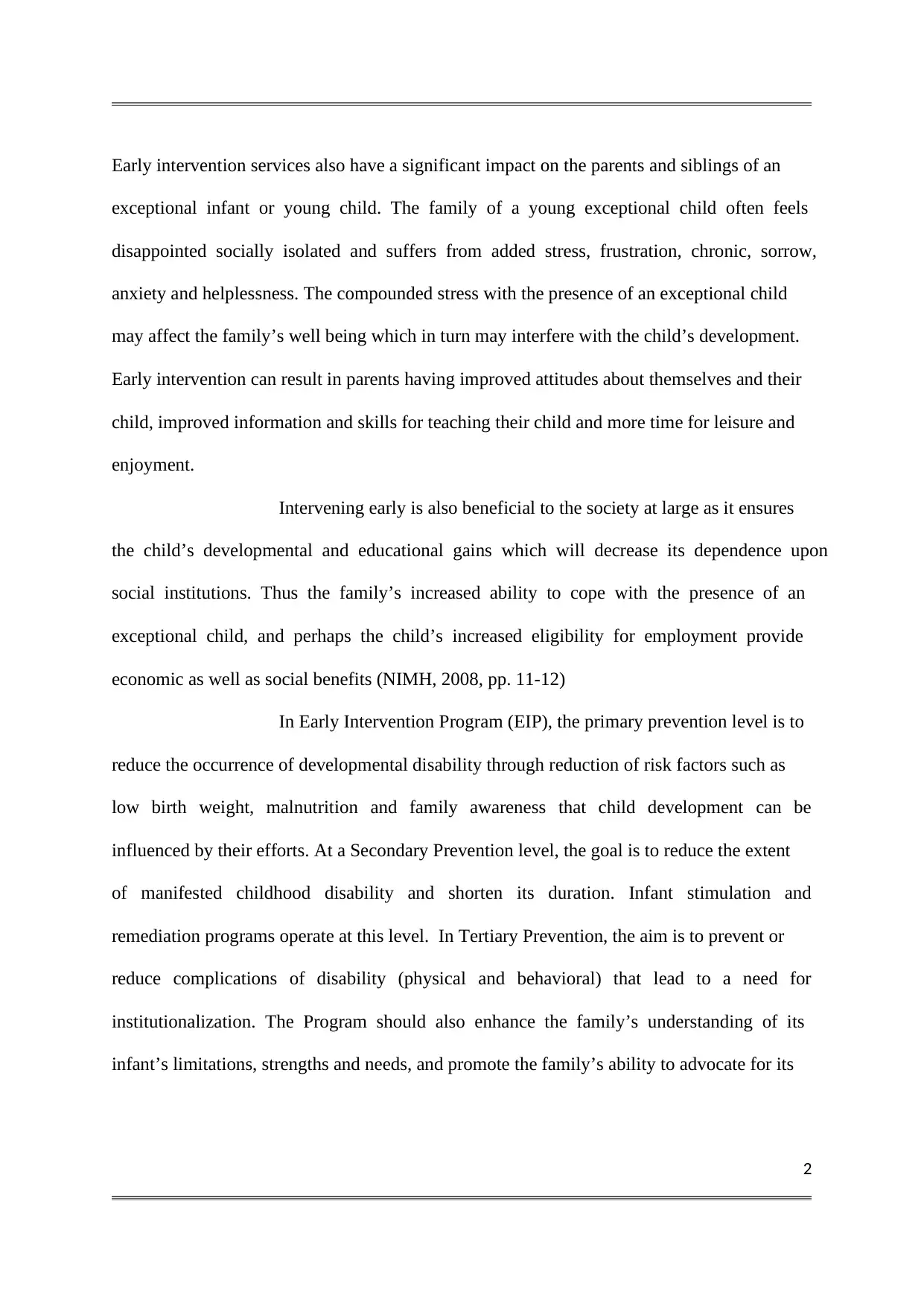
Early intervention services also have a significant impact on the parents and siblings of an
exceptional infant or young child. The family of a young exceptional child often feels
disappointed socially isolated and suffers from added stress, frustration, chronic, sorrow,
anxiety and helplessness. The compounded stress with the presence of an exceptional child
may affect the family’s well being which in turn may interfere with the child’s development.
Early intervention can result in parents having improved attitudes about themselves and their
child, improved information and skills for teaching their child and more time for leisure and
enjoyment.
Intervening early is also beneficial to the society at large as it ensures
the child’s developmental and educational gains which will decrease its dependence upon
social institutions. Thus the family’s increased ability to cope with the presence of an
exceptional child, and perhaps the child’s increased eligibility for employment provide
economic as well as social benefits (NIMH, 2008, pp. 11-12)
In Early Intervention Program (EIP), the primary prevention level is to
reduce the occurrence of developmental disability through reduction of risk factors such as
low birth weight, malnutrition and family awareness that child development can be
influenced by their efforts. At a Secondary Prevention level, the goal is to reduce the extent
of manifested childhood disability and shorten its duration. Infant stimulation and
remediation programs operate at this level. In Tertiary Prevention, the aim is to prevent or
reduce complications of disability (physical and behavioral) that lead to a need for
institutionalization. The Program should also enhance the family’s understanding of its
infant’s limitations, strengths and needs, and promote the family’s ability to advocate for its
Early intervention services also have a significant impact on the parents and siblings of an
exceptional infant or young child. The family of a young exceptional child often feels
disappointed socially isolated and suffers from added stress, frustration, chronic, sorrow,
anxiety and helplessness. The compounded stress with the presence of an exceptional child
may affect the family’s well being which in turn may interfere with the child’s development.
Early intervention can result in parents having improved attitudes about themselves and their
child, improved information and skills for teaching their child and more time for leisure and
enjoyment.
Intervening early is also beneficial to the society at large as it ensures
the child’s developmental and educational gains which will decrease its dependence upon
social institutions. Thus the family’s increased ability to cope with the presence of an
exceptional child, and perhaps the child’s increased eligibility for employment provide
economic as well as social benefits (NIMH, 2008, pp. 11-12)
In Early Intervention Program (EIP), the primary prevention level is to
reduce the occurrence of developmental disability through reduction of risk factors such as
low birth weight, malnutrition and family awareness that child development can be
influenced by their efforts. At a Secondary Prevention level, the goal is to reduce the extent
of manifested childhood disability and shorten its duration. Infant stimulation and
remediation programs operate at this level. In Tertiary Prevention, the aim is to prevent or
reduce complications of disability (physical and behavioral) that lead to a need for
institutionalization. The Program should also enhance the family’s understanding of its
infant’s limitations, strengths and needs, and promote the family’s ability to advocate for its
3
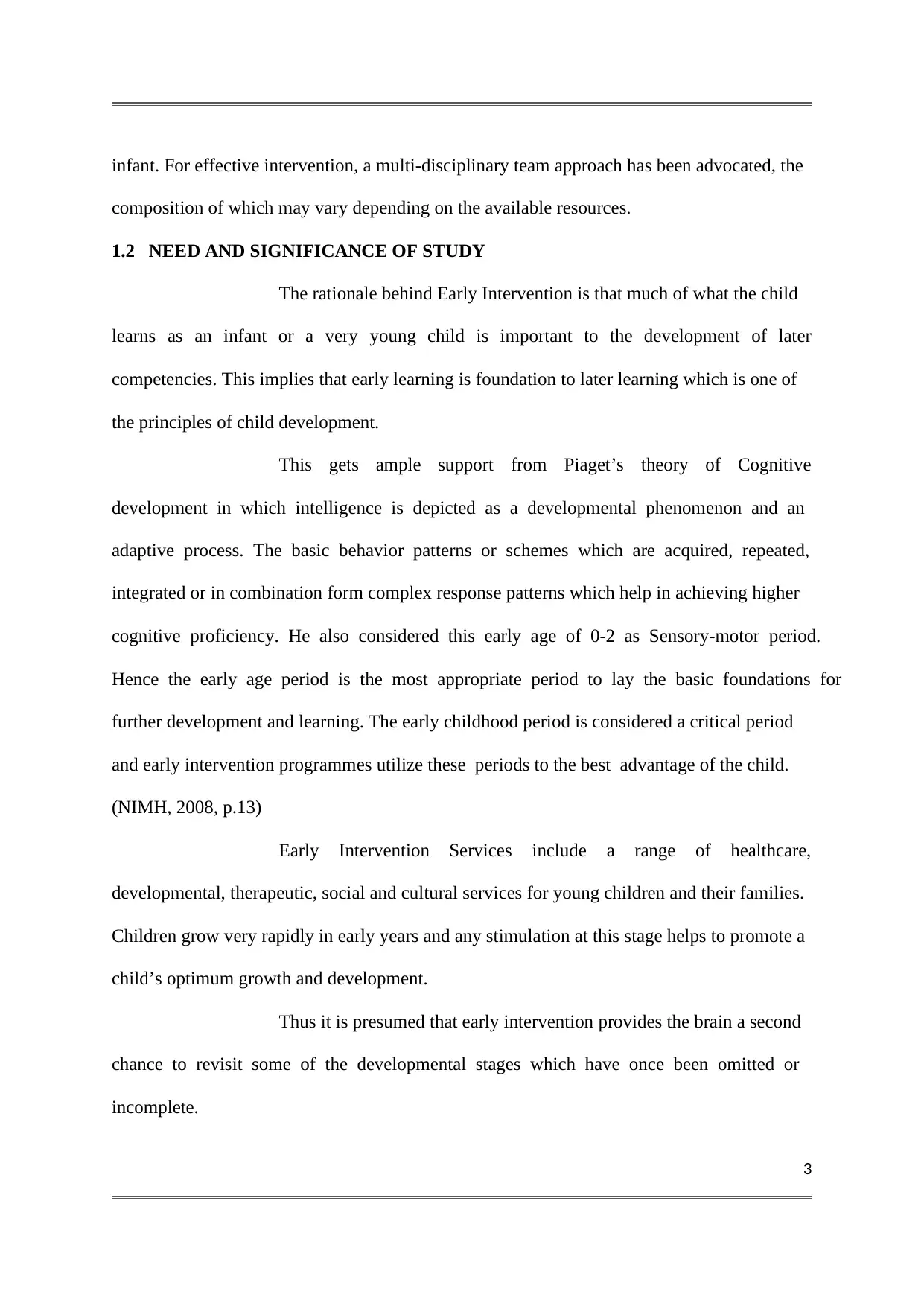
infant. For effective intervention, a multi-disciplinary team approach has been advocated, the
composition of which may vary depending on the available resources.
1.2 NEED AND SIGNIFICANCE OF STUDY
The rationale behind Early Intervention is that much of what the child
learns as an infant or a very young child is important to the development of later
competencies. This implies that early learning is foundation to later learning which is one of
the principles of child development.
This gets ample support from Piaget’s theory of Cognitive
development in which intelligence is depicted as a developmental phenomenon and an
adaptive process. The basic behavior patterns or schemes which are acquired, repeated,
integrated or in combination form complex response patterns which help in achieving higher
cognitive proficiency. He also considered this early age of 0-2 as Sensory-motor period.
Hence the early age period is the most appropriate period to lay the basic foundations for
further development and learning. The early childhood period is considered a critical period
and early intervention programmes utilize these periods to the best advantage of the child.
(NIMH, 2008, p.13)
Early Intervention Services include a range of healthcare,
developmental, therapeutic, social and cultural services for young children and their families.
Children grow very rapidly in early years and any stimulation at this stage helps to promote a
child’s optimum growth and development.
Thus it is presumed that early intervention provides the brain a second
chance to revisit some of the developmental stages which have once been omitted or
incomplete.
infant. For effective intervention, a multi-disciplinary team approach has been advocated, the
composition of which may vary depending on the available resources.
1.2 NEED AND SIGNIFICANCE OF STUDY
The rationale behind Early Intervention is that much of what the child
learns as an infant or a very young child is important to the development of later
competencies. This implies that early learning is foundation to later learning which is one of
the principles of child development.
This gets ample support from Piaget’s theory of Cognitive
development in which intelligence is depicted as a developmental phenomenon and an
adaptive process. The basic behavior patterns or schemes which are acquired, repeated,
integrated or in combination form complex response patterns which help in achieving higher
cognitive proficiency. He also considered this early age of 0-2 as Sensory-motor period.
Hence the early age period is the most appropriate period to lay the basic foundations for
further development and learning. The early childhood period is considered a critical period
and early intervention programmes utilize these periods to the best advantage of the child.
(NIMH, 2008, p.13)
Early Intervention Services include a range of healthcare,
developmental, therapeutic, social and cultural services for young children and their families.
Children grow very rapidly in early years and any stimulation at this stage helps to promote a
child’s optimum growth and development.
Thus it is presumed that early intervention provides the brain a second
chance to revisit some of the developmental stages which have once been omitted or
incomplete.
⊘ This is a preview!⊘
Do you want full access?
Subscribe today to unlock all pages.

Trusted by 1+ million students worldwide
4
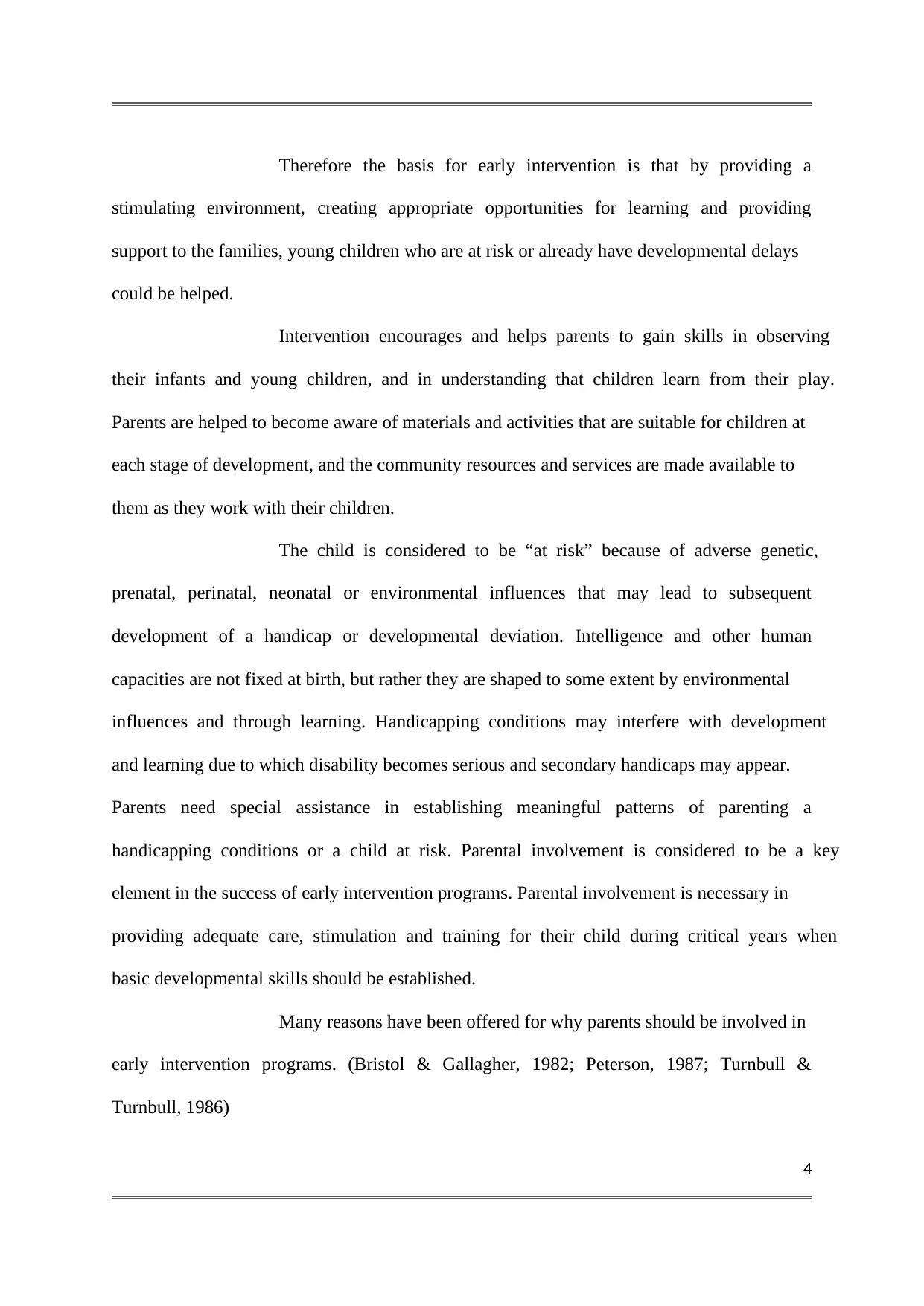
Therefore the basis for early intervention is that by providing a
stimulating environment, creating appropriate opportunities for learning and providing
support to the families, young children who are at risk or already have developmental delays
could be helped.
Intervention encourages and helps parents to gain skills in observing
their infants and young children, and in understanding that children learn from their play.
Parents are helped to become aware of materials and activities that are suitable for children at
each stage of development, and the community resources and services are made available to
them as they work with their children.
The child is considered to be “at risk” because of adverse genetic,
prenatal, perinatal, neonatal or environmental influences that may lead to subsequent
development of a handicap or developmental deviation. Intelligence and other human
capacities are not fixed at birth, but rather they are shaped to some extent by environmental
influences and through learning. Handicapping conditions may interfere with development
and learning due to which disability becomes serious and secondary handicaps may appear.
Parents need special assistance in establishing meaningful patterns of parenting a
handicapping conditions or a child at risk. Parental involvement is considered to be a key
element in the success of early intervention programs. Parental involvement is necessary in
providing adequate care, stimulation and training for their child during critical years when
basic developmental skills should be established.
Many reasons have been offered for why parents should be involved in
early intervention programs. (Bristol & Gallagher, 1982; Peterson, 1987; Turnbull &
Turnbull, 1986)
Therefore the basis for early intervention is that by providing a
stimulating environment, creating appropriate opportunities for learning and providing
support to the families, young children who are at risk or already have developmental delays
could be helped.
Intervention encourages and helps parents to gain skills in observing
their infants and young children, and in understanding that children learn from their play.
Parents are helped to become aware of materials and activities that are suitable for children at
each stage of development, and the community resources and services are made available to
them as they work with their children.
The child is considered to be “at risk” because of adverse genetic,
prenatal, perinatal, neonatal or environmental influences that may lead to subsequent
development of a handicap or developmental deviation. Intelligence and other human
capacities are not fixed at birth, but rather they are shaped to some extent by environmental
influences and through learning. Handicapping conditions may interfere with development
and learning due to which disability becomes serious and secondary handicaps may appear.
Parents need special assistance in establishing meaningful patterns of parenting a
handicapping conditions or a child at risk. Parental involvement is considered to be a key
element in the success of early intervention programs. Parental involvement is necessary in
providing adequate care, stimulation and training for their child during critical years when
basic developmental skills should be established.
Many reasons have been offered for why parents should be involved in
early intervention programs. (Bristol & Gallagher, 1982; Peterson, 1987; Turnbull &
Turnbull, 1986)
Paraphrase This Document
Need a fresh take? Get an instant paraphrase of this document with our AI Paraphraser
5
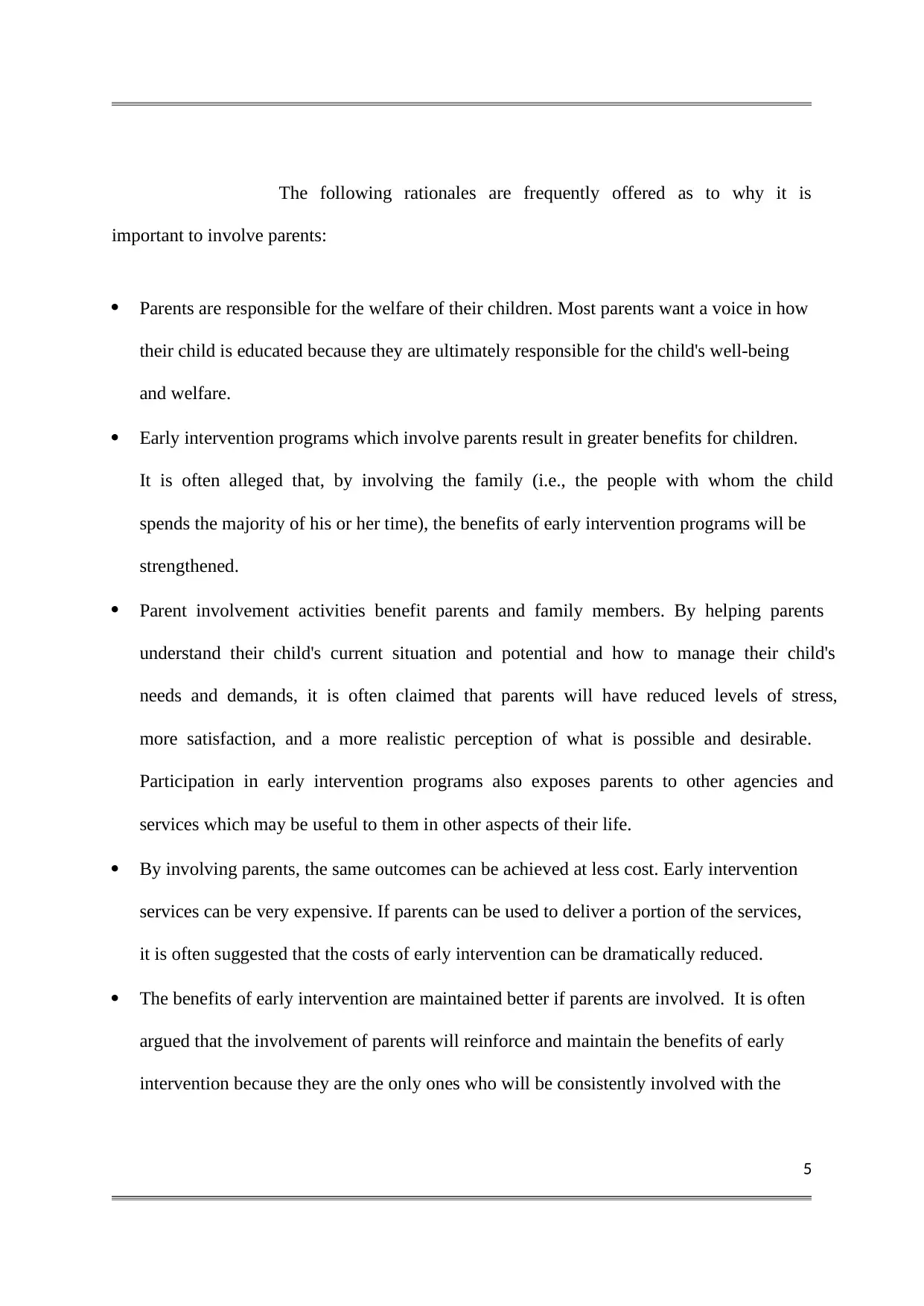
The following rationales are frequently offered as to why it is
important to involve parents:
Parents are responsible for the welfare of their children. Most parents want a voice in how
their child is educated because they are ultimately responsible for the child's well-being
and welfare.
Early intervention programs which involve parents result in greater benefits for children.
It is often alleged that, by involving the family (i.e., the people with whom the child
spends the majority of his or her time), the benefits of early intervention programs will be
strengthened.
Parent involvement activities benefit parents and family members. By helping parents
understand their child's current situation and potential and how to manage their child's
needs and demands, it is often claimed that parents will have reduced levels of stress,
more satisfaction, and a more realistic perception of what is possible and desirable.
Participation in early intervention programs also exposes parents to other agencies and
services which may be useful to them in other aspects of their life.
By involving parents, the same outcomes can be achieved at less cost. Early intervention
services can be very expensive. If parents can be used to deliver a portion of the services,
it is often suggested that the costs of early intervention can be dramatically reduced.
The benefits of early intervention are maintained better if parents are involved. It is often
argued that the involvement of parents will reinforce and maintain the benefits of early
intervention because they are the only ones who will be consistently involved with the
The following rationales are frequently offered as to why it is
important to involve parents:
Parents are responsible for the welfare of their children. Most parents want a voice in how
their child is educated because they are ultimately responsible for the child's well-being
and welfare.
Early intervention programs which involve parents result in greater benefits for children.
It is often alleged that, by involving the family (i.e., the people with whom the child
spends the majority of his or her time), the benefits of early intervention programs will be
strengthened.
Parent involvement activities benefit parents and family members. By helping parents
understand their child's current situation and potential and how to manage their child's
needs and demands, it is often claimed that parents will have reduced levels of stress,
more satisfaction, and a more realistic perception of what is possible and desirable.
Participation in early intervention programs also exposes parents to other agencies and
services which may be useful to them in other aspects of their life.
By involving parents, the same outcomes can be achieved at less cost. Early intervention
services can be very expensive. If parents can be used to deliver a portion of the services,
it is often suggested that the costs of early intervention can be dramatically reduced.
The benefits of early intervention are maintained better if parents are involved. It is often
argued that the involvement of parents will reinforce and maintain the benefits of early
intervention because they are the only ones who will be consistently involved with the
6
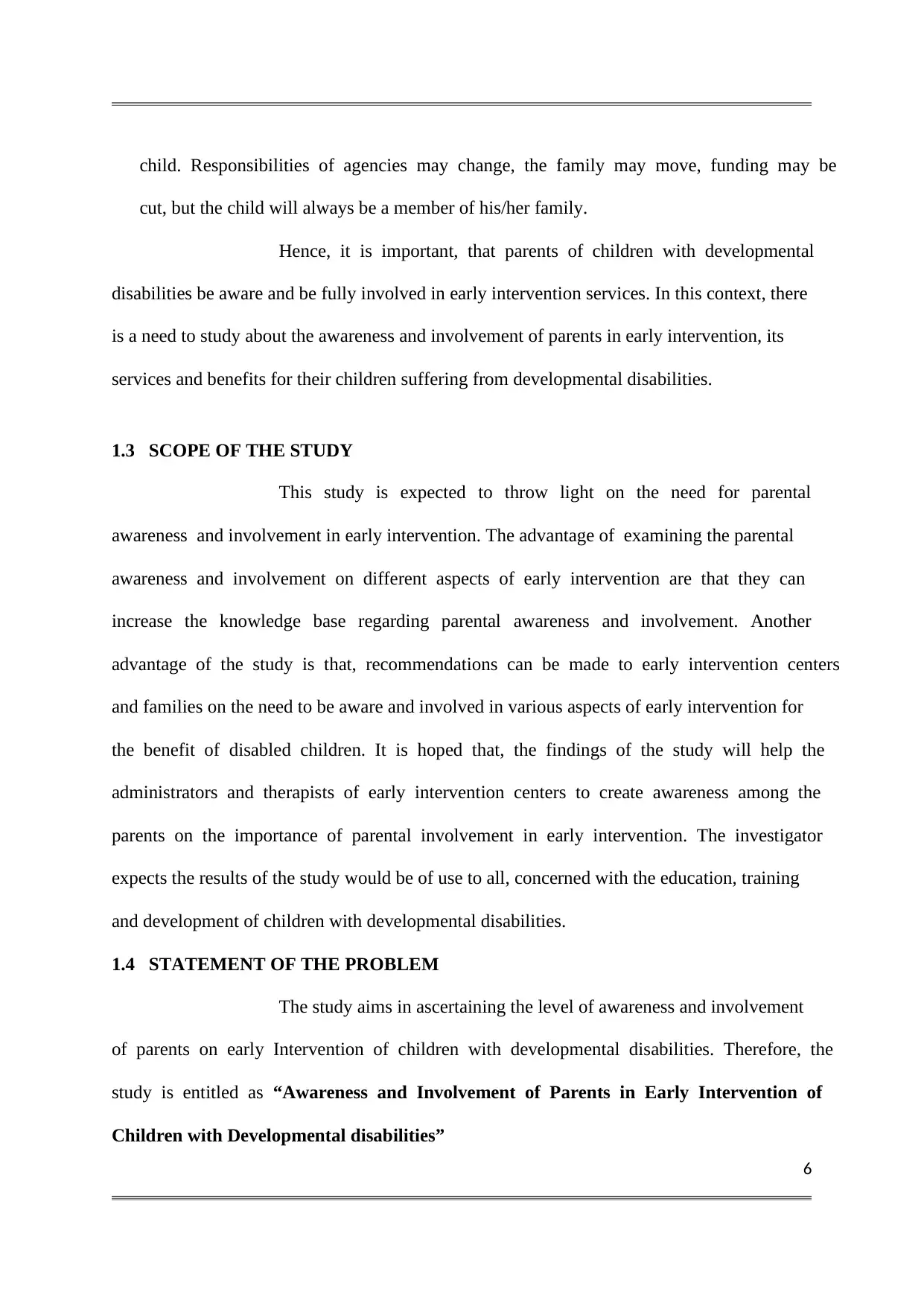
child. Responsibilities of agencies may change, the family may move, funding may be
cut, but the child will always be a member of his/her family.
Hence, it is important, that parents of children with developmental
disabilities be aware and be fully involved in early intervention services. In this context, there
is a need to study about the awareness and involvement of parents in early intervention, its
services and benefits for their children suffering from developmental disabilities.
1.3 SCOPE OF THE STUDY
This study is expected to throw light on the need for parental
awareness and involvement in early intervention. The advantage of examining the parental
awareness and involvement on different aspects of early intervention are that they can
increase the knowledge base regarding parental awareness and involvement. Another
advantage of the study is that, recommendations can be made to early intervention centers
and families on the need to be aware and involved in various aspects of early intervention for
the benefit of disabled children. It is hoped that, the findings of the study will help the
administrators and therapists of early intervention centers to create awareness among the
parents on the importance of parental involvement in early intervention. The investigator
expects the results of the study would be of use to all, concerned with the education, training
and development of children with developmental disabilities.
1.4 STATEMENT OF THE PROBLEM
The study aims in ascertaining the level of awareness and involvement
of parents on early Intervention of children with developmental disabilities. Therefore, the
study is entitled as “Awareness and Involvement of Parents in Early Intervention of
Children with Developmental disabilities”
child. Responsibilities of agencies may change, the family may move, funding may be
cut, but the child will always be a member of his/her family.
Hence, it is important, that parents of children with developmental
disabilities be aware and be fully involved in early intervention services. In this context, there
is a need to study about the awareness and involvement of parents in early intervention, its
services and benefits for their children suffering from developmental disabilities.
1.3 SCOPE OF THE STUDY
This study is expected to throw light on the need for parental
awareness and involvement in early intervention. The advantage of examining the parental
awareness and involvement on different aspects of early intervention are that they can
increase the knowledge base regarding parental awareness and involvement. Another
advantage of the study is that, recommendations can be made to early intervention centers
and families on the need to be aware and involved in various aspects of early intervention for
the benefit of disabled children. It is hoped that, the findings of the study will help the
administrators and therapists of early intervention centers to create awareness among the
parents on the importance of parental involvement in early intervention. The investigator
expects the results of the study would be of use to all, concerned with the education, training
and development of children with developmental disabilities.
1.4 STATEMENT OF THE PROBLEM
The study aims in ascertaining the level of awareness and involvement
of parents on early Intervention of children with developmental disabilities. Therefore, the
study is entitled as “Awareness and Involvement of Parents in Early Intervention of
Children with Developmental disabilities”
⊘ This is a preview!⊘
Do you want full access?
Subscribe today to unlock all pages.
Trusted by 1+ million students worldwide
7
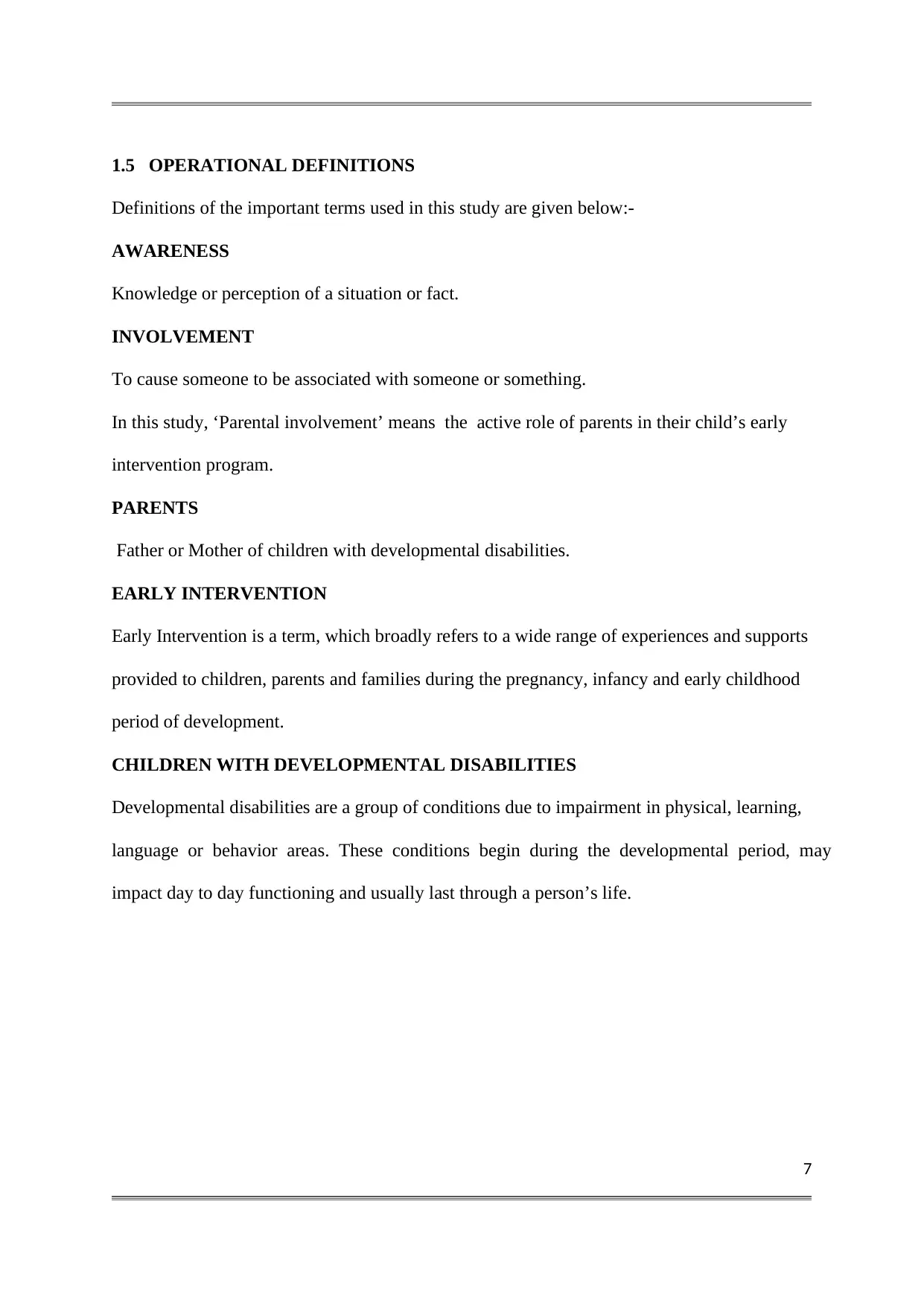
1.5 OPERATIONAL DEFINITIONS
Definitions of the important terms used in this study are given below:-
AWARENESS
Knowledge or perception of a situation or fact.
INVOLVEMENT
To cause someone to be associated with someone or something.
In this study, ‘Parental involvement’ means the active role of parents in their child’s early
intervention program.
PARENTS
Father or Mother of children with developmental disabilities.
EARLY INTERVENTION
Early Intervention is a term, which broadly refers to a wide range of experiences and supports
provided to children, parents and families during the pregnancy, infancy and early childhood
period of development.
CHILDREN WITH DEVELOPMENTAL DISABILITIES
Developmental disabilities are a group of conditions due to impairment in physical, learning,
language or behavior areas. These conditions begin during the developmental period, may
impact day to day functioning and usually last through a person’s life.
1.5 OPERATIONAL DEFINITIONS
Definitions of the important terms used in this study are given below:-
AWARENESS
Knowledge or perception of a situation or fact.
INVOLVEMENT
To cause someone to be associated with someone or something.
In this study, ‘Parental involvement’ means the active role of parents in their child’s early
intervention program.
PARENTS
Father or Mother of children with developmental disabilities.
EARLY INTERVENTION
Early Intervention is a term, which broadly refers to a wide range of experiences and supports
provided to children, parents and families during the pregnancy, infancy and early childhood
period of development.
CHILDREN WITH DEVELOPMENTAL DISABILITIES
Developmental disabilities are a group of conditions due to impairment in physical, learning,
language or behavior areas. These conditions begin during the developmental period, may
impact day to day functioning and usually last through a person’s life.
Paraphrase This Document
Need a fresh take? Get an instant paraphrase of this document with our AI Paraphraser
8
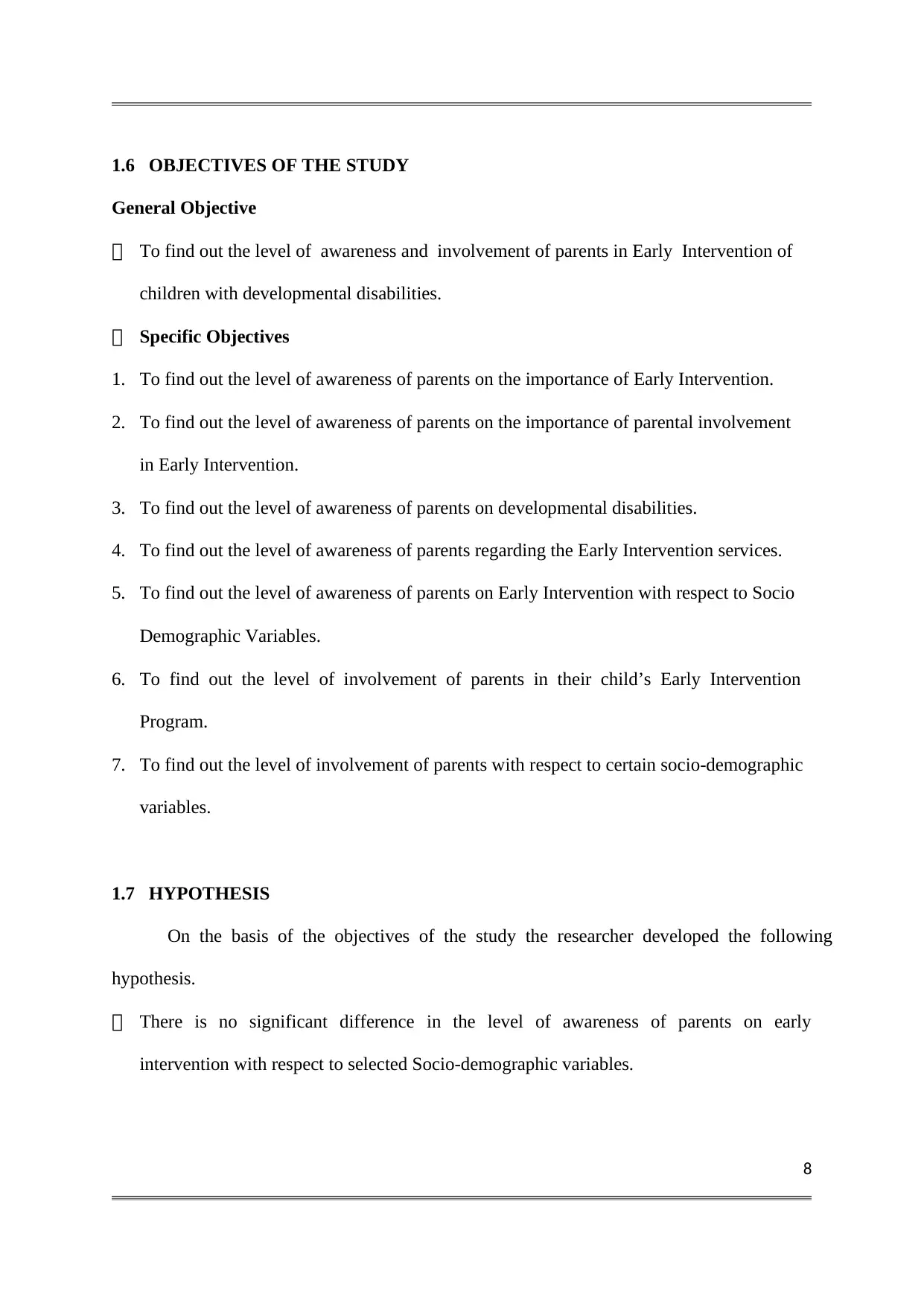
1.6 OBJECTIVES OF THE STUDY
General Objective
To find out the level of awareness and involvement of parents in Early Intervention of
children with developmental disabilities.
Specific Objectives
1. To find out the level of awareness of parents on the importance of Early Intervention.
2. To find out the level of awareness of parents on the importance of parental involvement
in Early Intervention.
3. To find out the level of awareness of parents on developmental disabilities.
4. To find out the level of awareness of parents regarding the Early Intervention services.
5. To find out the level of awareness of parents on Early Intervention with respect to Socio
Demographic Variables.
6. To find out the level of involvement of parents in their child’s Early Intervention
Program.
7. To find out the level of involvement of parents with respect to certain socio-demographic
variables.
1.7 HYPOTHESIS
On the basis of the objectives of the study the researcher developed the following
hypothesis.
There is no significant difference in the level of awareness of parents on early
intervention with respect to selected Socio-demographic variables.
1.6 OBJECTIVES OF THE STUDY
General Objective
To find out the level of awareness and involvement of parents in Early Intervention of
children with developmental disabilities.
Specific Objectives
1. To find out the level of awareness of parents on the importance of Early Intervention.
2. To find out the level of awareness of parents on the importance of parental involvement
in Early Intervention.
3. To find out the level of awareness of parents on developmental disabilities.
4. To find out the level of awareness of parents regarding the Early Intervention services.
5. To find out the level of awareness of parents on Early Intervention with respect to Socio
Demographic Variables.
6. To find out the level of involvement of parents in their child’s Early Intervention
Program.
7. To find out the level of involvement of parents with respect to certain socio-demographic
variables.
1.7 HYPOTHESIS
On the basis of the objectives of the study the researcher developed the following
hypothesis.
There is no significant difference in the level of awareness of parents on early
intervention with respect to selected Socio-demographic variables.
9
There is no significant difference in the level of involvement of parents in early
intervention with respect to selected Socio demographic variables.
1.8 METHODOLOGY IN BRIEF
Methodology implies to the methods the researcher intend to use to collect data. It is the
systematic theoretical analysis of the methods applied to a field of study.
Research Design
The present study attempts to reveal the awareness and involvement of parents in early
intervention of children with developmental disabilities. Descriptive Survey Design is chosen
for the present study.
Population
The study is conducted on a sample of parents of 110 children with developmental disabilities
receiving early intervention from various early intervention centres in Kottayam and
Ernakulam districts.
Sampling Method
Random Sampling technique will be used to select the sample. The study will be conducted
on a sample of parents of 110 children with developmental disabilities.
Tools
The tools for data collection are
Demographic data sheet
Awareness Inventory prepared by the researcher.
Parent Involvement Scale prepared by the researcher.
There is no significant difference in the level of involvement of parents in early
intervention with respect to selected Socio demographic variables.
1.8 METHODOLOGY IN BRIEF
Methodology implies to the methods the researcher intend to use to collect data. It is the
systematic theoretical analysis of the methods applied to a field of study.
Research Design
The present study attempts to reveal the awareness and involvement of parents in early
intervention of children with developmental disabilities. Descriptive Survey Design is chosen
for the present study.
Population
The study is conducted on a sample of parents of 110 children with developmental disabilities
receiving early intervention from various early intervention centres in Kottayam and
Ernakulam districts.
Sampling Method
Random Sampling technique will be used to select the sample. The study will be conducted
on a sample of parents of 110 children with developmental disabilities.
Tools
The tools for data collection are
Demographic data sheet
Awareness Inventory prepared by the researcher.
Parent Involvement Scale prepared by the researcher.
⊘ This is a preview!⊘
Do you want full access?
Subscribe today to unlock all pages.
Trusted by 1+ million students worldwide
10
Data Collection Procedure
All the tools are developed by the investigator and administered on the sample. The
investigator personally contacted the authorities of Early Intervention Centres. The scope of
the study was briefly explained to them and their permission was sought before collecting
data from parents. Permission of parents was also sought either directly or indirectly through
the authorities. The inventories were distributed and the guidelines and instruction on filling
the inventory were given to the parents by the investigator. The parents filled in the general
data sheet, Parental Awareness Inventory and Parental Involvement Inventory. The collected
data were analyzed with respect to a number of background variables. The following
statistical techniques were used for this purpose:
1) Computation of frequencies and percentages
2) Computation of arithmetic Mean, Median, Mode, Standard Deviation, Skewness and
Kurtosis.
3) Computation of‘t’ value to test the significance of difference between the means of two
groups of data.
4) One Way Analysis of Variance to test the significance of difference between the means of
three or more groups of data
1.9 DELIMITATION
The study is delimited to
Parents of children with developmental disabilities receiving early intervention services
from centres of Kottayam and Ernakulam district.
Data Collection Procedure
All the tools are developed by the investigator and administered on the sample. The
investigator personally contacted the authorities of Early Intervention Centres. The scope of
the study was briefly explained to them and their permission was sought before collecting
data from parents. Permission of parents was also sought either directly or indirectly through
the authorities. The inventories were distributed and the guidelines and instruction on filling
the inventory were given to the parents by the investigator. The parents filled in the general
data sheet, Parental Awareness Inventory and Parental Involvement Inventory. The collected
data were analyzed with respect to a number of background variables. The following
statistical techniques were used for this purpose:
1) Computation of frequencies and percentages
2) Computation of arithmetic Mean, Median, Mode, Standard Deviation, Skewness and
Kurtosis.
3) Computation of‘t’ value to test the significance of difference between the means of two
groups of data.
4) One Way Analysis of Variance to test the significance of difference between the means of
three or more groups of data
1.9 DELIMITATION
The study is delimited to
Parents of children with developmental disabilities receiving early intervention services
from centres of Kottayam and Ernakulam district.
Paraphrase This Document
Need a fresh take? Get an instant paraphrase of this document with our AI Paraphraser

11
Sample: The size of the sample studied was only 110 and it was taken from only 2
districts of Kerala. A larger sample selected from various other districts could have given
scope for wider generalization to the findings. Moreover, the population being scattered,
did not permit the investigator to increase the sample size.
Time: The present study has been conducted within a limited period of time
Sample: The size of the sample studied was only 110 and it was taken from only 2
districts of Kerala. A larger sample selected from various other districts could have given
scope for wider generalization to the findings. Moreover, the population being scattered,
did not permit the investigator to increase the sample size.
Time: The present study has been conducted within a limited period of time
12
REVIEW OF RELATED LITERATURE
2.1 INTRODUCTION
Literature in Research Methodology refers to the knowledge of a
particular area of investigation of any discipline which includes both theory and practice.
Review means to organize the knowledge of the specific area of research to evolve an edifice
of knowledge, to show that our study would be an addition to that particular field. The task of
review of literature is highly creative and tedious, as the researcher has to synthesize the
available knowledge of the field in a unique way to provide the rationale for his study.
A thorough sophisticated literature review is the foundation and
inspiration for substantial, useful research. Literature review is the written systematic
summary of the research which is conducted on a particular topic. Review of literature is
important any other component of the research process.
When every piece of the ongoing research is connected with the work
already done, it attains an overall relevance and purpose. Review of literature thus becomes a
link between the research proposed and the study already conducted. It conveys to the reader
about those aspects that have already been established or conclude by other authors, and also
give a chance to the reader to appreciate the evidence that has already been collected by
previous research and thus presents the current research work in the right perspective.
A review of literature highlights the differences in opinion,
contradictory findings or evidence and the various explanations given for the conclusions and
REVIEW OF RELATED LITERATURE
2.1 INTRODUCTION
Literature in Research Methodology refers to the knowledge of a
particular area of investigation of any discipline which includes both theory and practice.
Review means to organize the knowledge of the specific area of research to evolve an edifice
of knowledge, to show that our study would be an addition to that particular field. The task of
review of literature is highly creative and tedious, as the researcher has to synthesize the
available knowledge of the field in a unique way to provide the rationale for his study.
A thorough sophisticated literature review is the foundation and
inspiration for substantial, useful research. Literature review is the written systematic
summary of the research which is conducted on a particular topic. Review of literature is
important any other component of the research process.
When every piece of the ongoing research is connected with the work
already done, it attains an overall relevance and purpose. Review of literature thus becomes a
link between the research proposed and the study already conducted. It conveys to the reader
about those aspects that have already been established or conclude by other authors, and also
give a chance to the reader to appreciate the evidence that has already been collected by
previous research and thus presents the current research work in the right perspective.
A review of literature highlights the differences in opinion,
contradictory findings or evidence and the various explanations given for the conclusions and
⊘ This is a preview!⊘
Do you want full access?
Subscribe today to unlock all pages.
Trusted by 1+ million students worldwide

1 out of 135


Related Documents


Your All-in-One AI-Powered Toolkit for Academic Success.
+13062052269
info@desklib.com
Available 24*7 on WhatsApp / Email
![[object Object]](/_next/static/media/star-bottom.7253800d.svg)
Unlock your academic potential
Copyright © 2020–2026 A2Z Services. All Rights Reserved. Developed and managed by ZUCOL.