Report: Analysis of Business Information Systems at Axle Construction

Verified

Added on  2019/11/19

|10
|1817
|175
Report
AI Summary
This report provides a comprehensive analysis of Axle Construction's Business Information Systems (BIS) and Information Technology (IT) infrastructure. It examines the company's business processes, identifies management challenges, and explores the application of Enterprise systems, including ERP, CRM, and EAI, to gain a competitive advantage. The report also investigates the potential of a Social Media Information System (SMIS) for Axle Construction. The findings highlight the need for upgrades and improvements to handle increasing demands for technology and efficient information. The report offers recommendations based on the key issues discussed, providing relevant data to assist management in decision-making, despite the current negative outlook for the company. The report emphasizes the importance of integrating business processes with IT for lasting competitive advantages and suggests ways to improve processes and lower operational costs using information systems.
Document Page
Running head: BUSINESS INFORMATION SYSTEMS1
Business Information Systems
Name
Institutional Affiliation
Date
tabler-icon-diamond-filled.svg

Paraphrase This Document

Need a fresh take? Get an instant paraphrase of this document with our AI Paraphraser
Document Page
BUSINESS INFORMATION SYSTEMS2
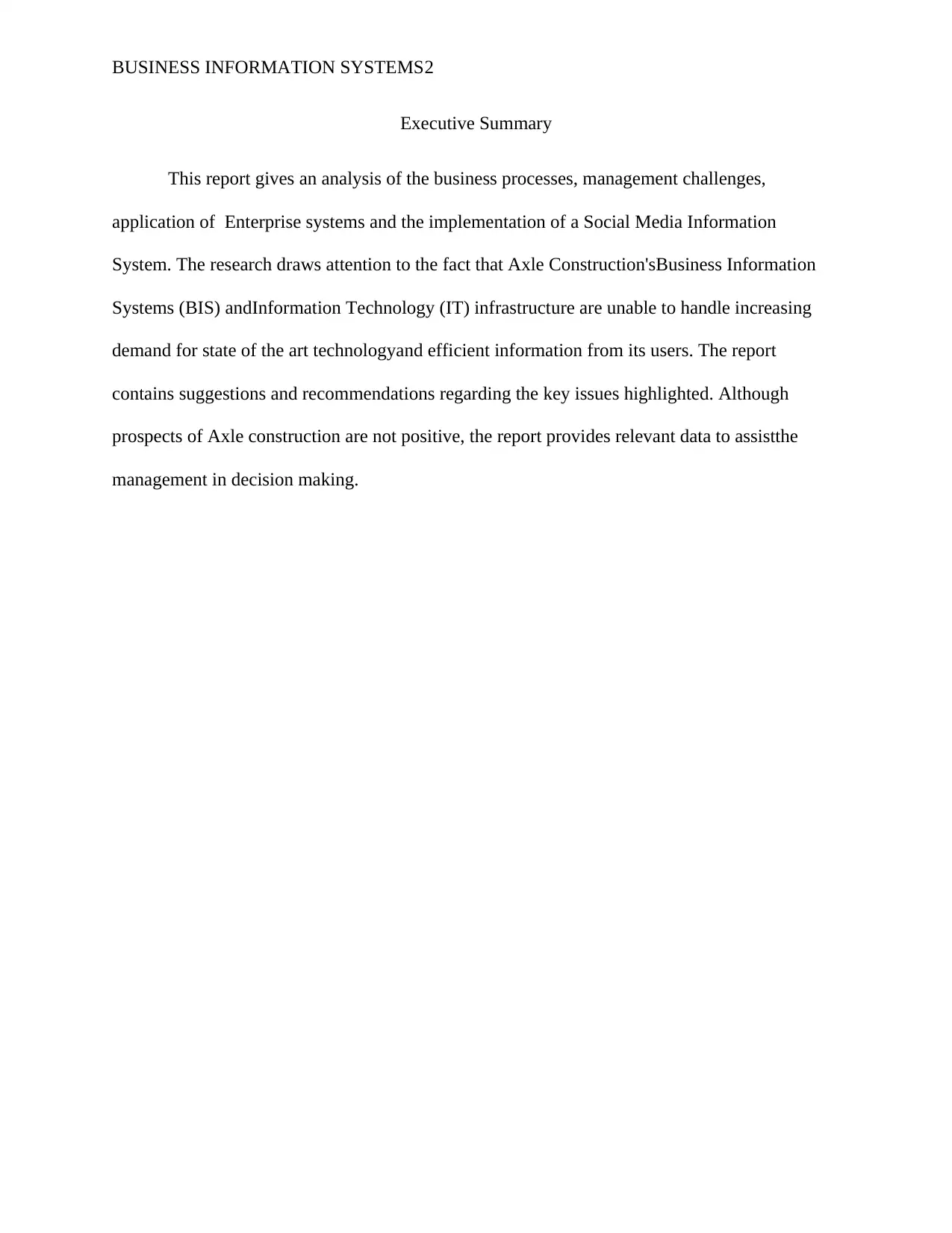
Executive Summary
This report gives an analysis of the business processes, management challenges,
application of Enterprise systems and the implementation of a Social Media Information
System. The research draws attention to the fact that Axle Construction'sBusiness Information
Systems (BIS) andInformation Technology (IT) infrastructure are unable to handle increasing
demand for state of the art technologyand efficient information from its users. The report
contains suggestions and recommendations regarding the key issues highlighted. Although
prospects of Axle construction are not positive, the report provides relevant data to assistthe
management in decision making.
Document Page
BUSINESS INFORMATION SYSTEMS3
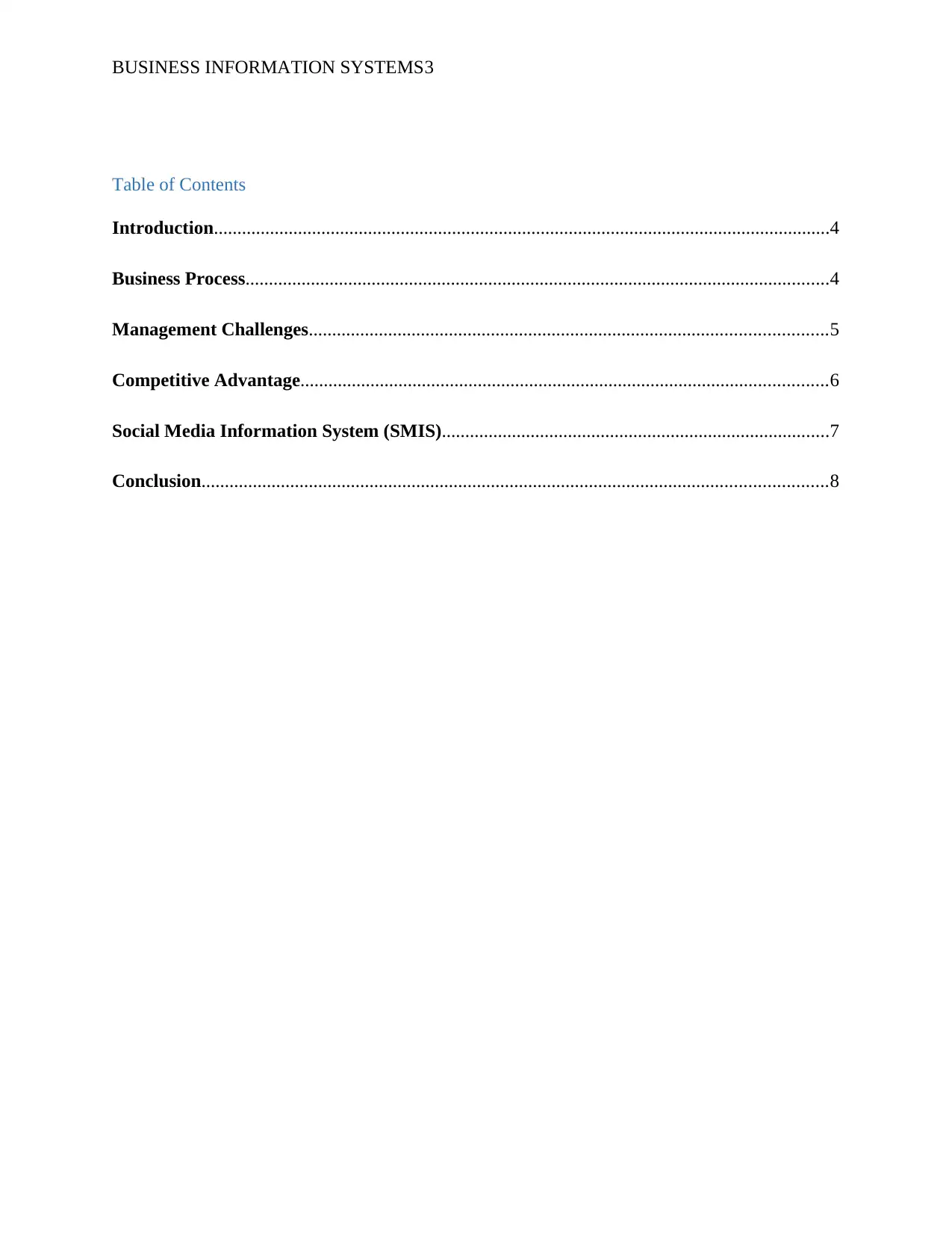
Table of Contents
Introduction....................................................................................................................................4
Business Process.............................................................................................................................4
Management Challenges...............................................................................................................5
Competitive Advantage.................................................................................................................6
Social Media Information System (SMIS)...................................................................................7
Conclusion......................................................................................................................................8
Document Page
BUSINESS INFORMATION SYSTEMS4
Introduction
An Information System is the collection of components that process, store, collect, and
distribute information to help in organizational decision making and control. In relation to
business, this is a system of value-adding processes for disseminating information to be used by
management in making decisions that promote performance and profitability.The success of a
company in the current dynamic business world is dependent on how quickly they respond to
environmental changes (Reichert & Weber, 2012). Business Information Systems (BIS)
propagate lasting organizational competitive advantages by integrating business processes with
Information Technology (IT). This report provides an analysis of key issues relevant to Axel
Construction’s initiative to enhance and upgrade their IT infrastructure and BIS.
Business Process
A business process may be defined as the pool of activities that collectively add value to
the organization.It is simply what thebusiness undergoes on a daily basis toachieve its goals or
objectives. Business processes are wide-spread and usually cover various departments in an
organization, or even cross the organizational boundary to include stakeholders such as
customers, suppliers, and partners. Organizations can acquire resources they need to re-energize
performance, innovate and deliver the value demanded by today’s market by prioritizing
business processes. Incorporation of information systems into the business processes effectively
tabler-icon-diamond-filled.svg

Paraphrase This Document

Need a fresh take? Get an instant paraphrase of this document with our AI Paraphraser
Document Page
BUSINESS INFORMATION SYSTEMS5
minimizes the gap between execution of decisions and management intent(Smith & Fingar,
2003, p. 1).It is therefore prudent for Axle Construction to understand and improve its business
processes.
The effectiveness of a businessis analyzedon the basis of their processes. Some
organizations even evaluate their processes as a competitive advantage strategy. Incorporation of
information systems can improve Axle’s processes and set the construction company apart while
lowering operational costs. Information systems make relevant and useful information readily
available to its users. The management team of Axel construction company can obtain updated
and comprehensive information necessary to make quick decisions that will help the firm
respond to business challenges. A smooth and efficient system with further cut down on
unnecessary expenses incurred as a result of misuse, misappropriation, and fragmentation of
company information in non-integrated systems. Furthermore, information systems will improve
the current processes by providing a monitoring and evaluation platform that will help the
management pick out redundant or inefficient aspects.
Management Challenges
Although information systems pose a lot of advantages and benefits to the growth of
organizations, there are some crucial challenges faced by managers especially in Small to
Medium Enterprises (SMEs). The first challenge a manager may encounter is to do with the
designing and building of the system. With the management being faced with cost and
functionality questions, they have to make carefully informed decisions. They need to determine
the need and purpose of the system. Once an appropriate information system is in place, the next
challenge is to ensure its integration into the business. To establish the system, both the
Document Page
BUSINESS INFORMATION SYSTEMS6
management and employees need training on the functionality of the system. The final challenge
lies in cost accountability and maintenance of the information system in a manner that
continuously aligns with the organization’s objectives(Kautz, Madsen & Nørbjerg, 2007, p. 220).
Challenges that the management of SMEs facewith regard to Information Systems may
alternatively be categorized into investment, strategic decisions, globalization, ethical
andsecurity challenges.A basicchallenge encountered while building or operating an information
system is related to value addition. Managers have to carry out cost-benefit analyses to determine
whether the system is a viable investment idea. This decision should take into account both the
long term and short returns on investment. In strategic decision making, the management has to
determine the complementary assets required for the information system to function effectively.
Likewise, the infrastructure of the information system should be able to accommodate their goals
in an environment with rapid technological and market changes. Globalization challenges require
the SME to understand and adjust to the world economy. In a digital world, ethics and security
are always a challenge to the management of organizations. The management must, therefore,
put in place safeguards to prevent loss or leakage of crucial information to competitors.
Competitive Advantage
It is prudent for organizations to realize that to gain a competitive advantage, they must
look into their processes and consider the possibility that their business mechanisms may be
outdated and inefficient if the current market. While putting this into consideration, Axle
construction should keep up with the level of competition and consider theintegration of updated
and relevant information systems such as the ERP system, the CRM system and the EAI
systems.
Document Page
BUSINESS INFORMATION SYSTEMS7
Enterprise Resource Planning (ERP) Systems standardize, integrate and automate
business processes to enhance planning and control. A defining characteristic of ERP systems is
the consolidated database that gathers all relevant organizational data into one complete system.
An ERP system is founded on a database that caters for decision making and operational needs
of the organization(Bradford, 2015, p. 2). Employees of Axle construction from different
departments such as manufacturing, accounting, purchasing, and sale can access any information
they need from the same data source. ERP systems, promise various benefits that may give Axle
construction competitive advantages over other market players. The systems can help increase
revenue by reducing operational expenses. Thisis achieved through improved customer service
and marketing, lower inventory costs, and enhanced revenue generating processes. The single
system integration also allows for effective monitoring and evaluating while enabling the
management to make quick and informed strategic decisions that put Axle construction ahead of
thecompetition.
Customer Relationship Management Systems (CRM) are information systems that
coordinate business processes revolving around an organization’s interaction with customers in
marketing services, sales, customer retention, and satisfaction. The system allows users to
evaluate or manage customer-focused marketing campaigns through channels such as telephone,
direct mail, e-mail, wireless messaging, and social media. With companies depending on
technology for day to day activities, the need to unify the separate applications into an integrated
set of processes has become a priority. Enterprise Application Integration (EAI)is the activity of
consolidating and modernizing the various programs or systems in an organization’s information
system infrastructure. Linthicum (2000) describes an EAI as an age old process of integrating
tabler-icon-diamond-filled.svg

Paraphrase This Document

Need a fresh take? Get an instant paraphrase of this document with our AI Paraphraser
Document Page
BUSINESS INFORMATION SYSTEMS8
applications in a firm in a manner that allows them to share processes and information freely.
EAI reduces costs and time that would have been lost in disparate applications.
Social Media Information System (SMIS)
This is an information system through which information and other content are shared in
a social network. Axel construction can use social media to form relationships with employees,
customers, and partners through productive interactions. SMIS help with organizational strategy
by creating a platform through which the company can inform people in the network, influence
them and build a conformity to the company’s ideals. Presence in social media strengthens
relationships, increases the number of target customers and even connect an organisation to
partners. SMIS has allowed sales of many companies to appreciate greatly. The system supports
sharing of information among the community, users, and social media providers. The first step
must be doing appropriate research on the system and the market. This necessary to position
Axle using its core competencies and objectives. So as to implement SMIS in Axle, it is
important to establish a social relationship between the organization and the target customers.
This relationship may be created throughcrowdsourcing or Social CRM. An effective marketing
and user engagement policy are the use of stories and repetition. Fruitful interaction will help
build a brand image and boost the company’s sales and profitability. The final step in
theimplementation of a successful SMIS in Axle would be to develop a social media policy for
the company. The importance of SMIS in today's digital market is demonstrated by companies
such as Bruce Clay and Newpath WEB who have successfully used SMIS to boost their
revenues.
Document Page
BUSINESS INFORMATION SYSTEMS9
Conclusion
In conclusion, for Axle construction to enhance its collective performance, the company
should embark on effective integration of their business processes. In order to achieve this, Axle
construction company can leverage some possible information systems in a bid to position itself
competitively. Effective implementation of the ERP, CRM, and EAI systems may enhance the
competitive advantage of the company. These information systems should be enforced only after
careful investigation and consideration onto their compatibility with Axle’s business processes.
In addition to the above Enterprise systems, the company should consider boosting sales through
SMIS.
Document Page
BUSINESS INFORMATION SYSTEMS10
References
Bradford, M. (2015). Modern ERP. 3rd ed. Morrisville, NC: Lulu, p.1-10.
Kautz, K., Madsen, S. and Nørbjerg, J., 2007. Persistent problems and practices in information
systems development. Information Systems Journal, 17(3), pp.217-239.
Linthicum, D.S., 2000. Enterprise application integration. Addison-Wesley Professional.
Reichert, M. and Weber, B., 2012. Enabling flexibility in process-aware information systems:
challenges, methods, technologies. Springer Science & Business Media.
Smith, H. and Fingar, P., 2003. Business process management: the third wave (Vol. 1). Tampa:
Meghan-Kiffer Press.
chevron_up_icon
1 out of 10
circle_padding
hide_on_mobile
zoom_out_icon
[object Object]