Problem Question: Statutory Interpretation of Back to Work Legislation

Verified

Added on  2023/03/17

|6
|1506
|36
Homework Assignment
AI Summary
This legal assignment addresses a problem question concerning statutory interpretation of the Back to Work Act 2015 (Vic) and the Back to Work Act 2019 (Cth). The client, Wilma, received grants under both Acts, leading the Commissioner to reverse a payment under the Victorian Act due to 'double dipping.' The assignment requires determining the meaning of 'incorrect' in s 9(1) of the Victorian Act, formulating opposing constructions, and assessing the Commissioner's power to demand repayment. It involves analyzing parliamentary materials, considering legislative history and wider context, and applying legal principles to the facts. The student is expected to provide arguments for both sides, evaluate them, and determine which construction a court would likely prefer, ultimately advising Wilma on her legal position. The analysis considers the implications of the two acts and the actions of the Commissioner under the Victorian Act, focusing on fairness and the application of relevant sections of the legislation.
Document Page
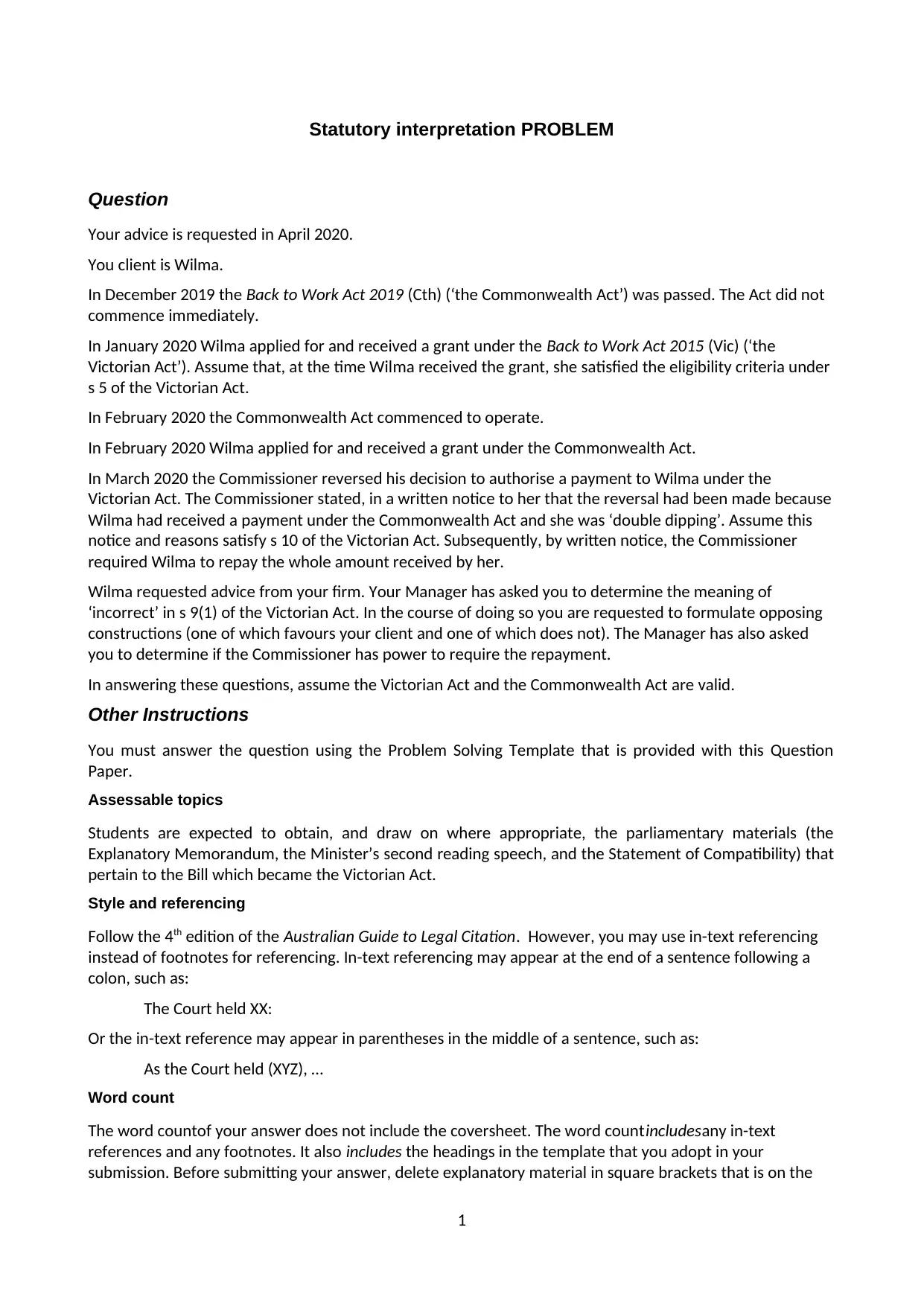
Statutory interpretation PROBLEM
Question
Your advice is requested in April 2020.
You client is Wilma.
In December 2019 the Back to Work Act 2019 (Cth) (‘the Commonwealth Act’) was passed. The Act did not
commence immediately.
In January 2020 Wilma applied for and received a grant under the Back to Work Act 2015 (Vic) (‘the
Victorian Act’). Assume that, at the time Wilma received the grant, she satisfied the eligibility criteria under
s 5 of the Victorian Act.
In February 2020 the Commonwealth Act commenced to operate.
In February 2020 Wilma applied for and received a grant under the Commonwealth Act.
In March 2020 the Commissioner reversed his decision to authorise a payment to Wilma under the
Victorian Act. The Commissioner stated, in a written notice to her that the reversal had been made because
Wilma had received a payment under the Commonwealth Act and she was ‘double dipping’. Assume this
notice and reasons satisfy s 10 of the Victorian Act. Subsequently, by written notice, the Commissioner
required Wilma to repay the whole amount received by her.
Wilma requested advice from your firm. Your Manager has asked you to determine the meaning of
‘incorrect’ in s 9(1) of the Victorian Act. In the course of doing so you are requested to formulate opposing
constructions (one of which favours your client and one of which does not). The Manager has also asked
you to determine if the Commissioner has power to require the repayment.
In answering these questions, assume the Victorian Act and the Commonwealth Act are valid.
Other Instructions
You must answer the question using the Problem Solving Template that is provided with this Question
Paper.
Assessable topics
Students are expected to obtain, and draw on where appropriate, the parliamentary materials (the
Explanatory Memorandum, the Minister’s second reading speech, and the Statement of Compatibility) that
pertain to the Bill which became the Victorian Act.
Style and referencing
Follow the 4th edition of the Australian Guide to Legal Citation. However, you may use in-text referencing
instead of footnotes for referencing. In-text referencing may appear at the end of a sentence following a
colon, such as:
The Court held XX:
Or the in-text reference may appear in parentheses in the middle of a sentence, such as:
As the Court held (XYZ), …
Word count
The word countof your answer does not include the coversheet. The word countincludesany in-text
references and any footnotes. It also includes the headings in the template that you adopt in your
submission. Before submitting your answer, delete explanatory material in square brackets that is on the
1
tabler-icon-diamond-filled.svg

Paraphrase This Document

Need a fresh take? Get an instant paraphrase of this document with our AI Paraphraser
Document Page
template. You should also delete a heading or subheading that is on the template if there is nothing to say
about it.
2
Document Page
[Statutory Interpretation]
[PROBLEM SOLVING TEMPLATE]
1. Question(s) Presented [optional if stated in the Problem]
What are the issues pertaining to the case?
2. Answer in Brief [the Answer to the Question(s) Presented]
The issues involved imply the interpretation of the word incorrect as per Sub-section 1 of Section 9 of the
Back to Work Act of 2015
3. Discussion
3.1 Facts [consider if this section is needed and omit if not needed]
The facts imply the applicability of the Back to Work Act of 2015 and the Back to Work Act of 2019
3.2 Unit of inquiry
The granting of payment in accordance with Section 9 of the Back to Work Act of 2015
3.3 Opposing constructions of unit of inquiry
The Commissioner has to prove that the reversing of the decision is made in the interest of firness
Wilma has to capitulate upon the fact pertaining to the term incorrect as per Sub-section 1 of Section 9 of
the Back to Work Act of 2015 since it has been reversed after she makes claim under the Back to Work Act
of 2019
3.4 Arguments for Party A’s construction
Provision
Back to Work Act of 2019
Remainder of Act
Decision pertaining to double dipping on part of Wilma
Legislative history
Enacted in order to provide relief for unemployed people at the federal level
Wider context
The Commissioner can defend its decision pertaining to double dipping if it is established that such a
decision has been made in the interest of fairness as far as the aspect of dichotomy is concerned between
the Back to Work Act of 2019 and Back to Work Act of 2015 a s far as claiming of payment is concerned
3
Document Page
with regard to Section 10 of the Back to Work Act of 20151. The aspect pertaining to correctness can be
taken into account by applying Sub-section 1 of Section 9 of the Back to Work Act of 2015.
3.5 Arguments for Party B’s construction
Provision
Back to Work Act of 2015
Remainder of Act
Wima’s defence pertaining to interpretation in literal form
Legislative history
Enacted in order to provide relief for unemployed people in the Australian state of Victoria
Wider context
Wilma can capitulate upon her claim by stating that such an aspect of the decision made by the
Commissioner has resulted in grievous error of law as far as the principles of natural justice is concerned as
far as Section 10 of the Back to Work Act of 2015 is concerned. Wilma can also claim that the aspect
pertaining to incorrect decision is not applicable under Sub-section 1 of Section 9 of the Back to Work Act
of 2015 since the Back to Work Act of 2019 was not in force during the time when the decision was made.
3.6 Evaluation of the parties’ arguments
Since the advice to Wilma would be entered in April 2020, the Back to Work Act of 2019 would be taken
into account as it is purported to come into effect in February 2020. As far as Sub-section 1 of Section 9 of
the Back to Work Act of 2015, the word incorrect means any wrong decision made by the Commissioner
meant by Section 3 of the Back to Work Act of 2015 as far as the Taxation Administrative Act of 1997 is
concerned. It further implies that in accordance with Sub-section 1 of Section 9 of the Back to Work Act of
2015, the Commissioner is at the discretion to vary or reverse such kind of incorrect decision. However, the
limitation period for such kind of an approach for the Commissioner would be five years as stipulated by
Sub-section 2 of Section 9 of the Back to Work Act of 20152. The only exception in this regard is the non-
disclosure of the details to the Commissioner by the claimant in a proper and appropriate manner regard as
far as the eligibility for the receipt of grant is concerned accordingly. Sub-section 1 of Section 10 of the Back
to Work Act of 2015 implies that any decision made by the Commissioner must involve a notice in the
desired manner which is to be served upon to the clamant accordingly. Sub-section 2 of Section 10 of the
Back to Work Act of 2015 implies that any notice pertaining to the refusal for the grant must have reasons.
The Commissioner can defend its decision pertaining to double dipping if it is established that such a
decision has been made in the interest of fairness as far as the aspect of dichotomy is concerned between
the Back to Work Act of 2019 and Back to Work Act of 2015 a s far as claiming of payment is concerned
with regard to Section 10 of the Back to Work Act of 2015.
3.7 Which construction is preferred [The construction a court would be likely to prefer]
The construction of Wilma’s claim is likely to be preferred.
1 Back to Work Act 2015 (Vic) s.10
2 Back to Work Act 2015 (Vic) s.9
4
tabler-icon-diamond-filled.svg

Paraphrase This Document

Need a fresh take? Get an instant paraphrase of this document with our AI Paraphraser
Document Page
4. Application of the law as interpreted to the facts [May require discussion if, for
instance, an evaluative judgment is to be made, but omit section if same as Answer
in Brief]
The law is to be applied in the manner so as to derive a comprehensive solution as far as the validity of
both the legislations as aforesaid is concerned.
5
Document Page
Bibliography
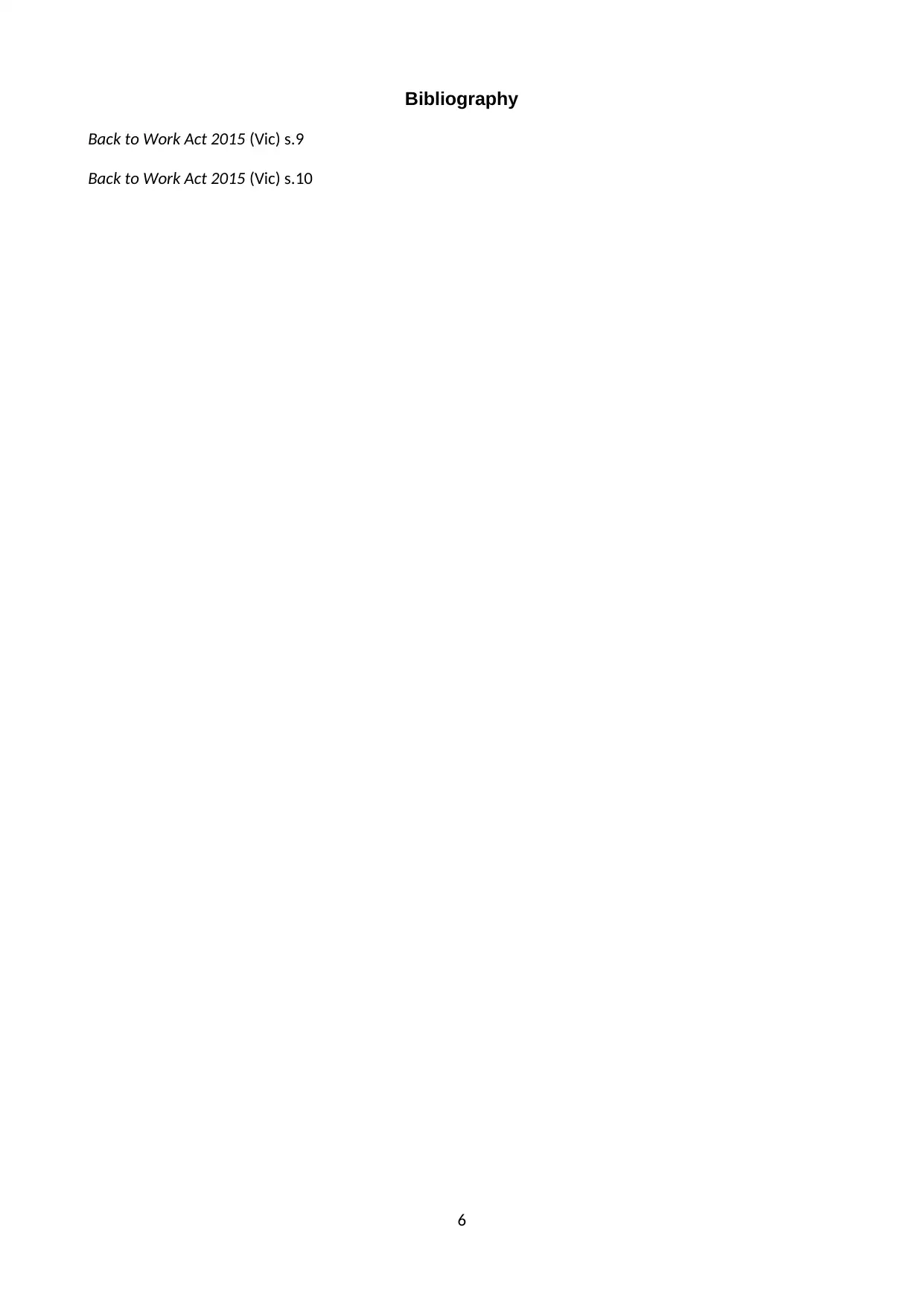
Back to Work Act 2015 (Vic) s.9
Back to Work Act 2015 (Vic) s.10
6
chevron_up_icon
1 out of 6
circle_padding
hide_on_mobile
zoom_out_icon
[object Object]