Audit Strategy Report for Bank of Queensland (BBAC601) - 2017-2018
VerifiedAdded on 2023/01/19
|16
|3613
|51
Report
AI Summary
This report presents an audit strategy for the Bank of Queensland (BOQ), focusing on the 2017-2018 financial year. It begins with an overview of the client, including its industry, regulatory environment, and nature as an Australian retail bank operating in banking and insurance segments. The report then delves into BOQ's accounting policies, covering areas such as plant, property, and equipment, inventory, accounts receivable, financial instruments, intangible assets, and revenue recognition. Additionally, it examines related party transactions. Part B of the report analyzes the client, discussing changes in accounting policies, preliminary analytical procedures, financial performance, objectives, strategies, and related business risks, concluding with an overall assessment. The report aims to assist newly appointed auditors in developing an effective audit strategy, referencing the annual report for the year ending 2018 and relevant auditing standards.
Running head: AUDITING & ASSURANCE
AUDITING & ASSURANCE
Name of the Student:
FAIZAN KHAN (S70396)
ATISH (S64756)
DANIAL (S62323)
HARIS ALI KHAN (S67251)
Name of the University:
Author Note
AUDITING & ASSURANCE
Name of the Student:
FAIZAN KHAN (S70396)
ATISH (S64756)
DANIAL (S62323)
HARIS ALI KHAN (S67251)
Name of the University:
Author Note

Paraphrase This Document
Need a fresh take? Get an instant paraphrase of this document with our AI Paraphraser
1AUDITING & ASSURANCE
Table of Contents
Part A: The Client......................................................................................................................3
Information about the client.......................................................................................................3
Industry, Regulatory and Other external factor..........................................................................3
Nature of the entity.....................................................................................................................5
Accounting Policy......................................................................................................................6
Policies w.r.t. Plant, property and Equipment........................................................................6
Policies w.r.t. Inventory.........................................................................................................6
Policies w.r.t. account receivables.........................................................................................6
Policies w.r.t. financial instruments.......................................................................................6
Policies w.r.t. intangible assets..............................................................................................6
Policies w.r.t. revenue recognition.........................................................................................6
Related Party and transactions with the related parties..............................................................7
Controlled entities..................................................................................................................7
Non-Controlled entities..............................................................................................................8
Other Related parties include the following...........................................................................8
Part B: Analysis of the client and impacts on the future audit work..........................................9
Changes in accounting policies and the impact of changes...................................................9
Preliminary analytical procedures........................................................................................10
Measurement and review of financial performance.................................................................11
Objectives, strategies and related business risks......................................................................11
Related business risks..............................................................................................................12
Table of Contents
Part A: The Client......................................................................................................................3
Information about the client.......................................................................................................3
Industry, Regulatory and Other external factor..........................................................................3
Nature of the entity.....................................................................................................................5
Accounting Policy......................................................................................................................6
Policies w.r.t. Plant, property and Equipment........................................................................6
Policies w.r.t. Inventory.........................................................................................................6
Policies w.r.t. account receivables.........................................................................................6
Policies w.r.t. financial instruments.......................................................................................6
Policies w.r.t. intangible assets..............................................................................................6
Policies w.r.t. revenue recognition.........................................................................................6
Related Party and transactions with the related parties..............................................................7
Controlled entities..................................................................................................................7
Non-Controlled entities..............................................................................................................8
Other Related parties include the following...........................................................................8
Part B: Analysis of the client and impacts on the future audit work..........................................9
Changes in accounting policies and the impact of changes...................................................9
Preliminary analytical procedures........................................................................................10
Measurement and review of financial performance.................................................................11
Objectives, strategies and related business risks......................................................................11
Related business risks..............................................................................................................12

2AUDITING & ASSURANCE
Conclusion................................................................................................................................12
Reference..................................................................................................................................14
Conclusion................................................................................................................................12
Reference..................................................................................................................................14
⊘ This is a preview!⊘
Do you want full access?
Subscribe today to unlock all pages.

Trusted by 1+ million students worldwide
3AUDITING & ASSURANCE
Part A: The Client
Information about the client
In the given case, our chosen client is the Bank of Queensland limited, which is listed
with the Australian Stock exchange. Along with that engaged in providing various financial
products and services in Australia together with its subsidiaries. It was established in the year
1874 as an Australian retail Bank. It is working in two different segments of Banking and
Insurance. The investment services of the Bank includes private banking, account and card
switching services. Our report is intended to assist the newly appointed auditor of the Bank in
the process of developing an Audit Strategy (Alieid 2016). In order to assist this purpose we
have taken the Annual report of the bank for the year ending 2018, which includes the
consolidated statement of financial position and financial performance, statement of changes
in equity and the cash Flow statement for the same period.
Industry, Regulatory and Other external factor
As it is quite clear from the message given by the Chairman, Managing, Director and
CEO of the bank in the Annual report for the Financial year ending 2018 that the year proved
to be a turmoil for the Banking Industry. Further, ids the reason why their focus was on the
implementation of such a strategy which can ensure them to remain fundamentally strong
(Alexander 2016).
The year 2018 had evidenced the strong scrutiny for the Banking sector. There were a
lot reports showing the fact that the industry failed to meet the expectation of its various
stakeholders in the same year. Few of those reports are royal commission’s report. Few of
these reports reflected the poorly performance of the industry as a result of which the
reputation of the few of the major Banks in the Industry had to lose their reputation too along
with the facing of significant inquiry into their operation (Arnott, et al 2017).
Part A: The Client
Information about the client
In the given case, our chosen client is the Bank of Queensland limited, which is listed
with the Australian Stock exchange. Along with that engaged in providing various financial
products and services in Australia together with its subsidiaries. It was established in the year
1874 as an Australian retail Bank. It is working in two different segments of Banking and
Insurance. The investment services of the Bank includes private banking, account and card
switching services. Our report is intended to assist the newly appointed auditor of the Bank in
the process of developing an Audit Strategy (Alieid 2016). In order to assist this purpose we
have taken the Annual report of the bank for the year ending 2018, which includes the
consolidated statement of financial position and financial performance, statement of changes
in equity and the cash Flow statement for the same period.
Industry, Regulatory and Other external factor
As it is quite clear from the message given by the Chairman, Managing, Director and
CEO of the bank in the Annual report for the Financial year ending 2018 that the year proved
to be a turmoil for the Banking Industry. Further, ids the reason why their focus was on the
implementation of such a strategy which can ensure them to remain fundamentally strong
(Alexander 2016).
The year 2018 had evidenced the strong scrutiny for the Banking sector. There were a
lot reports showing the fact that the industry failed to meet the expectation of its various
stakeholders in the same year. Few of those reports are royal commission’s report. Few of
these reports reflected the poorly performance of the industry as a result of which the
reputation of the few of the major Banks in the Industry had to lose their reputation too along
with the facing of significant inquiry into their operation (Arnott, et al 2017).
Paraphrase This Document
Need a fresh take? Get an instant paraphrase of this document with our AI Paraphraser
4AUDITING & ASSURANCE
.
It further states the fact that the operational environment of the industry too has
become quite challenging due to the major contributing actors like Slow credit growth,
regulatory change, high funding costs etc.
The major regulations, which are subject to the Corporation Act,2001, Royal
commission’s charter w.r.t. banking and financial services system, corporate governance
principles governed by ASX’s corporate governance council’s along with the IFRS and
Australian Auditing standards in relation to the preparation of Financial statement. Further,
treasury law amendment Bill 2017 also passed to ensure its applicability from July 1, 2018.
Similarly, the new banking code of practice got the affirmation from the ASIC (Goldman
2016).
Similarly, the regulation related to the consumer data rights is also in the process to
become effective as legislation.
In the recent times, Westpac Banking Corporation has emerged as one of the major
competitors as it has brought down the profit of the BOQ that was well reflected through its
surprisingly announced quarterly profit. The major competition it is facing due to its poorly
managed structure of retail banking and the lack of an effective Banking strategy to gain the
trust of the community.
The major competitors are St George bank Limited, National Australia bank Limited,
ANZ banking group limited, Commonwealth bank of Australia and Bank of Western
Australia Limited (Choy, 2018).
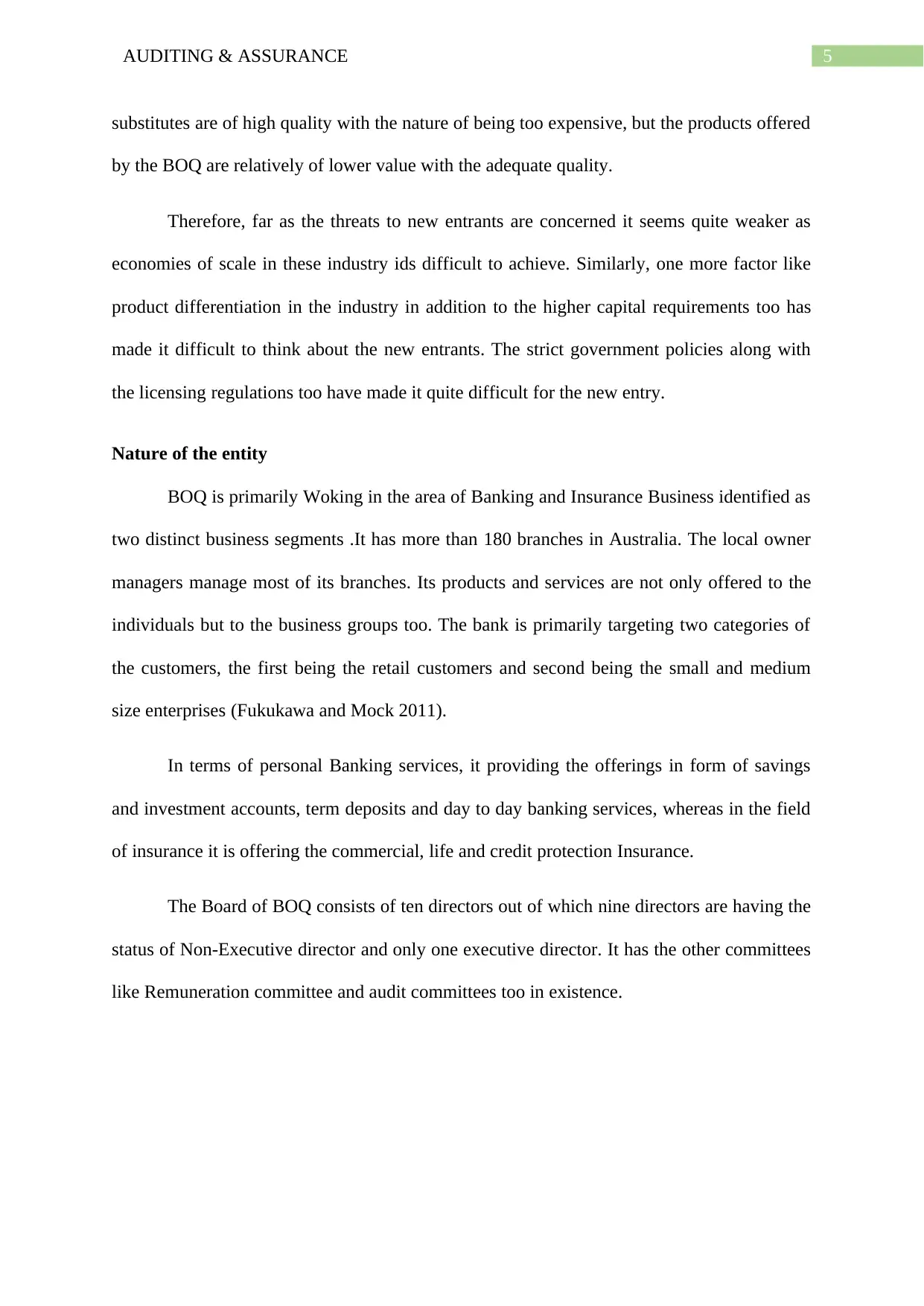
The products offered by the BOQ have very few market substitutes. Further, those
competitors providing the substitutes belong to the low profit earning industry. Again, these
.
It further states the fact that the operational environment of the industry too has
become quite challenging due to the major contributing actors like Slow credit growth,
regulatory change, high funding costs etc.
The major regulations, which are subject to the Corporation Act,2001, Royal
commission’s charter w.r.t. banking and financial services system, corporate governance
principles governed by ASX’s corporate governance council’s along with the IFRS and
Australian Auditing standards in relation to the preparation of Financial statement. Further,
treasury law amendment Bill 2017 also passed to ensure its applicability from July 1, 2018.
Similarly, the new banking code of practice got the affirmation from the ASIC (Goldman
2016).
Similarly, the regulation related to the consumer data rights is also in the process to
become effective as legislation.
In the recent times, Westpac Banking Corporation has emerged as one of the major
competitors as it has brought down the profit of the BOQ that was well reflected through its
surprisingly announced quarterly profit. The major competition it is facing due to its poorly
managed structure of retail banking and the lack of an effective Banking strategy to gain the
trust of the community.
The major competitors are St George bank Limited, National Australia bank Limited,
ANZ banking group limited, Commonwealth bank of Australia and Bank of Western
Australia Limited (Choy, 2018).
The products offered by the BOQ have very few market substitutes. Further, those
competitors providing the substitutes belong to the low profit earning industry. Again, these
5AUDITING & ASSURANCE
substitutes are of high quality with the nature of being too expensive, but the products offered
by the BOQ are relatively of lower value with the adequate quality.
Therefore, far as the threats to new entrants are concerned it seems quite weaker as
economies of scale in these industry ids difficult to achieve. Similarly, one more factor like
product differentiation in the industry in addition to the higher capital requirements too has
made it difficult to think about the new entrants. The strict government policies along with
the licensing regulations too have made it quite difficult for the new entry.
Nature of the entity
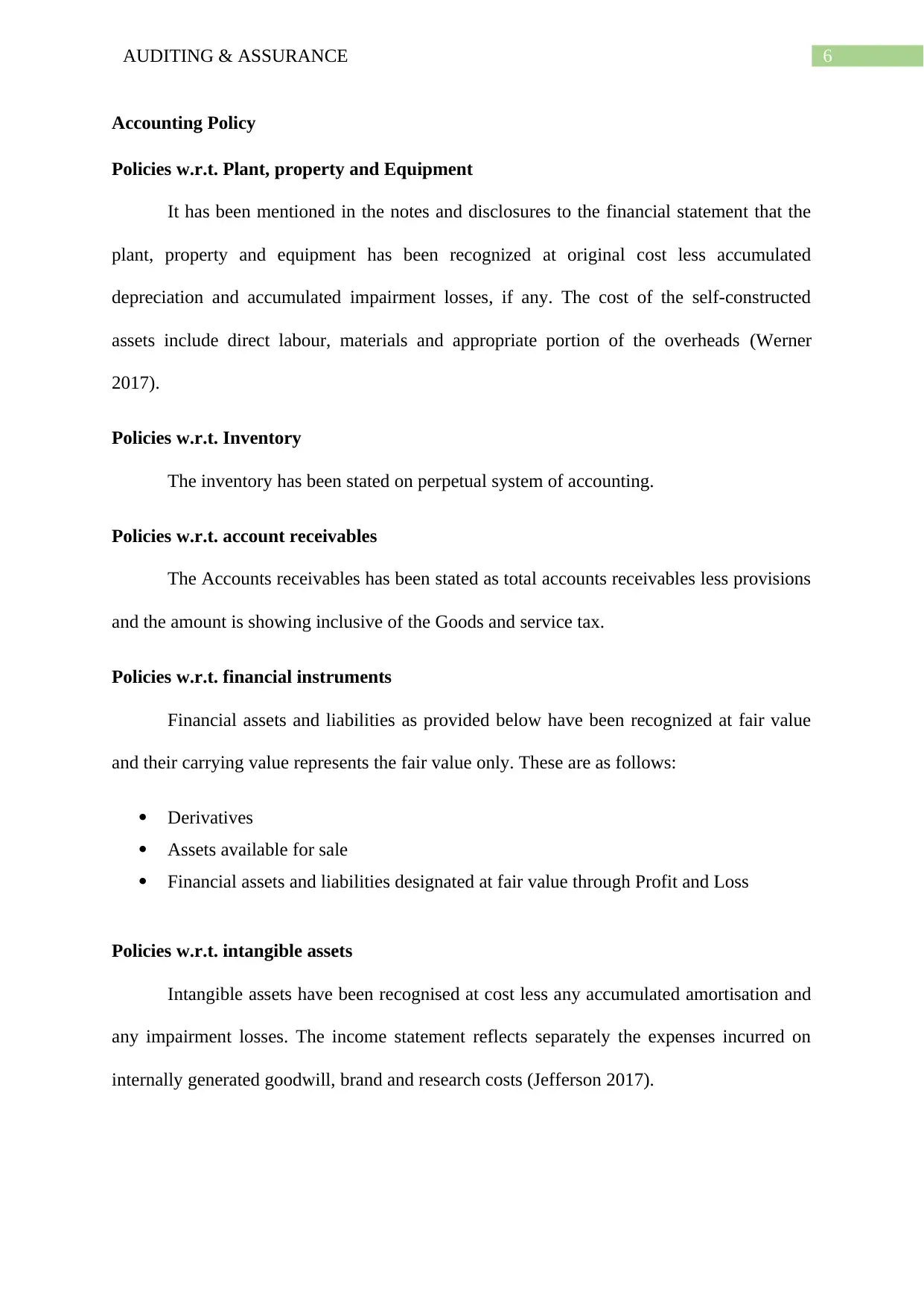
BOQ is primarily Woking in the area of Banking and Insurance Business identified as
two distinct business segments .It has more than 180 branches in Australia. The local owner
managers manage most of its branches. Its products and services are not only offered to the
individuals but to the business groups too. The bank is primarily targeting two categories of
the customers, the first being the retail customers and second being the small and medium
size enterprises (Fukukawa and Mock 2011).
In terms of personal Banking services, it providing the offerings in form of savings
and investment accounts, term deposits and day to day banking services, whereas in the field
of insurance it is offering the commercial, life and credit protection Insurance.
The Board of BOQ consists of ten directors out of which nine directors are having the
status of Non-Executive director and only one executive director. It has the other committees
like Remuneration committee and audit committees too in existence.
substitutes are of high quality with the nature of being too expensive, but the products offered
by the BOQ are relatively of lower value with the adequate quality.
Therefore, far as the threats to new entrants are concerned it seems quite weaker as
economies of scale in these industry ids difficult to achieve. Similarly, one more factor like
product differentiation in the industry in addition to the higher capital requirements too has
made it difficult to think about the new entrants. The strict government policies along with
the licensing regulations too have made it quite difficult for the new entry.
Nature of the entity
BOQ is primarily Woking in the area of Banking and Insurance Business identified as
two distinct business segments .It has more than 180 branches in Australia. The local owner
managers manage most of its branches. Its products and services are not only offered to the
individuals but to the business groups too. The bank is primarily targeting two categories of
the customers, the first being the retail customers and second being the small and medium
size enterprises (Fukukawa and Mock 2011).
In terms of personal Banking services, it providing the offerings in form of savings
and investment accounts, term deposits and day to day banking services, whereas in the field
of insurance it is offering the commercial, life and credit protection Insurance.
The Board of BOQ consists of ten directors out of which nine directors are having the
status of Non-Executive director and only one executive director. It has the other committees
like Remuneration committee and audit committees too in existence.
⊘ This is a preview!⊘
Do you want full access?
Subscribe today to unlock all pages.
Trusted by 1+ million students worldwide
6AUDITING & ASSURANCE
Accounting Policy
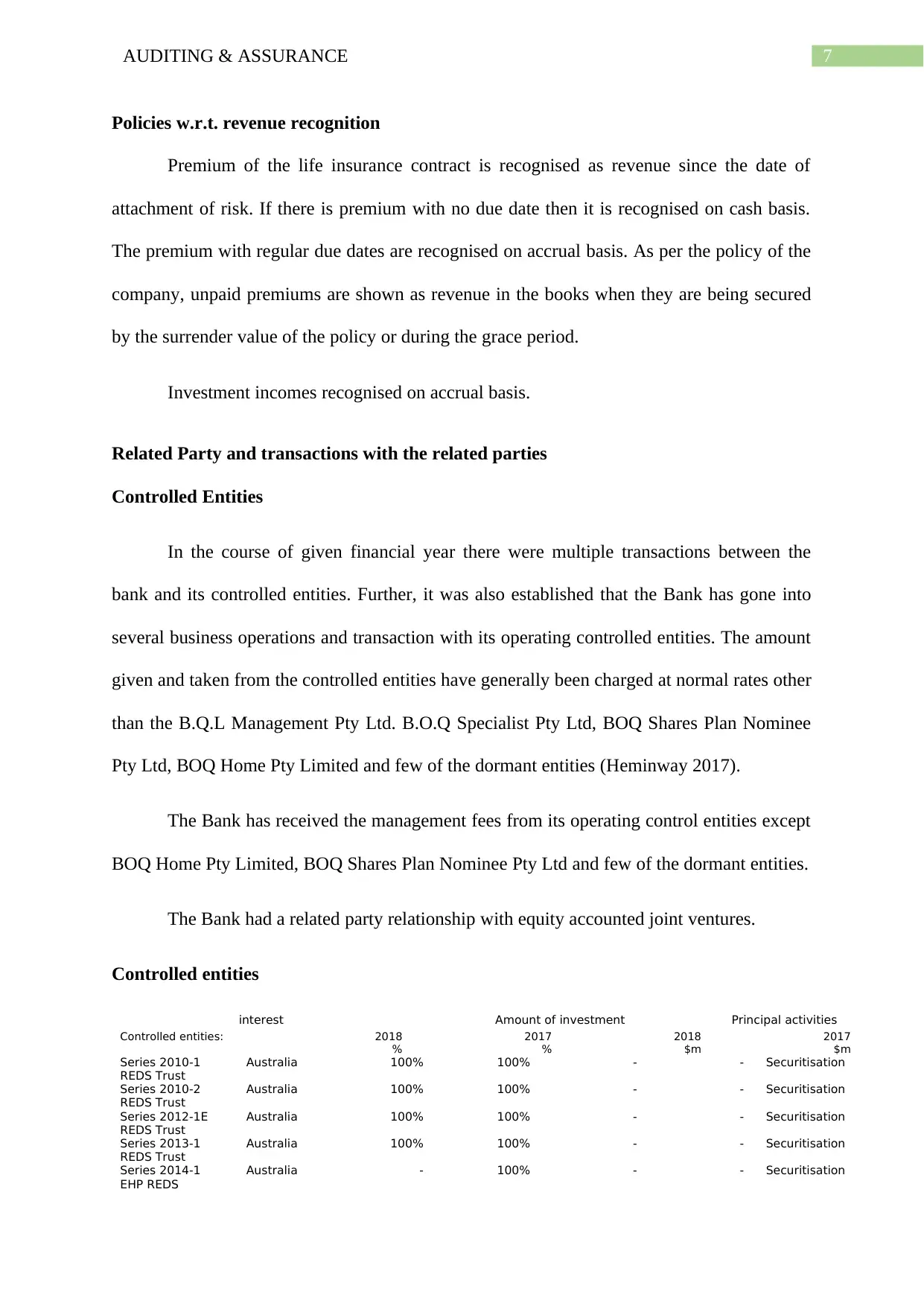
Policies w.r.t. Plant, property and Equipment
It has been mentioned in the notes and disclosures to the financial statement that the
plant, property and equipment has been recognized at original cost less accumulated
depreciation and accumulated impairment losses, if any. The cost of the self-constructed
assets include direct labour, materials and appropriate portion of the overheads (Werner
2017).
Policies w.r.t. Inventory
The inventory has been stated on perpetual system of accounting.
Policies w.r.t. account receivables
The Accounts receivables has been stated as total accounts receivables less provisions
and the amount is showing inclusive of the Goods and service tax.
Policies w.r.t. financial instruments
Financial assets and liabilities as provided below have been recognized at fair value
and their carrying value represents the fair value only. These are as follows:
Derivatives
Assets available for sale
Financial assets and liabilities designated at fair value through Profit and Loss
Policies w.r.t. intangible assets
Intangible assets have been recognised at cost less any accumulated amortisation and
any impairment losses. The income statement reflects separately the expenses incurred on
internally generated goodwill, brand and research costs (Jefferson 2017).
Accounting Policy
Policies w.r.t. Plant, property and Equipment
It has been mentioned in the notes and disclosures to the financial statement that the
plant, property and equipment has been recognized at original cost less accumulated
depreciation and accumulated impairment losses, if any. The cost of the self-constructed
assets include direct labour, materials and appropriate portion of the overheads (Werner
2017).
Policies w.r.t. Inventory
The inventory has been stated on perpetual system of accounting.
Policies w.r.t. account receivables
The Accounts receivables has been stated as total accounts receivables less provisions
and the amount is showing inclusive of the Goods and service tax.
Policies w.r.t. financial instruments
Financial assets and liabilities as provided below have been recognized at fair value
and their carrying value represents the fair value only. These are as follows:
Derivatives
Assets available for sale
Financial assets and liabilities designated at fair value through Profit and Loss
Policies w.r.t. intangible assets
Intangible assets have been recognised at cost less any accumulated amortisation and
any impairment losses. The income statement reflects separately the expenses incurred on
internally generated goodwill, brand and research costs (Jefferson 2017).
Paraphrase This Document
Need a fresh take? Get an instant paraphrase of this document with our AI Paraphraser
7AUDITING & ASSURANCE
Policies w.r.t. revenue recognition
Premium of the life insurance contract is recognised as revenue since the date of
attachment of risk. If there is premium with no due date then it is recognised on cash basis.
The premium with regular due dates are recognised on accrual basis. As per the policy of the
company, unpaid premiums are shown as revenue in the books when they are being secured
by the surrender value of the policy or during the grace period.
Investment incomes recognised on accrual basis.
Related Party and transactions with the related parties
Controlled Entities
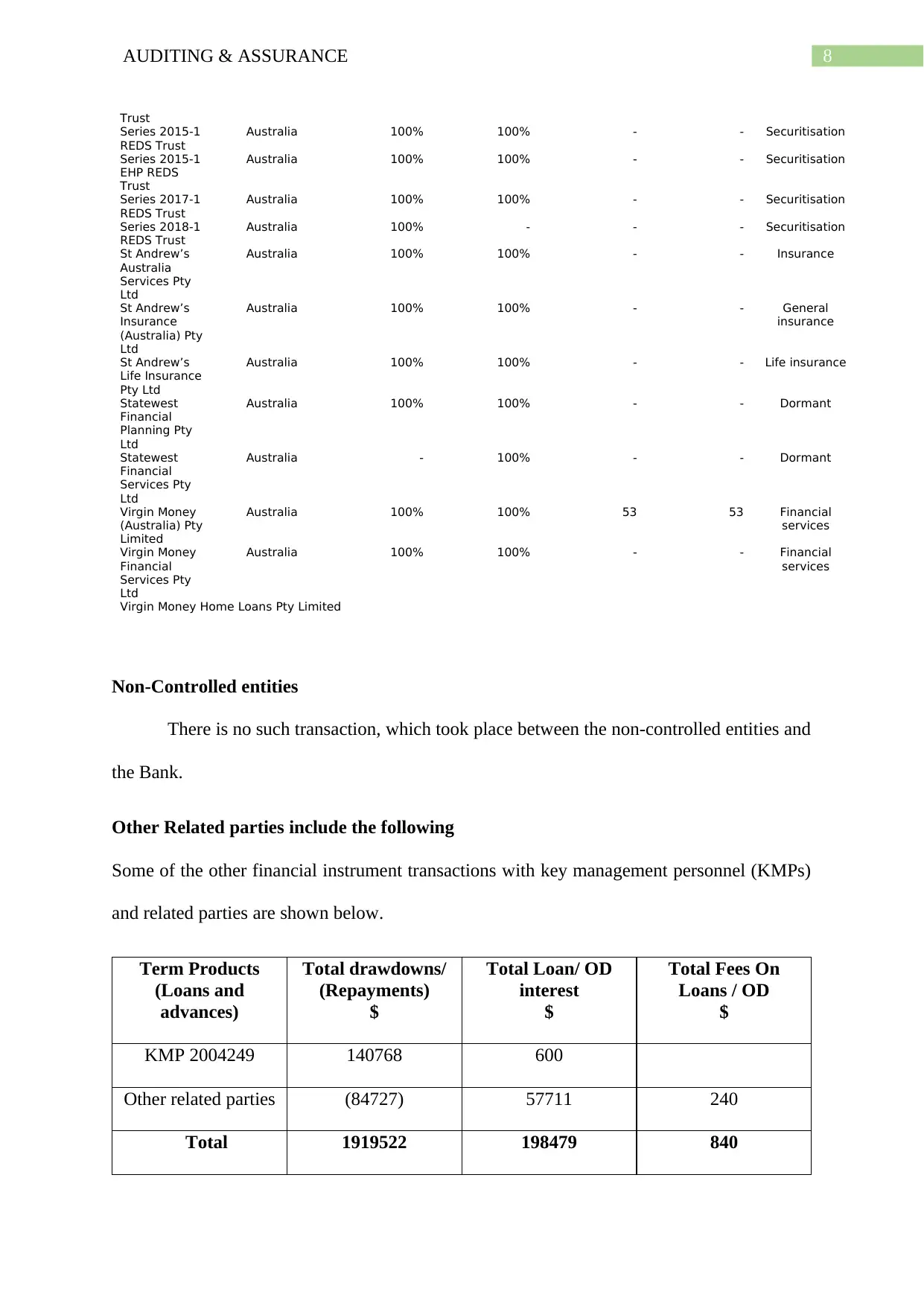
In the course of given financial year there were multiple transactions between the
bank and its controlled entities. Further, it was also established that the Bank has gone into
several business operations and transaction with its operating controlled entities. The amount
given and taken from the controlled entities have generally been charged at normal rates other
than the B.Q.L Management Pty Ltd. B.O.Q Specialist Pty Ltd, BOQ Shares Plan Nominee
Pty Ltd, BOQ Home Pty Limited and few of the dormant entities (Heminway 2017).
The Bank has received the management fees from its operating control entities except
BOQ Home Pty Limited, BOQ Shares Plan Nominee Pty Ltd and few of the dormant entities.
The Bank had a related party relationship with equity accounted joint ventures.
Controlled entities
interest Amount of investment Principal activities
Controlled entities: 2018
%
2017
%
2018
$m
2017
$m
Series 2010-1
REDS Trust
Australia 100% 100% - - Securitisation
Series 2010-2
REDS Trust
Australia 100% 100% - - Securitisation
Series 2012-1E
REDS Trust
Australia 100% 100% - - Securitisation
Series 2013-1
REDS Trust
Australia 100% 100% - - Securitisation
Series 2014-1
EHP REDS
Australia - 100% - - Securitisation
Policies w.r.t. revenue recognition
Premium of the life insurance contract is recognised as revenue since the date of
attachment of risk. If there is premium with no due date then it is recognised on cash basis.
The premium with regular due dates are recognised on accrual basis. As per the policy of the
company, unpaid premiums are shown as revenue in the books when they are being secured
by the surrender value of the policy or during the grace period.
Investment incomes recognised on accrual basis.
Related Party and transactions with the related parties
Controlled Entities
In the course of given financial year there were multiple transactions between the
bank and its controlled entities. Further, it was also established that the Bank has gone into
several business operations and transaction with its operating controlled entities. The amount
given and taken from the controlled entities have generally been charged at normal rates other
than the B.Q.L Management Pty Ltd. B.O.Q Specialist Pty Ltd, BOQ Shares Plan Nominee
Pty Ltd, BOQ Home Pty Limited and few of the dormant entities (Heminway 2017).
The Bank has received the management fees from its operating control entities except
BOQ Home Pty Limited, BOQ Shares Plan Nominee Pty Ltd and few of the dormant entities.
The Bank had a related party relationship with equity accounted joint ventures.
Controlled entities
interest Amount of investment Principal activities
Controlled entities: 2018
%
2017
%
2018
$m
2017
$m
Series 2010-1
REDS Trust
Australia 100% 100% - - Securitisation
Series 2010-2
REDS Trust
Australia 100% 100% - - Securitisation
Series 2012-1E
REDS Trust
Australia 100% 100% - - Securitisation
Series 2013-1
REDS Trust
Australia 100% 100% - - Securitisation
Series 2014-1
EHP REDS
Australia - 100% - - Securitisation
8AUDITING & ASSURANCE
Trust
Series 2015-1
REDS Trust
Australia 100% 100% - - Securitisation
Series 2015-1
EHP REDS
Trust
Australia 100% 100% - - Securitisation
Series 2017-1
REDS Trust
Australia 100% 100% - - Securitisation
Series 2018-1
REDS Trust
Australia 100% - - - Securitisation
St Andrew’s
Australia
Services Pty
Ltd
Australia 100% 100% - - Insurance
St Andrew’s
Insurance
(Australia) Pty
Ltd
Australia 100% 100% - - General
insurance
St Andrew’s
Life Insurance
Pty Ltd
Australia 100% 100% - - Life insurance
Statewest
Financial
Planning Pty
Ltd
Australia 100% 100% - - Dormant
Statewest
Financial
Services Pty
Ltd
Australia - 100% - - Dormant
Virgin Money
(Australia) Pty
Limited
Australia 100% 100% 53 53 Financial
services
Virgin Money
Financial
Services Pty
Ltd
Australia 100% 100% - - Financial
services
Virgin Money Home Loans Pty Limited
Non-Controlled entities
There is no such transaction, which took place between the non-controlled entities and
the Bank.
Other Related parties include the following
Some of the other financial instrument transactions with key management personnel (KMPs)
and related parties are shown below.
Term Products
(Loans and
advances)
Total drawdowns/
(Repayments)
$
Total Loan/ OD
interest
$
Total Fees On
Loans / OD
$
KMP 2004249 140768 600
Other related parties (84727) 57711 240
Total 1919522 198479 840
Trust
Series 2015-1
REDS Trust
Australia 100% 100% - - Securitisation
Series 2015-1
EHP REDS
Trust
Australia 100% 100% - - Securitisation
Series 2017-1
REDS Trust
Australia 100% 100% - - Securitisation
Series 2018-1
REDS Trust
Australia 100% - - - Securitisation
St Andrew’s
Australia
Services Pty
Ltd
Australia 100% 100% - - Insurance
St Andrew’s
Insurance
(Australia) Pty
Ltd
Australia 100% 100% - - General
insurance
St Andrew’s
Life Insurance
Pty Ltd
Australia 100% 100% - - Life insurance
Statewest
Financial
Planning Pty
Ltd
Australia 100% 100% - - Dormant
Statewest
Financial
Services Pty
Ltd
Australia - 100% - - Dormant
Virgin Money
(Australia) Pty
Limited
Australia 100% 100% 53 53 Financial
services
Virgin Money
Financial
Services Pty
Ltd
Australia 100% 100% - - Financial
services
Virgin Money Home Loans Pty Limited
Non-Controlled entities
There is no such transaction, which took place between the non-controlled entities and
the Bank.
Other Related parties include the following
Some of the other financial instrument transactions with key management personnel (KMPs)
and related parties are shown below.
Term Products
(Loans and
advances)
Total drawdowns/
(Repayments)
$
Total Loan/ OD
interest
$
Total Fees On
Loans / OD
$
KMP 2004249 140768 600
Other related parties (84727) 57711 240
Total 1919522 198479 840
⊘ This is a preview!⊘
Do you want full access?
Subscribe today to unlock all pages.
Trusted by 1+ million students worldwide
9AUDITING & ASSURANCE
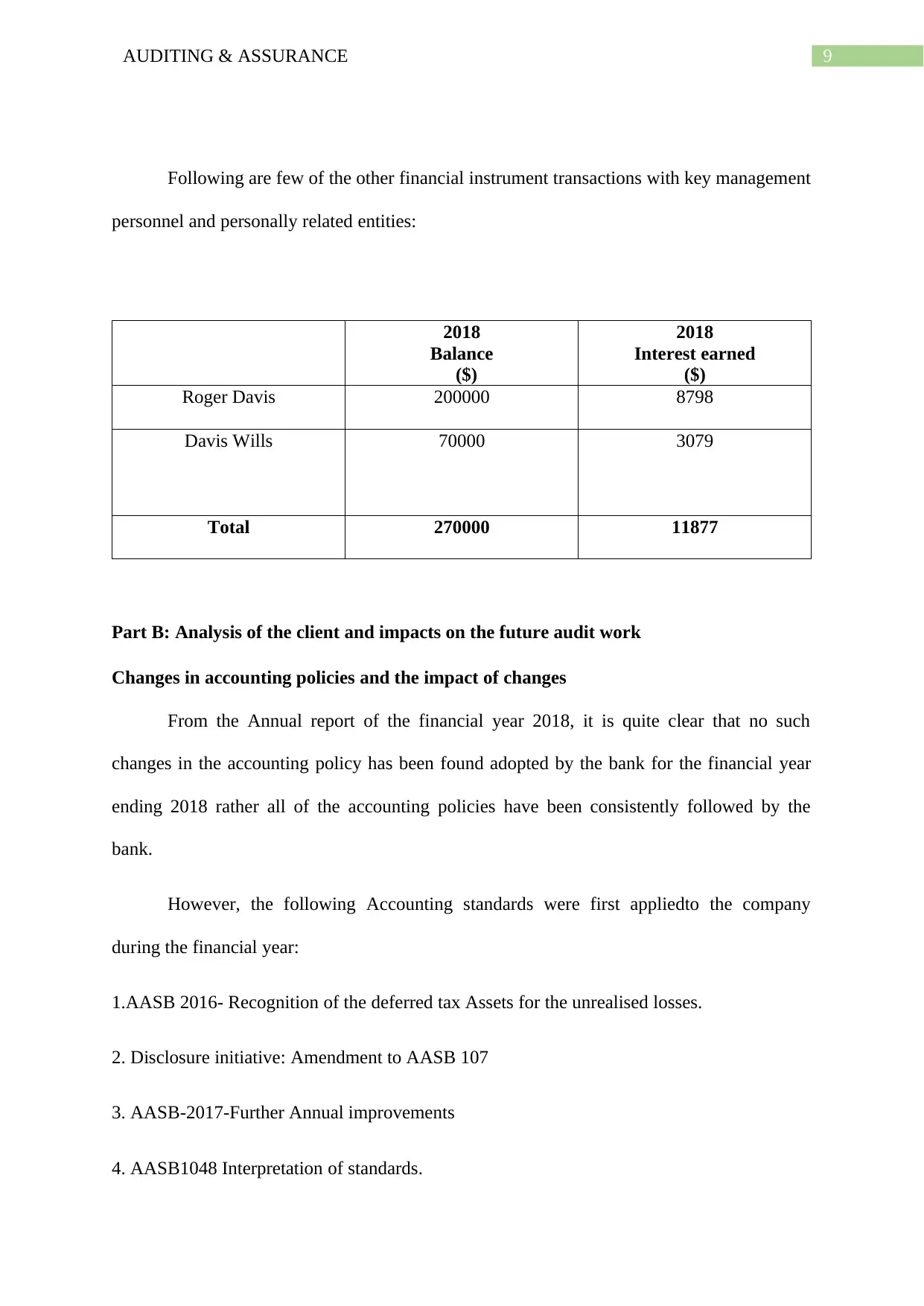
Following are few of the other financial instrument transactions with key management
personnel and personally related entities:
2018
Balance
($)
2018
Interest earned
($)
Roger Davis 200000 8798
Davis Wills 70000 3079
Total 270000 11877
Part B: Analysis of the client and impacts on the future audit work
Changes in accounting policies and the impact of changes
From the Annual report of the financial year 2018, it is quite clear that no such
changes in the accounting policy has been found adopted by the bank for the financial year
ending 2018 rather all of the accounting policies have been consistently followed by the
bank.
However, the following Accounting standards were first appliedto the company
during the financial year:
1.AASB 2016- Recognition of the deferred tax Assets for the unrealised losses.
2. Disclosure initiative: Amendment to AASB 107
3. AASB-2017-Further Annual improvements
4. AASB1048 Interpretation of standards.
Following are few of the other financial instrument transactions with key management
personnel and personally related entities:
2018
Balance
($)
2018
Interest earned
($)
Roger Davis 200000 8798
Davis Wills 70000 3079
Total 270000 11877
Part B: Analysis of the client and impacts on the future audit work
Changes in accounting policies and the impact of changes
From the Annual report of the financial year 2018, it is quite clear that no such
changes in the accounting policy has been found adopted by the bank for the financial year
ending 2018 rather all of the accounting policies have been consistently followed by the
bank.
However, the following Accounting standards were first appliedto the company
during the financial year:
1.AASB 2016- Recognition of the deferred tax Assets for the unrealised losses.
2. Disclosure initiative: Amendment to AASB 107
3. AASB-2017-Further Annual improvements
4. AASB1048 Interpretation of standards.
Paraphrase This Document
Need a fresh take? Get an instant paraphrase of this document with our AI Paraphraser
10AUDITING & ASSURANCE
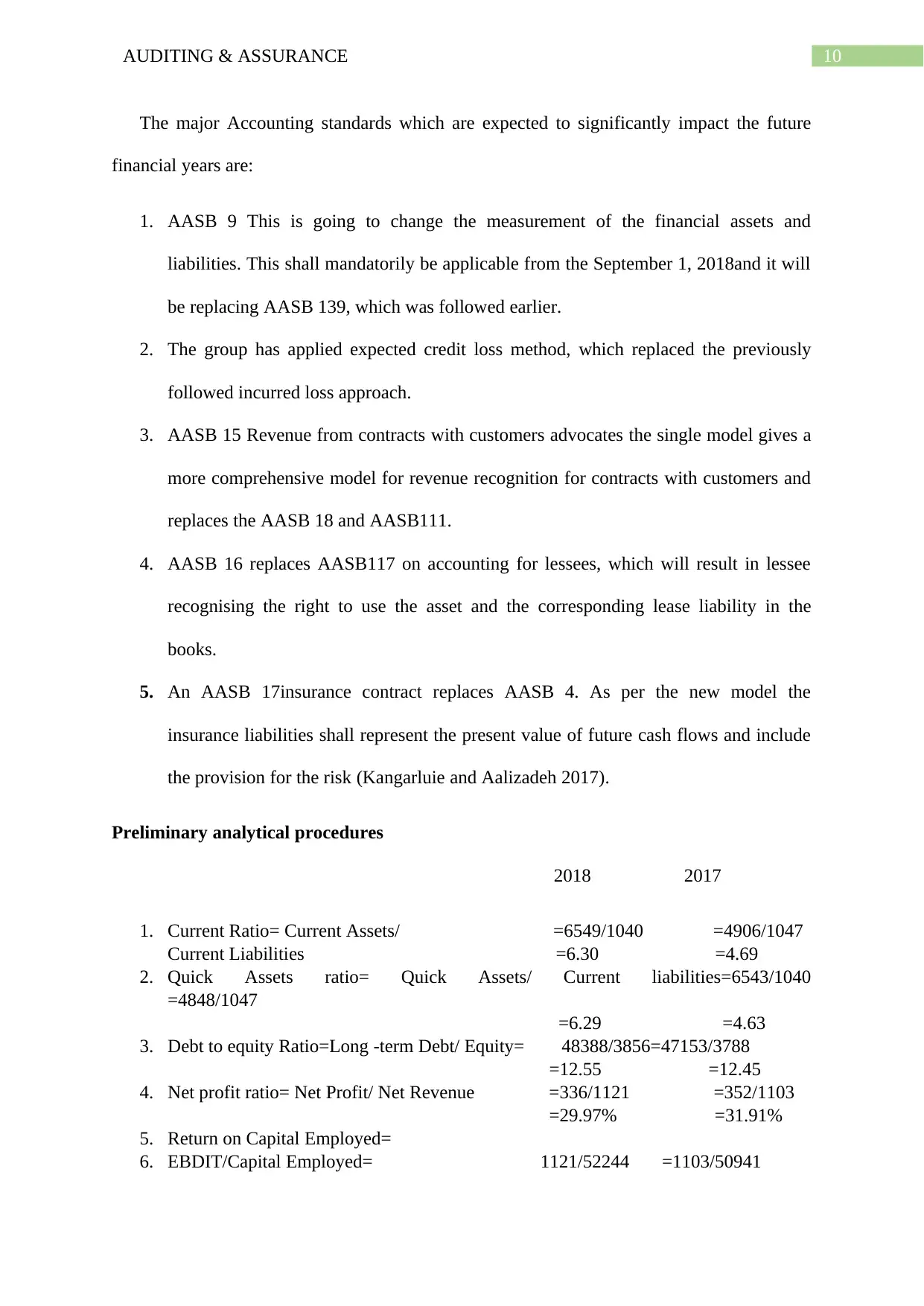
The major Accounting standards which are expected to significantly impact the future
financial years are:
1. AASB 9 This is going to change the measurement of the financial assets and
liabilities. This shall mandatorily be applicable from the September 1, 2018and it will
be replacing AASB 139, which was followed earlier.
2. The group has applied expected credit loss method, which replaced the previously
followed incurred loss approach.
3. AASB 15 Revenue from contracts with customers advocates the single model gives a
more comprehensive model for revenue recognition for contracts with customers and
replaces the AASB 18 and AASB111.
4. AASB 16 replaces AASB117 on accounting for lessees, which will result in lessee
recognising the right to use the asset and the corresponding lease liability in the
books.
5. An AASB 17insurance contract replaces AASB 4. As per the new model the
insurance liabilities shall represent the present value of future cash flows and include
the provision for the risk (Kangarluie and Aalizadeh 2017).
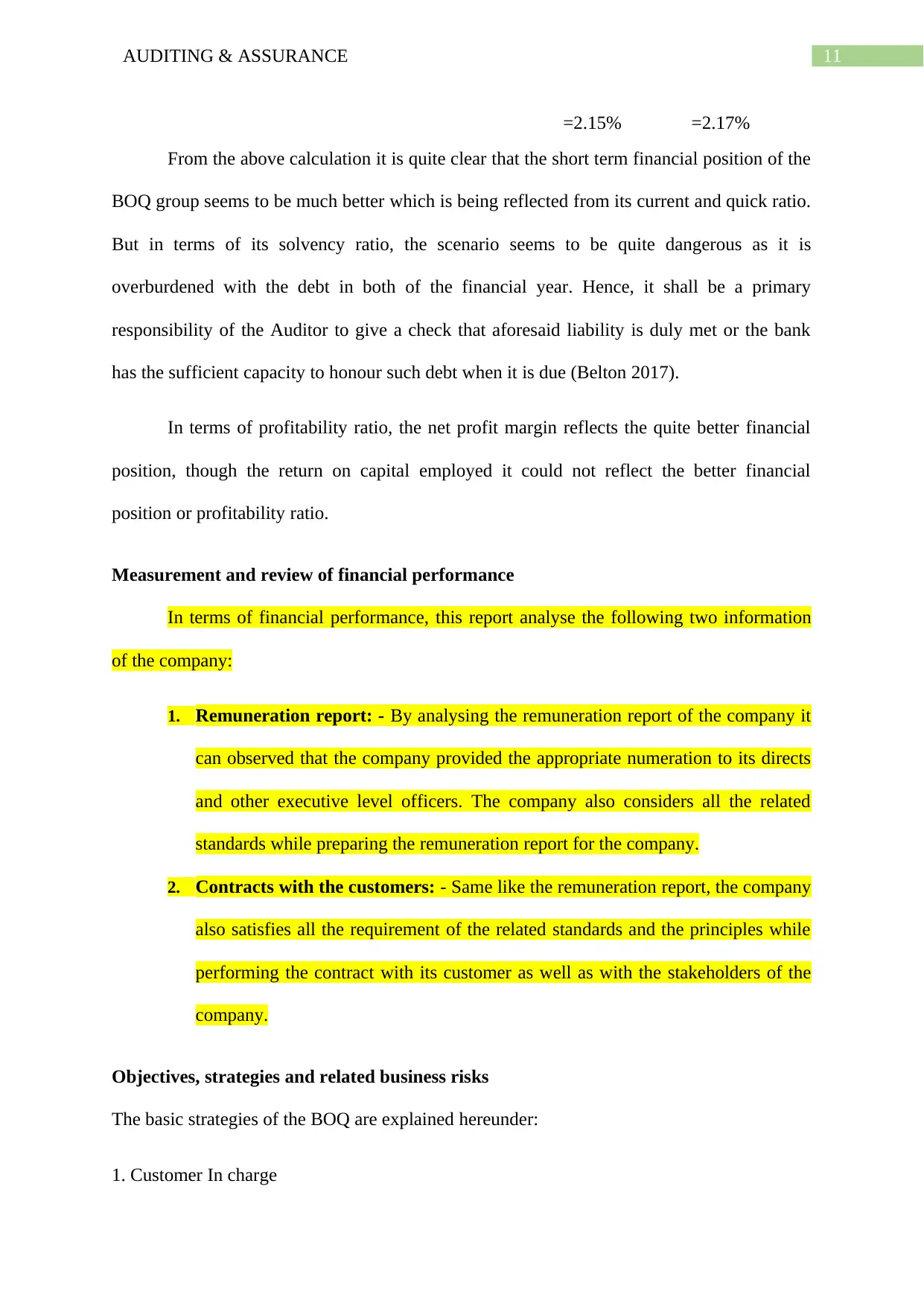
Preliminary analytical procedures
2018 2017
1. Current Ratio= Current Assets/ =6549/1040 =4906/1047
Current Liabilities =6.30 =4.69
2. Quick Assets ratio= Quick Assets/ Current liabilities=6543/1040
=4848/1047
=6.29 =4.63
3. Debt to equity Ratio=Long -term Debt/ Equity= 48388/3856=47153/3788
=12.55 =12.45
4. Net profit ratio= Net Profit/ Net Revenue =336/1121 =352/1103
=29.97% =31.91%
5. Return on Capital Employed=
6. EBDIT/Capital Employed= 1121/52244 =1103/50941
The major Accounting standards which are expected to significantly impact the future
financial years are:
1. AASB 9 This is going to change the measurement of the financial assets and
liabilities. This shall mandatorily be applicable from the September 1, 2018and it will
be replacing AASB 139, which was followed earlier.
2. The group has applied expected credit loss method, which replaced the previously
followed incurred loss approach.
3. AASB 15 Revenue from contracts with customers advocates the single model gives a
more comprehensive model for revenue recognition for contracts with customers and
replaces the AASB 18 and AASB111.
4. AASB 16 replaces AASB117 on accounting for lessees, which will result in lessee
recognising the right to use the asset and the corresponding lease liability in the
books.
5. An AASB 17insurance contract replaces AASB 4. As per the new model the
insurance liabilities shall represent the present value of future cash flows and include
the provision for the risk (Kangarluie and Aalizadeh 2017).
Preliminary analytical procedures
2018 2017
1. Current Ratio= Current Assets/ =6549/1040 =4906/1047
Current Liabilities =6.30 =4.69
2. Quick Assets ratio= Quick Assets/ Current liabilities=6543/1040
=4848/1047
=6.29 =4.63
3. Debt to equity Ratio=Long -term Debt/ Equity= 48388/3856=47153/3788
=12.55 =12.45
4. Net profit ratio= Net Profit/ Net Revenue =336/1121 =352/1103
=29.97% =31.91%
5. Return on Capital Employed=
6. EBDIT/Capital Employed= 1121/52244 =1103/50941
11AUDITING & ASSURANCE
=2.15% =2.17%
From the above calculation it is quite clear that the short term financial position of the
BOQ group seems to be much better which is being reflected from its current and quick ratio.
But in terms of its solvency ratio, the scenario seems to be quite dangerous as it is
overburdened with the debt in both of the financial year. Hence, it shall be a primary
responsibility of the Auditor to give a check that aforesaid liability is duly met or the bank
has the sufficient capacity to honour such debt when it is due (Belton 2017).
In terms of profitability ratio, the net profit margin reflects the quite better financial
position, though the return on capital employed it could not reflect the better financial
position or profitability ratio.
Measurement and review of financial performance
In terms of financial performance, this report analyse the following two information
of the company:
1. Remuneration report: - By analysing the remuneration report of the company it
can observed that the company provided the appropriate numeration to its directs
and other executive level officers. The company also considers all the related
standards while preparing the remuneration report for the company.
2. Contracts with the customers: - Same like the remuneration report, the company
also satisfies all the requirement of the related standards and the principles while
performing the contract with its customer as well as with the stakeholders of the
company.
Objectives, strategies and related business risks
The basic strategies of the BOQ are explained hereunder:
1. Customer In charge
=2.15% =2.17%
From the above calculation it is quite clear that the short term financial position of the
BOQ group seems to be much better which is being reflected from its current and quick ratio.
But in terms of its solvency ratio, the scenario seems to be quite dangerous as it is
overburdened with the debt in both of the financial year. Hence, it shall be a primary
responsibility of the Auditor to give a check that aforesaid liability is duly met or the bank
has the sufficient capacity to honour such debt when it is due (Belton 2017).
In terms of profitability ratio, the net profit margin reflects the quite better financial
position, though the return on capital employed it could not reflect the better financial
position or profitability ratio.
Measurement and review of financial performance
In terms of financial performance, this report analyse the following two information
of the company:
1. Remuneration report: - By analysing the remuneration report of the company it
can observed that the company provided the appropriate numeration to its directs
and other executive level officers. The company also considers all the related
standards while preparing the remuneration report for the company.
2. Contracts with the customers: - Same like the remuneration report, the company
also satisfies all the requirement of the related standards and the principles while
performing the contract with its customer as well as with the stakeholders of the
company.
Objectives, strategies and related business risks
The basic strategies of the BOQ are explained hereunder:
1. Customer In charge
⊘ This is a preview!⊘
Do you want full access?
Subscribe today to unlock all pages.
Trusted by 1+ million students worldwide

1 out of 16


Related Documents


Your All-in-One AI-Powered Toolkit for Academic Success.
+13062052269
info@desklib.com
Available 24*7 on WhatsApp / Email
![[object Object]](/_next/static/media/star-bottom.7253800d.svg)
Unlock your academic potential
Copyright © 2020–2026 A2Z Services. All Rights Reserved. Developed and managed by ZUCOL.