Relationships Between Banking Tech and Bank Performance in China, MSc
VerifiedAdded on 2020/03/16
|57
|15331
|32
Report
AI Summary
This report, submitted for an MSc in Accounting & Finance at the University of Lincoln, investigates the correlation between the application of banking technologies and the performance of commercial banks in China. The study focuses on the impact of credit cards and e-banking systems on bank performance and operational risks, employing a mixed research method with qualitative and quantitative approaches, including case studies of China Merchants Bank and the Bank of Communications. Data analysis, conducted using SPSS, reveals a significant positive link between the adoption of credit cards and e-banking and the overall performance of commercial banks, while no positive link was established with operational risks. The report offers recommendations for Chinese commercial banks to enhance risk management, foster innovation, and capitalize on existing and potential customer bases. It also acknowledges limitations in data accuracy and comprehensiveness.
1
Relationships Between the Application of Banking Technologies and the Performance of
Commercial Banks in China
Yuling Fu
Enrolment number: FUY15615651
Supervised by: Christopher Firth
University of Lincoln
Msc Accounting & Finance
Submission date : 25th sep 2017
Word count: 16132
Relationships Between the Application of Banking Technologies and the Performance of
Commercial Banks in China
Yuling Fu
Enrolment number: FUY15615651
Supervised by: Christopher Firth
University of Lincoln
Msc Accounting & Finance
Submission date : 25th sep 2017
Word count: 16132

Paraphrase This Document
Need a fresh take? Get an instant paraphrase of this document with our AI Paraphraser
2
Relationships Between the Application of Banking Technologies and the Performance of
Commercial Banks in China
Yuling Fu
Relationships Between the Application of Banking Technologies and the Performance of
Commercial Banks in China
Yuling Fu

3
Acknowledgments
First of all, I would like to thank my tutor for instructions, MR Christopher Firth . Without
these knowledge and research skills , I would not have finished this research. Without the
patient guidance and modifications, it would be difficult for me to finish this research.
Secondly, I want to thank my friends who have helped me to conduct the two interviews and
questionnaires. I set the study scope in China and some of my friends helped me to collect
primary data. With their help, I could complete my research within limited time and resources.
At last, I want to thank the two interviewees and all the participants who fill in questionnaires.
Without their support, the research could not have conducted.
Acknowledgments
First of all, I would like to thank my tutor for instructions, MR Christopher Firth . Without
these knowledge and research skills , I would not have finished this research. Without the
patient guidance and modifications, it would be difficult for me to finish this research.
Secondly, I want to thank my friends who have helped me to conduct the two interviews and
questionnaires. I set the study scope in China and some of my friends helped me to collect
primary data. With their help, I could complete my research within limited time and resources.
At last, I want to thank the two interviewees and all the participants who fill in questionnaires.
Without their support, the research could not have conducted.
⊘ This is a preview!⊘
Do you want full access?
Subscribe today to unlock all pages.

Trusted by 1+ million students worldwide
4
Abstract
Financial institutions in developed countries have applied financial innovations and banking
technologies in order to develop innovative products offerings, cut operational costs, increase
revenues, improve organizational performances. It is it is significant to research the relations
between the application of banking technologies and performances of commercial banks in
China.
Research purpose: The purpose of this study is to identify how does the application of credit
cards as well as the e-banking system influence performances of commercial banks in China.
Research method: This study applies the mixed researching method which contains both the
qualitative and the quantitative researching methods. The case study researching strategy is
applied through collecting information and data from both the primary resource and the
secondary sources. The case study focuses on two important commercial banks in China,
including China Merchants Bank as well as the Bank of Communications. This study applies
the abduct method and the SPSS data analysis tool to analyze data collected.
Key findings: There is a significant positive link between the application of credit cards and
e-banking systems and the performance of commercial banks in China. There is not a positive
link between the application of credit cards and e-banking systems and operational risks for
commercial banks in China.
Recommendations: Commercial banks in China is recommended to enhance commercial
banks’ abilities of risk prevention plus risk control, facilitate innovation ability, as well as
value the potential of both existing clients and rural customers.
Limitations: Secondary data used is not accurate and primary data collected is not
comprehensive.
Table of contents
Abstract
Financial institutions in developed countries have applied financial innovations and banking
technologies in order to develop innovative products offerings, cut operational costs, increase
revenues, improve organizational performances. It is it is significant to research the relations
between the application of banking technologies and performances of commercial banks in
China.
Research purpose: The purpose of this study is to identify how does the application of credit
cards as well as the e-banking system influence performances of commercial banks in China.
Research method: This study applies the mixed researching method which contains both the
qualitative and the quantitative researching methods. The case study researching strategy is
applied through collecting information and data from both the primary resource and the
secondary sources. The case study focuses on two important commercial banks in China,
including China Merchants Bank as well as the Bank of Communications. This study applies
the abduct method and the SPSS data analysis tool to analyze data collected.
Key findings: There is a significant positive link between the application of credit cards and
e-banking systems and the performance of commercial banks in China. There is not a positive
link between the application of credit cards and e-banking systems and operational risks for
commercial banks in China.
Recommendations: Commercial banks in China is recommended to enhance commercial
banks’ abilities of risk prevention plus risk control, facilitate innovation ability, as well as
value the potential of both existing clients and rural customers.
Limitations: Secondary data used is not accurate and primary data collected is not
comprehensive.
Table of contents
Paraphrase This Document
Need a fresh take? Get an instant paraphrase of this document with our AI Paraphraser
5
Abstract.......................................................................................................................................4
Chapter 1: Introduction...............................................................................................................8
1.1 Research background.....................................................................................................8
1.2 Research objectives and research questions...................................................................9
1.3 Research design............................................................................................................10
1.3 Structure outline...........................................................................................................10
Chapter 2: Literature review.....................................................................................................11
2.1 The application of credit card and banks’ performances..............................................11
2.2 The application of e-banking systems and performances of commercial banks..........12
2.2.1 The application of e-banking in America and European countries....................12
2.2.2 The application of e-banking in developing countries.......................................14
2.2.3 The application of e-banking in China...............................................................15
2.3 Research gaps...............................................................................................................18
2.4 Critique of the existing literature relevant to this research..........................................18
2.5 Identification of hypothesis..........................................................................................19
Chapter 3: Research methodology............................................................................................20
3.1 Research method..........................................................................................................20
3.2 Research design............................................................................................................20
3.3 Data collection approaches..........................................................................................21
3.4 Data analysis approach.................................................................................................22
3.5 Conceptual framework of this research........................................................................22
3.6 Limitations of this research..........................................................................................23
Chapter 4: Findings...................................................................................................................24
4.1 Case commercial banks in China.................................................................................24
4.2 Hypothesis analysis......................................................................................................25
4.2.1 Respondents analysis.........................................................................................25
4.2.2 Evaluation of hypothesis....................................................................................26
Chapter 5: Discussion...............................................................................................................41
5.1 Enhance commercial banks’ abilities of risk prevention plus risk control...................41
5.2 Enhance innovation ability...........................................................................................42
5.3 Value the potential of both existing clients and rural customers..................................43
Chapter 6: Conclusion...............................................................................................................45
Abstract.......................................................................................................................................4
Chapter 1: Introduction...............................................................................................................8
1.1 Research background.....................................................................................................8
1.2 Research objectives and research questions...................................................................9
1.3 Research design............................................................................................................10
1.3 Structure outline...........................................................................................................10
Chapter 2: Literature review.....................................................................................................11
2.1 The application of credit card and banks’ performances..............................................11
2.2 The application of e-banking systems and performances of commercial banks..........12
2.2.1 The application of e-banking in America and European countries....................12
2.2.2 The application of e-banking in developing countries.......................................14
2.2.3 The application of e-banking in China...............................................................15
2.3 Research gaps...............................................................................................................18
2.4 Critique of the existing literature relevant to this research..........................................18
2.5 Identification of hypothesis..........................................................................................19
Chapter 3: Research methodology............................................................................................20
3.1 Research method..........................................................................................................20
3.2 Research design............................................................................................................20
3.3 Data collection approaches..........................................................................................21
3.4 Data analysis approach.................................................................................................22
3.5 Conceptual framework of this research........................................................................22
3.6 Limitations of this research..........................................................................................23
Chapter 4: Findings...................................................................................................................24
4.1 Case commercial banks in China.................................................................................24
4.2 Hypothesis analysis......................................................................................................25
4.2.1 Respondents analysis.........................................................................................25
4.2.2 Evaluation of hypothesis....................................................................................26
Chapter 5: Discussion...............................................................................................................41
5.1 Enhance commercial banks’ abilities of risk prevention plus risk control...................41
5.2 Enhance innovation ability...........................................................................................42
5.3 Value the potential of both existing clients and rural customers..................................43
Chapter 6: Conclusion...............................................................................................................45

6
6.1 Key findings.................................................................................................................45
6.2 Recommendations........................................................................................................46
6.3 Limitations...................................................................................................................46
References.................................................................................................................................47
Appendixes: Interviews.............................................................................................................53
Appendix 1: The interview of the banking manager from China Merchants Bank...........53
Appendix 2: The interview of the banking manager from Bank of Communications.......55
6.1 Key findings.................................................................................................................45
6.2 Recommendations........................................................................................................46
6.3 Limitations...................................................................................................................46
References.................................................................................................................................47
Appendixes: Interviews.............................................................................................................53
Appendix 1: The interview of the banking manager from China Merchants Bank...........53
Appendix 2: The interview of the banking manager from Bank of Communications.......55
⊘ This is a preview!⊘
Do you want full access?
Subscribe today to unlock all pages.
Trusted by 1+ million students worldwide
7
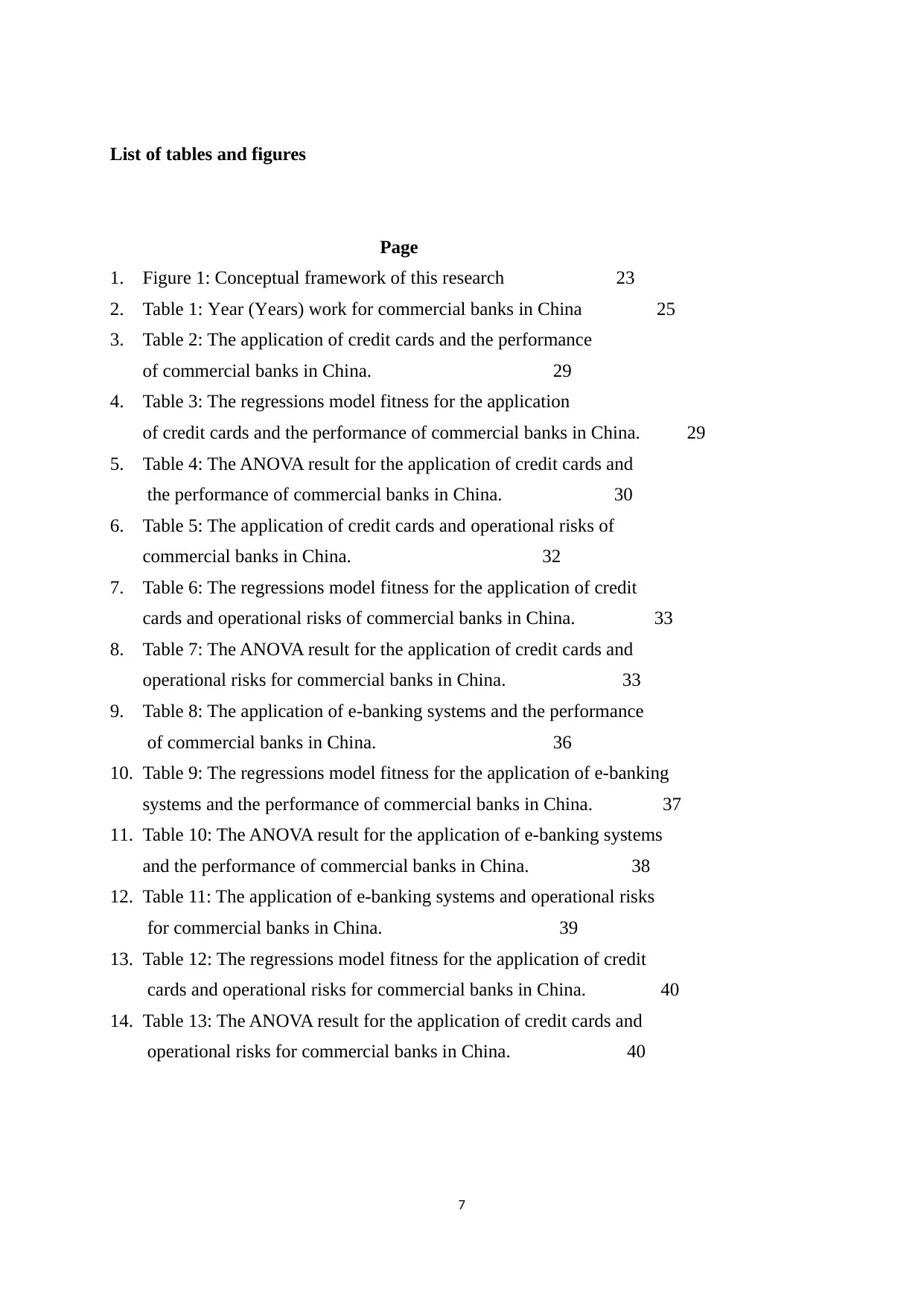
List of tables and figures
Page
1. Figure 1: Conceptual framework of this research 23
2. Table 1: Year (Years) work for commercial banks in China 25
3. Table 2: The application of credit cards and the performance
of commercial banks in China. 29
4. Table 3: The regressions model fitness for the application
of credit cards and the performance of commercial banks in China. 29
5. Table 4: The ANOVA result for the application of credit cards and
the performance of commercial banks in China. 30
6. Table 5: The application of credit cards and operational risks of
commercial banks in China. 32
7. Table 6: The regressions model fitness for the application of credit
cards and operational risks of commercial banks in China. 33
8. Table 7: The ANOVA result for the application of credit cards and
operational risks for commercial banks in China. 33
9. Table 8: The application of e-banking systems and the performance
of commercial banks in China. 36
10. Table 9: The regressions model fitness for the application of e-banking
systems and the performance of commercial banks in China. 37
11. Table 10: The ANOVA result for the application of e-banking systems
and the performance of commercial banks in China. 38
12. Table 11: The application of e-banking systems and operational risks
for commercial banks in China. 39
13. Table 12: The regressions model fitness for the application of credit
cards and operational risks for commercial banks in China. 40
14. Table 13: The ANOVA result for the application of credit cards and
operational risks for commercial banks in China. 40
List of tables and figures
Page
1. Figure 1: Conceptual framework of this research 23
2. Table 1: Year (Years) work for commercial banks in China 25
3. Table 2: The application of credit cards and the performance
of commercial banks in China. 29
4. Table 3: The regressions model fitness for the application
of credit cards and the performance of commercial banks in China. 29
5. Table 4: The ANOVA result for the application of credit cards and
the performance of commercial banks in China. 30
6. Table 5: The application of credit cards and operational risks of
commercial banks in China. 32
7. Table 6: The regressions model fitness for the application of credit
cards and operational risks of commercial banks in China. 33
8. Table 7: The ANOVA result for the application of credit cards and
operational risks for commercial banks in China. 33
9. Table 8: The application of e-banking systems and the performance
of commercial banks in China. 36
10. Table 9: The regressions model fitness for the application of e-banking
systems and the performance of commercial banks in China. 37
11. Table 10: The ANOVA result for the application of e-banking systems
and the performance of commercial banks in China. 38
12. Table 11: The application of e-banking systems and operational risks
for commercial banks in China. 39
13. Table 12: The regressions model fitness for the application of credit
cards and operational risks for commercial banks in China. 40
14. Table 13: The ANOVA result for the application of credit cards and
operational risks for commercial banks in China. 40
Paraphrase This Document
Need a fresh take? Get an instant paraphrase of this document with our AI Paraphraser
8
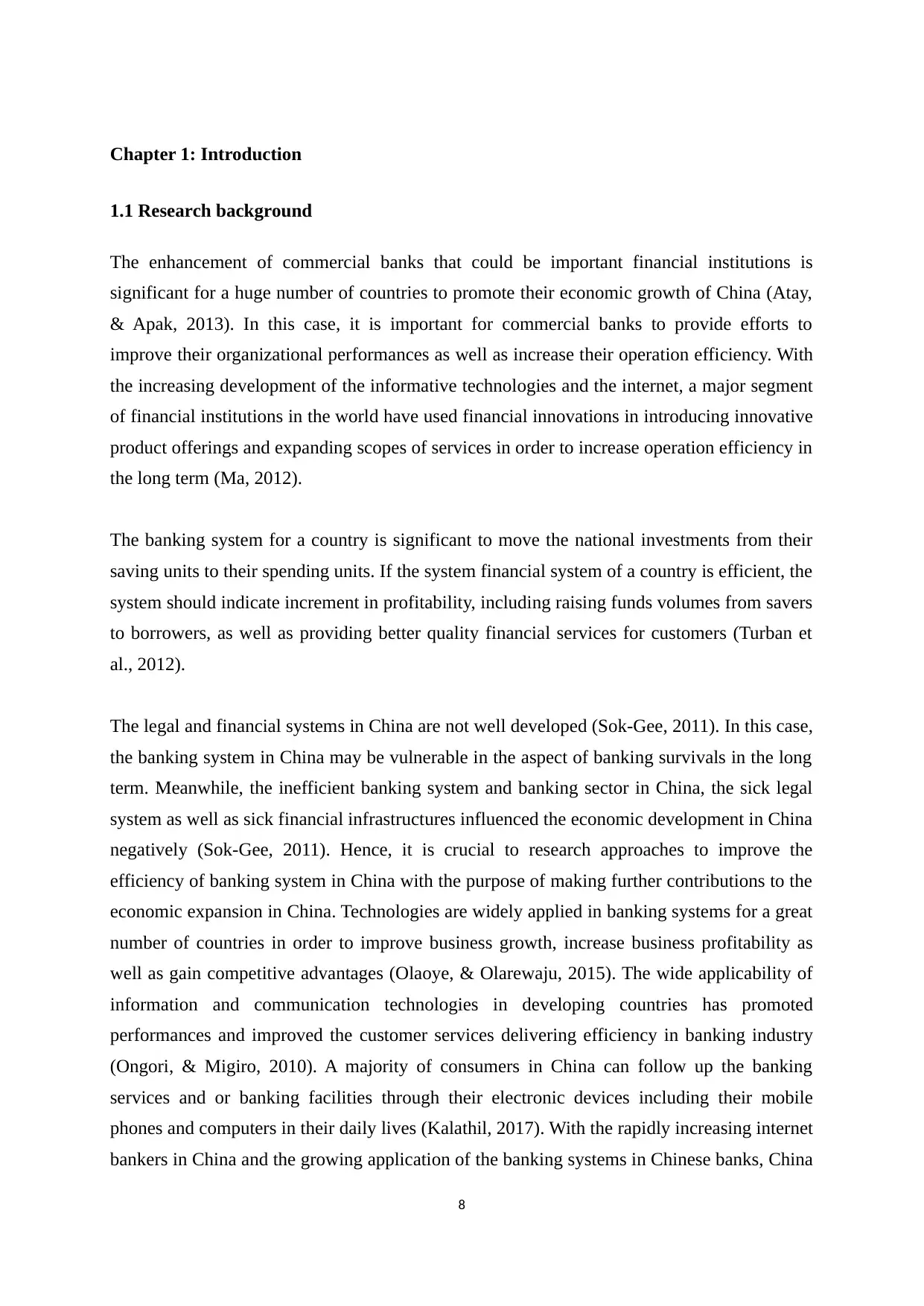
Chapter 1: Introduction
1.1 Research background
The enhancement of commercial banks that could be important financial institutions is
significant for a huge number of countries to promote their economic growth of China (Atay,
& Apak, 2013). In this case, it is important for commercial banks to provide efforts to
improve their organizational performances as well as increase their operation efficiency. With
the increasing development of the informative technologies and the internet, a major segment
of financial institutions in the world have used financial innovations in introducing innovative
product offerings and expanding scopes of services in order to increase operation efficiency in
the long term (Ma, 2012).
The banking system for a country is significant to move the national investments from their
saving units to their spending units. If the system financial system of a country is efficient, the
system should indicate increment in profitability, including raising funds volumes from savers
to borrowers, as well as providing better quality financial services for customers (Turban et
al., 2012).
The legal and financial systems in China are not well developed (Sok-Gee, 2011). In this case,
the banking system in China may be vulnerable in the aspect of banking survivals in the long
term. Meanwhile, the inefficient banking system and banking sector in China, the sick legal
system as well as sick financial infrastructures influenced the economic development in China
negatively (Sok-Gee, 2011). Hence, it is crucial to research approaches to improve the
efficiency of banking system in China with the purpose of making further contributions to the
economic expansion in China. Technologies are widely applied in banking systems for a great
number of countries in order to improve business growth, increase business profitability as
well as gain competitive advantages (Olaoye, & Olarewaju, 2015). The wide applicability of
information and communication technologies in developing countries has promoted
performances and improved the customer services delivering efficiency in banking industry
(Ongori, & Migiro, 2010). A majority of consumers in China can follow up the banking
services and or banking facilities through their electronic devices including their mobile
phones and computers in their daily lives (Kalathil, 2017). With the rapidly increasing internet
bankers in China and the growing application of the banking systems in Chinese banks, China
Chapter 1: Introduction
1.1 Research background
The enhancement of commercial banks that could be important financial institutions is
significant for a huge number of countries to promote their economic growth of China (Atay,
& Apak, 2013). In this case, it is important for commercial banks to provide efforts to
improve their organizational performances as well as increase their operation efficiency. With
the increasing development of the informative technologies and the internet, a major segment
of financial institutions in the world have used financial innovations in introducing innovative
product offerings and expanding scopes of services in order to increase operation efficiency in
the long term (Ma, 2012).
The banking system for a country is significant to move the national investments from their
saving units to their spending units. If the system financial system of a country is efficient, the
system should indicate increment in profitability, including raising funds volumes from savers
to borrowers, as well as providing better quality financial services for customers (Turban et
al., 2012).
The legal and financial systems in China are not well developed (Sok-Gee, 2011). In this case,
the banking system in China may be vulnerable in the aspect of banking survivals in the long
term. Meanwhile, the inefficient banking system and banking sector in China, the sick legal
system as well as sick financial infrastructures influenced the economic development in China
negatively (Sok-Gee, 2011). Hence, it is crucial to research approaches to improve the
efficiency of banking system in China with the purpose of making further contributions to the
economic expansion in China. Technologies are widely applied in banking systems for a great
number of countries in order to improve business growth, increase business profitability as
well as gain competitive advantages (Olaoye, & Olarewaju, 2015). The wide applicability of
information and communication technologies in developing countries has promoted
performances and improved the customer services delivering efficiency in banking industry
(Ongori, & Migiro, 2010). A majority of consumers in China can follow up the banking
services and or banking facilities through their electronic devices including their mobile
phones and computers in their daily lives (Kalathil, 2017). With the rapidly increasing internet
bankers in China and the growing application of the banking systems in Chinese banks, China
9
has a potential to grow its banking industry if the banking technologies are implemented
adequately (Atay, & Apak, 2013). In this case, it is significant to research the relations
between application of banking technologies and performances of commercial banks in China
with the purpose of improving high quality customer services delivery, reducing transaction
costs as well as improving performances.
1.2 Research objectives and research questions
The basic objective of this research is to study the relationships and association between
banking technologies and performances of commercial banks in China. In order to achieve
this objective, this research is guided by two sub issues listed as bellow: 1) assessing
influences of credit cards on performances of commercial banks in China; 2). evaluating
influences of the e-banking on performances of commercial banks in China.
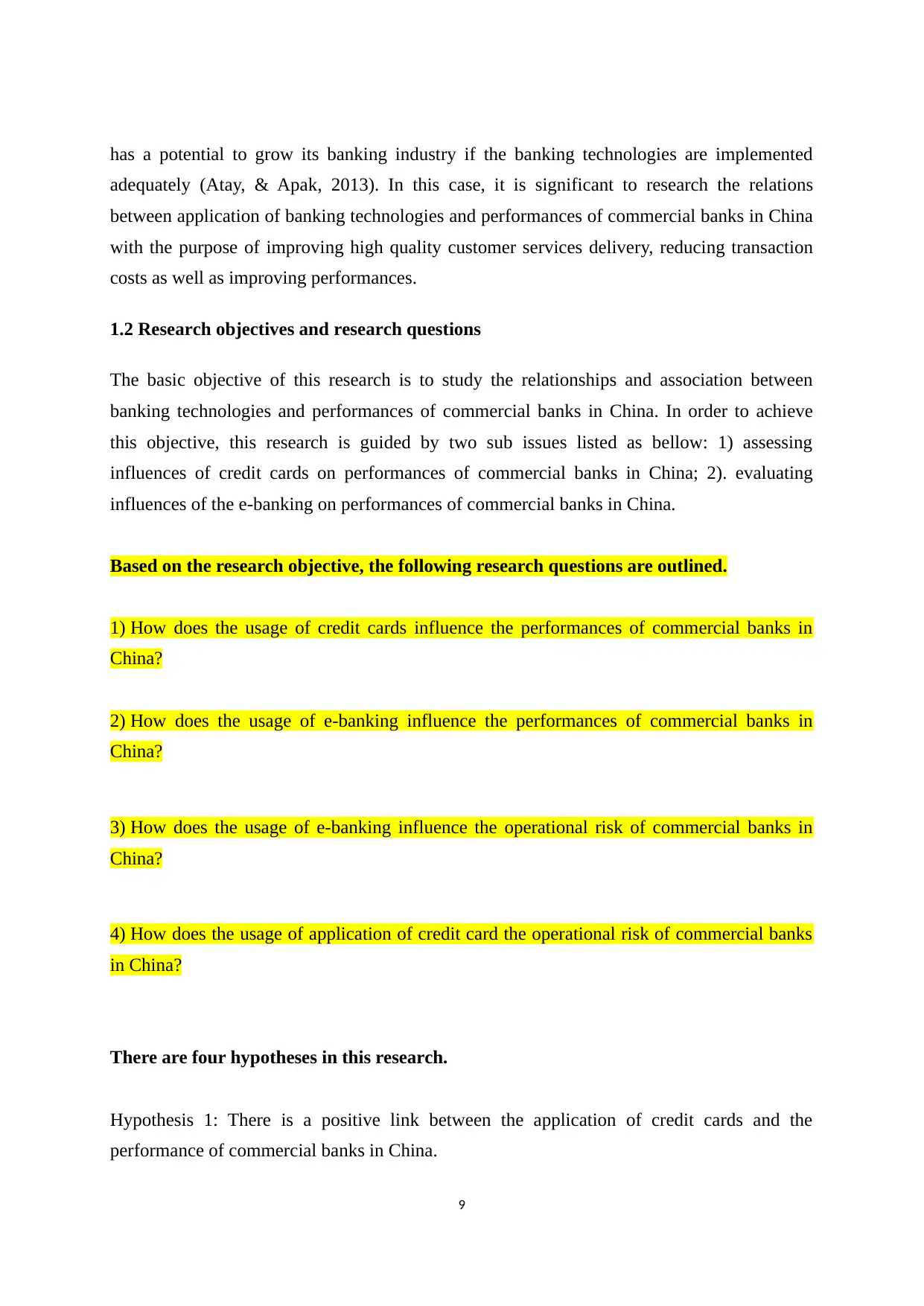
Based on the research objective, the following research questions are outlined.
1) How does the usage of credit cards influence the performances of commercial banks in
China?
2) How does the usage of e-banking influence the performances of commercial banks in
China?
3) How does the usage of e-banking influence the operational risk of commercial banks in
China?
4) How does the usage of application of credit card the operational risk of commercial banks
in China?
There are four hypotheses in this research.
Hypothesis 1: There is a positive link between the application of credit cards and the
performance of commercial banks in China.
has a potential to grow its banking industry if the banking technologies are implemented
adequately (Atay, & Apak, 2013). In this case, it is significant to research the relations
between application of banking technologies and performances of commercial banks in China
with the purpose of improving high quality customer services delivery, reducing transaction
costs as well as improving performances.
1.2 Research objectives and research questions
The basic objective of this research is to study the relationships and association between
banking technologies and performances of commercial banks in China. In order to achieve
this objective, this research is guided by two sub issues listed as bellow: 1) assessing
influences of credit cards on performances of commercial banks in China; 2). evaluating
influences of the e-banking on performances of commercial banks in China.
Based on the research objective, the following research questions are outlined.
1) How does the usage of credit cards influence the performances of commercial banks in
China?
2) How does the usage of e-banking influence the performances of commercial banks in
China?
3) How does the usage of e-banking influence the operational risk of commercial banks in
China?
4) How does the usage of application of credit card the operational risk of commercial banks
in China?
There are four hypotheses in this research.
Hypothesis 1: There is a positive link between the application of credit cards and the
performance of commercial banks in China.
⊘ This is a preview!⊘
Do you want full access?
Subscribe today to unlock all pages.
Trusted by 1+ million students worldwide
10
Hypothesis 2: There is a positive link between the application of credit cards and operational
risks of commercial banks in China.
Hypothesis 3: There is a positive link between the application of e-banking systems and the
performance of commercial banks in China.
Hypothesis 4: There is a positive link between the application of e-banking systems and
operational risks of commercial banks in China.
1.3 Research design
DeYoung, Lang and Nolle (2007) collect data from both the primary and secondary resources.
In this case, this study gathered dataset from the primary resources in the forms of interview
and questionnaire, as well as secondary resources in the forms of literature review and the
annual reports from the two case commercial banks in China. Stoica, Mehdian and Sargu
(2015) analyzed data through using the data development analysis method that includes a
wide range of mathematical linear programming models, whereas DeYoung, Lang and Nolle
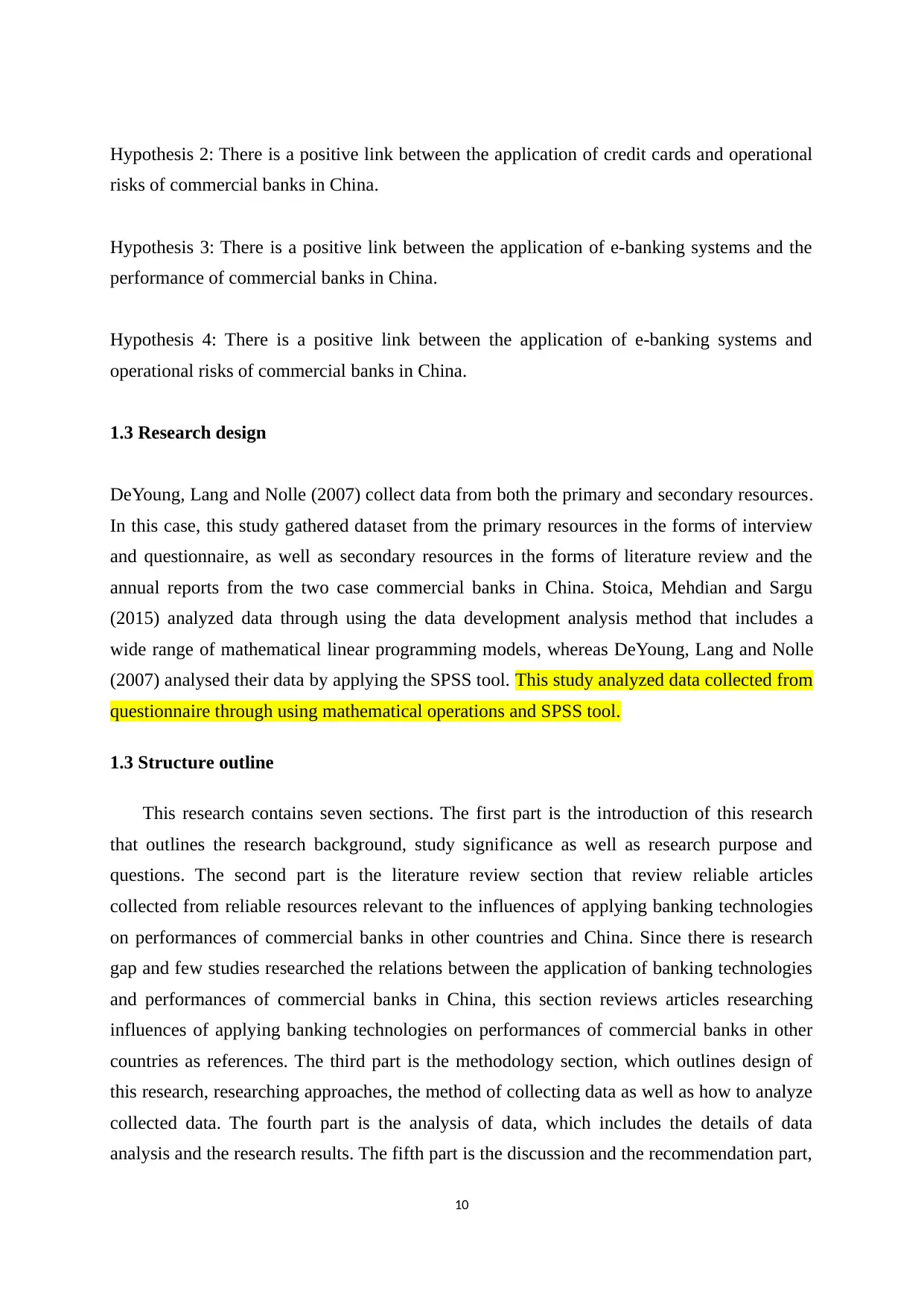
(2007) analysed their data by applying the SPSS tool. This study analyzed data collected from
questionnaire through using mathematical operations and SPSS tool.
1.3 Structure outline
This research contains seven sections. The first part is the introduction of this research
that outlines the research background, study significance as well as research purpose and
questions. The second part is the literature review section that review reliable articles
collected from reliable resources relevant to the influences of applying banking technologies
on performances of commercial banks in other countries and China. Since there is research
gap and few studies researched the relations between the application of banking technologies
and performances of commercial banks in China, this section reviews articles researching
influences of applying banking technologies on performances of commercial banks in other
countries as references. The third part is the methodology section, which outlines design of
this research, researching approaches, the method of collecting data as well as how to analyze
collected data. The fourth part is the analysis of data, which includes the details of data
analysis and the research results. The fifth part is the discussion and the recommendation part,
Hypothesis 2: There is a positive link between the application of credit cards and operational
risks of commercial banks in China.
Hypothesis 3: There is a positive link between the application of e-banking systems and the
performance of commercial banks in China.
Hypothesis 4: There is a positive link between the application of e-banking systems and
operational risks of commercial banks in China.
1.3 Research design
DeYoung, Lang and Nolle (2007) collect data from both the primary and secondary resources.
In this case, this study gathered dataset from the primary resources in the forms of interview
and questionnaire, as well as secondary resources in the forms of literature review and the
annual reports from the two case commercial banks in China. Stoica, Mehdian and Sargu
(2015) analyzed data through using the data development analysis method that includes a
wide range of mathematical linear programming models, whereas DeYoung, Lang and Nolle
(2007) analysed their data by applying the SPSS tool. This study analyzed data collected from
questionnaire through using mathematical operations and SPSS tool.
1.3 Structure outline
This research contains seven sections. The first part is the introduction of this research
that outlines the research background, study significance as well as research purpose and
questions. The second part is the literature review section that review reliable articles
collected from reliable resources relevant to the influences of applying banking technologies
on performances of commercial banks in other countries and China. Since there is research
gap and few studies researched the relations between the application of banking technologies
and performances of commercial banks in China, this section reviews articles researching
influences of applying banking technologies on performances of commercial banks in other
countries as references. The third part is the methodology section, which outlines design of
this research, researching approaches, the method of collecting data as well as how to analyze
collected data. The fourth part is the analysis of data, which includes the details of data
analysis and the research results. The fifth part is the discussion and the recommendation part,
Paraphrase This Document
Need a fresh take? Get an instant paraphrase of this document with our AI Paraphraser
11
which provides recommendations for commercial banks in China to enhance their
organizational performances.
Chapter 2: Literature review.
This chapter reviews book and journal articles relevant to influences of applying banking
technologies on performances of commercial banks in other countries and China.
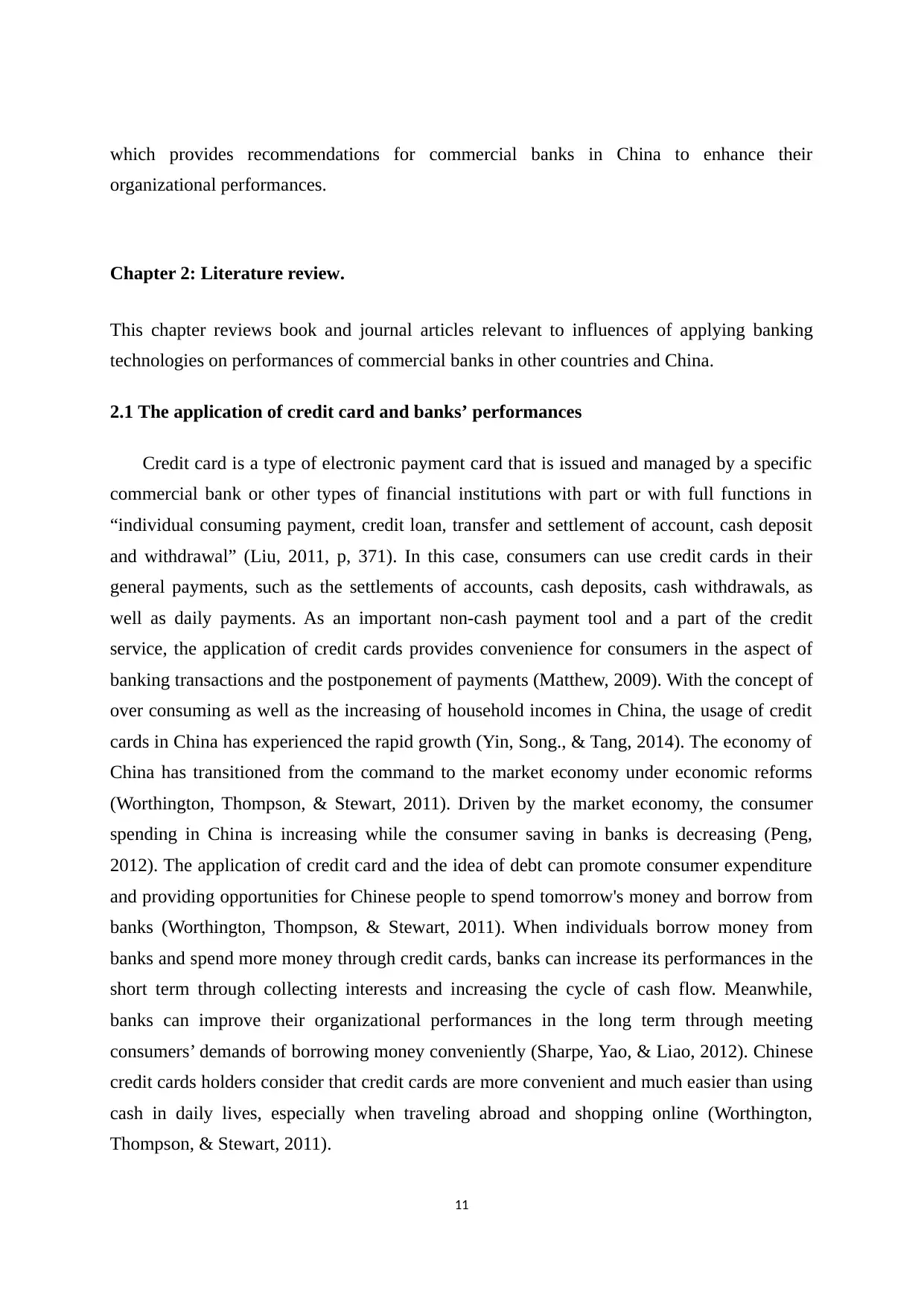
2.1 The application of credit card and banks’ performances
Credit card is a type of electronic payment card that is issued and managed by a specific
commercial bank or other types of financial institutions with part or with full functions in
“individual consuming payment, credit loan, transfer and settlement of account, cash deposit
and withdrawal” (Liu, 2011, p, 371). In this case, consumers can use credit cards in their
general payments, such as the settlements of accounts, cash deposits, cash withdrawals, as
well as daily payments. As an important non-cash payment tool and a part of the credit
service, the application of credit cards provides convenience for consumers in the aspect of
banking transactions and the postponement of payments (Matthew, 2009). With the concept of
over consuming as well as the increasing of household incomes in China, the usage of credit
cards in China has experienced the rapid growth (Yin, Song., & Tang, 2014). The economy of
China has transitioned from the command to the market economy under economic reforms
(Worthington, Thompson, & Stewart, 2011). Driven by the market economy, the consumer
spending in China is increasing while the consumer saving in banks is decreasing (Peng,
2012). The application of credit card and the idea of debt can promote consumer expenditure
and providing opportunities for Chinese people to spend tomorrow's money and borrow from
banks (Worthington, Thompson, & Stewart, 2011). When individuals borrow money from
banks and spend more money through credit cards, banks can increase its performances in the
short term through collecting interests and increasing the cycle of cash flow. Meanwhile,
banks can improve their organizational performances in the long term through meeting
consumers’ demands of borrowing money conveniently (Sharpe, Yao, & Liao, 2012). Chinese
credit cards holders consider that credit cards are more convenient and much easier than using
cash in daily lives, especially when traveling abroad and shopping online (Worthington,
Thompson, & Stewart, 2011).
which provides recommendations for commercial banks in China to enhance their
organizational performances.
Chapter 2: Literature review.
This chapter reviews book and journal articles relevant to influences of applying banking
technologies on performances of commercial banks in other countries and China.
2.1 The application of credit card and banks’ performances
Credit card is a type of electronic payment card that is issued and managed by a specific
commercial bank or other types of financial institutions with part or with full functions in
“individual consuming payment, credit loan, transfer and settlement of account, cash deposit
and withdrawal” (Liu, 2011, p, 371). In this case, consumers can use credit cards in their
general payments, such as the settlements of accounts, cash deposits, cash withdrawals, as
well as daily payments. As an important non-cash payment tool and a part of the credit
service, the application of credit cards provides convenience for consumers in the aspect of
banking transactions and the postponement of payments (Matthew, 2009). With the concept of
over consuming as well as the increasing of household incomes in China, the usage of credit
cards in China has experienced the rapid growth (Yin, Song., & Tang, 2014). The economy of
China has transitioned from the command to the market economy under economic reforms
(Worthington, Thompson, & Stewart, 2011). Driven by the market economy, the consumer
spending in China is increasing while the consumer saving in banks is decreasing (Peng,
2012). The application of credit card and the idea of debt can promote consumer expenditure
and providing opportunities for Chinese people to spend tomorrow's money and borrow from
banks (Worthington, Thompson, & Stewart, 2011). When individuals borrow money from
banks and spend more money through credit cards, banks can increase its performances in the
short term through collecting interests and increasing the cycle of cash flow. Meanwhile,
banks can improve their organizational performances in the long term through meeting
consumers’ demands of borrowing money conveniently (Sharpe, Yao, & Liao, 2012). Chinese
credit cards holders consider that credit cards are more convenient and much easier than using
cash in daily lives, especially when traveling abroad and shopping online (Worthington,
Thompson, & Stewart, 2011).
12
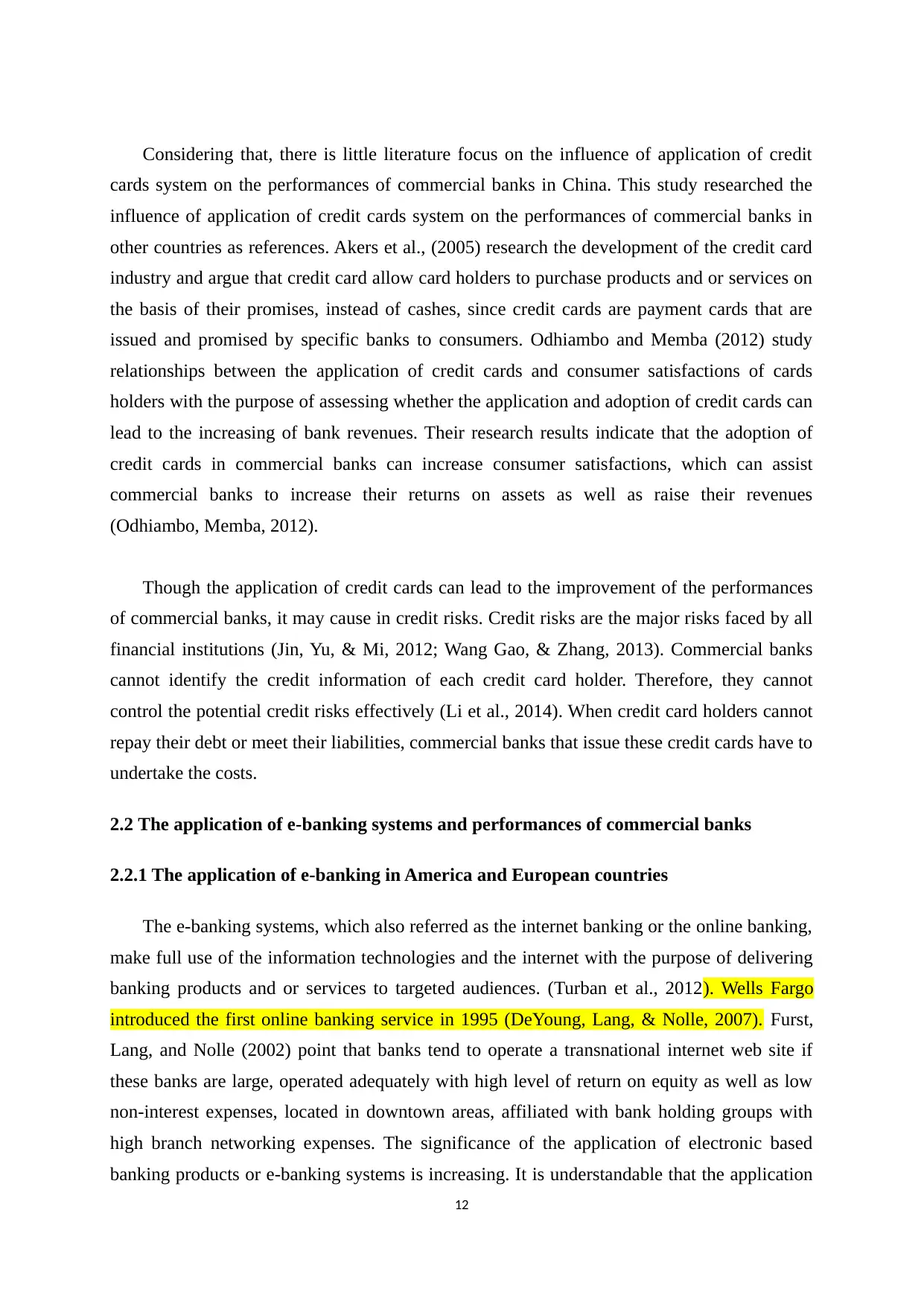
Considering that, there is little literature focus on the influence of application of credit
cards system on the performances of commercial banks in China. This study researched the
influence of application of credit cards system on the performances of commercial banks in
other countries as references. Akers et al., (2005) research the development of the credit card
industry and argue that credit card allow card holders to purchase products and or services on
the basis of their promises, instead of cashes, since credit cards are payment cards that are
issued and promised by specific banks to consumers. Odhiambo and Memba (2012) study
relationships between the application of credit cards and consumer satisfactions of cards
holders with the purpose of assessing whether the application and adoption of credit cards can
lead to the increasing of bank revenues. Their research results indicate that the adoption of
credit cards in commercial banks can increase consumer satisfactions, which can assist
commercial banks to increase their returns on assets as well as raise their revenues
(Odhiambo, Memba, 2012).
Though the application of credit cards can lead to the improvement of the performances
of commercial banks, it may cause in credit risks. Credit risks are the major risks faced by all
financial institutions (Jin, Yu, & Mi, 2012; Wang Gao, & Zhang, 2013). Commercial banks
cannot identify the credit information of each credit card holder. Therefore, they cannot
control the potential credit risks effectively (Li et al., 2014). When credit card holders cannot
repay their debt or meet their liabilities, commercial banks that issue these credit cards have to
undertake the costs.
2.2 The application of e-banking systems and performances of commercial banks
2.2.1 The application of e-banking in America and European countries
The e-banking systems, which also referred as the internet banking or the online banking,
make full use of the information technologies and the internet with the purpose of delivering
banking products and or services to targeted audiences. (Turban et al., 2012). Wells Fargo
introduced the first online banking service in 1995 (DeYoung, Lang, & Nolle, 2007). Furst,
Lang, and Nolle (2002) point that banks tend to operate a transnational internet web site if
these banks are large, operated adequately with high level of return on equity as well as low
non-interest expenses, located in downtown areas, affiliated with bank holding groups with
high branch networking expenses. The significance of the application of electronic based
banking products or e-banking systems is increasing. It is understandable that the application
Considering that, there is little literature focus on the influence of application of credit
cards system on the performances of commercial banks in China. This study researched the
influence of application of credit cards system on the performances of commercial banks in
other countries as references. Akers et al., (2005) research the development of the credit card
industry and argue that credit card allow card holders to purchase products and or services on
the basis of their promises, instead of cashes, since credit cards are payment cards that are
issued and promised by specific banks to consumers. Odhiambo and Memba (2012) study
relationships between the application of credit cards and consumer satisfactions of cards
holders with the purpose of assessing whether the application and adoption of credit cards can
lead to the increasing of bank revenues. Their research results indicate that the adoption of
credit cards in commercial banks can increase consumer satisfactions, which can assist
commercial banks to increase their returns on assets as well as raise their revenues
(Odhiambo, Memba, 2012).
Though the application of credit cards can lead to the improvement of the performances
of commercial banks, it may cause in credit risks. Credit risks are the major risks faced by all
financial institutions (Jin, Yu, & Mi, 2012; Wang Gao, & Zhang, 2013). Commercial banks
cannot identify the credit information of each credit card holder. Therefore, they cannot
control the potential credit risks effectively (Li et al., 2014). When credit card holders cannot
repay their debt or meet their liabilities, commercial banks that issue these credit cards have to
undertake the costs.
2.2 The application of e-banking systems and performances of commercial banks
2.2.1 The application of e-banking in America and European countries
The e-banking systems, which also referred as the internet banking or the online banking,
make full use of the information technologies and the internet with the purpose of delivering
banking products and or services to targeted audiences. (Turban et al., 2012). Wells Fargo
introduced the first online banking service in 1995 (DeYoung, Lang, & Nolle, 2007). Furst,
Lang, and Nolle (2002) point that banks tend to operate a transnational internet web site if
these banks are large, operated adequately with high level of return on equity as well as low
non-interest expenses, located in downtown areas, affiliated with bank holding groups with
high branch networking expenses. The significance of the application of electronic based
banking products or e-banking systems is increasing. It is understandable that the application
⊘ This is a preview!⊘
Do you want full access?
Subscribe today to unlock all pages.
Trusted by 1+ million students worldwide

1 out of 57


Related Documents


Your All-in-One AI-Powered Toolkit for Academic Success.
+13062052269
info@desklib.com
Available 24*7 on WhatsApp / Email
![[object Object]](/_next/static/media/star-bottom.7253800d.svg)
Unlock your academic potential
Copyright © 2020–2026 A2Z Services. All Rights Reserved. Developed and managed by ZUCOL.