Street Art's Context and Materiality: Banksy's Slave Labour Essay

Verified

Added on  2022/11/27

|4
|1465
|285
Essay
AI Summary
This essay examines the intersection of street art, urban context, and community through an analysis of Banksy's Slave Labour. It argues that street art, far from being mere decoration, actively shapes and strengthens the solidarity of a city. The essay delves into the reciprocal relationships between street art and its environment, discussing how the artwork's placement, symbolism, and the public reaction to its removal highlight its role as a communicative event and a democratic forum. The analysis draws on academic journals and the specific example of Slave Labour to demonstrate how street art engages with local culture, challenges capitalist ideologies, and fosters a sense of collective identity and critical reflection within urban spaces. The essay concludes by emphasizing the indivisible connection between street art and the dynamic nature of urban life.
Document Page
Q: In a properly made street art piece the forms and meanings of the street are not the
backdrop, they are the working material. Find a street art or graffiti image on the street or
online and discuss its context and its materiality
Slave Labour and The Street
Word count:
By the lens of the term “street art”, the emerging nature is that street art is an inherent
collaboration between physical infrastructure, urban context, artists, business, politics,
community, and even an entire society (Kenaan 2011; Abarca 2016; Hansen & Danny 2015).
Those underlying reciprocal relationships between street art and the city context has been
illustrated by the explosion of aesthetic protests after the removal of Banksy’s Slave Labour
from a wall in North London (BBC 2013). The protests further indicate the solidaritarian
place-making practice of street art on the city (Christensen & Thor 2017). Therefore, this
essay will argue that the street art is not only shaped by the city, but performs and strengthen
solidarity of city as well. To support my premise, I will examine this through an analysis of
academic journals, as well as Banksy’s Slave Labour.
Before beginning it, it makes sense to parse out what separate “street art” from the
mainstream of art and what constitutes “the street” of “street art”. Because compared with the
institutional works of art, the city space where street art is based upon is not a blank canvas,
but a complicated and ever-changing accumulation of objects, symbols, individuals, as well
as their both obvious and potential representations. On the other hand, when the artist put the
first action on the space, another layer of contestation process between his/her own
understandings of locality and spatial dynamic culture happens. Therefore, a street artwork
can be regarded as a visualised cultural product from all multifaceted contestations in the city
space. This product can further be internalised as a part of the city culture. A professor of
philosophy Hagi Kenaan (2011, 101) thus argues that street art embraces not only a specific
spatial matrix but also a dynamic and open-ended process of multi-subjective, interventions,
tensions, contestations, and even constructions that take place within the space of the city.
The collective and dynamic nature of street art makes it more likely to be an urban
democratic communicative landscape (Christensen & Thor 2017, 585) upon which every
individual has an equal accessibility and ability to put a layer of identity and perception by
doing critical reflections or creating new works. Such can be seen clearly in Banksy’s famous
street artwork, Slave Labour.
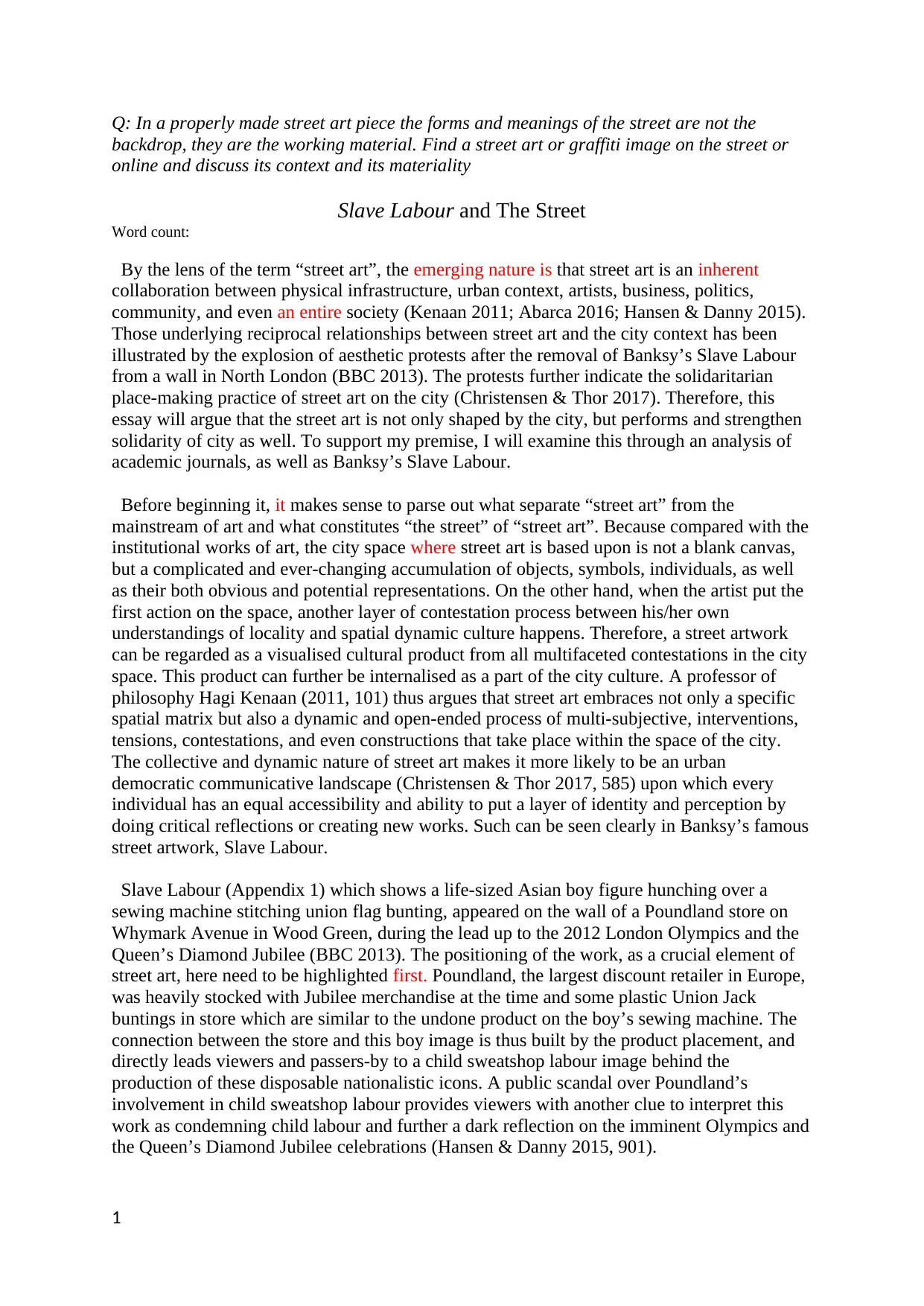
Slave Labour (Appendix 1) which shows a life-sized Asian boy figure hunching over a
sewing machine stitching union flag bunting, appeared on the wall of a Poundland store on
Whymark Avenue in Wood Green, during the lead up to the 2012 London Olympics and the
Queen’s Diamond Jubilee (BBC 2013). The positioning of the work, as a crucial element of
street art, here need to be highlighted first. Poundland, the largest discount retailer in Europe,
was heavily stocked with Jubilee merchandise at the time and some plastic Union Jack
buntings in store which are similar to the undone product on the boy’s sewing machine. The
connection between the store and this boy image is thus built by the product placement, and
directly leads viewers and passers-by to a child sweatshop labour image behind the
production of these disposable nationalistic icons. A public scandal over Poundland’s
involvement in child sweatshop labour provides viewers with another clue to interpret this
work as condemning child labour and further a dark reflection on the imminent Olympics and
the Queen’s Diamond Jubilee celebrations (Hansen & Danny 2015, 901).
1
tabler-icon-diamond-filled.svg

Paraphrase This Document

Need a fresh take? Get an instant paraphrase of this document with our AI Paraphraser
Document Page
Besides sensibly accumulating the meanings and connotations of the objects from this
space, Banksy injects his understandings and perceptions of this space, this community, this
whole city and even the time into the accumulation and visualising process (Abarca 2016,
61). This stencilled Asian boy thus can be understood as Banksy’s engagement with the city
as a collage of environment and source materials. From the perspective of viewers, this
visualised city engagement embracing relationships with local culture is similar to a street
sign or street name according to semiotics, which means that it in essence is complete
accessible and understandable by passers-by, and based upon a specific urban context,
informs the viewer of the intended critical meaning using explicit visual cues (Christensen &
Thor 2017, 594). But being different from simple street signs and names, Slave Labour can
become communicative events (594) – a magnet that attracts more street artworks to visually
colonise the entire current sphere, but simultaneously and constantly effacing other images
(Kenaan 2011,103). For viewers, Slave labour intervenes in the habitual communication
between individual and dominated capitalist space under a homogenizing ideology and
reveals the radical divisions and specific dark children labour fact existing in the public realm
(McDonough 1994, 69). Due to simultaneously partaking of a differential network of
changing and accumulating visual signs and individual reflections, it is gradually internalised
in the community as a democratic forum within which every people has the right to express
and speak on any specific political character.
Once this democracy is emerging, all visual images and all objects on the wall are conjoined
in their function as creating connectivity and reciprocity, as well as “solidatarian place-
making” a sub-landscape under hegemony urban space (Christensen & Thor 2017, 587). Here
“solidatarian place-making” is understood as an encouragement to mutual understanding and
respect for our positions in urban environment (587) and a call for action to do critical
reflections on established urban spaces as a free spectator rather than a part of the capitalism
world. Based upon the place-making practice, the Slave Labour’s removal implies not only a
deprivation of an asset of the community, but a destruction of an integral cultural system of
this space. Such is highlighted by a subsequent series of self-consciously egalitarian works of
aesthetic protest on the wall (Hansen & Danny 2015, 899), all of which express the outrage
on the extraction of their own public, democratic, accessible and readable platform rather
than of a famous artwork itself.
To conclude, we can observe that by looking at the analysis of Banksy’s Slave Labour,
images created on the street is understood as being shaped by changing and intersecting
objects, symbols and culture, consequently being internalised into a part of the dynamic of
urban space (Kenaan 2011, 103). The community reaction and aesthetic protest on the wall
after its removal further proves the indivisibility of street art and urban space.
2
Document Page
References:
Abarca, Javier. 2016. "From street art to murals, what have we lost?". the Street Art and
Urban
Creativity Scientific Journal 2 (2): 60-67.
BBC, 2013. "Banksy's Slave Labour auctioned". BBC News. https://www.bbc.com/news/uk-
england-london-22741911
Christensen, Miyase & Thor, Tindra. 2017. "The reciprocal city: Performing solidarity—
Mediating space through street art and graffiti". International Communication
Gazette 79 (6-7): 584-612.
Hansen, Susan & Danny, Flynn. 2015. "‘This is not a Banksy!’: street art as aesthetic
protest". Continuum 29 (6): 898-912.
McDonough, Thomas F. 1994. "Situationist Space". October 67 (Winter, 1994): 58-77.
Kenaan, Hagi. 2011. "Street Art and the Sovereign’s Imagination". Street Art in Israel: 97-
107.
3
Document Page
Appendix:
BBC. 2013. Tony Baxter from The Sincura Group told the BBC's Will Gompertz that the
auction is a chance for
the work to stay in the UK. Image. https://www.bbc.com/news/uk-england-london-
22741911.
4
chevron_up_icon
1 out of 4
circle_padding
hide_on_mobile
zoom_out_icon
[object Object]