Thesis: Bauxite Residue and Cement Production in Australia
VerifiedAdded on 2023/01/07
|32
|12317
|2
Thesis and Dissertation
AI Summary
This thesis investigates the potential of utilizing bauxite residue (BR), a waste product from aluminum ore extraction, in cement production, specifically focusing on its industrialization in Australia. The research employs a qualitative methodology, relying on a systematic literature review to address key research questions. The study aims to analyze ways BR can be used to meet cement demands, assess its structural viability, and determine its impact on cement quality. It identifies drivers and barriers to BR reuse in cement production and recommends methods to overcome adoption challenges. The thesis covers themes such as BR disposal methods, its characteristics, and its potential as a viable product. It also examines the importance of BR in affecting cement quality and explores ways to overcome barriers to its adoption. The findings contribute to understanding how BR can be used for cement production and the ways it can be industrialized in Australia, aiming to reduce environmental pollution and promote sustainable practices in the cement industry.
THESIS
1
1

Paraphrase This Document
Need a fresh take? Get an instant paraphrase of this document with our AI Paraphraser
ABSTRACT
Introduction: Bauxite reside is a highly alkaline waste product which is produced as wastage of
by product during extraction of aluminium ore. It is produced in tonnes and has a negative
impact upon environment and can result in increasing environment pollution. BR can be used as
a raw material in production of cement in such a manner that can increasing quality, durability of
cement and can also help in production of environmentally sustainable cement. The main
purpose of this thesis is- to analyse ways in which cement production made from BR can be
industrialized in Australia.
Research methodology: It is a qualitative type of research in which Secondary data had been
collected by the researcher from earlier credited research reports and mass media regarding the
use of BR in the production of cement. For analysis of this secondary data, Systematic literature
review analysis method had been chosen so that main research questions can be answered in a
proper and effective manner.
This research had successfully answered all the main research questions and has also helped in
understand ways in which Bauxite residue can be used for production of cement and ways in
which it can be industrialized in Australia.
2
Introduction: Bauxite reside is a highly alkaline waste product which is produced as wastage of
by product during extraction of aluminium ore. It is produced in tonnes and has a negative
impact upon environment and can result in increasing environment pollution. BR can be used as
a raw material in production of cement in such a manner that can increasing quality, durability of
cement and can also help in production of environmentally sustainable cement. The main
purpose of this thesis is- to analyse ways in which cement production made from BR can be
industrialized in Australia.
Research methodology: It is a qualitative type of research in which Secondary data had been
collected by the researcher from earlier credited research reports and mass media regarding the
use of BR in the production of cement. For analysis of this secondary data, Systematic literature
review analysis method had been chosen so that main research questions can be answered in a
proper and effective manner.
This research had successfully answered all the main research questions and has also helped in
understand ways in which Bauxite residue can be used for production of cement and ways in
which it can be industrialized in Australia.
2
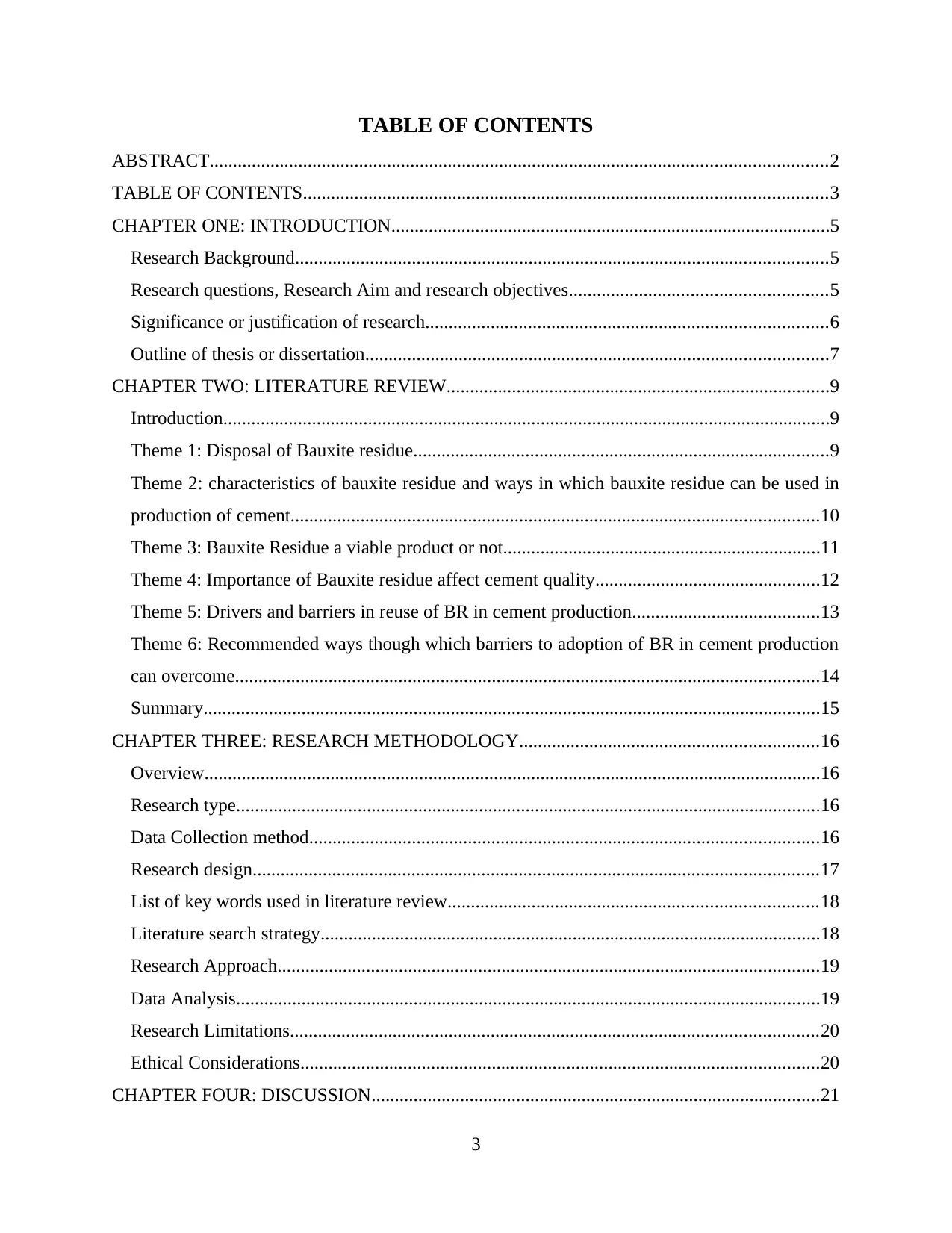
TABLE OF CONTENTS
ABSTRACT....................................................................................................................................2
TABLE OF CONTENTS................................................................................................................3
CHAPTER ONE: INTRODUCTION..............................................................................................5
Research Background..................................................................................................................5
Research questions, Research Aim and research objectives.......................................................5
Significance or justification of research......................................................................................6
Outline of thesis or dissertation...................................................................................................7
CHAPTER TWO: LITERATURE REVIEW..................................................................................9
Introduction..................................................................................................................................9
Theme 1: Disposal of Bauxite residue.........................................................................................9
Theme 2: characteristics of bauxite residue and ways in which bauxite residue can be used in
production of cement.................................................................................................................10
Theme 3: Bauxite Residue a viable product or not....................................................................11
Theme 4: Importance of Bauxite residue affect cement quality................................................12
Theme 5: Drivers and barriers in reuse of BR in cement production........................................13
Theme 6: Recommended ways though which barriers to adoption of BR in cement production
can overcome.............................................................................................................................14
Summary....................................................................................................................................15
CHAPTER THREE: RESEARCH METHODOLOGY................................................................16
Overview....................................................................................................................................16
Research type.............................................................................................................................16
Data Collection method.............................................................................................................16
Research design.........................................................................................................................17
List of key words used in literature review...............................................................................18
Literature search strategy...........................................................................................................18
Research Approach....................................................................................................................19
Data Analysis.............................................................................................................................19
Research Limitations.................................................................................................................20
Ethical Considerations...............................................................................................................20
CHAPTER FOUR: DISCUSSION................................................................................................21
3
ABSTRACT....................................................................................................................................2
TABLE OF CONTENTS................................................................................................................3
CHAPTER ONE: INTRODUCTION..............................................................................................5
Research Background..................................................................................................................5
Research questions, Research Aim and research objectives.......................................................5
Significance or justification of research......................................................................................6
Outline of thesis or dissertation...................................................................................................7
CHAPTER TWO: LITERATURE REVIEW..................................................................................9
Introduction..................................................................................................................................9
Theme 1: Disposal of Bauxite residue.........................................................................................9
Theme 2: characteristics of bauxite residue and ways in which bauxite residue can be used in
production of cement.................................................................................................................10
Theme 3: Bauxite Residue a viable product or not....................................................................11
Theme 4: Importance of Bauxite residue affect cement quality................................................12
Theme 5: Drivers and barriers in reuse of BR in cement production........................................13
Theme 6: Recommended ways though which barriers to adoption of BR in cement production
can overcome.............................................................................................................................14
Summary....................................................................................................................................15
CHAPTER THREE: RESEARCH METHODOLOGY................................................................16
Overview....................................................................................................................................16
Research type.............................................................................................................................16
Data Collection method.............................................................................................................16
Research design.........................................................................................................................17
List of key words used in literature review...............................................................................18
Literature search strategy...........................................................................................................18
Research Approach....................................................................................................................19
Data Analysis.............................................................................................................................19
Research Limitations.................................................................................................................20
Ethical Considerations...............................................................................................................20
CHAPTER FOUR: DISCUSSION................................................................................................21
3
⊘ This is a preview!⊘
Do you want full access?
Subscribe today to unlock all pages.

Trusted by 1+ million students worldwide

CHAPTER FIVE: RESULTS........................................................................................................26
CHAPTER SIX: CONCLUSION AND RECOMMENDATIONS..............................................28
Conclusion.................................................................................................................................28
Scope for further research..........................................................................................................29
REREFENCES..............................................................................................................................31
4
CHAPTER SIX: CONCLUSION AND RECOMMENDATIONS..............................................28
Conclusion.................................................................................................................................28
Scope for further research..........................................................................................................29
REREFENCES..............................................................................................................................31
4
Paraphrase This Document
Need a fresh take? Get an instant paraphrase of this document with our AI Paraphraser
CHAPTER ONE: INTRODUCTION
Research Background
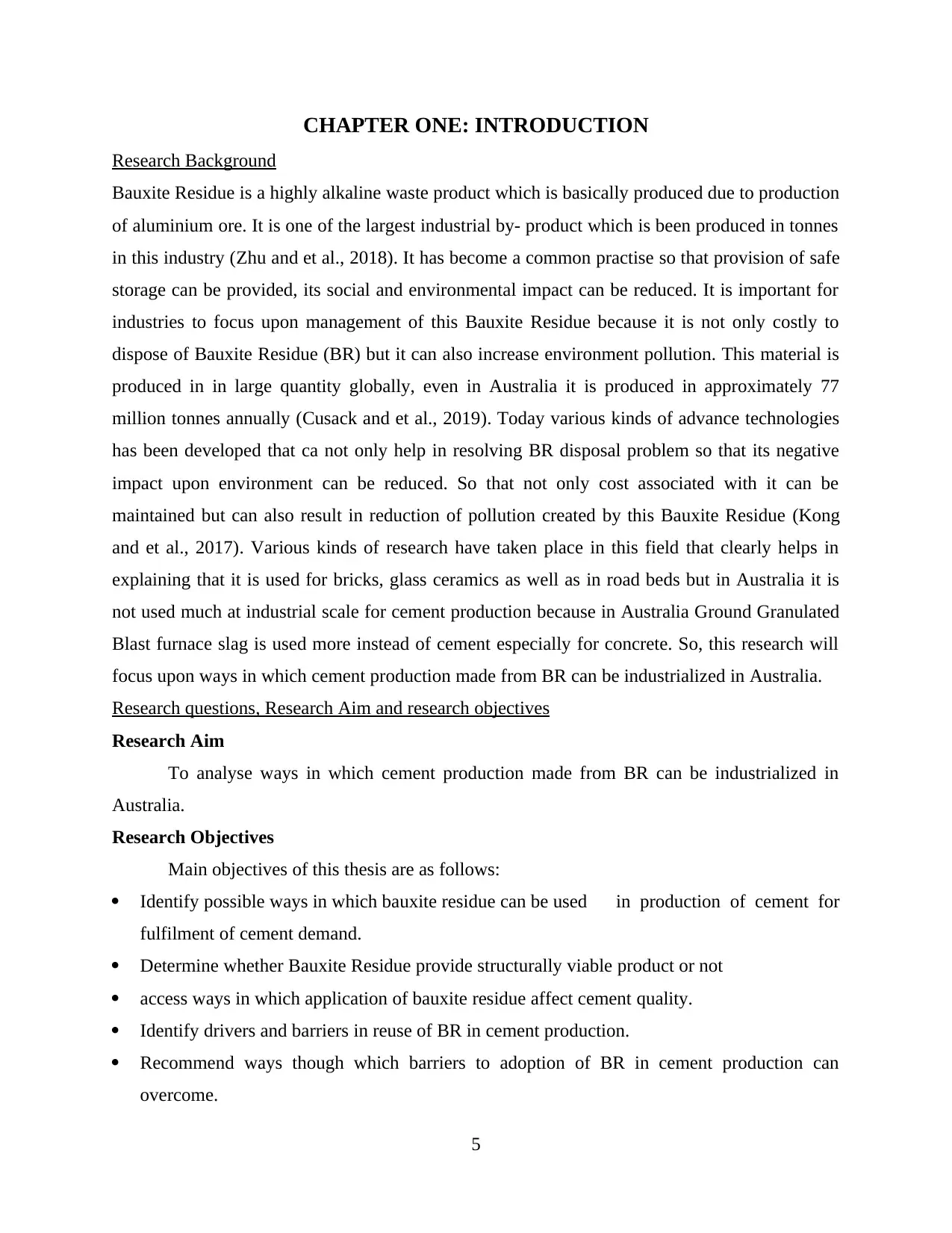
Bauxite Residue is a highly alkaline waste product which is basically produced due to production
of aluminium ore. It is one of the largest industrial by- product which is been produced in tonnes
in this industry (Zhu and et al., 2018). It has become a common practise so that provision of safe
storage can be provided, its social and environmental impact can be reduced. It is important for
industries to focus upon management of this Bauxite Residue because it is not only costly to
dispose of Bauxite Residue (BR) but it can also increase environment pollution. This material is
produced in in large quantity globally, even in Australia it is produced in approximately 77
million tonnes annually (Cusack and et al., 2019). Today various kinds of advance technologies
has been developed that ca not only help in resolving BR disposal problem so that its negative
impact upon environment can be reduced. So that not only cost associated with it can be
maintained but can also result in reduction of pollution created by this Bauxite Residue (Kong
and et al., 2017). Various kinds of research have taken place in this field that clearly helps in
explaining that it is used for bricks, glass ceramics as well as in road beds but in Australia it is
not used much at industrial scale for cement production because in Australia Ground Granulated
Blast furnace slag is used more instead of cement especially for concrete. So, this research will
focus upon ways in which cement production made from BR can be industrialized in Australia.
Research questions, Research Aim and research objectives
Research Aim
To analyse ways in which cement production made from BR can be industrialized in
Australia.
Research Objectives
Main objectives of this thesis are as follows:
Identify possible ways in which bauxite residue can be used in production of cement for
fulfilment of cement demand.
Determine whether Bauxite Residue provide structurally viable product or not
access ways in which application of bauxite residue affect cement quality.
Identify drivers and barriers in reuse of BR in cement production.
Recommend ways though which barriers to adoption of BR in cement production can
overcome.
5
Research Background
Bauxite Residue is a highly alkaline waste product which is basically produced due to production
of aluminium ore. It is one of the largest industrial by- product which is been produced in tonnes
in this industry (Zhu and et al., 2018). It has become a common practise so that provision of safe
storage can be provided, its social and environmental impact can be reduced. It is important for
industries to focus upon management of this Bauxite Residue because it is not only costly to
dispose of Bauxite Residue (BR) but it can also increase environment pollution. This material is
produced in in large quantity globally, even in Australia it is produced in approximately 77
million tonnes annually (Cusack and et al., 2019). Today various kinds of advance technologies
has been developed that ca not only help in resolving BR disposal problem so that its negative
impact upon environment can be reduced. So that not only cost associated with it can be
maintained but can also result in reduction of pollution created by this Bauxite Residue (Kong
and et al., 2017). Various kinds of research have taken place in this field that clearly helps in
explaining that it is used for bricks, glass ceramics as well as in road beds but in Australia it is
not used much at industrial scale for cement production because in Australia Ground Granulated
Blast furnace slag is used more instead of cement especially for concrete. So, this research will
focus upon ways in which cement production made from BR can be industrialized in Australia.
Research questions, Research Aim and research objectives
Research Aim
To analyse ways in which cement production made from BR can be industrialized in
Australia.
Research Objectives
Main objectives of this thesis are as follows:
Identify possible ways in which bauxite residue can be used in production of cement for
fulfilment of cement demand.
Determine whether Bauxite Residue provide structurally viable product or not
access ways in which application of bauxite residue affect cement quality.
Identify drivers and barriers in reuse of BR in cement production.
Recommend ways though which barriers to adoption of BR in cement production can
overcome.
5
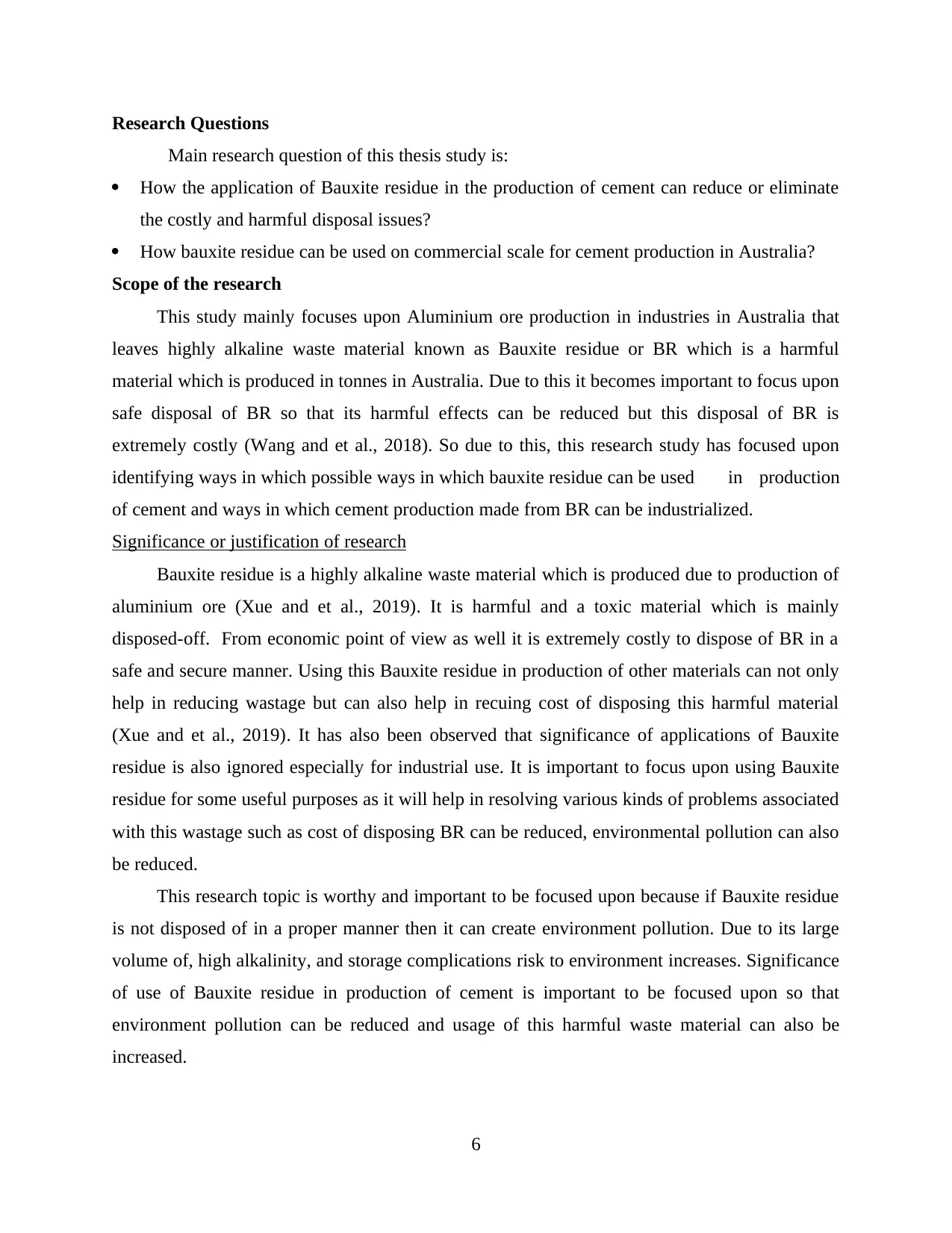
Research Questions
Main research question of this thesis study is:
How the application of Bauxite residue in the production of cement can reduce or eliminate
the costly and harmful disposal issues?
How bauxite residue can be used on commercial scale for cement production in Australia?
Scope of the research
This study mainly focuses upon Aluminium ore production in industries in Australia that
leaves highly alkaline waste material known as Bauxite residue or BR which is a harmful
material which is produced in tonnes in Australia. Due to this it becomes important to focus upon
safe disposal of BR so that its harmful effects can be reduced but this disposal of BR is
extremely costly (Wang and et al., 2018). So due to this, this research study has focused upon
identifying ways in which possible ways in which bauxite residue can be used in production
of cement and ways in which cement production made from BR can be industrialized.
Significance or justification of research
Bauxite residue is a highly alkaline waste material which is produced due to production of
aluminium ore (Xue and et al., 2019). It is harmful and a toxic material which is mainly
disposed-off. From economic point of view as well it is extremely costly to dispose of BR in a
safe and secure manner. Using this Bauxite residue in production of other materials can not only
help in reducing wastage but can also help in recuing cost of disposing this harmful material
(Xue and et al., 2019). It has also been observed that significance of applications of Bauxite
residue is also ignored especially for industrial use. It is important to focus upon using Bauxite
residue for some useful purposes as it will help in resolving various kinds of problems associated
with this wastage such as cost of disposing BR can be reduced, environmental pollution can also
be reduced.
This research topic is worthy and important to be focused upon because if Bauxite residue
is not disposed of in a proper manner then it can create environment pollution. Due to its large
volume of, high alkalinity, and storage complications risk to environment increases. Significance
of use of Bauxite residue in production of cement is important to be focused upon so that
environment pollution can be reduced and usage of this harmful waste material can also be
increased.
6
Main research question of this thesis study is:
How the application of Bauxite residue in the production of cement can reduce or eliminate
the costly and harmful disposal issues?
How bauxite residue can be used on commercial scale for cement production in Australia?
Scope of the research
This study mainly focuses upon Aluminium ore production in industries in Australia that
leaves highly alkaline waste material known as Bauxite residue or BR which is a harmful
material which is produced in tonnes in Australia. Due to this it becomes important to focus upon
safe disposal of BR so that its harmful effects can be reduced but this disposal of BR is
extremely costly (Wang and et al., 2018). So due to this, this research study has focused upon
identifying ways in which possible ways in which bauxite residue can be used in production
of cement and ways in which cement production made from BR can be industrialized.
Significance or justification of research
Bauxite residue is a highly alkaline waste material which is produced due to production of
aluminium ore (Xue and et al., 2019). It is harmful and a toxic material which is mainly
disposed-off. From economic point of view as well it is extremely costly to dispose of BR in a
safe and secure manner. Using this Bauxite residue in production of other materials can not only
help in reducing wastage but can also help in recuing cost of disposing this harmful material
(Xue and et al., 2019). It has also been observed that significance of applications of Bauxite
residue is also ignored especially for industrial use. It is important to focus upon using Bauxite
residue for some useful purposes as it will help in resolving various kinds of problems associated
with this wastage such as cost of disposing BR can be reduced, environmental pollution can also
be reduced.
This research topic is worthy and important to be focused upon because if Bauxite residue
is not disposed of in a proper manner then it can create environment pollution. Due to its large
volume of, high alkalinity, and storage complications risk to environment increases. Significance
of use of Bauxite residue in production of cement is important to be focused upon so that
environment pollution can be reduced and usage of this harmful waste material can also be
increased.
6
⊘ This is a preview!⊘
Do you want full access?
Subscribe today to unlock all pages.
Trusted by 1+ million students worldwide
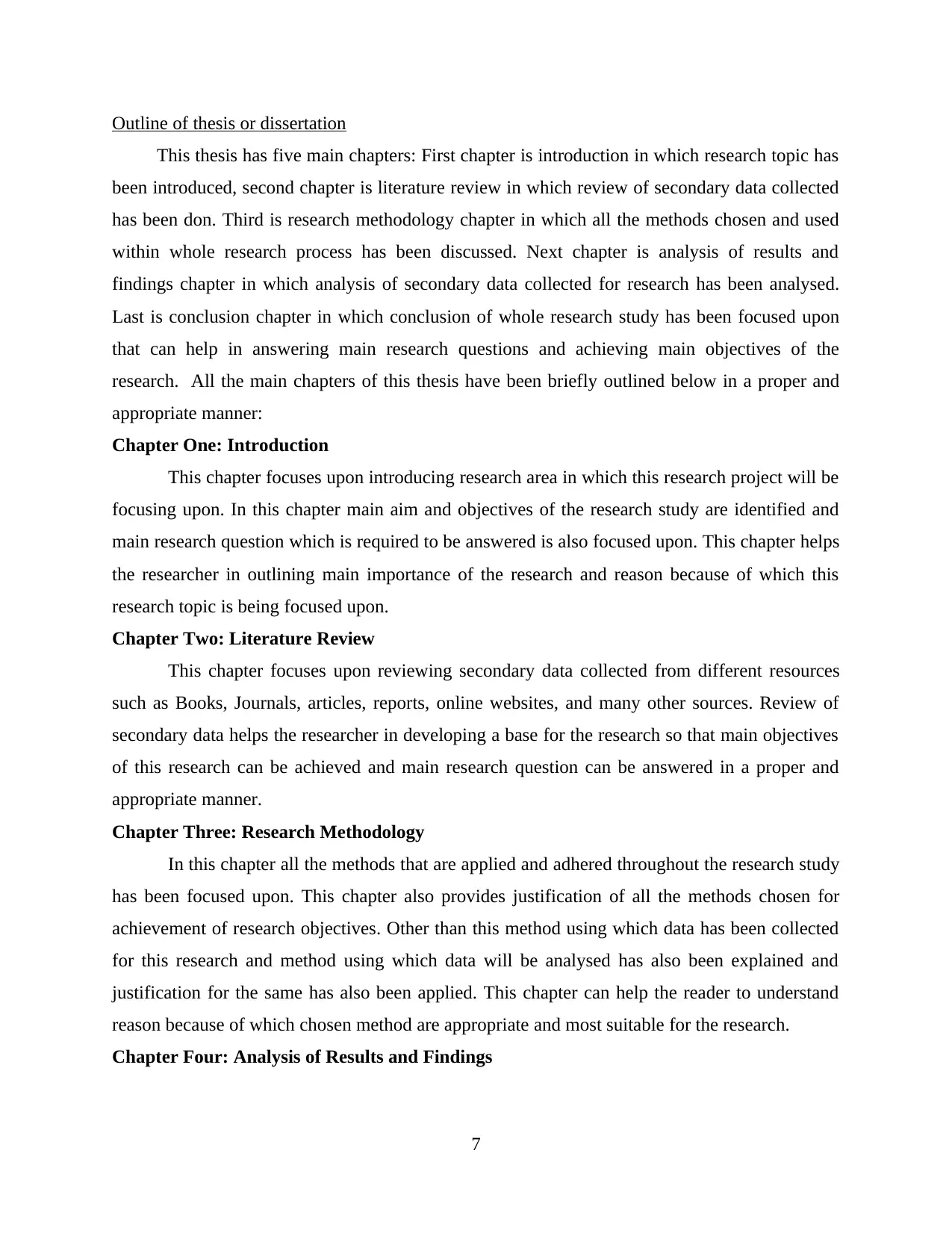
Outline of thesis or dissertation
This thesis has five main chapters: First chapter is introduction in which research topic has
been introduced, second chapter is literature review in which review of secondary data collected
has been don. Third is research methodology chapter in which all the methods chosen and used
within whole research process has been discussed. Next chapter is analysis of results and
findings chapter in which analysis of secondary data collected for research has been analysed.
Last is conclusion chapter in which conclusion of whole research study has been focused upon
that can help in answering main research questions and achieving main objectives of the
research. All the main chapters of this thesis have been briefly outlined below in a proper and
appropriate manner:
Chapter One: Introduction
This chapter focuses upon introducing research area in which this research project will be
focusing upon. In this chapter main aim and objectives of the research study are identified and
main research question which is required to be answered is also focused upon. This chapter helps
the researcher in outlining main importance of the research and reason because of which this
research topic is being focused upon.
Chapter Two: Literature Review
This chapter focuses upon reviewing secondary data collected from different resources
such as Books, Journals, articles, reports, online websites, and many other sources. Review of
secondary data helps the researcher in developing a base for the research so that main objectives
of this research can be achieved and main research question can be answered in a proper and
appropriate manner.
Chapter Three: Research Methodology
In this chapter all the methods that are applied and adhered throughout the research study
has been focused upon. This chapter also provides justification of all the methods chosen for
achievement of research objectives. Other than this method using which data has been collected
for this research and method using which data will be analysed has also been explained and
justification for the same has also been applied. This chapter can help the reader to understand
reason because of which chosen method are appropriate and most suitable for the research.
Chapter Four: Analysis of Results and Findings
7
This thesis has five main chapters: First chapter is introduction in which research topic has
been introduced, second chapter is literature review in which review of secondary data collected
has been don. Third is research methodology chapter in which all the methods chosen and used
within whole research process has been discussed. Next chapter is analysis of results and
findings chapter in which analysis of secondary data collected for research has been analysed.
Last is conclusion chapter in which conclusion of whole research study has been focused upon
that can help in answering main research questions and achieving main objectives of the
research. All the main chapters of this thesis have been briefly outlined below in a proper and
appropriate manner:
Chapter One: Introduction
This chapter focuses upon introducing research area in which this research project will be
focusing upon. In this chapter main aim and objectives of the research study are identified and
main research question which is required to be answered is also focused upon. This chapter helps
the researcher in outlining main importance of the research and reason because of which this
research topic is being focused upon.
Chapter Two: Literature Review
This chapter focuses upon reviewing secondary data collected from different resources
such as Books, Journals, articles, reports, online websites, and many other sources. Review of
secondary data helps the researcher in developing a base for the research so that main objectives
of this research can be achieved and main research question can be answered in a proper and
appropriate manner.
Chapter Three: Research Methodology
In this chapter all the methods that are applied and adhered throughout the research study
has been focused upon. This chapter also provides justification of all the methods chosen for
achievement of research objectives. Other than this method using which data has been collected
for this research and method using which data will be analysed has also been explained and
justification for the same has also been applied. This chapter can help the reader to understand
reason because of which chosen method are appropriate and most suitable for the research.
Chapter Four: Analysis of Results and Findings
7
Paraphrase This Document
Need a fresh take? Get an instant paraphrase of this document with our AI Paraphraser
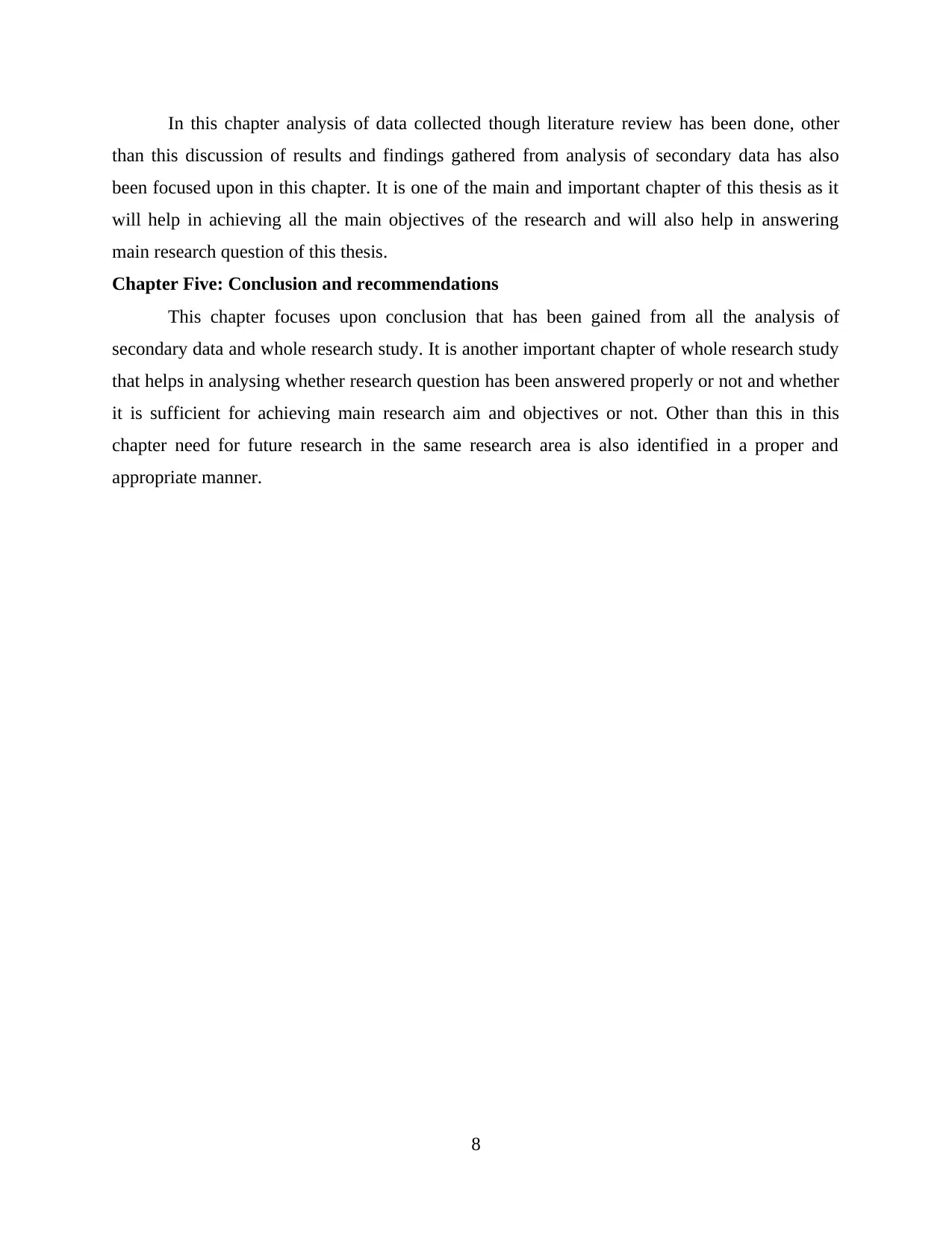
In this chapter analysis of data collected though literature review has been done, other
than this discussion of results and findings gathered from analysis of secondary data has also
been focused upon in this chapter. It is one of the main and important chapter of this thesis as it
will help in achieving all the main objectives of the research and will also help in answering
main research question of this thesis.
Chapter Five: Conclusion and recommendations
This chapter focuses upon conclusion that has been gained from all the analysis of
secondary data and whole research study. It is another important chapter of whole research study
that helps in analysing whether research question has been answered properly or not and whether
it is sufficient for achieving main research aim and objectives or not. Other than this in this
chapter need for future research in the same research area is also identified in a proper and
appropriate manner.
8
than this discussion of results and findings gathered from analysis of secondary data has also
been focused upon in this chapter. It is one of the main and important chapter of this thesis as it
will help in achieving all the main objectives of the research and will also help in answering
main research question of this thesis.
Chapter Five: Conclusion and recommendations
This chapter focuses upon conclusion that has been gained from all the analysis of
secondary data and whole research study. It is another important chapter of whole research study
that helps in analysing whether research question has been answered properly or not and whether
it is sufficient for achieving main research aim and objectives or not. Other than this in this
chapter need for future research in the same research area is also identified in a proper and
appropriate manner.
8
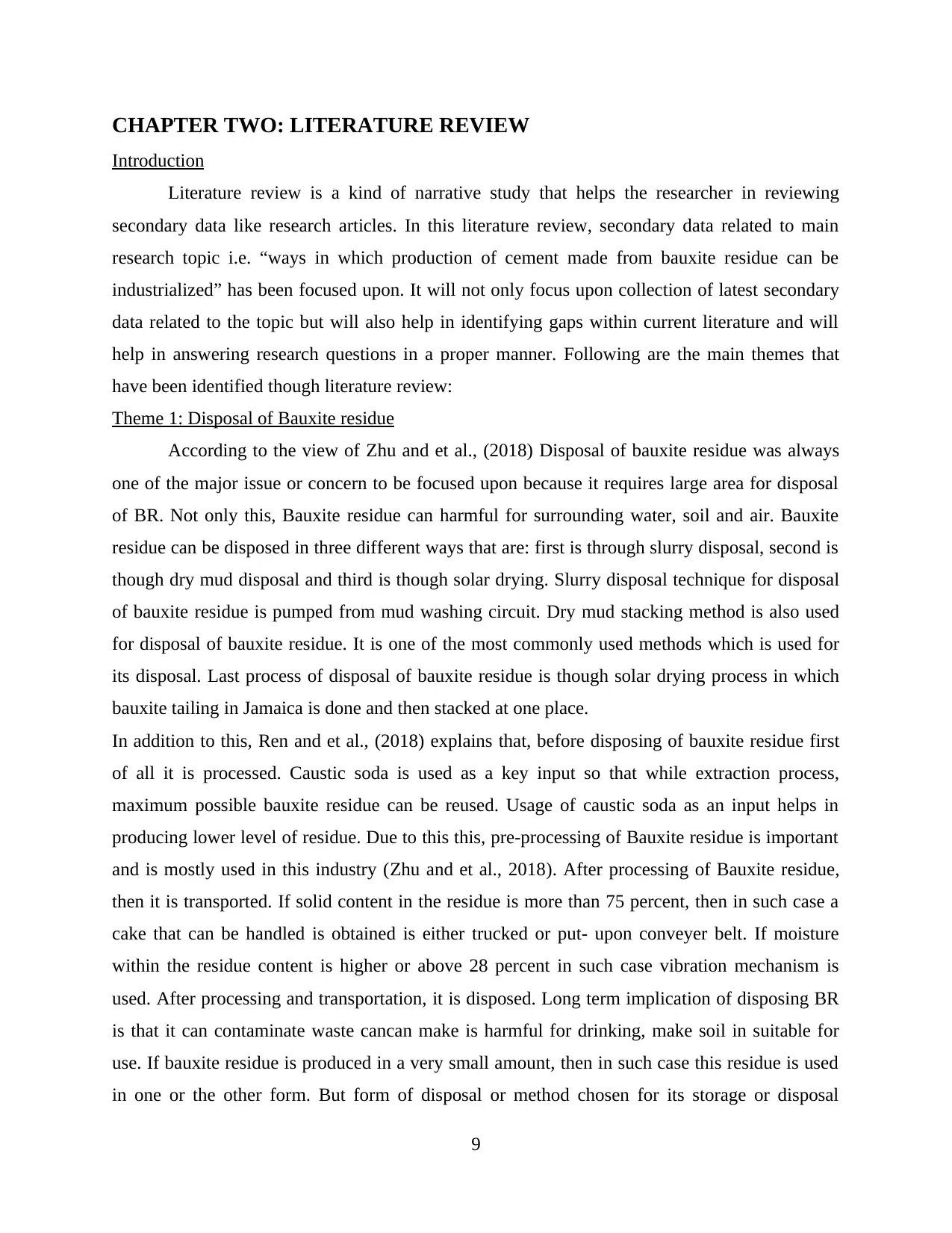
CHAPTER TWO: LITERATURE REVIEW
Introduction
Literature review is a kind of narrative study that helps the researcher in reviewing
secondary data like research articles. In this literature review, secondary data related to main
research topic i.e. “ways in which production of cement made from bauxite residue can be
industrialized” has been focused upon. It will not only focus upon collection of latest secondary
data related to the topic but will also help in identifying gaps within current literature and will
help in answering research questions in a proper manner. Following are the main themes that
have been identified though literature review:
Theme 1: Disposal of Bauxite residue
According to the view of Zhu and et al., (2018) Disposal of bauxite residue was always
one of the major issue or concern to be focused upon because it requires large area for disposal
of BR. Not only this, Bauxite residue can harmful for surrounding water, soil and air. Bauxite
residue can be disposed in three different ways that are: first is through slurry disposal, second is
though dry mud disposal and third is though solar drying. Slurry disposal technique for disposal
of bauxite residue is pumped from mud washing circuit. Dry mud stacking method is also used
for disposal of bauxite residue. It is one of the most commonly used methods which is used for
its disposal. Last process of disposal of bauxite residue is though solar drying process in which
bauxite tailing in Jamaica is done and then stacked at one place.
In addition to this, Ren and et al., (2018) explains that, before disposing of bauxite residue first
of all it is processed. Caustic soda is used as a key input so that while extraction process,
maximum possible bauxite residue can be reused. Usage of caustic soda as an input helps in
producing lower level of residue. Due to this this, pre-processing of Bauxite residue is important
and is mostly used in this industry (Zhu and et al., 2018). After processing of Bauxite residue,
then it is transported. If solid content in the residue is more than 75 percent, then in such case a
cake that can be handled is obtained is either trucked or put- upon conveyer belt. If moisture
within the residue content is higher or above 28 percent in such case vibration mechanism is
used. After processing and transportation, it is disposed. Long term implication of disposing BR
is that it can contaminate waste cancan make is harmful for drinking, make soil in suitable for
use. If bauxite residue is produced in a very small amount, then in such case this residue is used
in one or the other form. But form of disposal or method chosen for its storage or disposal
9
Introduction
Literature review is a kind of narrative study that helps the researcher in reviewing
secondary data like research articles. In this literature review, secondary data related to main
research topic i.e. “ways in which production of cement made from bauxite residue can be
industrialized” has been focused upon. It will not only focus upon collection of latest secondary
data related to the topic but will also help in identifying gaps within current literature and will
help in answering research questions in a proper manner. Following are the main themes that
have been identified though literature review:
Theme 1: Disposal of Bauxite residue
According to the view of Zhu and et al., (2018) Disposal of bauxite residue was always
one of the major issue or concern to be focused upon because it requires large area for disposal
of BR. Not only this, Bauxite residue can harmful for surrounding water, soil and air. Bauxite
residue can be disposed in three different ways that are: first is through slurry disposal, second is
though dry mud disposal and third is though solar drying. Slurry disposal technique for disposal
of bauxite residue is pumped from mud washing circuit. Dry mud stacking method is also used
for disposal of bauxite residue. It is one of the most commonly used methods which is used for
its disposal. Last process of disposal of bauxite residue is though solar drying process in which
bauxite tailing in Jamaica is done and then stacked at one place.
In addition to this, Ren and et al., (2018) explains that, before disposing of bauxite residue first
of all it is processed. Caustic soda is used as a key input so that while extraction process,
maximum possible bauxite residue can be reused. Usage of caustic soda as an input helps in
producing lower level of residue. Due to this this, pre-processing of Bauxite residue is important
and is mostly used in this industry (Zhu and et al., 2018). After processing of Bauxite residue,
then it is transported. If solid content in the residue is more than 75 percent, then in such case a
cake that can be handled is obtained is either trucked or put- upon conveyer belt. If moisture
within the residue content is higher or above 28 percent in such case vibration mechanism is
used. After processing and transportation, it is disposed. Long term implication of disposing BR
is that it can contaminate waste cancan make is harmful for drinking, make soil in suitable for
use. If bauxite residue is produced in a very small amount, then in such case this residue is used
in one or the other form. But form of disposal or method chosen for its storage or disposal
9
⊘ This is a preview!⊘
Do you want full access?
Subscribe today to unlock all pages.
Trusted by 1+ million students worldwide
depends upon following factors such as: nature of residue, presence of local features such as
mines et., availability of land and many more. These factors not only help in determining
appropriate process that can be used for disposal of BR but it also helps in identifying ways in
which this, residue can be used for future use. There are many different kinds of environmental
standards that have been set that not only helps in long term sustainability of soil condition,
reduce environment pollution, reduce chances of water pollution etc. (Cole and Trinh, 2017). All
the companies are required to ensure and comply with bauxite residue disposal area terms and
condition, and also comply with main environmental standards so that damage to environment
can be reduced. Not only while disposing off or storing this residue it is important for
organizations to continuously monitor disposal and storage process in order to maintain integrity
of the process with other factors.
Theme 2: characteristics of bauxite residue and ways in which bauxite residue can be used in
production of cement
As per the view of Kong and et al., (2017) Bauxite residue can be used for various kinds
of purposes. One of its main use is production of cement. It can be used in production of cement
in many different ways. it can be used as a raw material in Portland cement, can be used in
mortar or concrete mix or many other certain types of special cement. First step for using this
residue in cement production is to get to know its chemical composition so that its characteristics
can be known. In order to use Bauxite residue in production of cement there are various kinds of
oxides that are required to be present within bauxite residue such as aluminium, iron, calcium
and silicon. If organizations want to produce cement successfully then it is important to carefully
control silicon, calcium, iron and aluminium. They are also required to focus upon properties of
each of these elements at each stage of production. Ration and form in which these elements are
found in bauxite residue plays a vital role in production of cement from this residue. Typically
amount in which these components are present in bauxite residue are fixed such as
Component Typical range (wt%)
Fe2O3 5 – 60
Al2O3 5 – 30
TiO2 0.3 – 15
CaO 2 – 14
SiO2 3 – 50
10
mines et., availability of land and many more. These factors not only help in determining
appropriate process that can be used for disposal of BR but it also helps in identifying ways in
which this, residue can be used for future use. There are many different kinds of environmental
standards that have been set that not only helps in long term sustainability of soil condition,
reduce environment pollution, reduce chances of water pollution etc. (Cole and Trinh, 2017). All
the companies are required to ensure and comply with bauxite residue disposal area terms and
condition, and also comply with main environmental standards so that damage to environment
can be reduced. Not only while disposing off or storing this residue it is important for
organizations to continuously monitor disposal and storage process in order to maintain integrity
of the process with other factors.
Theme 2: characteristics of bauxite residue and ways in which bauxite residue can be used in
production of cement
As per the view of Kong and et al., (2017) Bauxite residue can be used for various kinds
of purposes. One of its main use is production of cement. It can be used in production of cement
in many different ways. it can be used as a raw material in Portland cement, can be used in
mortar or concrete mix or many other certain types of special cement. First step for using this
residue in cement production is to get to know its chemical composition so that its characteristics
can be known. In order to use Bauxite residue in production of cement there are various kinds of
oxides that are required to be present within bauxite residue such as aluminium, iron, calcium
and silicon. If organizations want to produce cement successfully then it is important to carefully
control silicon, calcium, iron and aluminium. They are also required to focus upon properties of
each of these elements at each stage of production. Ration and form in which these elements are
found in bauxite residue plays a vital role in production of cement from this residue. Typically
amount in which these components are present in bauxite residue are fixed such as
Component Typical range (wt%)
Fe2O3 5 – 60
Al2O3 5 – 30
TiO2 0.3 – 15
CaO 2 – 14
SiO2 3 – 50
10
Paraphrase This Document
Need a fresh take? Get an instant paraphrase of this document with our AI Paraphraser
Na2O 1 – 10
Other than this, it has further been explained by Xue and et al., (2020) that there are many
other varieties of components that are present in bauxite residue but in lower level. Majorly these
components are: copper, arsenic, beryllium, cadmium, gallium, chromium, magnesium, lead
nickel, mercury and many other elements including some rare metals of thew earth. There are
three important non- metallic elements as well that are present in bauxite residue like carbon,
phosphorus and sulphur. Most of the minerals present within it are quite complex and because of
this reason it becomes important to study presence of elements within it, their form and ration in
which they are present so that production of cement can be done accordingly.
According to Ghalehnovi and et al., (2019) Bauxite residue is used for production of
different kinds of cements. Its usage in different kinds of cement has always been a subject of
research. For usage of BR in production of cement it has to go though various kinds of processes.
At each step its characteristics are required to be monitored continuously. But mostly it is used as
a raw material for production of special cement, Portland cement, ceramics. Its characteristics
and components present within it helps in determining quality and strength of cement produced
from it. Due to this it becomes important for organizations to adopt techniques for its processing
in such a manner that it is suitable for components present within it so that overall strength and
quality of cement produced is not compromised.
Theme 3: Bauxite Residue a viable product or not
According to the view of Balomenos and et al., (2018) viable products are those products
that have enough and sufficient features for satisfying customers’ needs and can provide
feedback for future product development. It is an alternative viable product that can be used
within industries. It can help in provision of sustainability in terms of its durability and
environment sustainability (Xue and et al., 2019). But it cannot provide financial viability.
Whenever bauxite residue comes into use it is important to use CRM and base elements
extraction so that a financially viable process can be achieved. There are very fewer number of
studies available in which viability of Bauxite residue has been discussed. Disposal cost of
bauxite reside and usability of reusable technology helps in increasing feasibility of BR.
Balomenos and et al., (2018) further says that, Viable logistics in waste transportation and lower
aggregate value of BR is its one of the main limitations. This impacts management of BR waste.
11
Other than this, it has further been explained by Xue and et al., (2020) that there are many
other varieties of components that are present in bauxite residue but in lower level. Majorly these
components are: copper, arsenic, beryllium, cadmium, gallium, chromium, magnesium, lead
nickel, mercury and many other elements including some rare metals of thew earth. There are
three important non- metallic elements as well that are present in bauxite residue like carbon,
phosphorus and sulphur. Most of the minerals present within it are quite complex and because of
this reason it becomes important to study presence of elements within it, their form and ration in
which they are present so that production of cement can be done accordingly.
According to Ghalehnovi and et al., (2019) Bauxite residue is used for production of
different kinds of cements. Its usage in different kinds of cement has always been a subject of
research. For usage of BR in production of cement it has to go though various kinds of processes.
At each step its characteristics are required to be monitored continuously. But mostly it is used as
a raw material for production of special cement, Portland cement, ceramics. Its characteristics
and components present within it helps in determining quality and strength of cement produced
from it. Due to this it becomes important for organizations to adopt techniques for its processing
in such a manner that it is suitable for components present within it so that overall strength and
quality of cement produced is not compromised.
Theme 3: Bauxite Residue a viable product or not
According to the view of Balomenos and et al., (2018) viable products are those products
that have enough and sufficient features for satisfying customers’ needs and can provide
feedback for future product development. It is an alternative viable product that can be used
within industries. It can help in provision of sustainability in terms of its durability and
environment sustainability (Xue and et al., 2019). But it cannot provide financial viability.
Whenever bauxite residue comes into use it is important to use CRM and base elements
extraction so that a financially viable process can be achieved. There are very fewer number of
studies available in which viability of Bauxite residue has been discussed. Disposal cost of
bauxite reside and usability of reusable technology helps in increasing feasibility of BR.
Balomenos and et al., (2018) further says that, Viable logistics in waste transportation and lower
aggregate value of BR is its one of the main limitations. This impacts management of BR waste.
11
It is important for organizations to adopt viable alternatives for management of waste. Usage of
autochthonous alkaliphilic microorganisms in Bauxite residue is one of the most commonly used
viable alternative. Adoption of these alternatives can help in enhancement of cost- effectiveness
of transport of bauxite residue raw materials and final product made from its processing.
Theme 4: Importance of Bauxite residue affect cement quality
According to the view of Nikbin and et al., (2018) Bauxite residue is one of the most
appropriate raw material that can be used for production of cement in one way or the other.
Usage of this residue in cement production has shown many advantages, some of them are: it
helps in lowering consumption of other raw materials like limestone, iron powder. Then it also
helps in improving yield of kiln and lastly it helps in lowering carbon dioxide emission which is
a kind of positive initiative towards reduction of environment pollution. As explained by
Balomenos and et al., (2018) there are various kinds of elements that are present within bauxite
residue and different quantity. Presence of these elements helps in production of cement, reduce
requirement of other raw materials. Some of the most important elements that are required in
production of cement like iron and alumina can be directly provided by Bauxite residue. It not
only helps in producing cement within less input requirement but also helps in maintaining high
quality of cement and lower emission of carbon dioxide. BR usage in production of cement has
helped in bringing various kinds of changes in this industry. It can be used for industrial
purposes as it is a positive step towards sustainability. Quality of cement produced by Bauxite
residue can vary from medium to high because of presence of different composition of elements
in different quantity. So due to this reason it is important to focus upon monitoring and checking
presence of all the elements at each step of cement production so that overall quality of cement is
not degraded and higher quality is maintained.
As per the view of Arino Montoya and et al., (2017) it has been found that sage of cement
in last few years has increased drastically. In past 10 years usage of cement in construction
industry has just doubled up due to which environment pollution is also increasing. As a result of
this, it has become important for organizations to focus upon using Bauxite residue in production
of cement so that this environment pollution can be used and high quality of cement can be
produced. For this it is important to understand production of Bauxite residue as BR produced
from different products has different chemical composition. Especially bauxite residue produced
from Sinter or Bayer- Sinter extraction route has completely different composition as compared
12
autochthonous alkaliphilic microorganisms in Bauxite residue is one of the most commonly used
viable alternative. Adoption of these alternatives can help in enhancement of cost- effectiveness
of transport of bauxite residue raw materials and final product made from its processing.
Theme 4: Importance of Bauxite residue affect cement quality
According to the view of Nikbin and et al., (2018) Bauxite residue is one of the most
appropriate raw material that can be used for production of cement in one way or the other.
Usage of this residue in cement production has shown many advantages, some of them are: it
helps in lowering consumption of other raw materials like limestone, iron powder. Then it also
helps in improving yield of kiln and lastly it helps in lowering carbon dioxide emission which is
a kind of positive initiative towards reduction of environment pollution. As explained by
Balomenos and et al., (2018) there are various kinds of elements that are present within bauxite
residue and different quantity. Presence of these elements helps in production of cement, reduce
requirement of other raw materials. Some of the most important elements that are required in
production of cement like iron and alumina can be directly provided by Bauxite residue. It not
only helps in producing cement within less input requirement but also helps in maintaining high
quality of cement and lower emission of carbon dioxide. BR usage in production of cement has
helped in bringing various kinds of changes in this industry. It can be used for industrial
purposes as it is a positive step towards sustainability. Quality of cement produced by Bauxite
residue can vary from medium to high because of presence of different composition of elements
in different quantity. So due to this reason it is important to focus upon monitoring and checking
presence of all the elements at each step of cement production so that overall quality of cement is
not degraded and higher quality is maintained.
As per the view of Arino Montoya and et al., (2017) it has been found that sage of cement
in last few years has increased drastically. In past 10 years usage of cement in construction
industry has just doubled up due to which environment pollution is also increasing. As a result of
this, it has become important for organizations to focus upon using Bauxite residue in production
of cement so that this environment pollution can be used and high quality of cement can be
produced. For this it is important to understand production of Bauxite residue as BR produced
from different products has different chemical composition. Especially bauxite residue produced
from Sinter or Bayer- Sinter extraction route has completely different composition as compared
12
⊘ This is a preview!⊘
Do you want full access?
Subscribe today to unlock all pages.
Trusted by 1+ million students worldwide

1 out of 32


Related Documents


Your All-in-One AI-Powered Toolkit for Academic Success.
+13062052269
info@desklib.com
Available 24*7 on WhatsApp / Email
![[object Object]](/_next/static/media/star-bottom.7253800d.svg)
Unlock your academic potential
Copyright © 2020–2026 A2Z Services. All Rights Reserved. Developed and managed by ZUCOL.