Organizational Behavior Case Study: BBC's Reorganization Analysis
VerifiedAdded on 2024/05/31
|24
|4398
|92
Case Study
AI Summary
This case study provides an in-depth analysis of the BBC's organizational behavior, focusing on its structural reorganization and transformations. It examines the influence of culture, power, and politics within the organization, particularly highlighting the changes implemented since 2015. The report utilizes scholarly articles and Smith’s review of BBC to identify drawbacks in the previous organizational structure and the improvements resulting from recent changes. Key areas covered include the implementation of a task culture, improvements in employee communication and HR practices under Valerie Hughes-D’Aeth, and the impact of motivational theories on team efficiency. The study concludes with recommendations for sustaining the success of BBC's reorganization, emphasizing the importance of equity, clear communication, and positive reinforcement strategies to enhance employee commitment and overall organizational performance. This assignment is available on Desklib, a platform offering a wide array of study tools and solved assignments for students.
Organizational Behavior
Name of the student
Name of the university
Author note
Name of the student
Name of the university
Author note

Paraphrase This Document
Need a fresh take? Get an instant paraphrase of this document with our AI Paraphraser
1
ORGANIZATIONAL BEHAVIOR
Executive summary:
The objective of the report is to analyze the case study provided; delivering insights about the
organizational structure of BBC and the reorganization that has lead to transformation. A
strategic research based on scholarly articles and Smith’s review on BBC organization has
supported the aim. The results indicate some major drawback that prevailed in the earlier
structural conduct for BBC and major efficient and impressive organizational transformation in
the recent past since 2015. The report concludes on various suggestive techniques to carry
forward the success of reorganization of BBC and it is highly recommended to follow suggestive
measures for betterment of the organization.
ORGANIZATIONAL BEHAVIOR
Executive summary:
The objective of the report is to analyze the case study provided; delivering insights about the
organizational structure of BBC and the reorganization that has lead to transformation. A
strategic research based on scholarly articles and Smith’s review on BBC organization has
supported the aim. The results indicate some major drawback that prevailed in the earlier
structural conduct for BBC and major efficient and impressive organizational transformation in
the recent past since 2015. The report concludes on various suggestive techniques to carry
forward the success of reorganization of BBC and it is highly recommended to follow suggestive
measures for betterment of the organization.
2
ORGANIZATIONAL BEHAVIOR
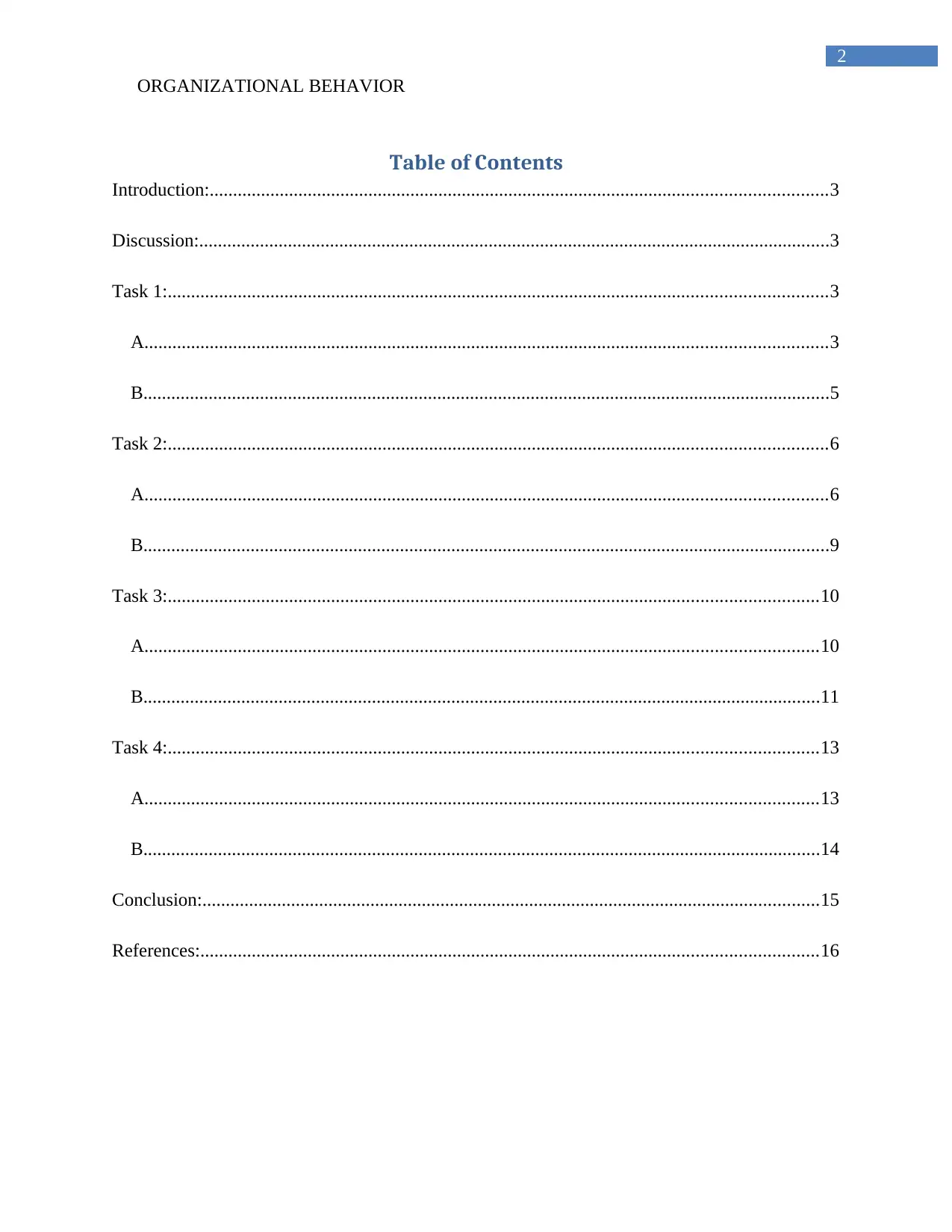
Table of Contents
Introduction:....................................................................................................................................3
Discussion:.......................................................................................................................................3
Task 1:.............................................................................................................................................3
A..................................................................................................................................................3
B...................................................................................................................................................5
Task 2:.............................................................................................................................................6
A..................................................................................................................................................6
B...................................................................................................................................................9
Task 3:...........................................................................................................................................10
A................................................................................................................................................10
B.................................................................................................................................................11
Task 4:...........................................................................................................................................13
A................................................................................................................................................13
B.................................................................................................................................................14
Conclusion:....................................................................................................................................15
References:....................................................................................................................................16
ORGANIZATIONAL BEHAVIOR
Table of Contents
Introduction:....................................................................................................................................3
Discussion:.......................................................................................................................................3
Task 1:.............................................................................................................................................3
A..................................................................................................................................................3
B...................................................................................................................................................5
Task 2:.............................................................................................................................................6
A..................................................................................................................................................6
B...................................................................................................................................................9
Task 3:...........................................................................................................................................10
A................................................................................................................................................10
B.................................................................................................................................................11
Task 4:...........................................................................................................................................13
A................................................................................................................................................13
B.................................................................................................................................................14
Conclusion:....................................................................................................................................15
References:....................................................................................................................................16
⊘ This is a preview!⊘
Do you want full access?
Subscribe today to unlock all pages.

Trusted by 1+ million students worldwide
3
ORGANIZATIONAL BEHAVIOR
ORGANIZATIONAL BEHAVIOR
Paraphrase This Document
Need a fresh take? Get an instant paraphrase of this document with our AI Paraphraser
4
ORGANIZATIONAL BEHAVIOR
Introduction:
An organization like any other efficient working system is based on its framework-the people.
The people of any concern have to show tremendous ability and skill in developing and planning
of an organization so as to build an efficient operational display. The managerial focus involves
the proper assessment of culture, power and politics to have a positive influence of each on the
employees and teams of any organization. This report in particular deals with the
reorganizational context of BBC based on the provided case study for the same, as this
organization has experienced a huge range of up gradation and transformations in the recent past
in terms of culture, politics and power. The upcoming sections will provide will demonstrate in
details about the influence these fields have had on the organization.
ORGANIZATIONAL BEHAVIOR
Introduction:
An organization like any other efficient working system is based on its framework-the people.
The people of any concern have to show tremendous ability and skill in developing and planning
of an organization so as to build an efficient operational display. The managerial focus involves
the proper assessment of culture, power and politics to have a positive influence of each on the
employees and teams of any organization. This report in particular deals with the
reorganizational context of BBC based on the provided case study for the same, as this
organization has experienced a huge range of up gradation and transformations in the recent past
in terms of culture, politics and power. The upcoming sections will provide will demonstrate in
details about the influence these fields have had on the organization.
5
ORGANIZATIONAL BEHAVIOR
Task 1:
A.
Over the years, regarding the construction of efficient organizations around the world, business
and organizational models have been formulized to provide suggestive methods for the
managerial sector of the organizations to build a strong and mindful framework for the
betterment of the quality of services they promise to deliver the community around and to study
the influences of various aspects of the business on its employees as well as its surroundings.
One of such organizational model is the ‘Charles Handy’s four types of organizational Cultures’
provides theories of organizational cultures classified directly under four prime aspects or fields
(van der Velden, 2012). This organizational model has had an extremely powerful effect
concerning the modern management techniques of the organizations around the globe. The
theories presented through this model have supported the enhancement of managements in a
more humanitarian process with a widened vision and purpose-oriented organizational front.
Each of the aspects present in the model deals with various presupposition concerning human
behavior and motivation alongside, the basis for power and its influence. The prime aspects in
this model are based on the following:
Power Culture: organizations revolving around power culture witness few regulations
indicating the actions and the decisions are solely dependent on few individuals wherein
power resides. Herein, the employees are rather recognized based on the list of their
achievements rather than their dedication. This is a strong methodology that can provide
easy decision making often proving to be toxic in the long term built for the
organization.
ORGANIZATIONAL BEHAVIOR
Task 1:
A.
Over the years, regarding the construction of efficient organizations around the world, business
and organizational models have been formulized to provide suggestive methods for the
managerial sector of the organizations to build a strong and mindful framework for the
betterment of the quality of services they promise to deliver the community around and to study
the influences of various aspects of the business on its employees as well as its surroundings.
One of such organizational model is the ‘Charles Handy’s four types of organizational Cultures’
provides theories of organizational cultures classified directly under four prime aspects or fields
(van der Velden, 2012). This organizational model has had an extremely powerful effect
concerning the modern management techniques of the organizations around the globe. The
theories presented through this model have supported the enhancement of managements in a
more humanitarian process with a widened vision and purpose-oriented organizational front.
Each of the aspects present in the model deals with various presupposition concerning human
behavior and motivation alongside, the basis for power and its influence. The prime aspects in
this model are based on the following:
Power Culture: organizations revolving around power culture witness few regulations
indicating the actions and the decisions are solely dependent on few individuals wherein
power resides. Herein, the employees are rather recognized based on the list of their
achievements rather than their dedication. This is a strong methodology that can provide
easy decision making often proving to be toxic in the long term built for the
organization.
⊘ This is a preview!⊘
Do you want full access?
Subscribe today to unlock all pages.
Trusted by 1+ million students worldwide
6
ORGANIZATIONAL BEHAVIOR
Role Culture: this type of organizational culture directs power based on designations and
is thoroughly controlled by the roles and responsibilities of everyone present in the
system or the structure built with the support of long-chain commands.
Task Culture: this type of culture flourishes on team dynamics. The efficiency of the
individuals addressing specific problems determines the power influence of the tem,
depending on the specific area of work power tends to shift (Russo et. al, 2013).
Person Culture: this type of is solely dedicated to a group of individuals working in the
same organization and view themselves as superior to the structure (do Carmo Silva &
Gomes,2015).
In light to the Smith’s Reviews (Smith, 2016) about the BBC organizational culture and the
analysis of Handy’s Cultural typology certain trends are noted prevailing in the BBC front
that is worth the further discussion (Smith,2016). In context to the Smith review, the report
findings critically indicate major failures that were evident in the earlier organizational
structure of BBC concerning some serious issues like the harassment and bullying of
employees and an ineffective system of complaint registration wherein, the staff issues were
completely unnoticed and ignored. Following these facets of the structure, a non-
complaining culture was developing in the organizational front as there was clear evidence
in BBC that the victims were persuaded from launching complaints as this would cause
certain damage to the staff’s careers. The atmosphere of fear existed in BBC making
impossible intractable situations concerning the problems. Especially, the non-complaining
culture about any member of the talent was more evident even in cases of sexual assaults.
On analysis of the theories presented in the model of Handy’s the BBC organization had a
strong power culture wherein, the rights to exploit or to decide depends only to few of the
ORGANIZATIONAL BEHAVIOR
Role Culture: this type of organizational culture directs power based on designations and
is thoroughly controlled by the roles and responsibilities of everyone present in the
system or the structure built with the support of long-chain commands.
Task Culture: this type of culture flourishes on team dynamics. The efficiency of the
individuals addressing specific problems determines the power influence of the tem,
depending on the specific area of work power tends to shift (Russo et. al, 2013).
Person Culture: this type of is solely dedicated to a group of individuals working in the
same organization and view themselves as superior to the structure (do Carmo Silva &
Gomes,2015).
In light to the Smith’s Reviews (Smith, 2016) about the BBC organizational culture and the
analysis of Handy’s Cultural typology certain trends are noted prevailing in the BBC front
that is worth the further discussion (Smith,2016). In context to the Smith review, the report
findings critically indicate major failures that were evident in the earlier organizational
structure of BBC concerning some serious issues like the harassment and bullying of
employees and an ineffective system of complaint registration wherein, the staff issues were
completely unnoticed and ignored. Following these facets of the structure, a non-
complaining culture was developing in the organizational front as there was clear evidence
in BBC that the victims were persuaded from launching complaints as this would cause
certain damage to the staff’s careers. The atmosphere of fear existed in BBC making
impossible intractable situations concerning the problems. Especially, the non-complaining
culture about any member of the talent was more evident even in cases of sexual assaults.
On analysis of the theories presented in the model of Handy’s the BBC organization had a
strong power culture wherein, the rights to exploit or to decide depends only to few of the
Paraphrase This Document
Need a fresh take? Get an instant paraphrase of this document with our AI Paraphraser
7
ORGANIZATIONAL BEHAVIOR
individuals with actual power and was protected from any complaints and the structure also
lacked proper complaint registering and communicating system. These recorded pointers
caused enough failures for the organization till the reorganizational transformations
happened in the recent past.
ORGANIZATIONAL BEHAVIOR
individuals with actual power and was protected from any complaints and the structure also
lacked proper complaint registering and communicating system. These recorded pointers
caused enough failures for the organization till the reorganizational transformations
happened in the recent past.
8
ORGANIZATIONAL BEHAVIOR
B.
As is discussed in the previous section, the BBC organizational structure to quite an extent
experienced failures regarding appropriate work culture that is expected to prevail in
organizations until recent past with the joining of Valerie Hughes-D’Aeth in 2014- the HR
director, the company’s organizational culture has experienced a revamp. She proved to be
betterment in regards to the improvised work culture wherein, the employees unlike in the earlier
setup, loves to work for the organization and feels proud to be a part of it (People Management,
2018). The politics and the vision for is to prove BBC more efficient with more contents and an
active HR system. She also awarded the organization with the delayering management which
was an important managerial step as a response to the Smith’s review and to make BBC a more
transparent platform for the employees where their rights are preserved. While the
reorganizational activities of Tony Hall, the director general the case study provides evidence of
construction of specific structural teams to address diverse issues and an efficient system of
employee and management communication is developed. In accordance of the theories of
Handy’s Model, BBC can be seen as a growing structure with a developing Task Culture,
wherein there is no single source of power but is a matrix organization in which the power is
derived from expertise depending upon a team’s necessity for the same.
ORGANIZATIONAL BEHAVIOR
B.
As is discussed in the previous section, the BBC organizational structure to quite an extent
experienced failures regarding appropriate work culture that is expected to prevail in
organizations until recent past with the joining of Valerie Hughes-D’Aeth in 2014- the HR
director, the company’s organizational culture has experienced a revamp. She proved to be
betterment in regards to the improvised work culture wherein, the employees unlike in the earlier
setup, loves to work for the organization and feels proud to be a part of it (People Management,
2018). The politics and the vision for is to prove BBC more efficient with more contents and an
active HR system. She also awarded the organization with the delayering management which
was an important managerial step as a response to the Smith’s review and to make BBC a more
transparent platform for the employees where their rights are preserved. While the
reorganizational activities of Tony Hall, the director general the case study provides evidence of
construction of specific structural teams to address diverse issues and an efficient system of
employee and management communication is developed. In accordance of the theories of
Handy’s Model, BBC can be seen as a growing structure with a developing Task Culture,
wherein there is no single source of power but is a matrix organization in which the power is
derived from expertise depending upon a team’s necessity for the same.
⊘ This is a preview!⊘
Do you want full access?
Subscribe today to unlock all pages.
Trusted by 1+ million students worldwide
9
ORGANIZATIONAL BEHAVIOR
Task 2:
A.
The basic motivational concepts deal with the aspects like the idea of motivation, reward,
extrinsic and the intrinsic rewards. A briefing on each of this provides us with the insights
relative to the theories relevant to the fields. Motivation refers to the urge within an individual to
achieve a persistent level of success. Reward is directly relative to the outcome of the chain of
efforts an individual channelizes, this is classified in two dynamics the extrinsic one, wherein an
external source values the outcome while in intrinsic value system a self-motivation develops as
one achieves his target. The extrinsic reward might just happen to be in terms of pay, bonuses,
promotions, awards and recognitions (Miner, 2015). The motivational are diversified depending
on three prime theories namely, Content, Process and Reinforcement theories. This theory will
deal with the concept of the theories and the possible managerial implementations surrounding
these motivational theories.
Content theory: this theory focuses on the diverse human behaviors depending on
individual needs and work situations. This further can be classified into three main
theories:
Hierarchy of needs: lower order needs like the psychological, social, security
necessities along with the physical and social well being and the higher order
needs as individual esteem and necessities for psychological growth, affect the
work-environment behaviors and attitudes of the employees. This follows a
progression principle to indicate that only a satisfaction of lower order need can
activate the next level need.
ORGANIZATIONAL BEHAVIOR
Task 2:
A.
The basic motivational concepts deal with the aspects like the idea of motivation, reward,
extrinsic and the intrinsic rewards. A briefing on each of this provides us with the insights
relative to the theories relevant to the fields. Motivation refers to the urge within an individual to
achieve a persistent level of success. Reward is directly relative to the outcome of the chain of
efforts an individual channelizes, this is classified in two dynamics the extrinsic one, wherein an
external source values the outcome while in intrinsic value system a self-motivation develops as
one achieves his target. The extrinsic reward might just happen to be in terms of pay, bonuses,
promotions, awards and recognitions (Miner, 2015). The motivational are diversified depending
on three prime theories namely, Content, Process and Reinforcement theories. This theory will
deal with the concept of the theories and the possible managerial implementations surrounding
these motivational theories.
Content theory: this theory focuses on the diverse human behaviors depending on
individual needs and work situations. This further can be classified into three main
theories:
Hierarchy of needs: lower order needs like the psychological, social, security
necessities along with the physical and social well being and the higher order
needs as individual esteem and necessities for psychological growth, affect the
work-environment behaviors and attitudes of the employees. This follows a
progression principle to indicate that only a satisfaction of lower order need can
activate the next level need.
Paraphrase This Document
Need a fresh take? Get an instant paraphrase of this document with our AI Paraphraser
10
ORGANIZATIONAL BEHAVIOR
ERG theory: this implies on the existence, relatedness and growth needs
indicating that any need can influence the behavior and follows a frustration-
regression principle.
Two-factor Theory: this revolves around hygiene and satisfier factors providing
elements of job content or dissatisfaction and the sources for job content and
employee satisfaction.
Process theory: this model completely focuses on the importance provided by people
towards any kind of rewards and their behavioral aspects with the work-related
environment (Kovjanic et al., 2012). This field revolves around the people preferences
and available rewards that are present that motivates for hard work with three theories:
Equity theory: any perceived inequity in payments is considered a motivating
state, this is most of the times responded through changing of work inputs, awards
and comparison factors.
Expectancy theory: three aspects are important- Expectancy, the will that drives
them to work hard, Instrumentality-that success would be rewarded and Valence
(Manzoor, 2012).
Reinforcement Theory: this field examines the ways environmental consequences affect
people’s behavior. There are most importantly few conditional strategies, the positive and
negative reinforcements wherein the former presents a pleasant consequence and vice-
versa for the later. Then is the Punishment and Extinction strategy, the former decreases
any unpleasant conduct through presentation of unpleasant output while the later is done
through removal of the same.
ORGANIZATIONAL BEHAVIOR
ERG theory: this implies on the existence, relatedness and growth needs
indicating that any need can influence the behavior and follows a frustration-
regression principle.
Two-factor Theory: this revolves around hygiene and satisfier factors providing
elements of job content or dissatisfaction and the sources for job content and
employee satisfaction.
Process theory: this model completely focuses on the importance provided by people
towards any kind of rewards and their behavioral aspects with the work-related
environment (Kovjanic et al., 2012). This field revolves around the people preferences
and available rewards that are present that motivates for hard work with three theories:
Equity theory: any perceived inequity in payments is considered a motivating
state, this is most of the times responded through changing of work inputs, awards
and comparison factors.
Expectancy theory: three aspects are important- Expectancy, the will that drives
them to work hard, Instrumentality-that success would be rewarded and Valence
(Manzoor, 2012).
Reinforcement Theory: this field examines the ways environmental consequences affect
people’s behavior. There are most importantly few conditional strategies, the positive and
negative reinforcements wherein the former presents a pleasant consequence and vice-
versa for the later. Then is the Punishment and Extinction strategy, the former decreases
any unpleasant conduct through presentation of unpleasant output while the later is done
through removal of the same.
11
ORGANIZATIONAL BEHAVIOR
Analysis and proper application of these mentioned theories as is presented in context of the
improvisation of in the efficiency of the teams within BBC (Uzonna, 2013). Few techniques
can be developed as managerial implications for the purpose:
Following the equity theory, the management must present perceptions of rewards
and negative comparisons should be minimized and importantly, the payment criteria
must have equity.
In light of expectancy theory the managers should appoint individuals with
appropriate abilities with a high-level performance goal. Additionally, psychological
contracts must be clarified, performance rewards must be communicated alongside,
identification of individual needs and deserving awards must be there (Goleman,
2017).
Regarding a positive reinforcement the management should communicate the
necessary work behavior, involve diverse inventory rewards, present recognitions and
the follow laws for immediate reinforcement.
Punishments must be a part of the policies in areas of misconduct and should be
communicated well to everyone.
Freedom of choice must be practiced but in a restricted way so that no organizational
harm occurs.
ORGANIZATIONAL BEHAVIOR
Analysis and proper application of these mentioned theories as is presented in context of the
improvisation of in the efficiency of the teams within BBC (Uzonna, 2013). Few techniques
can be developed as managerial implications for the purpose:
Following the equity theory, the management must present perceptions of rewards
and negative comparisons should be minimized and importantly, the payment criteria
must have equity.
In light of expectancy theory the managers should appoint individuals with
appropriate abilities with a high-level performance goal. Additionally, psychological
contracts must be clarified, performance rewards must be communicated alongside,
identification of individual needs and deserving awards must be there (Goleman,
2017).
Regarding a positive reinforcement the management should communicate the
necessary work behavior, involve diverse inventory rewards, present recognitions and
the follow laws for immediate reinforcement.
Punishments must be a part of the policies in areas of misconduct and should be
communicated well to everyone.
Freedom of choice must be practiced but in a restricted way so that no organizational
harm occurs.
⊘ This is a preview!⊘
Do you want full access?
Subscribe today to unlock all pages.
Trusted by 1+ million students worldwide

1 out of 24


Related Documents


Your All-in-One AI-Powered Toolkit for Academic Success.
+13062052269
info@desklib.com
Available 24*7 on WhatsApp / Email
![[object Object]](/_next/static/media/star-bottom.7253800d.svg)
Unlock your academic potential
Copyright © 2020–2026 A2Z Services. All Rights Reserved. Developed and managed by ZUCOL.