Biochemistry and Public Health: Midterm Exam, CUHK, BBMS6100
VerifiedAdded on 2022/08/26
|24
|5660
|13
Homework Assignment
AI Summary
This document presents a detailed solution to a take-home midterm exam in Biochemistry and Public Health (BBMS6100) from The Chinese University of Hong Kong. The exam includes answers to four questions addressing various aspects of public health. The first question focuses on a case study of a 12-year-old girl with asthma, covering diagnosis, allergic reactions, and treatment options. The second question discusses the microscopic, rapid diagnostic, and molecular diagnosis of malaria. The third question explores the mechanisms of action of various toxins, including Clostridium tetani, botulinum, diptheria, Shiga toxins, amatoxins, phallotoxins, virotoxins, ricin, aflatoxin, taxol, ciguatoxin, paralytic shellfish poisoning, and pufferfish poisoning, as well as the origin and toxic effects of substances like Sudan red, malachite green, melamine, phthalates, heroin, and cocaine. The fourth question examines the phases of drug metabolism, including oxidation, reduction, hydrolysis, and conjugation. The solution provides comprehensive explanations and examples for each topic.
Running head: QUESTION AND ANSWERS
Question and answers
Name of the Student
Name of the University
Author Note
Question and answers
Name of the Student
Name of the University
Author Note

Paraphrase This Document
Need a fresh take? Get an instant paraphrase of this document with our AI Paraphraser
1COMMUNITY MANAGEMENT OF SMOKING AND LUNG CANCER
Answer 1
A) According to the girl’s allergic reaction symptoms, and laboratory results, it is likely
that she is suffering from Type 1 hypersentivity reaction where the disease is allergic
asthma, form of anaphylaxis where airways are reversibly blocked preventing lung
tissues from receiving oxygen and increasing respiratory rate (Aulbach & Amuzie,
2017).
B) The most common environmental allergen that causes asthma is pollution or dust
containing dust mites.
Further diagnostic test to confirm specific allergen present in the serum are
molecular-based allergic test where panels containing allergens along with serum
containing allergen is tested to measure the presence of serum antibody, IgE specific
for the allergen. Radio allegro sorbent assay (RAST) is performed to detect the
presence of specific IgE for the allergen in the serum. Test for mast cell tryptase
released from mast cell granules as a sole mediator of inflammation during
anaphylaxis can be done within 1-2 hours of allergic response.
C) Medications for asthma in children include inhalers containing either short-acting
beta-2 agonists such as alvuterol or levalbuterol providing quick relief of
bronchioconstriction or long-acting corticosteroids such as aerosol form of Salmeterol
and Fluticasone that useful for persistant asthma. A nebulizer or face mask can aslo be
used (Chu & Bajaj, 2019).
D) Allergic specific immunotherapy or allergen-SIT is used as desensitizing therapy for
allergic diseases such as asthma. The mechanimsm include triggering peripheral T-
cell tolerance and development of regulatory T-cells along with release of interlukin
Answer 1
A) According to the girl’s allergic reaction symptoms, and laboratory results, it is likely
that she is suffering from Type 1 hypersentivity reaction where the disease is allergic
asthma, form of anaphylaxis where airways are reversibly blocked preventing lung
tissues from receiving oxygen and increasing respiratory rate (Aulbach & Amuzie,
2017).
B) The most common environmental allergen that causes asthma is pollution or dust
containing dust mites.
Further diagnostic test to confirm specific allergen present in the serum are
molecular-based allergic test where panels containing allergens along with serum
containing allergen is tested to measure the presence of serum antibody, IgE specific
for the allergen. Radio allegro sorbent assay (RAST) is performed to detect the
presence of specific IgE for the allergen in the serum. Test for mast cell tryptase
released from mast cell granules as a sole mediator of inflammation during
anaphylaxis can be done within 1-2 hours of allergic response.
C) Medications for asthma in children include inhalers containing either short-acting
beta-2 agonists such as alvuterol or levalbuterol providing quick relief of
bronchioconstriction or long-acting corticosteroids such as aerosol form of Salmeterol
and Fluticasone that useful for persistant asthma. A nebulizer or face mask can aslo be
used (Chu & Bajaj, 2019).
D) Allergic specific immunotherapy or allergen-SIT is used as desensitizing therapy for
allergic diseases such as asthma. The mechanimsm include triggering peripheral T-
cell tolerance and development of regulatory T-cells along with release of interlukin
2COMMUNITY MANAGEMENT OF SMOKING AND LUNG CANCER
10 and tumor growth factor-β, that helps in suppressing pro-inflammatory cells
including eosinophils, basophils and mast cells (Akdis & Akdis, 2015).
Answer 2:
Microscopic diagnosis of malaria is done by examination of patient blood smear that
is stained with Giemsa stain to distinguish the parasite from other cells in the blood under the
microscopei It gives a standard laboratory result for presence of malarial parasite and is easy
to perform however the results may vary if the quality of the reagents change. Rapid
Diagnostic Test s (RDTs) is an useful alternative to microscopic test. The patient’s blood
sample is collected for detection of specific antigens in the blood released by one of the
malarial parasite. RDTs rapidly determine malarial infection in patients however it shows
limitation when lower number of parasites are present in the bloodstream and therefore
requires microscopy to finally confirm the number of parasites present along with the RBCs
that are infected. Molecular diagnosis of malaria is more sensitive than microscopy but it is
unable to diagnose acute ill patients in a clinical setting. In molecular testing the genomic
DNA of the malarial parasite is extracted from the blood of the patient and real time PCR or
nested PCR is run with the DNA sample to confirm the presence of specific type of malarial
parasite (Who.int, 2020).
Answer 3:
A) i. Clostridium tetanus and Clostridium botulinum toxins are neurotoxins containing
three domains having three different functions including binding to neurospecific
receptor, translocation through membrane and proteolysis of specific molecules.
Clostridium neurotoxins have the capability to bind to the neuronal cells. C. tetani
releases tetanospasmin that interferers with motor neurons at the neuro-muscular
junction. The inhibitory neurotransmitters such as glycine released from the motor
10 and tumor growth factor-β, that helps in suppressing pro-inflammatory cells
including eosinophils, basophils and mast cells (Akdis & Akdis, 2015).
Answer 2:
Microscopic diagnosis of malaria is done by examination of patient blood smear that
is stained with Giemsa stain to distinguish the parasite from other cells in the blood under the
microscopei It gives a standard laboratory result for presence of malarial parasite and is easy
to perform however the results may vary if the quality of the reagents change. Rapid
Diagnostic Test s (RDTs) is an useful alternative to microscopic test. The patient’s blood
sample is collected for detection of specific antigens in the blood released by one of the
malarial parasite. RDTs rapidly determine malarial infection in patients however it shows
limitation when lower number of parasites are present in the bloodstream and therefore
requires microscopy to finally confirm the number of parasites present along with the RBCs
that are infected. Molecular diagnosis of malaria is more sensitive than microscopy but it is
unable to diagnose acute ill patients in a clinical setting. In molecular testing the genomic
DNA of the malarial parasite is extracted from the blood of the patient and real time PCR or
nested PCR is run with the DNA sample to confirm the presence of specific type of malarial
parasite (Who.int, 2020).
Answer 3:
A) i. Clostridium tetanus and Clostridium botulinum toxins are neurotoxins containing
three domains having three different functions including binding to neurospecific
receptor, translocation through membrane and proteolysis of specific molecules.
Clostridium neurotoxins have the capability to bind to the neuronal cells. C. tetani
releases tetanospasmin that interferers with motor neurons at the neuro-muscular
junction. The inhibitory neurotransmitters such as glycine released from the motor
⊘ This is a preview!⊘
Do you want full access?
Subscribe today to unlock all pages.

Trusted by 1+ million students worldwide
3COMMUNITY MANAGEMENT OF SMOKING AND LUNG CANCER
neurons blocks the receptor at the neuromuscular junction leading to inhibition of the
excitory transmitter and suppression of muscle activity. However tetanus toxin when
internalized through a wound and reaches the neuromuscular junction, it binds to the
presynaptic tereminals and then transferred to the spinal cord where it binds to the
receptor binding site for inhibitory neurotransmittors on the muscle cell and destroys
the vesicular synaptic membrane protein causing “lockjaw” of muscles. On the other
hand botulinum toxin blocks the sites on the nerve endings which releases
acetylcholine into the synaptic cleft. Upon binding to the release site, the toxin
cleaves synaptobrevin and other membrane protein present on the nerve endings. This
leads to paralysis or weakness of the muscles because acetylcholine can no longer act
as a neurotransmitter. Diptheria toxin is a AB type of bacterial toxin released by
Corynebacterium diphtheria. The toxin has two subunits the A part is the catalytic
subunit and the B is the binding subunit. The toxin binds to the receptor on the host
cell membrane by its binding domain and enters into the host cell through
endocytosis. The catalytic part A cleaves from the toxin but remains attached to the
vesicle through disulphide bond and after acidification of the vesicle, the A subunit is
released and then the A subunit catalyses the transfer of ADP ribose from NAD+ to
elongation factor EF-2 protein leading to prevention of elongation during translation
of proteins and thereby leading to death of the cell. Shiga toxin (Stx) released by
Eschericia coli strain consists of pentamer of subunit B and single A subunit. Shiga
toxin binds to the receptor of the intestinal lumen of eukaryotes named Gb3 and is
internalised through endocytosis. Stx is transferred to the golgi complex and then to
endoplasmic reticulum where it inactivates ribosomes thereby causing inhibition of
translation and finally apoptosis of the cell (Henkel, Baldwin & Barbieri, 2010).
neurons blocks the receptor at the neuromuscular junction leading to inhibition of the
excitory transmitter and suppression of muscle activity. However tetanus toxin when
internalized through a wound and reaches the neuromuscular junction, it binds to the
presynaptic tereminals and then transferred to the spinal cord where it binds to the
receptor binding site for inhibitory neurotransmittors on the muscle cell and destroys
the vesicular synaptic membrane protein causing “lockjaw” of muscles. On the other
hand botulinum toxin blocks the sites on the nerve endings which releases
acetylcholine into the synaptic cleft. Upon binding to the release site, the toxin
cleaves synaptobrevin and other membrane protein present on the nerve endings. This
leads to paralysis or weakness of the muscles because acetylcholine can no longer act
as a neurotransmitter. Diptheria toxin is a AB type of bacterial toxin released by
Corynebacterium diphtheria. The toxin has two subunits the A part is the catalytic
subunit and the B is the binding subunit. The toxin binds to the receptor on the host
cell membrane by its binding domain and enters into the host cell through
endocytosis. The catalytic part A cleaves from the toxin but remains attached to the
vesicle through disulphide bond and after acidification of the vesicle, the A subunit is
released and then the A subunit catalyses the transfer of ADP ribose from NAD+ to
elongation factor EF-2 protein leading to prevention of elongation during translation
of proteins and thereby leading to death of the cell. Shiga toxin (Stx) released by
Eschericia coli strain consists of pentamer of subunit B and single A subunit. Shiga
toxin binds to the receptor of the intestinal lumen of eukaryotes named Gb3 and is
internalised through endocytosis. Stx is transferred to the golgi complex and then to
endoplasmic reticulum where it inactivates ribosomes thereby causing inhibition of
translation and finally apoptosis of the cell (Henkel, Baldwin & Barbieri, 2010).
Paraphrase This Document
Need a fresh take? Get an instant paraphrase of this document with our AI Paraphraser
4COMMUNITY MANAGEMENT OF SMOKING AND LUNG CANCER
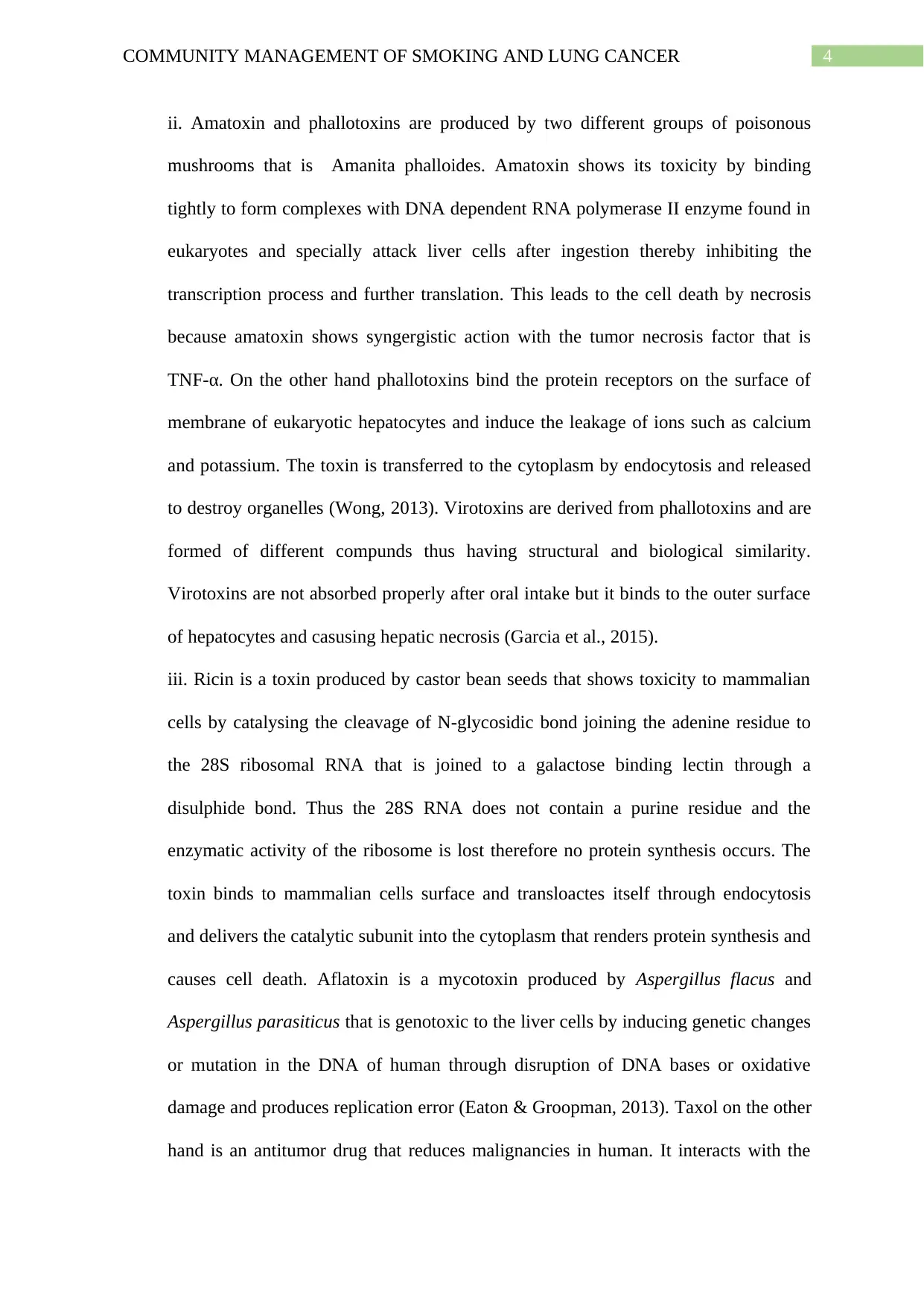
ii. Amatoxin and phallotoxins are produced by two different groups of poisonous
mushrooms that is Amanita phalloides. Amatoxin shows its toxicity by binding
tightly to form complexes with DNA dependent RNA polymerase II enzyme found in
eukaryotes and specially attack liver cells after ingestion thereby inhibiting the
transcription process and further translation. This leads to the cell death by necrosis
because amatoxin shows syngergistic action with the tumor necrosis factor that is
TNF-α. On the other hand phallotoxins bind the protein receptors on the surface of
membrane of eukaryotic hepatocytes and induce the leakage of ions such as calcium
and potassium. The toxin is transferred to the cytoplasm by endocytosis and released
to destroy organelles (Wong, 2013). Virotoxins are derived from phallotoxins and are
formed of different compunds thus having structural and biological similarity.
Virotoxins are not absorbed properly after oral intake but it binds to the outer surface
of hepatocytes and casusing hepatic necrosis (Garcia et al., 2015).
iii. Ricin is a toxin produced by castor bean seeds that shows toxicity to mammalian
cells by catalysing the cleavage of N-glycosidic bond joining the adenine residue to
the 28S ribosomal RNA that is joined to a galactose binding lectin through a
disulphide bond. Thus the 28S RNA does not contain a purine residue and the
enzymatic activity of the ribosome is lost therefore no protein synthesis occurs. The
toxin binds to mammalian cells surface and transloactes itself through endocytosis
and delivers the catalytic subunit into the cytoplasm that renders protein synthesis and
causes cell death. Aflatoxin is a mycotoxin produced by Aspergillus flacus and
Aspergillus parasiticus that is genotoxic to the liver cells by inducing genetic changes
or mutation in the DNA of human through disruption of DNA bases or oxidative
damage and produces replication error (Eaton & Groopman, 2013). Taxol on the other
hand is an antitumor drug that reduces malignancies in human. It interacts with the
ii. Amatoxin and phallotoxins are produced by two different groups of poisonous
mushrooms that is Amanita phalloides. Amatoxin shows its toxicity by binding
tightly to form complexes with DNA dependent RNA polymerase II enzyme found in
eukaryotes and specially attack liver cells after ingestion thereby inhibiting the
transcription process and further translation. This leads to the cell death by necrosis
because amatoxin shows syngergistic action with the tumor necrosis factor that is
TNF-α. On the other hand phallotoxins bind the protein receptors on the surface of
membrane of eukaryotic hepatocytes and induce the leakage of ions such as calcium
and potassium. The toxin is transferred to the cytoplasm by endocytosis and released
to destroy organelles (Wong, 2013). Virotoxins are derived from phallotoxins and are
formed of different compunds thus having structural and biological similarity.
Virotoxins are not absorbed properly after oral intake but it binds to the outer surface
of hepatocytes and casusing hepatic necrosis (Garcia et al., 2015).
iii. Ricin is a toxin produced by castor bean seeds that shows toxicity to mammalian
cells by catalysing the cleavage of N-glycosidic bond joining the adenine residue to
the 28S ribosomal RNA that is joined to a galactose binding lectin through a
disulphide bond. Thus the 28S RNA does not contain a purine residue and the
enzymatic activity of the ribosome is lost therefore no protein synthesis occurs. The
toxin binds to mammalian cells surface and transloactes itself through endocytosis
and delivers the catalytic subunit into the cytoplasm that renders protein synthesis and
causes cell death. Aflatoxin is a mycotoxin produced by Aspergillus flacus and
Aspergillus parasiticus that is genotoxic to the liver cells by inducing genetic changes
or mutation in the DNA of human through disruption of DNA bases or oxidative
damage and produces replication error (Eaton & Groopman, 2013). Taxol on the other
hand is an antitumor drug that reduces malignancies in human. It interacts with the
5COMMUNITY MANAGEMENT OF SMOKING AND LUNG CANCER
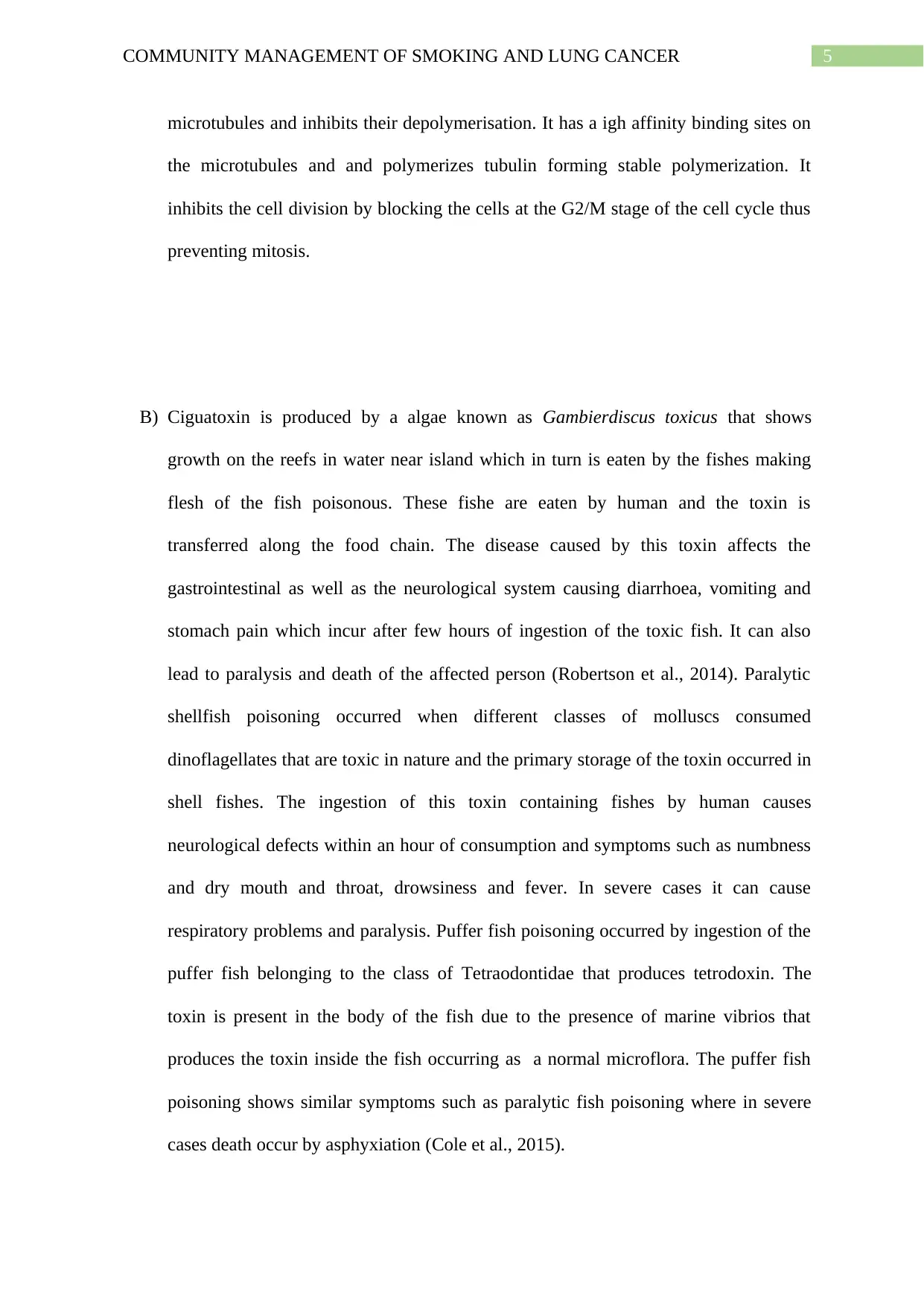
microtubules and inhibits their depolymerisation. It has a igh affinity binding sites on
the microtubules and and polymerizes tubulin forming stable polymerization. It
inhibits the cell division by blocking the cells at the G2/M stage of the cell cycle thus
preventing mitosis.
B) Ciguatoxin is produced by a algae known as Gambierdiscus toxicus that shows
growth on the reefs in water near island which in turn is eaten by the fishes making
flesh of the fish poisonous. These fishe are eaten by human and the toxin is
transferred along the food chain. The disease caused by this toxin affects the
gastrointestinal as well as the neurological system causing diarrhoea, vomiting and
stomach pain which incur after few hours of ingestion of the toxic fish. It can also
lead to paralysis and death of the affected person (Robertson et al., 2014). Paralytic
shellfish poisoning occurred when different classes of molluscs consumed
dinoflagellates that are toxic in nature and the primary storage of the toxin occurred in
shell fishes. The ingestion of this toxin containing fishes by human causes
neurological defects within an hour of consumption and symptoms such as numbness
and dry mouth and throat, drowsiness and fever. In severe cases it can cause
respiratory problems and paralysis. Puffer fish poisoning occurred by ingestion of the
puffer fish belonging to the class of Tetraodontidae that produces tetrodoxin. The
toxin is present in the body of the fish due to the presence of marine vibrios that
produces the toxin inside the fish occurring as a normal microflora. The puffer fish
poisoning shows similar symptoms such as paralytic fish poisoning where in severe
cases death occur by asphyxiation (Cole et al., 2015).
microtubules and inhibits their depolymerisation. It has a igh affinity binding sites on
the microtubules and and polymerizes tubulin forming stable polymerization. It
inhibits the cell division by blocking the cells at the G2/M stage of the cell cycle thus
preventing mitosis.
B) Ciguatoxin is produced by a algae known as Gambierdiscus toxicus that shows
growth on the reefs in water near island which in turn is eaten by the fishes making
flesh of the fish poisonous. These fishe are eaten by human and the toxin is
transferred along the food chain. The disease caused by this toxin affects the
gastrointestinal as well as the neurological system causing diarrhoea, vomiting and
stomach pain which incur after few hours of ingestion of the toxic fish. It can also
lead to paralysis and death of the affected person (Robertson et al., 2014). Paralytic
shellfish poisoning occurred when different classes of molluscs consumed
dinoflagellates that are toxic in nature and the primary storage of the toxin occurred in
shell fishes. The ingestion of this toxin containing fishes by human causes
neurological defects within an hour of consumption and symptoms such as numbness
and dry mouth and throat, drowsiness and fever. In severe cases it can cause
respiratory problems and paralysis. Puffer fish poisoning occurred by ingestion of the
puffer fish belonging to the class of Tetraodontidae that produces tetrodoxin. The
toxin is present in the body of the fish due to the presence of marine vibrios that
produces the toxin inside the fish occurring as a normal microflora. The puffer fish
poisoning shows similar symptoms such as paralytic fish poisoning where in severe
cases death occur by asphyxiation (Cole et al., 2015).
⊘ This is a preview!⊘
Do you want full access?
Subscribe today to unlock all pages.
Trusted by 1+ million students worldwide
6COMMUNITY MANAGEMENT OF SMOKING AND LUNG CANCER
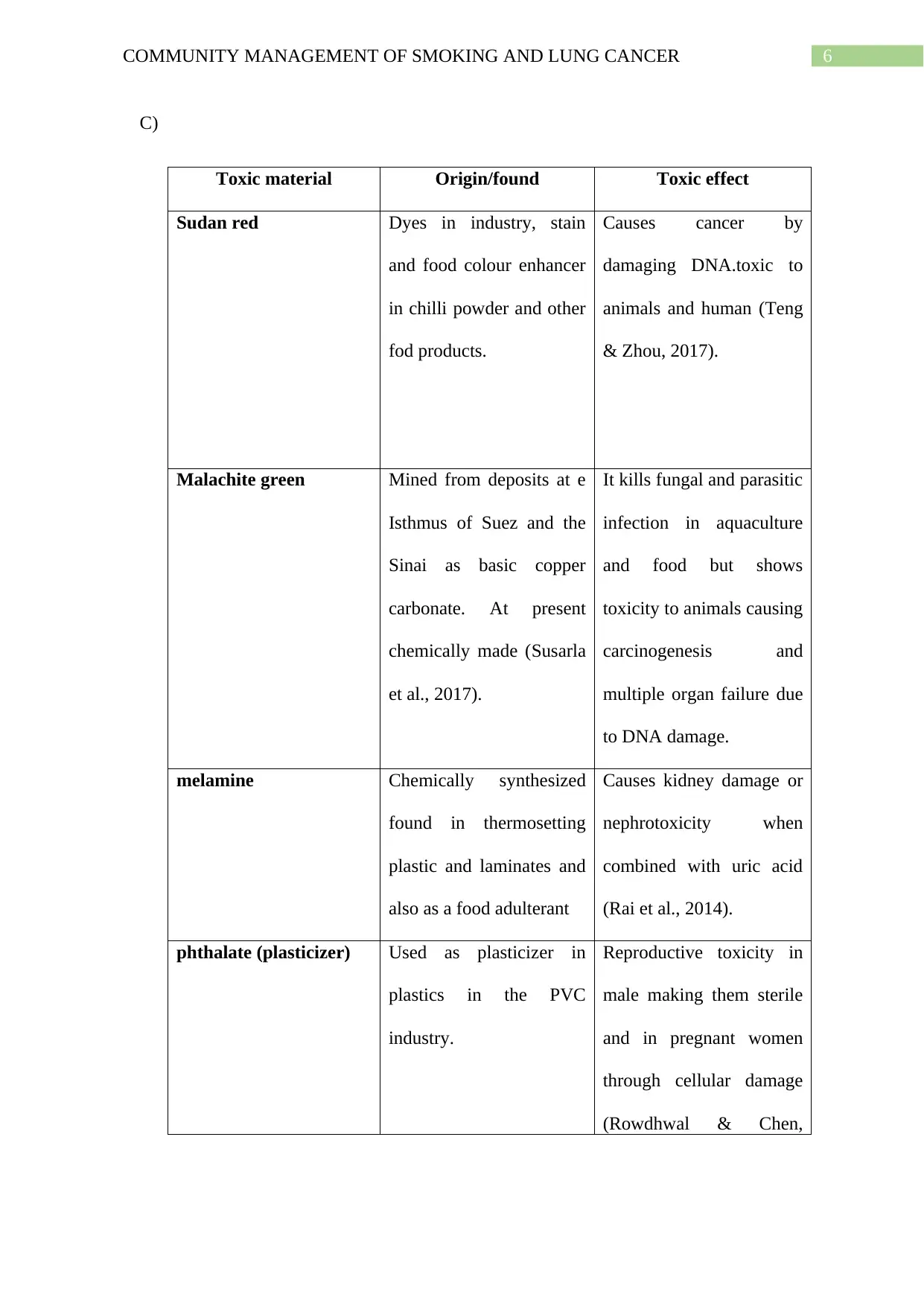
C)
Toxic material Origin/found Toxic effect
Sudan red Dyes in industry, stain
and food colour enhancer
in chilli powder and other
fod products.
Causes cancer by
damaging DNA.toxic to
animals and human (Teng
& Zhou, 2017).
Malachite green Mined from deposits at e
Isthmus of Suez and the
Sinai as basic copper
carbonate. At present
chemically made (Susarla
et al., 2017).
It kills fungal and parasitic
infection in aquaculture
and food but shows
toxicity to animals causing
carcinogenesis and
multiple organ failure due
to DNA damage.
melamine Chemically synthesized
found in thermosetting
plastic and laminates and
also as a food adulterant
Causes kidney damage or
nephrotoxicity when
combined with uric acid
(Rai et al., 2014).
phthalate (plasticizer) Used as plasticizer in
plastics in the PVC
industry.
Reproductive toxicity in
male making them sterile
and in pregnant women
through cellular damage
(Rowdhwal & Chen,
C)
Toxic material Origin/found Toxic effect
Sudan red Dyes in industry, stain
and food colour enhancer
in chilli powder and other
fod products.
Causes cancer by
damaging DNA.toxic to
animals and human (Teng
& Zhou, 2017).
Malachite green Mined from deposits at e
Isthmus of Suez and the
Sinai as basic copper
carbonate. At present
chemically made (Susarla
et al., 2017).
It kills fungal and parasitic
infection in aquaculture
and food but shows
toxicity to animals causing
carcinogenesis and
multiple organ failure due
to DNA damage.
melamine Chemically synthesized
found in thermosetting
plastic and laminates and
also as a food adulterant
Causes kidney damage or
nephrotoxicity when
combined with uric acid
(Rai et al., 2014).
phthalate (plasticizer) Used as plasticizer in
plastics in the PVC
industry.
Reproductive toxicity in
male making them sterile
and in pregnant women
through cellular damage
(Rowdhwal & Chen,
Paraphrase This Document
Need a fresh take? Get an instant paraphrase of this document with our AI Paraphraser
7COMMUNITY MANAGEMENT OF SMOKING AND LUNG CANCER
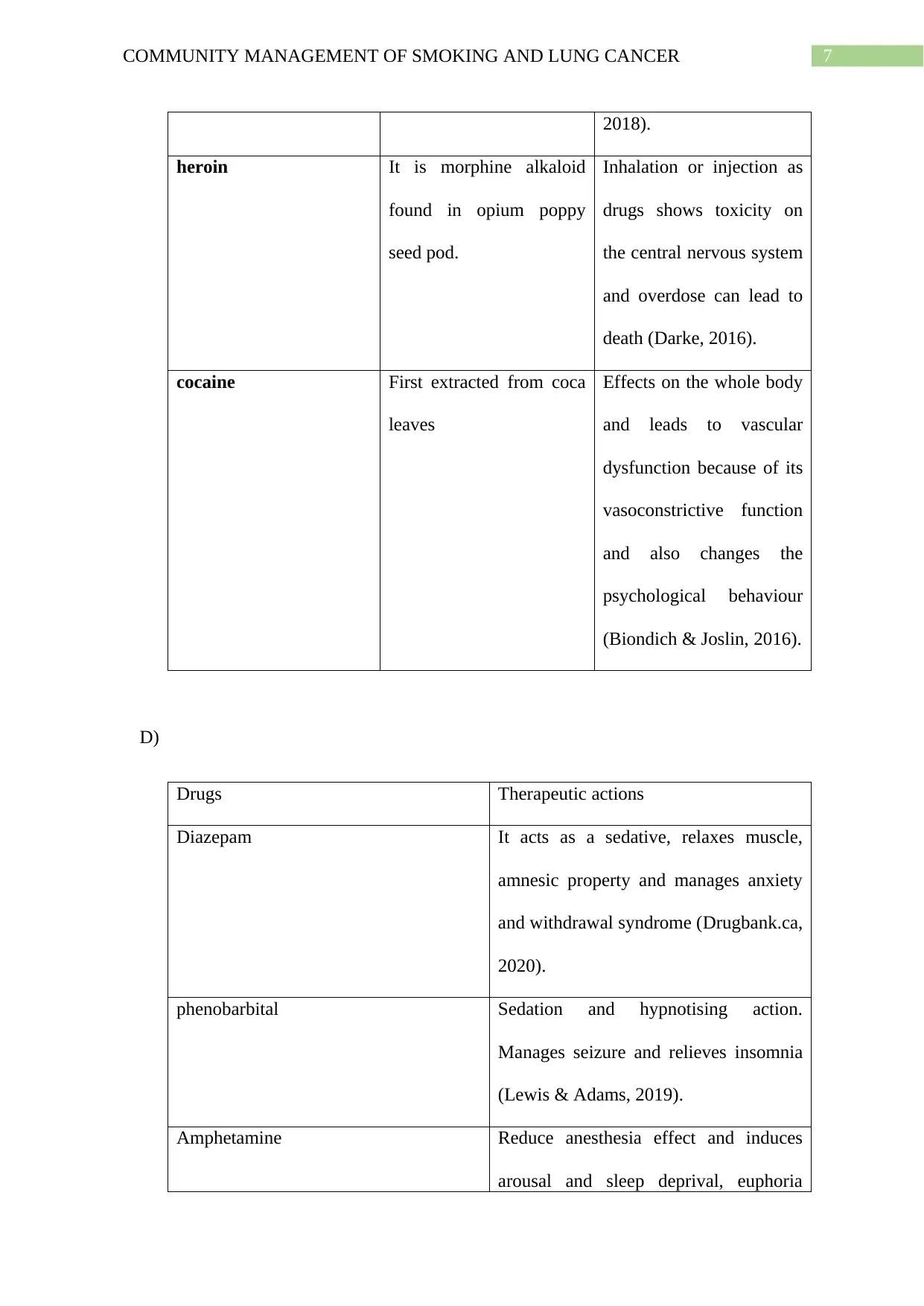
2018).
heroin It is morphine alkaloid
found in opium poppy
seed pod.
Inhalation or injection as
drugs shows toxicity on
the central nervous system
and overdose can lead to
death (Darke, 2016).
cocaine First extracted from coca
leaves
Effects on the whole body
and leads to vascular
dysfunction because of its
vasoconstrictive function
and also changes the
psychological behaviour
(Biondich & Joslin, 2016).
D)
Drugs Therapeutic actions
Diazepam It acts as a sedative, relaxes muscle,
amnesic property and manages anxiety
and withdrawal syndrome (Drugbank.ca,
2020).
phenobarbital Sedation and hypnotising action.
Manages seizure and relieves insomnia
(Lewis & Adams, 2019).
Amphetamine Reduce anesthesia effect and induces
arousal and sleep deprival, euphoria
2018).
heroin It is morphine alkaloid
found in opium poppy
seed pod.
Inhalation or injection as
drugs shows toxicity on
the central nervous system
and overdose can lead to
death (Darke, 2016).
cocaine First extracted from coca
leaves
Effects on the whole body
and leads to vascular
dysfunction because of its
vasoconstrictive function
and also changes the
psychological behaviour
(Biondich & Joslin, 2016).
D)
Drugs Therapeutic actions
Diazepam It acts as a sedative, relaxes muscle,
amnesic property and manages anxiety
and withdrawal syndrome (Drugbank.ca,
2020).
phenobarbital Sedation and hypnotising action.
Manages seizure and relieves insomnia
(Lewis & Adams, 2019).
Amphetamine Reduce anesthesia effect and induces
arousal and sleep deprival, euphoria
8COMMUNITY MANAGEMENT OF SMOKING AND LUNG CANCER
thereby enhances cognitive behaviour
(Drugbank.ca, 2020).
isoniazid Antibacterial against tuberculosis
Lithium poisoning Lithium stabilizes mood but
accumulates in the liver, kidney, bone,
brain, thyroid at high levels showing
systemic toxicity (Hedya & Swoboda,
2019).
E)
thereby enhances cognitive behaviour
(Drugbank.ca, 2020).
isoniazid Antibacterial against tuberculosis
Lithium poisoning Lithium stabilizes mood but
accumulates in the liver, kidney, bone,
brain, thyroid at high levels showing
systemic toxicity (Hedya & Swoboda,
2019).
E)
⊘ This is a preview!⊘
Do you want full access?
Subscribe today to unlock all pages.
Trusted by 1+ million students worldwide
9COMMUNITY MANAGEMENT OF SMOKING AND LUNG CANCER
Answer 4:
i) Phase 1 reactions of drug metabolism involves chemical reactions including
oxidation, reduction and hydrolysis. The reactions can result into three
possibilities- one is the complete inactivation of the drug, second is the activation
of one or more than one metabolites of the drug and the third is the activation of
the of one of the metabolites of the original drug where the latter is known as the
prodrug. This phase is also known as modification phase which occurs by various
processes such as oxidation, reduction, hydrolysis, cyclization and decyclization.
For example reaction oxidation of the aromatic ring produces hydroxyl (-OH)
group when acetanilide which is an analgesic is converted to paracetamol.
Another instance where the hydrolysis of the substrate occurs which converts
esters to carboxylic acids and alcohol such as aspirin administered as prodrug
coverts to salicylic acid and methanol (Taxak & Bharatam, 2014).
ii) In phase 2 the drug is chemically transformed into soluble compounds that are
easily excreted. The drug or the metabolite is linked to a ionizing group through a
process called conjugation and the product formed is known as conjugate and the
metabolites has to be pharmacologicaly active in this phase. These conjugates are
larger than the drug itself and are water soluble. For example in glucuronide
conjugation, the glucuronic acid is added to a toxicant or metabolite thereby
decreasing the toxicity of the metabolite or the drug such as glucuronidation of
aniline converts into aniline n-glucuronide that is useful in chemical industry
(Almazroo et al., 2017).
iii) Phase 3 elimination is the export of the meatbolites from the body with the help of
ATP dependent transporters. The conjugated drugs are excreted through the
kidney (Stanley, 2017). For examples the conjugates bind to the affinity regions of
Answer 4:
i) Phase 1 reactions of drug metabolism involves chemical reactions including
oxidation, reduction and hydrolysis. The reactions can result into three
possibilities- one is the complete inactivation of the drug, second is the activation
of one or more than one metabolites of the drug and the third is the activation of
the of one of the metabolites of the original drug where the latter is known as the
prodrug. This phase is also known as modification phase which occurs by various
processes such as oxidation, reduction, hydrolysis, cyclization and decyclization.
For example reaction oxidation of the aromatic ring produces hydroxyl (-OH)
group when acetanilide which is an analgesic is converted to paracetamol.
Another instance where the hydrolysis of the substrate occurs which converts
esters to carboxylic acids and alcohol such as aspirin administered as prodrug
coverts to salicylic acid and methanol (Taxak & Bharatam, 2014).
ii) In phase 2 the drug is chemically transformed into soluble compounds that are
easily excreted. The drug or the metabolite is linked to a ionizing group through a
process called conjugation and the product formed is known as conjugate and the
metabolites has to be pharmacologicaly active in this phase. These conjugates are
larger than the drug itself and are water soluble. For example in glucuronide
conjugation, the glucuronic acid is added to a toxicant or metabolite thereby
decreasing the toxicity of the metabolite or the drug such as glucuronidation of
aniline converts into aniline n-glucuronide that is useful in chemical industry
(Almazroo et al., 2017).
iii) Phase 3 elimination is the export of the meatbolites from the body with the help of
ATP dependent transporters. The conjugated drugs are excreted through the
kidney (Stanley, 2017). For examples the conjugates bind to the affinity regions of
Paraphrase This Document
Need a fresh take? Get an instant paraphrase of this document with our AI Paraphraser
10COMMUNITY MANAGEMENT OF SMOKING AND LUNG CANCER
the membrane tarnsporters with their anionic region such as binding to the
multidrug resistance protein of the ATP-binding cassette transporters that remove
the metabolites that may be further excreted or metabolized.
B) The reason why some drugs are effective for some people why ineffective in other is
because of adverse drug reactions. Adverse drug effects can be caused due to various
factors related to patients physiological functions, age, weight and proper organ
functioning. A certain drug will react differently in different patients based on the
dosage , roure of administration and pharmacological effect of the drug. The therapeutic
effect of the drug may differ based on the age, genetic factors, gender, maternity status
and immunodeficiency (Alomar, 2014). The patient may have low metabolism for the
drug or show abnormalities regarding pharmacokinetic or pharmacodynamics. Some
people may show side effects due to multidrug resisatance towards certain drugs due to
overuse or misuse of the drug for a certain period of time. For example some disease
causing organism’s develop multidrug resistance towards a range of similar acting drugs
such as those related to penicillin. This occurs because patients do not follow the
prescribed dosage and duration of the administration of the drug which leads to
incomplete drug treatment. Therefore when the same drug is administered for a disease
which has been previously encountered, the drug fails to act against the disease.
C) Cytochrome P450 are a classes of monooxygenase enzymes encoded by the gene
CYP, located within endoplasmic reticulum and mitochondria, contain a heme group as a
cofactor and catalyzes a variety of chemical reactions such as hydroxylation,
decarboxylation and reduction, methylation and deamination, bond formation between
carbon atoms and its breakage, dehalogenation and nitration within cells and in
abundance in liver cells (Jeffreys et al., 2018).
the membrane tarnsporters with their anionic region such as binding to the
multidrug resistance protein of the ATP-binding cassette transporters that remove
the metabolites that may be further excreted or metabolized.
B) The reason why some drugs are effective for some people why ineffective in other is
because of adverse drug reactions. Adverse drug effects can be caused due to various
factors related to patients physiological functions, age, weight and proper organ
functioning. A certain drug will react differently in different patients based on the
dosage , roure of administration and pharmacological effect of the drug. The therapeutic
effect of the drug may differ based on the age, genetic factors, gender, maternity status
and immunodeficiency (Alomar, 2014). The patient may have low metabolism for the
drug or show abnormalities regarding pharmacokinetic or pharmacodynamics. Some
people may show side effects due to multidrug resisatance towards certain drugs due to
overuse or misuse of the drug for a certain period of time. For example some disease
causing organism’s develop multidrug resistance towards a range of similar acting drugs
such as those related to penicillin. This occurs because patients do not follow the
prescribed dosage and duration of the administration of the drug which leads to
incomplete drug treatment. Therefore when the same drug is administered for a disease
which has been previously encountered, the drug fails to act against the disease.
C) Cytochrome P450 are a classes of monooxygenase enzymes encoded by the gene
CYP, located within endoplasmic reticulum and mitochondria, contain a heme group as a
cofactor and catalyzes a variety of chemical reactions such as hydroxylation,
decarboxylation and reduction, methylation and deamination, bond formation between
carbon atoms and its breakage, dehalogenation and nitration within cells and in
abundance in liver cells (Jeffreys et al., 2018).
11COMMUNITY MANAGEMENT OF SMOKING AND LUNG CANCER
Cytochrome P450 is involved in synthesizing steroid hormones, cholesterol and fatty
acids and bile acids. It also plays a vital role in metabolism of drugs that are orally
administered and toxins formed inside the cells. Inside the mitochondria it synthesizes
and metabolizes cellular substances and inside endoplasmic reticulum it metabolizes
medication and toxins (Manikandan & Nagini, 2018).
D)
i) P-glycoproteins are transport protein of the ABC transporters that act as efflux pumps
for extrusion of toxic substances such as toxic drugs that are harmful for the cells. It
limits the cellular uptake of toxic materials and impedes its absorption, permeation by
effluxing the toxic substance out of the cells. P-glycoproteins are found in the epithelial
cells of the large intestine and small intestine, pancreatic and bile duct, kidney tubules and
adrenal gland and also present in endothelial cells of the blood brain barrier. Therefore it
protects the organs from preventing the entry of toxic substances into the cell and
extruding them out of the cell. Animals who lack p-glycoproteins are susceptible to the
toxic substances and its effects because the lack of this transporter will allow the entry of
the toxic drugs inside the cells. On the other hand animals who have p-glycoproteins are
protected from the harmful effects of these toxic drugs as the transporter extrudes the
drugs out of the cells (Amin 2013).
ii) Acetylation is a process of the phase 2 drug metabolism, where acetylation is
correlated with the toxicity of the drug. Slow acetylation leads to the realease of toxic
substances from the drugs that can cause organ damage and development of diseases.
Slow acetylators may recieve therapeutic response from the drug and also the toxic effect
from the metabolism of the drug. Drugs such as isoniazid, sulphonamide and hydralazine
show toxic effects to the slow acetylators whereas no response is found in case of fast
Cytochrome P450 is involved in synthesizing steroid hormones, cholesterol and fatty
acids and bile acids. It also plays a vital role in metabolism of drugs that are orally
administered and toxins formed inside the cells. Inside the mitochondria it synthesizes
and metabolizes cellular substances and inside endoplasmic reticulum it metabolizes
medication and toxins (Manikandan & Nagini, 2018).
D)
i) P-glycoproteins are transport protein of the ABC transporters that act as efflux pumps
for extrusion of toxic substances such as toxic drugs that are harmful for the cells. It
limits the cellular uptake of toxic materials and impedes its absorption, permeation by
effluxing the toxic substance out of the cells. P-glycoproteins are found in the epithelial
cells of the large intestine and small intestine, pancreatic and bile duct, kidney tubules and
adrenal gland and also present in endothelial cells of the blood brain barrier. Therefore it
protects the organs from preventing the entry of toxic substances into the cell and
extruding them out of the cell. Animals who lack p-glycoproteins are susceptible to the
toxic substances and its effects because the lack of this transporter will allow the entry of
the toxic drugs inside the cells. On the other hand animals who have p-glycoproteins are
protected from the harmful effects of these toxic drugs as the transporter extrudes the
drugs out of the cells (Amin 2013).
ii) Acetylation is a process of the phase 2 drug metabolism, where acetylation is
correlated with the toxicity of the drug. Slow acetylation leads to the realease of toxic
substances from the drugs that can cause organ damage and development of diseases.
Slow acetylators may recieve therapeutic response from the drug and also the toxic effect
from the metabolism of the drug. Drugs such as isoniazid, sulphonamide and hydralazine
show toxic effects to the slow acetylators whereas no response is found in case of fast
⊘ This is a preview!⊘
Do you want full access?
Subscribe today to unlock all pages.
Trusted by 1+ million students worldwide

1 out of 24


Your All-in-One AI-Powered Toolkit for Academic Success.
+13062052269
info@desklib.com
Available 24*7 on WhatsApp / Email
![[object Object]](/_next/static/media/star-bottom.7253800d.svg)
Unlock your academic potential
Copyright © 2020–2026 A2Z Services. All Rights Reserved. Developed and managed by ZUCOL.