BEA602 Finance Assignment: Deep Dive into Futures, Hedging, and Swaps

Verified

Added on  2023/06/03

|7
|1213
|173
Homework Assignment
AI Summary
This assignment provides solutions to questions related to futures contracts, hedging strategies, and interest rate swaps. It explains the open interest in futures contracts, the convergence of futures prices to spot prices, and arbitrage opportunities. It also calculates the risk-minimization hedge ratio for a cocoa merchant and determines the number of contracts to trade. Furthermore, it discusses hedging strategies for portfolio withdrawals using S&P 500 futures and explains the construction of swaps using floating and fixed-rate bonds, including calculations for fixed payments and swap values. The document includes relevant references to support the analysis and solutions provided. Desklib offers a range of resources for students, including similar assignments and past papers.
Document Page
Question 1 a
This is because when a new contract is introduced only a few people are willing to trade on it so
the open interest is low on the contract. But as the contract gains popularity more people are
willing to trade so increase in open interest. When a new buyer trades with an older buyer there
is no change in open interest. When an old buyer trades with an old seller this is a low because
they leave the market. When a new seller trades with a new buyer this is a high because they
have made an entry to the market. But as the contract nears its expiration time those who had
held the contract rushes to dispose before the expiration so focusing open interest to be zero.
(Kaufman, 2013)
Question 1 b
Future price converges to the spot price because the risk that was there of what will happen in the
future is not there. Because of uncertainty of whether the price of a commodity will either fall or
rise most people take caution against such risks. As time of expiration comes near the risk that
the price might fall for the commodity help reduces completely because there is a surety. Also,
future price is pushed to lower figure than spot price because there are more people who are
willing to sell their commodity because of future risk of prices reducing than willing to buy but
as expiration nears that risk is removed so many holds and waits for expiration time so this
pushes the future price to be same as spot price (Gregoriou, G, 2008).
When this convergence fails an arbitrage, opportunity arises and one can take the advantage of
the price difference. When the spot is below the future price one can buy the commodity in the
cash market and sell it in the future market and make a risk-free profit. When the cash spot price
is above the future price one can buy in the future market and sell it in the cash market and earn a
risk-free profit. (Taylor, F. ed. ,2013).
tabler-icon-diamond-filled.svg

Paraphrase This Document

Need a fresh take? Get an instant paraphrase of this document with our AI Paraphraser
Document Page
Question 2
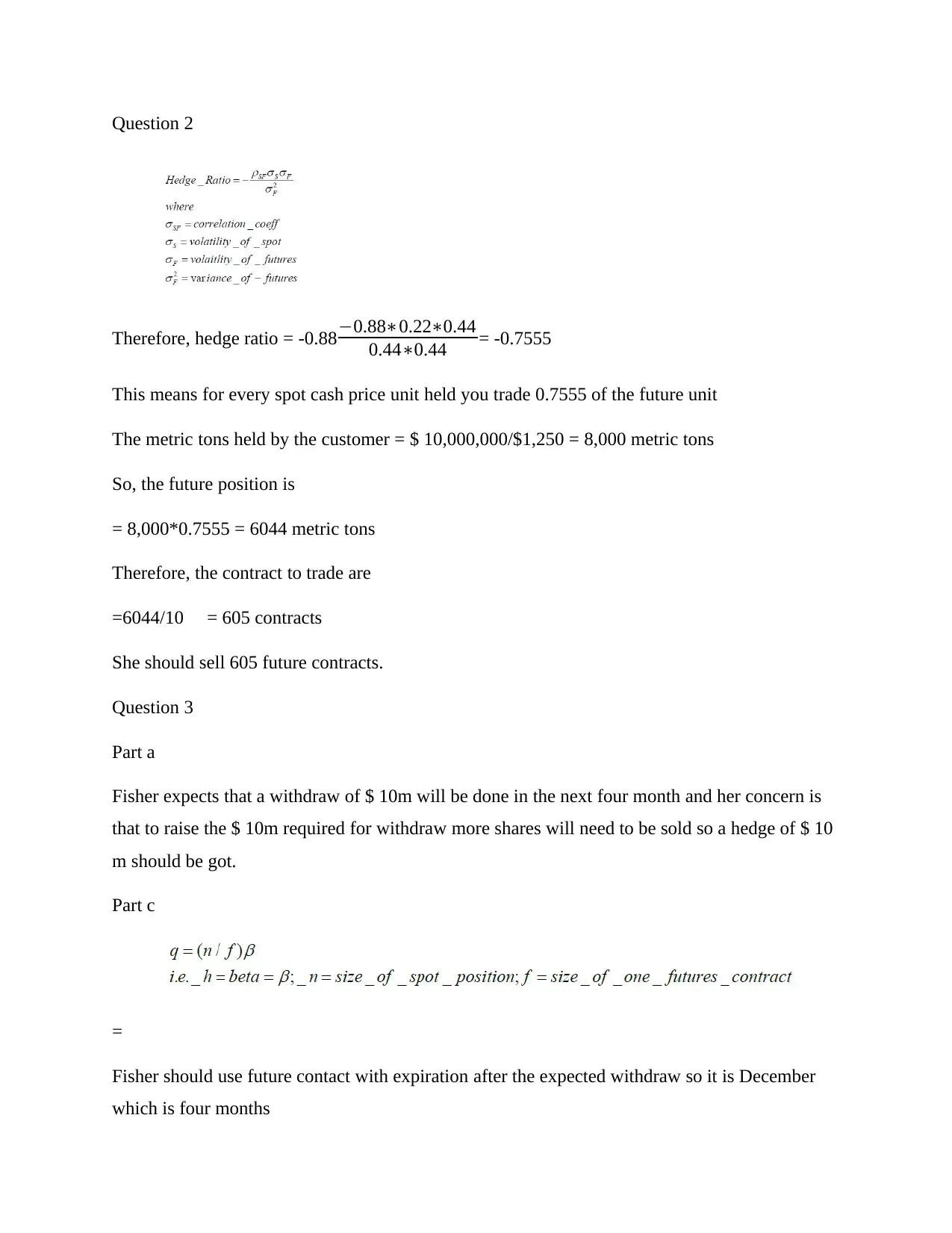
Therefore, hedge ratio = -0.88 0.880.220.44
0.440.44 = -0.7555
This means for every spot cash price unit held you trade 0.7555 of the future unit
The metric tons held by the customer = $ 10,000,000/$1,250 = 8,000 metric tons
So, the future position is
= 8,000*0.7555 = 6044 metric tons
Therefore, the contract to trade are
=6044/10 = 605 contracts
She should sell 605 future contracts.
Question 3
Part a
Fisher expects that a withdraw of $ 10m will be done in the next four month and her concern is
that to raise the $ 10m required for withdraw more shares will need to be sold so a hedge of $ 10
m should be got.
Part c
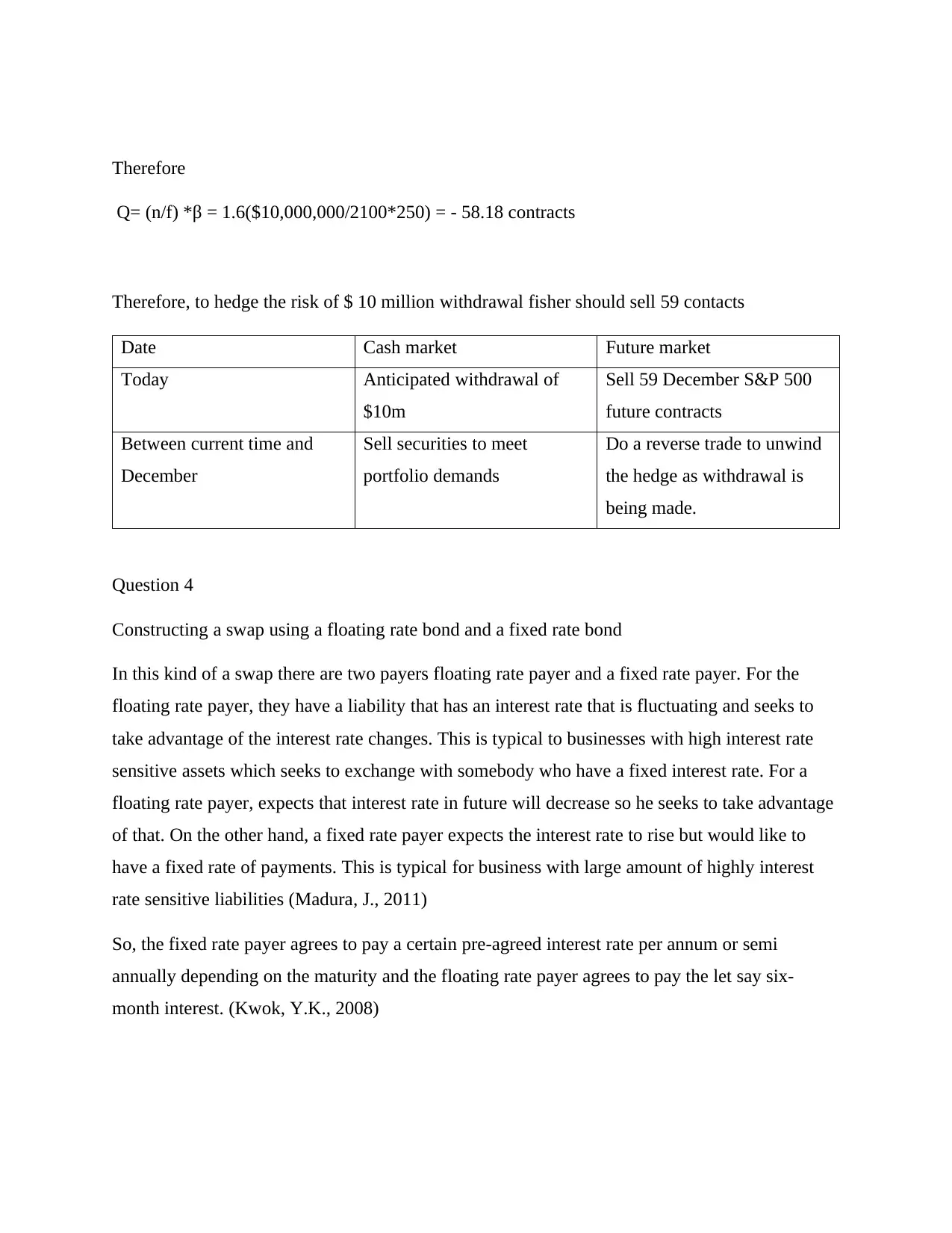
=
Fisher should use future contact with expiration after the expected withdraw so it is December
which is four months
Document Page
Therefore
Q= (n/f) *β = 1.6($10,000,000/2100*250) = - 58.18 contracts
Therefore, to hedge the risk of $ 10 million withdrawal fisher should sell 59 contacts
Date Cash market Future market
Today Anticipated withdrawal of
$10m
Sell 59 December S&P 500
future contracts
Between current time and
December
Sell securities to meet
portfolio demands
Do a reverse trade to unwind
the hedge as withdrawal is
being made.
Question 4
Constructing a swap using a floating rate bond and a fixed rate bond
In this kind of a swap there are two payers floating rate payer and a fixed rate payer. For the
floating rate payer, they have a liability that has an interest rate that is fluctuating and seeks to
take advantage of the interest rate changes. This is typical to businesses with high interest rate
sensitive assets which seeks to exchange with somebody who have a fixed interest rate. For a
floating rate payer, expects that interest rate in future will decrease so he seeks to take advantage
of that. On the other hand, a fixed rate payer expects the interest rate to rise but would like to
have a fixed rate of payments. This is typical for business with large amount of highly interest
rate sensitive liabilities (Madura, J., 2011)
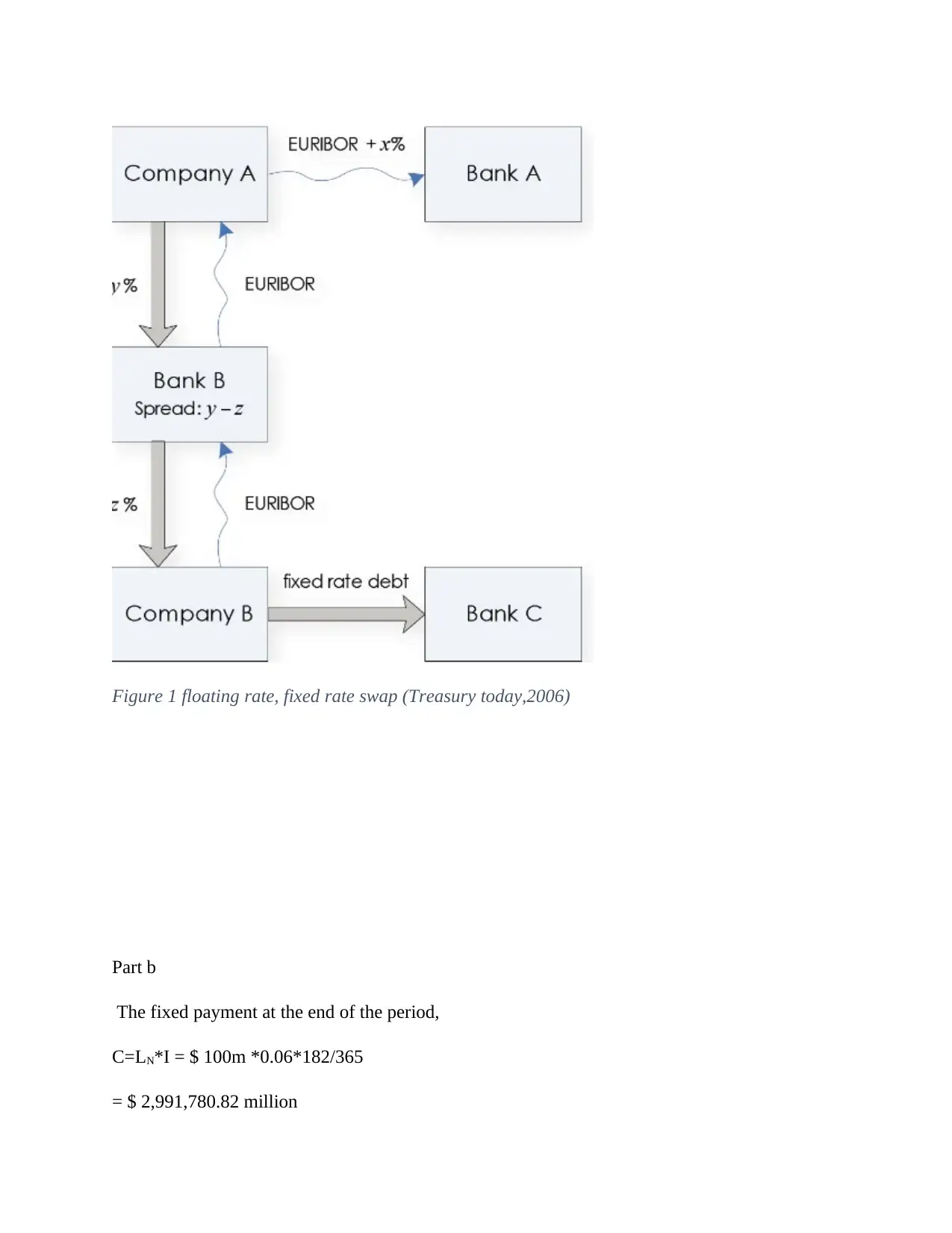
So, the fixed rate payer agrees to pay a certain pre-agreed interest rate per annum or semi
annually depending on the maturity and the floating rate payer agrees to pay the let say six-
month interest. (Kwok, Y.K., 2008)
Document Page
Figure 1 floating rate, fixed rate swap (Treasury today,2006)
Part b
The fixed payment at the end of the period,
C=LN*I = $ 100m *0.06*182/365
= $ 2,991,780.82 million
tabler-icon-diamond-filled.svg

Paraphrase This Document

Need a fresh take? Get an instant paraphrase of this document with our AI Paraphraser
Document Page
PVfix= B (0.05) *C+B (0.1) *C+B (0.15) +B (0.2) *C+B (0.25) *C+B (0.3) *C+B (0.3) * LN
=(0.99+0.97+0.95+0.93+0.91+0.88)*2,991,780.82+0.88*100
= $104.84
The floating rate loan is always equal to its par value at the payment dates
PVFloat= LN = $ 100 million
so, the value of this swap is
= PVFloat- PVFix
= 100-104.84
= -$4.84
Therefore, to enter in to the swap Fixed Towers will be paid $ 4.84 million today.
Document Page
Reference
Kolb. (2018). Future Prices. [online] Available at:
http://www.blackwellpublishing.com/content/kolb5thedition/chapter_03_solution.pdf [Accessed
29 Sep. 2018].
Kolb, Robert W. and James Overdahl (2006) Understanding futures markets.6th Ed.
Peter R.(2004) forward and future prices [Online] Available from:
https://faculty.weatherhead.case.edu/ritchken/textbook/chapter2ps.pdf [Accessed 29th
September 2018].
Kaufman, P.J(2013). Trading Systems and Methods (5th Ed.) John Wiley & Sons.
Gregoriou, G.N. ed. (2008) Encyclopedia of alternative investments. CRC Press.
Taylor, F. ed., (2013). Mastering the Commodities Markets: A step-by-step guide to the markets,
products and their trading. Pearson UK.
Kolb. (2018). Using Future Prices. [online] Available at:
http://www.blackwellpublishing.com/content/kolb5thedition/chapter_04_solution.pdf [Accessed
29 Sep. 2018].
Kolb. (2018). Stock index futures: introduction. [online] Available at:
http://www.blackwellpublishing.com/content/kolb5thedition/chapter_07_solution.pdf [Accessed
29 Sep. 2018].
Kwok, Y.K., (2008) Mathematical models of financial derivatives. Springer.
Britten-Jones, M., (1998) Fixed income and interest rate derivative analysis. Elsevier.
Madura, J., (2011). International financial management. Cengage Learning.
Document Page
Treasury today (2006) Interest rate risk – managing it with swaps. [online] Available at:
http://treasurytoday.com/2006/04/interest-rate-risk-managing-it-with-swaps [Accessed 29 Sep.
2018].
chevron_up_icon
1 out of 7
circle_padding
hide_on_mobile
zoom_out_icon
[object Object]