Auckland University Thesis: Beauty Standards & Body Image
VerifiedAdded on 2024/01/17
|115
|35136
|483
Thesis and Dissertation
AI Summary
This thesis investigates the influence of media and societal beauty standards on women's perceptions of beauty and body image, comparing Western and non-Western beauty practices across historical and contemporary contexts. It challenges the notion of standardized beauty, referencing various theorists who argue that beauty ideals are socially constructed and often detrimental to women's self-worth. The study includes qualitative data from structured interviews, exploring themes such as self-esteem, celebrity culture, and the portrayal of women in the media. The research concludes by emphasizing the need for positive body image development and questioning the roles women play in perpetuating unrealistic beauty standards. Desklib provides access to this thesis and other resources for students.
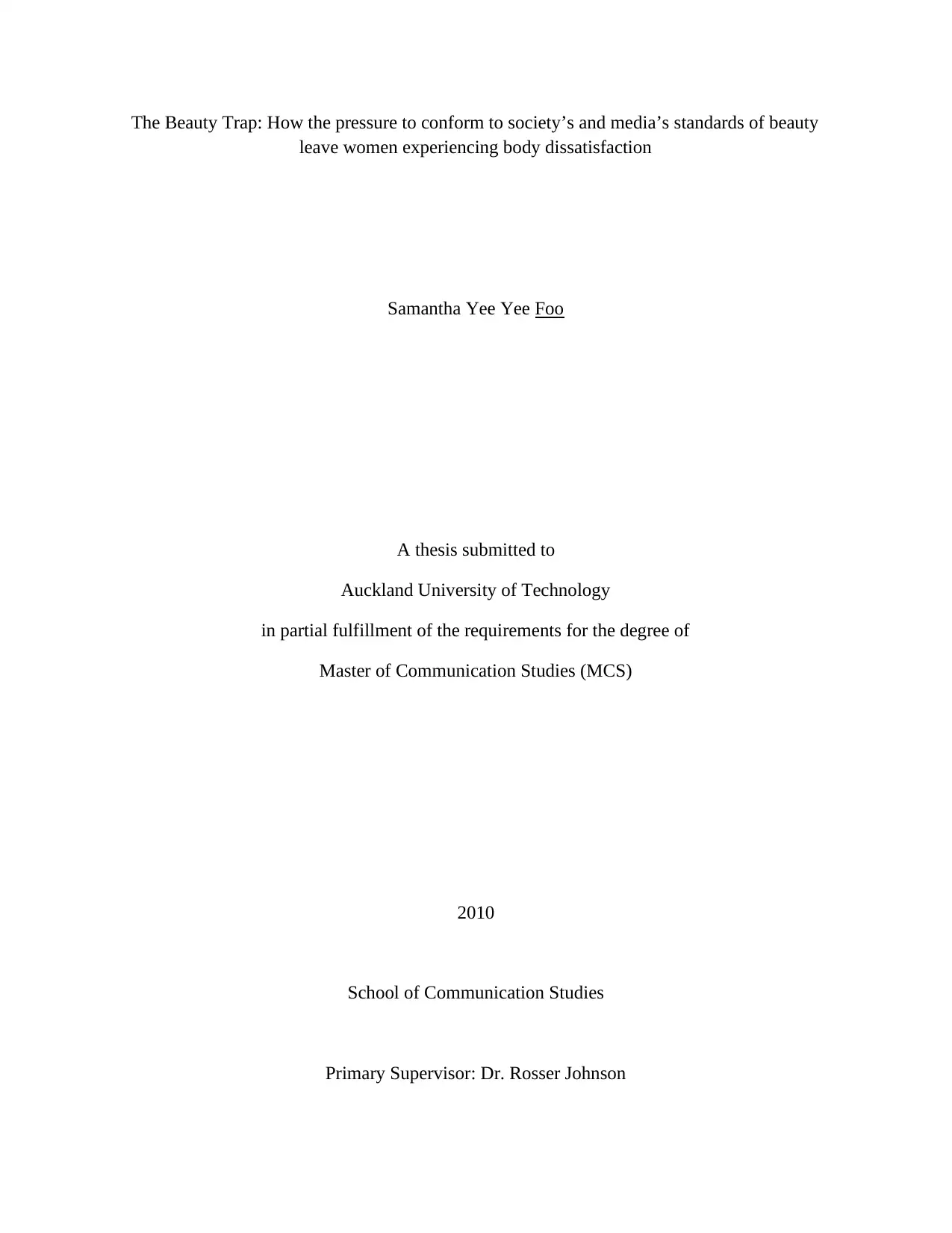
The Beauty Trap: How the pressure to conform to society’s and media’s standards of beauty
leave women experiencing body dissatisfaction
Samantha Yee Yee Foo
A thesis submitted to
Auckland University of Technology
in partial fulfillment of the requirements for the degree of
Master of Communication Studies (MCS)
2010
School of Communication Studies
Primary Supervisor: Dr. Rosser Johnson
leave women experiencing body dissatisfaction
Samantha Yee Yee Foo
A thesis submitted to
Auckland University of Technology
in partial fulfillment of the requirements for the degree of
Master of Communication Studies (MCS)
2010
School of Communication Studies
Primary Supervisor: Dr. Rosser Johnson

Paraphrase This Document
Need a fresh take? Get an instant paraphrase of this document with our AI Paraphraser
i
Attestation of Authorship
“I hereby declare that this submission is my own work and that, to the best of my
knowledge and belief, it contains no material previously published or written by another
person (except where explicitly defined in the acknowledgements), nor material which
to a substantial extent has been submitted for the award of any other degree or diploma
of a university or other institution of higher learning.”
Samantha Yee Yee Foo
Attestation of Authorship
“I hereby declare that this submission is my own work and that, to the best of my
knowledge and belief, it contains no material previously published or written by another
person (except where explicitly defined in the acknowledgements), nor material which
to a substantial extent has been submitted for the award of any other degree or diploma
of a university or other institution of higher learning.”
Samantha Yee Yee Foo
ii
Acknowledgements
My deepest thanks to:
Christina Vogels, my first supervisor, who has provided me invaluable advice and
encouragement in developing this thesis. You have taught me a lot about femininity,
beauty, body image, and the issue of ‘disciplining the body’. I really enjoyed working
and discussing with you, despite the short length of time.
Dr. Rosser Johnson, my second supervisor, who gave me guidance and advice
throughout the process of my thesis especially with the statistical graphs and study
analysis section. Your advice and guidance are and will always be greatly appreciated.
Dr. Janet Bedggood for the Media, Culture and Society classes of Semester 1 2009.
Your lessons on the portrayal of women in the media have not only taught me greatly
but also given me an in-depth insight towards the portrayal of femininity and beauty by
the media.
My parents who have given me all the love and unwavering support from the beginning.
You both have encouraged me to go the distance in life and I am forever grateful.
Without you, I would not be here today writing this Acknowledgements page.
Popo, my maternal grandmother, for all her love and support as well as teaching me the
real meaning of beauty.
My friends and former schoolmates for all their support, love and generosity via online
and offline
My study participants, without your insights, this thesis would not be possible. Your
participation is always greatly appreciated.
Acknowledgements
My deepest thanks to:
Christina Vogels, my first supervisor, who has provided me invaluable advice and
encouragement in developing this thesis. You have taught me a lot about femininity,
beauty, body image, and the issue of ‘disciplining the body’. I really enjoyed working
and discussing with you, despite the short length of time.
Dr. Rosser Johnson, my second supervisor, who gave me guidance and advice
throughout the process of my thesis especially with the statistical graphs and study
analysis section. Your advice and guidance are and will always be greatly appreciated.
Dr. Janet Bedggood for the Media, Culture and Society classes of Semester 1 2009.
Your lessons on the portrayal of women in the media have not only taught me greatly
but also given me an in-depth insight towards the portrayal of femininity and beauty by
the media.
My parents who have given me all the love and unwavering support from the beginning.
You both have encouraged me to go the distance in life and I am forever grateful.
Without you, I would not be here today writing this Acknowledgements page.
Popo, my maternal grandmother, for all her love and support as well as teaching me the
real meaning of beauty.
My friends and former schoolmates for all their support, love and generosity via online
and offline
My study participants, without your insights, this thesis would not be possible. Your
participation is always greatly appreciated.
⊘ This is a preview!⊘
Do you want full access?
Subscribe today to unlock all pages.

Trusted by 1+ million students worldwide

iii
Last but not least, God, for guiding me and being by my side through thick and thin.
Last but not least, God, for guiding me and being by my side through thick and thin.
Paraphrase This Document
Need a fresh take? Get an instant paraphrase of this document with our AI Paraphraser
iv
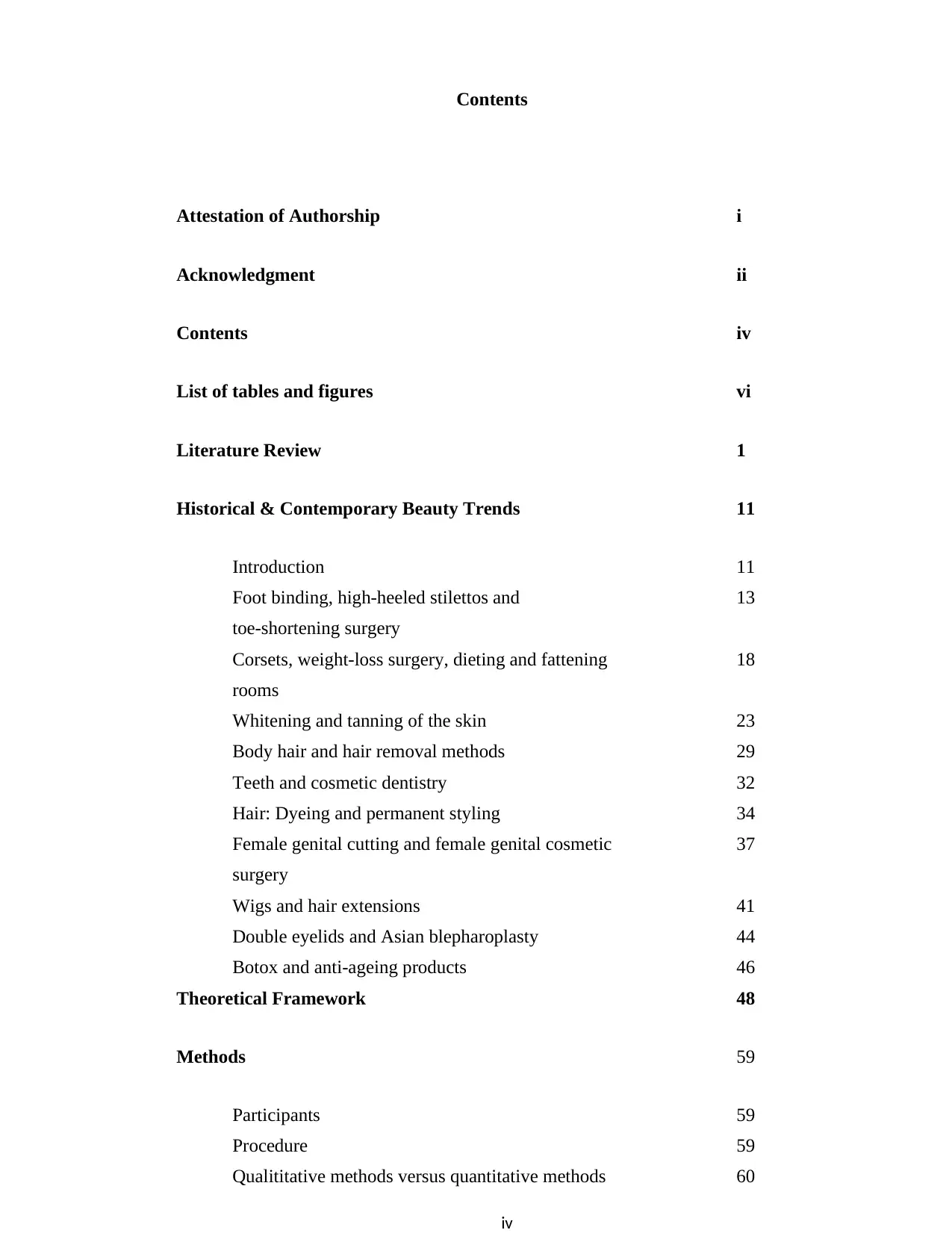
Contents
Attestation of Authorship i
Acknowledgment ii
Contents iv
List of tables and figures vi
Literature Review 1
Historical & Contemporary Beauty Trends 11
Introduction 11
Foot binding, high-heeled stilettos and 13
toe-shortening surgery
Corsets, weight-loss surgery, dieting and fattening 18
rooms
Whitening and tanning of the skin 23
Body hair and hair removal methods 29
Teeth and cosmetic dentistry 32
Hair: Dyeing and permanent styling 34
Female genital cutting and female genital cosmetic 37
surgery
Wigs and hair extensions 41
Double eyelids and Asian blepharoplasty 44
Botox and anti-ageing products 46
Theoretical Framework 48
Methods 59
Participants 59
Procedure 59
Qualititative methods versus quantitative methods 60
Contents
Attestation of Authorship i
Acknowledgment ii
Contents iv
List of tables and figures vi
Literature Review 1
Historical & Contemporary Beauty Trends 11
Introduction 11
Foot binding, high-heeled stilettos and 13
toe-shortening surgery
Corsets, weight-loss surgery, dieting and fattening 18
rooms
Whitening and tanning of the skin 23
Body hair and hair removal methods 29
Teeth and cosmetic dentistry 32
Hair: Dyeing and permanent styling 34
Female genital cutting and female genital cosmetic 37
surgery
Wigs and hair extensions 41
Double eyelids and Asian blepharoplasty 44
Botox and anti-ageing products 46
Theoretical Framework 48
Methods 59
Participants 59
Procedure 59
Qualititative methods versus quantitative methods 60
v
Data Analysis 61
Qualitative data 61
Qualitative data 68
Discussion: Comparative between Literature Review 75
and Data Analysis
Self-esteem 75
Celebrity culture, ‘celebrification’ of beauty and the 79
overrepresentation of Western beauty
Body image 81
Beauty practices (Historical and Contemporary) 82
‘Perfect’ body versus the natural body 83
Femininity and beauty: The portrayal of real women via 84
via the media and what roles do we play in?
Conclusion 86
Bibliography 88
Data Analysis 61
Qualitative data 61
Qualitative data 68
Discussion: Comparative between Literature Review 75
and Data Analysis
Self-esteem 75
Celebrity culture, ‘celebrification’ of beauty and the 79
overrepresentation of Western beauty
Body image 81
Beauty practices (Historical and Contemporary) 82
‘Perfect’ body versus the natural body 83
Femininity and beauty: The portrayal of real women via 84
via the media and what roles do we play in?
Conclusion 86
Bibliography 88
⊘ This is a preview!⊘
Do you want full access?
Subscribe today to unlock all pages.
Trusted by 1+ million students worldwide
vi
List of table and figures
Figure 1 Ethnic groups of 110 participants in Page 62
my structured interview
Figure 2 Percentage of ethnic groups in Greater Page 62
Auckland
Figure 3 Percentage of ethnic groups in the Page 63
Structured interview
Figure 4 Comparative graph between Greater Auckland Page 64
And my study
Figure 5 Participants’ age groups Page 65
Figure 6 Well-known figures chosen by participants Page 66
they believe to epitomize feminine beauty
Figure 7 Participants' satisfaction towards their bodies Page 67
and faces
Figure 8 Participants’ response to the structured interview Page 68
question, “Do you think you are beautiful?”
List of table and figures
Figure 1 Ethnic groups of 110 participants in Page 62
my structured interview
Figure 2 Percentage of ethnic groups in Greater Page 62
Auckland
Figure 3 Percentage of ethnic groups in the Page 63
Structured interview
Figure 4 Comparative graph between Greater Auckland Page 64
And my study
Figure 5 Participants’ age groups Page 65
Figure 6 Well-known figures chosen by participants Page 66
they believe to epitomize feminine beauty
Figure 7 Participants' satisfaction towards their bodies Page 67
and faces
Figure 8 Participants’ response to the structured interview Page 68
question, “Do you think you are beautiful?”
Paraphrase This Document
Need a fresh take? Get an instant paraphrase of this document with our AI Paraphraser
1
Literature Review
The paper aims to explore how media and society‟s alleged standards of beauty have
influenced how they influence women and girls from various socio-cultural backgrounds to
define what „beauty‟ is and how they perceive their body image. In addition, this paper will
compare Western and non-Western beauty practices, both historical and contemporary, and
also debunk the myths that beauty is standardised for women and girls.
Etcoff (2000) argues that “no definition can capture beauty entirely” (p.8) and she quotes
dictionaries defining beauty as “something intrinsic to the object or simply as the pleasure
an object evokes in the beholder” (p. 8). Brand (2000) cites Plato‟s definition of beauty as
timeless, changing and universal where women‟s bodies have not only played a role in the
making of art or provoking philosophical interests but also establishes the business of the
beautification such as the use of beauty and hair products for personal grooming. Like its
sister called fashion, beauty is a language of identity and a promoter of self-esteem (Man,
2000). Beauty is not just an aesthetic category applied to faces and bodies, instead as Peiss
(2000) adds, it helps to define social status, gender and class. Thereby, beauty ideals are
formed by social relations and cultural categories and practices which eventually created
opportunities and commercialization of fashion and beauty industries (Peiss, 2000).
From the Ancient Persian era to the present, Corson (2003) writes that history has countless
records of men and women grooming and adorning their faces and bodies to either mark a
rite of passage, for example puberty, or their social status. Sherrow (2001) also believes
that beautification has been done to symbolize social history, attitudes and values of many
different cultures. For example, during the Elizabethan era, Sherrow (2001) states that
English women used saffron and sulphur to dye their hair red in order to emulate the hair
Literature Review
The paper aims to explore how media and society‟s alleged standards of beauty have
influenced how they influence women and girls from various socio-cultural backgrounds to
define what „beauty‟ is and how they perceive their body image. In addition, this paper will
compare Western and non-Western beauty practices, both historical and contemporary, and
also debunk the myths that beauty is standardised for women and girls.
Etcoff (2000) argues that “no definition can capture beauty entirely” (p.8) and she quotes
dictionaries defining beauty as “something intrinsic to the object or simply as the pleasure
an object evokes in the beholder” (p. 8). Brand (2000) cites Plato‟s definition of beauty as
timeless, changing and universal where women‟s bodies have not only played a role in the
making of art or provoking philosophical interests but also establishes the business of the
beautification such as the use of beauty and hair products for personal grooming. Like its
sister called fashion, beauty is a language of identity and a promoter of self-esteem (Man,
2000). Beauty is not just an aesthetic category applied to faces and bodies, instead as Peiss
(2000) adds, it helps to define social status, gender and class. Thereby, beauty ideals are
formed by social relations and cultural categories and practices which eventually created
opportunities and commercialization of fashion and beauty industries (Peiss, 2000).
From the Ancient Persian era to the present, Corson (2003) writes that history has countless
records of men and women grooming and adorning their faces and bodies to either mark a
rite of passage, for example puberty, or their social status. Sherrow (2001) also believes
that beautification has been done to symbolize social history, attitudes and values of many
different cultures. For example, during the Elizabethan era, Sherrow (2001) states that
English women used saffron and sulphur to dye their hair red in order to emulate the hair
2
colour of Elizabeth I. In addition, besides being a symbol of beauty, some men, especially
members of the royal English court, dyed their facial hair auburn to signify their “loyalty to
their queen” (p. 178). Compared to today where one can choose from many shades ranging
from blonde to auburn, dyeing one‟s hair to emulate a celebrity or a model is more or less
similar to the Elizabethan era. The blonde bombshell mania is an example where the
platinum blonde shade had been popularized by Jean Harlow and Marilyn Monroe in the
1930s and 1950s respectively. Johnson and Lennon (1999) state that socially constructed
ideals towards beauty not only encourage individuals to create appearances but also
determine how they define themselves based on self-worth and their perception towards
appearances in the societies they come from. From demure to playful, Man (2000) believes
historical and contemporary women project their self-images through make-up and fashion
as current or new “frames of references for beauty” (p. 193).
The female body is a medium of culture where a woman faces pressures to meet certain
ideals of beauty in society (Gimlin, 2002). Ehrenreich and English (1978, cited by
Wiseman, Gray, Mosimann, and Ahrens, 1990) agrees that females have historically
attempted to change their bodies to conform to a particular era‟s beauty ideal. From the
Rubenesque voluptuous body of the 1600s to the modern waif-like slender body, Grogan
(2008) believes the idealization of the woman‟s body is due to the “outcome of successful
marketing” (p. 19) which plays a role in the standard of the cultural beauty in Western and
affluent societies. Therefore, a woman‟s body is not just perceived as an object but also is
expected to undergo “constant self-surveillance and disciplinary practices” (p. 38) in the
pursuit of the „perfect‟ body (Blood, 2005). Baumann (2008) adds that ideals regarding
beauty vary between societies and cultures as well as groups within a society such as
colour of Elizabeth I. In addition, besides being a symbol of beauty, some men, especially
members of the royal English court, dyed their facial hair auburn to signify their “loyalty to
their queen” (p. 178). Compared to today where one can choose from many shades ranging
from blonde to auburn, dyeing one‟s hair to emulate a celebrity or a model is more or less
similar to the Elizabethan era. The blonde bombshell mania is an example where the
platinum blonde shade had been popularized by Jean Harlow and Marilyn Monroe in the
1930s and 1950s respectively. Johnson and Lennon (1999) state that socially constructed
ideals towards beauty not only encourage individuals to create appearances but also
determine how they define themselves based on self-worth and their perception towards
appearances in the societies they come from. From demure to playful, Man (2000) believes
historical and contemporary women project their self-images through make-up and fashion
as current or new “frames of references for beauty” (p. 193).
The female body is a medium of culture where a woman faces pressures to meet certain
ideals of beauty in society (Gimlin, 2002). Ehrenreich and English (1978, cited by
Wiseman, Gray, Mosimann, and Ahrens, 1990) agrees that females have historically
attempted to change their bodies to conform to a particular era‟s beauty ideal. From the
Rubenesque voluptuous body of the 1600s to the modern waif-like slender body, Grogan
(2008) believes the idealization of the woman‟s body is due to the “outcome of successful
marketing” (p. 19) which plays a role in the standard of the cultural beauty in Western and
affluent societies. Therefore, a woman‟s body is not just perceived as an object but also is
expected to undergo “constant self-surveillance and disciplinary practices” (p. 38) in the
pursuit of the „perfect‟ body (Blood, 2005). Baumann (2008) adds that ideals regarding
beauty vary between societies and cultures as well as groups within a society such as
⊘ This is a preview!⊘
Do you want full access?
Subscribe today to unlock all pages.
Trusted by 1+ million students worldwide
3
“ideals for height, body shape, facial parts, hairstyles and skin tone” (p. 4). For example,
plumpness is a symbol of beauty and fertility in African and Eastern cultures where a plus
sized, usually big-boned and curvaceous, wife symbolised a happy and successful husband.
Whereas, plumpness is considered un-ideal and symbolises the lack of willpower in the
Western culture which prides on smaller figures. Grogan (2008) agrees by adding that
slenderness in the Western norm represents social success, happiness and social
acceptability. As a result, Wolf (1990) and Blood (2005) write that beauty standards have
not only undermined women‟s self-worth but also pressure them to conform to the beauty
practices of femininity in the attempt to emulate the ideal images of womanhood presented
by media and society. When a woman ignores or fails to conform to the alleged standards
of the ideal beauty, she is not only vulnerable of becoming an outcast from normality,
desirability and femininity but also Blood (2005) adds she is blamed for resisting societal
influences by accepting her body instead of changing it to fit the beauty ideal. Halprin
(1995) believes without support and self-acceptance, many women “tend to internalize
standards of beauty, and judge themselves to the point of self-hatred” (p. 42) or harbour
distorted views about how their bodies and faces should look (Blood, 2005). Therefore,
Grogan (2008) believes there is a great need to develop positive body image in women at
both individual and societal levels through education and health campaigns.
Throughout many eras, beauty has frequently mattered as an inevitable and underlying
socio-political framework for how it tells women what is acceptable as „beautiful‟ within
societal and cultural norms (Brand, 2000). For example, the reinforcement of “media-
presented societal messages” of the beauty ideal that are accepted and internalised by
women (Jones et al, 2004, cited by Dohnt and Tiggerman, 2006, p. 142). Jeffreys (2005)
“ideals for height, body shape, facial parts, hairstyles and skin tone” (p. 4). For example,
plumpness is a symbol of beauty and fertility in African and Eastern cultures where a plus
sized, usually big-boned and curvaceous, wife symbolised a happy and successful husband.
Whereas, plumpness is considered un-ideal and symbolises the lack of willpower in the
Western culture which prides on smaller figures. Grogan (2008) agrees by adding that
slenderness in the Western norm represents social success, happiness and social
acceptability. As a result, Wolf (1990) and Blood (2005) write that beauty standards have
not only undermined women‟s self-worth but also pressure them to conform to the beauty
practices of femininity in the attempt to emulate the ideal images of womanhood presented
by media and society. When a woman ignores or fails to conform to the alleged standards
of the ideal beauty, she is not only vulnerable of becoming an outcast from normality,
desirability and femininity but also Blood (2005) adds she is blamed for resisting societal
influences by accepting her body instead of changing it to fit the beauty ideal. Halprin
(1995) believes without support and self-acceptance, many women “tend to internalize
standards of beauty, and judge themselves to the point of self-hatred” (p. 42) or harbour
distorted views about how their bodies and faces should look (Blood, 2005). Therefore,
Grogan (2008) believes there is a great need to develop positive body image in women at
both individual and societal levels through education and health campaigns.
Throughout many eras, beauty has frequently mattered as an inevitable and underlying
socio-political framework for how it tells women what is acceptable as „beautiful‟ within
societal and cultural norms (Brand, 2000). For example, the reinforcement of “media-
presented societal messages” of the beauty ideal that are accepted and internalised by
women (Jones et al, 2004, cited by Dohnt and Tiggerman, 2006, p. 142). Jeffreys (2005)
Paraphrase This Document
Need a fresh take? Get an instant paraphrase of this document with our AI Paraphraser
4
agrees with Brand (2000) and Etcoff‟s (2000) statements regarding beauty by highlighting
how feminist critics such as Dworkin (1974) have pointed out “beauty is a cultural practice
which is time wasting, expensive and painful to one‟s self-esteem” (p. 6). Women are
required to “„create‟ beauty through make-up, hairstyles, depilation or creation by surgery”
(p.24) in order to create sexual difference to prove they can fulfil the ideal feminine beauty
(Jeffreys, 2005). Feminist writers from academic and popular literature have consistently
argued when a woman attempts to cultivate her appearance, she is considered as a
collaborator in her own oppression at the expense of women‟s fullest development
(Halprin, 1995; Scott, 2005). However, Wolf (1990) argues that beauty practices are
actually about men‟s institutions and institutional power which aims to “destroy women
physically and deplete them psychologically” (p. 6). Jeffreys (2005) believe the concept of
Western and non-Western beauty practices create a stereotyped masculinity and femininity
where women are subjected to criticism instead of being regarded as natural or progressive.
Orbach (1988, cited by Blood, 2005) and Lennon, Lillethun and Buckland (1999) conclude
that the stereotyped representation of women in media, cultural and societal levels not only
define women‟s relationship to men and to themselves as individuals but increase the
pressure to conform to the ideal body or beauty type.
Just as Jeffreys (2005) argues that beauty practices in Western culture should be understood
as “harmful cultural practices” (p.3) like corsetry and stilettos in the historical and
contemporary eras respectively, Ping (2000) writes that the East Asian symbol of feminine
beauty during the olden times was lotus feet, known as „foot binding‟. Like its modern
Western sister such as the stilettos, foot binding was the “synonym for femininity, beauty,
hierarchy, and eroticism” (p. 7) which are “tightly integrated with pain, violence and death”
agrees with Brand (2000) and Etcoff‟s (2000) statements regarding beauty by highlighting
how feminist critics such as Dworkin (1974) have pointed out “beauty is a cultural practice
which is time wasting, expensive and painful to one‟s self-esteem” (p. 6). Women are
required to “„create‟ beauty through make-up, hairstyles, depilation or creation by surgery”
(p.24) in order to create sexual difference to prove they can fulfil the ideal feminine beauty
(Jeffreys, 2005). Feminist writers from academic and popular literature have consistently
argued when a woman attempts to cultivate her appearance, she is considered as a
collaborator in her own oppression at the expense of women‟s fullest development
(Halprin, 1995; Scott, 2005). However, Wolf (1990) argues that beauty practices are
actually about men‟s institutions and institutional power which aims to “destroy women
physically and deplete them psychologically” (p. 6). Jeffreys (2005) believe the concept of
Western and non-Western beauty practices create a stereotyped masculinity and femininity
where women are subjected to criticism instead of being regarded as natural or progressive.
Orbach (1988, cited by Blood, 2005) and Lennon, Lillethun and Buckland (1999) conclude
that the stereotyped representation of women in media, cultural and societal levels not only
define women‟s relationship to men and to themselves as individuals but increase the
pressure to conform to the ideal body or beauty type.
Just as Jeffreys (2005) argues that beauty practices in Western culture should be understood
as “harmful cultural practices” (p.3) like corsetry and stilettos in the historical and
contemporary eras respectively, Ping (2000) writes that the East Asian symbol of feminine
beauty during the olden times was lotus feet, known as „foot binding‟. Like its modern
Western sister such as the stilettos, foot binding was the “synonym for femininity, beauty,
hierarchy, and eroticism” (p. 7) which are “tightly integrated with pain, violence and death”
5
(p.8). Similar to its historical sisters, Grogan (2008) writes contemporary women resort to
diet regimes and cosmetic surgery to try and attain the “culturally defined” (p. 41) ideal
body. As the beauty industry, including cosmetic surgery, continues to thrive, Greer (1999,
cited by Gauntlett, 2008) explains the mediated beauty ideal is “often a substantial pressure
on women” (p. 86) to attain the „perfect body‟. Therefore, it is proven that beauty practices
from both sides of the world, historical and modern, have played a role which affects the
“relationship between women‟s bodies and the image industry where women‟s physical
appearance is able to be changed at will” (Bordo, 1993, as cited by Blood, 2005, p. 13).
In the modern age, Halprin (1995) writes that the maidenly appearance of the extreme,
slender youth, cast in a European style of beauty, has become a global standard for women
of all cultures which is often “opposed to individuality” (p. 42) or in most, uniqueness.
Davies (1982) agrees by stating that the western ideal of femininity has been propagating
western cultural imperialism or cultural values onto its non-Western counterparts.
Therefore, Halprin (1995) writes the myth of the beautiful white woman plays a role in
denying the “value of black beauty, Asian beauty and even the beauties of indigenous or
aboriginal peoples” (p. 43). Shennow (2001) provides an example where critics say Barbie
dolls provide a limited white Anglo-Saxon beauty ideal which could leave girls, especially
from non-Western context, feeling inadequate about themselves. As a result of the
ingrained white beauty standard as the unrealistic ideal, Makkar and Strube (1995) believe
non-Western viewers are often left “in feelings of low self-worth” (p. 1548).
Halprin (1995) adds that women from the non-Western context undergo pain to alter a
physical feature in order to achieve unrealistic ethnic-based standards of beauty ideals. For
(p.8). Similar to its historical sisters, Grogan (2008) writes contemporary women resort to
diet regimes and cosmetic surgery to try and attain the “culturally defined” (p. 41) ideal
body. As the beauty industry, including cosmetic surgery, continues to thrive, Greer (1999,
cited by Gauntlett, 2008) explains the mediated beauty ideal is “often a substantial pressure
on women” (p. 86) to attain the „perfect body‟. Therefore, it is proven that beauty practices
from both sides of the world, historical and modern, have played a role which affects the
“relationship between women‟s bodies and the image industry where women‟s physical
appearance is able to be changed at will” (Bordo, 1993, as cited by Blood, 2005, p. 13).
In the modern age, Halprin (1995) writes that the maidenly appearance of the extreme,
slender youth, cast in a European style of beauty, has become a global standard for women
of all cultures which is often “opposed to individuality” (p. 42) or in most, uniqueness.
Davies (1982) agrees by stating that the western ideal of femininity has been propagating
western cultural imperialism or cultural values onto its non-Western counterparts.
Therefore, Halprin (1995) writes the myth of the beautiful white woman plays a role in
denying the “value of black beauty, Asian beauty and even the beauties of indigenous or
aboriginal peoples” (p. 43). Shennow (2001) provides an example where critics say Barbie
dolls provide a limited white Anglo-Saxon beauty ideal which could leave girls, especially
from non-Western context, feeling inadequate about themselves. As a result of the
ingrained white beauty standard as the unrealistic ideal, Makkar and Strube (1995) believe
non-Western viewers are often left “in feelings of low self-worth” (p. 1548).
Halprin (1995) adds that women from the non-Western context undergo pain to alter a
physical feature in order to achieve unrealistic ethnic-based standards of beauty ideals. For
⊘ This is a preview!⊘
Do you want full access?
Subscribe today to unlock all pages.
Trusted by 1+ million students worldwide

1 out of 115


Your All-in-One AI-Powered Toolkit for Academic Success.
+13062052269
info@desklib.com
Available 24*7 on WhatsApp / Email
![[object Object]](/_next/static/media/star-bottom.7253800d.svg)
Unlock your academic potential
Copyright © 2020–2026 A2Z Services. All Rights Reserved. Developed and managed by ZUCOL.