Behaviour Modification Process on Eating Habits: A Case Study Report
VerifiedAdded on 2023/06/04
|10
|2014
|315
Report
AI Summary
This report details a case study on behaviour modification applied to a college student's unhealthy eating habits and excessive screen time. The study utilizes principles of classical and operant conditioning, including positive and negative reinforcement, and a token economy system to modify the participant's behavior. The treatment plan involved an antecedent control strategy to minimize time spent on TV watching and internet browsing, and to increase time spent on meal preparation and sleep. The report documents the baseline, thinning, and monitoring phases of the 21-day program, presenting data on meal preparation times. The results show an improvement in eating habits during the thinning phase, with a slight decline during the monitoring phase, when the conditions were removed. Limitations are discussed, including the lack of alternative activities for the participant and the potential for sleep schedule challenges. The report provides valuable insights into the practical application of behavior modification techniques.
Running head: BEHAVIOUR MODIFICATION PROCESS ON EATING HABITS
1
Behaviour modification process on eating habits
Name of Student
Institutional Affiliation
Name of Professor
Date
1
Behaviour modification process on eating habits
Name of Student
Institutional Affiliation
Name of Professor
Date

Paraphrase This Document
Need a fresh take? Get an instant paraphrase of this document with our AI Paraphraser
BEHAVIOUR MODIFICATION PROCESS ON EATING HABITS
2
Behaviour modification process on eating habits
Case description
With the advancement in technology, there has been reported advantages and the
disadvantages that come along these advancements (Urech et al., 2018, pp.1-13). However, most
reported disadvantages that have been brought about by the technology improvements such as
the fast internet speeds, easily accessible web content, and social media among others are centred
on human habits. These habits over time become the behaviour of the relevant participant.
Concisely, the consistent poor habits evolve into bad behaviour that are influenced by the lack of
self-discipline. Therefore, this makes the behavioral modification a necessary practice that can be
applied in various ways to counter for the behavioral habits that do not conform to the well-being
being of the participant(s) or the expected code of moral ethics. However, to achieve the
alteration in the behaviour patterns, the behaviour modification process relies on two
conditioning concepts, which are the classical and operant conditioning (Hulse, Stewart, and
Harry, 2018).
Although there are similarities between the two concepts, they take different approaches,
for instance, (Vorster and Albrecht, 2018, pp.206-312) acknowledges that the similarities such as
stimulus generalization, acquisition, spontaneous recovery, and extinction are exhibited in both
the approaches. However, they explain that the operant conditions relies on the reinforcement
and is based on voluntary behaviour while the classical conditioning relies more on the
association between the stimuli and the outcome of the responses while it often involves
reflexive behaviour. Moreover, some of techniques are used to implement these conditions are
negative and positive re-enforcement/punishment, aversion therapy, and the systematic
2
Behaviour modification process on eating habits
Case description
With the advancement in technology, there has been reported advantages and the
disadvantages that come along these advancements (Urech et al., 2018, pp.1-13). However, most
reported disadvantages that have been brought about by the technology improvements such as
the fast internet speeds, easily accessible web content, and social media among others are centred
on human habits. These habits over time become the behaviour of the relevant participant.
Concisely, the consistent poor habits evolve into bad behaviour that are influenced by the lack of
self-discipline. Therefore, this makes the behavioral modification a necessary practice that can be
applied in various ways to counter for the behavioral habits that do not conform to the well-being
being of the participant(s) or the expected code of moral ethics. However, to achieve the
alteration in the behaviour patterns, the behaviour modification process relies on two
conditioning concepts, which are the classical and operant conditioning (Hulse, Stewart, and
Harry, 2018).
Although there are similarities between the two concepts, they take different approaches,
for instance, (Vorster and Albrecht, 2018, pp.206-312) acknowledges that the similarities such as
stimulus generalization, acquisition, spontaneous recovery, and extinction are exhibited in both
the approaches. However, they explain that the operant conditions relies on the reinforcement
and is based on voluntary behaviour while the classical conditioning relies more on the
association between the stimuli and the outcome of the responses while it often involves
reflexive behaviour. Moreover, some of techniques are used to implement these conditions are
negative and positive re-enforcement/punishment, aversion therapy, and the systematic
BEHAVIOUR MODIFICATION PROCESS ON EATING HABITS
3
desensitization (Joob and Beuy, 2018, p.301). These techniques rely on the consistency in their
applications to achieve the desired modification.
In this report, the participant is a college student in his early twenties who is currently
staying alone at an apartment a few miles away from the college. The participant has subjected
himself in addictive practices such as binge-watching and excessive internet browsing. After the
lectures, the participant stays up until late hours and sleeps for limited hours to cop up with the
college schedule. These practices have also led to poor eating habits since the participant finds
no time to prepare or observe the diets he takes every day (Nguyen et al., 2018). The participant
has therefore opted to fill up the fridge with junk foods and sugary soft drinks, which he takes
within minutes to embark on his evening practices. However, before joining college, the
participant could be fed on a balanced diet that was supervised by the parents who provided it on
time. The consequences of these practices could lead to obesity due to the junk food and the
sugary drinks being taken by the participant with time. The programme was conducted in 21
days.
Treatment plan
This treatment plan aims to minimize the time taken on TV watching and internet
browsing while increasing the time taken for preparation of desirable meals and the time for
enough sleep. A plan that aims to reduce the addictions to enforce new habits is known as the
antecedent control (Costa et al., 2018, p.26). However, both the positive and negative re-
enforcement will be used in addition to the token economy technique to achieve the modification
(Sundel and Martin, 2017). For the negative re-enforcement, a cable network will be
disconnected so that there is no internet access in addition to removal of the junk foods from the
fridge. The positive re-enforcement will be applied through the token economy where the
3
desensitization (Joob and Beuy, 2018, p.301). These techniques rely on the consistency in their
applications to achieve the desired modification.
In this report, the participant is a college student in his early twenties who is currently
staying alone at an apartment a few miles away from the college. The participant has subjected
himself in addictive practices such as binge-watching and excessive internet browsing. After the
lectures, the participant stays up until late hours and sleeps for limited hours to cop up with the
college schedule. These practices have also led to poor eating habits since the participant finds
no time to prepare or observe the diets he takes every day (Nguyen et al., 2018). The participant
has therefore opted to fill up the fridge with junk foods and sugary soft drinks, which he takes
within minutes to embark on his evening practices. However, before joining college, the
participant could be fed on a balanced diet that was supervised by the parents who provided it on
time. The consequences of these practices could lead to obesity due to the junk food and the
sugary drinks being taken by the participant with time. The programme was conducted in 21
days.
Treatment plan
This treatment plan aims to minimize the time taken on TV watching and internet
browsing while increasing the time taken for preparation of desirable meals and the time for
enough sleep. A plan that aims to reduce the addictions to enforce new habits is known as the
antecedent control (Costa et al., 2018, p.26). However, both the positive and negative re-
enforcement will be used in addition to the token economy technique to achieve the modification
(Sundel and Martin, 2017). For the negative re-enforcement, a cable network will be
disconnected so that there is no internet access in addition to removal of the junk foods from the
fridge. The positive re-enforcement will be applied through the token economy where the
⊘ This is a preview!⊘
Do you want full access?
Subscribe today to unlock all pages.

Trusted by 1+ million students worldwide

BEHAVIOUR MODIFICATION PROCESS ON EATING HABITS
4
participants will be awarded allowances for observing the expected behaviour. The initial plan
will ensure that the participant sets aside enough time to plan and prepare his meals/ diet before
settling for other activities. The program also includes a three-day thinning phase followed by
the monitoring phase for four days.
After the participant arrives at the apartment at 6 p.m., he will be expected to take a
shower and freshen up for 1 hour, prepare dinner for one hour. From 8.00 p.m to 9.00 p.m the
participant is expected to surf and later watch his TV shows on Netflix. This can be summarized
as shown below.
Time Activity
6.00 pm to 7:00 pm Arriving at home and taking a shower
7:00 pm to 8:00 pm Preparation and taking of supper
8:00 pm to 9:00 pm Iron clothes in readiness for the next day
9:00 pm to 9:30 pm Call friends and family
9:30pm to 5:00 am Sleep
5:00 am to 7:00am Homework and personal studies
7:30 am to 8:00 am Taking shower, dressing up and leaving for school
The above treatment plan was set for 21 days. However, the results for the first week for
the preparation of meals is shown below.
Days Preparation and
taking supper
Preparation and
taking breakfast
Day 1 11.00 to 11.10pm 7.30am
4
participants will be awarded allowances for observing the expected behaviour. The initial plan
will ensure that the participant sets aside enough time to plan and prepare his meals/ diet before
settling for other activities. The program also includes a three-day thinning phase followed by
the monitoring phase for four days.
After the participant arrives at the apartment at 6 p.m., he will be expected to take a
shower and freshen up for 1 hour, prepare dinner for one hour. From 8.00 p.m to 9.00 p.m the
participant is expected to surf and later watch his TV shows on Netflix. This can be summarized
as shown below.
Time Activity
6.00 pm to 7:00 pm Arriving at home and taking a shower
7:00 pm to 8:00 pm Preparation and taking of supper
8:00 pm to 9:00 pm Iron clothes in readiness for the next day
9:00 pm to 9:30 pm Call friends and family
9:30pm to 5:00 am Sleep
5:00 am to 7:00am Homework and personal studies
7:30 am to 8:00 am Taking shower, dressing up and leaving for school
The above treatment plan was set for 21 days. However, the results for the first week for
the preparation of meals is shown below.
Days Preparation and
taking supper
Preparation and
taking breakfast
Day 1 11.00 to 11.10pm 7.30am
Paraphrase This Document
Need a fresh take? Get an instant paraphrase of this document with our AI Paraphraser
BEHAVIOUR MODIFICATION PROCESS ON EATING HABITS
5
Day 2 11.30 to 11.35pm 7:25 to 7:30am
Day 3 9.00 to 10.00 pm 7:00am to 7:30am
Day 4 12.00 to 10.15 am 7:25 to 7:30am
Day 5 8.00 to 8.20 pm 7:25 to 7:30am
Day 6 7.30-8.30pm 7:00am to 7:30am
Day 7 11.10 to 11.20pm 7:25 to 7:30am
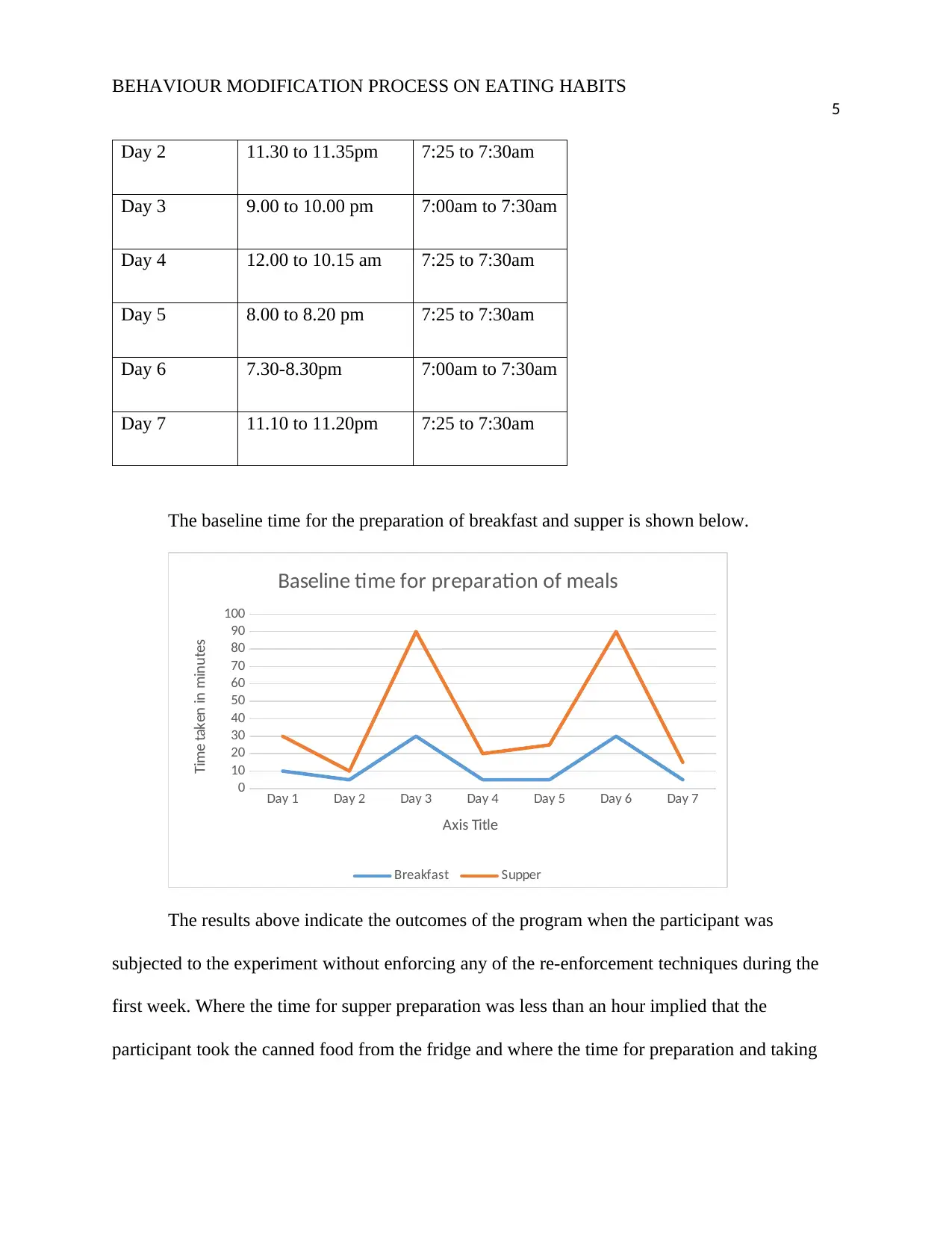
The baseline time for the preparation of breakfast and supper is shown below.
Day 1 Day 2 Day 3 Day 4 Day 5 Day 6 Day 7
0
10
20
30
40
50
60
70
80
90
100
Baseline time for preparation of meals
Breakfast Supper
Axis Title
Time taken in minutes
The results above indicate the outcomes of the program when the participant was
subjected to the experiment without enforcing any of the re-enforcement techniques during the
first week. Where the time for supper preparation was less than an hour implied that the
participant took the canned food from the fridge and where the time for preparation and taking
5
Day 2 11.30 to 11.35pm 7:25 to 7:30am
Day 3 9.00 to 10.00 pm 7:00am to 7:30am
Day 4 12.00 to 10.15 am 7:25 to 7:30am
Day 5 8.00 to 8.20 pm 7:25 to 7:30am
Day 6 7.30-8.30pm 7:00am to 7:30am
Day 7 11.10 to 11.20pm 7:25 to 7:30am
The baseline time for the preparation of breakfast and supper is shown below.
Day 1 Day 2 Day 3 Day 4 Day 5 Day 6 Day 7
0
10
20
30
40
50
60
70
80
90
100
Baseline time for preparation of meals
Breakfast Supper
Axis Title
Time taken in minutes
The results above indicate the outcomes of the program when the participant was
subjected to the experiment without enforcing any of the re-enforcement techniques during the
first week. Where the time for supper preparation was less than an hour implied that the
participant took the canned food from the fridge and where the time for preparation and taking
BEHAVIOUR MODIFICATION PROCESS ON EATING HABITS
6
breakfast was less than 30 minutes implied that the participant took soft drinks from the
refrigerator and left for school.
Thinning and Monitoring phase
In the thinning phase, the participant was subjected to the conditioning where all the junk
foods and the surgery soft drinks in the fridge were removed. This was aimed at making the
participant to prepare his own meals with the given menus and the ingredients that promote a
balanced diet. Additionally, the cable internet was disconnected when the participant exhibited
the binge-watching and late night internet surfing. Moreover, the participant was awarded an
allowance of $5 in case he observed the intended test program. In the monitoring phase, in
essence, the last 7 days, all the conditions were removed to observe the participants behaviour.
Treatment progress and outcome
In the treatment phase, the participant was observed to follow the given programme
schedule. The results of the outcome during the thinning and the monitoring phase are shown
below. For the second week, the thinning phase;
Days Preparation for
supper
Preparation for
breakfast
Day 8 7:00 pm to 8:00 pm 6:30 am to 7:30 am
Day 9 7:00 pm to 8:00 pm 6:30 am to 7:30 am
Day 10 7:00 pm to 8:00 pm 6:30 am to 7:30 am
Day 11 7:00 pm to 8:00 pm 6:30am to 7:30am
Day 12 7:00 pm to 8:00 pm 6:30 am to 7:30 am
6
breakfast was less than 30 minutes implied that the participant took soft drinks from the
refrigerator and left for school.
Thinning and Monitoring phase
In the thinning phase, the participant was subjected to the conditioning where all the junk
foods and the surgery soft drinks in the fridge were removed. This was aimed at making the
participant to prepare his own meals with the given menus and the ingredients that promote a
balanced diet. Additionally, the cable internet was disconnected when the participant exhibited
the binge-watching and late night internet surfing. Moreover, the participant was awarded an
allowance of $5 in case he observed the intended test program. In the monitoring phase, in
essence, the last 7 days, all the conditions were removed to observe the participants behaviour.
Treatment progress and outcome
In the treatment phase, the participant was observed to follow the given programme
schedule. The results of the outcome during the thinning and the monitoring phase are shown
below. For the second week, the thinning phase;
Days Preparation for
supper
Preparation for
breakfast
Day 8 7:00 pm to 8:00 pm 6:30 am to 7:30 am
Day 9 7:00 pm to 8:00 pm 6:30 am to 7:30 am
Day 10 7:00 pm to 8:00 pm 6:30 am to 7:30 am
Day 11 7:00 pm to 8:00 pm 6:30am to 7:30am
Day 12 7:00 pm to 8:00 pm 6:30 am to 7:30 am
⊘ This is a preview!⊘
Do you want full access?
Subscribe today to unlock all pages.
Trusted by 1+ million students worldwide
BEHAVIOUR MODIFICATION PROCESS ON EATING HABITS
7
Day 13 7:00 pm to 8:00 pm 6:30 am to 7:30 am
Day 14 7:00 pm to 8:00 pm 6:30 am to 7:30 am
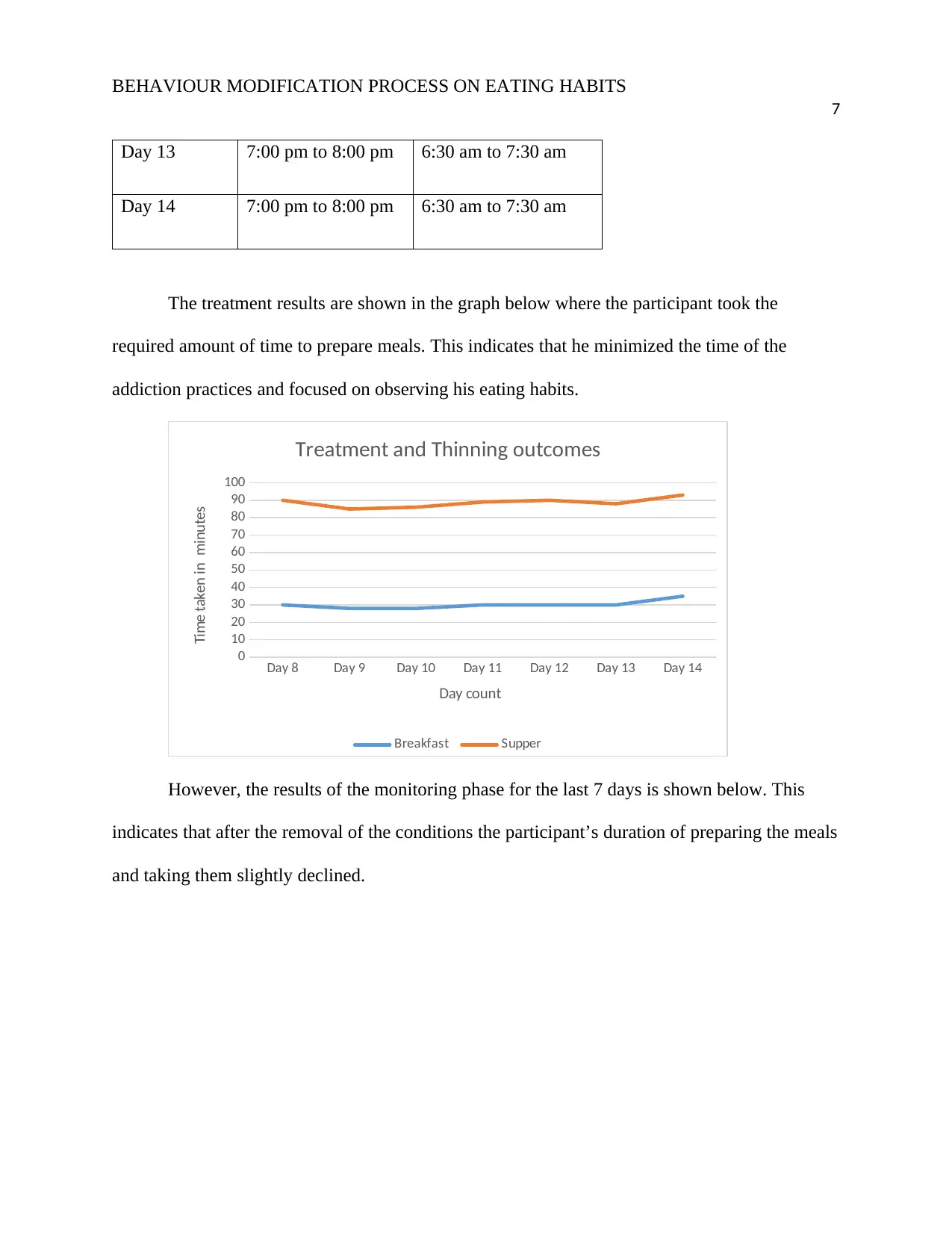
The treatment results are shown in the graph below where the participant took the
required amount of time to prepare meals. This indicates that he minimized the time of the
addiction practices and focused on observing his eating habits.
Day 8 Day 9 Day 10 Day 11 Day 12 Day 13 Day 14
0
10
20
30
40
50
60
70
80
90
100
Treatment and Thinning outcomes
Breakfast Supper
Day count
Time taken in minutes
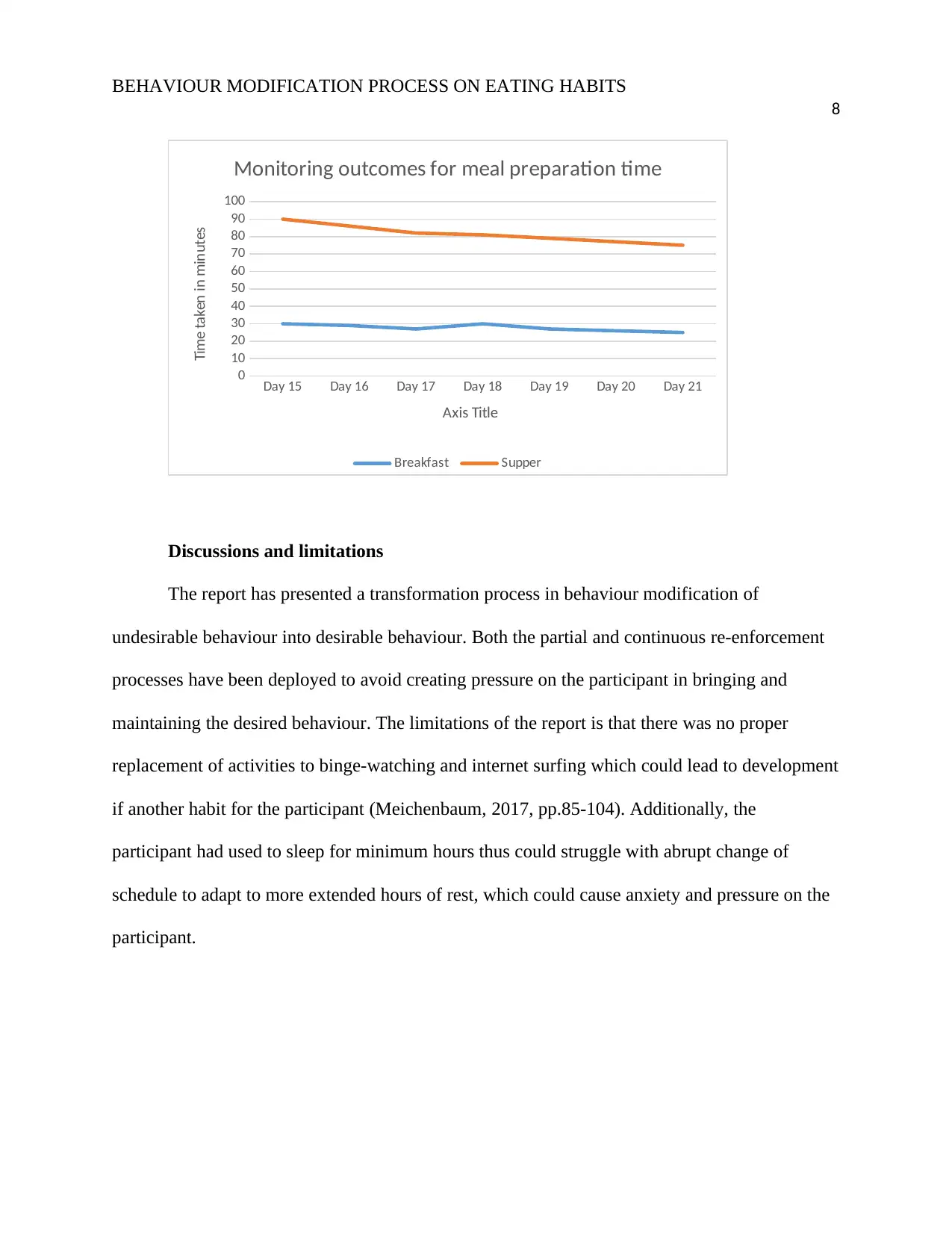
However, the results of the monitoring phase for the last 7 days is shown below. This
indicates that after the removal of the conditions the participant’s duration of preparing the meals
and taking them slightly declined.
7
Day 13 7:00 pm to 8:00 pm 6:30 am to 7:30 am
Day 14 7:00 pm to 8:00 pm 6:30 am to 7:30 am
The treatment results are shown in the graph below where the participant took the
required amount of time to prepare meals. This indicates that he minimized the time of the
addiction practices and focused on observing his eating habits.
Day 8 Day 9 Day 10 Day 11 Day 12 Day 13 Day 14
0
10
20
30
40
50
60
70
80
90
100
Treatment and Thinning outcomes
Breakfast Supper
Day count
Time taken in minutes
However, the results of the monitoring phase for the last 7 days is shown below. This
indicates that after the removal of the conditions the participant’s duration of preparing the meals
and taking them slightly declined.
Paraphrase This Document
Need a fresh take? Get an instant paraphrase of this document with our AI Paraphraser
BEHAVIOUR MODIFICATION PROCESS ON EATING HABITS
8
Day 15 Day 16 Day 17 Day 18 Day 19 Day 20 Day 21
0
10
20
30
40
50
60
70
80
90
100
Monitoring outcomes for meal preparation time
Breakfast Supper
Axis Title
Time taken in minutes
Discussions and limitations
The report has presented a transformation process in behaviour modification of
undesirable behaviour into desirable behaviour. Both the partial and continuous re-enforcement
processes have been deployed to avoid creating pressure on the participant in bringing and
maintaining the desired behaviour. The limitations of the report is that there was no proper
replacement of activities to binge-watching and internet surfing which could lead to development
if another habit for the participant (Meichenbaum, 2017, pp.85-104). Additionally, the
participant had used to sleep for minimum hours thus could struggle with abrupt change of
schedule to adapt to more extended hours of rest, which could cause anxiety and pressure on the
participant.
8
Day 15 Day 16 Day 17 Day 18 Day 19 Day 20 Day 21
0
10
20
30
40
50
60
70
80
90
100
Monitoring outcomes for meal preparation time
Breakfast Supper
Axis Title
Time taken in minutes
Discussions and limitations
The report has presented a transformation process in behaviour modification of
undesirable behaviour into desirable behaviour. Both the partial and continuous re-enforcement
processes have been deployed to avoid creating pressure on the participant in bringing and
maintaining the desired behaviour. The limitations of the report is that there was no proper
replacement of activities to binge-watching and internet surfing which could lead to development
if another habit for the participant (Meichenbaum, 2017, pp.85-104). Additionally, the
participant had used to sleep for minimum hours thus could struggle with abrupt change of
schedule to adapt to more extended hours of rest, which could cause anxiety and pressure on the
participant.
BEHAVIOUR MODIFICATION PROCESS ON EATING HABITS
9
References
Costa, S., Gugliandolo, M. C., Barberis, N., Cuzzocrea, F., & Liga, F. (2018). Antecedents and
consequences of parental psychological control and autonomy support: The role of
psychological basic needs. Journal of Social and Personal Relationships,26
Hulse, S. H., Fowler, H., & Honig, W. K. (2018). Cognitive processes in animal behavior.
Routledge.
Joob, B., & Wiwanitkit, V. (2018). Medical Errors in Autopsied Cases. Journal of Nepal Health
Research Council, 15(3), 301.
Meichenbaum, D. (2017). Teaching thinking: A cognitive behavioral perspective. In The
Evolution of Cognitive Behavior Therapy (pp. 85-104). Routledge.
Nguyen, H., Ruiz, C., Wilson, V., Strong, D., & Djamasbi, S. (2018, January). Using Personality
Traits and Chronotype to Support Personalization and Feedback in a Sleep Health
Behavior Change Support System. In Proceedings of the 51st Hawaii International
Conference on System Sciences.
Sundel, M., & Sundel, S. S. (2017). Behavior change in the human services: Behavioral and
cognitive principles and applications. Sage Publications.
Urech, A., Krieger, T., Möseneder, L., Biaggi, A., Vincent, A., Poppe, C., ... & Berger, T.
(2018). A patient post hoc perspective on advantages and disadvantages of blended
cognitive behaviour therapy for depression: A qualitative content
analysis. Psychotherapy research, 1-13.
9
References
Costa, S., Gugliandolo, M. C., Barberis, N., Cuzzocrea, F., & Liga, F. (2018). Antecedents and
consequences of parental psychological control and autonomy support: The role of
psychological basic needs. Journal of Social and Personal Relationships,26
Hulse, S. H., Fowler, H., & Honig, W. K. (2018). Cognitive processes in animal behavior.
Routledge.
Joob, B., & Wiwanitkit, V. (2018). Medical Errors in Autopsied Cases. Journal of Nepal Health
Research Council, 15(3), 301.
Meichenbaum, D. (2017). Teaching thinking: A cognitive behavioral perspective. In The
Evolution of Cognitive Behavior Therapy (pp. 85-104). Routledge.
Nguyen, H., Ruiz, C., Wilson, V., Strong, D., & Djamasbi, S. (2018, January). Using Personality
Traits and Chronotype to Support Personalization and Feedback in a Sleep Health
Behavior Change Support System. In Proceedings of the 51st Hawaii International
Conference on System Sciences.
Sundel, M., & Sundel, S. S. (2017). Behavior change in the human services: Behavioral and
cognitive principles and applications. Sage Publications.
Urech, A., Krieger, T., Möseneder, L., Biaggi, A., Vincent, A., Poppe, C., ... & Berger, T.
(2018). A patient post hoc perspective on advantages and disadvantages of blended
cognitive behaviour therapy for depression: A qualitative content
analysis. Psychotherapy research, 1-13.
⊘ This is a preview!⊘
Do you want full access?
Subscribe today to unlock all pages.
Trusted by 1+ million students worldwide
BEHAVIOUR MODIFICATION PROCESS ON EATING HABITS
10
Vorster, A. P., & Born, J. (2018). Wakefulness rather than sleep benefits extinction of an
inhibitory operant conditioning memory in Aplysia. Neurobiology of learning and
memory, 155, 306-312.
10
Vorster, A. P., & Born, J. (2018). Wakefulness rather than sleep benefits extinction of an
inhibitory operant conditioning memory in Aplysia. Neurobiology of learning and
memory, 155, 306-312.

1 out of 10


Your All-in-One AI-Powered Toolkit for Academic Success.
+13062052269
info@desklib.com
Available 24*7 on WhatsApp / Email
![[object Object]](/_next/static/media/star-bottom.7253800d.svg)
Unlock your academic potential
Copyright © 2020–2026 A2Z Services. All Rights Reserved. Developed and managed by ZUCOL.