Organisational Behaviour Report: Company Performance Analysis
VerifiedAdded on 2020/10/22
|15
|3474
|260
Report
AI Summary
This report provides a comprehensive analysis of organisational behaviour within a UK-based retail company. It explores the influence of culture, politics, and power on individual and team behaviour, examining how these factors impact overall performance. The report delves into Handy's model of organisational culture, highlighting the impact of power dynamics, and analyzing both positive and negative effects of the company's culture. Furthermore, it examines content and process theories of motivation, including Maslow's hierarchy of needs, Herzberg's two-factor theory, and Vroom's expectancy theory, to address issues of low job satisfaction and performance. The report also discusses the importance of emotional intelligence and soft skills in the workplace, emphasizing their role in effective teamwork and leadership. Finally, the report suggests practical applications of these concepts to improve employee morale, enhance productivity, and achieve organisational goals.
ORGANISATIONAL
BEHAVIOUR
BEHAVIOUR

Paraphrase This Document
Need a fresh take? Get an instant paraphrase of this document with our AI Paraphraser

Table of Contents
INTRODUCTION...........................................................................................................................1
TASK 1............................................................................................................................................1
P1. Analysis of the influence of culture, politics and power on the behaviour of individual,
team and on the overall performance...........................................................................................1
TASK 2............................................................................................................................................4
P2. Analysing content and process theory of motivation and various motivational techniques
in the organisation........................................................................................................................4
TASK 3............................................................................................................................................8
P3. Effective team vs. In effective team......................................................................................8
TASK 4..........................................................................................................................................10
P4. Applying philosophies and concepts of organisational behaviour within the organisational
context........................................................................................................................................10
CONCLUSION..............................................................................................................................10
REFERENCES..............................................................................................................................11
INTRODUCTION...........................................................................................................................1
TASK 1............................................................................................................................................1
P1. Analysis of the influence of culture, politics and power on the behaviour of individual,
team and on the overall performance...........................................................................................1
TASK 2............................................................................................................................................4
P2. Analysing content and process theory of motivation and various motivational techniques
in the organisation........................................................................................................................4
TASK 3............................................................................................................................................8
P3. Effective team vs. In effective team......................................................................................8
TASK 4..........................................................................................................................................10
P4. Applying philosophies and concepts of organisational behaviour within the organisational
context........................................................................................................................................10
CONCLUSION..............................................................................................................................10
REFERENCES..............................................................................................................................11
⊘ This is a preview!⊘
Do you want full access?
Subscribe today to unlock all pages.

Trusted by 1+ million students worldwide

Paraphrase This Document
Need a fresh take? Get an instant paraphrase of this document with our AI Paraphraser
INTRODUCTION
Organisational behaviour refers to the understanding of behaviour of human being in the
organisational setting and it examines the consequences that groups or individuals have on the
behaviour within the industry. The present study aims to evaluate the behaviour of team and
individuals in the sales department impact in Company. It is one of the biggest retailing business
in UK that was founded in 1919. It will identify determinant of power,culture and politics on the
action of teams and individuals in the context of organisation and also will measure how one can
encourage team and individual person to attain objective or goal of the company.
TASK 1
P1. Analysis of the influence of culture, politics and power on the behaviour of individual, team
and on the overall performance
In Company, there are different element that influence the behaviour of teams and
individuals in the company (Bakotić, 2016). The organisational culture of Company is changed
after change and control structure were made by the new CEO. Individuals in the company face
these three combination in the system. Culture, politics and power in Company influence daily
operational function as well as the environment of the organisation.
Influence of culture
The culture provides a set of predefined guidelines to the workforce and also provide a
direction to them to how to work effectively in the industry to accomplish the industry's goal.
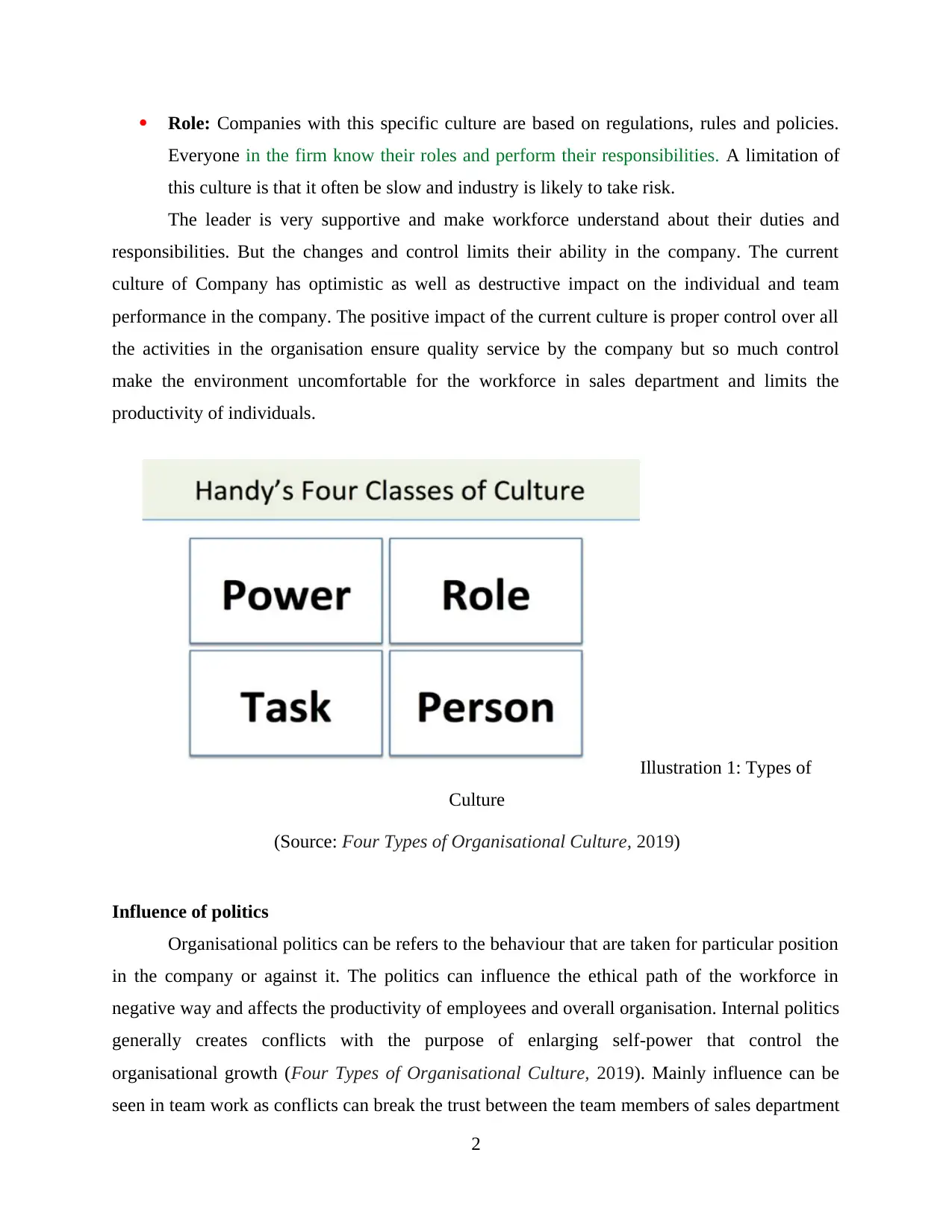
The culture of the company can be understand by Handy's model of organisational culture.
Under this model there are 4 kind of culture; power, person, task and role (Chumg and et. al.,
2016).
Power: In an industry, few individuals held power culture. Generally the power is in the
hand of CEO that changes the organisational structure and make it more controllable.
Person: Company with this culture, members in the workplace perceive themselves as
superior and unique to the company. Person culture in an industry is just a aggregation of
individuals that happen for doing work for the same enterprise.
Task: task culture form in an organisation when group in the company are settled
especially to address particular issue or progress report. This culture in the business
proves ascertained by the team dynamics.
1
Organisational behaviour refers to the understanding of behaviour of human being in the
organisational setting and it examines the consequences that groups or individuals have on the
behaviour within the industry. The present study aims to evaluate the behaviour of team and
individuals in the sales department impact in Company. It is one of the biggest retailing business
in UK that was founded in 1919. It will identify determinant of power,culture and politics on the
action of teams and individuals in the context of organisation and also will measure how one can
encourage team and individual person to attain objective or goal of the company.
TASK 1
P1. Analysis of the influence of culture, politics and power on the behaviour of individual, team
and on the overall performance
In Company, there are different element that influence the behaviour of teams and
individuals in the company (Bakotić, 2016). The organisational culture of Company is changed
after change and control structure were made by the new CEO. Individuals in the company face
these three combination in the system. Culture, politics and power in Company influence daily
operational function as well as the environment of the organisation.
Influence of culture
The culture provides a set of predefined guidelines to the workforce and also provide a
direction to them to how to work effectively in the industry to accomplish the industry's goal.
The culture of the company can be understand by Handy's model of organisational culture.
Under this model there are 4 kind of culture; power, person, task and role (Chumg and et. al.,
2016).
Power: In an industry, few individuals held power culture. Generally the power is in the
hand of CEO that changes the organisational structure and make it more controllable.
Person: Company with this culture, members in the workplace perceive themselves as
superior and unique to the company. Person culture in an industry is just a aggregation of
individuals that happen for doing work for the same enterprise.
Task: task culture form in an organisation when group in the company are settled
especially to address particular issue or progress report. This culture in the business
proves ascertained by the team dynamics.
1
Role: Companies with this specific culture are based on regulations, rules and policies.
Everyone in the firm know their roles and perform their responsibilities. A limitation of
this culture is that it often be slow and industry is likely to take risk.
The leader is very supportive and make workforce understand about their duties and
responsibilities. But the changes and control limits their ability in the company. The current
culture of Company has optimistic as well as destructive impact on the individual and team
performance in the company. The positive impact of the current culture is proper control over all
the activities in the organisation ensure quality service by the company but so much control
make the environment uncomfortable for the workforce in sales department and limits the
productivity of individuals.
Influence of politics
Organisational politics can be refers to the behaviour that are taken for particular position
in the company or against it. The politics can influence the ethical path of the workforce in
negative way and affects the productivity of employees and overall organisation. Internal politics
generally creates conflicts with the purpose of enlarging self-power that control the
organisational growth (Four Types of Organisational Culture, 2019). Mainly influence can be
seen in team work as conflicts can break the trust between the team members of sales department
2
Illustration 1: Types of
Culture
(Source: Four Types of Organisational Culture, 2019)
Everyone in the firm know their roles and perform their responsibilities. A limitation of
this culture is that it often be slow and industry is likely to take risk.
The leader is very supportive and make workforce understand about their duties and
responsibilities. But the changes and control limits their ability in the company. The current
culture of Company has optimistic as well as destructive impact on the individual and team
performance in the company. The positive impact of the current culture is proper control over all
the activities in the organisation ensure quality service by the company but so much control
make the environment uncomfortable for the workforce in sales department and limits the
productivity of individuals.
Influence of politics
Organisational politics can be refers to the behaviour that are taken for particular position
in the company or against it. The politics can influence the ethical path of the workforce in
negative way and affects the productivity of employees and overall organisation. Internal politics
generally creates conflicts with the purpose of enlarging self-power that control the
organisational growth (Four Types of Organisational Culture, 2019). Mainly influence can be
seen in team work as conflicts can break the trust between the team members of sales department
2
Illustration 1: Types of
Culture
(Source: Four Types of Organisational Culture, 2019)
⊘ This is a preview!⊘
Do you want full access?
Subscribe today to unlock all pages.
Trusted by 1+ million students worldwide
that negatively affect the team performance. It also has positive influence on the performance of
team, individual and overall organisation. For example; positive politics in the company results
from amalgamation of shared goals and stimulating collaboration and it provides basis for
competitive advantage that enhance the growth of the organisation.
Influence of power
Power in the corporate surrounding is depend from person to person and it can be utilise
as per on the attitude of an individual. If the power of position can be used properly that help in
achieving desired goals and objectives and in opposite, if used ineffectively that can lead non-
functioning of the system and decrease in the morale of employees. In business enterprise,
mainly power is directional and travel from higher level to lower level. Generally there are six
type of power in any organisation; Reward power, Coercive power, Legitimate power, expert
power, informational power and referent power.
Coercive Power: This power raise from an understanding that if someone dos not
comply to demands and wishes of the ordering person consequences will ensue.
Reward Power: The power of reward is extracted from the knowledge of a person and to
reward other for compliance.
Legitimate Power: The power come from belief that member in the organisation has
right to make demand and expect obedience and compliance from others.
Referent Power: It is a type of outcome of detected attractiveness, right to respect
other's and worthiness of a person.
Informational Power: This type of power derived from capability of an individual and
provide access to a particular information.
Expert Power: The power comes from mastery in any specific skill or knowledge of an
individual.
In Company, the new CEO has all the maximum power and by using this, he implement
more policies and monitoring within the organisational structure (Elsmore, 2017). The counter
impact of this power is that it influence the team, behaviour and result in demotivation and
decrease in the productivity of them. This power has negative and positive impact on the
individual, team and organisational performance. Power is the ability to get things done. The
CEO can improve the productiveness of the company performance by applying new strategies
3
team, individual and overall organisation. For example; positive politics in the company results
from amalgamation of shared goals and stimulating collaboration and it provides basis for
competitive advantage that enhance the growth of the organisation.
Influence of power
Power in the corporate surrounding is depend from person to person and it can be utilise
as per on the attitude of an individual. If the power of position can be used properly that help in
achieving desired goals and objectives and in opposite, if used ineffectively that can lead non-
functioning of the system and decrease in the morale of employees. In business enterprise,
mainly power is directional and travel from higher level to lower level. Generally there are six
type of power in any organisation; Reward power, Coercive power, Legitimate power, expert
power, informational power and referent power.
Coercive Power: This power raise from an understanding that if someone dos not
comply to demands and wishes of the ordering person consequences will ensue.
Reward Power: The power of reward is extracted from the knowledge of a person and to
reward other for compliance.
Legitimate Power: The power come from belief that member in the organisation has
right to make demand and expect obedience and compliance from others.
Referent Power: It is a type of outcome of detected attractiveness, right to respect
other's and worthiness of a person.
Informational Power: This type of power derived from capability of an individual and
provide access to a particular information.
Expert Power: The power comes from mastery in any specific skill or knowledge of an
individual.
In Company, the new CEO has all the maximum power and by using this, he implement
more policies and monitoring within the organisational structure (Elsmore, 2017). The counter
impact of this power is that it influence the team, behaviour and result in demotivation and
decrease in the productivity of them. This power has negative and positive impact on the
individual, team and organisational performance. Power is the ability to get things done. The
CEO can improve the productiveness of the company performance by applying new strategies
3
Paraphrase This Document
Need a fresh take? Get an instant paraphrase of this document with our AI Paraphraser
and policies by using the power. Other than that, leader in the company use their power to
prevent individuals and teams from restraining undisciplined activities in the sales department.
TASK 2
P2. Analysing content and process theory of motivation and various motivational techniques in
the organisation
Motivation can be understand as the procedure that account for the strength, continuity of
the effort and direction of an individual towards achieving the organisational goal. As per the
scenario a team will be develop from the HRM division that will attempt and figure out the
recent problem of motivation and issues analysed regarding employee motivation and job
satisfaction. There are two type of motivational theory that work best to encourage and motivate
employees in their job.
Content theory- This concept centered on identifying the requirement or needs of
employees in the sales department of Company ( Difference Between Content Theory and
4
Illustration 2: Types of motivation theories
(Source: Difference Between Content Theory and Process Theory, 2018)
prevent individuals and teams from restraining undisciplined activities in the sales department.
TASK 2
P2. Analysing content and process theory of motivation and various motivational techniques in
the organisation
Motivation can be understand as the procedure that account for the strength, continuity of
the effort and direction of an individual towards achieving the organisational goal. As per the
scenario a team will be develop from the HRM division that will attempt and figure out the
recent problem of motivation and issues analysed regarding employee motivation and job
satisfaction. There are two type of motivational theory that work best to encourage and motivate
employees in their job.
Content theory- This concept centered on identifying the requirement or needs of
employees in the sales department of Company ( Difference Between Content Theory and
4
Illustration 2: Types of motivation theories
(Source: Difference Between Content Theory and Process Theory, 2018)
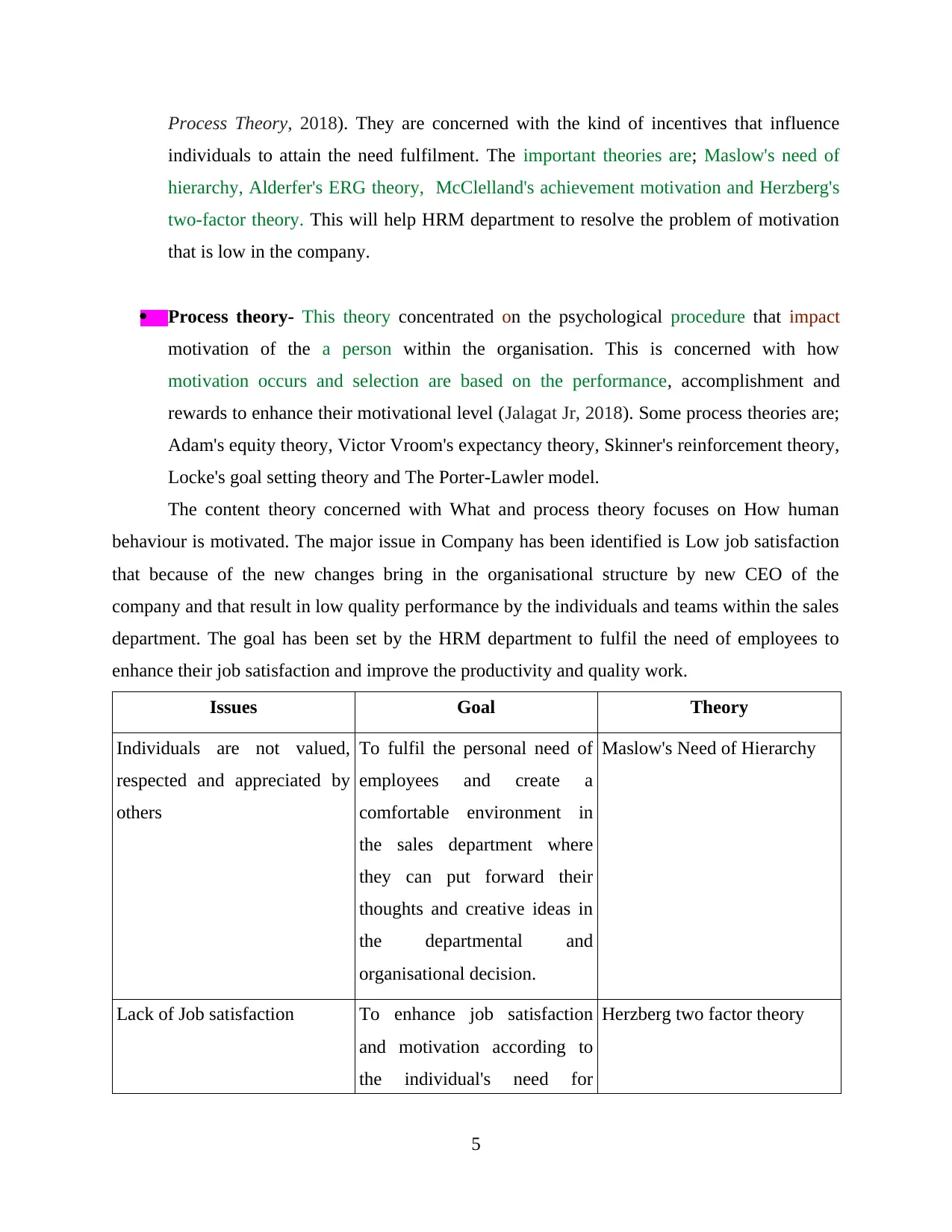
Process Theory, 2018). They are concerned with the kind of incentives that influence
individuals to attain the need fulfilment. The important theories are; Maslow's need of
hierarchy, Alderfer's ERG theory, McClelland's achievement motivation and Herzberg's
two-factor theory. This will help HRM department to resolve the problem of motivation
that is low in the company.
Process theory- This theory concentrated on the psychological procedure that impact
motivation of the a person within the organisation. This is concerned with how
motivation occurs and selection are based on the performance, accomplishment and
rewards to enhance their motivational level (Jalagat Jr, 2018). Some process theories are;
Adam's equity theory, Victor Vroom's expectancy theory, Skinner's reinforcement theory,
Locke's goal setting theory and The Porter-Lawler model.
The content theory concerned with What and process theory focuses on How human
behaviour is motivated. The major issue in Company has been identified is Low job satisfaction
that because of the new changes bring in the organisational structure by new CEO of the
company and that result in low quality performance by the individuals and teams within the sales
department. The goal has been set by the HRM department to fulfil the need of employees to
enhance their job satisfaction and improve the productivity and quality work.
Issues Goal Theory
Individuals are not valued,
respected and appreciated by
others
To fulfil the personal need of
employees and create a
comfortable environment in
the sales department where
they can put forward their
thoughts and creative ideas in
the departmental and
organisational decision.
Maslow's Need of Hierarchy
Lack of Job satisfaction To enhance job satisfaction
and motivation according to
the individual's need for
Herzberg two factor theory
5
individuals to attain the need fulfilment. The important theories are; Maslow's need of
hierarchy, Alderfer's ERG theory, McClelland's achievement motivation and Herzberg's
two-factor theory. This will help HRM department to resolve the problem of motivation
that is low in the company.
Process theory- This theory concentrated on the psychological procedure that impact
motivation of the a person within the organisation. This is concerned with how
motivation occurs and selection are based on the performance, accomplishment and
rewards to enhance their motivational level (Jalagat Jr, 2018). Some process theories are;
Adam's equity theory, Victor Vroom's expectancy theory, Skinner's reinforcement theory,
Locke's goal setting theory and The Porter-Lawler model.
The content theory concerned with What and process theory focuses on How human
behaviour is motivated. The major issue in Company has been identified is Low job satisfaction
that because of the new changes bring in the organisational structure by new CEO of the
company and that result in low quality performance by the individuals and teams within the sales
department. The goal has been set by the HRM department to fulfil the need of employees to
enhance their job satisfaction and improve the productivity and quality work.
Issues Goal Theory
Individuals are not valued,
respected and appreciated by
others
To fulfil the personal need of
employees and create a
comfortable environment in
the sales department where
they can put forward their
thoughts and creative ideas in
the departmental and
organisational decision.
Maslow's Need of Hierarchy
Lack of Job satisfaction To enhance job satisfaction
and motivation according to
the individual's need for
Herzberg two factor theory
5
⊘ This is a preview!⊘
Do you want full access?
Subscribe today to unlock all pages.
Trusted by 1+ million students worldwide
personal growth in the sales
department (Ritchie, 2018).
Low quality of work and
performance
To make the individual in the
sales department believe that
more effort in working hard
will result in better
performance.
Vroom's expectancy theory
There are various reason of arising these issues within the sales department in Company.
To change the issues in the goal, some motivational theories can be used. For example; more
control has been introduced by the CEO of the company and as per the new policy and his power
of position and employee's decisions does not matter in the organisational structure that results in
individuals are feeling less valuable and the lack of appreciation results in low morale within the
workforce (Kitchin, 2017). To enhance their motivation the Human Resource Management team
evaluate and decide to implement the Maslow's need of hierarchy that help them in fulfilling the
self-esteem needs that change the environment and motivate employees to be independent.
Along with it the major issue has been seen in the sales department that individuals are
not satisfied with their job. Along with this issue, company have to face many other issues such
as; Low productivity, unable to achieve the goal, decrease in sales, etc. For resolving this issue,
the HRM department has been selected the Herzberg Two-factor motivational theory that
improve job satisfaction amongst the individuals by make changes in the working environment
and conditions and by enhance the safety and security. Hygiene factor help them to make sure
that an individual is not dissatisfied and motivation factor help in motivate the employees to
higher performance. The HRM department will create a positive environment by aware people
not to criticise and respect each other as well as promote team work.
The third major issue was low quality in work performance of employees that can be
resolve by Vroom's Expectancy theory (Osabiya, 2015). As this theory aims to enhance self-
efficacy and self-related abilities of the individual. In implementation of all the theories, Leader
of Company plays and essential role to motivate the employees and to provide them direction to
achieve the organisational goal with their personal objectives. The theories will implement in the
6
department (Ritchie, 2018).
Low quality of work and
performance
To make the individual in the
sales department believe that
more effort in working hard
will result in better
performance.
Vroom's expectancy theory
There are various reason of arising these issues within the sales department in Company.
To change the issues in the goal, some motivational theories can be used. For example; more
control has been introduced by the CEO of the company and as per the new policy and his power
of position and employee's decisions does not matter in the organisational structure that results in
individuals are feeling less valuable and the lack of appreciation results in low morale within the
workforce (Kitchin, 2017). To enhance their motivation the Human Resource Management team
evaluate and decide to implement the Maslow's need of hierarchy that help them in fulfilling the
self-esteem needs that change the environment and motivate employees to be independent.
Along with it the major issue has been seen in the sales department that individuals are
not satisfied with their job. Along with this issue, company have to face many other issues such
as; Low productivity, unable to achieve the goal, decrease in sales, etc. For resolving this issue,
the HRM department has been selected the Herzberg Two-factor motivational theory that
improve job satisfaction amongst the individuals by make changes in the working environment
and conditions and by enhance the safety and security. Hygiene factor help them to make sure
that an individual is not dissatisfied and motivation factor help in motivate the employees to
higher performance. The HRM department will create a positive environment by aware people
not to criticise and respect each other as well as promote team work.
The third major issue was low quality in work performance of employees that can be
resolve by Vroom's Expectancy theory (Osabiya, 2015). As this theory aims to enhance self-
efficacy and self-related abilities of the individual. In implementation of all the theories, Leader
of Company plays and essential role to motivate the employees and to provide them direction to
achieve the organisational goal with their personal objectives. The theories will implement in the
6
Paraphrase This Document
Need a fresh take? Get an instant paraphrase of this document with our AI Paraphraser
company with leadership style and create positive environment that boost the morale of
employees.
Emotional Intelligence refers to the ability of people to manage and control the emotions.
It also includes the capability to control the emotions of other people. In other words, people may
also have capacity to influence the emotions of other people. There are various elements of
emotional intelligence such as motivation, self-awareness, social skills and empathy etc. It helps
to overcome the challenges, relieve stress, defuse conflict and communicate effectively etc.
Soft skills are very important for team as well as for manager. Soft skills like
communication skills, skill of working in team etc. are very important because it helps team
members to work effectively with supervisors and co-workers. It also helps to avoid internal
conflicts. Further, Manager should have some essential soft skills such as leadership, listening,
trustworthiness, delegation etc (Lee and Chelladurai, 2018). The skill of delegation helps to
delegate responsibilities to other team members. Communication skills help Manager to
effectively communicate instructions to subordinates.
Task leadership theory -
It says that leader of firm is motivated by completing tasks and concerned with depicting
role and responsibilities for employee's. Task oriented leaders develop procedures and policies,
inform employee's regarding these policies and procedures for determining the performance of
subordinates.
Relationship leadership theory -
The theory describes that a leader get motivated by interactions with other people. They
often acts as mentors to team members. Leader schedule time for communicating with
employee's and also include their feedback into decisions. These type of leaders make efforts to
make work experience of subordinates more enjoyable.
Psychodynamic approach of behaviour -
The theory includes various psychological theories that develops from ideas that people
are generally driven by unconscious motivations and relationships and these are generally the
result of experience they get in childhood. The theory includes the impact of childhood on
personality of adults (Barreto and Hogg, 2018). Further, it also innate the factors that motivate
the behaviour of people. One of the weakness of this theory is that, it is too deterministic. It
focuses on the roots of personality in childhood experience.
7
employees.
Emotional Intelligence refers to the ability of people to manage and control the emotions.
It also includes the capability to control the emotions of other people. In other words, people may
also have capacity to influence the emotions of other people. There are various elements of
emotional intelligence such as motivation, self-awareness, social skills and empathy etc. It helps
to overcome the challenges, relieve stress, defuse conflict and communicate effectively etc.
Soft skills are very important for team as well as for manager. Soft skills like
communication skills, skill of working in team etc. are very important because it helps team
members to work effectively with supervisors and co-workers. It also helps to avoid internal
conflicts. Further, Manager should have some essential soft skills such as leadership, listening,
trustworthiness, delegation etc (Lee and Chelladurai, 2018). The skill of delegation helps to
delegate responsibilities to other team members. Communication skills help Manager to
effectively communicate instructions to subordinates.
Task leadership theory -
It says that leader of firm is motivated by completing tasks and concerned with depicting
role and responsibilities for employee's. Task oriented leaders develop procedures and policies,
inform employee's regarding these policies and procedures for determining the performance of
subordinates.
Relationship leadership theory -
The theory describes that a leader get motivated by interactions with other people. They
often acts as mentors to team members. Leader schedule time for communicating with
employee's and also include their feedback into decisions. These type of leaders make efforts to
make work experience of subordinates more enjoyable.
Psychodynamic approach of behaviour -
The theory includes various psychological theories that develops from ideas that people
are generally driven by unconscious motivations and relationships and these are generally the
result of experience they get in childhood. The theory includes the impact of childhood on
personality of adults (Barreto and Hogg, 2018). Further, it also innate the factors that motivate
the behaviour of people. One of the weakness of this theory is that, it is too deterministic. It
focuses on the roots of personality in childhood experience.
7
TASK 3
P3. Effective team vs. In effective team
Team is a group of individual having complementary skills and are committed in
achieving a common goal by coordinating and communicating with each other. Two or more
than two individual come together with a common interest or objective and interact with each
other is called group.
Not all the teams are successful. Effective team has various characteristics. The size of
team is such that it is possible to achieve goals of team. Everyone is having clarity of team aim
and objectives. Team must have diverse points of view and all the members encourage to have
honest discussion. There should be fairness in decision-making. All the team members should
feel that their ideas are welcome.
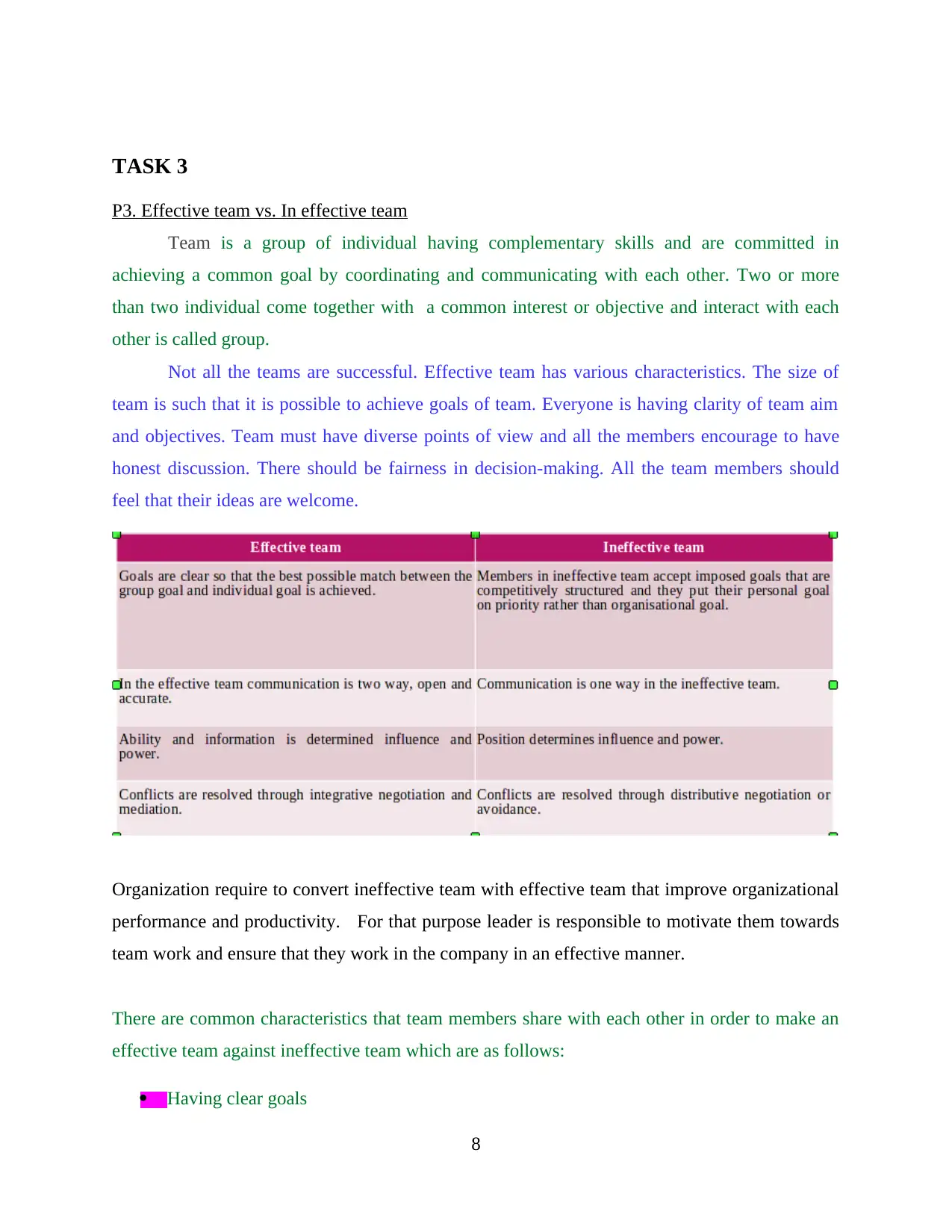
Organization require to convert ineffective team with effective team that improve organizational
performance and productivity. For that purpose leader is responsible to motivate them towards
team work and ensure that they work in the company in an effective manner.
There are common characteristics that team members share with each other in order to make an
effective team against ineffective team which are as follows:
Having clear goals
8
P3. Effective team vs. In effective team
Team is a group of individual having complementary skills and are committed in
achieving a common goal by coordinating and communicating with each other. Two or more
than two individual come together with a common interest or objective and interact with each
other is called group.
Not all the teams are successful. Effective team has various characteristics. The size of
team is such that it is possible to achieve goals of team. Everyone is having clarity of team aim
and objectives. Team must have diverse points of view and all the members encourage to have
honest discussion. There should be fairness in decision-making. All the team members should
feel that their ideas are welcome.
Organization require to convert ineffective team with effective team that improve organizational
performance and productivity. For that purpose leader is responsible to motivate them towards
team work and ensure that they work in the company in an effective manner.
There are common characteristics that team members share with each other in order to make an
effective team against ineffective team which are as follows:
Having clear goals
8
⊘ This is a preview!⊘
Do you want full access?
Subscribe today to unlock all pages.
Trusted by 1+ million students worldwide

1 out of 15


Related Documents


Your All-in-One AI-Powered Toolkit for Academic Success.
+13062052269
info@desklib.com
Available 24*7 on WhatsApp / Email
![[object Object]](/_next/static/media/star-bottom.7253800d.svg)
Unlock your academic potential
Copyright © 2020–2026 A2Z Services. All Rights Reserved. Developed and managed by ZUCOL.