BEHS 364: Evaluating Understanding of Alcohol Use Disorder Concepts

Verified

Added on  2023/06/10

|3
|694
|149
Homework Assignment
AI Summary
This assignment for BEHS 364 consists of true/false and multiple-choice questions designed to assess understanding of Alcohol Use Disorder (AUD). The true/false section covers topics such as gender differences in alcohol use disorders, relapse, impaired control, binge drinking definitions, differences between alcohol abuse and dependence, the definition of Alcohol Use Disorder, ethanol metabolism, standard drink guidelines, underage drinking, and salience. The multiple-choice section includes questions on BAC levels and DWI, alcohol dependence diagnosis criteria, Prochaska's Stages of Change, protective factors like resiliency, risk factors such as low neighborhood attachment, medications for treating alcoholism, and research diagnostic interviews like the Michigan Alcoholism Screening Test (MAST). Desklib provides access to this and other solved assignments to support student learning.
Document Page
Running head: BEHS 364
BEHS 364
NAME:
LECTURE:
INSTITUTION:
tabler-icon-diamond-filled.svg

Paraphrase This Document

Need a fresh take? Get an instant paraphrase of this document with our AI Paraphraser
Document Page
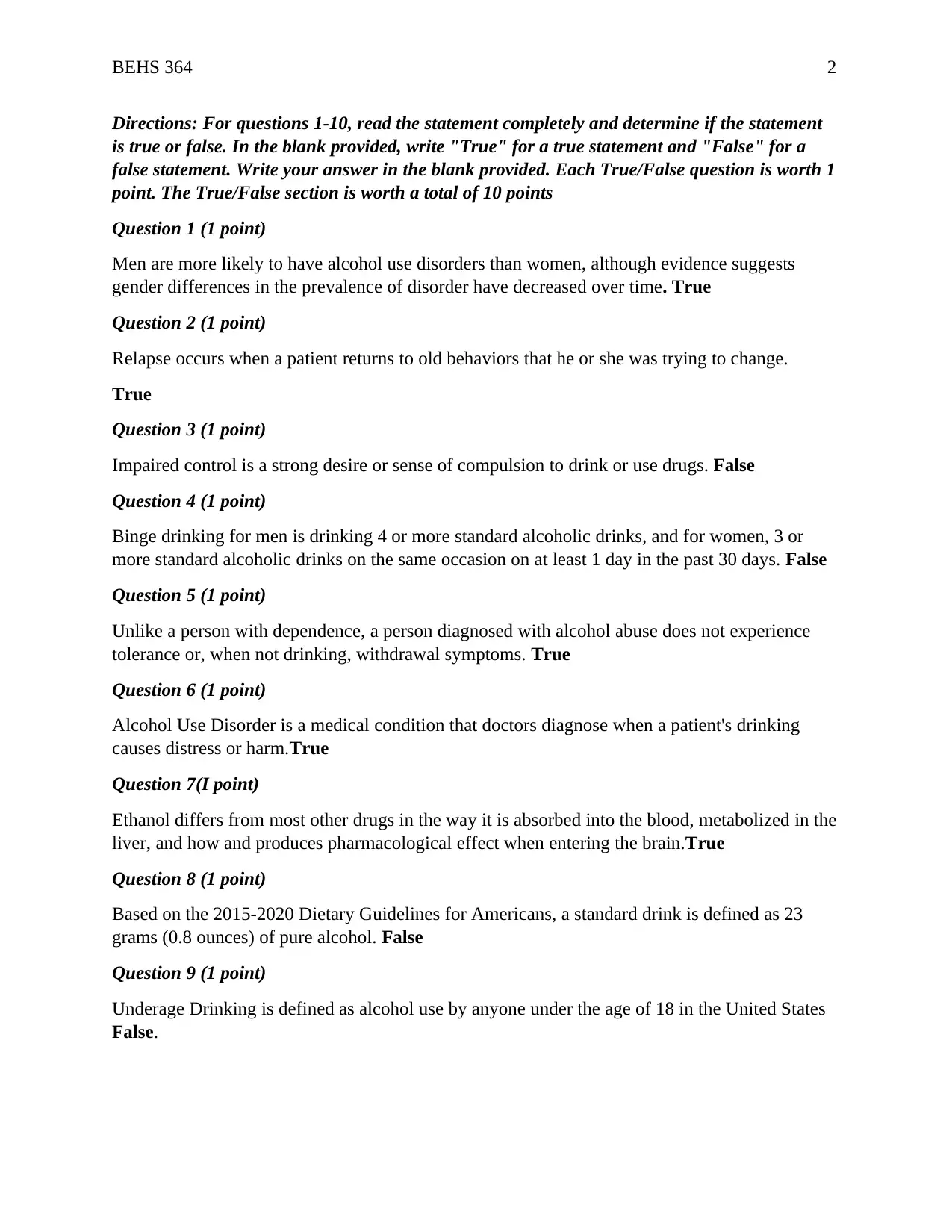
BEHS 364 2
Directions: For questions 1-10, read the statement completely and determine if the statement
is true or false. In the blank provided, write "True" for a true statement and "False" for a
false statement. Write your answer in the blank provided. Each True/False question is worth 1
point. The True/False section is worth a total of 10 points
Question 1 (1 point)
Men are more likely to have alcohol use disorders than women, although evidence suggests
gender differences in the prevalence of disorder have decreased over time. True
Question 2 (1 point)
Relapse occurs when a patient returns to old behaviors that he or she was trying to change.
True
Question 3 (1 point)
Impaired control is a strong desire or sense of compulsion to drink or use drugs. False
Question 4 (1 point)
Binge drinking for men is drinking 4 or more standard alcoholic drinks, and for women, 3 or
more standard alcoholic drinks on the same occasion on at least 1 day in the past 30 days. False
Question 5 (1 point)
Unlike a person with dependence, a person diagnosed with alcohol abuse does not experience
tolerance or, when not drinking, withdrawal symptoms. True
Question 6 (1 point)
Alcohol Use Disorder is a medical condition that doctors diagnose when a patient's drinking
causes distress or harm.True
Question 7(I point)
Ethanol differs from most other drugs in the way it is absorbed into the blood, metabolized in the
liver, and how and produces pharmacological effect when entering the brain.True
Question 8 (1 point)
Based on the 2015-2020 Dietary Guidelines for Americans, a standard drink is defined as 23
grams (0.8 ounces) of pure alcohol. False
Question 9 (1 point)
Underage Drinking is defined as alcohol use by anyone under the age of 18 in the United States
False.
Document Page
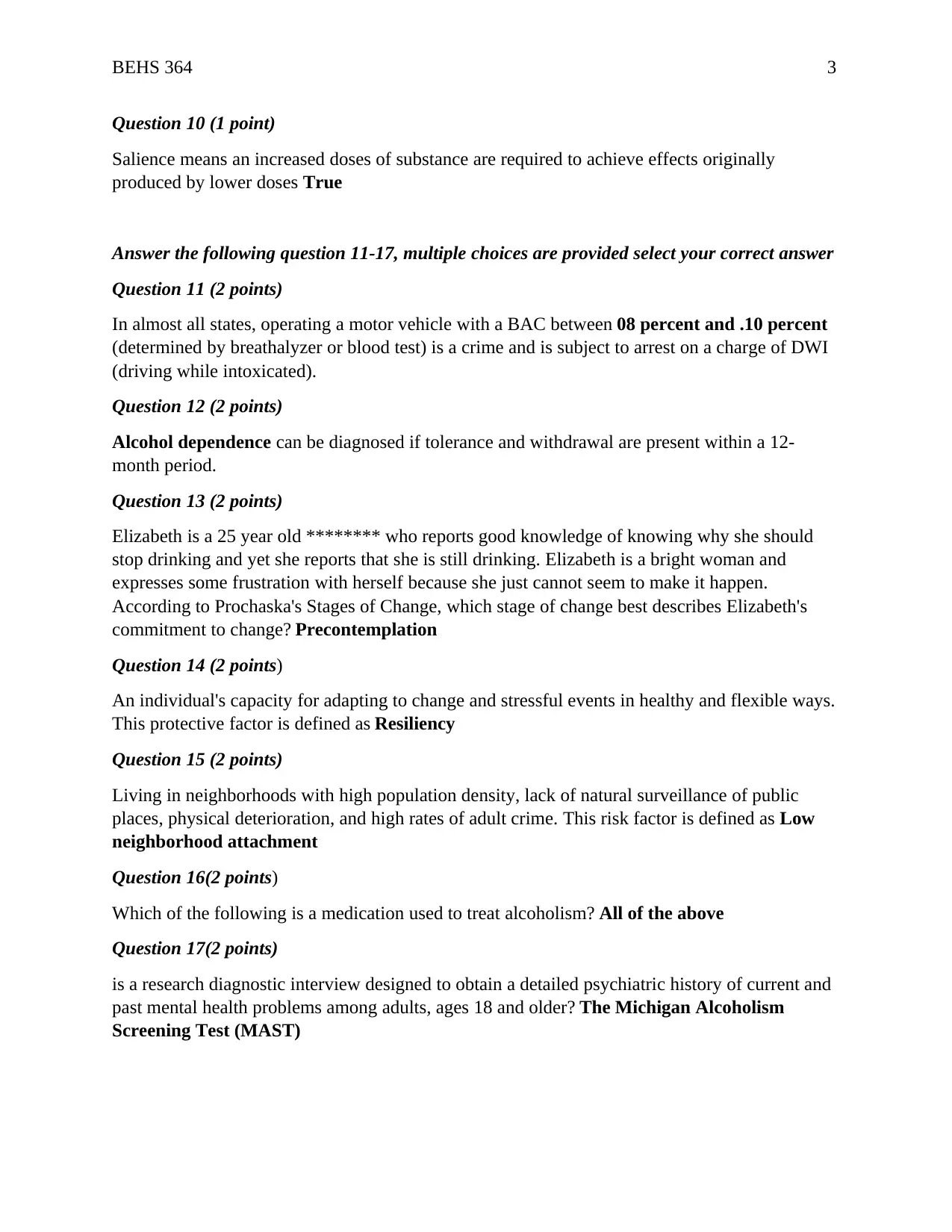
BEHS 364 3
Question 10 (1 point)
Salience means an increased doses of substance are required to achieve effects originally
produced by lower doses True
Answer the following question 11-17, multiple choices are provided select your correct answer
Question 11 (2 points)
In almost all states, operating a motor vehicle with a BAC between 08 percent and .10 percent
(determined by breathalyzer or blood test) is a crime and is subject to arrest on a charge of DWI
(driving while intoxicated).
Question 12 (2 points)
Alcohol dependence can be diagnosed if tolerance and withdrawal are present within a 12-
month period.
Question 13 (2 points)
Elizabeth is a 25 year old ******** who reports good knowledge of knowing why she should
stop drinking and yet she reports that she is still drinking. Elizabeth is a bright woman and
expresses some frustration with herself because she just cannot seem to make it happen.
According to Prochaska's Stages of Change, which stage of change best describes Elizabeth's
commitment to change? Precontemplation
Question 14 (2 points)
An individual's capacity for adapting to change and stressful events in healthy and flexible ways.
This protective factor is defined as Resiliency
Question 15 (2 points)
Living in neighborhoods with high population density, lack of natural surveillance of public
places, physical deterioration, and high rates of adult crime. This risk factor is defined as Low
neighborhood attachment
Question 16(2 points)
Which of the following is a medication used to treat alcoholism? All of the above
Question 17(2 points)
is a research diagnostic interview designed to obtain a detailed psychiatric history of current and
past mental health problems among adults, ages 18 and older? The Michigan Alcoholism
Screening Test (MAST)
chevron_up_icon
1 out of 3
circle_padding
hide_on_mobile
zoom_out_icon
[object Object]