African American History: Restrictions and Beliefs in the 1800s

Verified

Added on  2023/04/21

|4
|520
|97
Essay
AI Summary
This essay examines how restrictions and beliefs shaped American society, particularly concerning African Americans, in the latter half of the 1800s. It highlights the shift in attitudes towards slavery, leading to the 13th Amendment and a more inclusive society. The essay discusses how the abolishment of slavery impacted African Americans, protecting them from former slave owners but also exposing them to continued racism and discrimination. It also outlines key historical events and figures, such as the Stono Rebellion, Nat Turner, Sojourner Truth, and Frederick Douglas, who significantly contributed to the abolitionist movement and the fight for equal rights, ultimately fostering collaboration between African Americans and white Americans and promoting a multicultural American society. Desklib offers a variety of resources for students, including solved assignments and past papers.
Document Page
Running head: HISTORY
African American History
Name of the Student
Name of the University
Author Note
tabler-icon-diamond-filled.svg

Paraphrase This Document

Need a fresh take? Get an instant paraphrase of this document with our AI Paraphraser
Document Page
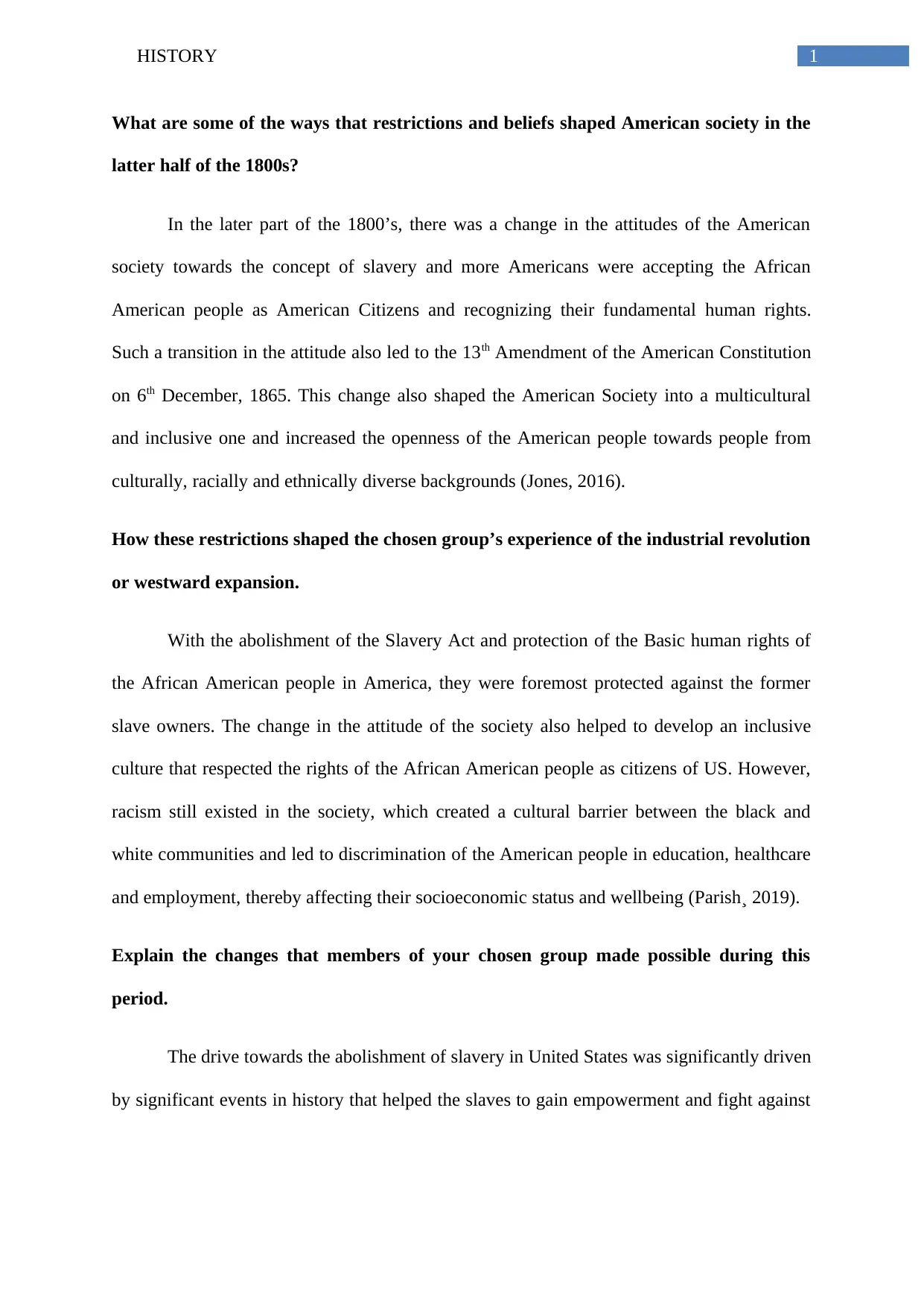
1HISTORY
What are some of the ways that restrictions and beliefs shaped American society in the
latter half of the 1800s?
In the later part of the 1800’s, there was a change in the attitudes of the American
society towards the concept of slavery and more Americans were accepting the African
American people as American Citizens and recognizing their fundamental human rights.
Such a transition in the attitude also led to the 13th Amendment of the American Constitution
on 6th December, 1865. This change also shaped the American Society into a multicultural
and inclusive one and increased the openness of the American people towards people from
culturally, racially and ethnically diverse backgrounds (Jones, 2016).
How these restrictions shaped the chosen group’s experience of the industrial revolution
or westward expansion.
With the abolishment of the Slavery Act and protection of the Basic human rights of
the African American people in America, they were foremost protected against the former
slave owners. The change in the attitude of the society also helped to develop an inclusive
culture that respected the rights of the African American people as citizens of US. However,
racism still existed in the society, which created a cultural barrier between the black and
white communities and led to discrimination of the American people in education, healthcare
and employment, thereby affecting their socioeconomic status and wellbeing (Parish¸ 2019).
Explain the changes that members of your chosen group made possible during this
period.
The drive towards the abolishment of slavery in United States was significantly driven
by significant events in history that helped the slaves to gain empowerment and fight against
Document Page
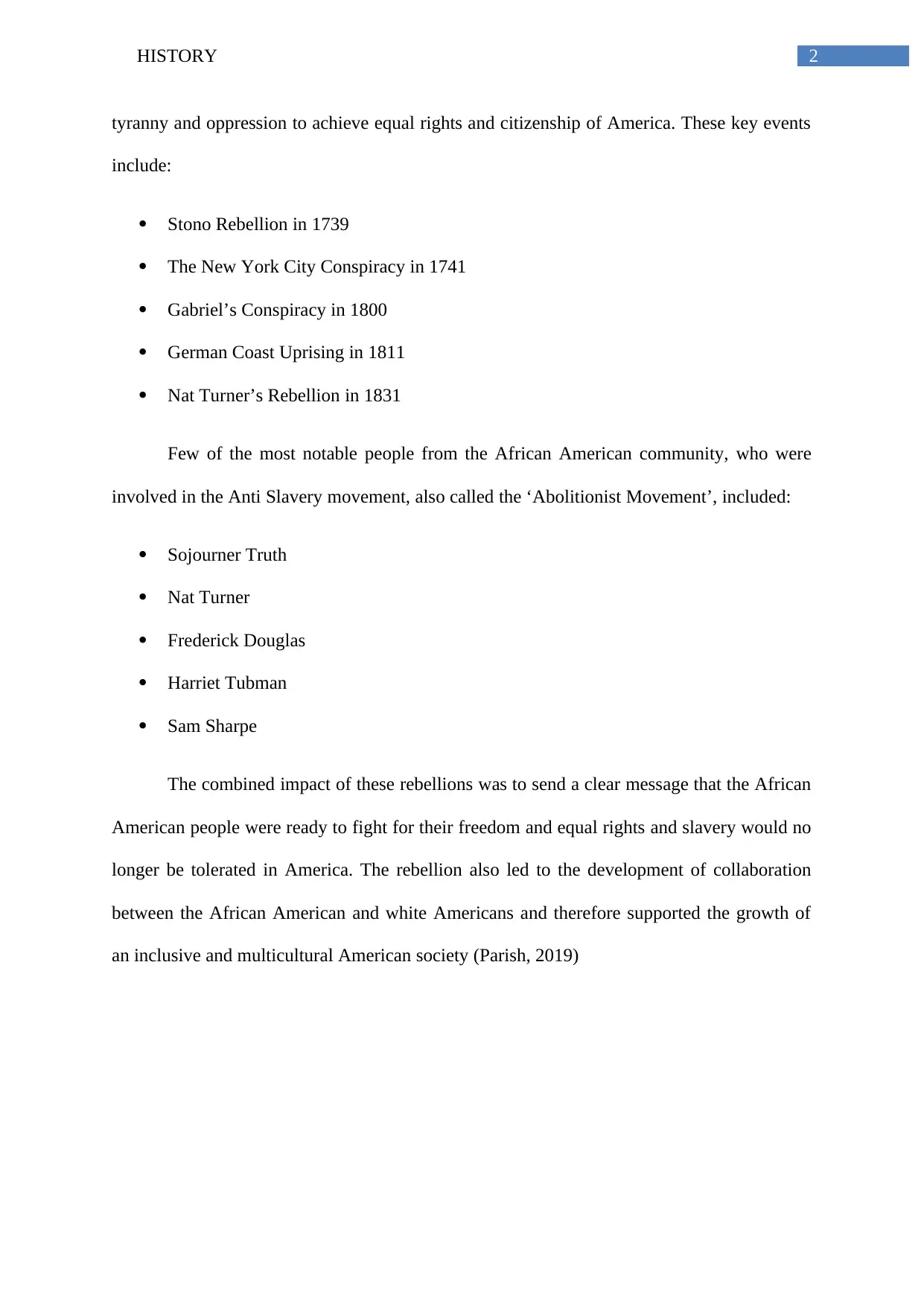
2HISTORY
tyranny and oppression to achieve equal rights and citizenship of America. These key events
include:
Stono Rebellion in 1739
The New York City Conspiracy in 1741
Gabriel’s Conspiracy in 1800
German Coast Uprising in 1811
Nat Turner’s Rebellion in 1831
Few of the most notable people from the African American community, who were
involved in the Anti Slavery movement, also called the ‘Abolitionist Movement’, included:
Sojourner Truth
Nat Turner
Frederick Douglas
Harriet Tubman
Sam Sharpe
The combined impact of these rebellions was to send a clear message that the African
American people were ready to fight for their freedom and equal rights and slavery would no
longer be tolerated in America. The rebellion also led to the development of collaboration
between the African American and white Americans and therefore supported the growth of
an inclusive and multicultural American society (Parish, 2019)
Document Page
3HISTORY
References:
Jones, D. E. (2016). The Unknown Legacy of the 13th Amendment.
Parish, P. J. (2018). Slavery: history and historians. Routledge.
chevron_up_icon
1 out of 4
circle_padding
hide_on_mobile
zoom_out_icon
[object Object]