Comprehensive Retail Strategy Report: Bell Canada, MGMT3058 Project
VerifiedAdded on 2023/01/19
|15
|4169
|44
Report
AI Summary
This report provides a comprehensive analysis of Bell Canada's retail strategy, fulfilling the requirements of a MGMT3058 final project. It begins by defining Bell Canada's business mission, analyzing its current state, future goals, and core capabilities. The report then evaluates the company's performance objectives, including financial metrics like GMROI and identifies key performance indicators across input, output, and productivity categories. The merchandise flow is examined, with recommendations for improvement. Category management is explored, focusing on the electrical goods category. The branding strategy, including national and private label brands, is assessed, along with pricing strategies and customer loyalty programs. The report concludes with a summary of findings and recommendations to enhance Bell Canada's retail strategy and improve its market position. The report uses information from the company's annual report and other sources to support its claims and analysis.

BELL CANADA
Name of the Author-
[DATE]
Name of the Author-
[DATE]

Paraphrase This Document
Need a fresh take? Get an instant paraphrase of this document with our AI Paraphraser
Table of Contents
1. Business Mission...........................................................................................................................3
a. What business is Bell Canada in................................................................................................3
b. What should business be in the future........................................................................................3
c. What are our capabilities...........................................................................................................3
2. Performance objectives..................................................................................................................4
a. How is the business performing currently? Provide three examples that support your
statement..........................................................................................................................................4
b. Gross Margin Return on Inventory Investment (GMORI).........................................................4
c. Identify two performance measures under each of the following three categories and explain
why the measures would be appropriate for the company:................................................................6
3. Merchandise Flow.........................................................................................................................7
a. Merchandise flow for the company............................................................................................7
b. Recommendation about changing the merchandise flow...............................................................7
4. Category Management...................................................................................................................7
a. Purpose of this section...............................................................................................................7
b. Type of merchandise does this category represent.....................................................................8
c. Category in its’ life cycle...........................................................................................................8
d. Assortment plan for the category...............................................................................................8
5. Branding strategy...........................................................................................................................9
a. Mix of national brands and private label brands sold by the company.......................................9
b. Determine if Company should expand or contract the number of private label brands available
9
c. Private brand strategy the company...............................................................................................9
6. Pricing Strategies...........................................................................................................................9
c. What price adjustments does the company engage in?............................................................10
d. Make two (2) recommendation on possible price adjustments.................................................10
e. What pricing strategy is the company following?....................................................................11
f. Make one (1) recommendation on changing the pricing strategy used....................................11
g. How does the company currently use pricing (apart from pricing adjustments) to stimulate
sales?...............................................................................................................................................11
h. Make two (2) recommendation on how the company can stimulate sales................................11
7. Customer Loyalty........................................................................................................................11
a. CRM process, how is the company getting customer loyalty...................................................11
1. Business Mission...........................................................................................................................3
a. What business is Bell Canada in................................................................................................3
b. What should business be in the future........................................................................................3
c. What are our capabilities...........................................................................................................3
2. Performance objectives..................................................................................................................4
a. How is the business performing currently? Provide three examples that support your
statement..........................................................................................................................................4
b. Gross Margin Return on Inventory Investment (GMORI).........................................................4
c. Identify two performance measures under each of the following three categories and explain
why the measures would be appropriate for the company:................................................................6
3. Merchandise Flow.........................................................................................................................7
a. Merchandise flow for the company............................................................................................7
b. Recommendation about changing the merchandise flow...............................................................7
4. Category Management...................................................................................................................7
a. Purpose of this section...............................................................................................................7
b. Type of merchandise does this category represent.....................................................................8
c. Category in its’ life cycle...........................................................................................................8
d. Assortment plan for the category...............................................................................................8
5. Branding strategy...........................................................................................................................9
a. Mix of national brands and private label brands sold by the company.......................................9
b. Determine if Company should expand or contract the number of private label brands available
9
c. Private brand strategy the company...............................................................................................9
6. Pricing Strategies...........................................................................................................................9
c. What price adjustments does the company engage in?............................................................10
d. Make two (2) recommendation on possible price adjustments.................................................10
e. What pricing strategy is the company following?....................................................................11
f. Make one (1) recommendation on changing the pricing strategy used....................................11
g. How does the company currently use pricing (apart from pricing adjustments) to stimulate
sales?...............................................................................................................................................11
h. Make two (2) recommendation on how the company can stimulate sales................................11
7. Customer Loyalty........................................................................................................................11
a. CRM process, how is the company getting customer loyalty...................................................11
b. Recommendations on how the company can increase customer loyalty..................................12
8. Summary.....................................................................................................................................12
9. References...................................................................................................................................13
8. Summary.....................................................................................................................................12
9. References...................................................................................................................................13
⊘ This is a preview!⊘
Do you want full access?
Subscribe today to unlock all pages.

Trusted by 1+ million students worldwide
1. Business Mission
The only mission of the Bell Canada is to be recognised by the clients and customers as the
leading communication company of Canada
a. What business is Bell Canada in
Bell Canada (Bell) is a telecommunication company of Canada, the headquarters of the
company is in Montreal, Quebec, Canada. Bell is Canada’s one of the most powerful and
important companies. In the year 1975, it was the fifth largest company of Canada. Bell
commitment is to delight their clients with customer support, services and products. Besides,
Bell also promises to provide proper description of the charges and rates, and also of the
terms and conditions for the services (Mohd, Idris, & Momani, 2013).
b. What should business be in the future
Bell is growing its content across various media properties, and last January they announced
a long-term partnership of their brand with Bloomberg Media in order to develop Canada’s
one of the leading multi-platform for business news brand: BNN Bloomberg. This new
network targets the business decision makers of Canada. In order to maintain the high
standards of the company, Bell follows the strategy of Diversity. There first priority in future
will be on the broadband side, they are putting quite a significant amount of concentration on
it, and they are spending a major part of capital on it. Apart from this, the company is
investing quite good amount in the fibre internet, and currently in Mississauga, Bell is trying
its wireless network and is hoping to achieve the speed of 1Gbps soon. According to BCE
also, Bell Canada is now recognised for competitive future (Johnston, and Bate, (2013). Bell
is investing where there is growth. According to the statement of CEO and president of
national carrier Bell, George Cope, the company will be investing over $20 billion CAD
within the coming 5 years across all over the footprints of telecom service providers, and
within those five years, the company will definitely cover 4.5 million homes and businesses
with fibre internet (Rashid. & Ghose, 2015).
c. What are our capabilities
The only mission of the Bell Canada is to be recognised by the clients and customers as the
leading communication company of Canada
a. What business is Bell Canada in
Bell Canada (Bell) is a telecommunication company of Canada, the headquarters of the
company is in Montreal, Quebec, Canada. Bell is Canada’s one of the most powerful and
important companies. In the year 1975, it was the fifth largest company of Canada. Bell
commitment is to delight their clients with customer support, services and products. Besides,
Bell also promises to provide proper description of the charges and rates, and also of the
terms and conditions for the services (Mohd, Idris, & Momani, 2013).
b. What should business be in the future
Bell is growing its content across various media properties, and last January they announced
a long-term partnership of their brand with Bloomberg Media in order to develop Canada’s
one of the leading multi-platform for business news brand: BNN Bloomberg. This new
network targets the business decision makers of Canada. In order to maintain the high
standards of the company, Bell follows the strategy of Diversity. There first priority in future
will be on the broadband side, they are putting quite a significant amount of concentration on
it, and they are spending a major part of capital on it. Apart from this, the company is
investing quite good amount in the fibre internet, and currently in Mississauga, Bell is trying
its wireless network and is hoping to achieve the speed of 1Gbps soon. According to BCE
also, Bell Canada is now recognised for competitive future (Johnston, and Bate, (2013). Bell
is investing where there is growth. According to the statement of CEO and president of
national carrier Bell, George Cope, the company will be investing over $20 billion CAD
within the coming 5 years across all over the footprints of telecom service providers, and
within those five years, the company will definitely cover 4.5 million homes and businesses
with fibre internet (Rashid. & Ghose, 2015).
c. What are our capabilities
Paraphrase This Document
Need a fresh take? Get an instant paraphrase of this document with our AI Paraphraser
Company has developed its core competency in the product differentiation strategy
and offering best quality network services to clients. Company’s net earnings was increased
by 3.1% i.e. up to $709 million. This company has focused on using the fibre lines, and
because of the fibre lines, the company is getting quite a good growth and developed
effective brand image in market. Company has used loyalty card approach and advance
technologies to promote its business. Therefore, the branding strategy of company would be
creating the product differentiation core competency in market.
2. Performance objectives
a. How is the business performing currently? Provide three examples that support your
statement
Bell Canada was selected as Canada’s one of the top hundred employers and
Montreal’s top employer, so Bell has achieved a lot and is still working very hard to perform
best in its field. There are several reasons behind this success, like the company cultivates a
culture of recognition via many initiatives including the President’s Wallet program to the
Bravo awards; it provides the employees with various on-site and local amenities, fitness
facilities and nutritionists as well and various other services like physiotherapist and massage
therapists. According to the results of 2018 BCE report, company’s net earnings was
increased by 3.1% i.e. up to $709 million. The wireless revenue of the company was
increased by 3.6% and is still growing continuously because of the fibre lines, and because of
the fibre lines, the company is getting quite a good growth. The service revenue growth was
mainly driven by post-paid subscriber rate, total 101,707 customers were added (Schmidt,
Spann, & Zeithammer, 2014).
b. Gross Margin Return on Inventory Investment (GMORI).
From data in the financial statements provided with the Annual Report calculate a GMROI
for the company (Solomon, 2014).
The gross margin return on inventory management has increased by 22% since last three year
which reflected that company has improved its capital efficiency in its business and blocked
less funds in the process.
and offering best quality network services to clients. Company’s net earnings was increased
by 3.1% i.e. up to $709 million. This company has focused on using the fibre lines, and
because of the fibre lines, the company is getting quite a good growth and developed
effective brand image in market. Company has used loyalty card approach and advance
technologies to promote its business. Therefore, the branding strategy of company would be
creating the product differentiation core competency in market.
2. Performance objectives
a. How is the business performing currently? Provide three examples that support your
statement
Bell Canada was selected as Canada’s one of the top hundred employers and
Montreal’s top employer, so Bell has achieved a lot and is still working very hard to perform
best in its field. There are several reasons behind this success, like the company cultivates a
culture of recognition via many initiatives including the President’s Wallet program to the
Bravo awards; it provides the employees with various on-site and local amenities, fitness
facilities and nutritionists as well and various other services like physiotherapist and massage
therapists. According to the results of 2018 BCE report, company’s net earnings was
increased by 3.1% i.e. up to $709 million. The wireless revenue of the company was
increased by 3.6% and is still growing continuously because of the fibre lines, and because of
the fibre lines, the company is getting quite a good growth. The service revenue growth was
mainly driven by post-paid subscriber rate, total 101,707 customers were added (Schmidt,
Spann, & Zeithammer, 2014).
b. Gross Margin Return on Inventory Investment (GMORI).
From data in the financial statements provided with the Annual Report calculate a GMROI
for the company (Solomon, 2014).
The gross margin return on inventory management has increased by 22% since last three year
which reflected that company has improved its capital efficiency in its business and blocked
less funds in the process.
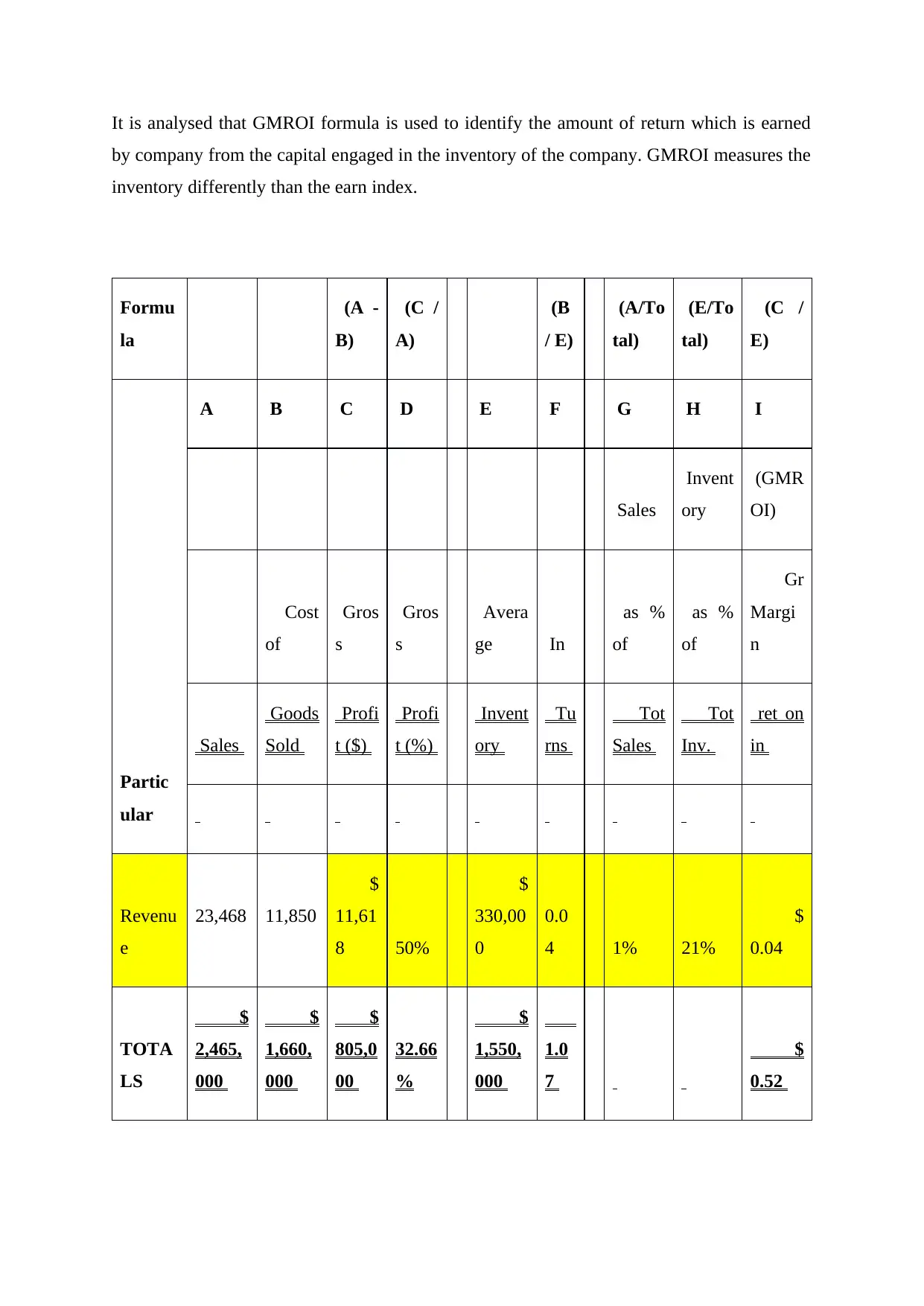
It is analysed that GMROI formula is used to identify the amount of return which is earned
by company from the capital engaged in the inventory of the company. GMROI measures the
inventory differently than the earn index.
Formu
la
(A -
B)
(C /
A)
(B
/ E)
(A/To
tal)
(E/To
tal)
(C /
E)
Partic
ular
A B C D E F G H I
Sales
Invent
ory
(GMR
OI)
Cost
of
Gros
s
Gros
s
Avera
ge In
as %
of
as %
of
Gr
Margi
n
Sales
Goods
Sold
Profi
t ($)
Profi
t (%)
Invent
ory
Tu
rns
Tot
Sales
Tot
Inv.
ret on
in
Revenu
e
23,468 11,850
$
11,61
8 50%
$
330,00
0
0.0
4 1% 21%
$
0.04
TOTA
LS
$
2,465,
000
$
1,660,
000
$
805,0
00
32.66
%
$
1,550,
000
1.0
7
$
0.52
by company from the capital engaged in the inventory of the company. GMROI measures the
inventory differently than the earn index.
Formu
la
(A -
B)
(C /
A)
(B
/ E)
(A/To
tal)
(E/To
tal)
(C /
E)
Partic
ular
A B C D E F G H I
Sales
Invent
ory
(GMR
OI)
Cost
of
Gros
s
Gros
s
Avera
ge In
as %
of
as %
of
Gr
Margi
n
Sales
Goods
Sold
Profi
t ($)
Profi
t (%)
Invent
ory
Tu
rns
Tot
Sales
Tot
Inv.
ret on
in
Revenu
e
23,468 11,850
$
11,61
8 50%
$
330,00
0
0.0
4 1% 21%
$
0.04
TOTA
LS
$
2,465,
000
$
1,660,
000
$
805,0
00
32.66
%
$
1,550,
000
1.0
7
$
0.52
⊘ This is a preview!⊘
Do you want full access?
Subscribe today to unlock all pages.
Trusted by 1+ million students worldwide
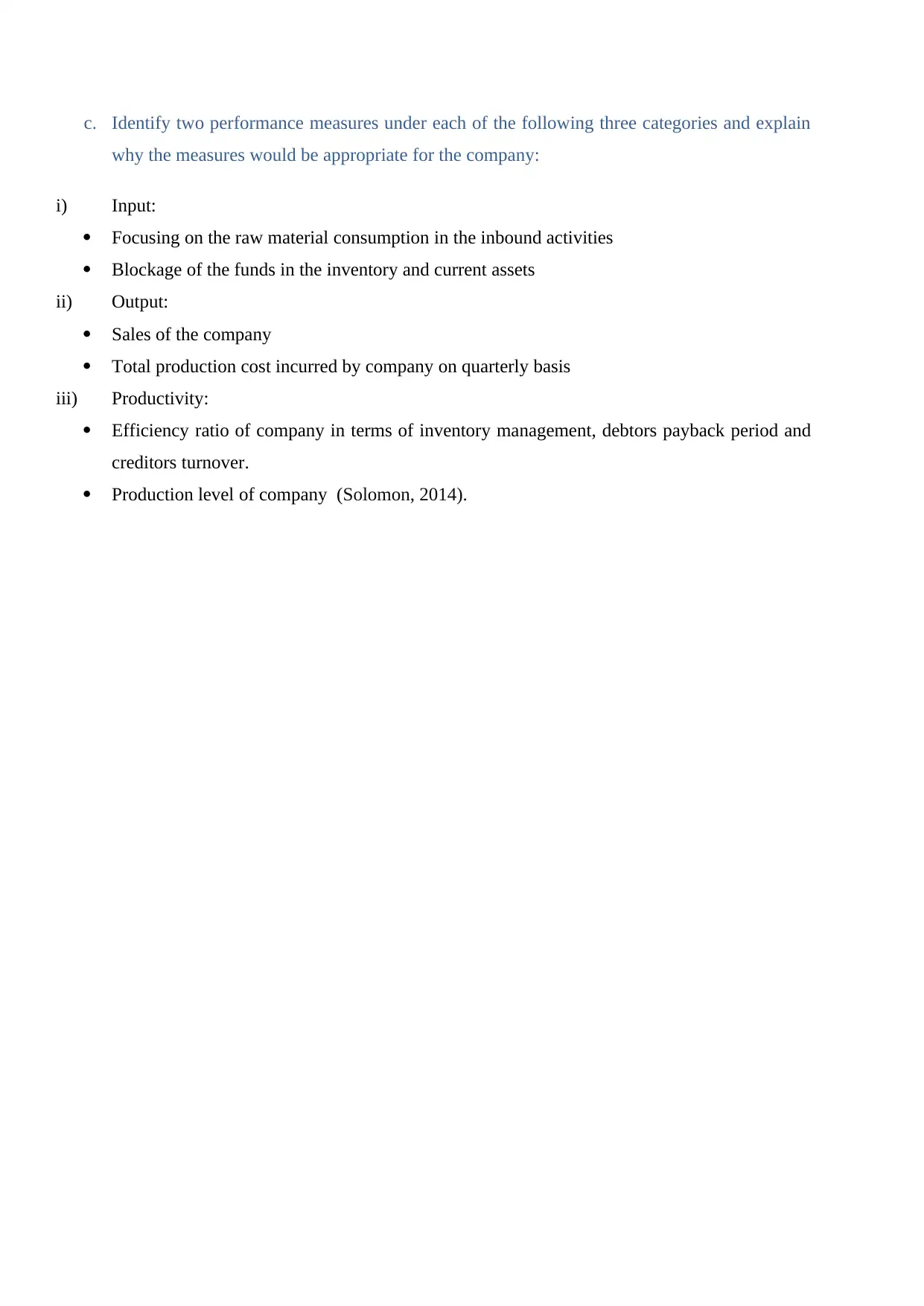
c. Identify two performance measures under each of the following three categories and explain
why the measures would be appropriate for the company:
i) Input:
Focusing on the raw material consumption in the inbound activities
Blockage of the funds in the inventory and current assets
ii) Output:
Sales of the company
Total production cost incurred by company on quarterly basis
iii) Productivity:
Efficiency ratio of company in terms of inventory management, debtors payback period and
creditors turnover.
Production level of company (Solomon, 2014).
why the measures would be appropriate for the company:
i) Input:
Focusing on the raw material consumption in the inbound activities
Blockage of the funds in the inventory and current assets
ii) Output:
Sales of the company
Total production cost incurred by company on quarterly basis
iii) Productivity:
Efficiency ratio of company in terms of inventory management, debtors payback period and
creditors turnover.
Production level of company (Solomon, 2014).
Paraphrase This Document
Need a fresh take? Get an instant paraphrase of this document with our AI Paraphraser
3. Merchandise Flow
a. Merchandise flow for the company
It is analysed that merchandise flow is accompanied with the practice and undertaken
activities which are used to display and selling products to clients.
The merchandise flow of the company is supported with the inbound and outbound activities
of the business sales which company undertake to sell its products and services to clients. In
the merchandise flow of the company, the procedure to procured goods by retailer’s vis-à-vis
the annual and seasonal planning and in-season merchandise management process is taken
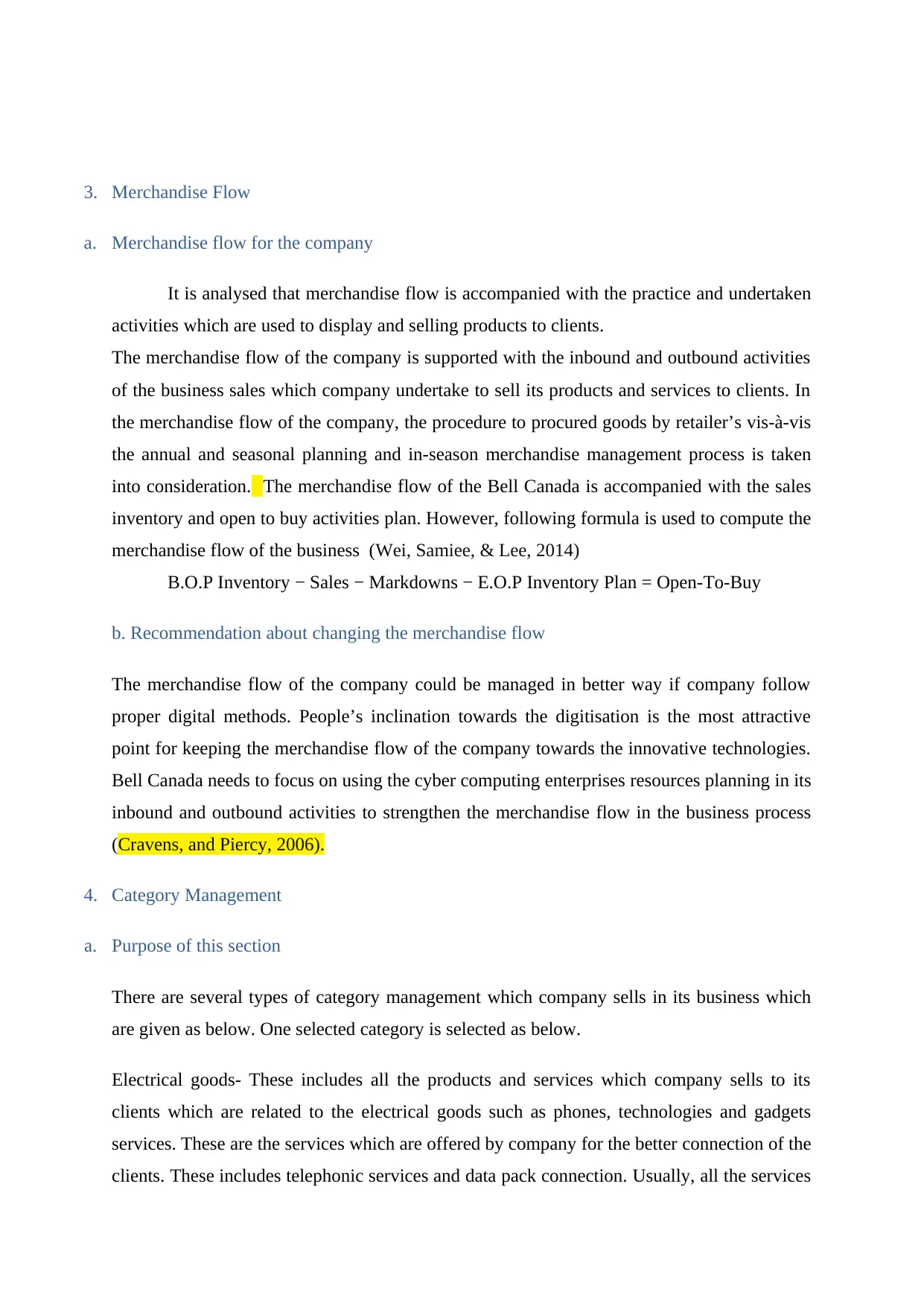
into consideration. The merchandise flow of the Bell Canada is accompanied with the sales
inventory and open to buy activities plan. However, following formula is used to compute the
merchandise flow of the business (Wei, Samiee, & Lee, 2014)
B.O.P Inventory − Sales − Markdowns − E.O.P Inventory Plan = Open-To-Buy
b. Recommendation about changing the merchandise flow
The merchandise flow of the company could be managed in better way if company follow
proper digital methods. People’s inclination towards the digitisation is the most attractive
point for keeping the merchandise flow of the company towards the innovative technologies.
Bell Canada needs to focus on using the cyber computing enterprises resources planning in its
inbound and outbound activities to strengthen the merchandise flow in the business process
(Cravens, and Piercy, 2006).
4. Category Management
a. Purpose of this section
There are several types of category management which company sells in its business which
are given as below. One selected category is selected as below.
Electrical goods- These includes all the products and services which company sells to its
clients which are related to the electrical goods such as phones, technologies and gadgets
services. These are the services which are offered by company for the better connection of the
clients. These includes telephonic services and data pack connection. Usually, all the services
a. Merchandise flow for the company
It is analysed that merchandise flow is accompanied with the practice and undertaken
activities which are used to display and selling products to clients.
The merchandise flow of the company is supported with the inbound and outbound activities
of the business sales which company undertake to sell its products and services to clients. In
the merchandise flow of the company, the procedure to procured goods by retailer’s vis-à-vis
the annual and seasonal planning and in-season merchandise management process is taken
into consideration. The merchandise flow of the Bell Canada is accompanied with the sales
inventory and open to buy activities plan. However, following formula is used to compute the
merchandise flow of the business (Wei, Samiee, & Lee, 2014)
B.O.P Inventory − Sales − Markdowns − E.O.P Inventory Plan = Open-To-Buy
b. Recommendation about changing the merchandise flow
The merchandise flow of the company could be managed in better way if company follow
proper digital methods. People’s inclination towards the digitisation is the most attractive
point for keeping the merchandise flow of the company towards the innovative technologies.
Bell Canada needs to focus on using the cyber computing enterprises resources planning in its
inbound and outbound activities to strengthen the merchandise flow in the business process
(Cravens, and Piercy, 2006).
4. Category Management
a. Purpose of this section
There are several types of category management which company sells in its business which
are given as below. One selected category is selected as below.
Electrical goods- These includes all the products and services which company sells to its
clients which are related to the electrical goods such as phones, technologies and gadgets
services. These are the services which are offered by company for the better connection of the
clients. These includes telephonic services and data pack connection. Usually, all the services
such as 5G and networks plans services are offered by company to its clients. These includes
all the merchandise services which are related to offering advance technologies services and
helps clients to boundless gadgets to connect with each other’s such as electronic accessories
and other things (Westwood, 2016).
b. Type of merchandise does this category represent
Bell Canada for the purpose of merchandise this category of the product uses the advance
technologies and system process. This process is helpful in strengthen the sell and increasing
the display of the products sell in market. This is highly attractive merchandise which is
ideally used when company wants to attract more clients through the digitalisation. Bell is
trying its wireless network and is hoping to achieve the speed of 1Gbps soon
c. Category in its’ life cycle
The category of this product in its life cycle stage is introductory stage. These products are
consistent used by the introductory life cycle with a view to consistently meet the client’s
need and demand in market. Therefore, introductory stage will be the stage of this product
life cycle in the value chain activities of the company (Vargas-Hernández, &Jimenez, 2016).
d. Assortment plan for the category
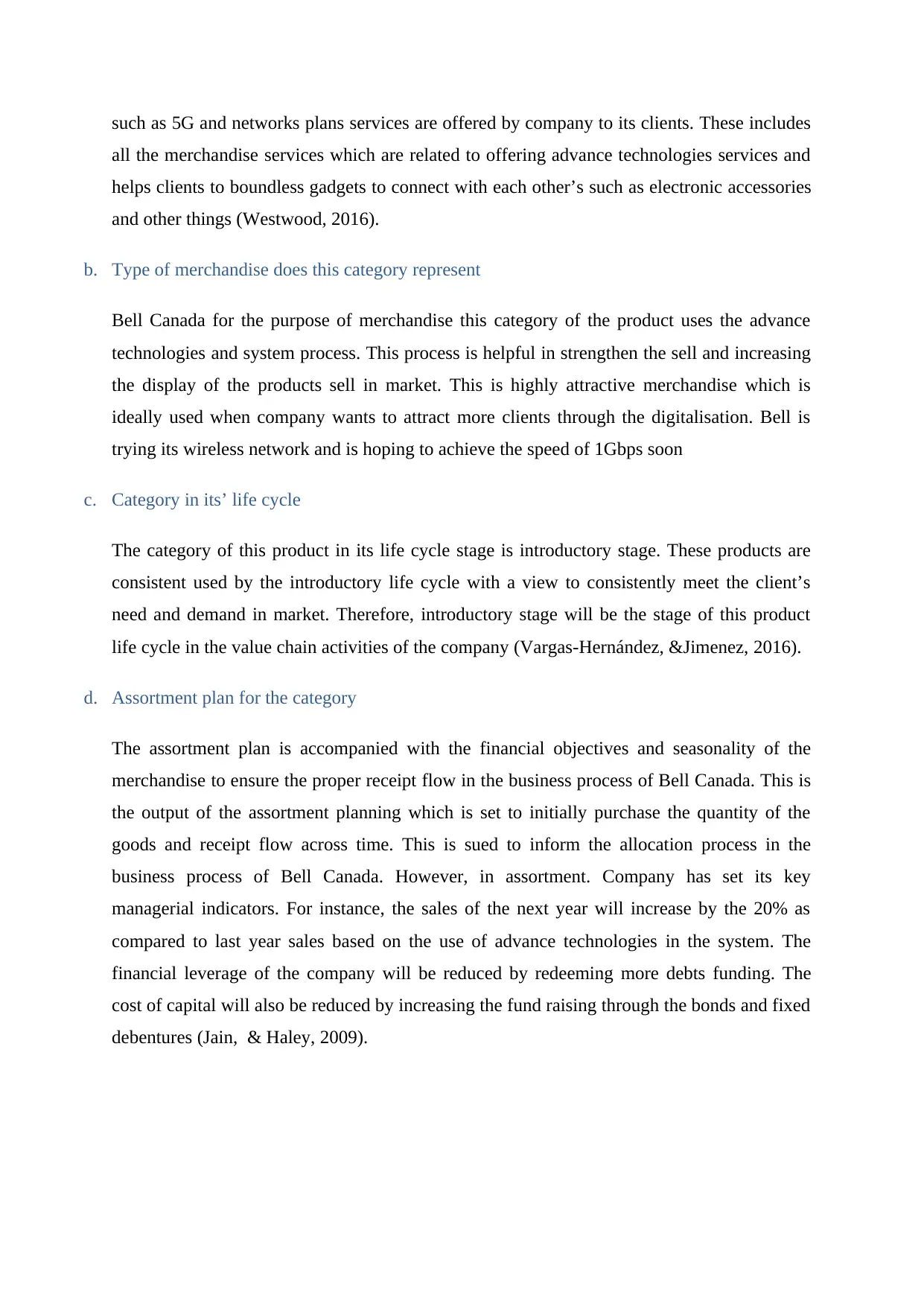
The assortment plan is accompanied with the financial objectives and seasonality of the
merchandise to ensure the proper receipt flow in the business process of Bell Canada. This is
the output of the assortment planning which is set to initially purchase the quantity of the
goods and receipt flow across time. This is sued to inform the allocation process in the
business process of Bell Canada. However, in assortment. Company has set its key
managerial indicators. For instance, the sales of the next year will increase by the 20% as
compared to last year sales based on the use of advance technologies in the system. The
financial leverage of the company will be reduced by redeeming more debts funding. The
cost of capital will also be reduced by increasing the fund raising through the bonds and fixed
debentures (Jain, & Haley, 2009).
all the merchandise services which are related to offering advance technologies services and
helps clients to boundless gadgets to connect with each other’s such as electronic accessories
and other things (Westwood, 2016).
b. Type of merchandise does this category represent
Bell Canada for the purpose of merchandise this category of the product uses the advance
technologies and system process. This process is helpful in strengthen the sell and increasing
the display of the products sell in market. This is highly attractive merchandise which is
ideally used when company wants to attract more clients through the digitalisation. Bell is
trying its wireless network and is hoping to achieve the speed of 1Gbps soon
c. Category in its’ life cycle
The category of this product in its life cycle stage is introductory stage. These products are
consistent used by the introductory life cycle with a view to consistently meet the client’s
need and demand in market. Therefore, introductory stage will be the stage of this product
life cycle in the value chain activities of the company (Vargas-Hernández, &Jimenez, 2016).
d. Assortment plan for the category
The assortment plan is accompanied with the financial objectives and seasonality of the
merchandise to ensure the proper receipt flow in the business process of Bell Canada. This is
the output of the assortment planning which is set to initially purchase the quantity of the
goods and receipt flow across time. This is sued to inform the allocation process in the
business process of Bell Canada. However, in assortment. Company has set its key
managerial indicators. For instance, the sales of the next year will increase by the 20% as
compared to last year sales based on the use of advance technologies in the system. The
financial leverage of the company will be reduced by redeeming more debts funding. The
cost of capital will also be reduced by increasing the fund raising through the bonds and fixed
debentures (Jain, & Haley, 2009).
⊘ This is a preview!⊘
Do you want full access?
Subscribe today to unlock all pages.
Trusted by 1+ million students worldwide
5. Branding strategy
a. Mix of national brands and private label brands sold by the company
Bell Canada has been selling Fixed line and mobile telephony, Internet services, Digital
television, Radio broadcasting products in market. This company has been selling products to
clients on national and international level. However, It also offers VoIP to customers,
branded as "Digital Voice". Businesses can still obtain VoIP service on domestic level and
owns ns Virgin Mobile Canada to provide international services.
b. Determine if Company should expand or contract the number of private label brands
available
Yes company should expand its number of private label brands. The main reason of this is
based on the increased profitability and business expansion on international level. Company
has strengthen its business by integrating its advance technologies and by expanding its
private label brands it could easily attract more clients in market.
c. Private brand strategy the company
It is analysed that private brand is the product which is is exclusively manufactured for a
retailer. The private brand label is services of VoIP to customers, branded as "Digital Voice".
Businesses can still obtain VoIP service on domestic level and owns ns Virgin Mobile
Canada to provide international services.
NO company should not change this private brand strategy as it as good exposure and giving
good amount of profitability to company.
6. Pricing Strategies
When setting prices, describe how the company takes into account i. Cost ii. Demand iii.
Competition iv. Legal considerations (West, Ford & Ibrahim, 2015).
a. When setting prices, describe how the company takes into account
While deciding the cost of product or services, Bell considered following factors.
1. Cost: Before the company sets the price, it worked out with the costs involved with
managing the business. These include the direct cost as well as fixed cost. The direct cost is
a. Mix of national brands and private label brands sold by the company
Bell Canada has been selling Fixed line and mobile telephony, Internet services, Digital
television, Radio broadcasting products in market. This company has been selling products to
clients on national and international level. However, It also offers VoIP to customers,
branded as "Digital Voice". Businesses can still obtain VoIP service on domestic level and
owns ns Virgin Mobile Canada to provide international services.
b. Determine if Company should expand or contract the number of private label brands
available
Yes company should expand its number of private label brands. The main reason of this is
based on the increased profitability and business expansion on international level. Company
has strengthen its business by integrating its advance technologies and by expanding its
private label brands it could easily attract more clients in market.
c. Private brand strategy the company
It is analysed that private brand is the product which is is exclusively manufactured for a
retailer. The private brand label is services of VoIP to customers, branded as "Digital Voice".
Businesses can still obtain VoIP service on domestic level and owns ns Virgin Mobile
Canada to provide international services.
NO company should not change this private brand strategy as it as good exposure and giving
good amount of profitability to company.
6. Pricing Strategies
When setting prices, describe how the company takes into account i. Cost ii. Demand iii.
Competition iv. Legal considerations (West, Ford & Ibrahim, 2015).
a. When setting prices, describe how the company takes into account
While deciding the cost of product or services, Bell considered following factors.
1. Cost: Before the company sets the price, it worked out with the costs involved with
managing the business. These include the direct cost as well as fixed cost. The direct cost is
Paraphrase This Document
Need a fresh take? Get an instant paraphrase of this document with our AI Paraphraser
the cost that expenses the company incur by manufacturing and delivering the services and
products.
2. Demand: The Company firstly takes the market tour before introducing the product. Various
surveys are held regarding the needs and demands of that product. The survey is done
covering the full range of all the sectors, from working to house-holds. The Bell’s launched
all their offers according to the needs (Effing, & Spil, 2016).
3. Competition: This is considered to be one of the key times, when the company do a little
competitor snooping. Bell’s always make sure that the charges and prices of all their products
must be unique, not only the product charges, but the offers as well. Bell’s make sure that
what inclusions and level of services they are providing within that range.
4. Legal Consideration: While deciding the prices, the company keeps a total check that they
are doing everything according to the allowance according to the legal terms or not (Karim,
& Arif-Uz-Zaman, 2013)
b. Make two (2) recommendations on how setting prices could change.
While pricing the products, the setting prices could be varied by two main factors, i.e. the
profit driver and value-based pricing. The pricing effects on profit very dramatically.
Pricing’s impact on profitability is bigger than the any other tactical measures, like cost
reduction and growth. The pricing is basically the main profit driver. The prices must be
made on the basis on the customers. Also, according to the substantial empirical research, it
has been confirmed that the only approach which leads to the higher profits is the value-based
pricing (Boshyk., 2016).
c. What price adjustments does the company engage in?
There are various pricing adjustments in which the customers are engaged like the
communication values, pricing rules, company values, negotiating and value
communications, knowing the company, knowing the competition, what are the needs of
customers and how much are they willing to pay, customer is willing to pay how much more,
how can the value of threshold ne increased, what must be the differences with the segments
of market, how the prices affects the bottom line. There are few adjustment which are kept in
mind while doing the price adjustments.
d. Make two (2) recommendation on possible price adjustments.
Predatory pricing and price fixing
products.
2. Demand: The Company firstly takes the market tour before introducing the product. Various
surveys are held regarding the needs and demands of that product. The survey is done
covering the full range of all the sectors, from working to house-holds. The Bell’s launched
all their offers according to the needs (Effing, & Spil, 2016).
3. Competition: This is considered to be one of the key times, when the company do a little
competitor snooping. Bell’s always make sure that the charges and prices of all their products
must be unique, not only the product charges, but the offers as well. Bell’s make sure that
what inclusions and level of services they are providing within that range.
4. Legal Consideration: While deciding the prices, the company keeps a total check that they
are doing everything according to the allowance according to the legal terms or not (Karim,
& Arif-Uz-Zaman, 2013)
b. Make two (2) recommendations on how setting prices could change.
While pricing the products, the setting prices could be varied by two main factors, i.e. the
profit driver and value-based pricing. The pricing effects on profit very dramatically.
Pricing’s impact on profitability is bigger than the any other tactical measures, like cost
reduction and growth. The pricing is basically the main profit driver. The prices must be
made on the basis on the customers. Also, according to the substantial empirical research, it
has been confirmed that the only approach which leads to the higher profits is the value-based
pricing (Boshyk., 2016).
c. What price adjustments does the company engage in?
There are various pricing adjustments in which the customers are engaged like the
communication values, pricing rules, company values, negotiating and value
communications, knowing the company, knowing the competition, what are the needs of
customers and how much are they willing to pay, customer is willing to pay how much more,
how can the value of threshold ne increased, what must be the differences with the segments
of market, how the prices affects the bottom line. There are few adjustment which are kept in
mind while doing the price adjustments.
d. Make two (2) recommendation on possible price adjustments.
Predatory pricing and price fixing
The predatory pricing is done when the business the business (who’s share in market is quite
significant) reduces the price for damaging or eliminating the competitors, it is like an anti-
competitive thing. And the price fixing is done when two or more competitors agree on
setting price on any particular product or something.
e. What pricing strategy is the company following?
Company is following the pricing strategy of RPR (Recommended Retail Price). Basically
this prices are for resellers, the company legally allow the resellers to sell their price higher
than the actual prices of the products, although it is illegal (Siguaw, & Simpson, 2015).
f. Make one (1) recommendation on changing the pricing strategy used.
Instead of using RPR, the company must use Unit Pricing code, as unit pricing allows the
clients and customers to compare the value and price of similar price of products (Goi, 2015).
g. How does the company currently use pricing (apart from pricing adjustments) to stimulate
sales?
In order to stimulate sales, company works on seven main factors, like Dynamic pricing,
Psychological pricing, segmented pricing, International price skimming strategy (Cravens,
and Piercy, 2016).
h. Make two (2) recommendation on how the company can stimulate sales.
Company could increase its sales by using the product differentiation strategy which will
include the integration of the advance technologies and system process in its marketing sales
activities.
In addition to this, second company should also lower down the product costing irrespective
of compromising with the quality of the products and services offered in market (Effing, &
Spil, 2016).
7. Customer Loyalty
a. CRM process, how is the company getting customer loyalty
Company has focused on using the mail process in its CRM process in which all the
clients are offered different discounts and coupes program. It will also include positive
emotional experience, physical attribute-based satisfaction and perceived value of an
experience, which includes the product or services. Consider who you yourself are loyal to.
Surely you'll answer family and friends (Finch, 2016).
significant) reduces the price for damaging or eliminating the competitors, it is like an anti-
competitive thing. And the price fixing is done when two or more competitors agree on
setting price on any particular product or something.
e. What pricing strategy is the company following?
Company is following the pricing strategy of RPR (Recommended Retail Price). Basically
this prices are for resellers, the company legally allow the resellers to sell their price higher
than the actual prices of the products, although it is illegal (Siguaw, & Simpson, 2015).
f. Make one (1) recommendation on changing the pricing strategy used.
Instead of using RPR, the company must use Unit Pricing code, as unit pricing allows the
clients and customers to compare the value and price of similar price of products (Goi, 2015).
g. How does the company currently use pricing (apart from pricing adjustments) to stimulate
sales?
In order to stimulate sales, company works on seven main factors, like Dynamic pricing,
Psychological pricing, segmented pricing, International price skimming strategy (Cravens,
and Piercy, 2016).
h. Make two (2) recommendation on how the company can stimulate sales.
Company could increase its sales by using the product differentiation strategy which will
include the integration of the advance technologies and system process in its marketing sales
activities.
In addition to this, second company should also lower down the product costing irrespective
of compromising with the quality of the products and services offered in market (Effing, &
Spil, 2016).
7. Customer Loyalty
a. CRM process, how is the company getting customer loyalty
Company has focused on using the mail process in its CRM process in which all the
clients are offered different discounts and coupes program. It will also include positive
emotional experience, physical attribute-based satisfaction and perceived value of an
experience, which includes the product or services. Consider who you yourself are loyal to.
Surely you'll answer family and friends (Finch, 2016).
⊘ This is a preview!⊘
Do you want full access?
Subscribe today to unlock all pages.
Trusted by 1+ million students worldwide

1 out of 15


Related Documents


Your All-in-One AI-Powered Toolkit for Academic Success.
+13062052269
info@desklib.com
Available 24*7 on WhatsApp / Email
![[object Object]](/_next/static/media/star-bottom.7253800d.svg)
Unlock your academic potential
Copyright © 2020–2026 A2Z Services. All Rights Reserved. Developed and managed by ZUCOL.