Microeconomics Assignment: Bertrand Competition and Nash Equilibrium

Verified

Added on  2023/04/11

|3
|872
|384
Homework Assignment
AI Summary
This assignment analyzes Bertrand competition with differentiated products. Part A determines the Nash equilibrium in a static game where two companies independently choose prices, deriving optimal prices, quantities, and profits. Part B explores a sequential dynamic game where one company sets its price first. The analysis examines strategies for the second company, demonstrating a strategy that results in the Nash equilibrium from Part A. The solution includes calculations of profits under different pricing scenarios, and an examination of price wars and the advantages of setting prices. The document concludes with a discussion of the optimal pricing strategy and the impact of sequential price setting, supported by references to economic literature on Bertrand competition.
Document Page
Microeconomics
Task 1 Bertrand competition with differentiated products
Part A
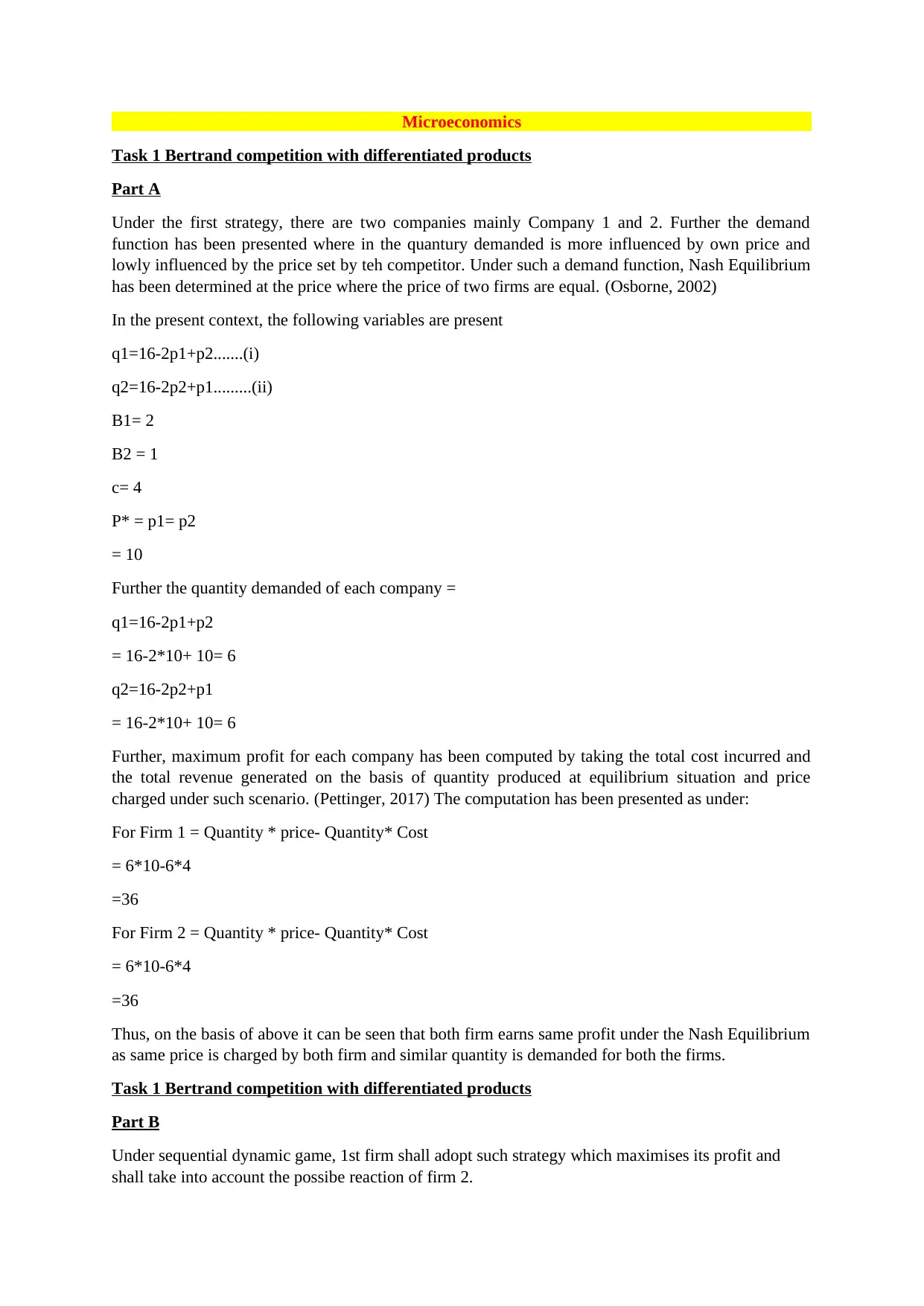
Under the first strategy, there are two companies mainly Company 1 and 2. Further the demand
function has been presented where in the quantury demanded is more influenced by own price and
lowly influenced by the price set by teh competitor. Under such a demand function, Nash Equilibrium
has been determined at the price where the price of two firms are equal. (Osborne, 2002)
In the present context, the following variables are present
q1=16-2p1+p2.......(i)
q2=16-2p2+p1.........(ii)
B1= 2
B2 = 1
c= 4
P* = p1= p2
= 10
Further the quantity demanded of each company =
q1=16-2p1+p2
= 16-2*10+ 10= 6
q2=16-2p2+p1
= 16-2*10+ 10= 6
Further, maximum profit for each company has been computed by taking the total cost incurred and
the total revenue generated on the basis of quantity produced at equilibrium situation and price
charged under such scenario. (Pettinger, 2017) The computation has been presented as under:
For Firm 1 = Quantity * price- Quantity* Cost
= 6*10-6*4
=36
For Firm 2 = Quantity * price- Quantity* Cost
= 6*10-6*4
=36
Thus, on the basis of above it can be seen that both firm earns same profit under the Nash Equilibrium
as same price is charged by both firm and similar quantity is demanded for both the firms.
Task 1 Bertrand competition with differentiated products
Part B
Under sequential dynamic game, 1st firm shall adopt such strategy which maximises its profit and
shall take into account the possibe reaction of firm 2.
tabler-icon-diamond-filled.svg

Paraphrase This Document

Need a fresh take? Get an instant paraphrase of this document with our AI Paraphraser
Document Page
The demand equation is
q1=16-2p1+p2.
Further, firm 2 shall adopt a strategy which shall maximises its profit by taking into consideration the
action of the firm 1. There can be two scenario either to adopt the pricing adopted by firm 1 or to
initiate a price war under which pay off shall be least for both companies. Under the long run, both
firm shall realise that maximum profit shall be achieved under Nash equilibrium. The pay off of the
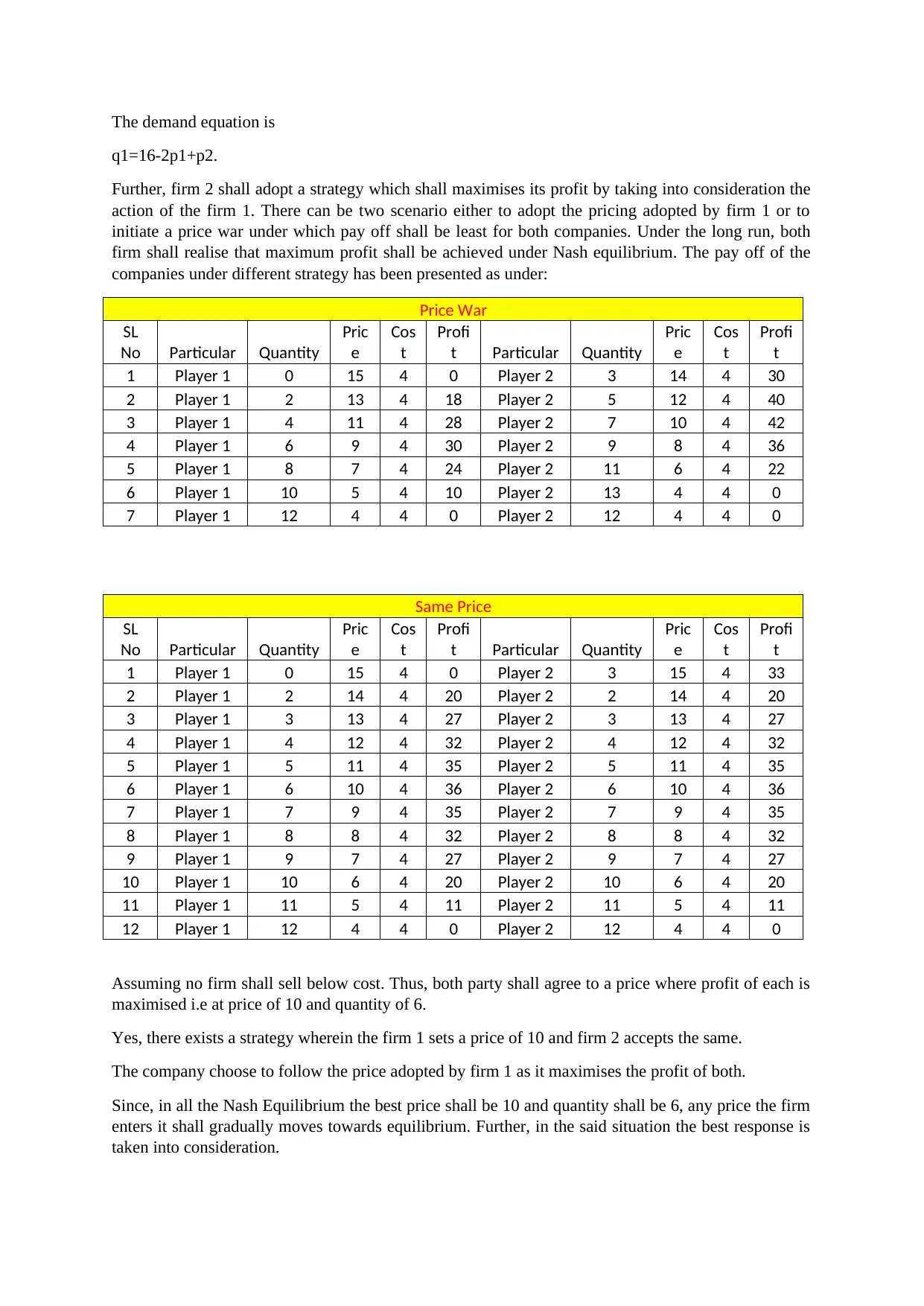
companies under different strategy has been presented as under:
Price War
SL
No Particular Quantity
Pric
e
Cos
t
Profi
t Particular Quantity
Pric
e
Cos
t
Profi
t
1 Player 1 0 15 4 0 Player 2 3 14 4 30
2 Player 1 2 13 4 18 Player 2 5 12 4 40
3 Player 1 4 11 4 28 Player 2 7 10 4 42
4 Player 1 6 9 4 30 Player 2 9 8 4 36
5 Player 1 8 7 4 24 Player 2 11 6 4 22
6 Player 1 10 5 4 10 Player 2 13 4 4 0
7 Player 1 12 4 4 0 Player 2 12 4 4 0
Same Price
SL
No Particular Quantity
Pric
e
Cos
t
Profi
t Particular Quantity
Pric
e
Cos
t
Profi
t
1 Player 1 0 15 4 0 Player 2 3 15 4 33
2 Player 1 2 14 4 20 Player 2 2 14 4 20
3 Player 1 3 13 4 27 Player 2 3 13 4 27
4 Player 1 4 12 4 32 Player 2 4 12 4 32
5 Player 1 5 11 4 35 Player 2 5 11 4 35
6 Player 1 6 10 4 36 Player 2 6 10 4 36
7 Player 1 7 9 4 35 Player 2 7 9 4 35
8 Player 1 8 8 4 32 Player 2 8 8 4 32
9 Player 1 9 7 4 27 Player 2 9 7 4 27
10 Player 1 10 6 4 20 Player 2 10 6 4 20
11 Player 1 11 5 4 11 Player 2 11 5 4 11
12 Player 1 12 4 4 0 Player 2 12 4 4 0
Assuming no firm shall sell below cost. Thus, both party shall agree to a price where profit of each is
maximised i.e at price of 10 and quantity of 6.
Yes, there exists a strategy wherein the firm 1 sets a price of 10 and firm 2 accepts the same.
The company choose to follow the price adopted by firm 1 as it maximises the profit of both.
Since, in all the Nash Equilibrium the best price shall be 10 and quantity shall be 6, any price the firm
enters it shall gradually moves towards equilibrium. Further, in the said situation the best response is
taken into consideration.
Document Page
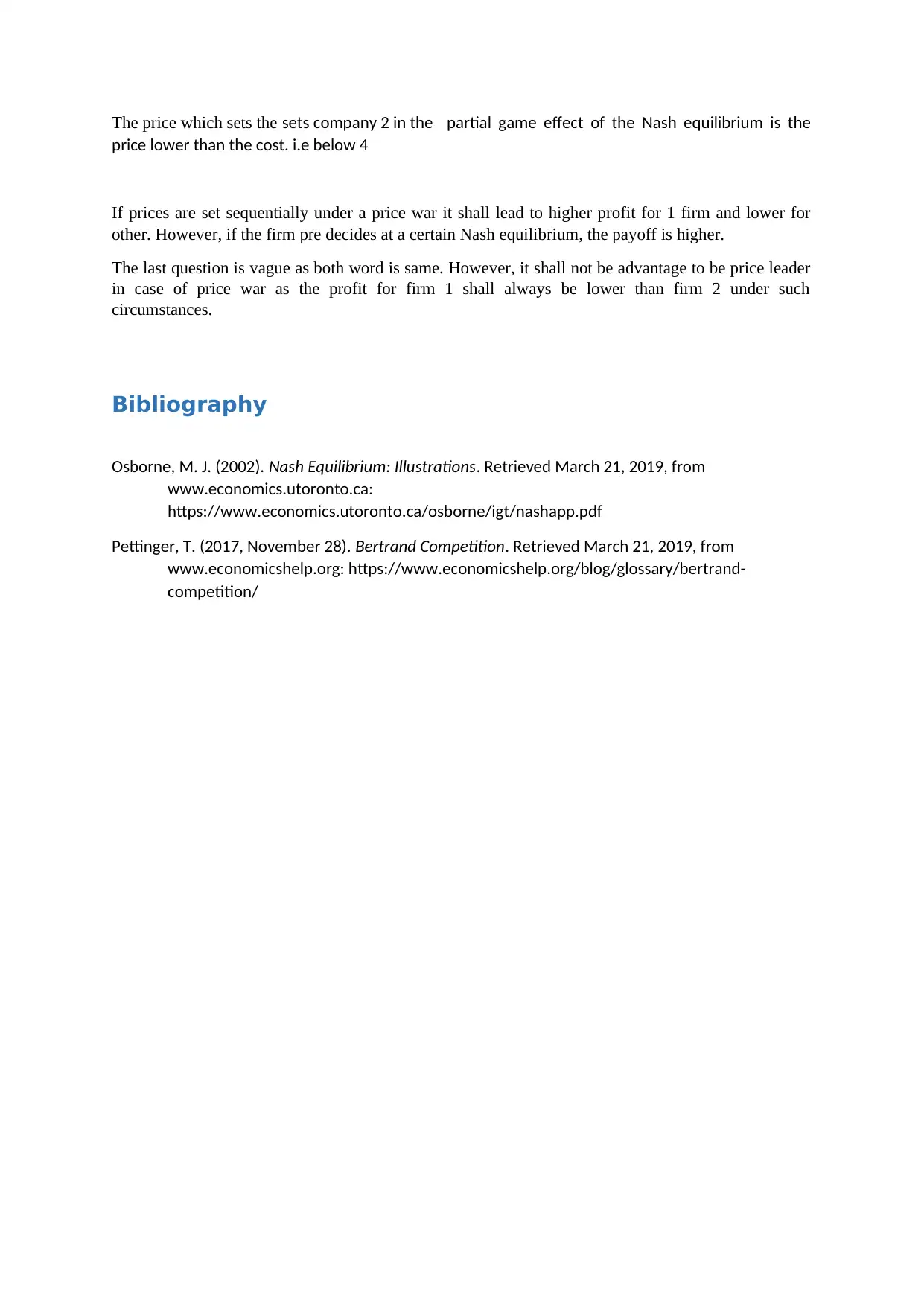
The price which sets the sets company 2 in the partial game effect of the Nash equilibrium is the
price lower than the cost. i.e below 4
If prices are set sequentially under a price war it shall lead to higher profit for 1 firm and lower for
other. However, if the firm pre decides at a certain Nash equilibrium, the payoff is higher.
The last question is vague as both word is same. However, it shall not be advantage to be price leader
in case of price war as the profit for firm 1 shall always be lower than firm 2 under such
circumstances.
Bibliography
Osborne, M. J. (2002). Nash Equilibrium: Illustrations. Retrieved March 21, 2019, from
www.economics.utoronto.ca:
https://www.economics.utoronto.ca/osborne/igt/nashapp.pdf
Pettinger, T. (2017, November 28). Bertrand Competition. Retrieved March 21, 2019, from
www.economicshelp.org: https://www.economicshelp.org/blog/glossary/bertrand-
competition/
chevron_up_icon
1 out of 3
circle_padding
hide_on_mobile
zoom_out_icon
[object Object]