Evaluating the Long-Term Public Health Effects of Bhopal Disaster

Verified

Added on  2023/06/07

|4
|514
|284
Essay
AI Summary
This essay discusses the severe public health crisis resulting from the Bhopal gas tragedy in India in 1983, where a methyl gas leak led to approximately 3,800 deaths and long-term morbidity for thousands more. Considered the worst industrial accident in history, the Bhopal disaster caused lasting damage to the environment, contaminating water and land, which affected human, animal, and plant species. The incident resulted in significant economic losses due to lost lives and the incapacitation of many survivors, leaving about 75% of Bhopal unable to work. The long-term physical challenges from heavy metal exposure have led to a generation of physically incapacitated individuals, and the health, environmental, and economic repercussions continue to affect the people and the Indian government today. The essay references studies highlighting the ongoing environmental and economic impacts, emphasizing the need for lasting solutions to address the persistent issues.
Document Page
Running head: BHOPAL 1
Student Name
Institutional Affiliation
Public Health
tabler-icon-diamond-filled.svg

Paraphrase This Document

Need a fresh take? Get an instant paraphrase of this document with our AI Paraphraser
Document Page
BHOPAL 2
Public Health
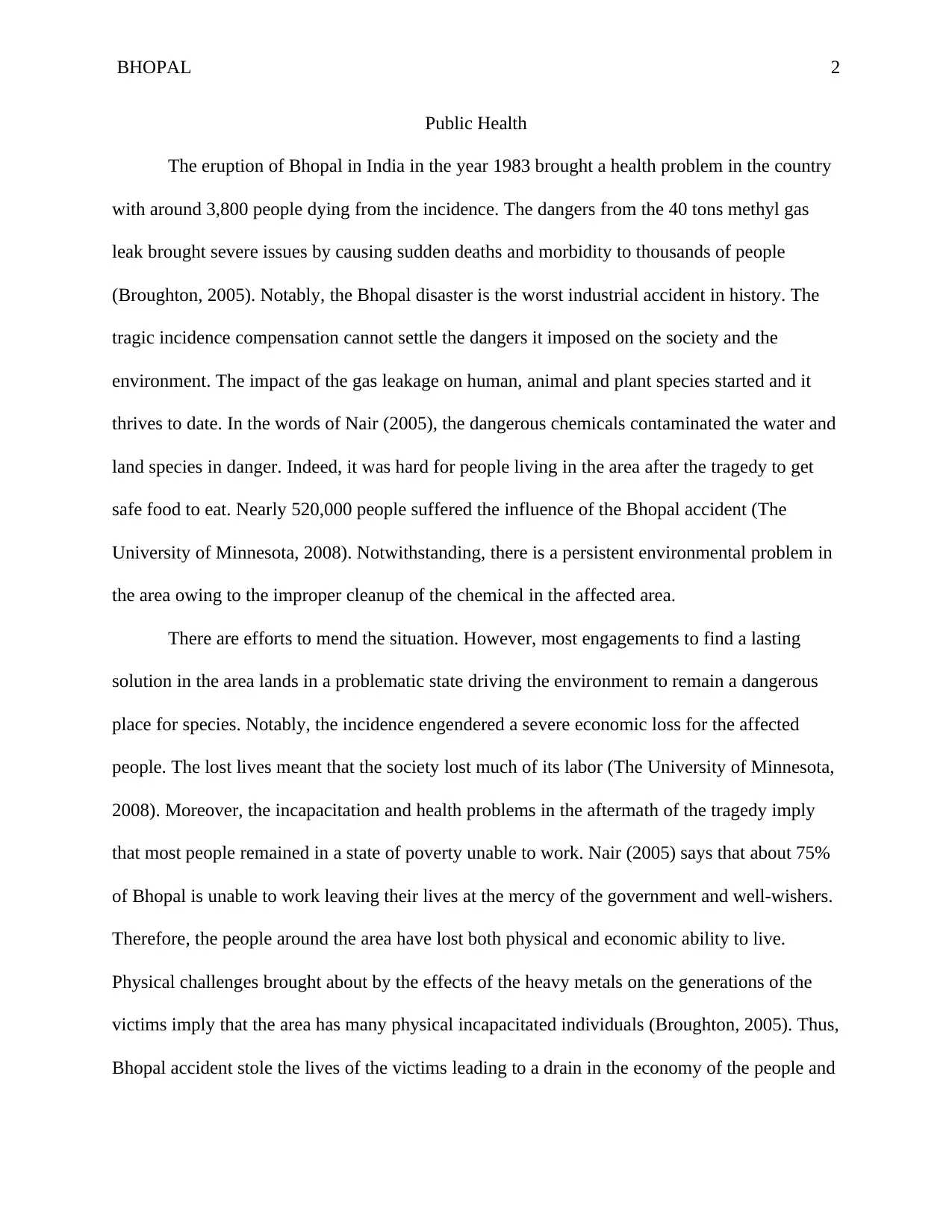
The eruption of Bhopal in India in the year 1983 brought a health problem in the country
with around 3,800 people dying from the incidence. The dangers from the 40 tons methyl gas
leak brought severe issues by causing sudden deaths and morbidity to thousands of people
(Broughton, 2005). Notably, the Bhopal disaster is the worst industrial accident in history. The
tragic incidence compensation cannot settle the dangers it imposed on the society and the
environment. The impact of the gas leakage on human, animal and plant species started and it
thrives to date. In the words of Nair (2005), the dangerous chemicals contaminated the water and
land species in danger. Indeed, it was hard for people living in the area after the tragedy to get
safe food to eat. Nearly 520,000 people suffered the influence of the Bhopal accident (The
University of Minnesota, 2008). Notwithstanding, there is a persistent environmental problem in
the area owing to the improper cleanup of the chemical in the affected area.
There are efforts to mend the situation. However, most engagements to find a lasting
solution in the area lands in a problematic state driving the environment to remain a dangerous
place for species. Notably, the incidence engendered a severe economic loss for the affected
people. The lost lives meant that the society lost much of its labor (The University of Minnesota,
2008). Moreover, the incapacitation and health problems in the aftermath of the tragedy imply
that most people remained in a state of poverty unable to work. Nair (2005) says that about 75%
of Bhopal is unable to work leaving their lives at the mercy of the government and well-wishers.
Therefore, the people around the area have lost both physical and economic ability to live.
Physical challenges brought about by the effects of the heavy metals on the generations of the
victims imply that the area has many physical incapacitated individuals (Broughton, 2005). Thus,
Bhopal accident stole the lives of the victims leading to a drain in the economy of the people and
Document Page
BHOPAL 3
the government. Until today, the people and the Indian government pay for the results of the
catastrophe concerning the health, environmental, and economic ramifications from the tragedy.
References
Document Page
BHOPAL 4
Broughton, E. (2005). The Bhopal disaster and its aftermath: a review. Environmental
Health, 4(1), 6.
Nair, M. (2005). Bhopal Gas Tragedy–A Social, Economic, Legal and Environmental Analysis.
The University of Minnesota. (2008). The Bhopal Disaster : Student Website for PubH 6101:
Environmental Health : University of Minneosta. Retrieved from
http://enhs.umn.edu/current/2008studentwebsites/pubh6101/bhopal/environment.html
chevron_up_icon
1 out of 4
circle_padding
hide_on_mobile
zoom_out_icon
[object Object]