IMD124: Bibliographical Services and Utilities Report - UiTM Kedah
VerifiedAdded on 2023/07/05
|32
|8720
|91
Report
AI Summary
This report provides an overview of bibliographical services and utilities, focusing on key organizations such as the Online Computer Library Center (OCLC), the International Nuclear Information System (INIS), the Library of Congress (LOC), and the Congress of Southeast Asian Libraries (CONSAL). The report details each organization's background, mission, objectives, membership, services, benefits, and future plans. It also includes points of view about the organizations, covering aspects like their role in library cooperation, resource sharing, and metadata management. Prepared by students of Universiti Teknologi MARA (UiTM) Cawangan Kedah for the course IMD124: Access to Information, this document offers insights into the functionalities and impacts of these vital bibliographic entities in the global information landscape. Desklib offers a wealth of similar reports and study resources for students.
FACULTY OF INFORMATION MANAGEMENT
UNIVERSITI TEKNOLOGI MARA (UiTM)
CAWANGAN KEDAH
IMD124: ACCESS TO INFORMATION
“REPORT ON BIBLIOGRAPHICAL SERVICES AND UTILITIES”
Prepared by:
AHMAD FARID IZMIR BIN NAZRI (2021891874)
MUHAMMAD AFIQ HAKIMI BIN ZAINAL HAFIZI (2021880956)
RIFAA NIFAIL BIN RASHIDI (2021449918)
Prepared for:
SIR MOHD NOR AZAM BIN MD SALLEH
4TH JULY 2022
UNIVERSITI TEKNOLOGI MARA (UiTM)
CAWANGAN KEDAH
IMD124: ACCESS TO INFORMATION
“REPORT ON BIBLIOGRAPHICAL SERVICES AND UTILITIES”
Prepared by:
AHMAD FARID IZMIR BIN NAZRI (2021891874)
MUHAMMAD AFIQ HAKIMI BIN ZAINAL HAFIZI (2021880956)
RIFAA NIFAIL BIN RASHIDI (2021449918)
Prepared for:
SIR MOHD NOR AZAM BIN MD SALLEH
4TH JULY 2022

Paraphrase This Document
Need a fresh take? Get an instant paraphrase of this document with our AI Paraphraser
“REPORT ON BIBLIOGRAPHICAL SERVICES AND UTILITIES”
Prepared by:
AHMAD FARID IZMIR BIN NAZRI (2021891874)
MUHAMMAD AFIQ HAKIMI BIN ZAINAL HAFIZI (2021880956)
RIFAA NIFAIL BIN RASHIDI (2021449918)
KIM1102E
IM110- Diploma in Information Management
FACULTY OF INFORMATION MANAGEMENT
UNIVERSITI TEKNOLOGI MARA (UiTM)
CAWANGAN KEDAH
Prepared by:
AHMAD FARID IZMIR BIN NAZRI (2021891874)
MUHAMMAD AFIQ HAKIMI BIN ZAINAL HAFIZI (2021880956)
RIFAA NIFAIL BIN RASHIDI (2021449918)
KIM1102E
IM110- Diploma in Information Management
FACULTY OF INFORMATION MANAGEMENT
UNIVERSITI TEKNOLOGI MARA (UiTM)
CAWANGAN KEDAH
ACKNOWLEDGEMENT
Assalamualaikum WBT,
We, Ahmad Farid Izmir Bin Nazri, Muhammad Afiq Hakimi Bin Zainal Hafizi and Rifaa Nifail
Bin Rashidi owe a debt of gratitude to the following people who have contributed to the
success of our assignment. We would like to thank them for all their valuable help on our
preparation by finishing our research on this topic.
In fact, we would like to say thank you to our lecturer, Sir Mohd Nor Azam our lecturer of this
subject, Communication Skills for Information Professionals (IMD124) who has been guided
us in doing this task since day 1 and especially for answered all of our question in this topic
and helping us out in providing some useful information from the assignment was given until
it has been submitted.
Furthermore, we would like to say thank you to our beloved family who supported us since
we must do this assignment at the hostel.
Lastly, we managed to finish it on time since this task is contain 40% marks for this report.
THANK YOU
i
Assalamualaikum WBT,
We, Ahmad Farid Izmir Bin Nazri, Muhammad Afiq Hakimi Bin Zainal Hafizi and Rifaa Nifail
Bin Rashidi owe a debt of gratitude to the following people who have contributed to the
success of our assignment. We would like to thank them for all their valuable help on our
preparation by finishing our research on this topic.
In fact, we would like to say thank you to our lecturer, Sir Mohd Nor Azam our lecturer of this
subject, Communication Skills for Information Professionals (IMD124) who has been guided
us in doing this task since day 1 and especially for answered all of our question in this topic
and helping us out in providing some useful information from the assignment was given until
it has been submitted.
Furthermore, we would like to say thank you to our beloved family who supported us since
we must do this assignment at the hostel.
Lastly, we managed to finish it on time since this task is contain 40% marks for this report.
THANK YOU
i
⊘ This is a preview!⊘
Do you want full access?
Subscribe today to unlock all pages.

Trusted by 1+ million students worldwide
TABLE OF CONTENT
SECTION A: BIBLIOGRAPHICAL SERVICES & UTILITIES
1. ONLINE COMPUTER LIBRARY CENTER (OCLC)…….……...……………………………. 1
1.0 INTRODUCTION
2.0 HISTORY OR BACKGROUND INFORMATION
3.0 MISSION, VISION, AND OBJECTIVES
4.0 PARTICIPATION OR MEMBERSHIP FROM ANOTHER BODIES, COUNTRIES,
ASSOCIATIONS OR TYPES OF MEMBERSHIPS
5.0 SERVICES
6.0 BENEFITS
7.0 FUTURE PLANNING
8.0 POINT OF VIEW ABOUT THE ORGANIZATION
9.0 CONCLUSION
2. INTERNATIONAL NUCLEAR INFORMATION SYSTEM (INIS)…..…………………....… 7
1.0 INTRODUCTION
2.0 HISTORY OR BACKGROUND INFORMATION
3.0 MISSION, VISION, AND OBJECTIVES
4.0 PARTICIPATION OR MEMBERSHIP FROM ANOTHER BODIES, COUNTRIES,
ASSOCIATIONS OR TYPES OF MEMBERSHIPS
5.0 SERVICES
6.0 BENEFITS
7.0 FUTURE PLANNING
8.0 POINT OF VIEW ABOUT THE ORGANIZATION
9.0 CONCLUSION
SECTION A: BIBLIOGRAPHICAL SERVICES & UTILITIES
1. ONLINE COMPUTER LIBRARY CENTER (OCLC)…….……...……………………………. 1
1.0 INTRODUCTION
2.0 HISTORY OR BACKGROUND INFORMATION
3.0 MISSION, VISION, AND OBJECTIVES
4.0 PARTICIPATION OR MEMBERSHIP FROM ANOTHER BODIES, COUNTRIES,
ASSOCIATIONS OR TYPES OF MEMBERSHIPS
5.0 SERVICES
6.0 BENEFITS
7.0 FUTURE PLANNING
8.0 POINT OF VIEW ABOUT THE ORGANIZATION
9.0 CONCLUSION
2. INTERNATIONAL NUCLEAR INFORMATION SYSTEM (INIS)…..…………………....… 7
1.0 INTRODUCTION
2.0 HISTORY OR BACKGROUND INFORMATION
3.0 MISSION, VISION, AND OBJECTIVES
4.0 PARTICIPATION OR MEMBERSHIP FROM ANOTHER BODIES, COUNTRIES,
ASSOCIATIONS OR TYPES OF MEMBERSHIPS
5.0 SERVICES
6.0 BENEFITS
7.0 FUTURE PLANNING
8.0 POINT OF VIEW ABOUT THE ORGANIZATION
9.0 CONCLUSION
Paraphrase This Document
Need a fresh take? Get an instant paraphrase of this document with our AI Paraphraser
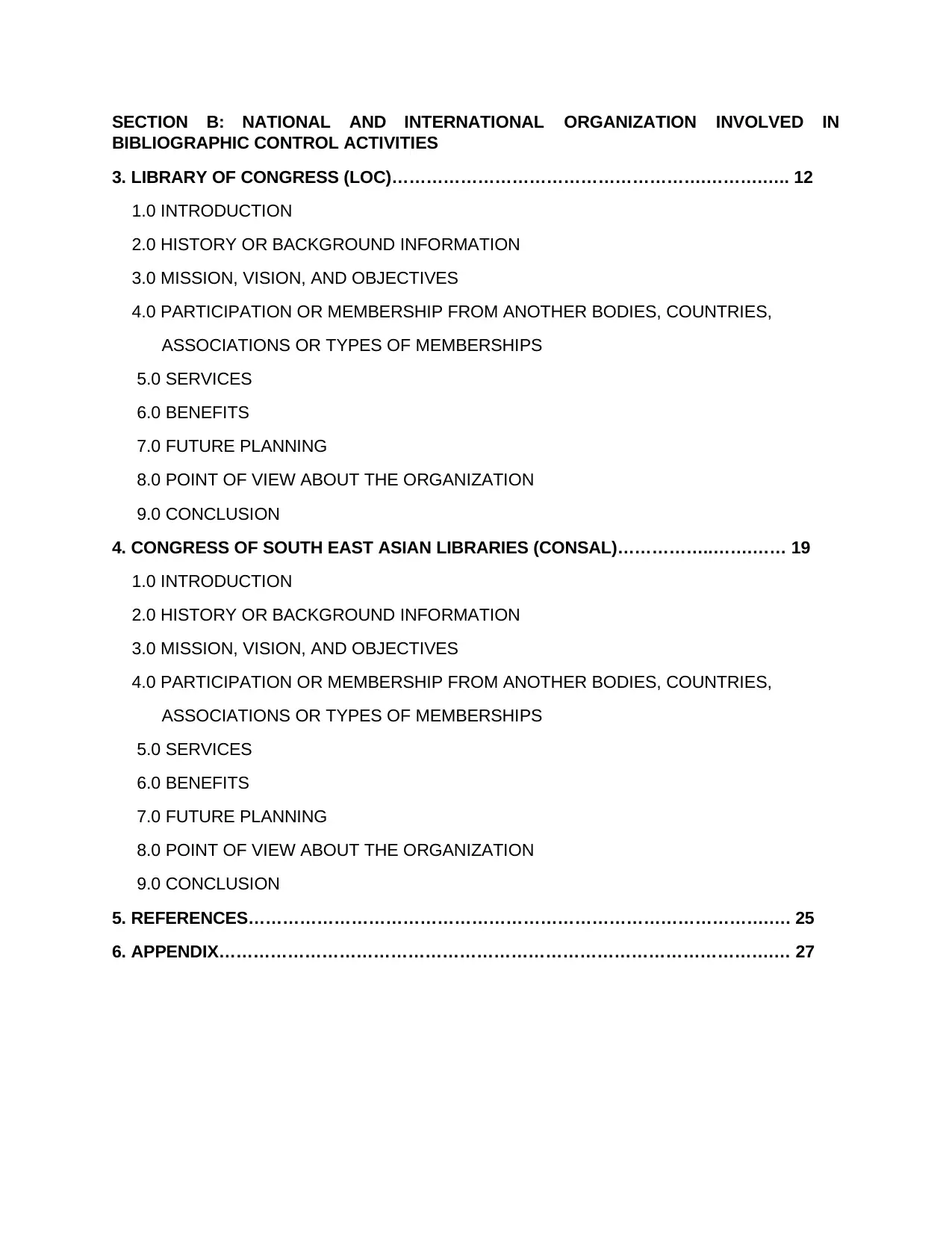
SECTION B: NATIONAL AND INTERNATIONAL ORGANIZATION INVOLVED IN
BIBLIOGRAPHIC CONTROL ACTIVITIES
3. LIBRARY OF CONGRESS (LOC)……………………………………………….……….….. 12
1.0 INTRODUCTION
2.0 HISTORY OR BACKGROUND INFORMATION
3.0 MISSION, VISION, AND OBJECTIVES
4.0 PARTICIPATION OR MEMBERSHIP FROM ANOTHER BODIES, COUNTRIES,
ASSOCIATIONS OR TYPES OF MEMBERSHIPS
5.0 SERVICES
6.0 BENEFITS
7.0 FUTURE PLANNING
8.0 POINT OF VIEW ABOUT THE ORGANIZATION
9.0 CONCLUSION
4. CONGRESS OF SOUTH EAST ASIAN LIBRARIES (CONSAL)……………..…….…… 19
1.0 INTRODUCTION
2.0 HISTORY OR BACKGROUND INFORMATION
3.0 MISSION, VISION, AND OBJECTIVES
4.0 PARTICIPATION OR MEMBERSHIP FROM ANOTHER BODIES, COUNTRIES,
ASSOCIATIONS OR TYPES OF MEMBERSHIPS
5.0 SERVICES
6.0 BENEFITS
7.0 FUTURE PLANNING
8.0 POINT OF VIEW ABOUT THE ORGANIZATION
9.0 CONCLUSION
5. REFERENCES……………………………………………………………………………….…. 25
6. APPENDIX…………………………………………………………………………………….… 27
BIBLIOGRAPHIC CONTROL ACTIVITIES
3. LIBRARY OF CONGRESS (LOC)……………………………………………….……….….. 12
1.0 INTRODUCTION
2.0 HISTORY OR BACKGROUND INFORMATION
3.0 MISSION, VISION, AND OBJECTIVES
4.0 PARTICIPATION OR MEMBERSHIP FROM ANOTHER BODIES, COUNTRIES,
ASSOCIATIONS OR TYPES OF MEMBERSHIPS
5.0 SERVICES
6.0 BENEFITS
7.0 FUTURE PLANNING
8.0 POINT OF VIEW ABOUT THE ORGANIZATION
9.0 CONCLUSION
4. CONGRESS OF SOUTH EAST ASIAN LIBRARIES (CONSAL)……………..…….…… 19
1.0 INTRODUCTION
2.0 HISTORY OR BACKGROUND INFORMATION
3.0 MISSION, VISION, AND OBJECTIVES
4.0 PARTICIPATION OR MEMBERSHIP FROM ANOTHER BODIES, COUNTRIES,
ASSOCIATIONS OR TYPES OF MEMBERSHIPS
5.0 SERVICES
6.0 BENEFITS
7.0 FUTURE PLANNING
8.0 POINT OF VIEW ABOUT THE ORGANIZATION
9.0 CONCLUSION
5. REFERENCES……………………………………………………………………………….…. 25
6. APPENDIX…………………………………………………………………………………….… 27
1
ONLINE COMPUTER LIBRARY CENTER (OCLC)
INTRODUCTION
A global library association, OCLC offers its members and the larger library community
programme, unique research, and shared technological services. They are researchers,
innovators, leaders, technicians, and learners. They at OCLC work together to make knowledge
more available and valuable by connecting thousands of libraries from more than 100 different
countries.
Shared knowledge is the connecting factor no matter if people are promoting cutting-
edge scientific developments or assisting young learners in laying a solid academic foundation.
People can discover the solutions they require to deal with significant issues in their lives,
communities, and the wider world. Together, people can achieve breakthroughs. both large and
little.
HISTORY OR BACKGROUND INFORMATION
A computerized library network that links 54 college libraries in Ohio, OCLC was first
founded as the Ohio College Library Center (OCLC) in 1967. The first president of OCLC was
Frederick Gridley Kilgour (January 6, 1914 - July 31), a librarian at Yale Medical Library. Under
his direction, OCLC expanded from a local network of libraries to a global library network.
The Ohio College Library Center was renamed OCLC, Inc. in 1977 after OCLC
expanded its network to include libraries outside of its own. OCLC Inc. changed its name to
OCLC Online Computer Library Center, Inc. in 1981. Today, OCLC provides services to more
than 60,000 libraries worldwide, including academic, public, educational, corporate, and other
specialized libraries.
ONLINE COMPUTER LIBRARY CENTER (OCLC)
INTRODUCTION
A global library association, OCLC offers its members and the larger library community
programme, unique research, and shared technological services. They are researchers,
innovators, leaders, technicians, and learners. They at OCLC work together to make knowledge
more available and valuable by connecting thousands of libraries from more than 100 different
countries.
Shared knowledge is the connecting factor no matter if people are promoting cutting-
edge scientific developments or assisting young learners in laying a solid academic foundation.
People can discover the solutions they require to deal with significant issues in their lives,
communities, and the wider world. Together, people can achieve breakthroughs. both large and
little.
HISTORY OR BACKGROUND INFORMATION
A computerized library network that links 54 college libraries in Ohio, OCLC was first
founded as the Ohio College Library Center (OCLC) in 1967. The first president of OCLC was
Frederick Gridley Kilgour (January 6, 1914 - July 31), a librarian at Yale Medical Library. Under
his direction, OCLC expanded from a local network of libraries to a global library network.
The Ohio College Library Center was renamed OCLC, Inc. in 1977 after OCLC
expanded its network to include libraries outside of its own. OCLC Inc. changed its name to
OCLC Online Computer Library Center, Inc. in 1981. Today, OCLC provides services to more
than 60,000 libraries worldwide, including academic, public, educational, corporate, and other
specialized libraries.
⊘ This is a preview!⊘
Do you want full access?
Subscribe today to unlock all pages.
Trusted by 1+ million students worldwide
2
MISION
To connect people to knowledge through library cooperation
VISION
To be the leading global library cooperative, helping libraries serve people by providing
economical access to knowledge through innovation and collaboration.
OBJECTIVES
The objective is to establish, maintain and operate a computerized library network and
promote the evolution of library use. Besides, to provide processes and products for the benefit
of library users. Other than that, reducing the rate-of-rise of library per unit cost. Lastly, to help
colleges and universities cope with information exploration.
PARTICIPATION OR MEMBERSHIP FROM OTHER BODIES, COUNTRIES, ASSOCIATIONS
OR TYPES OF MEMBERSHIP
In OCLC, it is guided by representatives from member institutions that uses its products
and services. Together, they exchange information, enhance the quality of information services,
conduct novel research, and strengthen links between libraries and the communities they serve.
But in order to develop initiatives, projects, solutions, and training that help all libraries, OCLC
also works closely with thousands of people, some of whom are employed by these
organizations and others who are not.
Some of the OCLC memberships would include individuals, councils, libraries and
groups including resources. The ability to choose representatives who represent your local and
regional perspectives on the problems currently affecting libraries is a significant advantage of
OCLC membership. As an example, the members of OCLC Global and Regional Councils have
a voice through their elected representatives. They are urged to take part in member meetings
and elections as well as in-person interactions with their chosen delegates.
MISION
To connect people to knowledge through library cooperation
VISION
To be the leading global library cooperative, helping libraries serve people by providing
economical access to knowledge through innovation and collaboration.
OBJECTIVES
The objective is to establish, maintain and operate a computerized library network and
promote the evolution of library use. Besides, to provide processes and products for the benefit
of library users. Other than that, reducing the rate-of-rise of library per unit cost. Lastly, to help
colleges and universities cope with information exploration.
PARTICIPATION OR MEMBERSHIP FROM OTHER BODIES, COUNTRIES, ASSOCIATIONS
OR TYPES OF MEMBERSHIP
In OCLC, it is guided by representatives from member institutions that uses its products
and services. Together, they exchange information, enhance the quality of information services,
conduct novel research, and strengthen links between libraries and the communities they serve.
But in order to develop initiatives, projects, solutions, and training that help all libraries, OCLC
also works closely with thousands of people, some of whom are employed by these
organizations and others who are not.
Some of the OCLC memberships would include individuals, councils, libraries and
groups including resources. The ability to choose representatives who represent your local and
regional perspectives on the problems currently affecting libraries is a significant advantage of
OCLC membership. As an example, the members of OCLC Global and Regional Councils have
a voice through their elected representatives. They are urged to take part in member meetings
and elections as well as in-person interactions with their chosen delegates.
Paraphrase This Document
Need a fresh take? Get an instant paraphrase of this document with our AI Paraphraser
3
Regional Councils facilitate connections in three world regions which are Europe, the
Middle East, and Africa (EMEA), Asia Pacific (APRC), and the Americas (ARC). Delegates are
chosen by members from each region to serve on the OCLC Global Council. Global Council
brings many points of view together, educating and directing the cooperative from their special
vantage points.
Libraries of all sizes, types, cultures, and languages are represented by OCLC member
institutions, all of which are devoted to serving their communities and embracing diversity. They
are committed to enhancing communities' quality of life through technology, innovation, and
their expertise as librarians. They are passionate about diversity. They are here as delegates to
represent and listen to the various library requirements and to cooperate with OCLC to develop
solutions that will help libraries all over the world.
SERVICES
Today's libraries face a rapidly changing environment, evolving user needs, and
increasing pressure to measure and communicate impact. By sharing data, streamlining
workflows, and connecting people to the knowledge held in the world's library collections, OCLC
products assist libraries in addressing these challenges.
Firstly, the OCLC provides management services for their users. This would include
EZproxy, GreenGlass, WorldShare License Manager and many more. EZproxy enables libraries
to easily and securely deliver e-resources to users no matter where or when they search.
EZproxy was created to advance libraries' critical role in protecting patron privacy and
influencing learning outcomes, making it a reliable e-resource access and authentication
solution. EZproxy is used by thousands of libraries in over 100 countries to provide secure,
dependable access to e-resources.
WorldShare License Manager streamlines electronic resource management by
aggregating the data required to keep licences active and show your users exactly what
resources they can access. License Manager centrally stores, shares, manages, and reports on
all information and actions pertaining to licenced resources in a searchable database. In
addition, GreenGlass is a web-based interactive application that provides the actionable insights
required to confidently manage sustainable collections and protect the scholarly record.
Regional Councils facilitate connections in three world regions which are Europe, the
Middle East, and Africa (EMEA), Asia Pacific (APRC), and the Americas (ARC). Delegates are
chosen by members from each region to serve on the OCLC Global Council. Global Council
brings many points of view together, educating and directing the cooperative from their special
vantage points.
Libraries of all sizes, types, cultures, and languages are represented by OCLC member
institutions, all of which are devoted to serving their communities and embracing diversity. They
are committed to enhancing communities' quality of life through technology, innovation, and
their expertise as librarians. They are passionate about diversity. They are here as delegates to
represent and listen to the various library requirements and to cooperate with OCLC to develop
solutions that will help libraries all over the world.
SERVICES
Today's libraries face a rapidly changing environment, evolving user needs, and
increasing pressure to measure and communicate impact. By sharing data, streamlining
workflows, and connecting people to the knowledge held in the world's library collections, OCLC
products assist libraries in addressing these challenges.
Firstly, the OCLC provides management services for their users. This would include
EZproxy, GreenGlass, WorldShare License Manager and many more. EZproxy enables libraries
to easily and securely deliver e-resources to users no matter where or when they search.
EZproxy was created to advance libraries' critical role in protecting patron privacy and
influencing learning outcomes, making it a reliable e-resource access and authentication
solution. EZproxy is used by thousands of libraries in over 100 countries to provide secure,
dependable access to e-resources.
WorldShare License Manager streamlines electronic resource management by
aggregating the data required to keep licences active and show your users exactly what
resources they can access. License Manager centrally stores, shares, manages, and reports on
all information and actions pertaining to licenced resources in a searchable database. In
addition, GreenGlass is a web-based interactive application that provides the actionable insights
required to confidently manage sustainable collections and protect the scholarly record.
4
Second, they offer resource sharing services. WorldShare Interlibrary Loan, for example,
allows you to automate your interlibrary borrowing and lending. Tipasa, a cloud-based ILL
management system, aids in the simplification of resource sharing. OCLC also provides
metadata services. It aids in the creation, management, and sharing of data about your
collections while also increasing the visibility of your library. As an example, CatExpress is a
simple copy cataloguing solution that allows you to get materials into your catalogue faster and
at a lower cost by using WorldCat MARC records.
Lastly, the OCLC provides discovery and reference services. It gets people to the
materials they require from your library and other libraries around the world. Some of them
would include WorldCat.org, WorldCat Discovery, FirstSearch and etc. WorldCat.org is central
to our web visibility program, which allows libraries to be visible where information searches
begin. WorldCat.org connects people to the collections that make your library unique and helps
people find items in libraries near them, whether it's local history, important e-resources, or an
area of specialized expertise.
Then, WorldCat Discovery assists people in their research journeys by locating and
obtaining resources from your library and libraries worldwide. To keep up with your library's
changing needs, the service balances technical advances and ongoing research with extensive
user input and testing. FirstSearch is a proven tool that allows anyone to find authoritative
content in any format from global library collections. FirstSearch provides library staff and
researchers with the precise, full-featured WorldCat searching that they require.
BENEFITS
Working with OCLC allows you to provide better service to your customers by
streamlining content creation, delivery, and access. When you collaborate with OCLC, you
strengthen your ties to a community that includes hundreds of organizations that serve
thousands of libraries and millions of users.
Second, they offer resource sharing services. WorldShare Interlibrary Loan, for example,
allows you to automate your interlibrary borrowing and lending. Tipasa, a cloud-based ILL
management system, aids in the simplification of resource sharing. OCLC also provides
metadata services. It aids in the creation, management, and sharing of data about your
collections while also increasing the visibility of your library. As an example, CatExpress is a
simple copy cataloguing solution that allows you to get materials into your catalogue faster and
at a lower cost by using WorldCat MARC records.
Lastly, the OCLC provides discovery and reference services. It gets people to the
materials they require from your library and other libraries around the world. Some of them
would include WorldCat.org, WorldCat Discovery, FirstSearch and etc. WorldCat.org is central
to our web visibility program, which allows libraries to be visible where information searches
begin. WorldCat.org connects people to the collections that make your library unique and helps
people find items in libraries near them, whether it's local history, important e-resources, or an
area of specialized expertise.
Then, WorldCat Discovery assists people in their research journeys by locating and
obtaining resources from your library and libraries worldwide. To keep up with your library's
changing needs, the service balances technical advances and ongoing research with extensive
user input and testing. FirstSearch is a proven tool that allows anyone to find authoritative
content in any format from global library collections. FirstSearch provides library staff and
researchers with the precise, full-featured WorldCat searching that they require.
BENEFITS
Working with OCLC allows you to provide better service to your customers by
streamlining content creation, delivery, and access. When you collaborate with OCLC, you
strengthen your ties to a community that includes hundreds of organizations that serve
thousands of libraries and millions of users.
⊘ This is a preview!⊘
Do you want full access?
Subscribe today to unlock all pages.
Trusted by 1+ million students worldwide
5
OCLC offers a variety of benefits to partners who join this global library community. They
collaborate with you to create and deliver metadata, as well as provide testing and technology
for interoperability, so that libraries not only have the best content available from our partners,
but their patrons can access it wherever they are. Your information is visible, discoverable, and
consumable by end users in a variety of locations thanks to the work of OCLC and the
community of libraries and partners.
With the help of OCLC metadata, you can make your work more visible and encourage
discovery. When you use our self-service model and license WorldCat records, or when you
outsource your record creation and delivery to OCLC, you can have access to our high-quality
metadata. When people find and use your content, libraries notice the increased use and are
more likely to renew, which helps your sales.
FUTURE PLANNING
OCLC Alternative and likely futures favored futures detecting trends Vision Name the
main forces Mission Situational narratives Are tactics solid? Do they function in most or all
circumstances? Scenarios foster visioning creativity Goals creation of novel tactics Analyzing
both new and established tactics Are tactics in line with the goals, mission, and vision? Priorities
and a plan of action for the future an illustration from the Institute for Alternative Futures.
POINTS OF VIEW ABOUT THE ORGANIZATION
Jeffrey Beall criticised OCLC in May 2008 for monopolistic practises, among other flaws.
Although library blogger Rick Mason agreed that Beall had some "valid criticisms" of OCLC, he
cautioned readers to "beware the hyperbole and the personal nature of his criticism, for they
strongly overshadow that which is worth stating." The OCLC Board of Directors unilaterally
issued a new Policy for Use and Transfer of WorldCat Records in November 2008, which would
have required member libraries to include an OCLC policy note on their bibliographic records;
the policy sparked outrage among librarian bloggers.
OCLC offers a variety of benefits to partners who join this global library community. They
collaborate with you to create and deliver metadata, as well as provide testing and technology
for interoperability, so that libraries not only have the best content available from our partners,
but their patrons can access it wherever they are. Your information is visible, discoverable, and
consumable by end users in a variety of locations thanks to the work of OCLC and the
community of libraries and partners.
With the help of OCLC metadata, you can make your work more visible and encourage
discovery. When you use our self-service model and license WorldCat records, or when you
outsource your record creation and delivery to OCLC, you can have access to our high-quality
metadata. When people find and use your content, libraries notice the increased use and are
more likely to renew, which helps your sales.
FUTURE PLANNING
OCLC Alternative and likely futures favored futures detecting trends Vision Name the
main forces Mission Situational narratives Are tactics solid? Do they function in most or all
circumstances? Scenarios foster visioning creativity Goals creation of novel tactics Analyzing
both new and established tactics Are tactics in line with the goals, mission, and vision? Priorities
and a plan of action for the future an illustration from the Institute for Alternative Futures.
POINTS OF VIEW ABOUT THE ORGANIZATION
Jeffrey Beall criticised OCLC in May 2008 for monopolistic practises, among other flaws.
Although library blogger Rick Mason agreed that Beall had some "valid criticisms" of OCLC, he
cautioned readers to "beware the hyperbole and the personal nature of his criticism, for they
strongly overshadow that which is worth stating." The OCLC Board of Directors unilaterally
issued a new Policy for Use and Transfer of WorldCat Records in November 2008, which would
have required member libraries to include an OCLC policy note on their bibliographic records;
the policy sparked outrage among librarian bloggers.
Paraphrase This Document
Need a fresh take? Get an instant paraphrase of this document with our AI Paraphraser
6
Non-librarian activist Aaron Swartz was among those who objected to the policy,
believing that it would jeopardise projects such as the Open Library, Zotero, and Wikipedia, and
he started a petition to "Stop the OCLC powergrab." Swartz's petition received 858 signatures,
but the specifics of his proposed actions were mostly ignored. Within a few months, the library
community had forced OCLC to withdraw its policy and establish a Review Board to consult with
member libraries in a more transparent manner.
OCLC recommended in August 2012 that member libraries use the Open Data
Commons Attribution (ODC-BY) license when sharing library catalogue data, though some
member libraries have explicit agreements with OCLC that allow them to publish catalogue data
under the CC0 Public Domain Dedication license. SkyRiver, a competitor startup, filed an
antitrust suit against the company in July 2010. Innovative Interfaces, a library automation
company, joined SkyRiver in the suit. However, the suit was dropped in March 2013, following
Innovative Interfaces' acquisition of SkyRiver. ExLibris later purchased Innovative Interfaces,
displacing OCLC as the dominant provider of ILS services in the United States.
CONCLUSION
It will be fascinating to watch OCLC’s future, and more libraries will start to realize that
they are not getting their money’s worth from the organization, given the poor data quality and
computer applications it provides, as well as the way it exploits its employees and dismisses the
library profession. OCLC will eventually be exposed for what it is: a profit-seeking multinational
corporation masquerading as a non-profit cultural heritage organization. When this occurs,
libraries may be freed from their ties to OCLC and forced to innovate, resulting in better, home-
grown solutions to library needs than a large, distant, and disconnected organization could ever
provide. Libraries will encourage true resource sharing, rather than sending their scarce capital
to Ohio. Libraries will be able to spend more of their budgets on purchasing resources for their
users as a result.
Non-librarian activist Aaron Swartz was among those who objected to the policy,
believing that it would jeopardise projects such as the Open Library, Zotero, and Wikipedia, and
he started a petition to "Stop the OCLC powergrab." Swartz's petition received 858 signatures,
but the specifics of his proposed actions were mostly ignored. Within a few months, the library
community had forced OCLC to withdraw its policy and establish a Review Board to consult with
member libraries in a more transparent manner.
OCLC recommended in August 2012 that member libraries use the Open Data
Commons Attribution (ODC-BY) license when sharing library catalogue data, though some
member libraries have explicit agreements with OCLC that allow them to publish catalogue data
under the CC0 Public Domain Dedication license. SkyRiver, a competitor startup, filed an
antitrust suit against the company in July 2010. Innovative Interfaces, a library automation
company, joined SkyRiver in the suit. However, the suit was dropped in March 2013, following
Innovative Interfaces' acquisition of SkyRiver. ExLibris later purchased Innovative Interfaces,
displacing OCLC as the dominant provider of ILS services in the United States.
CONCLUSION
It will be fascinating to watch OCLC’s future, and more libraries will start to realize that
they are not getting their money’s worth from the organization, given the poor data quality and
computer applications it provides, as well as the way it exploits its employees and dismisses the
library profession. OCLC will eventually be exposed for what it is: a profit-seeking multinational
corporation masquerading as a non-profit cultural heritage organization. When this occurs,
libraries may be freed from their ties to OCLC and forced to innovate, resulting in better, home-
grown solutions to library needs than a large, distant, and disconnected organization could ever
provide. Libraries will encourage true resource sharing, rather than sending their scarce capital
to Ohio. Libraries will be able to spend more of their budgets on purchasing resources for their
users as a result.
7
INTERNATIONAL NUCLEAR INFORMATION SYSTEM (INIS)
INTRODUCTION
One of the greatest databases of information on the beneficent applications of nuclear
science and technology may be found on the International Nuclear Information System (INIS).
With its comprehensive coverage of nuclear literature, INIS is a special and priceless
information source.
It addresses every aspect of IAEA operations, including nuclear engineering and
technology, nuclear safety and radiation protection, safeguards and non-proliferation,
applications of nuclear and isotope techniques, nuclear and high energy physics, nuclear and
radiation chemistry, nuclear applications in the life sciences, legal considerations, and
environmental and economic considerations of nuclear and non-nuclear energy sources.
HISTORY OR BACKGROUND INFORMATION
In accordance with the IAEA's purpose "to facilitate the exchange of scientific and
technical information on peaceful applications of atomic energy," INIS was founded in 1970.
IAEA run it with the assistance of more than 130 nations
MISSION
To foster the exchange of scientific and technical information on peaceful uses of atomic energy.
VISION
To be world's most authoritative and comprehensive source reliable information and knowledge
on the peaceful uses of nuclear science and technology.
OBJECTIVES
INTERNATIONAL NUCLEAR INFORMATION SYSTEM (INIS)
INTRODUCTION
One of the greatest databases of information on the beneficent applications of nuclear
science and technology may be found on the International Nuclear Information System (INIS).
With its comprehensive coverage of nuclear literature, INIS is a special and priceless
information source.
It addresses every aspect of IAEA operations, including nuclear engineering and
technology, nuclear safety and radiation protection, safeguards and non-proliferation,
applications of nuclear and isotope techniques, nuclear and high energy physics, nuclear and
radiation chemistry, nuclear applications in the life sciences, legal considerations, and
environmental and economic considerations of nuclear and non-nuclear energy sources.
HISTORY OR BACKGROUND INFORMATION
In accordance with the IAEA's purpose "to facilitate the exchange of scientific and
technical information on peaceful applications of atomic energy," INIS was founded in 1970.
IAEA run it with the assistance of more than 130 nations
MISSION
To foster the exchange of scientific and technical information on peaceful uses of atomic energy.
VISION
To be world's most authoritative and comprehensive source reliable information and knowledge
on the peaceful uses of nuclear science and technology.
OBJECTIVES
⊘ This is a preview!⊘
Do you want full access?
Subscribe today to unlock all pages.
Trusted by 1+ million students worldwide

1 out of 32


Your All-in-One AI-Powered Toolkit for Academic Success.
+13062052269
info@desklib.com
Available 24*7 on WhatsApp / Email
![[object Object]](/_next/static/media/star-bottom.7253800d.svg)
Unlock your academic potential
Copyright © 2020–2026 A2Z Services. All Rights Reserved. Developed and managed by ZUCOL.