Big D Inc. Expansion: Forecasting and Regression Analysis Report

Verified

Added on  2023/01/23

|5
|981
|36
Report
AI Summary
This report analyzes forecasting and regression models for Big D Inc., focusing on the potential expansion into Maryland. It begins by introducing forecasting as a tool for predicting future business outcomes, including budgeting and strategic planning, while acknowledging its inherent limitations. The report then explains the regression model as a statistical method to examine relationships between variables, highlighting linear, multiple linear, and nonlinear regression types. The context of Big D Inc.'s potential entry into Maryland is explored, considering the city's high median income and reliance on public transport and outdoor activities. The report emphasizes the importance of considering various variables that could affect the company's success and the need for executives to prepare for different outcomes. The report references key academic papers and articles to support the analysis.
Document Page
Running head: BIG D INC.
Big D Inc.
Name of Student:
Name of the University:
Author note:
1.
tabler-icon-diamond-filled.svg

Paraphrase This Document

Need a fresh take? Get an instant paraphrase of this document with our AI Paraphraser
Document Page
1BIG D INC.
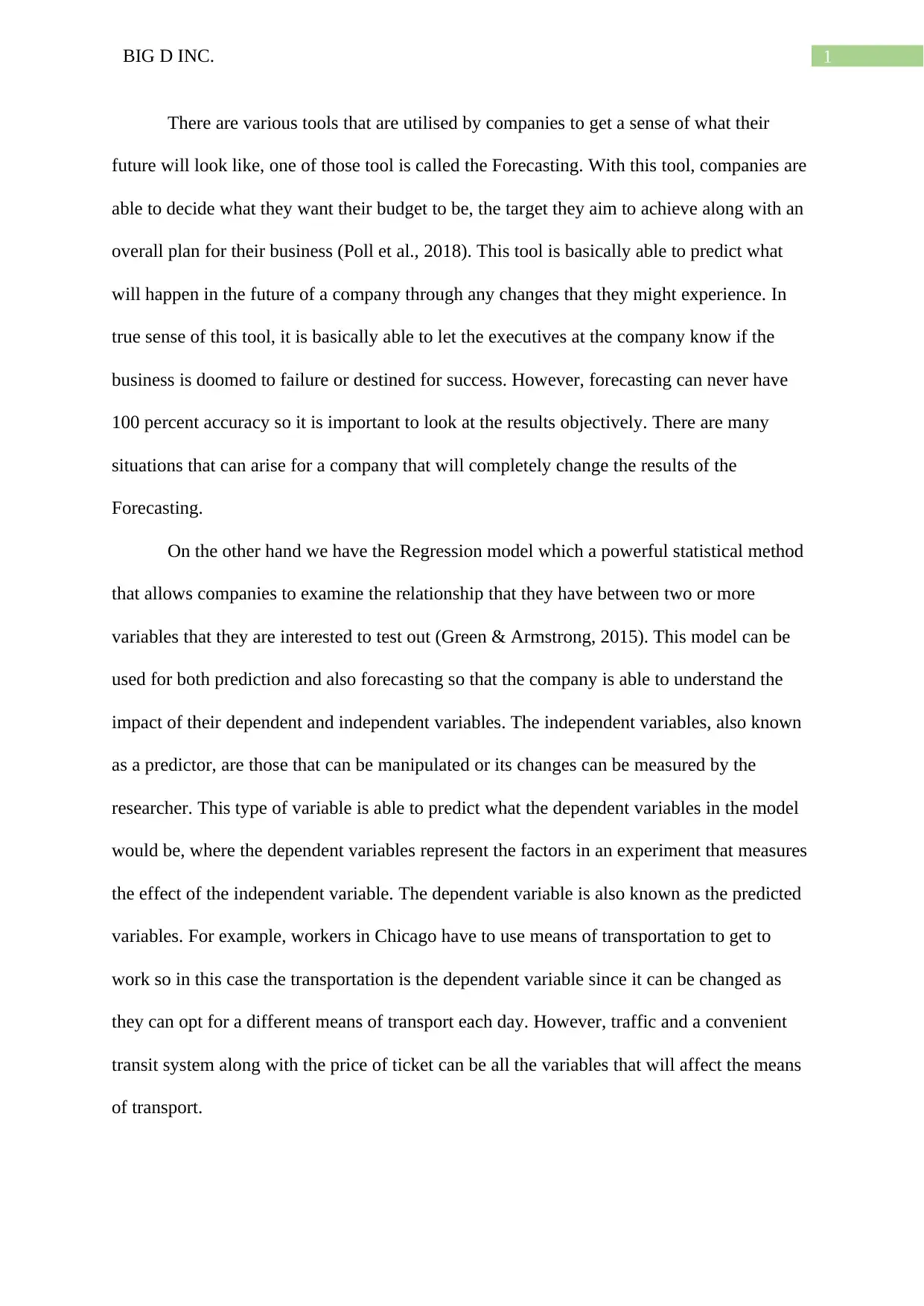
There are various tools that are utilised by companies to get a sense of what their
future will look like, one of those tool is called the Forecasting. With this tool, companies are
able to decide what they want their budget to be, the target they aim to achieve along with an
overall plan for their business (Poll et al., 2018). This tool is basically able to predict what
will happen in the future of a company through any changes that they might experience. In
true sense of this tool, it is basically able to let the executives at the company know if the
business is doomed to failure or destined for success. However, forecasting can never have
100 percent accuracy so it is important to look at the results objectively. There are many
situations that can arise for a company that will completely change the results of the
Forecasting.
On the other hand we have the Regression model which a powerful statistical method
that allows companies to examine the relationship that they have between two or more
variables that they are interested to test out (Green & Armstrong, 2015). This model can be
used for both prediction and also forecasting so that the company is able to understand the
impact of their dependent and independent variables. The independent variables, also known
as a predictor, are those that can be manipulated or its changes can be measured by the
researcher. This type of variable is able to predict what the dependent variables in the model
would be, where the dependent variables represent the factors in an experiment that measures
the effect of the independent variable. The dependent variable is also known as the predicted
variables. For example, workers in Chicago have to use means of transportation to get to
work so in this case the transportation is the dependent variable since it can be changed as
they can opt for a different means of transport each day. However, traffic and a convenient
transit system along with the price of ticket can be all the variables that will affect the means
of transport.
Document Page
2BIG D INC.
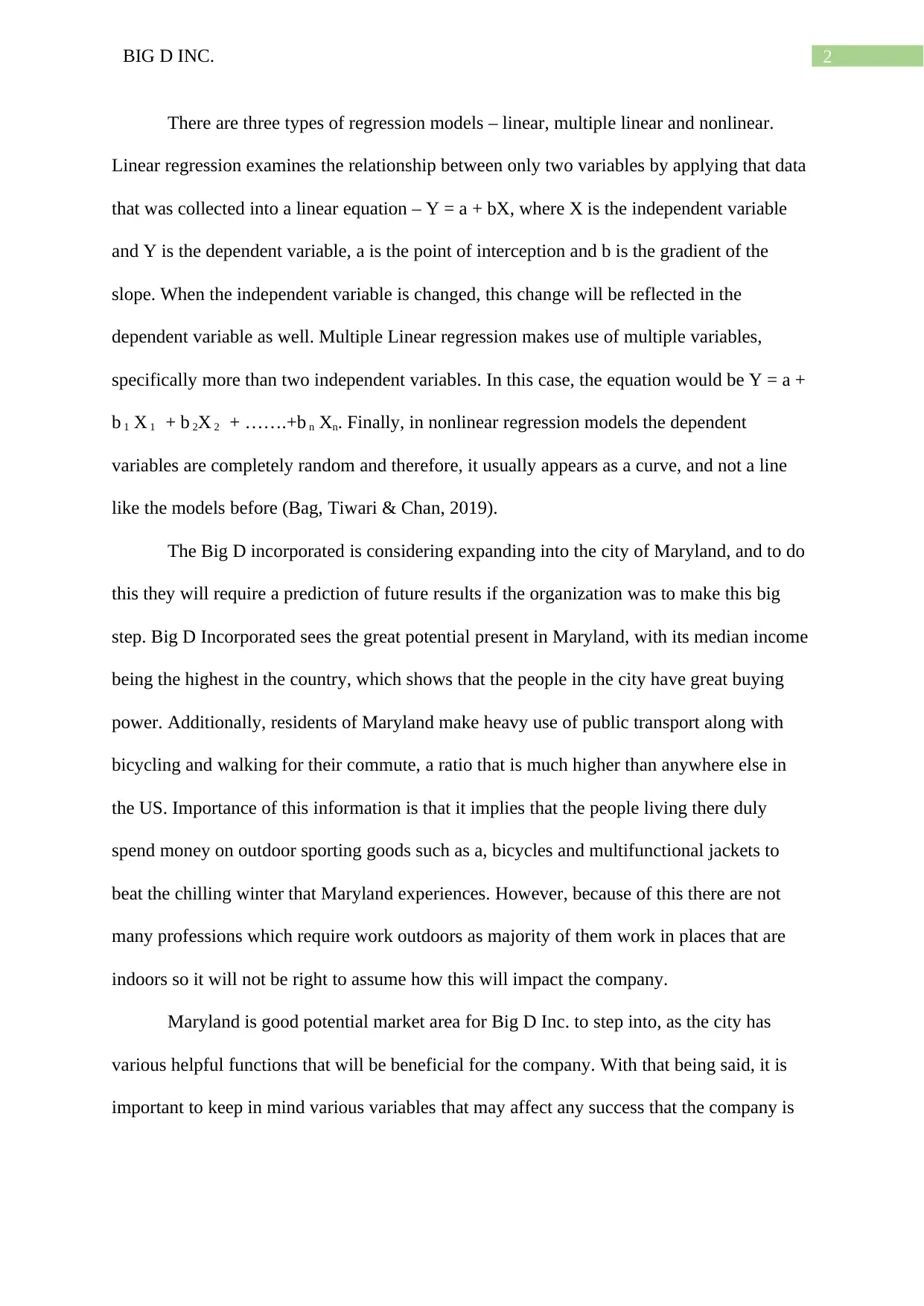
There are three types of regression models – linear, multiple linear and nonlinear.
Linear regression examines the relationship between only two variables by applying that data
that was collected into a linear equation – Y = a + bX, where X is the independent variable
and Y is the dependent variable, a is the point of interception and b is the gradient of the
slope. When the independent variable is changed, this change will be reflected in the
dependent variable as well. Multiple Linear regression makes use of multiple variables,
specifically more than two independent variables. In this case, the equation would be Y = a +
b 1 X 1 + b 2X 2 + …….+b n Xn. Finally, in nonlinear regression models the dependent
variables are completely random and therefore, it usually appears as a curve, and not a line
like the models before (Bag, Tiwari & Chan, 2019).
The Big D incorporated is considering expanding into the city of Maryland, and to do
this they will require a prediction of future results if the organization was to make this big
step. Big D Incorporated sees the great potential present in Maryland, with its median income
being the highest in the country, which shows that the people in the city have great buying
power. Additionally, residents of Maryland make heavy use of public transport along with
bicycling and walking for their commute, a ratio that is much higher than anywhere else in
the US. Importance of this information is that it implies that the people living there duly
spend money on outdoor sporting goods such as a, bicycles and multifunctional jackets to
beat the chilling winter that Maryland experiences. However, because of this there are not
many professions which require work outdoors as majority of them work in places that are
indoors so it will not be right to assume how this will impact the company.
Maryland is good potential market area for Big D Inc. to step into, as the city has
various helpful functions that will be beneficial for the company. With that being said, it is
important to keep in mind various variables that may affect any success that the company is
Document Page
3BIG D INC.
predicted to have. It will be important for executives at Big D Inc. to be prepared for all the
possible outcomes in order to be fully prepared.
tabler-icon-diamond-filled.svg

Paraphrase This Document

Need a fresh take? Get an instant paraphrase of this document with our AI Paraphraser
Document Page
4BIG D INC.
References:
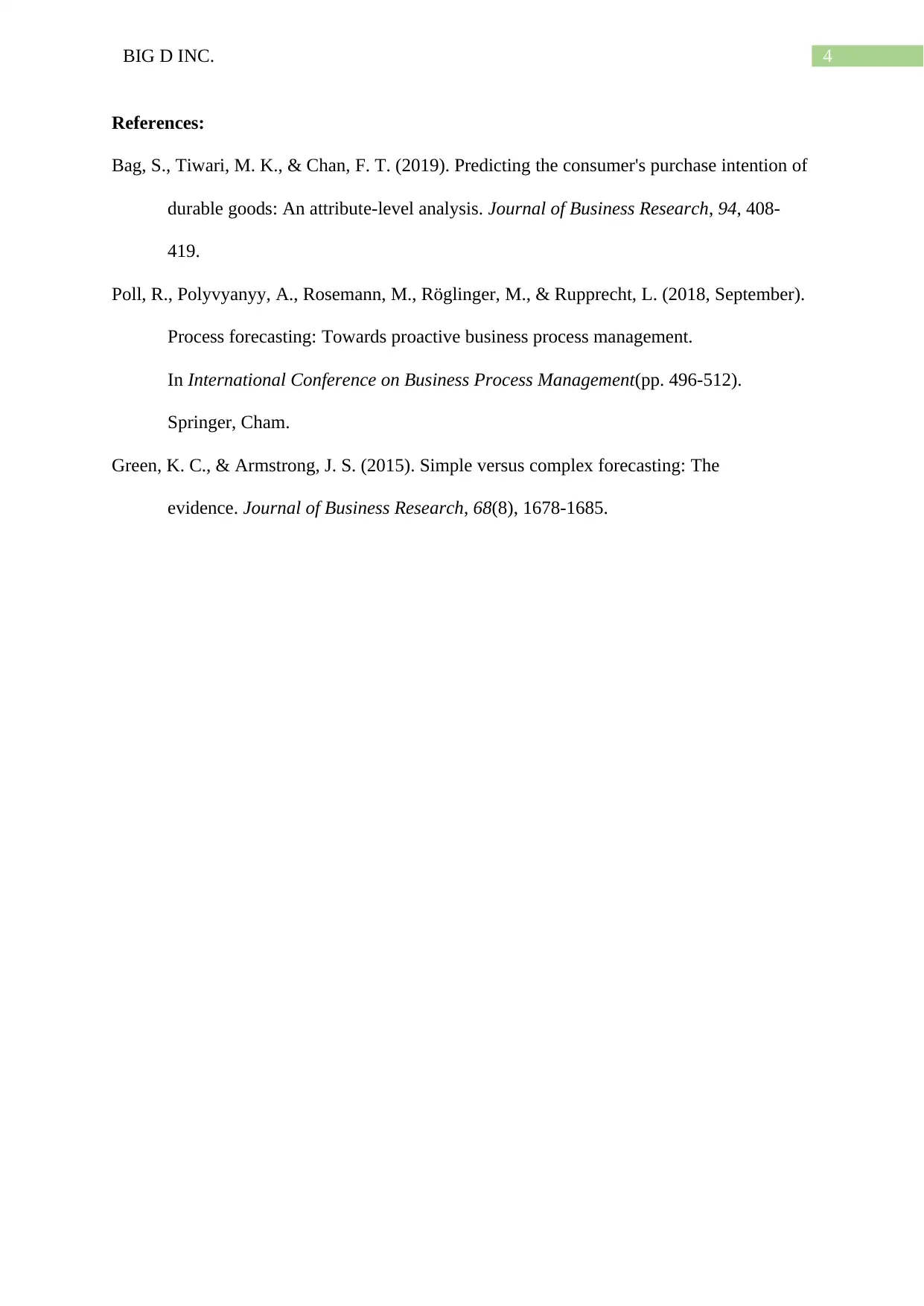
Bag, S., Tiwari, M. K., & Chan, F. T. (2019). Predicting the consumer's purchase intention of
durable goods: An attribute-level analysis. Journal of Business Research, 94, 408-
419.
Poll, R., Polyvyanyy, A., Rosemann, M., Röglinger, M., & Rupprecht, L. (2018, September).
Process forecasting: Towards proactive business process management.
In International Conference on Business Process Management(pp. 496-512).
Springer, Cham.
Green, K. C., & Armstrong, J. S. (2015). Simple versus complex forecasting: The
evidence. Journal of Business Research, 68(8), 1678-1685.
chevron_up_icon
1 out of 5
circle_padding
hide_on_mobile
zoom_out_icon
[object Object]