A Comprehensive Report on Big Data Analysis for Business Support
VerifiedAdded on 2023/06/07
|8
|2024
|336
Report
AI Summary
This report provides a comprehensive overview of big data analysis. It begins with a historical perspective, defining big data and outlining its core characteristics, including volume, variety, velocity, variability, and veracity. The report then delves into the challenges associated with big data analysis, such as the lack of expertise, data storage issues, and security concerns. It explores various techniques currently used to analyze big data, including regression analysis, hypothesis analysis, content analysis, and discourse analysis. Furthermore, the report examines how big data technology supports businesses through automation, in-depth insights, and improved decision-making processes. The document also includes a list of references.
Information systems
and big data analysis
and big data analysis

Paraphrase This Document
Need a fresh take? Get an instant paraphrase of this document with our AI Paraphraser
Table of Contents
History of Big data.................................................................................................................3
What is big data?....................................................................................................................3
Characteristics of big data......................................................................................................3
Challenges of big data analysis..............................................................................................4
Techniques that are currently available to analysis big data..................................................6
How big data technology could support business giving examples.......................................6
REFERENCES................................................................................................................................8
History of Big data.................................................................................................................3
What is big data?....................................................................................................................3
Characteristics of big data......................................................................................................3
Challenges of big data analysis..............................................................................................4
Techniques that are currently available to analysis big data..................................................6
How big data technology could support business giving examples.......................................6
REFERENCES................................................................................................................................8
History of Big data
Big Data has been defined with the aid of using a few Data Management pundits (with a chunk
of a snicker) as “huge, overwhelming, and uncontrollable quantities of information.” In 1663,
John Graunt dealt with “overwhelming quantities of information” as well, even as he studied the
bubonic plague, which turned into presently ravaging Europe. Graunt used facts statistics and is
credited with being the primary man to apply statistical information analysis. In the early 1800s,
the sector of statistics improved to consist accumulating and studying information. Evolution of
Big Data consists of some of initial steps for its foundation, and even as searching again to 1663
is not important for the growth of information volumes today, the factor stays that “Big Data” is
a relative term relying on who is discussing it. Big Data to Amazon or Google may be very
exclusive than Big Data to a medium-sized organization (Al-Abassi and Parizi, 2020).
What is big data?
Big Data is a group of statistics this is massive in extent, but developing exponentially with time.
It is a statistics with so huge size and complexity that none of conventional statistics control tools
can save it or process it efficiently. Big data is likewise a statistics however with massive size.
Big Data incorporates a huge quantity of statistics that is not always being processed through
conventional statistics storage or the processing unit. It is utilized by many multinational groups
to process the statistics and enterprise of many organizations. The statistics flow could exceed a
hundred and fifty exabytes in line with day earlier than replication (Bi and Wang, 2021).
Some examples of big data are as follows: the New York Stock Exchange is an instance of Big
Data that generates approximately one terabyte of recent change statistics in line with day. The
statistic suggests that 500+terabytes of recent statistics get assimilated into the databases of
social media page Facebook, each day. This statistics is specifically generated in phrases of
image and video uploads, message exchanges, setting remarks etc.
Big Data has been defined with the aid of using a few Data Management pundits (with a chunk
of a snicker) as “huge, overwhelming, and uncontrollable quantities of information.” In 1663,
John Graunt dealt with “overwhelming quantities of information” as well, even as he studied the
bubonic plague, which turned into presently ravaging Europe. Graunt used facts statistics and is
credited with being the primary man to apply statistical information analysis. In the early 1800s,
the sector of statistics improved to consist accumulating and studying information. Evolution of
Big Data consists of some of initial steps for its foundation, and even as searching again to 1663
is not important for the growth of information volumes today, the factor stays that “Big Data” is
a relative term relying on who is discussing it. Big Data to Amazon or Google may be very
exclusive than Big Data to a medium-sized organization (Al-Abassi and Parizi, 2020).
What is big data?
Big Data is a group of statistics this is massive in extent, but developing exponentially with time.
It is a statistics with so huge size and complexity that none of conventional statistics control tools
can save it or process it efficiently. Big data is likewise a statistics however with massive size.
Big Data incorporates a huge quantity of statistics that is not always being processed through
conventional statistics storage or the processing unit. It is utilized by many multinational groups
to process the statistics and enterprise of many organizations. The statistics flow could exceed a
hundred and fifty exabytes in line with day earlier than replication (Bi and Wang, 2021).
Some examples of big data are as follows: the New York Stock Exchange is an instance of Big
Data that generates approximately one terabyte of recent change statistics in line with day. The
statistic suggests that 500+terabytes of recent statistics get assimilated into the databases of
social media page Facebook, each day. This statistics is specifically generated in phrases of
image and video uploads, message exchanges, setting remarks etc.
⊘ This is a preview!⊘
Do you want full access?
Subscribe today to unlock all pages.

Trusted by 1+ million students worldwide
Characteristics of big data
5 V's of Big Data that defines the characteristics are:
Volume – The name of Big Data is itself associated with a length that is enormous. Size
of statistics performs a completely important position in figuring out value out of
statistics. Also, whether or not a selected statistics can truly be taken into consideration as
a Big Data, relies upon the extent of statistics. Hence, 'Volume' is one feature which is
required to be taken into consideration even as coping with Big Data solutions. Variety –
The subsequent component of Big Data is its variety (Hausladen and Schosser, 2020).
Variety explains heterogeneous sources and the character of statistics, both established
and unstructured. During advance days, spreadsheets and databases have been the best
sources of statistics taken into consideration through maximum of the applications.
Nowadays, statistics in the form of emails, photos, videos, tracking devices, PDFs, audio,
etc. also are being taken into consideration within the evaluation applications. This kind
of unstructured statistics poses certain problems for storage, mining and analysing
statistics.
Velocity – The velocity explains the speed of technology of statistics. How speedy the
statistics is generated and processed to fulfil the demands, determines actual ability
within the statistics. Velocity of big data offers with the velocity at which statistics flows
in from sources like enterprise processes, utility logs, networks, and social media sites,
sensors, Mobile devices, etc. The float of statistics is large and continuous.
Variability – This explains the inconsistency which may be proven through the statistics
at times, consequently hampering the manner of being capable to handle and control the
statistics effectively.
Veracity - Veracity explains how much the statistics is reliable. It has many approaches
to clear out or translate the statistics (Kovacova and Lewis, 2021). Veracity is the manner
of being capable of handling and controlling statistics efficiently. Big Data is likewise
important in enterprise development. For instance, Facebook posts with hashtags.
5 V's of Big Data that defines the characteristics are:
Volume – The name of Big Data is itself associated with a length that is enormous. Size
of statistics performs a completely important position in figuring out value out of
statistics. Also, whether or not a selected statistics can truly be taken into consideration as
a Big Data, relies upon the extent of statistics. Hence, 'Volume' is one feature which is
required to be taken into consideration even as coping with Big Data solutions. Variety –
The subsequent component of Big Data is its variety (Hausladen and Schosser, 2020).
Variety explains heterogeneous sources and the character of statistics, both established
and unstructured. During advance days, spreadsheets and databases have been the best
sources of statistics taken into consideration through maximum of the applications.
Nowadays, statistics in the form of emails, photos, videos, tracking devices, PDFs, audio,
etc. also are being taken into consideration within the evaluation applications. This kind
of unstructured statistics poses certain problems for storage, mining and analysing
statistics.
Velocity – The velocity explains the speed of technology of statistics. How speedy the
statistics is generated and processed to fulfil the demands, determines actual ability
within the statistics. Velocity of big data offers with the velocity at which statistics flows
in from sources like enterprise processes, utility logs, networks, and social media sites,
sensors, Mobile devices, etc. The float of statistics is large and continuous.
Variability – This explains the inconsistency which may be proven through the statistics
at times, consequently hampering the manner of being capable to handle and control the
statistics effectively.
Veracity - Veracity explains how much the statistics is reliable. It has many approaches
to clear out or translate the statistics (Kovacova and Lewis, 2021). Veracity is the manner
of being capable of handling and controlling statistics efficiently. Big Data is likewise
important in enterprise development. For instance, Facebook posts with hashtags.
Paraphrase This Document
Need a fresh take? Get an instant paraphrase of this document with our AI Paraphraser
Challenges of big data analysis
Big Data are characterised through excessive dimensionality and massive pattern size. These
capabilities raise 3 particular demanding challenges: (i) excessive dimensionality brings noise
accumulation, spurious correlations and incidental homogeneity; (ii) excessive dimensionality
mixed with massive pattern size creates problems along with heavy computational fee and
algorithmic instability; (iii) the big samples in Big Data are commonly aggregated from a couple
of sources at distinctive time factors utilising distinctive technology. This creates problems of
heterogeneity, experimental versions and statistical biases, and needs us to increase extra
adaptive and strong procedures (Li and Luo, 2022).
Lack of proper know-how of Big Data: Companies fail in projects of big data because of
inadequate know-how. Employees might not realize what facts is, its storage, processing,
significance, and sources. Data experts can also additionally realize what goes on,
however others might not have a clean picture. For instance, if personnel do not
recognize the significance of facts storage, they may not preserve the backup of touchy
facts. They may not use databases nicely for storage. As a result, whilst this vital facts is
required, it can not be retrieved easily.
Growth of data problems: One of the most demanding situations of Big Data is storing
these kind of big units of facts nicely. The quantity of facts being saved in data facilities
and databases of corporations is growing rapidly. As those data develop exponentially
with time, it gets extraordinarily tough to handle (Mangla and Zhang, 2020). Most of the
facts is unstructured and originated from documents, videos, audios, textual content
documents and different sources. This means one can not locate them in databases.
Confusion in selection for tool for big data: Companies frequently get burdened even as
choosing the excellent device for Big Data evaluation and storage. These questions
trouble corporations and every so often they are not able to find answers. They become
making poor choices and choosing irrelevant era. As a result, money, time, efforts and
hours of work are wasted.
Lack of data experts: To run those contemporary-day technology and tools of big data,
corporations want professional facts experts. These experts will consist of data scientists,
Big Data are characterised through excessive dimensionality and massive pattern size. These
capabilities raise 3 particular demanding challenges: (i) excessive dimensionality brings noise
accumulation, spurious correlations and incidental homogeneity; (ii) excessive dimensionality
mixed with massive pattern size creates problems along with heavy computational fee and
algorithmic instability; (iii) the big samples in Big Data are commonly aggregated from a couple
of sources at distinctive time factors utilising distinctive technology. This creates problems of
heterogeneity, experimental versions and statistical biases, and needs us to increase extra
adaptive and strong procedures (Li and Luo, 2022).
Lack of proper know-how of Big Data: Companies fail in projects of big data because of
inadequate know-how. Employees might not realize what facts is, its storage, processing,
significance, and sources. Data experts can also additionally realize what goes on,
however others might not have a clean picture. For instance, if personnel do not
recognize the significance of facts storage, they may not preserve the backup of touchy
facts. They may not use databases nicely for storage. As a result, whilst this vital facts is
required, it can not be retrieved easily.
Growth of data problems: One of the most demanding situations of Big Data is storing
these kind of big units of facts nicely. The quantity of facts being saved in data facilities
and databases of corporations is growing rapidly. As those data develop exponentially
with time, it gets extraordinarily tough to handle (Mangla and Zhang, 2020). Most of the
facts is unstructured and originated from documents, videos, audios, textual content
documents and different sources. This means one can not locate them in databases.
Confusion in selection for tool for big data: Companies frequently get burdened even as
choosing the excellent device for Big Data evaluation and storage. These questions
trouble corporations and every so often they are not able to find answers. They become
making poor choices and choosing irrelevant era. As a result, money, time, efforts and
hours of work are wasted.
Lack of data experts: To run those contemporary-day technology and tools of big data,
corporations want professional facts experts. These experts will consist of data scientists,
data analysts and data engineers who' are skilled in running with the tools and making
facts out of big data units (Verma and Kumar, 2018).
Data security: Securing those big units of facts is one of the daunting demanding
situations of Big Data. Often corporations are so busy in know-how, storing and reading
their data units that they push data safety for later stages. But, this is not a clever step as
unprotected facts repositories can end up breeding grounds for malicious hackers.
Data integration from loads of sources: Data in an corporation comes from loads of
sources, like social media pages, ERP applications, consumer logs, monetary reviews, e-
mails, shows and reviews created through personnel. Combining all this facts to put
together reviews is a tough task. This is a place frequently overlooked through firms. But,
facts integration is important for evaluation, reporting and enterprise intelligence, so it
must be perfect.
Techniques that are currently available to analysis big data
The top 4 data analysis techniques are as follows:
Regression analysis: This is a quantitative data analysis technique. It examines relationships
between two variables.
Hypothesis analysis: This is also a quantitative data analysis technique. It is used to tests whether
a hypothesis is true.
Content analysis: This is a qualitative data analysis technique. It measures content changes over
time and across media.
Discourse analysis: This is also a qualitative data analysis technique. It is used to explore
conversations in their social context.
How big data technology could support business giving examples
Understanding and utilising massive data is an essential competitive gain for main corporations.
To the extent corporations can gather greater facts from present infrastructure and customers will
provide them the possibility to find out hidden insights that their competition do not have get
access to. Big data can show an abundance of latest increase in opportunities, from inner insights
to front-going facing client interactions. Three principal enterprise opportunities include:
automation, in-depth insights, and data driven making of decisions.
facts out of big data units (Verma and Kumar, 2018).
Data security: Securing those big units of facts is one of the daunting demanding
situations of Big Data. Often corporations are so busy in know-how, storing and reading
their data units that they push data safety for later stages. But, this is not a clever step as
unprotected facts repositories can end up breeding grounds for malicious hackers.
Data integration from loads of sources: Data in an corporation comes from loads of
sources, like social media pages, ERP applications, consumer logs, monetary reviews, e-
mails, shows and reviews created through personnel. Combining all this facts to put
together reviews is a tough task. This is a place frequently overlooked through firms. But,
facts integration is important for evaluation, reporting and enterprise intelligence, so it
must be perfect.
Techniques that are currently available to analysis big data
The top 4 data analysis techniques are as follows:
Regression analysis: This is a quantitative data analysis technique. It examines relationships
between two variables.
Hypothesis analysis: This is also a quantitative data analysis technique. It is used to tests whether
a hypothesis is true.
Content analysis: This is a qualitative data analysis technique. It measures content changes over
time and across media.
Discourse analysis: This is also a qualitative data analysis technique. It is used to explore
conversations in their social context.
How big data technology could support business giving examples
Understanding and utilising massive data is an essential competitive gain for main corporations.
To the extent corporations can gather greater facts from present infrastructure and customers will
provide them the possibility to find out hidden insights that their competition do not have get
access to. Big data can show an abundance of latest increase in opportunities, from inner insights
to front-going facing client interactions. Three principal enterprise opportunities include:
automation, in-depth insights, and data driven making of decisions.
⊘ This is a preview!⊘
Do you want full access?
Subscribe today to unlock all pages.
Trusted by 1+ million students worldwide
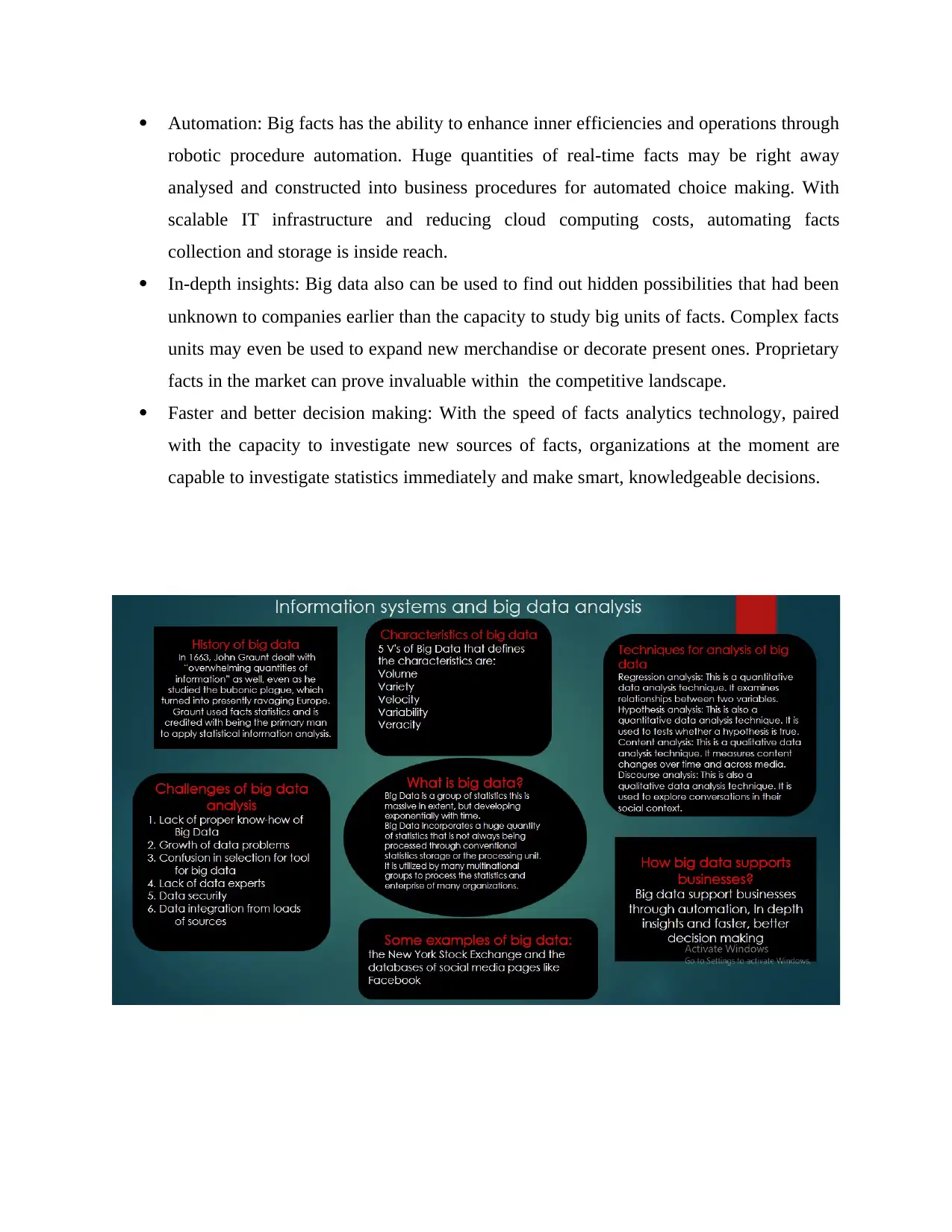
Automation: Big facts has the ability to enhance inner efficiencies and operations through
robotic procedure automation. Huge quantities of real-time facts may be right away
analysed and constructed into business procedures for automated choice making. With
scalable IT infrastructure and reducing cloud computing costs, automating facts
collection and storage is inside reach.
In-depth insights: Big data also can be used to find out hidden possibilities that had been
unknown to companies earlier than the capacity to study big units of facts. Complex facts
units may even be used to expand new merchandise or decorate present ones. Proprietary
facts in the market can prove invaluable within the competitive landscape.
Faster and better decision making: With the speed of facts analytics technology, paired
with the capacity to investigate new sources of facts, organizations at the moment are
capable to investigate statistics immediately and make smart, knowledgeable decisions.
robotic procedure automation. Huge quantities of real-time facts may be right away
analysed and constructed into business procedures for automated choice making. With
scalable IT infrastructure and reducing cloud computing costs, automating facts
collection and storage is inside reach.
In-depth insights: Big data also can be used to find out hidden possibilities that had been
unknown to companies earlier than the capacity to study big units of facts. Complex facts
units may even be used to expand new merchandise or decorate present ones. Proprietary
facts in the market can prove invaluable within the competitive landscape.
Faster and better decision making: With the speed of facts analytics technology, paired
with the capacity to investigate new sources of facts, organizations at the moment are
capable to investigate statistics immediately and make smart, knowledgeable decisions.
Paraphrase This Document
Need a fresh take? Get an instant paraphrase of this document with our AI Paraphraser
REFERENCES
Books and Journals
Al-Abassi, A. and Parizi, R.M., 2020. Industrial big data analytics: challenges and
opportunities. Handbook of big data privacy. pp.37-61.
Bi, Z. and Wang, L., 2021. Internet of things (IoT) and big data analytics (BDA) for digital
manufacturing (DM). International Journal of Production Research. pp.1-18.
Hausladen, I. and Schosser, M., 2020. Towards a maturity model for big data analytics in airline
network planning. Journal of Air Transport Management, 82. p.101721.
Kovacova, M. and Lewis, E., 2021. Smart factory performance, cognitive automation, and
industrial big data analytics in sustainable manufacturing internet of things. Journal of
Self-Governance & Management Economics, 9(3).
Li, L. and Luo, X.R., 2022. Evaluating the impact of big data analytics usage on the decision-
making quality of organizations. Technological Forecasting and Social Change, 175.
p.121355.
Mangla and Zhang, Z.J., 2020. Mediating effect of big data analytics on project performance of
small and medium enterprises. Journal of Enterprise Information Management.
Verma, S. and Kumar, S., 2018. An extension of the technology acceptance model in the big data
analytics system implementation environment. Information Processing &
Management, 54(5). pp.791-806.
Books and Journals
Al-Abassi, A. and Parizi, R.M., 2020. Industrial big data analytics: challenges and
opportunities. Handbook of big data privacy. pp.37-61.
Bi, Z. and Wang, L., 2021. Internet of things (IoT) and big data analytics (BDA) for digital
manufacturing (DM). International Journal of Production Research. pp.1-18.
Hausladen, I. and Schosser, M., 2020. Towards a maturity model for big data analytics in airline
network planning. Journal of Air Transport Management, 82. p.101721.
Kovacova, M. and Lewis, E., 2021. Smart factory performance, cognitive automation, and
industrial big data analytics in sustainable manufacturing internet of things. Journal of
Self-Governance & Management Economics, 9(3).
Li, L. and Luo, X.R., 2022. Evaluating the impact of big data analytics usage on the decision-
making quality of organizations. Technological Forecasting and Social Change, 175.
p.121355.
Mangla and Zhang, Z.J., 2020. Mediating effect of big data analytics on project performance of
small and medium enterprises. Journal of Enterprise Information Management.
Verma, S. and Kumar, S., 2018. An extension of the technology acceptance model in the big data
analytics system implementation environment. Information Processing &
Management, 54(5). pp.791-806.

1 out of 8


Related Documents


Your All-in-One AI-Powered Toolkit for Academic Success.
+13062052269
info@desklib.com
Available 24*7 on WhatsApp / Email
![[object Object]](/_next/static/media/star-bottom.7253800d.svg)
Unlock your academic potential
Copyright © 2020–2026 A2Z Services. All Rights Reserved. Developed and managed by ZUCOL.