A Research Report on Big Data Use in Business Organizations
VerifiedAdded on 2021/06/14
|13
|2858
|37
Report
AI Summary
This report delves into the contemporary use of big data within business organizations, examining its significance and impact. It explores the research methodology employed, focusing on both qualitative and quantitative approaches, including questionnaires, interviews, and statistical analysis. The report investigates the advantages of big data, such as gaining a competitive edge, re-developing products, ensuring data safety, carrying out risk evaluation, and generating new revenue streams. It also outlines the processes of big data use, including understanding and targeting consumers, optimizing business processes, enhancing performance, and improving public health care. The research addresses key questions regarding the efficient use of big data, its applications in daily business operations, and the reasons behind its adoption by companies. Limitations in data collection and potential biases are acknowledged. The report concludes by highlighting the importance of big data in understanding consumer behavior and making informed business decisions, offering valuable insights for researchers and practitioners alike.
Running head: BIG DATA USE IN BUSINESS ORGNIZATIONS
Big Data Use in Business Organizations
Name of the University:
Name of the Student:
Authors Note:
Big Data Use in Business Organizations
Name of the University:
Name of the Student:
Authors Note:

Paraphrase This Document
Need a fresh take? Get an instant paraphrase of this document with our AI Paraphraser
1BIG DATA USE IN BUSINESS ORGNIZATIONS
1. Introduction
It is evident that all the businesses in the world irrespective of their sixes along with the
amount of business do not require a huge data amount along with insights to turn out to be
successful within the increasingly competitive business surrounding (Akter et al. 2016). The use
of big data within the companies or its management facilitates in the recognition of the target
consumer group along with facilitating to recognize the preferences or the choices of the
consumers. The identification, implementation along with the evaluation of distinct data forms
can be helpful in attaining all the organizational objectives to make their business successful
within the complex competitive environment (Chen, Preston and Swink 2015). The report
intends to deal with the contemporary concerns related with the use of big data by the
companies. The paper will also focus on explaining the research methodology that will be
employed in investigating the role of big data use within companies.
2. Project objective
The major objective in carrying out investigation in this paper is to reveal the ways in
which the necessary big data or bulk amount is employed for the daily use of business operations
by the organizations.
Another objective of this report is to evaluate the reasons behind use of such type of
information by the business companies and also the major users of the different large data forms
by the organizational heads will be analyzed.
The research has an objective of playing a vital role in determining suitable use, needs
and storage for the big data by various business organizations.
1. Introduction
It is evident that all the businesses in the world irrespective of their sixes along with the
amount of business do not require a huge data amount along with insights to turn out to be
successful within the increasingly competitive business surrounding (Akter et al. 2016). The use
of big data within the companies or its management facilitates in the recognition of the target
consumer group along with facilitating to recognize the preferences or the choices of the
consumers. The identification, implementation along with the evaluation of distinct data forms
can be helpful in attaining all the organizational objectives to make their business successful
within the complex competitive environment (Chen, Preston and Swink 2015). The report
intends to deal with the contemporary concerns related with the use of big data by the
companies. The paper will also focus on explaining the research methodology that will be
employed in investigating the role of big data use within companies.
2. Project objective
The major objective in carrying out investigation in this paper is to reveal the ways in
which the necessary big data or bulk amount is employed for the daily use of business operations
by the organizations.
Another objective of this report is to evaluate the reasons behind use of such type of
information by the business companies and also the major users of the different large data forms
by the organizational heads will be analyzed.
The research has an objective of playing a vital role in determining suitable use, needs
and storage for the big data by various business organizations.
2BIG DATA USE IN BUSINESS ORGNIZATIONS
3. Project scope
The current research focuses on investigating the role of big data use within the business
organization irrespective of the fact whether it is large or small (Akter et al. 2016). The research
has taken into consideration a huge amount of distinct elements such as the likes of distinct data
types used by companies, their implications, their applications, implementation along with the
way they are employed by the companies. The scope of this research is also focused on
providing useful implications regarding process of the big data use by companies so that they can
bring competitive advantages (Erevelles and Swayne 2016). The emergence of all such different
aspects within this current research has facilitated in developing the research scope that is much
larger in size. It is deemed that this repot has several implications in analyzing the advantages
and use of big data in companies that will make it one of the useful reports which can be helpful
for the researchers to carry out future research on this topic.
4. Literature review
4.1. Big Data
Erevelles, Fukawa and Swayne (2016) indicated that the big data within the organizations
are required for different reasons that encompass the likes of the identification of the anticipated
consumers for the company, preference identification regarding the consumers along with
several other similar factors. Erevelles and Swayne (2016) revealed that big data can be
explained as a combination of all the processes along with tools that is associated with the
management and use of large data set volume. The following concept was introduced for
attaining a clear picture of the preferences, trends along with patterns amongst huge range of
database which was generated at the time the individuals interacts with distinct kinds of systems.
3. Project scope
The current research focuses on investigating the role of big data use within the business
organization irrespective of the fact whether it is large or small (Akter et al. 2016). The research
has taken into consideration a huge amount of distinct elements such as the likes of distinct data
types used by companies, their implications, their applications, implementation along with the
way they are employed by the companies. The scope of this research is also focused on
providing useful implications regarding process of the big data use by companies so that they can
bring competitive advantages (Erevelles and Swayne 2016). The emergence of all such different
aspects within this current research has facilitated in developing the research scope that is much
larger in size. It is deemed that this repot has several implications in analyzing the advantages
and use of big data in companies that will make it one of the useful reports which can be helpful
for the researchers to carry out future research on this topic.
4. Literature review
4.1. Big Data
Erevelles, Fukawa and Swayne (2016) indicated that the big data within the organizations
are required for different reasons that encompass the likes of the identification of the anticipated
consumers for the company, preference identification regarding the consumers along with
several other similar factors. Erevelles and Swayne (2016) revealed that big data can be
explained as a combination of all the processes along with tools that is associated with the
management and use of large data set volume. The following concept was introduced for
attaining a clear picture of the preferences, trends along with patterns amongst huge range of
database which was generated at the time the individuals interacts with distinct kinds of systems.
⊘ This is a preview!⊘
Do you want full access?
Subscribe today to unlock all pages.

Trusted by 1+ million students worldwide
3BIG DATA USE IN BUSINESS ORGNIZATIONS
Flick (2015) also stated that the big data concept is not new and it is observed that the modern
business world has evidenced increased dependence on the big data by the organizations in order
to install basic facilities along with implementing the same for attaining market success. These
researchers also evidenced that implementation of big data by these companies clears the way in
order to attain increased information regarding the market condition, the consumer strategies
along with focusing greatly in the consumer perceptions. The benefits of the big data are
explained in most of the previous researches available.
4.2. Advantages of Big Data
Xu, Frankwick and Ramirez (2016) examined several advantages that can be attained by
the big data are explained below:
Big data in attaining competitive edge: Big data can facilitate in reaching out better
evaluating on the initial stages of any business. Considering same, it can be said that big
data can be a key to success for businesses in capturing market share and compete
successfully in the market.
Re-developing products: Wamba et al. (2015) stared that big data is efficient in
collecting and employing feedback attained from consumers. Evaluation of such
consumer feedback analysis can facilitate companies in understanding their product
expectations based on which amendments can be made in organizations structure.
Data safety: Tools that are used in big data analysis can facilitate the organizations in
mapping total data amounts that is available and processes within business systems. This
facilitates maintaining confidential company information in a safe manner.
Flick (2015) also stated that the big data concept is not new and it is observed that the modern
business world has evidenced increased dependence on the big data by the organizations in order
to install basic facilities along with implementing the same for attaining market success. These
researchers also evidenced that implementation of big data by these companies clears the way in
order to attain increased information regarding the market condition, the consumer strategies
along with focusing greatly in the consumer perceptions. The benefits of the big data are
explained in most of the previous researches available.
4.2. Advantages of Big Data
Xu, Frankwick and Ramirez (2016) examined several advantages that can be attained by
the big data are explained below:
Big data in attaining competitive edge: Big data can facilitate in reaching out better
evaluating on the initial stages of any business. Considering same, it can be said that big
data can be a key to success for businesses in capturing market share and compete
successfully in the market.
Re-developing products: Wamba et al. (2015) stared that big data is efficient in
collecting and employing feedback attained from consumers. Evaluation of such
consumer feedback analysis can facilitate companies in understanding their product
expectations based on which amendments can be made in organizations structure.
Data safety: Tools that are used in big data analysis can facilitate the organizations in
mapping total data amounts that is available and processes within business systems. This
facilitates maintaining confidential company information in a safe manner.
Paraphrase This Document
Need a fresh take? Get an instant paraphrase of this document with our AI Paraphraser

4BIG DATA USE IN BUSINESS ORGNIZATIONS
Carrying into risk evaluation: Wamba et al. (2015) indicated that carrying out risk
analysis is supported by predictive analysis if big data that facilitates in proper evaluation
of social media reports and consumer feedback.
Generating new revenue streams: Apart from installing infrastructure companies need
to operate big data that can provide the management in changing performance of
companies along with consumer demands.
4.3. Process of Big Data Use in Organizations
Taylor, Bogdan and DeVault (2015) certain vital processes through which the following
data can be implemented and employed by management of the organizations:
Understanding and targeting consumers: A company’s management is greatly agreed
in expanding traditional database through means of social media, browser logo and text
media analytics. This facilitates in targeting and understanding consumers based on their
product expectations.
Optimizing various business processes: Smith (2015) stated that big data has several
simplified ways in optimizing several processes within the organizations. It is vital for the
business operations for information optimization as it is supportive in future outcome
predictions.
Performance optimization and personal qualification: Riggins and Wamba (2015)
evidenced that big data is not just for maintaining effective business operations but also
for personal improvement tools for employees. The organization offers well equipped
technology advanced wearable devices set such as smart watches for increasing employee
productivity.
Carrying into risk evaluation: Wamba et al. (2015) indicated that carrying out risk
analysis is supported by predictive analysis if big data that facilitates in proper evaluation
of social media reports and consumer feedback.
Generating new revenue streams: Apart from installing infrastructure companies need
to operate big data that can provide the management in changing performance of
companies along with consumer demands.
4.3. Process of Big Data Use in Organizations
Taylor, Bogdan and DeVault (2015) certain vital processes through which the following
data can be implemented and employed by management of the organizations:
Understanding and targeting consumers: A company’s management is greatly agreed
in expanding traditional database through means of social media, browser logo and text
media analytics. This facilitates in targeting and understanding consumers based on their
product expectations.
Optimizing various business processes: Smith (2015) stated that big data has several
simplified ways in optimizing several processes within the organizations. It is vital for the
business operations for information optimization as it is supportive in future outcome
predictions.
Performance optimization and personal qualification: Riggins and Wamba (2015)
evidenced that big data is not just for maintaining effective business operations but also
for personal improvement tools for employees. The organization offers well equipped
technology advanced wearable devices set such as smart watches for increasing employee
productivity.
5BIG DATA USE IN BUSINESS ORGNIZATIONS
Public heath care improvement: Mackey and Gass (2015) stated that data regarding
health of distinct individuals can be simply available from the smart watches that will
make it simple for the doctors for suggesting effective ways in treatment of different
individuals. The usefulness of internet along with computer technologies evaluation and
artificial intelligence that facilitates effectible heath sector growth.
5. Research question100
5.1. Primary Question
The primary question set out in this research and that is to be answered through the
completion of this research is:
What are the ways in which big data use can be employed efficiently within companies?
5.2. Secondary Questions
The secondary questions those are to be answered in investigating the big data se within
business organizations are explained under:
What are the ways in which the necessary big data or bulk amount is employed for the
daily use of business operations by the organizations?
What are the reasons behind use of such type of information by the business companies
and also the major users of the different large data forms by the organizational heads?
How big data has a vital role in determining suitable use, needs and storage for them by
various business organizations?
Public heath care improvement: Mackey and Gass (2015) stated that data regarding
health of distinct individuals can be simply available from the smart watches that will
make it simple for the doctors for suggesting effective ways in treatment of different
individuals. The usefulness of internet along with computer technologies evaluation and
artificial intelligence that facilitates effectible heath sector growth.
5. Research question100
5.1. Primary Question
The primary question set out in this research and that is to be answered through the
completion of this research is:
What are the ways in which big data use can be employed efficiently within companies?
5.2. Secondary Questions
The secondary questions those are to be answered in investigating the big data se within
business organizations are explained under:
What are the ways in which the necessary big data or bulk amount is employed for the
daily use of business operations by the organizations?
What are the reasons behind use of such type of information by the business companies
and also the major users of the different large data forms by the organizational heads?
How big data has a vital role in determining suitable use, needs and storage for them by
various business organizations?
⊘ This is a preview!⊘
Do you want full access?
Subscribe today to unlock all pages.
Trusted by 1+ million students worldwide
6BIG DATA USE IN BUSINESS ORGNIZATIONS
6. Research design and methodology
6.1. Qualitative Research
Qualitative data for investigating the role of big data use in the organizations will be
gathered from employing the questionnaire method. Interview method will be employed by the
researcher in attaining suitable responses on big data use within their organizations for attaining
competitive advantages (Smith 2015). In employing such qualitative data collection method
certain effective open and close ended questions will be asked to all the selected survey
respondents or managers of selected Australian organizations. In addition, the researcher will
primarily consider inviting the employees of Australian organizations in filling up the
questionnaire through social media platform (Alvesson and Sköldberg 2017). For attaining
qualitative data the researcher has also considered sending e-mails to its respondents that have
shown increased interest and the respondents are offered a period of seven days in fling up the
questionnaire. Such qualitative method has facilitated in gathering necessary explanation,
understanding along with interpretation of employees and situations in which investigating is
carried out (Taylor, Bogdan and DeVault 2015).
6.2. Quantitative Research
In investigating the role of big data use in business organizations, the researcher has
considered employing both the primary as well as secondary data. Secondary data regarding big
data use by organizations will be gathered from authentic government websites, journals and the
authentic data sources (Chen, Preston and Swink 2015). The quantitative data focuses on
attaining a relatively bigger size for its analysis. Considering the same, the employees working
within the selected organizations will be selected in evaluating the ways in which big data is used
by these Australian companies (Taylor, Bogdan and DeVault 2015). Single random sampling is
6. Research design and methodology
6.1. Qualitative Research
Qualitative data for investigating the role of big data use in the organizations will be
gathered from employing the questionnaire method. Interview method will be employed by the
researcher in attaining suitable responses on big data use within their organizations for attaining
competitive advantages (Smith 2015). In employing such qualitative data collection method
certain effective open and close ended questions will be asked to all the selected survey
respondents or managers of selected Australian organizations. In addition, the researcher will
primarily consider inviting the employees of Australian organizations in filling up the
questionnaire through social media platform (Alvesson and Sköldberg 2017). For attaining
qualitative data the researcher has also considered sending e-mails to its respondents that have
shown increased interest and the respondents are offered a period of seven days in fling up the
questionnaire. Such qualitative method has facilitated in gathering necessary explanation,
understanding along with interpretation of employees and situations in which investigating is
carried out (Taylor, Bogdan and DeVault 2015).
6.2. Quantitative Research
In investigating the role of big data use in business organizations, the researcher has
considered employing both the primary as well as secondary data. Secondary data regarding big
data use by organizations will be gathered from authentic government websites, journals and the
authentic data sources (Chen, Preston and Swink 2015). The quantitative data focuses on
attaining a relatively bigger size for its analysis. Considering the same, the employees working
within the selected organizations will be selected in evaluating the ways in which big data is used
by these Australian companies (Taylor, Bogdan and DeVault 2015). Single random sampling is
Paraphrase This Document
Need a fresh take? Get an instant paraphrase of this document with our AI Paraphraser
7BIG DATA USE IN BUSINESS ORGNIZATIONS
employed by the researchers in selecting appropriate size for the reason that in this sampling
technique there is an equal chance of all the respondents to get selected from the selected
research population (Alvesson and Sköldberg 2017).
Considering the same, 51 employees from selected companies of Australia are chosen for
attaining their viewpoints regarding big data use in and competitive advantages that are attained
by their organizations. Quantitative data will be gathered through employing interview research
instrument as this can offer relevant information on the subject of inclination regarding human
perception regarding specific research information of big data use (Alvesson and Sköldberg
2017). Quantitative data gathered will be analyzed through employing reliable statistical tools
such as MS excel. Moreover, correlation and regression analysis will also be conducted for
attaining suitable results regarding the data gathered from the employee opinions. Such results
gathered will be represented through employing graphs and charts that can facilitate in better
evaluation of collected interview responses (Alvesson and Sköldberg 2017).
7. Research limitations
Desire of having several research implications, the current research has numerous
limitations that are associated with its data collection method. As primary data has been gathered
from the managers of the selected organizations there are increased risk regarding ensuring the
reliability of such data (Alvesson and Sköldberg 2017). The reliability of the information
gathered from interview might get affected as the employees might have a tendency to providing
positive image of the companies through disclosing the major concerns. Another limitation of
this research is too observed in collection of secondary data as it might get manipulated to a
employed by the researchers in selecting appropriate size for the reason that in this sampling
technique there is an equal chance of all the respondents to get selected from the selected
research population (Alvesson and Sköldberg 2017).
Considering the same, 51 employees from selected companies of Australia are chosen for
attaining their viewpoints regarding big data use in and competitive advantages that are attained
by their organizations. Quantitative data will be gathered through employing interview research
instrument as this can offer relevant information on the subject of inclination regarding human
perception regarding specific research information of big data use (Alvesson and Sköldberg
2017). Quantitative data gathered will be analyzed through employing reliable statistical tools
such as MS excel. Moreover, correlation and regression analysis will also be conducted for
attaining suitable results regarding the data gathered from the employee opinions. Such results
gathered will be represented through employing graphs and charts that can facilitate in better
evaluation of collected interview responses (Alvesson and Sköldberg 2017).
7. Research limitations
Desire of having several research implications, the current research has numerous
limitations that are associated with its data collection method. As primary data has been gathered
from the managers of the selected organizations there are increased risk regarding ensuring the
reliability of such data (Alvesson and Sköldberg 2017). The reliability of the information
gathered from interview might get affected as the employees might have a tendency to providing
positive image of the companies through disclosing the major concerns. Another limitation of
this research is too observed in collection of secondary data as it might get manipulated to a
8BIG DATA USE IN BUSINESS ORGNIZATIONS
certain extent. Moreover, this might also affect the research quality along with the research
findings (Ary et al. 2018).
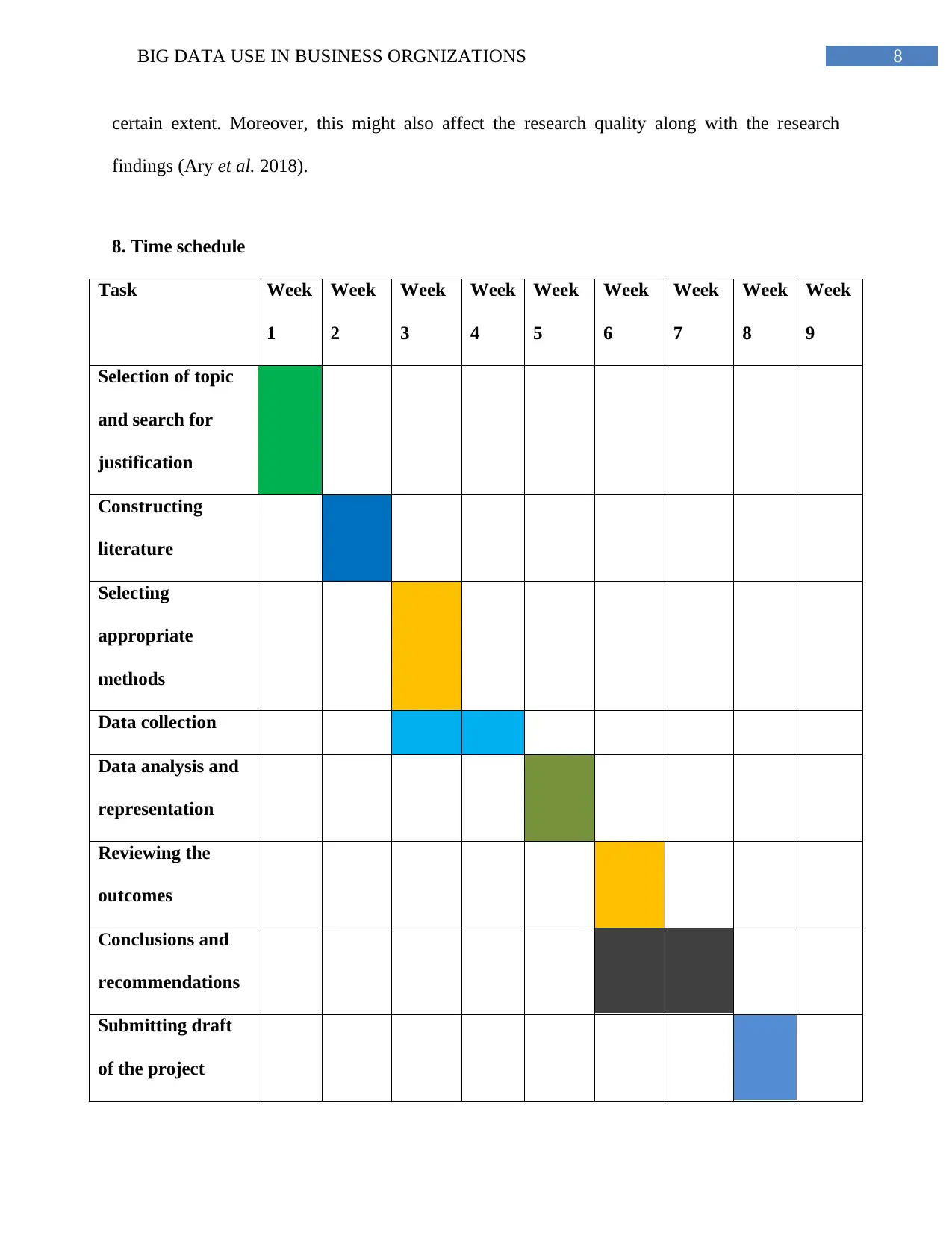
8. Time schedule
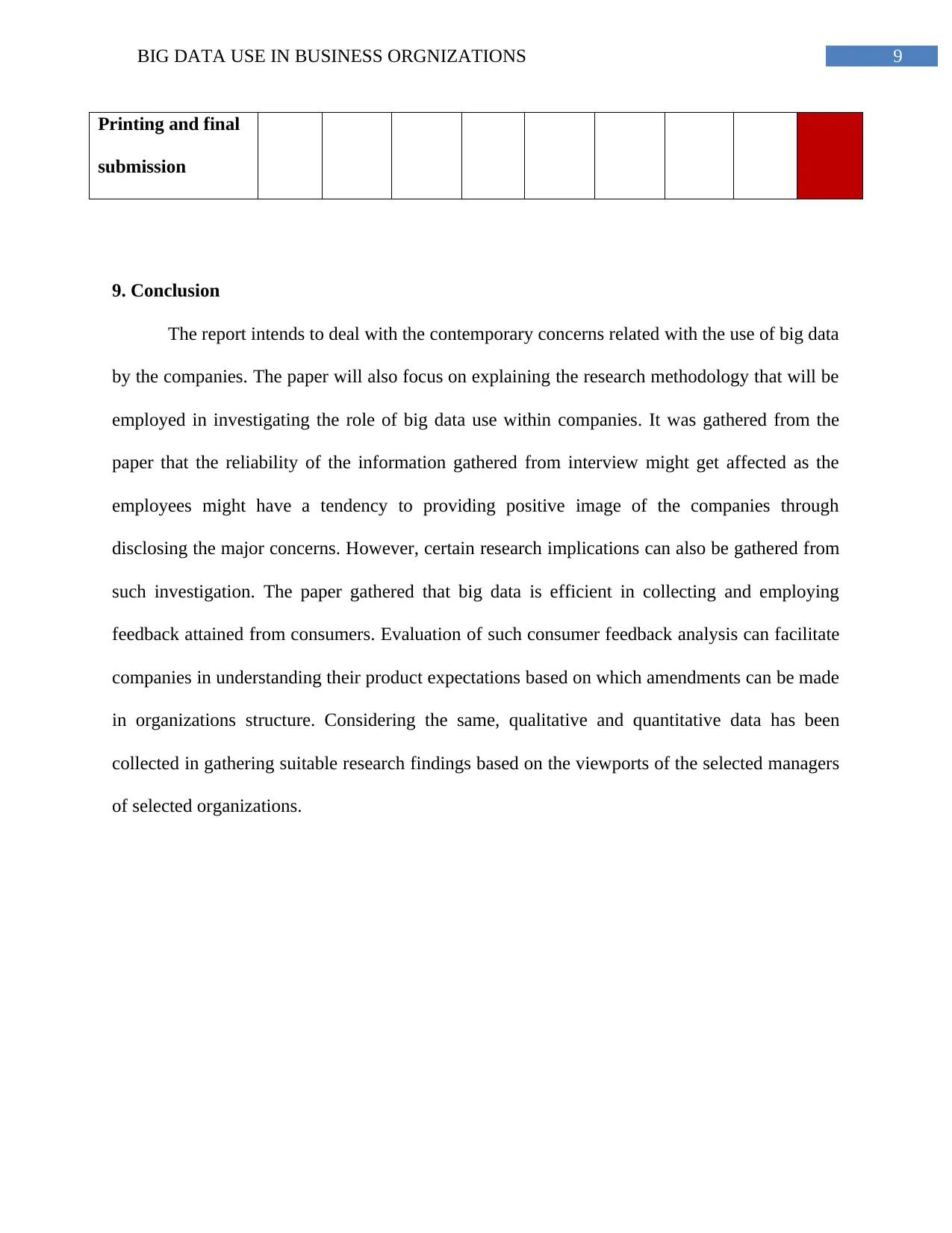
Task Week
1
Week
2
Week
3
Week
4
Week
5
Week
6
Week
7
Week
8
Week
9
Selection of topic
and search for
justification
Constructing
literature
Selecting
appropriate
methods
Data collection
Data analysis and
representation
Reviewing the
outcomes
Conclusions and
recommendations
Submitting draft
of the project
certain extent. Moreover, this might also affect the research quality along with the research
findings (Ary et al. 2018).
8. Time schedule
Task Week
1
Week
2
Week
3
Week
4
Week
5
Week
6
Week
7
Week
8
Week
9
Selection of topic
and search for
justification
Constructing
literature
Selecting
appropriate
methods
Data collection
Data analysis and
representation
Reviewing the
outcomes
Conclusions and
recommendations
Submitting draft
of the project
⊘ This is a preview!⊘
Do you want full access?
Subscribe today to unlock all pages.
Trusted by 1+ million students worldwide
9BIG DATA USE IN BUSINESS ORGNIZATIONS
Printing and final
submission
9. Conclusion
The report intends to deal with the contemporary concerns related with the use of big data
by the companies. The paper will also focus on explaining the research methodology that will be
employed in investigating the role of big data use within companies. It was gathered from the
paper that the reliability of the information gathered from interview might get affected as the
employees might have a tendency to providing positive image of the companies through
disclosing the major concerns. However, certain research implications can also be gathered from
such investigation. The paper gathered that big data is efficient in collecting and employing
feedback attained from consumers. Evaluation of such consumer feedback analysis can facilitate
companies in understanding their product expectations based on which amendments can be made
in organizations structure. Considering the same, qualitative and quantitative data has been
collected in gathering suitable research findings based on the viewports of the selected managers
of selected organizations.
Printing and final
submission
9. Conclusion
The report intends to deal with the contemporary concerns related with the use of big data
by the companies. The paper will also focus on explaining the research methodology that will be
employed in investigating the role of big data use within companies. It was gathered from the
paper that the reliability of the information gathered from interview might get affected as the
employees might have a tendency to providing positive image of the companies through
disclosing the major concerns. However, certain research implications can also be gathered from
such investigation. The paper gathered that big data is efficient in collecting and employing
feedback attained from consumers. Evaluation of such consumer feedback analysis can facilitate
companies in understanding their product expectations based on which amendments can be made
in organizations structure. Considering the same, qualitative and quantitative data has been
collected in gathering suitable research findings based on the viewports of the selected managers
of selected organizations.
Paraphrase This Document
Need a fresh take? Get an instant paraphrase of this document with our AI Paraphraser
10BIG DATA USE IN BUSINESS ORGNIZATIONS
References
Akter, S., Wamba, S.F., Gunasekaran, A., Dubey, R. and Childe, S.J., 2016. How to improve
firm performance using big data analytics capability and business strategy
alignment?. International Journal of Production Economics, 182, pp.113-131.
Akter, S., Wamba, S.F., Gunasekaran, A., Dubey, R. and Childe, S.J., 2016. How to improve
firm performance using big data analytics capability and business strategy
alignment?. International Journal of Production Economics, 182, pp.113-131.
Alvesson, M. and Sköldberg, K., 2017. Reflexive methodology: New vistas for qualitative
research. Sage.
Ary, D., Jacobs, L.C., Irvine, C.K.S. and Walker, D., 2018. Introduction to research in
education. Cengage Learning.
Chen, D.Q., Preston, D.S. and Swink, M., 2015. How the use of big data analytics affects value
creation in supply chain management. Journal of Management Information Systems, 32(4), pp.4-
39.
Erevelles, S., and Swayne, L., 2016. Big Data consumer analytics and the transformation of
marketing. Journal of Business Research, 69(2), pp.897-904.
Erevelles, S., Fukawa, N. and Swayne, L., 2016. Big Data consumer analytics and the
transformation of marketing. Journal of Business Research, 69(2), pp.897-904.
Erevelles, S. and Swayne, L., 2016. Big Data consumer analytics and the transformation of
marketing. Journal of Business Research, 69(2), pp.897-904.
References
Akter, S., Wamba, S.F., Gunasekaran, A., Dubey, R. and Childe, S.J., 2016. How to improve
firm performance using big data analytics capability and business strategy
alignment?. International Journal of Production Economics, 182, pp.113-131.
Akter, S., Wamba, S.F., Gunasekaran, A., Dubey, R. and Childe, S.J., 2016. How to improve
firm performance using big data analytics capability and business strategy
alignment?. International Journal of Production Economics, 182, pp.113-131.
Alvesson, M. and Sköldberg, K., 2017. Reflexive methodology: New vistas for qualitative
research. Sage.
Ary, D., Jacobs, L.C., Irvine, C.K.S. and Walker, D., 2018. Introduction to research in
education. Cengage Learning.
Chen, D.Q., Preston, D.S. and Swink, M., 2015. How the use of big data analytics affects value
creation in supply chain management. Journal of Management Information Systems, 32(4), pp.4-
39.
Erevelles, S., and Swayne, L., 2016. Big Data consumer analytics and the transformation of
marketing. Journal of Business Research, 69(2), pp.897-904.
Erevelles, S., Fukawa, N. and Swayne, L., 2016. Big Data consumer analytics and the
transformation of marketing. Journal of Business Research, 69(2), pp.897-904.
Erevelles, S. and Swayne, L., 2016. Big Data consumer analytics and the transformation of
marketing. Journal of Business Research, 69(2), pp.897-904.
11BIG DATA USE IN BUSINESS ORGNIZATIONS
Flick, U., 2015. Introducing research methodology: A beginner's guide to doing a research
project. Sage.
Gandomi, A. and Haider, M., 2015. Beyond the hype: Big data concepts, methods, and
analytics. International Journal of Information Management, 35(2), pp.137-144.
George, G., Haas, M.R. and Pentland, A., 2014. Big data and management. Academy of
management Journal, 57(2), pp.321-326.
Mackey, A. and Gass, S.M., 2015. Second language research: Methodology and design.
Routledge.
Riggins, F.J. and Wamba, S.F., 2015, January. Research directions on the adoption, usage, and
impact of the internet of things through the use of big data analytics. In System Sciences
(HICSS), 2015 48th Hawaii International Conference on (pp. 1531-1540). IEEE.
Smith, J.A. ed., 2015. Qualitative psychology: A practical guide to research methods. Sage.
Taylor, S.J., Bogdan, R. and DeVault, M., 2015. Introduction to qualitative research methods: A
guidebook and resource. John Wiley & Sons.
Wamba, S.F., Akter, S., Edwards, A., Chopin, G. and Gnanzou, D., 2015. How ‘big data’can
make big impact: Findings from a systematic review and a longitudinal case study. International
Journal of Production Economics, 165, pp.234-246.
Wamba, S.F., Akter, S., Edwards, and Gnanzou, D., 2015. How ‘big data’can make big impact:
Findings from a systematic review and a longitudinal case study. International Journal of
Production Economics, 165, pp.234-246.
Flick, U., 2015. Introducing research methodology: A beginner's guide to doing a research
project. Sage.
Gandomi, A. and Haider, M., 2015. Beyond the hype: Big data concepts, methods, and
analytics. International Journal of Information Management, 35(2), pp.137-144.
George, G., Haas, M.R. and Pentland, A., 2014. Big data and management. Academy of
management Journal, 57(2), pp.321-326.
Mackey, A. and Gass, S.M., 2015. Second language research: Methodology and design.
Routledge.
Riggins, F.J. and Wamba, S.F., 2015, January. Research directions on the adoption, usage, and
impact of the internet of things through the use of big data analytics. In System Sciences
(HICSS), 2015 48th Hawaii International Conference on (pp. 1531-1540). IEEE.
Smith, J.A. ed., 2015. Qualitative psychology: A practical guide to research methods. Sage.
Taylor, S.J., Bogdan, R. and DeVault, M., 2015. Introduction to qualitative research methods: A
guidebook and resource. John Wiley & Sons.
Wamba, S.F., Akter, S., Edwards, A., Chopin, G. and Gnanzou, D., 2015. How ‘big data’can
make big impact: Findings from a systematic review and a longitudinal case study. International
Journal of Production Economics, 165, pp.234-246.
Wamba, S.F., Akter, S., Edwards, and Gnanzou, D., 2015. How ‘big data’can make big impact:
Findings from a systematic review and a longitudinal case study. International Journal of
Production Economics, 165, pp.234-246.
⊘ This is a preview!⊘
Do you want full access?
Subscribe today to unlock all pages.
Trusted by 1+ million students worldwide

1 out of 13


Related Documents


Your All-in-One AI-Powered Toolkit for Academic Success.
+13062052269
info@desklib.com
Available 24*7 on WhatsApp / Email
![[object Object]](/_next/static/media/star-bottom.7253800d.svg)
Unlock your academic potential
Copyright © 2020–2026 A2Z Services. All Rights Reserved. Developed and managed by ZUCOL.