University Report: Big Data - Properties and Uses of Graph Databases

Verified

Added on  2020/04/15

|4
|477
|78
Report
AI Summary
This report examines the properties and applications of graph databases in the context of big data. It begins by contrasting graph databases with relational databases, highlighting the limitations of the latter when dealing with complex interconnections and large datasets. The report discusses the challenges posed by numerous JOIN statements and self-joins in relational databases and introduces graph databases as a more efficient solution. It details the structure and functionality of graph databases, which store data as nodes and edges, facilitating easier and more efficient data retrieval compared to the row-wise approach of relational databases. Furthermore, the report provides an overview of NoSQL databases, including Key-Value Stores, Document-based Stores, and Column-Based Stores, explaining their specific storage needs and how they differ from graph databases. The report concludes by emphasizing the suitability of graph databases for managing and operating with large clusters of relational data or graphs.
Document Page
Running head: Big Data - PROPERTIES AND USES OF GRAPH DATABASES
Big Data - Properties and Uses of Graph Databases
Name of the Student:
Name of the University:
Author note:
tabler-icon-diamond-filled.svg

Paraphrase This Document

Need a fresh take? Get an instant paraphrase of this document with our AI Paraphraser
Document Page
2
BIG DATA – PROPERTIES AND USES OF GRAPH DATABASES
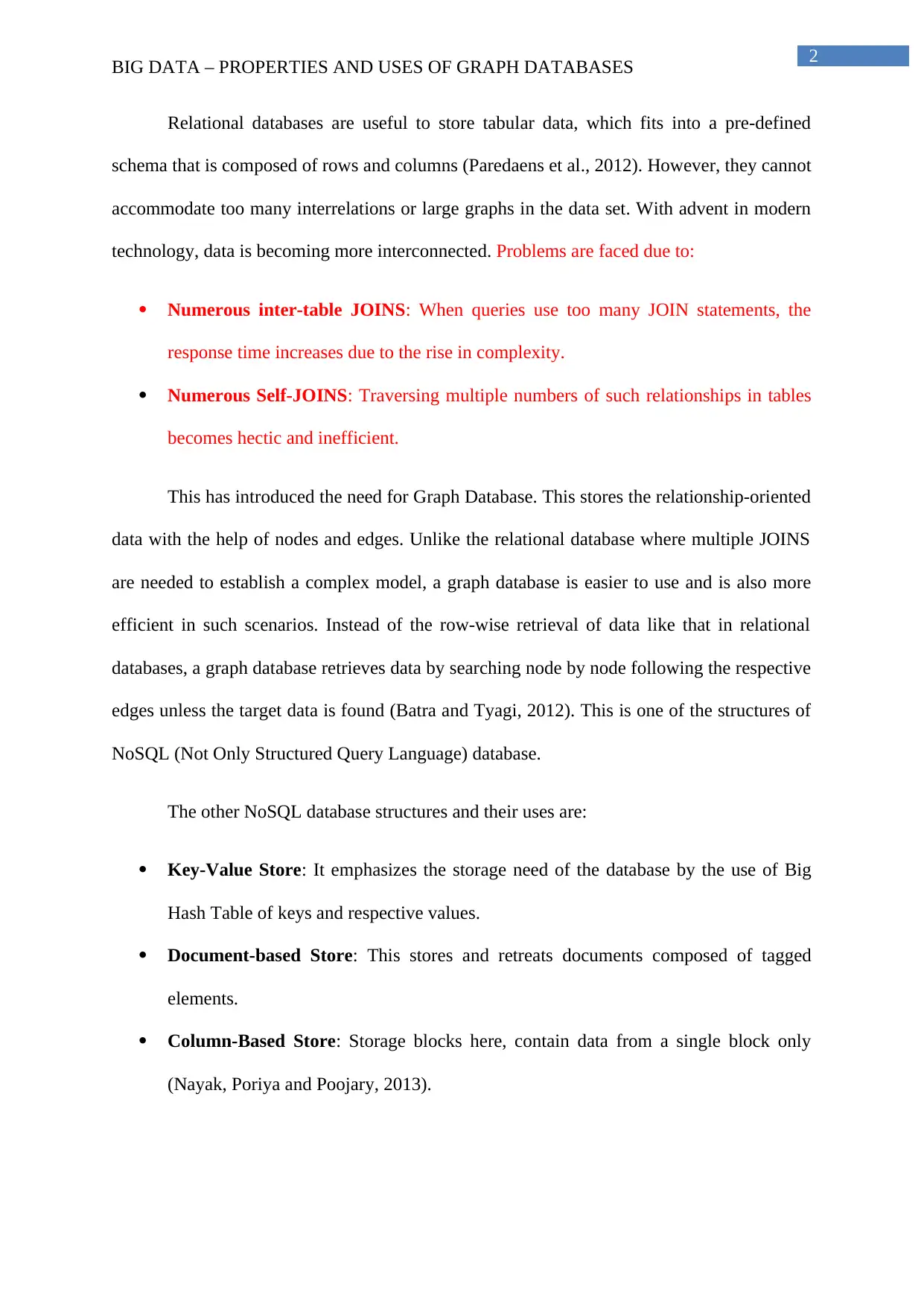
Relational databases are useful to store tabular data, which fits into a pre-defined
schema that is composed of rows and columns (Paredaens et al., 2012). However, they cannot
accommodate too many interrelations or large graphs in the data set. With advent in modern
technology, data is becoming more interconnected. Problems are faced due to:
Numerous inter-table JOINS: When queries use too many JOIN statements, the
response time increases due to the rise in complexity.
Numerous Self-JOINS: Traversing multiple numbers of such relationships in tables
becomes hectic and inefficient.
This has introduced the need for Graph Database. This stores the relationship-oriented
data with the help of nodes and edges. Unlike the relational database where multiple JOINS
are needed to establish a complex model, a graph database is easier to use and is also more
efficient in such scenarios. Instead of the row-wise retrieval of data like that in relational
databases, a graph database retrieves data by searching node by node following the respective
edges unless the target data is found (Batra and Tyagi, 2012). This is one of the structures of
NoSQL (Not Only Structured Query Language) database.
The other NoSQL database structures and their uses are:
Key-Value Store: It emphasizes the storage need of the database by the use of Big
Hash Table of keys and respective values.
Document-based Store: This stores and retreats documents composed of tagged
elements.
Column-Based Store: Storage blocks here, contain data from a single block only
(Nayak, Poriya and Poojary, 2013).
Document Page
3
BIG DATA – PROPERTIES AND USES OF GRAPH DATABASES
None of the above are fit to retain a complex relational model. The Graph Database
provides the perfect stage to store and operate with large cluster of relational data or graphs.
Document Page
4
BIG DATA – PROPERTIES AND USES OF GRAPH DATABASES
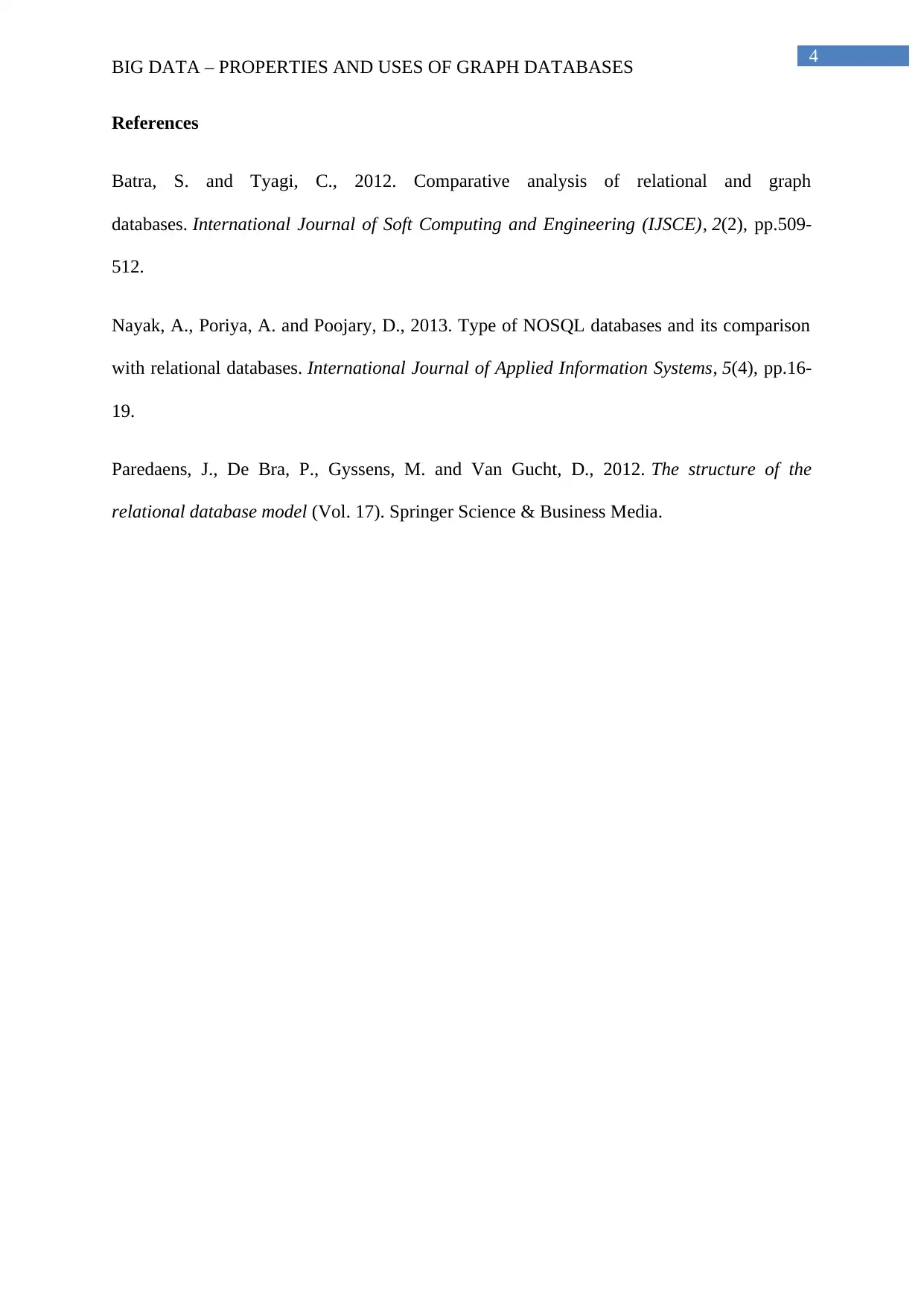
References
Batra, S. and Tyagi, C., 2012. Comparative analysis of relational and graph
databases. International Journal of Soft Computing and Engineering (IJSCE), 2(2), pp.509-
512.
Nayak, A., Poriya, A. and Poojary, D., 2013. Type of NOSQL databases and its comparison
with relational databases. International Journal of Applied Information Systems, 5(4), pp.16-
19.
Paredaens, J., De Bra, P., Gyssens, M. and Van Gucht, D., 2012. The structure of the
relational database model (Vol. 17). Springer Science & Business Media.
chevron_up_icon
1 out of 4
circle_padding
hide_on_mobile
zoom_out_icon
[object Object]