BSc Business Management: Big Data Analysis & Info Systems Report
VerifiedAdded on 2023/06/10
|6
|2091
|153
Report
AI Summary
This report provides a comprehensive overview of big data analysis within the context of information systems. It defines big data, outlining its characteristics through the 5 V's (Volume, Variety, Veracity, Value, and Velocity). The report delves into the challenges associated with big data analytics, such as lack of understanding, poor tool selection, data integration difficulties, security concerns, and data growth issues. Various techniques for analyzing big data, including factor analysis, cluster analysis, and data mining, are discussed. Furthermore, the report elucidates how big data technology supports businesses, providing examples of improved customer experience, new growth opportunities, enhanced information management, optimized supply chains, and improved marketing strategies. The report concludes by emphasizing the importance of data security and complexity reduction in managing large datasets.
BSc (Hons) Business Management
BMP4005
Information Systems and Big Data
Analysis
Poster and Summary Paper
Submitted by:
Name:
ID:
0
BMP4005
Information Systems and Big Data
Analysis
Poster and Summary Paper
Submitted by:
Name:
ID:
0
Paraphrase This Document
Need a fresh take? Get an instant paraphrase of this document with our AI Paraphraser

Contents
Introduction p
What big data is and the characteristics of big data p
The challenges of big data analytics p
The techniques that are currently available to analyse big data
p
How Big Data technology could support business, an explanation with
examples p
References p
Appendix 1: Poster p
1
Introduction p
What big data is and the characteristics of big data p
The challenges of big data analytics p
The techniques that are currently available to analyse big data
p
How Big Data technology could support business, an explanation with
examples p
References p
Appendix 1: Poster p
1

Introduction
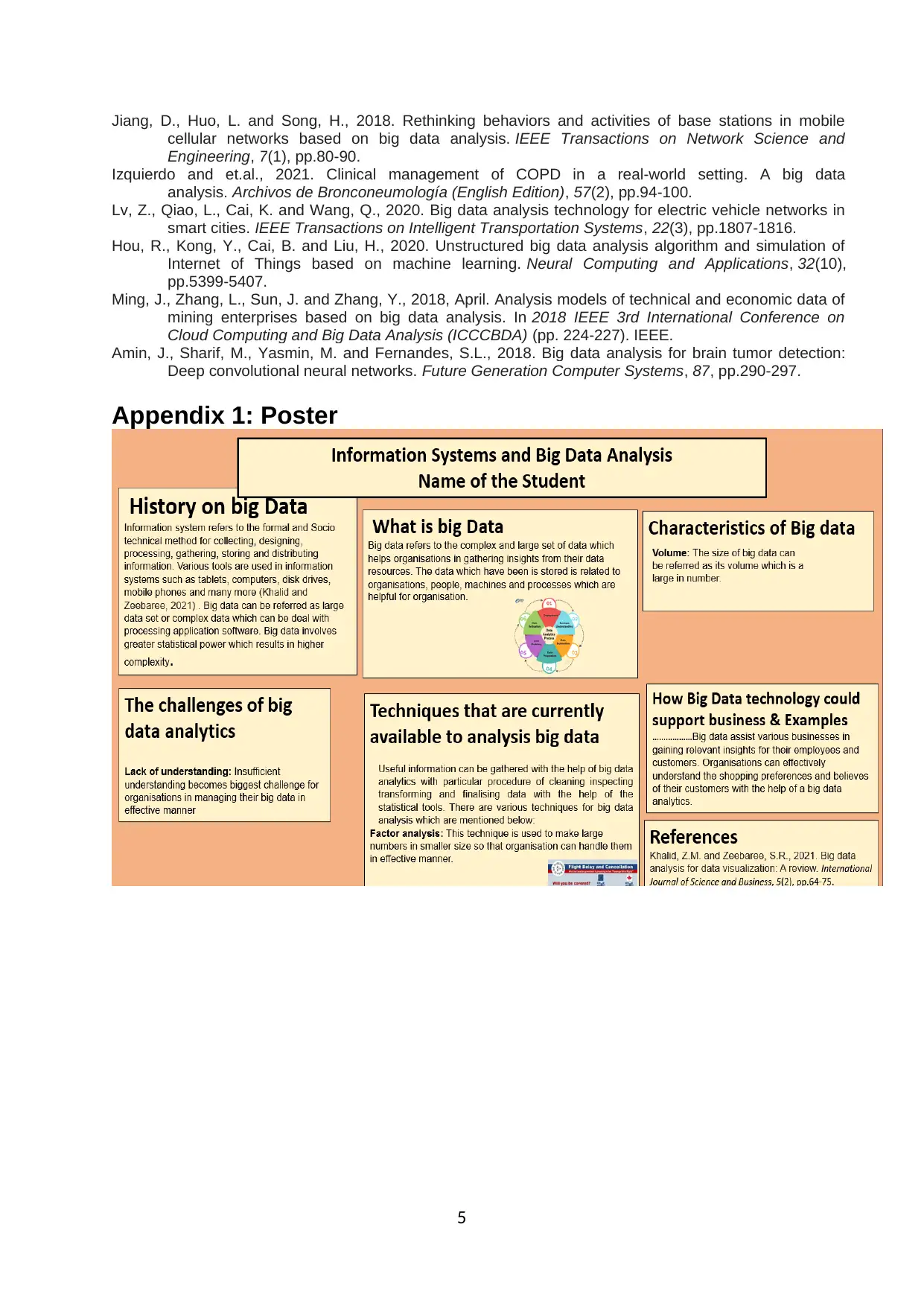
Information system refers to the formal and Socio technical method for
collecting, designing, processing, gathering, storing and distributing information.
Various tools are used in information systems such as tablets, computers, disk
drives, mobile phones and many more (Khalid and Zeebaree, 2021) . Big data can be
referred as large data set or complex data which can be deal with processing
application software. Big data involves greater statistical power which results in
higher complexity. This report will include about big data and its characteristics.
Challenges of big data analytics are also discussed in this report. Different
techniques which are currently available in order to analyze big data were
mentioned. This report also includes how big data technologies help businesses with
respective examples.
What big data is and the characteristics of big data
Big data refers to the complex and large set of data which helps organisations in
gathering insights from their data resources. The data which have been is stored is
related to organisations, people, machines and processes which are helpful for
organisation. Some of the examples of big data analytics our cloud applications,
social media and machine sensor data. It assist organisation in conducting relevant
research so that they can find effective conclusions for their operations (Jiang, Wang,
Lv, Qi and Singh, 2019). Big data analytics helps managers of organisation in decision
making and planning so that they can improve their outcomes. Various competitive
advantages can be achieved with the help of big data analytics as it provides is in
carry out operations. Traditional data storages cannot process big data because they
are highly complex in nature. It is important to manage big data as it stores number
of relevant and confidential information about customers employees or organisation
so that proper functions can be commenced. The 5 V’s of big data can be referred as
its characteristics which is mentioned below:
Volume: The size of big data can be referred as its volume which is a large in
number. All the regular information and daily sources are stored as big data in
organisations such as machines, big processes, networks, social media platforms
and human interactions. Big data can be measured in zettabyte gigabytes and
yottabytes.
Variety: Big data is in the form of unstructured, structured and semi structured
which are gathered from different available sources in an organisation. Managers
uses Excel sheets and data bases in order to collect the large data sets which can
be stored in the forms of audios, PDFs, photos, emails and videos.
Veracity: It suggest the reliability of data which It states that data can be
managed and handled in effective manner (Amin, Sharif, Yasmin and Fernandes, 2018).
There are various methods which organisations use in order to translate and filter
data in different ways so that they can use data in future operations. Example of
veracity can be said as a Facebook post which comes with different hashtags.
Value: One of the relevant characteristics of a big data can be referred as a value
which shows the valuably of data during process, store and analyzing. It decide
the effectiveness of operations because it helps in gaining different insights of
organisation.
Velocity: It shows and suggest the speed of data which use organisations in their
day today operations. It contains rate of change, dataset speed and activity burst
2
Information system refers to the formal and Socio technical method for
collecting, designing, processing, gathering, storing and distributing information.
Various tools are used in information systems such as tablets, computers, disk
drives, mobile phones and many more (Khalid and Zeebaree, 2021) . Big data can be
referred as large data set or complex data which can be deal with processing
application software. Big data involves greater statistical power which results in
higher complexity. This report will include about big data and its characteristics.
Challenges of big data analytics are also discussed in this report. Different
techniques which are currently available in order to analyze big data were
mentioned. This report also includes how big data technologies help businesses with
respective examples.
What big data is and the characteristics of big data
Big data refers to the complex and large set of data which helps organisations in
gathering insights from their data resources. The data which have been is stored is
related to organisations, people, machines and processes which are helpful for
organisation. Some of the examples of big data analytics our cloud applications,
social media and machine sensor data. It assist organisation in conducting relevant
research so that they can find effective conclusions for their operations (Jiang, Wang,
Lv, Qi and Singh, 2019). Big data analytics helps managers of organisation in decision
making and planning so that they can improve their outcomes. Various competitive
advantages can be achieved with the help of big data analytics as it provides is in
carry out operations. Traditional data storages cannot process big data because they
are highly complex in nature. It is important to manage big data as it stores number
of relevant and confidential information about customers employees or organisation
so that proper functions can be commenced. The 5 V’s of big data can be referred as
its characteristics which is mentioned below:
Volume: The size of big data can be referred as its volume which is a large in
number. All the regular information and daily sources are stored as big data in
organisations such as machines, big processes, networks, social media platforms
and human interactions. Big data can be measured in zettabyte gigabytes and
yottabytes.
Variety: Big data is in the form of unstructured, structured and semi structured
which are gathered from different available sources in an organisation. Managers
uses Excel sheets and data bases in order to collect the large data sets which can
be stored in the forms of audios, PDFs, photos, emails and videos.
Veracity: It suggest the reliability of data which It states that data can be
managed and handled in effective manner (Amin, Sharif, Yasmin and Fernandes, 2018).
There are various methods which organisations use in order to translate and filter
data in different ways so that they can use data in future operations. Example of
veracity can be said as a Facebook post which comes with different hashtags.
Value: One of the relevant characteristics of a big data can be referred as a value
which shows the valuably of data during process, store and analyzing. It decide
the effectiveness of operations because it helps in gaining different insights of
organisation.
Velocity: It shows and suggest the speed of data which use organisations in their
day today operations. It contains rate of change, dataset speed and activity burst
2
⊘ This is a preview!⊘
Do you want full access?
Subscribe today to unlock all pages.

Trusted by 1+ million students worldwide

which provide data rapidly. Different sources are used to maintain the flow of data
such as business processes, application logs, social media site, networks, mobile
devices and sensors.
The challenges of big data analytics
Every organisation requires big data so that they can operate their functions.
Continuous data generation can be seen in organisations from sales figures,
transactions, stakeholders and customer logs. Sometimes organisations find difficulties
in managing and handling big data which are as follows:
Lack of understanding: Insufficient understanding becomes biggest challenge for
organisations in managing their big data in effective manner. Employees may wrongly
store and process big data which results in negative outcomes (Jiang, Huo and Song,
2018). It is very essential to understand the importance of big data so that employees
can easily keep track of their sensitive and relevant data which can help them in their
operations.
Poor big data tools selection: It becomes a very challenging situation for
organisations to select the best appropriate tool for big data analyses. Due to in
appropriate tool selection organisations faces various challenges in their day to day
operations. Number of times organisations get confused that they have to adapt
Cassandra or Is HBase for storing their big data.
Integration of data from different sources: Variety of sources are used by
organisation in order to gather relevant and confidential information. Different sources
of information can be referred as ERP applications, financial reports, social media
pages, customer logs, reports created by employees, presentations and emails.
Employees of an organisation face difficulties in combining all these data is so that they
can prepare effective report.
Securing data: One of the major challenges which organisation face regarding big
data analyses is securing huge and complex set of data. Employees take lot of time in
understanding how to analyse and store complex data so that they can maintain
effective and efficient security (Izquierdo and et.al., 2021). It is essential to secure big data
because there are lot of chances of theft and unauthorised access of malicious
hackers.
Data growth issues: It becomes a highly complex for organisations to handle
increasing number of data. Generally employees gather unstructured data from
different sources like videos, documents, text files and audios which have to be
managed in proper manner. Rapidly increasing complex data becomes difficult for
organisation and is storing them in traditional manner.
The techniques that are currently available to analyse big
data
Useful information can be gathered with the help of big data analytics with particular
procedure of cleaning inspecting transforming and finalising data with the help of the
statistical tools. There are various techniques for big data analysis which are
mentioned below:
Factor analysis: This technique is used to make large numbers in smaller size so that
organisation can handle them in effective manner. It assist in work on different basis
such as separating multiple variables into different groups. It provides manageable
samples by adjusting the pattern of number in desired manner.
3
such as business processes, application logs, social media site, networks, mobile
devices and sensors.
The challenges of big data analytics
Every organisation requires big data so that they can operate their functions.
Continuous data generation can be seen in organisations from sales figures,
transactions, stakeholders and customer logs. Sometimes organisations find difficulties
in managing and handling big data which are as follows:
Lack of understanding: Insufficient understanding becomes biggest challenge for
organisations in managing their big data in effective manner. Employees may wrongly
store and process big data which results in negative outcomes (Jiang, Huo and Song,
2018). It is very essential to understand the importance of big data so that employees
can easily keep track of their sensitive and relevant data which can help them in their
operations.
Poor big data tools selection: It becomes a very challenging situation for
organisations to select the best appropriate tool for big data analyses. Due to in
appropriate tool selection organisations faces various challenges in their day to day
operations. Number of times organisations get confused that they have to adapt
Cassandra or Is HBase for storing their big data.
Integration of data from different sources: Variety of sources are used by
organisation in order to gather relevant and confidential information. Different sources
of information can be referred as ERP applications, financial reports, social media
pages, customer logs, reports created by employees, presentations and emails.
Employees of an organisation face difficulties in combining all these data is so that they
can prepare effective report.
Securing data: One of the major challenges which organisation face regarding big
data analyses is securing huge and complex set of data. Employees take lot of time in
understanding how to analyse and store complex data so that they can maintain
effective and efficient security (Izquierdo and et.al., 2021). It is essential to secure big data
because there are lot of chances of theft and unauthorised access of malicious
hackers.
Data growth issues: It becomes a highly complex for organisations to handle
increasing number of data. Generally employees gather unstructured data from
different sources like videos, documents, text files and audios which have to be
managed in proper manner. Rapidly increasing complex data becomes difficult for
organisation and is storing them in traditional manner.
The techniques that are currently available to analyse big
data
Useful information can be gathered with the help of big data analytics with particular
procedure of cleaning inspecting transforming and finalising data with the help of the
statistical tools. There are various techniques for big data analysis which are
mentioned below:
Factor analysis: This technique is used to make large numbers in smaller size so that
organisation can handle them in effective manner. It assist in work on different basis
such as separating multiple variables into different groups. It provides manageable
samples by adjusting the pattern of number in desired manner.
3
Paraphrase This Document
Need a fresh take? Get an instant paraphrase of this document with our AI Paraphraser

Cluster analysis: It helps in identifying the structure of database in proper manner. It
aims to sort different types of data points into similar groups so that it becomes very
simpler for ploys to analyse and understand the data. Structure of data can be easily
revealed with the help of this technique so that employees can classify them under
different segments according to their nature.
Data mining: It provides insight for additional data context and direction with the help
of this technique (Lv, Qiao, Cai and Wang, 2020). It identify relations, dependencies, trends
and patterns so that advanced knowledge can be generated. This technique helps
organisations in analysing data and adopting them in effective manner so that
employees can work in desired manner.
How Big Data technology could support business, an
explanation with examples
Big data assist various businesses in gaining relevant insights for their employees
and customers. Organisations can effectively understand the shopping preferences
and believes of their customers with the help of a big data analytics. It helps
organisation in understanding how to offer products so that they can satisfy the
requirements and demands of the targeted audience (Hou, Kong, Cai and Liu, 2020). It
becomes easier for organisations to use analytics and resources like figures so that
they can identify their valuable customers. Big data can easily improve experience of
their customers along with products and services which helps in higher revenue
generation. New growth opportunities can be achieved by managers of organisation
because it assist in enhancement of the productivity so that employees can create
better customer interactions. Different opportunities like in-depth insights ,
automation and data driven decision making can be carried out in effective manner
with the assistance of big data analytics.
It enhances information management which is significant for organisations so
that they can effectively understand their profits and losses factors. Supply chain can
be maintained in affective manner so that organisation can maintain healthy
relationship with their customers and suppliers which are most important part of the
organisation. Marketing strategies can be improved with the help of big data
analytics as it provides numbers for competitors which helps organisation in gaining
various competitive advantages (Ming, Zhang, Sun and Zhang, 2018). Security is improved
of data so that organisation can eliminate unauthorized access of hackers. Is
structured and and unstructured data can be stored in secure and desired manner so
that organisations do not face any challenges in their day today operations. It
reduces complexity in managing large number of data which organisation uses in
their buying and purchasing of raw material and equipments for offering products
and services to the targeted audience.
References
Khalid, Z.M. and Zeebaree, S.R., 2021. Big data analysis for data visualization: A review. International
Journal of Science and Business, 5(2), pp.64-75.
Jiang, D., Wang, Y., Lv, Z., Qi, S. and Singh, S., 2019. Big data analysis based network behavior insight of
cellular networks for industry 4.0 applications. IEEE Transactions on Industrial Informatics, 16(2),
pp.1310-1320.
4
aims to sort different types of data points into similar groups so that it becomes very
simpler for ploys to analyse and understand the data. Structure of data can be easily
revealed with the help of this technique so that employees can classify them under
different segments according to their nature.
Data mining: It provides insight for additional data context and direction with the help
of this technique (Lv, Qiao, Cai and Wang, 2020). It identify relations, dependencies, trends
and patterns so that advanced knowledge can be generated. This technique helps
organisations in analysing data and adopting them in effective manner so that
employees can work in desired manner.
How Big Data technology could support business, an
explanation with examples
Big data assist various businesses in gaining relevant insights for their employees
and customers. Organisations can effectively understand the shopping preferences
and believes of their customers with the help of a big data analytics. It helps
organisation in understanding how to offer products so that they can satisfy the
requirements and demands of the targeted audience (Hou, Kong, Cai and Liu, 2020). It
becomes easier for organisations to use analytics and resources like figures so that
they can identify their valuable customers. Big data can easily improve experience of
their customers along with products and services which helps in higher revenue
generation. New growth opportunities can be achieved by managers of organisation
because it assist in enhancement of the productivity so that employees can create
better customer interactions. Different opportunities like in-depth insights ,
automation and data driven decision making can be carried out in effective manner
with the assistance of big data analytics.
It enhances information management which is significant for organisations so
that they can effectively understand their profits and losses factors. Supply chain can
be maintained in affective manner so that organisation can maintain healthy
relationship with their customers and suppliers which are most important part of the
organisation. Marketing strategies can be improved with the help of big data
analytics as it provides numbers for competitors which helps organisation in gaining
various competitive advantages (Ming, Zhang, Sun and Zhang, 2018). Security is improved
of data so that organisation can eliminate unauthorized access of hackers. Is
structured and and unstructured data can be stored in secure and desired manner so
that organisations do not face any challenges in their day today operations. It
reduces complexity in managing large number of data which organisation uses in
their buying and purchasing of raw material and equipments for offering products
and services to the targeted audience.
References
Khalid, Z.M. and Zeebaree, S.R., 2021. Big data analysis for data visualization: A review. International
Journal of Science and Business, 5(2), pp.64-75.
Jiang, D., Wang, Y., Lv, Z., Qi, S. and Singh, S., 2019. Big data analysis based network behavior insight of
cellular networks for industry 4.0 applications. IEEE Transactions on Industrial Informatics, 16(2),
pp.1310-1320.
4

Jiang, D., Huo, L. and Song, H., 2018. Rethinking behaviors and activities of base stations in mobile
cellular networks based on big data analysis. IEEE Transactions on Network Science and
Engineering, 7(1), pp.80-90.
Izquierdo and et.al., 2021. Clinical management of COPD in a real-world setting. A big data
analysis. Archivos de Bronconeumología (English Edition), 57(2), pp.94-100.
Lv, Z., Qiao, L., Cai, K. and Wang, Q., 2020. Big data analysis technology for electric vehicle networks in
smart cities. IEEE Transactions on Intelligent Transportation Systems, 22(3), pp.1807-1816.
Hou, R., Kong, Y., Cai, B. and Liu, H., 2020. Unstructured big data analysis algorithm and simulation of
Internet of Things based on machine learning. Neural Computing and Applications, 32(10),
pp.5399-5407.
Ming, J., Zhang, L., Sun, J. and Zhang, Y., 2018, April. Analysis models of technical and economic data of
mining enterprises based on big data analysis. In 2018 IEEE 3rd International Conference on
Cloud Computing and Big Data Analysis (ICCCBDA) (pp. 224-227). IEEE.
Amin, J., Sharif, M., Yasmin, M. and Fernandes, S.L., 2018. Big data analysis for brain tumor detection:
Deep convolutional neural networks. Future Generation Computer Systems, 87, pp.290-297.
Appendix 1: Poster
5
cellular networks based on big data analysis. IEEE Transactions on Network Science and
Engineering, 7(1), pp.80-90.
Izquierdo and et.al., 2021. Clinical management of COPD in a real-world setting. A big data
analysis. Archivos de Bronconeumología (English Edition), 57(2), pp.94-100.
Lv, Z., Qiao, L., Cai, K. and Wang, Q., 2020. Big data analysis technology for electric vehicle networks in
smart cities. IEEE Transactions on Intelligent Transportation Systems, 22(3), pp.1807-1816.
Hou, R., Kong, Y., Cai, B. and Liu, H., 2020. Unstructured big data analysis algorithm and simulation of
Internet of Things based on machine learning. Neural Computing and Applications, 32(10),
pp.5399-5407.
Ming, J., Zhang, L., Sun, J. and Zhang, Y., 2018, April. Analysis models of technical and economic data of
mining enterprises based on big data analysis. In 2018 IEEE 3rd International Conference on
Cloud Computing and Big Data Analysis (ICCCBDA) (pp. 224-227). IEEE.
Amin, J., Sharif, M., Yasmin, M. and Fernandes, S.L., 2018. Big data analysis for brain tumor detection:
Deep convolutional neural networks. Future Generation Computer Systems, 87, pp.290-297.
Appendix 1: Poster
5
⊘ This is a preview!⊘
Do you want full access?
Subscribe today to unlock all pages.

Trusted by 1+ million students worldwide
1 out of 6
Related Documents
Your All-in-One AI-Powered Toolkit for Academic Success.
+13062052269
info@desklib.com
Available 24*7 on WhatsApp / Email
Unlock your academic potential
Copyright © 2020–2026 A2Z Services. All Rights Reserved. Developed and managed by ZUCOL.