ITC571 Annotated Bibliography
VerifiedAdded on 2019/10/09
|6
|2900
|317
Annotated Bibliography
AI Summary
This assignment is an annotated bibliography focusing on the security and privacy challenges of big data. The student is tasked with reviewing twelve research papers related to this topic, analyzing their approaches, identifying research gaps, and ultimately defining the aim of their own research. The assignment includes sections outlining the significance of the research, originality of approach, a literature review summarizing the twelve selected papers, an identification of research gaps, and a statement of the student's research aim. The methodology section details the plan for primary data collection using a questionnaire distributed to practitioners with at least 10 years of experience in the field, followed by data analysis using linear regression and correlation with SPSS or R. The provided content shows a partial completion of the assignment, including the introduction and literature review sections.
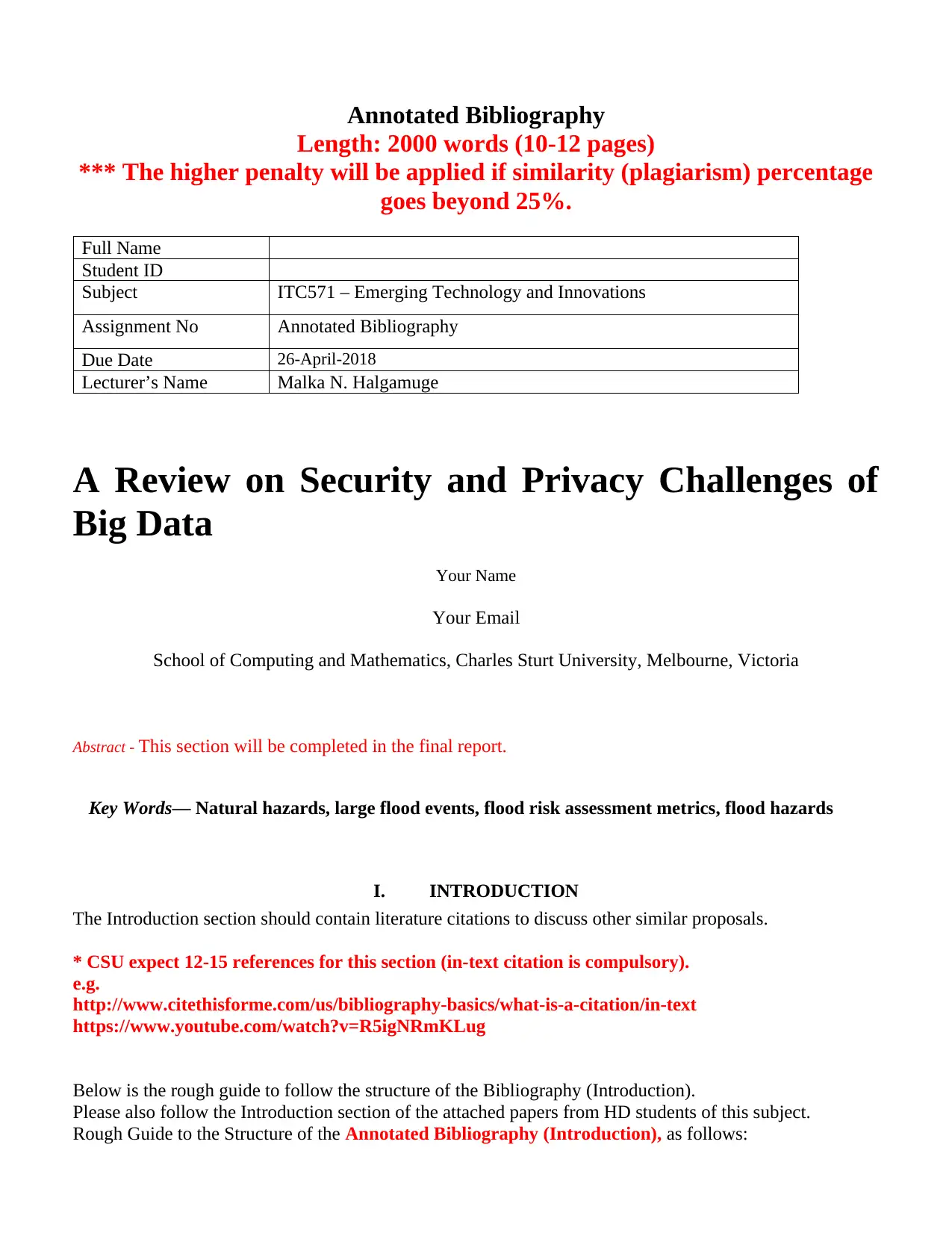
Annotated Bibliography
Length: 2000 words (10-12 pages)
*** The higher penalty will be applied if similarity (plagiarism) percentage
goes beyond 25%.
Full Name
Student ID
Subject ITC571 – Emerging Technology and Innovations
Assignment No Annotated Bibliography
Due Date 26-April-2018
Lecturer’s Name Malka N. Halgamuge
A Review on Security and Privacy Challenges of
Big Data
Your Name
Your Email
School of Computing and Mathematics, Charles Sturt University, Melbourne, Victoria
Abstract - This section will be completed in the final report.
Key Words— Natural hazards, large flood events, flood risk assessment metrics, flood hazards
I. INTRODUCTION
The Introduction section should contain literature citations to discuss other similar proposals.
* CSU expect 12-15 references for this section (in-text citation is compulsory).
e.g.
http://www.citethisforme.com/us/bibliography-basics/what-is-a-citation/in-text
https://www.youtube.com/watch?v=R5igNRmKLug
Below is the rough guide to follow the structure of the Bibliography (Introduction).
Please also follow the Introduction section of the attached papers from HD students of this subject.
Rough Guide to the Structure of the Annotated Bibliography (Introduction), as follows:
Length: 2000 words (10-12 pages)
*** The higher penalty will be applied if similarity (plagiarism) percentage
goes beyond 25%.
Full Name
Student ID
Subject ITC571 – Emerging Technology and Innovations
Assignment No Annotated Bibliography
Due Date 26-April-2018
Lecturer’s Name Malka N. Halgamuge
A Review on Security and Privacy Challenges of
Big Data
Your Name
Your Email
School of Computing and Mathematics, Charles Sturt University, Melbourne, Victoria
Abstract - This section will be completed in the final report.
Key Words— Natural hazards, large flood events, flood risk assessment metrics, flood hazards
I. INTRODUCTION
The Introduction section should contain literature citations to discuss other similar proposals.
* CSU expect 12-15 references for this section (in-text citation is compulsory).
e.g.
http://www.citethisforme.com/us/bibliography-basics/what-is-a-citation/in-text
https://www.youtube.com/watch?v=R5igNRmKLug
Below is the rough guide to follow the structure of the Bibliography (Introduction).
Please also follow the Introduction section of the attached papers from HD students of this subject.
Rough Guide to the Structure of the Annotated Bibliography (Introduction), as follows:

Paraphrase This Document
Need a fresh take? Get an instant paraphrase of this document with our AI Paraphraser
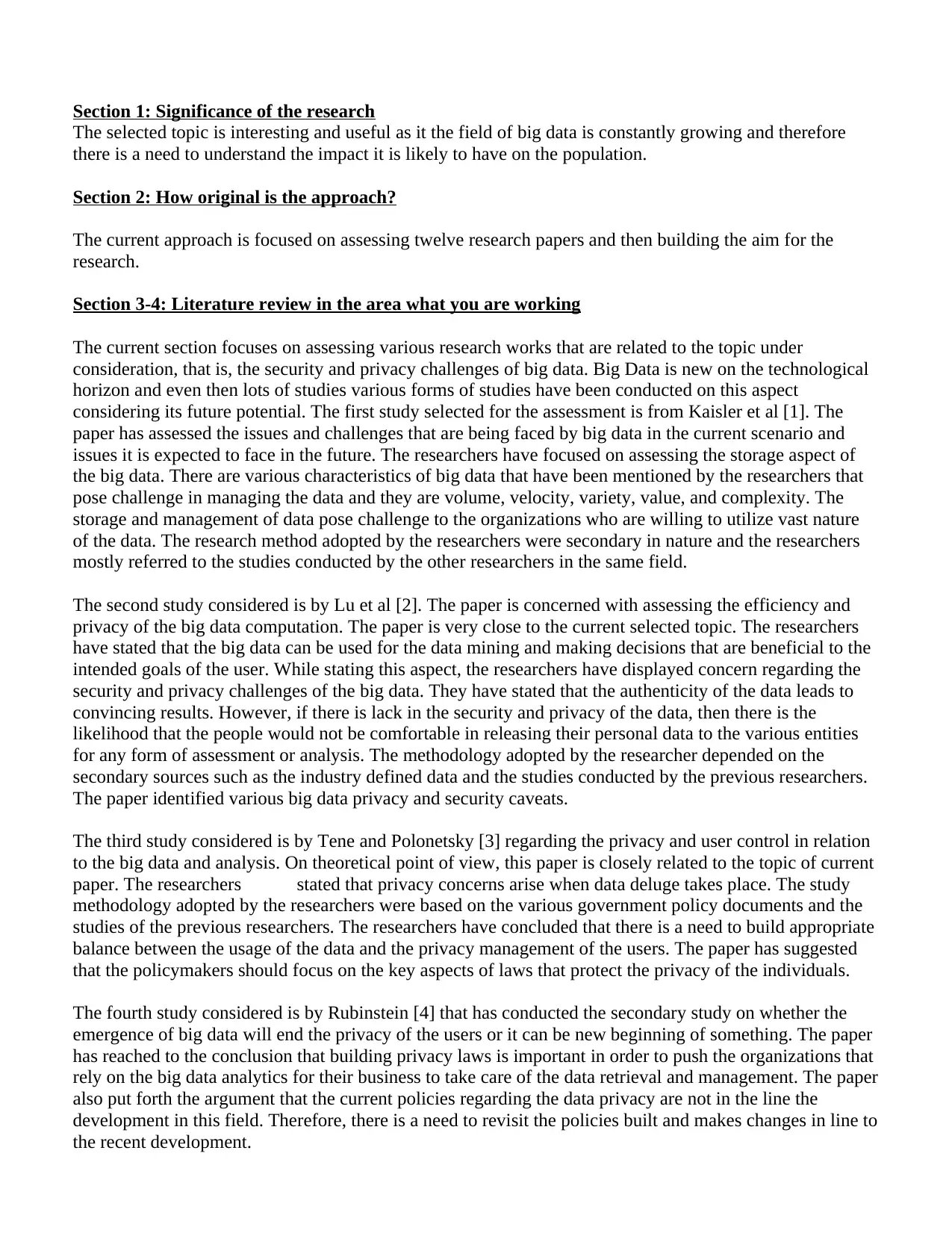
Section 1: Significance of the research
The selected topic is interesting and useful as it the field of big data is constantly growing and therefore
there is a need to understand the impact it is likely to have on the population.
Section 2: How original is the approach?
The current approach is focused on assessing twelve research papers and then building the aim for the
research.
Section 3-4: Literature review in the area what you are working
The current section focuses on assessing various research works that are related to the topic under
consideration, that is, the security and privacy challenges of big data. Big Data is new on the technological
horizon and even then lots of studies various forms of studies have been conducted on this aspect
considering its future potential. The first study selected for the assessment is from Kaisler et al [1]. The
paper has assessed the issues and challenges that are being faced by big data in the current scenario and
issues it is expected to face in the future. The researchers have focused on assessing the storage aspect of
the big data. There are various characteristics of big data that have been mentioned by the researchers that
pose challenge in managing the data and they are volume, velocity, variety, value, and complexity. The
storage and management of data pose challenge to the organizations who are willing to utilize vast nature
of the data. The research method adopted by the researchers were secondary in nature and the researchers
mostly referred to the studies conducted by the other researchers in the same field.
The second study considered is by Lu et al [2]. The paper is concerned with assessing the efficiency and
privacy of the big data computation. The paper is very close to the current selected topic. The researchers
have stated that the big data can be used for the data mining and making decisions that are beneficial to the
intended goals of the user. While stating this aspect, the researchers have displayed concern regarding the
security and privacy challenges of the big data. They have stated that the authenticity of the data leads to
convincing results. However, if there is lack in the security and privacy of the data, then there is the
likelihood that the people would not be comfortable in releasing their personal data to the various entities
for any form of assessment or analysis. The methodology adopted by the researcher depended on the
secondary sources such as the industry defined data and the studies conducted by the previous researchers.
The paper identified various big data privacy and security caveats.
The third study considered is by Tene and Polonetsky [3] regarding the privacy and user control in relation
to the big data and analysis. On theoretical point of view, this paper is closely related to the topic of current
paper. The researchers stated that privacy concerns arise when data deluge takes place. The study
methodology adopted by the researchers were based on the various government policy documents and the
studies of the previous researchers. The researchers have concluded that there is a need to build appropriate
balance between the usage of the data and the privacy management of the users. The paper has suggested
that the policymakers should focus on the key aspects of laws that protect the privacy of the individuals.
The fourth study considered is by Rubinstein [4] that has conducted the secondary study on whether the
emergence of big data will end the privacy of the users or it can be new beginning of something. The paper
has reached to the conclusion that building privacy laws is important in order to push the organizations that
rely on the big data analytics for their business to take care of the data retrieval and management. The paper
also put forth the argument that the current policies regarding the data privacy are not in the line the
development in this field. Therefore, there is a need to revisit the policies built and makes changes in line to
the recent development.
The selected topic is interesting and useful as it the field of big data is constantly growing and therefore
there is a need to understand the impact it is likely to have on the population.
Section 2: How original is the approach?
The current approach is focused on assessing twelve research papers and then building the aim for the
research.
Section 3-4: Literature review in the area what you are working
The current section focuses on assessing various research works that are related to the topic under
consideration, that is, the security and privacy challenges of big data. Big Data is new on the technological
horizon and even then lots of studies various forms of studies have been conducted on this aspect
considering its future potential. The first study selected for the assessment is from Kaisler et al [1]. The
paper has assessed the issues and challenges that are being faced by big data in the current scenario and
issues it is expected to face in the future. The researchers have focused on assessing the storage aspect of
the big data. There are various characteristics of big data that have been mentioned by the researchers that
pose challenge in managing the data and they are volume, velocity, variety, value, and complexity. The
storage and management of data pose challenge to the organizations who are willing to utilize vast nature
of the data. The research method adopted by the researchers were secondary in nature and the researchers
mostly referred to the studies conducted by the other researchers in the same field.
The second study considered is by Lu et al [2]. The paper is concerned with assessing the efficiency and
privacy of the big data computation. The paper is very close to the current selected topic. The researchers
have stated that the big data can be used for the data mining and making decisions that are beneficial to the
intended goals of the user. While stating this aspect, the researchers have displayed concern regarding the
security and privacy challenges of the big data. They have stated that the authenticity of the data leads to
convincing results. However, if there is lack in the security and privacy of the data, then there is the
likelihood that the people would not be comfortable in releasing their personal data to the various entities
for any form of assessment or analysis. The methodology adopted by the researcher depended on the
secondary sources such as the industry defined data and the studies conducted by the previous researchers.
The paper identified various big data privacy and security caveats.
The third study considered is by Tene and Polonetsky [3] regarding the privacy and user control in relation
to the big data and analysis. On theoretical point of view, this paper is closely related to the topic of current
paper. The researchers stated that privacy concerns arise when data deluge takes place. The study
methodology adopted by the researchers were based on the various government policy documents and the
studies of the previous researchers. The researchers have concluded that there is a need to build appropriate
balance between the usage of the data and the privacy management of the users. The paper has suggested
that the policymakers should focus on the key aspects of laws that protect the privacy of the individuals.
The fourth study considered is by Rubinstein [4] that has conducted the secondary study on whether the
emergence of big data will end the privacy of the users or it can be new beginning of something. The paper
has reached to the conclusion that building privacy laws is important in order to push the organizations that
rely on the big data analytics for their business to take care of the data retrieval and management. The paper
also put forth the argument that the current policies regarding the data privacy are not in the line the
development in this field. Therefore, there is a need to revisit the policies built and makes changes in line to
the recent development.
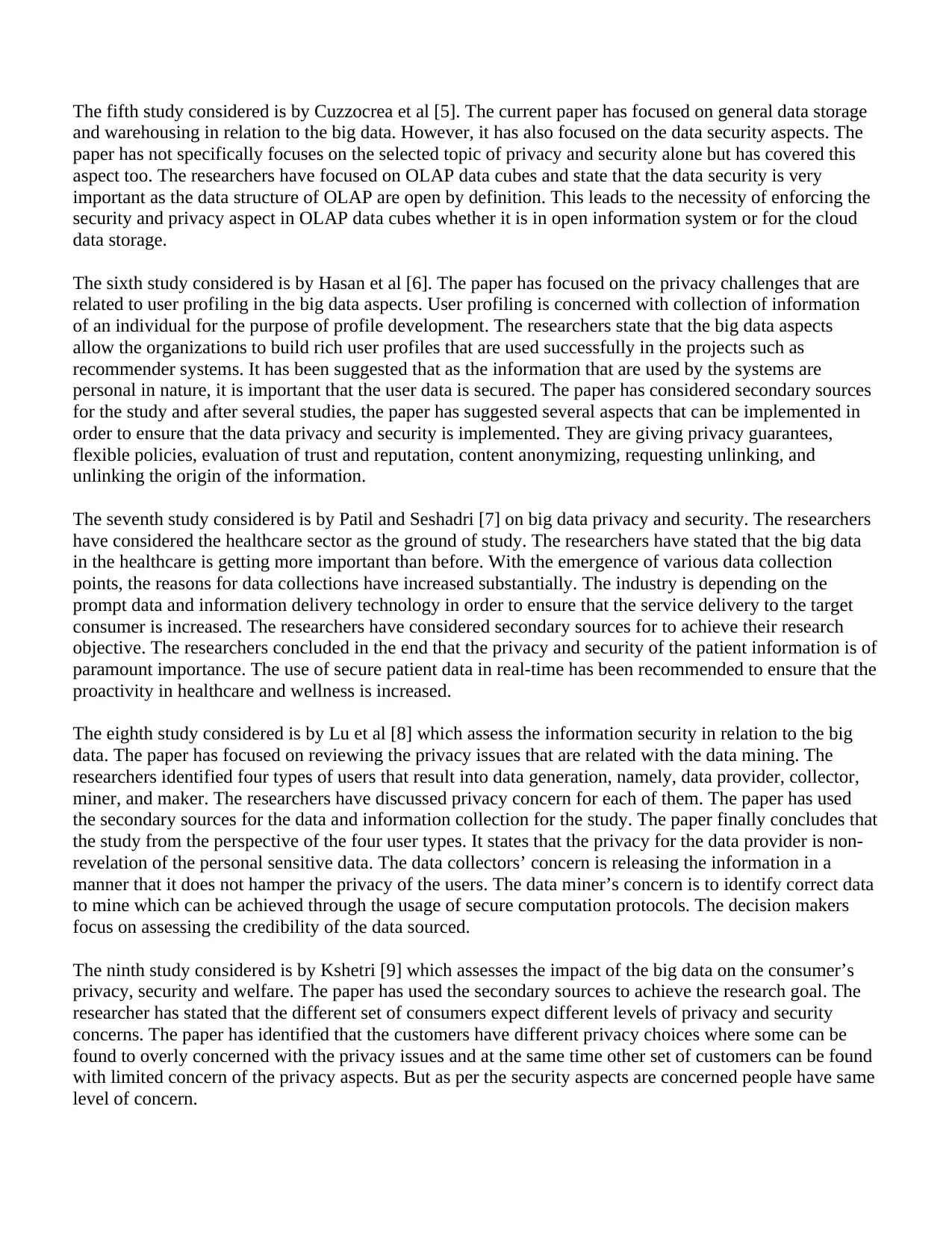
The fifth study considered is by Cuzzocrea et al [5]. The current paper has focused on general data storage
and warehousing in relation to the big data. However, it has also focused on the data security aspects. The
paper has not specifically focuses on the selected topic of privacy and security alone but has covered this
aspect too. The researchers have focused on OLAP data cubes and state that the data security is very
important as the data structure of OLAP are open by definition. This leads to the necessity of enforcing the
security and privacy aspect in OLAP data cubes whether it is in open information system or for the cloud
data storage.
The sixth study considered is by Hasan et al [6]. The paper has focused on the privacy challenges that are
related to user profiling in the big data aspects. User profiling is concerned with collection of information
of an individual for the purpose of profile development. The researchers state that the big data aspects
allow the organizations to build rich user profiles that are used successfully in the projects such as
recommender systems. It has been suggested that as the information that are used by the systems are
personal in nature, it is important that the user data is secured. The paper has considered secondary sources
for the study and after several studies, the paper has suggested several aspects that can be implemented in
order to ensure that the data privacy and security is implemented. They are giving privacy guarantees,
flexible policies, evaluation of trust and reputation, content anonymizing, requesting unlinking, and
unlinking the origin of the information.
The seventh study considered is by Patil and Seshadri [7] on big data privacy and security. The researchers
have considered the healthcare sector as the ground of study. The researchers have stated that the big data
in the healthcare is getting more important than before. With the emergence of various data collection
points, the reasons for data collections have increased substantially. The industry is depending on the
prompt data and information delivery technology in order to ensure that the service delivery to the target
consumer is increased. The researchers have considered secondary sources for to achieve their research
objective. The researchers concluded in the end that the privacy and security of the patient information is of
paramount importance. The use of secure patient data in real-time has been recommended to ensure that the
proactivity in healthcare and wellness is increased.
The eighth study considered is by Lu et al [8] which assess the information security in relation to the big
data. The paper has focused on reviewing the privacy issues that are related with the data mining. The
researchers identified four types of users that result into data generation, namely, data provider, collector,
miner, and maker. The researchers have discussed privacy concern for each of them. The paper has used
the secondary sources for the data and information collection for the study. The paper finally concludes that
the study from the perspective of the four user types. It states that the privacy for the data provider is non-
revelation of the personal sensitive data. The data collectors’ concern is releasing the information in a
manner that it does not hamper the privacy of the users. The data miner’s concern is to identify correct data
to mine which can be achieved through the usage of secure computation protocols. The decision makers
focus on assessing the credibility of the data sourced.
The ninth study considered is by Kshetri [9] which assesses the impact of the big data on the consumer’s
privacy, security and welfare. The paper has used the secondary sources to achieve the research goal. The
researcher has stated that the different set of consumers expect different levels of privacy and security
concerns. The paper has identified that the customers have different privacy choices where some can be
found to overly concerned with the privacy issues and at the same time other set of customers can be found
with limited concern of the privacy aspects. But as per the security aspects are concerned people have same
level of concern.
and warehousing in relation to the big data. However, it has also focused on the data security aspects. The
paper has not specifically focuses on the selected topic of privacy and security alone but has covered this
aspect too. The researchers have focused on OLAP data cubes and state that the data security is very
important as the data structure of OLAP are open by definition. This leads to the necessity of enforcing the
security and privacy aspect in OLAP data cubes whether it is in open information system or for the cloud
data storage.
The sixth study considered is by Hasan et al [6]. The paper has focused on the privacy challenges that are
related to user profiling in the big data aspects. User profiling is concerned with collection of information
of an individual for the purpose of profile development. The researchers state that the big data aspects
allow the organizations to build rich user profiles that are used successfully in the projects such as
recommender systems. It has been suggested that as the information that are used by the systems are
personal in nature, it is important that the user data is secured. The paper has considered secondary sources
for the study and after several studies, the paper has suggested several aspects that can be implemented in
order to ensure that the data privacy and security is implemented. They are giving privacy guarantees,
flexible policies, evaluation of trust and reputation, content anonymizing, requesting unlinking, and
unlinking the origin of the information.
The seventh study considered is by Patil and Seshadri [7] on big data privacy and security. The researchers
have considered the healthcare sector as the ground of study. The researchers have stated that the big data
in the healthcare is getting more important than before. With the emergence of various data collection
points, the reasons for data collections have increased substantially. The industry is depending on the
prompt data and information delivery technology in order to ensure that the service delivery to the target
consumer is increased. The researchers have considered secondary sources for to achieve their research
objective. The researchers concluded in the end that the privacy and security of the patient information is of
paramount importance. The use of secure patient data in real-time has been recommended to ensure that the
proactivity in healthcare and wellness is increased.
The eighth study considered is by Lu et al [8] which assess the information security in relation to the big
data. The paper has focused on reviewing the privacy issues that are related with the data mining. The
researchers identified four types of users that result into data generation, namely, data provider, collector,
miner, and maker. The researchers have discussed privacy concern for each of them. The paper has used
the secondary sources for the data and information collection for the study. The paper finally concludes that
the study from the perspective of the four user types. It states that the privacy for the data provider is non-
revelation of the personal sensitive data. The data collectors’ concern is releasing the information in a
manner that it does not hamper the privacy of the users. The data miner’s concern is to identify correct data
to mine which can be achieved through the usage of secure computation protocols. The decision makers
focus on assessing the credibility of the data sourced.
The ninth study considered is by Kshetri [9] which assesses the impact of the big data on the consumer’s
privacy, security and welfare. The paper has used the secondary sources to achieve the research goal. The
researcher has stated that the different set of consumers expect different levels of privacy and security
concerns. The paper has identified that the customers have different privacy choices where some can be
found to overly concerned with the privacy issues and at the same time other set of customers can be found
with limited concern of the privacy aspects. But as per the security aspects are concerned people have same
level of concern.
⊘ This is a preview!⊘
Do you want full access?
Subscribe today to unlock all pages.

Trusted by 1+ million students worldwide
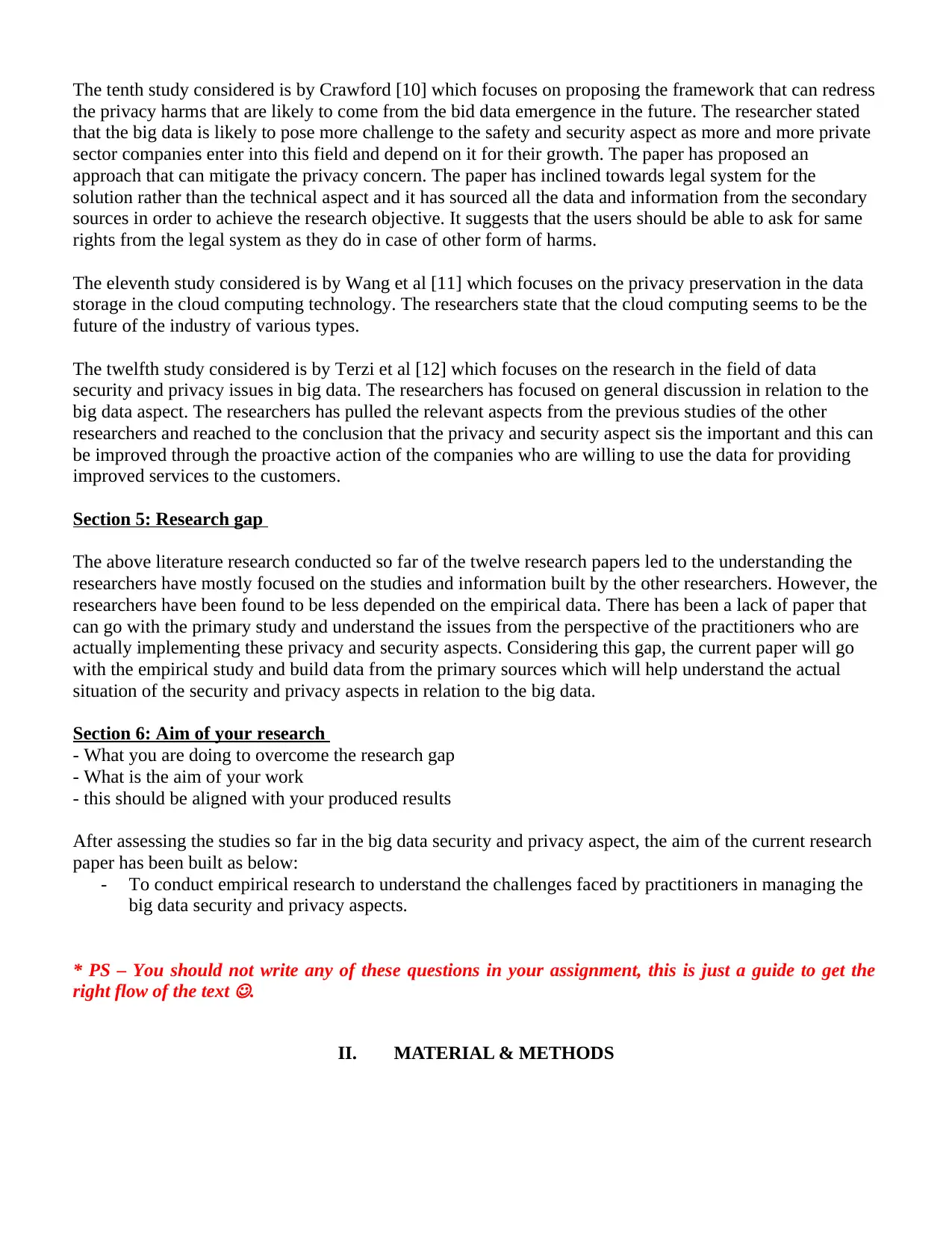
The tenth study considered is by Crawford [10] which focuses on proposing the framework that can redress
the privacy harms that are likely to come from the bid data emergence in the future. The researcher stated
that the big data is likely to pose more challenge to the safety and security aspect as more and more private
sector companies enter into this field and depend on it for their growth. The paper has proposed an
approach that can mitigate the privacy concern. The paper has inclined towards legal system for the
solution rather than the technical aspect and it has sourced all the data and information from the secondary
sources in order to achieve the research objective. It suggests that the users should be able to ask for same
rights from the legal system as they do in case of other form of harms.
The eleventh study considered is by Wang et al [11] which focuses on the privacy preservation in the data
storage in the cloud computing technology. The researchers state that the cloud computing seems to be the
future of the industry of various types.
The twelfth study considered is by Terzi et al [12] which focuses on the research in the field of data
security and privacy issues in big data. The researchers has focused on general discussion in relation to the
big data aspect. The researchers has pulled the relevant aspects from the previous studies of the other
researchers and reached to the conclusion that the privacy and security aspect sis the important and this can
be improved through the proactive action of the companies who are willing to use the data for providing
improved services to the customers.
Section 5: Research gap
The above literature research conducted so far of the twelve research papers led to the understanding the
researchers have mostly focused on the studies and information built by the other researchers. However, the
researchers have been found to be less depended on the empirical data. There has been a lack of paper that
can go with the primary study and understand the issues from the perspective of the practitioners who are
actually implementing these privacy and security aspects. Considering this gap, the current paper will go
with the empirical study and build data from the primary sources which will help understand the actual
situation of the security and privacy aspects in relation to the big data.
Section 6: Aim of your research
- What you are doing to overcome the research gap
- What is the aim of your work
- this should be aligned with your produced results
After assessing the studies so far in the big data security and privacy aspect, the aim of the current research
paper has been built as below:
- To conduct empirical research to understand the challenges faced by practitioners in managing the
big data security and privacy aspects.
* PS – You should not write any of these questions in your assignment, this is just a guide to get the
right flow of the text
.
II. MATERIAL & METHODS
the privacy harms that are likely to come from the bid data emergence in the future. The researcher stated
that the big data is likely to pose more challenge to the safety and security aspect as more and more private
sector companies enter into this field and depend on it for their growth. The paper has proposed an
approach that can mitigate the privacy concern. The paper has inclined towards legal system for the
solution rather than the technical aspect and it has sourced all the data and information from the secondary
sources in order to achieve the research objective. It suggests that the users should be able to ask for same
rights from the legal system as they do in case of other form of harms.
The eleventh study considered is by Wang et al [11] which focuses on the privacy preservation in the data
storage in the cloud computing technology. The researchers state that the cloud computing seems to be the
future of the industry of various types.
The twelfth study considered is by Terzi et al [12] which focuses on the research in the field of data
security and privacy issues in big data. The researchers has focused on general discussion in relation to the
big data aspect. The researchers has pulled the relevant aspects from the previous studies of the other
researchers and reached to the conclusion that the privacy and security aspect sis the important and this can
be improved through the proactive action of the companies who are willing to use the data for providing
improved services to the customers.
Section 5: Research gap
The above literature research conducted so far of the twelve research papers led to the understanding the
researchers have mostly focused on the studies and information built by the other researchers. However, the
researchers have been found to be less depended on the empirical data. There has been a lack of paper that
can go with the primary study and understand the issues from the perspective of the practitioners who are
actually implementing these privacy and security aspects. Considering this gap, the current paper will go
with the empirical study and build data from the primary sources which will help understand the actual
situation of the security and privacy aspects in relation to the big data.
Section 6: Aim of your research
- What you are doing to overcome the research gap
- What is the aim of your work
- this should be aligned with your produced results
After assessing the studies so far in the big data security and privacy aspect, the aim of the current research
paper has been built as below:
- To conduct empirical research to understand the challenges faced by practitioners in managing the
big data security and privacy aspects.
* PS – You should not write any of these questions in your assignment, this is just a guide to get the
right flow of the text
.
II. MATERIAL & METHODS
Paraphrase This Document
Need a fresh take? Get an instant paraphrase of this document with our AI Paraphraser
A. Data Collection
The data for the research will be collected through primary sources. A questionnaire will be built
and distributed to the actual data security and privacy practitioners to assess their response on the
challenges they face in handling this aspect.
B. Data Inclusion Criteria
The practitioners must have at least 10 years of experience in this field. They can be from any industry.
C. Data Analysis
The data collected to be passed through linear regression and correlation. The tool that will be used is SPSS
software. R programming can be used if SPSS will not be available as alternate option.
IV DISCUSSION (OPTIONAL)
[LEFT CONSIDERING OPTIONAL]
The discussion is the productive, creative and innovative part of writing a paper. It is the thinking about
the implications of the results that you got, and the literature search for a comparable or contradictive
paper that you learn something.
Are the claims in this section supported by the results, do they seem reasonable? Have the authors
indicated how the results relate to expectations and to earlier research?
REFERENCES
[1] Kaisler S, Armour F, Espinosa JA, Money W. Big data: Issues and challenges moving forward.
InSystem sciences (HICSS), 2013 46th Hawaii international conference on 2013 Jan 7 (pp. 995-1004).
IEEE.
[2] Lu R, Zhu H, Liu X, Liu JK, Shao J. Toward efficient and privacy-preserving computing in big data era.
IEEE Network. 2014 Jul;28(4):46-50.
[3] Tene, O., & Polonetsky, J. (2012). Big data for all: Privacy and user control in the age of analytics. Nw.
J. Tech. & Intell. Prop., 11, xxvii.
[4] Rubinstein I. Big data: the end of privacy or a new beginning. 2012.
[5] Cuzzocrea A, Bellatreche L, Song IY. Data warehousing and OLAP over big data: current challenges
and future research directions. InProceedings of the sixteenth international workshop on Data warehousing
and OLAP 2013 Oct 28 (pp. 67-70). ACM.
The data for the research will be collected through primary sources. A questionnaire will be built
and distributed to the actual data security and privacy practitioners to assess their response on the
challenges they face in handling this aspect.
B. Data Inclusion Criteria
The practitioners must have at least 10 years of experience in this field. They can be from any industry.
C. Data Analysis
The data collected to be passed through linear regression and correlation. The tool that will be used is SPSS
software. R programming can be used if SPSS will not be available as alternate option.
IV DISCUSSION (OPTIONAL)
[LEFT CONSIDERING OPTIONAL]
The discussion is the productive, creative and innovative part of writing a paper. It is the thinking about
the implications of the results that you got, and the literature search for a comparable or contradictive
paper that you learn something.
Are the claims in this section supported by the results, do they seem reasonable? Have the authors
indicated how the results relate to expectations and to earlier research?
REFERENCES
[1] Kaisler S, Armour F, Espinosa JA, Money W. Big data: Issues and challenges moving forward.
InSystem sciences (HICSS), 2013 46th Hawaii international conference on 2013 Jan 7 (pp. 995-1004).
IEEE.
[2] Lu R, Zhu H, Liu X, Liu JK, Shao J. Toward efficient and privacy-preserving computing in big data era.
IEEE Network. 2014 Jul;28(4):46-50.
[3] Tene, O., & Polonetsky, J. (2012). Big data for all: Privacy and user control in the age of analytics. Nw.
J. Tech. & Intell. Prop., 11, xxvii.
[4] Rubinstein I. Big data: the end of privacy or a new beginning. 2012.
[5] Cuzzocrea A, Bellatreche L, Song IY. Data warehousing and OLAP over big data: current challenges
and future research directions. InProceedings of the sixteenth international workshop on Data warehousing
and OLAP 2013 Oct 28 (pp. 67-70). ACM.
[6] Hasan O, Habegger B, Brunie L, Bennani N, Damiani E. A discussion of privacy challenges in user
profiling with big data techniques: The EEXCESS use case. InBig Data (BigData Congress), 2013 IEEE
International Congress on 2013 Jun 27 (pp. 25-30). IEEE.
[7] Patil HK, Seshadri R. Big data security and privacy issues in healthcare. InBig Data (BigData
Congress), 2014 IEEE International Congress on 2014 Jun 27 (pp. 762-765). IEEE.
[8] Xu L, Jiang C, Wang J, Yuan J, Ren Y. Information security in big data: privacy and data mining. IEEE
Access. 2014;2:1149-76.
[9] Kshetri N. Big data׳ s impact on privacy, security and consumer welfare. Telecommunications Policy.
2014 Dec 1;38(11):1134-45.
[10] Crawford K, Schultz J. Big data and due process: Toward a framework to redress predictive privacy
harms. BCL Rev.. 2014;55:93.
[11] Wang C, Wang Q, Ren K, Lou W. Privacy-preserving public auditing for data storage security in
cloud computing. InInfocom, 2010 proceedings ieee 2010 Mar 14 (pp. 1-9). Ieee.
[12] Terzi DS, Terzi R, Sagiroglu S. A survey on security and privacy issues in big data. InInternet
Technology and Secured Transactions (ICITST), 2015 10th International Conference for 2015 Dec 14 (pp.
202-207). IEEE.
profiling with big data techniques: The EEXCESS use case. InBig Data (BigData Congress), 2013 IEEE
International Congress on 2013 Jun 27 (pp. 25-30). IEEE.
[7] Patil HK, Seshadri R. Big data security and privacy issues in healthcare. InBig Data (BigData
Congress), 2014 IEEE International Congress on 2014 Jun 27 (pp. 762-765). IEEE.
[8] Xu L, Jiang C, Wang J, Yuan J, Ren Y. Information security in big data: privacy and data mining. IEEE
Access. 2014;2:1149-76.
[9] Kshetri N. Big data׳ s impact on privacy, security and consumer welfare. Telecommunications Policy.
2014 Dec 1;38(11):1134-45.
[10] Crawford K, Schultz J. Big data and due process: Toward a framework to redress predictive privacy
harms. BCL Rev.. 2014;55:93.
[11] Wang C, Wang Q, Ren K, Lou W. Privacy-preserving public auditing for data storage security in
cloud computing. InInfocom, 2010 proceedings ieee 2010 Mar 14 (pp. 1-9). Ieee.
[12] Terzi DS, Terzi R, Sagiroglu S. A survey on security and privacy issues in big data. InInternet
Technology and Secured Transactions (ICITST), 2015 10th International Conference for 2015 Dec 14 (pp.
202-207). IEEE.
⊘ This is a preview!⊘
Do you want full access?
Subscribe today to unlock all pages.
Trusted by 1+ million students worldwide

1 out of 6


Related Documents


Your All-in-One AI-Powered Toolkit for Academic Success.
+13062052269
info@desklib.com
Available 24*7 on WhatsApp / Email
![[object Object]](/_next/static/media/star-bottom.7253800d.svg)
Unlock your academic potential
Copyright © 2020–2026 A2Z Services. All Rights Reserved. Developed and managed by ZUCOL.