The Impact of Big Data and Analytics on Supply Chain Efficiency
VerifiedAdded on  2021/11/17
|6
|1755
|32
Report
AI Summary
This report examines the transformative impact of big data and analytical tools on supply chain management. It begins with an introduction to key concepts such as big data, predictive analysis, lean supply chain management, supply chain analytics, KPIs, and outsourcing analytics. The evaluation section then delves into how companies can leverage these tools to optimize their supply chains, including consumer behavior analysis, enhanced traceability, strategic sourcing, supply chain network design, and inventory planning. The report highlights the successful implementation of these strategies by Walmart, showcasing how the company utilizes big data analytics to enhance efficiency, customize products, and improve supplier collaboration. The conclusion emphasizes the significant benefits of integrating big data applications into supply chain processes for increased profitability and operational efficiency, making it a valuable resource for understanding and implementing data-driven supply chain optimization.
1.INTRODUCTION:
This report was prepared together with a summary and analysis of the articles "Data Science,
Predictive Analysis and Big Data; Big Data Analytics and Supply Chain Management; How to
use big data to drive your supply chain". With the advancement of globalization and technology in
today's world, companies need to take innovative and sustainable steps to maintain their competitive
advantage with other companies in an economic sense. The analyses conducted in this study will talk
about the significant benefits that big data and technological tools will provide to both customers and
companies, as well as optimizing the supply chain. While discussing the summaries of the articles in
general, we will also explain the key concepts for our project. A number of specialized tools are used
when it comes to the implementation phase of the supply chain. These tools will be mentioned below.
1.1BIG DATA:
Big data is a resource that generates value from the storage and processing of large amounts of
digital information and cannot be analyzed by traditional computational techniques. For this reason,
calculation and analysis techniques specific to big data should be used.
1.2.PREDICTIVE ANALYSIS:
Predictive analysis, we can say that it is a sub-branch of advanced analytics used to make
predictions about future uncertain and unknown events using various scientific tools. Various
techniques such as data mining, statistics, modeling, machine learning and artificial intelligence are
used to perform this analysis. In predictive analysis, organizations arrive at proactive, forward-looking
modeling that predicts results and behavior based on data, not hunches or assumptions.
1.3.LEAN SUPPLY CHAIN MANAGEMENT:
The Lean Supply Chain (LSC) focuses on optimizing all stages in the supply chain, reducing
waste and simplifying the system. The main purpose of this model is to eliminate waste and create
value along the chain.
1.4. SUPPLY CHAIN ANALYTICS:
This report was prepared together with a summary and analysis of the articles "Data Science,
Predictive Analysis and Big Data; Big Data Analytics and Supply Chain Management; How to
use big data to drive your supply chain". With the advancement of globalization and technology in
today's world, companies need to take innovative and sustainable steps to maintain their competitive
advantage with other companies in an economic sense. The analyses conducted in this study will talk
about the significant benefits that big data and technological tools will provide to both customers and
companies, as well as optimizing the supply chain. While discussing the summaries of the articles in
general, we will also explain the key concepts for our project. A number of specialized tools are used
when it comes to the implementation phase of the supply chain. These tools will be mentioned below.
1.1BIG DATA:
Big data is a resource that generates value from the storage and processing of large amounts of
digital information and cannot be analyzed by traditional computational techniques. For this reason,
calculation and analysis techniques specific to big data should be used.
1.2.PREDICTIVE ANALYSIS:
Predictive analysis, we can say that it is a sub-branch of advanced analytics used to make
predictions about future uncertain and unknown events using various scientific tools. Various
techniques such as data mining, statistics, modeling, machine learning and artificial intelligence are
used to perform this analysis. In predictive analysis, organizations arrive at proactive, forward-looking
modeling that predicts results and behavior based on data, not hunches or assumptions.
1.3.LEAN SUPPLY CHAIN MANAGEMENT:
The Lean Supply Chain (LSC) focuses on optimizing all stages in the supply chain, reducing
waste and simplifying the system. The main purpose of this model is to eliminate waste and create
value along the chain.
1.4. SUPPLY CHAIN ANALYTICS:
Paraphrase This Document
Need a fresh take? Get an instant paraphrase of this document with our AI Paraphraser

Supply chain analytics is a complex structure that enables organizations to derive value by
gaining insight from and using large amounts of data regarding the supply, processing, and distribution
of goods. One of the importance of SCA software is to optimize productivity based on predictions and
return to customers' demands, needs and expectations. With end-to-end supply chain analytics, the
supply process chain is integrated with its components at every stage, and all components can see the
process at every stage of the supply chain.
1.5.KEY PERFORMANCE INDICATORS:
KPIs allow quantitative and qualitative evaluation of the performance of supply chain
processes. These KPIs allow the process to be optimized by evaluating the cost and effectiveness of
the supply chain.
1.6.OUTSOURCING ANALYTICS:
This method is a system that enables continuous analytical evaluation of the supply chain and
improves network tuning. This system continuously provides output to optimize the organization at the
lowest costs. So here, the supply chain is not examined intermittently, but instead, the necessary
updates are made to continuously optimize the supply chain thanks to the outputs. Thanks to this
analytical system, the current internal supply chain organization focuses on daily business operations
and the use of this external analytics is necessary to observe the internal supply chain. It provides
control of the supply chain by sending the output to the design service provider.
The supply chain is a structure that provides information and financial flow as well as the
transfer of products from raw material suppliers to the end user. It is of great importance to use BDA
techniques in order to evolve this complex process into a process with added value and to minimize
procurement, transportation, storage and stocking costs. Because BDA can be applied to all areas of
SCM, it is also used in other activities of the supply chain. BDA helps and supports a wide variety of
supply chain activities. The implementation of BDA techniques helps with issues in the links between
supply chain data experts and business functions, such as processes and activities. For this reason,
BDA techniques should be used throughout the entire supply chain. With BDA applications,
companies can manage their demands in sales departments, increase the visibility of retail, delivery,
inventory, production and supplier data and manage supplier relations, plan and optimize demand-
gaining insight from and using large amounts of data regarding the supply, processing, and distribution
of goods. One of the importance of SCA software is to optimize productivity based on predictions and
return to customers' demands, needs and expectations. With end-to-end supply chain analytics, the
supply process chain is integrated with its components at every stage, and all components can see the
process at every stage of the supply chain.
1.5.KEY PERFORMANCE INDICATORS:
KPIs allow quantitative and qualitative evaluation of the performance of supply chain
processes. These KPIs allow the process to be optimized by evaluating the cost and effectiveness of
the supply chain.
1.6.OUTSOURCING ANALYTICS:
This method is a system that enables continuous analytical evaluation of the supply chain and
improves network tuning. This system continuously provides output to optimize the organization at the
lowest costs. So here, the supply chain is not examined intermittently, but instead, the necessary
updates are made to continuously optimize the supply chain thanks to the outputs. Thanks to this
analytical system, the current internal supply chain organization focuses on daily business operations
and the use of this external analytics is necessary to observe the internal supply chain. It provides
control of the supply chain by sending the output to the design service provider.
The supply chain is a structure that provides information and financial flow as well as the
transfer of products from raw material suppliers to the end user. It is of great importance to use BDA
techniques in order to evolve this complex process into a process with added value and to minimize
procurement, transportation, storage and stocking costs. Because BDA can be applied to all areas of
SCM, it is also used in other activities of the supply chain. BDA helps and supports a wide variety of
supply chain activities. The implementation of BDA techniques helps with issues in the links between
supply chain data experts and business functions, such as processes and activities. For this reason,
BDA techniques should be used throughout the entire supply chain. With BDA applications,
companies can manage their demands in sales departments, increase the visibility of retail, delivery,
inventory, production and supplier data and manage supplier relations, plan and optimize demand-

production-supply-logistics-distribution activities. In addition, they can be moved to a positive point in
inventory planning. Thanks to these applications, coordination and cooperation between supply chain
units is ensured and decision-making processes are managed more smoothly and with the least cost.
2.EVALUATION:
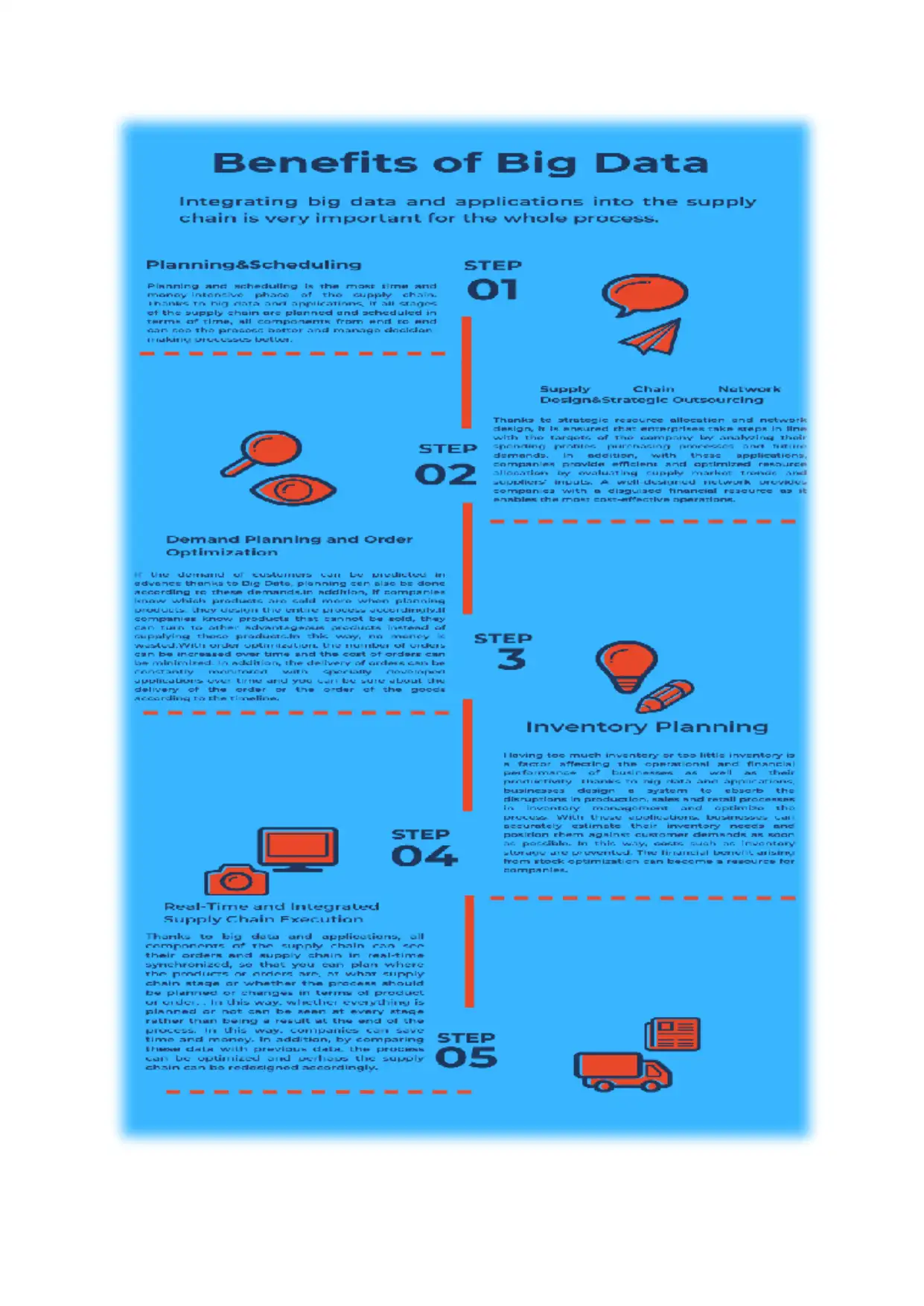
At this stage, we will talk about how companies optimize their supply chains with big data and
applications, and how they integrate it into the supply chain to increase their profits.
2.1. ANALYSIS OF CONSUMER BEHAVIOR AND USAGE,PRODUCT
DESIGN,DEMAND PLANNING:
Businesses make significant investments in big data. Thanks to these investments, they
produce analysis reports on consumer behavior and the way the products are used and design the
supply chain accordingly. In this way, they protect and increase their market advantages with options
such as customized product design. With SCA, businesses that design products in a cheap and
differentiated way increase their profitability, because companies can produce the most economical
product that meets the quality standards they set by using these applications. By using big data,
companies can predict which items will be needed as it is related to demand and can make their
planning accordingly. Businesses can make important decisions such as new product designs, product
improvements or abandoning the supply of non-demanded products according to the demands of
customers. In this way, if it is determined which products sell well and which do not, the supply chain
is redesigned according to this analysis. In this way, companies can turn to more profitable products.
2.2.ENHANCED END-TO-END TRACEABILITY IN THE SUPPLY CHAIN:
Enhanced traceability enables businesses to better coordinate with supply chain stakeholders
to facilitate the distribution of products or orders. With product traceability, supply chain managers
can observe the entire process end-to-end and find faster solutions to unexpected events that may arise.
This saves time and money.
2.3. USING STRATEGIC SOURCES AND ENSURING SUCCESFUL AND
COORDINATED SUPPLY CHAIN COMMUNICATION:
inventory planning. Thanks to these applications, coordination and cooperation between supply chain
units is ensured and decision-making processes are managed more smoothly and with the least cost.
2.EVALUATION:
At this stage, we will talk about how companies optimize their supply chains with big data and
applications, and how they integrate it into the supply chain to increase their profits.
2.1. ANALYSIS OF CONSUMER BEHAVIOR AND USAGE,PRODUCT
DESIGN,DEMAND PLANNING:
Businesses make significant investments in big data. Thanks to these investments, they
produce analysis reports on consumer behavior and the way the products are used and design the
supply chain accordingly. In this way, they protect and increase their market advantages with options
such as customized product design. With SCA, businesses that design products in a cheap and
differentiated way increase their profitability, because companies can produce the most economical
product that meets the quality standards they set by using these applications. By using big data,
companies can predict which items will be needed as it is related to demand and can make their
planning accordingly. Businesses can make important decisions such as new product designs, product
improvements or abandoning the supply of non-demanded products according to the demands of
customers. In this way, if it is determined which products sell well and which do not, the supply chain
is redesigned according to this analysis. In this way, companies can turn to more profitable products.
2.2.ENHANCED END-TO-END TRACEABILITY IN THE SUPPLY CHAIN:
Enhanced traceability enables businesses to better coordinate with supply chain stakeholders
to facilitate the distribution of products or orders. With product traceability, supply chain managers
can observe the entire process end-to-end and find faster solutions to unexpected events that may arise.
This saves time and money.
2.3. USING STRATEGIC SOURCES AND ENSURING SUCCESFUL AND
COORDINATED SUPPLY CHAIN COMMUNICATION:
⊘ This is a preview!⊘
Do you want full access?
Subscribe today to unlock all pages.

Trusted by 1+ million students worldwide

With SCA, planning of the supply chain, effective and correct use of resources, prediction of
future market trends and supply disruptions can be provided. In this way, businesses make analysis for
future uncertainties and make plans in the future without any interruption in their supply. It should
also be known that if the suppliers of the enterprises fail to supply on time or at the required quality,
this may cause the supply chain to be interrupted. Companies will also keep a high amount of
inventory and transfer the resources of the company to capital, as a result of which low quality
products, increased costs and timing are inefficient. such possible consequences will occur. If firms
successfully design resource allocation and supply chain communication, company productivity can
increase.
2.4.SUPPLY CHAIN NETWORK DESIGN:
Network design covers decisions about what the supply chain should physically do and how it
can be deployed. SCA produces a variety of variations that help businesses to decide, according to
future predictions, taking into account external influences, based on historical data on which facility
should be open or closed, or on the location, number, design, and how the shipping systems should be.
designs. In this way, businesses minimize their costs and increase the efficiency of the supply chain.
2.5.PROCUREMENT, INVENTORY PLANNING,REPLENISMENT PLANNING
SCA allows businesses to analyze the performance of their suppliers according to various
criteria, enabling them to make the most accurate supplier selection decisions for themselves. Thanks
to SCA, inventory optimization is achieved and the inventory needs of the enterprises are determined
correctly and inventory storage is done accordingly. In this way, the costs and cumbersome required
for inventory storage are saved. In addition, with SCA, instead of seeing whether something is
exhausted and / or needs to be renewed over time, future-based predictions can be prepared for the
company, which will benefit the company, increase its efficiency and need renewal programs.
future market trends and supply disruptions can be provided. In this way, businesses make analysis for
future uncertainties and make plans in the future without any interruption in their supply. It should
also be known that if the suppliers of the enterprises fail to supply on time or at the required quality,
this may cause the supply chain to be interrupted. Companies will also keep a high amount of
inventory and transfer the resources of the company to capital, as a result of which low quality
products, increased costs and timing are inefficient. such possible consequences will occur. If firms
successfully design resource allocation and supply chain communication, company productivity can
increase.
2.4.SUPPLY CHAIN NETWORK DESIGN:
Network design covers decisions about what the supply chain should physically do and how it
can be deployed. SCA produces a variety of variations that help businesses to decide, according to
future predictions, taking into account external influences, based on historical data on which facility
should be open or closed, or on the location, number, design, and how the shipping systems should be.
designs. In this way, businesses minimize their costs and increase the efficiency of the supply chain.
2.5.PROCUREMENT, INVENTORY PLANNING,REPLENISMENT PLANNING
SCA allows businesses to analyze the performance of their suppliers according to various
criteria, enabling them to make the most accurate supplier selection decisions for themselves. Thanks
to SCA, inventory optimization is achieved and the inventory needs of the enterprises are determined
correctly and inventory storage is done accordingly. In this way, the costs and cumbersome required
for inventory storage are saved. In addition, with SCA, instead of seeing whether something is
exhausted and / or needs to be renewed over time, future-based predictions can be prepared for the
company, which will benefit the company, increase its efficiency and need renewal programs.
Paraphrase This Document
Need a fresh take? Get an instant paraphrase of this document with our AI Paraphraser


3.IMPLEMENTATION&CONCLUSION:
In this section, we would like to give some information about the successful integration of the
benefits described above into the systems of Walmart company.
Walmart's supply chain is one of the most well-known and successful in the world. They
process 1 million orders per hour with the help of their cutting-edge supply chain application, analyze
various supply chain decisions, optimize products, and customize them to local preferences. Walmart
uses these analytics to learn about their customers' preferences. Not only that, but Walmart's suppliers
have access to these analytic data, which number over 17,400 and are spread across 80 countries. They
are required to use this system to monitor demand for goods, track shipments, and determine when
restocking is necessary. The device can be used by suppliers to look up information about purchases,
shipments, purchase orders, invoices, claims, and estimates, as well as run data queries. Walmart
connects the supply chain from beginning to end using big data analytics. These analytic data assist
suppliers in working more efficiently and matching supply to customer demand. It is important to
when big data and applications are applied to processes such as supply chain, it maximizes the
processes in terms of profitability and efficiency of the company. Thanks to these numerous
advantages, it is highly beneficial for companies to use these tools while designing their systems in the
short and long term.
In conclusion,this essay has discussed how to use big data to drive your supply chain and other
and other tools through it process.
In this section, we would like to give some information about the successful integration of the
benefits described above into the systems of Walmart company.
Walmart's supply chain is one of the most well-known and successful in the world. They
process 1 million orders per hour with the help of their cutting-edge supply chain application, analyze
various supply chain decisions, optimize products, and customize them to local preferences. Walmart
uses these analytics to learn about their customers' preferences. Not only that, but Walmart's suppliers
have access to these analytic data, which number over 17,400 and are spread across 80 countries. They
are required to use this system to monitor demand for goods, track shipments, and determine when
restocking is necessary. The device can be used by suppliers to look up information about purchases,
shipments, purchase orders, invoices, claims, and estimates, as well as run data queries. Walmart
connects the supply chain from beginning to end using big data analytics. These analytic data assist
suppliers in working more efficiently and matching supply to customer demand. It is important to
when big data and applications are applied to processes such as supply chain, it maximizes the
processes in terms of profitability and efficiency of the company. Thanks to these numerous
advantages, it is highly beneficial for companies to use these tools while designing their systems in the
short and long term.
In conclusion,this essay has discussed how to use big data to drive your supply chain and other
and other tools through it process.
⊘ This is a preview!⊘
Do you want full access?
Subscribe today to unlock all pages.

Trusted by 1+ million students worldwide
1 out of 6
Related Documents
Your All-in-One AI-Powered Toolkit for Academic Success.
 +13062052269
info@desklib.com
Available 24*7 on WhatsApp / Email
Unlock your academic potential
Copyright © 2020–2025 A2Z Services. All Rights Reserved. Developed and managed by ZUCOL.